
Keeping the Minar Alive: Its Role in Today’s Islamic Spaces
6 December, 2025
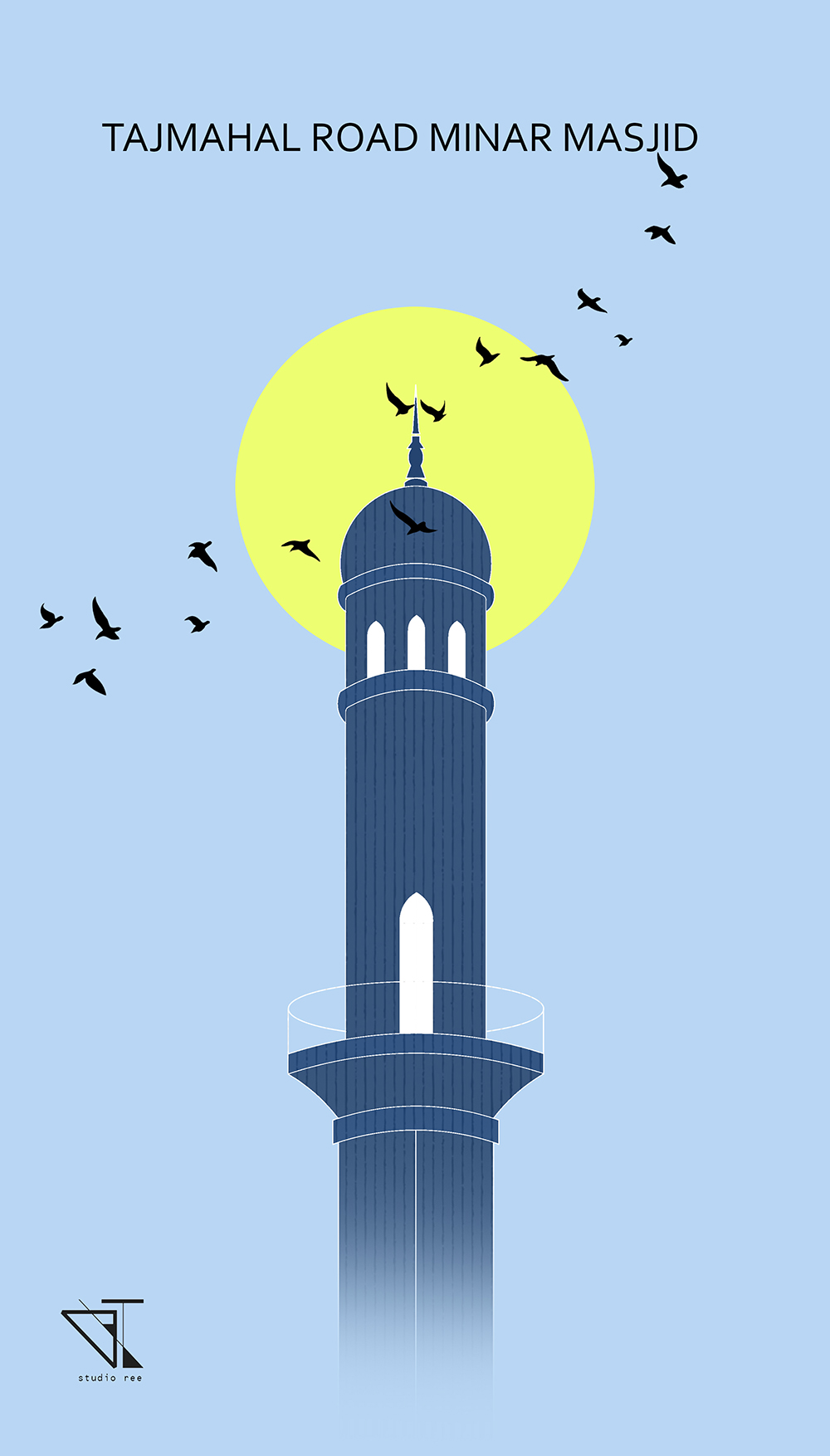
The minaret, a defining architectural element of classical Islamic architecture, serves both functional and symbolic purposes, yet it is becoming less common in contemporary mosque design. Rising above the surrounding structures, minarets historically provided a high point from which muezzin could call the Adhan for prayer. This height ensured that Adhan reached the surrounding communities (Bloom, 1989). Beyond practicality, the minaret or minar holds deep cultural as well as artistic significance, expressing the craftsmanship and grandeur of Islamic architecture while acting as a landmark within the urban landscape (Grabar, 1992). Its verticality also symbolizes a link between earth and the divine (Petersen, 2002).
During the Prophet Muhammad’s (PBUH) time, the call to prayer was made from a rooftop, suited to a small community (Creswell, 1989). As cities expanded under the Umayyads, taller structures became necessary, leading to the minaret’s introduction (Bloom, 1989). Over centuries, distinct regional styles emerged, with historical examples in Bangladesh dating from the 15th to the 19th centuries (Alam & Noble, 2021).
However, today, minimalist architectural trends often avoid the minaret as technology like microphones and speakers has replaced the need for tall towers. Yet the minar remains a vital tool for visual clarity and wayfinding. In the past, when cities were more open and buildings were lower, the tall silhouette of a minaret helped people quickly identify the location of a mosque. Even today, in dense urban areas with high-rise buildings and tightly packed neighborhoods, when multiple mosques recite the Adhan simultaneously, the minar helps to distinguish which mosque is nearest. While technology aids projection, it cannot replace the cultural, visual, and symbolic resonance of the minar. Without it, we risk losing a key element of Islamic architectural identity.


References
Bloom, J. (1989). Minaret: Symbol of Islam. Oxford University Press.
Grabar, O. (1992). The Formation of Islamic Art. Yale University Press.
Goodwin, G. (1997). A History of Ottoman Architecture. Thames & Hudson.
Petersen, A. (2002). Dictionary of Islamic Architecture. Routledge.
Creswell, K. A. C. (1989). A Short Account of Early Muslim Architecture. Penguin.
Alam, M. S., & Noble, A. G. (2021). Mosque architecture in Bangladesh: The archetype and its changing morphology.Scribd.
About the Authors:
Md. Ibrahim Badhan completed his Bachelor of Architecture at North South University (NSU) and Master of Architecture at the Bangladesh University of Engineering and Technology (BUET). He is currently pursuing PhD at BUET.
Rubaiet Sharmeen Sornali completed her Bachelor of Architecture at North South University (NSU) and is currently pursuing her Master of Architecture at the Bangladesh University of Engineering and Technology (BUET).
PEOPLE ALSO VIEW

Printed Publications

NEXT 50: Collective Futures

ASPIRATIONS AND IDEAS: Designing with Context