
Ghorar mosque at Barobazar, Jhenaida
18 June, 2016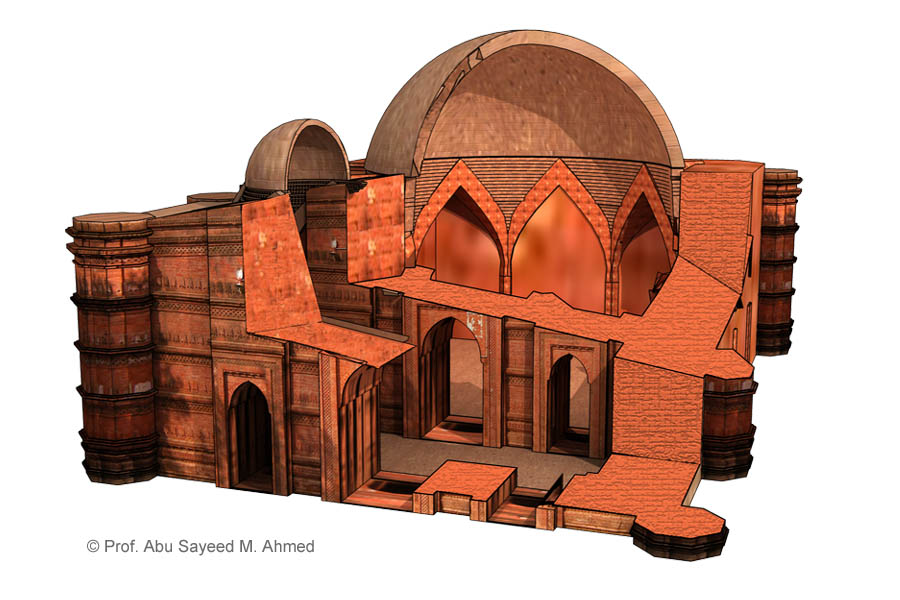
Ghorar Mosque is an excellent example of the best conserved monument in Barobazar by the Directorate of Archaeology in the southern region associated with the history of legendary Saint Khan Jahan Ali. It is located in the village Barobazar under Kaliganj Upazilla of Jhenidah district and about one kilometer west from the Jessore- Jhenidah highway.

Barobazar in Jhenidah is believed to have derived its name from a certain twelve (Baro) obscure Muslim saints who settled here prior to Khan Jahan Ali (Ahmed, N.1989: 28). The architecture of Barobazar resembles with the Illyas Shahi architecture in Gaur and Pandua than the style of Khan Jahan Ali that developed in the nearby Bagerhat. Neither structure has any inscription, but according to its stylistic resemblance with the architecture of Gaur and Adina; such as square room with foreroom, octagonal turret, vertical offset and projected shallow panels of entrance, it may be assumed that this structure was built during the Illyas Shahi period prior to the Khan Jahan architecture i.e early 15th or late 14th century AD.

Typologically, it belongs to the single-domed square building with a foreroom in front and is akin to the Chamkatti, Rajbibi and Latton mosques of Gaur. The square shaped main prayer hall is 6.01m square and the foreroom is 2.08m wide internally with 1.45m wide wall. The foreroom has three pointed-arch entrances in front and one on each side. Three arched entrances lead to the prayer chamber from the foreroom. The northern and southern walls of the main prayer hall contain one arched openings each. Every outside opening has a projected shallow entrance panel, which results a vertical offset and resembles the early Illys Shahi architecture in Gaur and Hazrat Pandua. Corresponding to the front entrance there are three mihrab niches in the qibla wall decorated with abstract geometrical terracotta ornamentation. The central mihrab is higher and wider then the side ones and from outside has a projection.

The mosque has six corner turrets, one at each corner of the main hall and one on either end of the foreroom. Two frontal turrets are square in shape and the rest four are octagonal in shape. Square turrets are also observed in Pathrail mosque at Faridpur, Shahi mosque at Bashirhat. The slightly curved cornice is composed with simple mouldings and the spaces between the mouldings are embedded with geometrical ornamentation. The transition from the square supporting areas of the main hall to the circular base attained first by four squinches at four corners to an octagon and finally from an octagon to the circular base by brick pendentives, upon which the dome rests. The base or shoulder of the dome is decorated from inside with blind merlons. The foreroom is covered by three equal hemispherical domes using pendentives at each corner

The Ghorar msque is a well renowned monument for its surface ornamentation; whereas the adjacent Khan-i-Jahan’s architecture is popular for its austerity that means less ornamentation. The whole outside surface is embellished with horizontal band of ornamentation or friezes. Besides the mouldings in the plinth and cornice level, the total height of the façade is divided into four layers by three groups of friezes. Each group consists of three types of friezes, where terracotta tile of geometrical or abstract motif is used in a repetitive style by selecting a single motif.

PEOPLE ALSO VIEW
Printed Publications

NEXT 50: Collective Futures

ASPIRATIONS AND IDEAS: Designing with Context