
Health Complex One Project- 3rd Place Winning Entry
30 January, 2017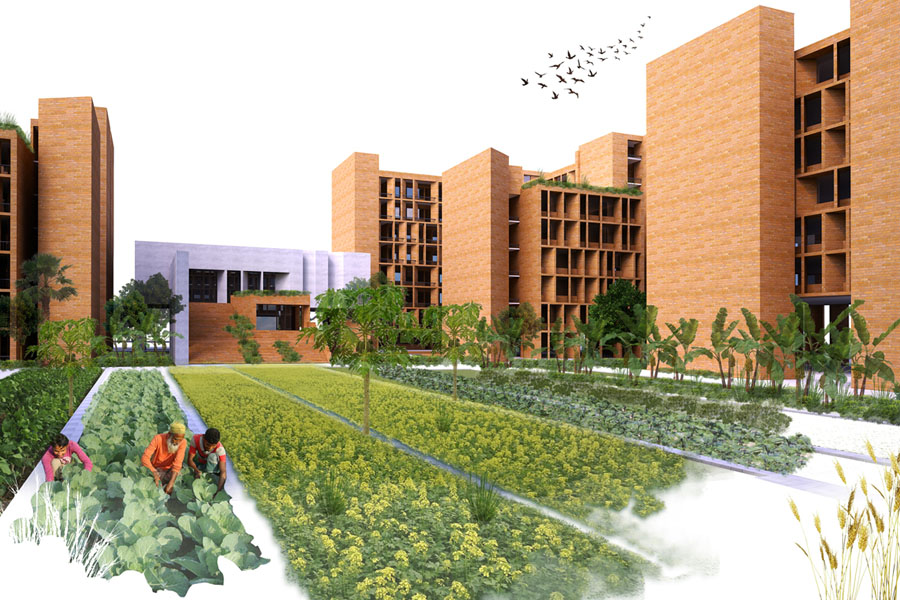
PROJECT BACKGROUND
Grameen associated companies are expanding their activity, operation and business since their inception. They strive to transform societies through Social Business. Through practical realization of Social Business ideas they envision in achieving a world without poverty. Grameen associated companies will make every effort to implement projects within 2025 abiding by the policies set forth for Social Business. Keeping the vision in view, Grameen associated companies are providing technical and financial assistance to the projects in the following key areas –
- Healthcare;
- Education;
- Industrial Parks; and
- Environment.

Grameen Telecom Trust (GTT) and Grameen Kalyan (GK) have purchased 25.75 bighas (8.51 acres) of land in joint venture on Avenue 2 at Diabari, Uttara 3rd Phase, Dhaka. On 19 bighas (6.28 acres) ofarea within this land GTT and GK are planning to develop a project named ‘Health Complex One Project’ comprising 500 bed Samajik Medical College Hospital, Grameen Caledonian College of Nursing and Samajik Health Technology Institute. Commercial high-rise building(s) will be constructed on the remaining land.

The objective of the competition was to produce a design and proposal for:
- Master plan of the complex comprising
- 500 bed Samajik Medical College and Hospital,
- Grameen Caledonian College of Nursing,
- Samajik Health Technology Institute and
- commercial high-rise building(s)
- Detail design (schematic) for Grameen Caledonian College of Nursing (GCCN)

DESIGN CONCEPT
“Towards Productive Architecture: A Bioclimatically responsive complex”
While cities offer opportunities for living a life with a low ecological footprint, they suffer from pollution, noise and remoteness from nature. Integrating vegetation into the urban fabric allows us to improve these quality of life issues, by offering ‘Biophilic’ benefits (intuitive and deeply ingrained attraction to nature, and a biological need for contact with the natural world) to inhabitants, increase the ecological productivity of the site, and connect buildings with their unique local environment.

In the spirit of Grameen-
Visioning future as an enabler of social business ideas, Grameen focuses to achieve a world without poverty. It initiated to implement projects in healthcare sector and various other areas within 2025.While designing the project ‘Health Complex One’ at Diabari, Uttara, Dhaka, we metaphorically assumed that as self reactive platform, the building entity connects and works according to people’s activity, need and possible reaction to nature. This design inspires the buildings work together as generically expressive buildings which do not differ from its own climate and context.
The intention was to address issues of food production and sustainable land use in this site. Perhaps the most cost effective and rewarding benefit of integrating vegetation into buildings is the biophilic connection it gives to building occupants that we tried to provide. Plants are part of the high quality environment that sustainable productive architecture should focus. The design of this complex aims at identifying, through the perception of different groups of users of urban space and provided nature.
DESIGN MORPHOLOGY
Building Form, Orientation, Accessibility & Circulation in the Masterplan
In the masterplan, the building forms have been generated through various phases of design and oriented according to its different activities and possible reaction to oriental weather. Inner courtyards in-between building forms and open green vegetation area have been introduced to ensure cross ventilation and to create maximum vista to the site.

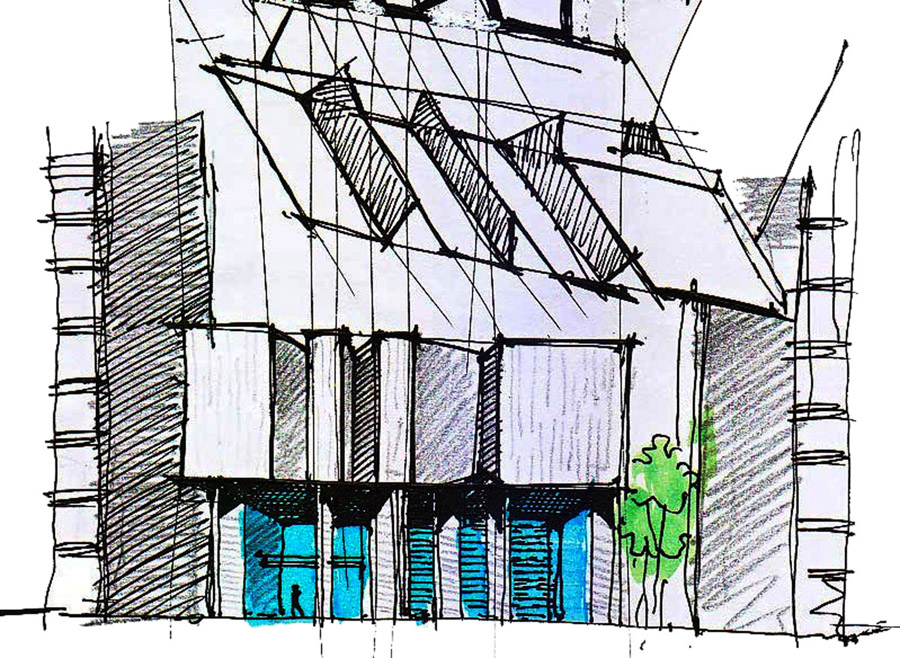
Orientation is a significant consideration as proper placement of the built forms will enable the buildings to receive maximum natural ventilation and light. This would save electricity and in the long-run prove to be environment friendly. The masterplan is designed in such manner so that the buildings gain maximum natural light but avoid the heat and also well ventilated by the openings and well protected from heat by angled louvers throughout building periphery.

The nursing college academic block and hostel block have their own courtyard to circulate natural air. Buildings also have been designed with single loaded corridor circulation to ensure maximum ventilation. The whole complex has its own peripheral vehicular circulation and every building has pedestrian access. Inside the complex, around building blocks and vegetable garden has pedestrian connection to each other.
Addressing Urban Context with Open Green
The site is in an area which can be seen as a margin of the residential belt of Uttara. The approach to the site is clear and conscious in terms of visibility. The architectural strategy for the exterior of the buildings was to maintain the same expression to create a strong establishment. The green vegetation area on the ground and open terraces has been considered as stronger portion of the master plan.

Towards Productive Architecture: Organic Vegetable Gardening area
A big green area on the ground has been considered as productive food source of the master plan. We designed around 50,000 sft area for this organic vegetable gardening purpose, which will grow various all-year round vegetables (potato, bottle gourd, eggplant etc.) and seasonal vegetables (tomato, cabbage, cauliflower, onion, spinach) for the inhabitants of the hostel area and serve the canteen as well.

The site is in an area which can be seen as a margin of the residential belt of Uttara. The approach to the site is clear and conscious in terms of visibility. The architectural strategy for the exterior of the buildings was to maintain the same expression to create a strong establishment. The green vegetation area on the ground and open terraces has been considered as stronger portion of the master plan.

The green terraces allow vast amounts of light and ventilation deep within the building; and provide pleasant views to those working or residing within the building. The shrubs in these open terraces will help to filter pollutants from the air entering into the interiors.
<< Image gallery >>




PEOPLE ALSO VIEW
No related posts in the parent category.
BROWSE BY CATEGORY:
Printed Publications

NEXT 50: Collective Futures

ASPIRATIONS AND IDEAS: Designing with Context