
World Environment Day 2026
Urban [Re]Stitch
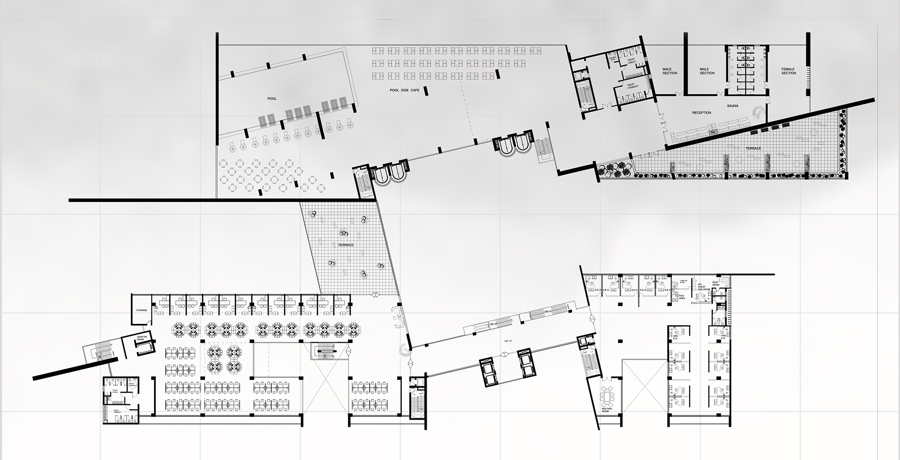
Headquarters for Roads and Highways Department: A Thesis Project

Roads and Highways Department under the Ministry of Communication is responsible for construction and maintenance of all major road networks in Bangladesh. Their mission is to provide safe, cost effective and well maintained road network through the country. Due to availability of fund and vast expansion plan the department has taken necessary steps to establish a new large scale structure in Dhaka to host their headquarter.


‘Roads and Highways’ owns a 16.98 acre site in Tejgaon Industrial Area. The allowable built area is 301,561 sft. The requirements were a verity of office functions with some residential provisions.
Program Outline:
Honorable Minister’s Office 1210| Chief Engineer’s Office 920| Additional Chief Engineer’s Office (x20) 30200| Executive Engineer’s Office (x57) 66120| Superintending Engineer’s Office (x29) 31030| Sub Divisional Engineer’s Office (x51) 46620| Total Office Area 180100| Total (Common or General Facilities) 55736| Total Area Without Circulation 235836| 30% Circulation 69591| Apartment for AE’s 26910| Duplex house for CE’s 11302
The diversified working pattern of different departments demanded working environments of different tastes. This aspect opened the prospect of exploring various types of working environment united in a single complex.
Aims and Objectives:
To improve collaboration among the departments| To present a unified image in a large scale| To achieve greater economics even with a large scale| To ensure security rules and protocol| To explore various aspects of sustainability for an intended healthy working environment
Concept:

Offices were once designed for efficiency based on predictable principles of hierarchy, status and repetition. They were planned by ‘department’ and stacked in a way that minimized movement; thus promoting a sedentary and isolated work style that kept people in their place and impeded the flow of new ideas and information. Today, a new generation of offices is emerging that challenges this inflexible and outdated model.

Now a days office is a space where people work together as a team. Employees collaborate each other. They need a regular space to concentrate on their work and at the same time need space for relaxation. They are connected for work but have respective individual identity. So, in this project attempts were made to create lots of collaboration spaces into the regular workstation arrangement. The collaborative spaces are placed variously with respect of interaction and views. To assist further coherence ground level is left free for public gathering.


|More images in the gallery|


Kettuvallams: Kerala Houseboats
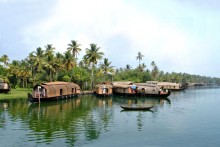
On 2nd March, 2011 we started our journey to Alappuzha /Alleppey, the “Venice of the East”; located far south of the port city Kochi .Alappuzha is crisscrossed by numerous backwaters and one of the biggest hubs of Houseboat. We experienced a very fascinating journey by houseboat there which glided across the shimmering blue waters, dazzled in gorgeous green with fringed edges.
We also met the Houseboat builders, the native community who has been building the houseboats with the collective experiences gathered from their ancestors since the ancient times.
After the delightful experience from Alappuzha we headed for Kovalam; a beach town by the Arabian Sea in Thiruvananthapuram city, Kerala. There we experienced a very fascinating boat trip in Poovar which took us gradually from backwaters to the Arabian Sea.
Poovar is almost at the southern tip of Trivandrum;a natural harbor; connect the Arabian Sea during high tides. Swaying coconut palms, endless golden sands, and the ultramarine of the ocean, emerald backwaters, crimson sunsets and lush green vegetation created a magical ambience around us.
We made an end of our tour on the Light House Beach; the southernmost of Kovalam. The Light house over the Kurumkal hillock, the lashing of waves on the rocks, shallow waters stretching for hundreds of meters, steep palm covered headlands and the shops offering all kinds of goods and services made hundreds of everlasting memories in our mind.

In the Malayalam language “kettu” means “to tie” and “vallam” means boat – the two together make the local name “kettuvallam”. Through the centuries these Kettuvalams have been roaming within the backwaters transporting men and materials to different destinations.
Due to its sheer size and shape, Kettuvallams could carry very heavy loads, more than three times that of a cargo truck. Traders used this as a main mode of transportation in the inland waterways since ancient times. This House boats, with thatched roof covers over wooden hulls, also had enough facilities for cooking and sleeping for the boatmen and sometimes even for boatmen’s families too.
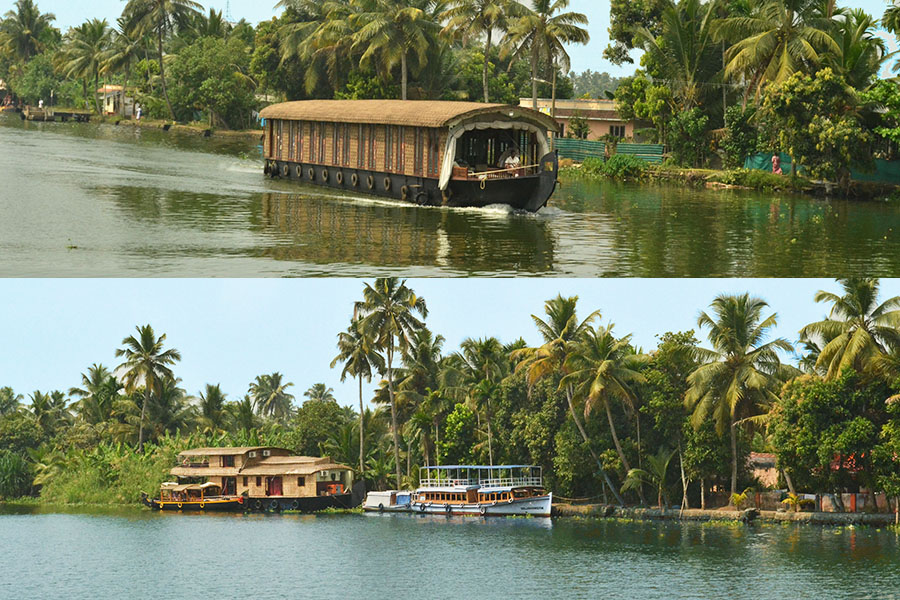
Becoming an increasing destination for tourists, these Kettuvalams (House Boat in Kerala) have been given a new lease of life in Kerala. These days, more than 2000 kettuvallams ply the backwaters . Floating along the cool tranquil water one can experience an unusual approach to the Kerala way of life. Accounting for eco-friendliness has now become the yardstick gauging the efficiency and effectiveness in transportation. Thus a Kettuvallam is not only economical but also environment friendly. Thus the tourist demand to explore the beauty of the Kerala brought the Kettuvallam back to the waters in the restored form of a modernized Houseboat.
Basic structure of Kerala houseboat
The size of the hull or body or the framework varies, number of rooms may be one, two, or three, the superstructure designs vary, and level of comfort and luxury differs. Some houseboats are small and some are large. Materials used for construction also differ.
Hull is made by joining wooden planks with coir-ropes and coconut husk fibers, stuffed in between. Then, the sticky resin collected from cashew nut shells during processing is applied on the long-lasting coconut fiber and the binding ropes made with it, sealing the gap between the wooden planks.
The roof of Kerala houseboats are usually made using bamboo, cane, areca nut tree stems, and other eco-friendly natural materials. The framework can be made with bamboo poles. Split bamboo, thinned and smoothened is woven into mats and is used as roof cover. It is made water-proof, and will last for several years. The shape of the roof differs according to the design.Windows and other openings are provided for light, airflow and view.
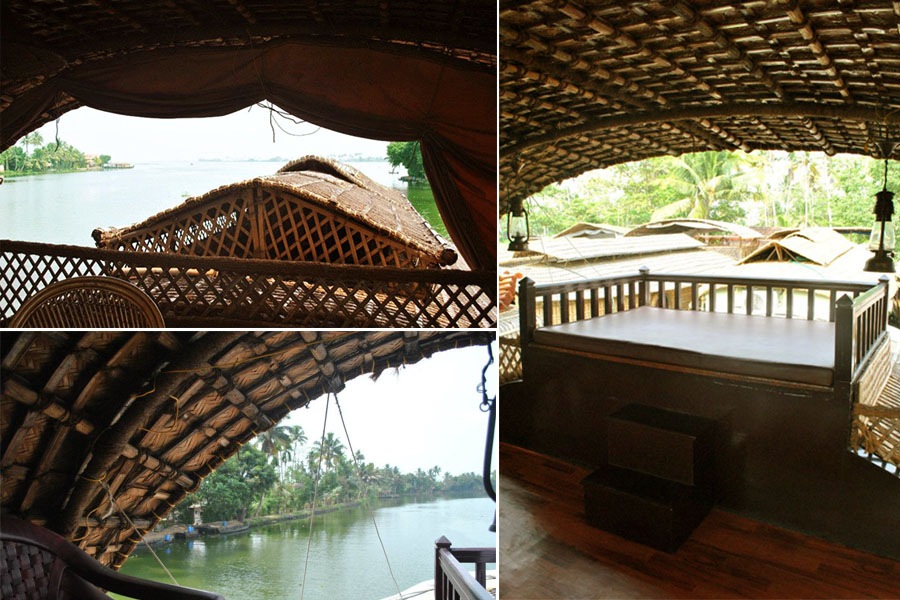
The transformed versions of the boat have incorporated 2 bed rooms with a modern toilet, a living space and kitchen. For fixing the toilet seats, shower tray and ceramic floor finish on a concrete slab is laid at the floor level. The soil outlet of the toilet seats are taken through the hull and let out to the following water beneath.
The colour of the Valavara is yellowish brown, which is the colour of the natural materials like panambu, coir and bamboo. It is a warmer colour comparing to the colour of the surrounding atmosphere. This gives a nice feeling of being inside the Vallam. Bamboo poles are used for punting the Vallams. It is strong fiber and absorbs more carbon. Latest houseboats have modern interiors.
The interior furnitures are either of cane or wood, floor carpeted with coir mat or wood panels. Valavara of panambu, Bamboo and coir all colours matching each other but bring the depth and variations in vision.

At night the traditional hurricane lamp is used to light the interiors. Usually each one is hung from the ridge of Valavara one at front, one at rear and one or two accordingly for the living spaces. And mostly for half of a month there will be moonlight, which gives enough light, reflected on water.

Possibilities in Bangladesh
In Kerala, the local community near the black water are involved with the tourism board. With the help of the tourism of Kerala, they are able to maintain their hereditary profession and yet get benefited by it. Like Kerala, the waterways of Bangladesh are home to nearly 800,000 ‘River gypsies’ or Bedey that navigate along the network of over 700 rivers and canals on their hand-constructed houseboats. Although a moderately large community, they are deprived from basic social rights and subjected to discrimination and identity crisis.
So before losing the identity of “River gypsy” and their living boats, the tourism board can engage these river people and their indigenous boats into the eco-tourism in possible locations like Katka, Dublar -char,Sundarbans;‘haor’s of Syllhet; river delta of Bhola; Kochi Khali, Kuakata; Tangua haor,Sunamganj District etc. These places of Bangladesh are immense importance and needed to be ecologically conserved.
Author(s)
Nandita Barai, B.Arch ( BUET ) , 2013 | Faculty of American Int. University-Bangladesh , former faculty of State University Bangladesh.
Shaswati Chowdhury, B.Arch ( BUET ) , 2013 | Project Architect at Trust Alliance Technology Ltd.
Sabrina Afroz Mostofa, B.Arch ( BUET ) , 2013 | studying masters at University of Nottingham on Environmental Design, former faculty of BUET .


Origamic Architecture by Vaj Binnash
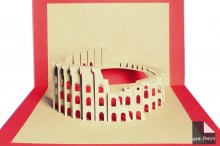
Khulna University Architecture student Mahamud Hasan Reaz is very passionate about paper work and likes to do origami and pop- up cards. He drew his inspiration from Japanese origamic architecture, very popular form of paper art widely practice all around the world. In his own word “Artist from other countries make their own architecture in the form of pop up. So, I wanted to introduce this kind of art in our country and also make our own famous architecture as pop up.” Reaz is currently moderating a page ‘Vaj Binnash’ (www.facebook.com/vaj.binnash) in a social media site.
His art works involve Origami and Kirigami including pop up cards on architecture, traditional and modern vehicles, action figures of birds and animals and different floral patterns ranging from simple to exceptionally intricate.


Basically ‘Origamic architecture’ is the art of paper cutting and folding to create three-dimensional objects including architectural form, geometric patterns, everyday objects, or other images, -usually from single sheet of paper.
Visually, these creations are comparable to intricate ‘pop-ups’, indeed, some works are deliberately engineered to possess ‘pop-up’-like properties. However, origamic architecture tends to be cut out of a single sheet of paper, whereas most pop-ups involve two or more. To create the three-dimensional image out of the two-dimensional surface requires skill akin to that of an architect.

How to make it:
To make it one needs to draw the outline of the intended shape on the paper first. And then following some easy geometrical techniques other lines are drawn, cut it out and folded accordingly to give its 3d volume. With some design in front cover it is ready to present.


