
Robotics and AI Innovation Lab | RUET
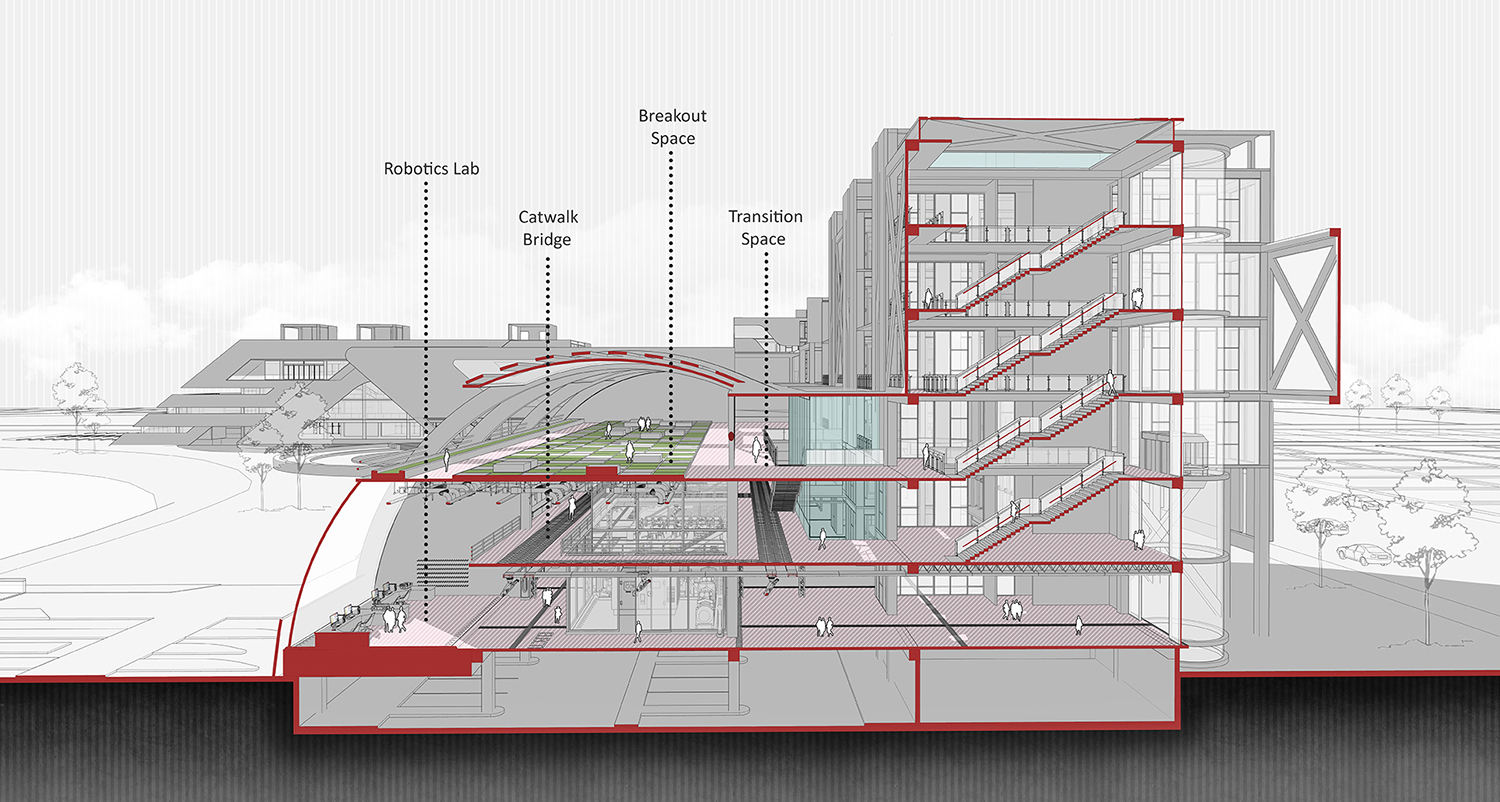
The proposed Robotics and AI Innovation Lab in Purbachal is an ultra-modern techno institute designed to facilitate cutting-edge Artificial Intelligence (AI) and Robotics researches and to inspire the young minds dedicated to the ICT-based industry of our country.
The core of the conceptual idea came from the hypothetical future situation of the possible conflict between Humans & Robots regarding the superiority issue. How the future world would look like? Is “Robot Invasion” or “AI Takeover” can be a possibility in near future? Is it possible to make a successful co-existence for both mankind and their own creation robots & automation? For this project, to conceptualize the spaces provided for both humans and robots, the answer should be always “Consilience and Companionship”, a facility needs to be designed where priorities will be set for both human comfort and technical considerations for robot making.


The selected site area is 14 acres and is surrounded by Narsunda River on the southeast side. There’s a 100 feet wide road on the west side that connects with the ‘helicopter chottor’ & there’s a 75 feet wide road on the south side also. The three major primary functions are: the academic block, the laboratory block and the dormitory block for the researcher. The academic block is placed in the north-south direction so that this particular orientation can provide the maximum amount of light and air ventilation throughout the year. The laboratory block is placed in the east-west direction so that it can get the maximum river view from the different types of labs. The dormitory block for accommodating the researchers is adjacent to the laboratory block. The building masses are facing the green landscape in front. These building masses are placed in a way so that they can get maximum exposure to the river.


The common ‘admin and faculty block’ is connecting both the academic and the research laboratory building. The research laboratory building is divided into two parts: One part is the lab functions with an open floor plan facing the riverside and the other part is the research department behind the labs with a common connection. The warehouse on one side of the building serves as a products storage for the labs. The design development is carefully handled by taking into consideration of site forces, road accessibilities, functions and service flow, and context. Nonetheless, consideration is given to compact massing in relation to the solid-void of the form. The design has prioritized both the natural and technical context in its space formation. The front plaza, deck near the river and arena space connecting the surrounding landscape will remain active all the time. All the labs, offices and academic blocks are designed to take benefits from daylight and natural ventilation. They offer wide-open view of the green and river, thus ensuring the proper space quality for collaborative research works and activities.


The ‘technical part’ is based on mainly 3 design principles-Motion, Energy, and Intelligence. The first step is to ensure the functional flow of a prototype making. For this, the whole process should be systematic and continuous without any interruption. That’s why the activity of the lab block is designed on the ground floor level while the major circulation for lab users is separated on the upper floor. The prototype will be started in the mechanical lab. After body making it will be sent to the electrical lab for power sourcing and then simulation lab. Finally, it will be assembled in the assemble room. The ground floor of the lab facility is an open free floor space where each lab has its separate areas and all the labs can be used as a single lab space. The upper catwalk bridge will be used for the major circulation of lab users so that they can monitor all the lab activities from the upper level without interrupting anything. The lab block is separated from the other functions by the sensor-controlled glass partition. This will provide the controlled temperature particularly required for the specific lab space. The firefighting system is also provided, sprinklers are installed in the lab ceiling in case of fire along with the air-conditioning ducts and ceiling lights.


The ‘natural part’ is also based on 3 design principles-Daylighting, Water proximity & Green adequacy. “Daylight is circadian-effective & triggers positive emotional, attitudinal and cognitive response in the individual” – (Strong, 2012). In a workspace like this, people need a space to relax and rest, to lessen their stress and tiredness. Water proximity in the workspace is the best way to do so. The sound and wave of water flow help to reduce mental stress. So, some water walls have been installed in both interior transitional spaces and adjacent to the exterior facades. Uplifted green terraces, open breakout spaces and green buffer spaces are introduced here to enhance the green adequacy. According to the World Green Building Council “Proximity to natural elements such as greenery and open sunlight was associated with 15% improved wellbeing and creativity and 6% of higher productivity”
This project is specifically designed to be an example of how nature & technology can merge together so that it can bring the best possible outcome in the future.


PEOPLE ALSO VIEW

Printed Publications

NEXT 50: Collective Futures

ASPIRATIONS AND IDEAS: Designing with Context