International Day for Monuments and Sites 2026

International Day for Monuments and Sites 2026

International Day for Monuments and Sites 2026

A Celebration of Space Between Multitude & Metropolis

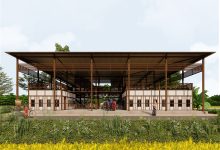
The fundamental purpose of this project was to create architecture that interacts with people, reminds them of their heritage and roots and adds value to the lives of citizens. Instead of designing a timeless architecture, this project was conceived as an architecture of the moment. Because it’s not just about the design and other technical aspects of a building, but also about how that piece of architecture finds its place in the community and in people’s hearts.

One of Bangladesh’s six major cities, Rajshahi serves as both the divisional and administrative district headquarters for the Rajshahi division. Often referred to as Silk City and Education City, it is located on the northern banks of the river Padma. Virtually, the whole Rajshahi district is laced and criss-crossed by the river Padma and its tributaries. Communities large and small along the Padma River have started discovering their river heritage, turning back to their riverfronts and recognizing them as tremendous communities and economic assets.

Glimpse of Rajshahi © Sumia Binta Kalam | KUET

© Sumia Binta Kalam | KUET

However, the city is expanding and going through rapid urbanization. There is a growing demand for a central area to serve as a public space for the enlarging community. The lack of a cultural heart or pulse that reflects the essence of the city to its’ citizens and tourists is seen as a need in a modern city.

Synopsis of Activities © Sumia Binta Kalam | KUET

The location of the project is about 300 meters distant from Vodra Mor, a significant city center node in Rajshahi City and the most prominent zones surrounding are Residential, Commercial, Mixed-use and Educational.

Conceptual Framework © Sumia Binta Kalam | KUET

Emphasis on waterbody © Sumia Binta Kalam | KUET

The aim of the project was to create an architecture that would improve their quality of life and foster a sense of community as well as a space that the people of Rajshahi will cherish.

The approach to achieve this goal is based on an in-depth study of the context of Rajshahi, architectural styles, culture, heritage and an overall understanding of the spirit of Rajshahi using methods including photography, interviews, literature study and survey of the site and the people of the city. The challenge of this project is to create a space that becomes not only functionally sound but also an architecture that can be a part of the people of Rajshahi.

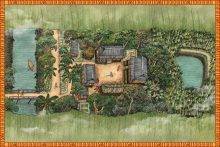
Proposed Site Plan © Sumia Binta Kalam | KUET

Ground Floor Plan © Sumia Binta Kalam | KUET

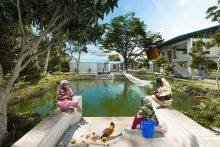
The ‘pukur’ (pond) in Rajshahi’s old town is a significant contributor to the figure-ground pattern and evolved into a space for social interaction as a result of its climate and sociocultural necessities. Therefore, pukur or pukurghat, which makes up about 30% of the public space, has been a responsive social space for a long time and still is relevant till this date. Reflecting this spirit of Rajshahi on the existing waterbody of the site to revive the traditional community gathering character.

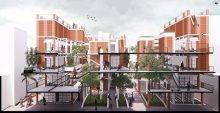
Section © Sumia Binta Kalam | KUET
Sections © Sumia Binta Kalam | KUET

Elevations © Sumia Binta Kalam | KUET

© Sumia Binta Kalam | KUET

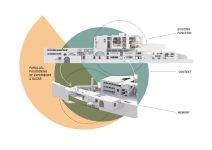
The conceptual framework started with emphasizing the surrounding land use to dictate the zoning and direction of circulation. Thinking of the connecting lines of masses as roads, creating nodal points at each junction. The nodes act as a pause. A pause from movements also creates a cause for movements. The trail connects the pauses. Using local crafts on the trail to create a metaphysical backdrop that can be called walking through culture. Arch is the most common feature of Rajshahis’ architectural heritage buildings. Abstraction of the traditional arches creates a design that is contextual yet gives an impression of something modern.

© Sumia Binta Kalam | KUET

© Sumia Binta Kalam | KUET

© Sumia Binta Kalam | KUET

© Sumia Binta Kalam | KUET

© Sumia Binta Kalam | KUET

The master plan was developed in a grid format surrounding the waterbody. Two large plazas are designed on both entrances to give the citizens a recreational ground that can be enjoyed separately on a daily basis. Developing a water-centric recreational space for the citizens’ of Rajshahi to enjoy. The total solid-void ratio was developed respecting the existing ratio of 60%-40% of Rajshahi. The spatial arrangement was maintained to reflect the pattern of both the old and new city of Rajshahi so that the city as a whole can relate to the spaces and enjoy them.


আয়না বুড়ির আদার | Sharal Architects

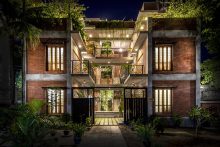
The building is located in a modest residential neighbourhood in the Natore district of Rajshahi Division in northern Bangladesh. The 2.7 katha property has a frontage that offers beautiful views of nature and looks out over the Kanaikhali field toward the west. Its northern boundary is shared with Ansar Camp. This Kanaikhali field was a deep jungle many years ago, where people were afraid to live due to the danger posed by wild animals. An old woman named Ayna built her own shelter and lighted her lamp, allowing her to dwell there without fear. This served as the inspiration for the building’s name, “আয়না বুড়ির আদার” (Ayna Burir Adar), which translates as “Jungle of the Old Woman Ayna”.

© Sharal Architects

Design process © Sharal Architects

Ground floor plan © Sharal Architects

Elevations © Sharal Architects

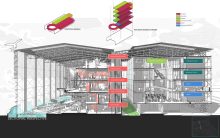
Building section © Sharal Architects

The family consists of a couple, their children, and their elderly mother. The client clearly wanted unrestricted access to the grounds as they were rebuilding their home to resemble the previous one that had been here before. It has 6 bedrooms with attached washrooms, balconies, living space, family living, dining space, kitchen, storeroom, study room, and terraces. There is a cluster of existing bamboo trees situated next to the stairs that follow the three-story building, providing a chance to bring nature inside the structure.

© Sharal Architects

Interplay of light & Shadow on the corridor © Sharal Architects

Open corridors, places of joy © Sharal Architects

Connecting places through corridor © Sharal Architects

Corridor at night © Sharal Architects

The architects were inspired by the lush surroundings of the site to select the colour and texture palette that would draw attention to the building without overpowering the serene environment. Building components like concrete, exposed brick, wood, glass, and metal bar are used in the construction of the building. An element that both the built environment and nature share, “Brick,” was chosen to portray this interacting link. “Concrete,” in its raw state, was then used to consolidate it. A natural sense of being immersed in the comforting earth is created by the colour and texture of the building.

Staircase, carried by green © Sharal Architects

Staircase, connecting levels © Sharal Architects

Tranquility of the balcony © Sharal Architects

Spiral stair toward roof © Sharal Architects

To create two linear living spaces that are east-west aligned and to allow natural light and ventilation to circulate throughout the interior spaces, the building’s basic mass is reduced. This leaves an open space in the centre which acts as a central courtyard. Balconies and circulation pathways within the open space provide direct access to the courtyard, which itself offers a connection to the exterior. The visual connectivity of the entire building is enhanced by this courtyard.

The courtyard offers visual connectivity & interactions © Sharal Architects

Courtyard during day and night © Sharal Architects

Enjoyment of openness right from courtyard © Sharal Architects

A significant stairway has been added near the existing clustered bamboo tree to connect the building at different levels. Additionally, stairs and all other features are placed around the courtyard to allow for natural light and ventilation to enter all interior spaces. The interior layout of the spaces was designed to represent an approach to combining habitat and nature. By eliminating mass from the second level, terrace gardens are formed, along with greater visual linkages and sunlight accessibility. The temperature inside the bedroom is controlled by 12-inch-thick walls and small windows on the west side. Large windows also provide cross ventilation for each compartment on the opposing sides. The incorporation of design elements such as brick-jali, brick pointing, spiral stairs, and a pergola shed adds a new dimension to the structure.

Indoor -outdoor © Sharal Architects

Indoor -outdoor © Sharal Architects

Lush green of spiral stair terrace © Sharal Architects

Study room terrace © Sharal Architects

Project credits:

Architecture Firm: Sharal Architects

Firm Location: Dhaka, Bangladesh

Social Media Page: www.facebook.com/sharal.architects

Lead Architects: Ar. Md. Mainul Islam, Ar. Anindita Laz Banti

Associate Architects: Ar. Md. Mainul Islam, Ar. Anindita Laz Banti

Structural Consultants: Eng. Sanjoy Mohan Sarker

Engineer in Charge: Eng. Sagar Ahmed

Photo Credits: Prantography / Junaid Hasan Pranto

Bridge School | CODEC

| Notes from the Architect |

The context of education status in coastal Bangladesh is much more different than the other regions of Bangladesh. Access to formal education is very much constrained for the children of the coastal areas. In some of the remote and detached islands, formal education is as close as being non-existent. Due to frequent natural disasters, the regular classes are interrupted. Communication failure, reduction in family income, damaged school buildings are the key reasons for children not attending schools. Poverty is very dominant resulting in child labor, school drop-out, child marriage, and climate change induced migration.

Linear layout © CODEC

© CODEC

© CODEC

© CODEC

The coastal areas are facing a higher rate of school drop-out in secondary education than other areas of Bangladesh. Dropout from school is higher in remote coastal areas due to different socio-economic and environmental reasons. Economic hardship, geographical isolation, insufficient secondary schools, lack of parents’ education, poor physical condition, lack of quality resources are the key barriers to ensure the quality of education in coastal areas. The school closures during COVID-19 pandemic even worsened the situation and resulted in an increase of school dropouts and child marriage.

To address this challenge, Community Development Centre – CODEC, supported by ERIKS Development Partner and Friendship as technical partner is implementing “Showpner Thikana” project in Mongla & Shoronkhola of Bagerhat and Rangabali of Patuakhali. The project aims to establish quality secondary educational services for dropout school children and bring them back to school.

L-shape layout © CODEC

© CODEC

© CODEC

© CODEC

© CODEC

© CODEC

We have already constructed eight bridge schools as a part of this project in Mongla, Shoronkhola & Rangabali where currently 341 out school children have been admitted to grade – 6 to continue their education. We are also working closely with the parents of the children so that their education is continued, and they do not fall victim to child marriage and child labor. Our bridge schools will provide educational services until grade-8 and afterwards, the children will be mainstreamed to government secondary schools where they will be able to complete their SSC examination.

Participatory process © CODEC

The design process of the bridge schools started with community level participatory design development workshops where school dropout children, parents and community members were engaged actively. The aim of these workshops was to brainstorm and articulate the needs, ideas, and expectations of the key stakeholders to initiate the design process of the bridge schools. All sessions of the workshop were designed and facilitated to maximize the participation of all members attending the workshop. The workshop was organized in two phases. In the first phase, discussion and sharing were made about joyful learning, quality education, environment of education, health hygiene, access for PWD (Person with disability), disaster resilience and more. The participants proactively provided their ideas and feedback regarding these issues. The second phase was focused more on the initial design development of the bridge schools through drawings and model making. During this phase, the children drew sketches and made models to express their ideas and aspirations of their schools. All lands required to construct the schools were donated by the community members. Also, the location of the schools was selected by the community members, parents and children considering the proximity to their villages, access, and safety.

© CODEC

© CODEC

© CODEC

© CODEC

© CODEC

The final design reflects the needs, ideas, and expectations of the stakeholders, especially children. Two types of floor plans (L-Shape & Linear Shape) were developed to accommodate the schools to the available sites and incorporate the functional requirements. As the schools are constructed in highly cyclone prone areas, the structural system was designed with RCC members to provide the required rigidity. Steel framing was used for the roofing. Wooden panels are used for enclosures and windows. The windows are designed in such a way that they can provide an ample amount of natural light and ventilation in the classrooms but during cyclones the windows can be closed completely with ease. Bright colors selected by the children were used in the wooden panels which makes our schools very colorful, playful, and interesting for the children. Cross ventilation is ensured in all spaces with openings on different levels which helps to maintain climatic comfort for the children in the warm summer seasons.

© CODEC

© CODEC

In addition to providing secondary level education, the children of our schools are also engaged in different extra-curricular activities which makes our school very enjoyable for the children. The overall goal of this project is “Empowering school dropout students and communities of coastal areas through collective actions for a better future.”  Through the establishment of these bridge schools are slowly by surely progressing towards achieving our goal.

Placemaking through Historic Urban Landscape Approach

This design thesis seeks to investigate the potential for rejuvenating the identity of a German city, Chemnitz, through open-space design. Following the recommendations of the historic urban landscape (HUL) approach by UNESCO, the relationship between urban design and urban placemaking is explored. The thesis argues that preserving the traits and values associated with an urban public space’s history and collective memory can establish urban placemaking. The outcome of this design research is an open space design with the vision of making Chemnitz a cultural city realized through citizen involvement in shaping the place.

Historical layers of the city of Chemnitz© Abu Sayeed Mohammed Ziad


Chemnitz, the third largest city in Saxony, is a part of the central German metropolitan region and was selected as the European Capital of Culture 2025. The city’s history is an eventful one, which began in 1136.  One of the most noticeable landmarks on the city skyline is the Schlossberg Castle. In the 19th century, Chemnitz prospered into one of the major centers of industrialized Germany, eventually becoming the most thriving city in the country. Between 1860 and 1915, the paramount green spaces in Chemnitz were created. A crucial green space was designed in the Ufer Park, which links Brückenstrasse, a vital street connecting the city center with the Schlossteich lake facilities, then Schlossberg terraces created by Karl Wienke and Schlossberg Castle. However, the incomplete and fragmented urban redevelopments and historical structures continue to present challenges for the city.

© Abu Sayeed Mohammed Ziad

© Abu Sayeed Mohammed Ziad

Chemnitz becoming the official European Capital of Culture in 2025, initiates fresh cultural starts and long-term urban development initiatives. Despite its rich cultural history, Chemnitz is a region that is often overlooked and receives little attention.

The urban development in Chemnitz is a conglomeration of different types of urban fabric from various eras throughout its history. Furthermore, Chemnitz has been dealing with the emergence of right wing movements and therefore the citizenry have been dealing with establishing a sense of identity related to the urban spaces of the city.

Proposed master plan © Abu Sayeed Mohammed Ziad

© Abu Sayeed Mohammed Ziad

The project site is around 22 hectares and is situated north of the city center. It consists of a corridor of open space that runs from Brückenstrasse Street in the south through the Schlossteich lake area to the Schlossberg terraces in the north (Berlin.de, 2022). The selected site poses an opportunity to explore the possibilities to employ urban design to create a public open space that could manifest the city’s identity through traversing its historical urban development phases. Also, the site is deemed an important location to present programmes of the capital of culture year. The site is fragmented visually and spatially with a lack of coherent and contiguous urban development. This thesis will attempt to produce a design proposal through which these issues will be addressed.

Through a comprehensive analysis of the site, four key problems were identified. To address these problems and the main objective of the work, namely the creation of identity through place-making, the tools of the Historic Urban Landscape Approach recommended by UNESCO are used. The tools are applied to address the facets of urban placemaking described by Fürst (2010). A bridge can be built between the design and layout of an urban area, where the quality of life and human environment is paramount, using knowledge and planning tools. The Civic Engagement Tool addresses place-making by connecting people and culture in an urban area. It focuses on how people work together in a place to create functions and thus transform the space into a place.

The application of the different tools in the context of sustainable urban development thus makes it possible to use the HUL approach for the design of urban space. If we look a bit more into the proper application of these tools, we can link the HUL proposals to urban place-making.

Detail plan of Schlossberg terraces © Abu Sayeed Mohammed Ziad

Green Canvas in Schlossberg Terraces © Abu Sayeed Mohammed Ziad

A green canvas like landscape is provided in Schlossberg Terraces where the goal is to intervene minimally while providing a backdrop like lawn landscape for the heritage elements and Landscape planning of Karl Wienke to shine through. Chemnitz riverbank is redeveloped with terraced steps, known as “Ghat ” in Eastern cultures. This area promotes dialogue between the people as well as establishing spatial and visual relations. The lake is given the center stage and viewing decks and pleasant walkways to enjoy the lakefront are implemented in the design. The original planning philosophy of English landscape gardens is followed. The musikpavillon from the GDR era is reinvigorated by incorporating seating areas around it: with the goal of transforming it into a relic similar to the amphitheater – the cultural heart of the whole ensemble. The Promenadenstrasse between Schlossteichpark and Uferpark is redesigned as a shared space, promoting uninterrupted visual and spatial connection. This, in turn, develops a walkable neighborhood for the surrounding areas, whilst giving the visitors an opportunity to enjoy a stroll through the many layers of history in Chemnitz.

River Terraces, Chemnitz riverbank © Abu Sayeed Mohammed Ziad

Citizen’s park around Schlossteich lake © Abu Sayeed Mohammed Ziad

Schlossteichinsel Musik Pavilion © Abu Sayeed Mohammed Ziad

Detail plan of Brueckenstrasse Stub © Abu Sayeed Mohammed Ziad

The Promenadenstrasse, a Shared space © Abu Sayeed Mohammed Ziad

The design proposal attempts to transform the existing areas into democratic spaces. With the recent violent trends seen in Chemnitz, the need for areas is higher than ever where proper dialogue and exchange between different groups can occur. The design provides spaces that encourage community bonding, exchange and wellness of the citizens, thus, creating a platform for the inhabitants to transcend the borders and leave their imprint on the already rich identity of Chemnitz.

Transforming a Government Colony into a Block-based Housing

The compound effects of plot-based development and low per-capita open spaces in Dhaka have led to an individualist society with reduced outdoor activities for its citizens. To counter this, the concept of block-based development, in which 50% of its open space is dedicated as community open space, has been introduced in the proposed Detailed Area Plan 2022-2035. This studio project explores the idea of block-based development by using the Government colony at Banani as a case. The guidelines of the proposed DAP 2022-2035 were followed in order to expand the city blocks vertically rather than horizontally. The intention was to transform the low-rise outdated government colony into a more livable, inclusive and interactive housing community, without compromising the green and open spaces.


Background

Plot-based development is the current practice of Land development to meet housing demands. But the practice is causing the landfill of flood plains, encroachment in agricultural lands, and unplanned expansion of residential blocks in suburban areas. The cost of infrastructural development is also high, compared to block-based development on the same amount of land.

In Dhaka, the plot-based development created an individualist society, and the lack of open spaces reduced outdoor activities for both young and adults. The parks and fields located in the planned residential areas are not adequate in proportion to the number of inhabitants of the neighborhood. Moreover, those open spaces are often restricted to the outsiders of the resident community, resulting in social discrimination and class division among adjacent neighborhoods.

The Detailed Area Plan 2022-2035 introduces the concept of Block based development which aims to encourage vertical rather than horizontal expansion of urban blocks, resulting in the protection of flood plains and agricultural lands surrounding the existing urban perimeter.

Block-based development has been proposed to have 50% of its open space dedicated as community open space, which will be shared with the adjacent community and cannot be enclosed by walls. The proposal might have positive impacts in terms of social mixing and increased outdoor activities among teenagers and young individuals. Government colonies, as recommended by the DAP, can be prospective redevelopment sites for block-based development that adheres to policy rules, spatial criteria, and density targets. Proposed Block based re-development will accommodate more people to meet the current demand while ensuring quality open spaces for a healthy living environment.

As an exercise in the Housing Design Studio (Studio VIII) of Fall 2022-23 semester at the Department of Architecture, the concept of block-based development has been introduced as an approach to re-think the Government colony at Banani in Dhaka city, following the given guidelines in the proposed DAP 2022-2035. The students have re-imagined the existing colony housing through the lens of block-based housing, considering social, environmental, cultural, and technical issues; while re-generating community interaction of the colony life, which is much different than in a plot-based housing community.

The site is currently inhabited by Government officers of different organizations, like Banks, Customs, Rajuk, PWD, etc. The average building height is 4 stories, having 2-4 units on each floor. Existing buildings are arranged in a staggered formation, to provide south exposure. The whole area has plenty of native trees in between the built forms. According to the current inhabitants, there is a lack of dedicated open spaces for kids, community gatherings, neighborhood interaction, and other outdoor activities, apart from Banani playground, which serves at a community level. The setback spaces around the buildings are unused lands and the buildings are accessed by paved driveways.

Analysis of existing condition © Shahira Sarwat, Munia Rahman, and Nida Sultana


Concept

While re-thinking this site for possible block-based development, the provision of dedicated open spaces, like, playgrounds, parks, and courtyards for all ages was prioritized. This will create memorable experiences while living there as a community, and re-generate the ‘colony life’ which used to be the most cherished memories of every kid and teenager who grew up there. The places were created to encourage more interactions among community members. Both territorial open spaces and shared open spaces were carefully considered and applied in the design decisions. Sky terraces and courts serve as territorial open spaces, while the central park and the field at the southeast serve as community open spaces. For healthy social mixing, different classes of units were composed in different clusters, while maintaining their territorial zoning and open spaces. Through the use of open spaces and parks with neighbors close to their living spaces, a unique experience of interaction has been generated in such colonies, which is barely present in plot-based housing. Sky terraces with the scope of a plantation have been provided to create a sense of belongingness, especially for kids who are more comfortable in their own space while also observing their social surroundings. This would result in them becoming sensible neighbors within a community of the same social strata. Target density has been achieved as per the mentioned figure in the proposed DAP 22-35, i.e. 200 People per acre for Banani area.

Concept and Considerations © Shahira Sarwat, Munia Rahman and Nida Sultana

Master Plan

While developing the master plan, the hierarchy of open spaces has been considered with the highest priority. Every cluster of units is provided with courtyard-like open spaces, which are connected to the central park stretching from the south to the north end of the premise. The courts provide territorial open spaces for kids and teenagers, while the central park is a breathing space for all age groups of people. Especially, it will serve the adults and elderly, who needs to have morning and evening walks and social interaction with their neighbors. Large open space at south East has been kept as it is to serve the neighborhood community and not enclosed by the physical boundary, as suggested in the guidelines for block-based housing. In addition to considering the open spaces, several social amenities within walking distance have been layered in the master plan after dedicating the green and paved areas to create an equipped community.

Proposed master Plan © Shahira Sarwat, Munia Rahman and Nida Sultana

Layering and development of master Plan © Shahira Sarwat, Munia Rahman, and Nida Sultana

Aerial view of proposed design © Shahira Sarwat, Munia Rahman, and Nida Sultana

Housing Units

Unit sizes range from 890 to 1900 S-ft to accommodate government officers of different classes. 890 S-ft units are providing accommodation for 3rd and 4th class employees which is 20% of the total number of units. Rests of the units are provided for 1st and 2nd class employees. All the units are designed to have at least 2 sides open so that occupants receive ample daylight and natural ventilation.

Cluster generation for social mixing © Shahira Sarwat, Munia Rahman and Nida Sultana


Clusters of Unit Type A (890 S-ft), Unit Type B (1550 S-ft), and Unit Type C (1900 S-ft) © Shahira Sarwat, Munia Rahman and Nida Sultana

The concept of block-based housing having high-rise towers and a compact living environment without compromising the green and open spaces might bring new challenges to the real estate development sector in Bangladesh. Through this practice, the students have learned to transform low-rise outdated government colonies into a more livable and interactive housing community.

From Spiritual to Touristic Experience: Rethinking Religious Tourism in Langalbandh

This studio project envisions the historic holy site of Langalbandh, a well-known pilgrimage destination in Bangladesh for Sanatan (Hindu) believers. Every year, approximately 1-1.5 million Hindu devotees visit this place from all across Bangladesh, as well as India, Nepal, and Sri Lanka, to take a sacred bath in the Old Brahmaputra River and participate in other religious festivities. In order to make this holy occasion more convenient and secure, the project looks into a sustainable strategy for developing religious tourism in Langalbandh through the creation of new infrastructure.

© Dip Chandra Das

© Dip Chandra Das

Langalbandh is home to a number of ancient temples and hermitages as well as numerous bathing ghats built to make bathing easier for the pilgrims. Currently, the site has 13 ghats and 10 temples dedicated to various gods. The majority of the ghats are on the river’s west bank since they were erected with the Sun god, who rises in the east, in mind.

But due to years of neglect, the three-kilometer-long sacred site of Langalbandh’s infrastructure is now in poor shape. Every year, numerous mishaps occur during the celebration. According to the minutes of different inter-ministerial meetings, it is advised that this holy location be promoted as a tourism destination for its history, social values, and religious values by taking proper efforts to ensure that religious festivals are celebrated peacefully and safely.


© Dip Chandra Das

Detail area plan © Dip Chandra Das

Model © Dip Chandra Das

The goal of this project is to safeguard Langalbandh’s cultural and historical significance while also striving to restore the local built and social environment. The proposed development strategy focuses on three areas:

Routes and accessibility:

Langalbandh Road became a pedestrian route during the festival. Visitors usually take the same route in and out, causing overcrowding and accidents during festivals. Furthermore, ghats are isolated by no connecting paths. A bypass lane connecting to the temple road is proposed to create a loop. A stand is designed at the connecting point for medium-sized vehicles. A riverside promenade is also planned connecting all the temples and ghats.

Proposed route and accessibility scheme © Dip Chandra Das

Proposed Langalbandh Road © Dip Chandra Das


Bathing ghats: 

Existing ghats are in poor condition. The festival crowd has outgrown these ghats. Therefore, a ghat module with a plaza area and a change space to service a group of people has been proposed.

Proposed ghat area © Dip Chandra Das

Section through ghat area © Dip Chandra DasAncillary facilities:

As many visitors come and stay here for a while, many temporary structures and shades are erected up during the event. Hence, new facilities like accommodation, health care center (Maternity center), craft market, multi-usable pavilion, restaurant and shop, public toilet and drinking water facilities, administration and parking are proposed.

The sacred site of Langalbandh plays a significant role in Bangladesh’s heritage. Due to the location’s historical and religious significance, a detailed master plan design and sustainable development of this place of worship are absolutely essential. If the development plan is effective, more pilgrims and tourists will visit the historic holy place all year round, providing a substantial boost to the local and national economies.

Collapsible multi-purpose structure © Dip Chandra Das

Proposed crematorium © Dip Chandra Das

Tilok shed renovated© Dip Chandra Das

Multiusable pavilion © Dip Chandra Das

Plaza area © Dip Chandra Das

Temple complex © Dip Chandra Das

Temple complex © Dip Chandra Das

© Dip Chandra Das

View from Brahmaputra River © Dip Chandra Das


Pulse of the Machine: Dhaka 2050 | Asad Hossen

‘Cyberpunk’ cities are vast collages with strange and often shocking juxtapositions awaiting at every turn. The future folded into the past, and vice versa. Cities are like compost heaps with layers and layers of stuff. The vertigo of accelerating change, the dizzying spectacle of globalized media, the feeling of being drowned in consumer goods with barely a shelf life before obsolescence. Disjointed imagery always has the power because life is disjointed and we are. Cyberpunk transforms those jumble emotions into a place, where it’s no longer necessary to resist the splintering pressures of society because the fight is over and we lost. All that remains is to surrender to the carnival of sensations. There is a relief in that, even a feeling of oneness.

Think of the monologue Roy Batty delivers at the end of ‘Blade Runner’ (1982):

“𝘈𝘭𝘭 𝘵𝘩𝘰𝘴𝘦 𝘮𝘰𝘮𝘦𝘯𝘵𝘴 𝘸𝘪𝘭𝘭 𝘣𝘦 𝘭𝘰𝘴𝘵 𝘪𝘯 𝘵𝘪𝘮𝘦, 𝘭𝘪𝘬𝘦 𝘵𝘦𝘢𝘳𝘴 𝘪𝘯 𝘳𝘢𝘪𝘯.”

While there is angst in this line of thinking, there is also a blissful feeling of surrender. Voyaging through this strange sea of thoughts; part of me is calmed by my insignificance, by the teardrop of my life being lost in the downpour of time.

Citytour © Asad Hossen

Crossroad Blues © Asad Hossen

Eye of the Beholder © Asad Hossen

Mid Summer Night © Asad Hossen

Nightshift © Asad Hossen

Voyager © Asad Hossen

About the artist:

Asad Hossen is an architect, urbanist and graphic designer, currently working as an urban designer in a Shenzhen-based firm in China. He passed his B.Arch from BRAC University, Bangladesh, and completed his masters in Urban Design from the University of Hong Kong. From the beginning of his study in architecture, he has always been fascinated by architectural drawings and illustrations; constantly looking for inspiration from other artists. He tries to communicate as much as possible with his drawings. Drawings and illustrations are always therapeutic to him.

Follow Asad on Instagramhttps://www.instagram.com/ide.o.gram/


Unigas Central Jame Mosque, Chittagong

The site is located beside the seashore and a scenic view of the sea can be seen from the site. The mosque is 1 storied building with double-height space, which is approx. 22 feet, to give a feeling of openness, comfort, and spirituality. The lofty space helps to reduce noise and creates an open view of the outside which explores the combination of light and built form to create a spiritual experience. This place invites the surrounding context to weave through the mosque and tie up with the prayer environment. The Prayer Hall and Plaza Space together can accommodate approx. 500 people. Also, it has a small-scale residential facility for the Imam and the Khatib with all supporting amenities.

© Sharmin Sultana Tithi

© Sharmin Sultana Tithi

Elevations © Sharmin Sultana Tithi

Sections © Sharmin Sultana Tithi

The main idea is to design an open and transparent space to keep in touch with nature within a basic form where people can find peace and relate themselves to their surroundings. Islam believes in peace and truthfulness. Hence, the white color is used to create a sense of openness and “peace”. Also, this color represents faith and happiness, innocence and purity.

Building masses are well integrated with the site’s current contours to maximize the monumental feeling in the hall interior and achieve low-profile service masses. For breaking the solidity of the dome, triangular shapes openings are introduced. The filtered light through the screen and openings give a spiritual ambience to the interior of the mosque as well as creates a visually isolated space for prayers.

© Sharmin Sultana Tithi

© Sharmin Sultana Tithi

© Sharmin Sultana Tithi

© Sharmin Sultana Tithi

© Sharmin Sultana Tithi

© Sharmin Sultana Tithi

© Sharmin Sultana Tithi

Consultant: Innovate Engineering & Development

Architect:  Sharmin Sultana Tithi

Design Team: Mazharul Islam, Rafiul al Mosaddeque, Hazzaz Miah, Abu Taher, Nur Khan, Rubel Hossain

Structural Engineer: Engr.Rana Masud

Construction Team: APL Construction LTD

From Extraction to Exploration: Transforming the Stone Quarry into a Visitor Center

The project rethinks the abandoned stone-mine field of Bholagonj Ropeway area which lies on the foothill of Meghalayan-hills. The area now consists of 3 land chunks: 1. White Stone Zero Point (no intervention border area), 2. An Abandoned Ropeway Station Island (Site B) and 3. An Abandoned Quarry Brownfield with Ghat 10 (Site A).  The proposal offers an engaging sightseeing experience by connecting these sites where visitors can reconnect with the industrial and geological heritage of the site as well as get aware of local and global issues. Guided through multiple destination points, visitors can have a memorable journey that reveals an untold story of the site.

Unique history and geography of Bholagonj ©Rubaiat Jannat

Historical narrative of Bholagonj © Rubaiat Jannat

Site evolution and spatial transformation narrative of Bholagonj Ropeway area © Rubaiat Jannat

Heritage trail of Bholagonj © Rubaiat Jannat

The journey begins with the Visitor Center located in an existing quarry pit. The next destination point is a stone-observatory cum amphitheater where visitors can see the variations in the stone deposit levels in the flood shed during different seasons. Ghat-10 will remind the visitors of the true local context of the site where boatmen act as custodians of the River Dholai. Visitors can also closely observe the Iron Towers of the Ropeway, a unique industrial heritage before they set out for the boat journey to explore site B. When visitors arrive at site B, they will be enthralled by the site’s industrial history. The abandoned ropeway is converted into a cable car route. The abandoned Ansar Camp (an old industrial building) is given public use by removing walls and exposing its frame structure. From here, visitors can take boats to reach their final destination, White Stone Zero Point to witness the last remaining vast sheet of exposed white sandstone layer.

Site map with zoning © Rubaiat Jannat

Masterplan phase analysis © Rubaiat Jannat

Ground floor plan of the visitor center © Rubaiat Jannat

Sections © Rubaiat Jannat

© Rubaiat Jannat

For landscaping, indigenous plants were given priority. Since most of the site is contaminated, phytoremediation with Vetiver (a local plant) is proposed. Different seasonal plants are used to respond to different water levels for productive landscapes and afforestation for lost riparian bio-diversity regeneration at the final stage. Thus, site A will act like a geo-tourism park, and site B as an island park positively responding to the river.

© Rubaiat Jannat

Concrete is used as a core building material to keep the industrial traces alive and for earth-quack resistance. Since the master plan focuses on a horizontal journey immersed in the landscape, the proposed Visitor Centre, the only and main built intervention in the master plan, focuses on vertical movement. In the museum section, different exhibition galleries of the material evolution are placed at different levels of the existing quarry pit within which the building embeds itself. Tunnels and sky-lit sunken galleries provide a metaphorical experience of moving within a dark stone mine. Visiting them, tourists can learn about the reckless consumption of natural resources (stones, sand, etc.) for the industrial production of concrete, glass, etc. which pose a great threat to natural systems. The other programs include an entrance shed, café, tourist accommodation, etc.

Concrete & Stone Gallery © Rubaiat Jannat

Steel Gallery © Rubaiat Jannat

Gallery of Void © Rubaiat Jannat

Glass Gallery © Rubaiat Jannat

Passageway © Rubaiat Jannat

The building is off-grid, solar-run and has a submerged organic waste treatment plant producing fertilizers that can be reused for the park vegetation. In conclusion, the project brings an abandoned quarry back from the brink of oblivion, tells the heinous tale of resource extraction, and reconnects tourists with natural phenomena and splendour.

Creative Kids: An Accessible Inclusive Indoor Playground

Panthapath, a vibrant urban center in Dhaka, is a mixed-use district surrounded by major residential areas containing half the required open space for residents. The lack of open spaces essential for children’s healthy social development prompted the creation of an accessible, inclusive indoor playground ‘Creative Kids’. This indoor facility is designed by Trikon Architects in collaboration with Child Psychologists, clients, and potential user groups to promote intellectual, psychomotor and cognitive development in children. – Editor


An accessible inclusive playground provides engaging and meaningful play opportunities for all children regardless of abilities. It fosters children’s social interactions and cognitive growth. It also celebrates diversity by ensuring everyone can participate in playground activities. It allows children of all developmental stages to enjoy the same play area on their own terms, addressing their own comfort and enjoyment requirements.

Floor plan of Creative Kids © Trikon Architects


Creative Kids © Trikon Architects

The design concept of Creative Kids is underpinned by research findings on children’s psychological, social, and behavioural appearance. The design is derived from the notion of creating an accessible and friendly space for children as well as a center for interaction with their community. A set of activities have been designed as a series of stories that offer children to recreate their own narratives. The activity spaces provide an intriguing playing environment that will aid in the creative and intellectual abilities of the children.

Creative Kids © Trikon Architects

Creative Kids © Trikon Architects

Creative Kids © Trikon Architects

Creative Kids © Trikon Architects

A commercial building in Panthapath has been repurposed as an indoor playground. The play area includes several child-friendly interactive spaces on multiple levels. It encourages interactions between kids irrespective of their age, gender, or classification. Different zones tell different stories accommodated in a free-flowing space that allows universal access to most of the activity areas. Services like lockers, toilets, and learning resources are textured with graffiti that also promotes global learning and is inclusively accessible.

Creative Kids © Trikon Architects

Creative Kids © Trikon Architects

The spatial connectedness in design is well articulated and related to many zones that emerge fluidly from one another. The whole play zone has been built with a thematic narrative and adopts a rich and bold color combination to create a vibrant and playful space. For example, there is a double-decker playbus that allows nine kids together to meet and learn socialization by interacting on an intimate scale. Facilities for visitors like a traditional café are placed in a central location for allowing individuals to watch over the activities across the floor. Accessibility of the kid’s zone allows guardians to stay around and assist the children in developing many cognitive skills, while also interacting with the people of their community.

Creative Kids © Trikon Architects

Creative Kids © Trikon Architects

Creative Kids © Trikon Architects

Creative Kids © Trikon Architects

Creative Kids offers a child an array of possibilities to explore. The indoor space overlooking the city allows sufficient natural light and minimizes energy consumption during the day.  Here children and their parents perform together to build strong social bonds. The activity spaces ensure safety, accessibility and inclusivity to grow and learn together.

Creative Kids © Trikon Architects

Creative Kids © Trikon Architects

Creative Kids © Trikon Architects

Creative Kids © Trikon Architects

Creative Kids © Trikon Architects

Creative Kids © Trikon Architects

Creative Kids © Trikon Architects

Team Profile: 

Office Name: Trikon Architects

Lead Architect: Shafique Rahman

Design Team:  Shanila Saifullah, Niaz Morshed, Anannya Rahman , Rakib Patwary , Mashkura Chowdhury

Graffiti Artist: Sharmin shormi, M.a.Akbor, Shahzim Hossain Riaz , Humayun Ahmed , Al Imran Sojol, Fazar, Sohag sg

Photographer : Junaid Hasan Pranto

Office Website: www.trikonarchitects.com

Social Media Accounts: www.facebook.com/trikon2009

Contact email: studio@trikonarchitects.com