
World Environment Day 2026
Urban [Re]Stitch
karamba3d

karamba is an interactive, parametric finite element program. It lets you analyze the response of 3-dimensional beam and shell structures under arbitrary loads.
karamba is being developed by Clemens Preisinger in cooperation with Bollinger-Grohmann-Schneider ZTGmbH Vienna.
Download the free version for non-commercial use only. In case you want to purchase a commercial license contact us via info@karamba3d.com or read the manual for details.
Examples with pictures can be found at http://www.karamba3d.com/.
Find here a list of fixed bugs and new features.
Use Karamba (64bit) with Rhino5-64bit and Karamba (32bit) with Rhino5-32bit. Karamba 1.1.0 does not run under Rhino 4.
Karamba 1.1.0 installs itself to the “Plug-ins”-folder of Rhino.
Download : here
Examples : here
Rhinoceros

Rhinoceros geometry is based on NURBS mathematical model, which focuses on producing mathematically precise representation of curves and freeform surfaces in computer graphic. NURBS (non-uniform rational B-splines) are mathematical representations that can accurately model any shape from a simple 2-D line, circle, arc, or box to the most complex 3-D freeform organic surface or solid. Because of their flexibility and accuracy, NURBS models can be used in any process from illustration and animation to manufacturing.
NURBS geometry is an industry standard for designers who work in 3-D where forms are free and flowing; where both form and function is important. Rhino is used in marine, aerospace, and automobile interior and exterior design. Makers of household and office appliances, furniture, medical and sports equipment, footwear, and jewelry use Rhino to create free-form shapes.
NURBS modeling is also widely used by professional animators and graphic artists. The advantage over using polygon modelers is that there are no facets. The models can be rendered at any resolution. A mesh can be created from the model at any resolution. For more information about the mathematics of NURBS, see the Rhino Help topic.
Rhino 5 for Windows runs on ordinary Windows desktop and laptop computers, with:
Hardware:
- 1 GB RAM. 8 GB or more is recommended
- DVD drive or an Internet connection for installation
- 600 MB disk space
- OpenGL 2 capable video cardrecommended
- Note:Apple hardware is supported only with Bootcamp
Operating systems:
- Windows 7 or 8 – recommended
- Windows Vista
- Windows XP (32-bit only) Service Pack 3
- Note:Both 32- and 64-bit versions are installed on 64-bit Windows systems.
Internet:
- Service releases downloaded automatically
- License validation and product registration is simplified
Not supported:
- Linux
- Windows NT, 95, 98, ME, or 2000
- Windows XP 64-bit
- Mac OS X, but an OS X version is under development. ..
- Virtualization systems on OS X such as VMWare and Parallels
Gallery: http://www.rhino3d.com/gallery
Download : http://www.rhino3d.com/download
Designing Dhaka: A Manifesto for a Better City
Authored by architect and urbanist Kazi Kahlled Ashraf, with contributions by architects committed to a better prospect for Dhaka, Designing Dhaka promises to be a landmark publication. With original and provocative ideas assembled from Bangladesh and other parts of the world, the book may be a recipe for an organized transformation of a complex city. In the author’s own words “Various architectural institution are adopting Dhaka as a laboratory for urban thinking. This is critical: Dhaka is not just a premonition for catastrophes but an urban theorem in the context of climate change, rapid development, imbalanced ecologies and hydrological landscape. Even though exercise conducted at those institutions are hypothetical and speculative, they combine a broader history of design of cities with extensive analyses of the particularities of Dhaka city… it is important that such ideas and propositions infiltrate the collective imagination so that they may become fodders for public pressure and civic activism, and even perhaps policy making. It is with that intention of affecting the public discourse that we present this tract, Designing Dhaka”.
[TOKYO] Music Centre
AIM OF THIS COMPETITION
The aim of this International Competition is to design a new Music Centre in the heart of Tokyo. The architecture of this new building should reflect contemporary design tendencies. The proposal must not only attend to the specific function but also take into consideration the urban context and impact. This competition hopes to achieve the following:
_Encourage and reward design excellence at a large scale which integrates function, structure and details.
_Research, respond to and highlight the unique aspects of designing a cultural building.
_To generate the discussion of ideas regarding the relation between Architecture and Music.
_Encourage the employment of sustainable design in all aspects of the proposal.
Compressing and Cantilever Structure_Studio VI, AIUB
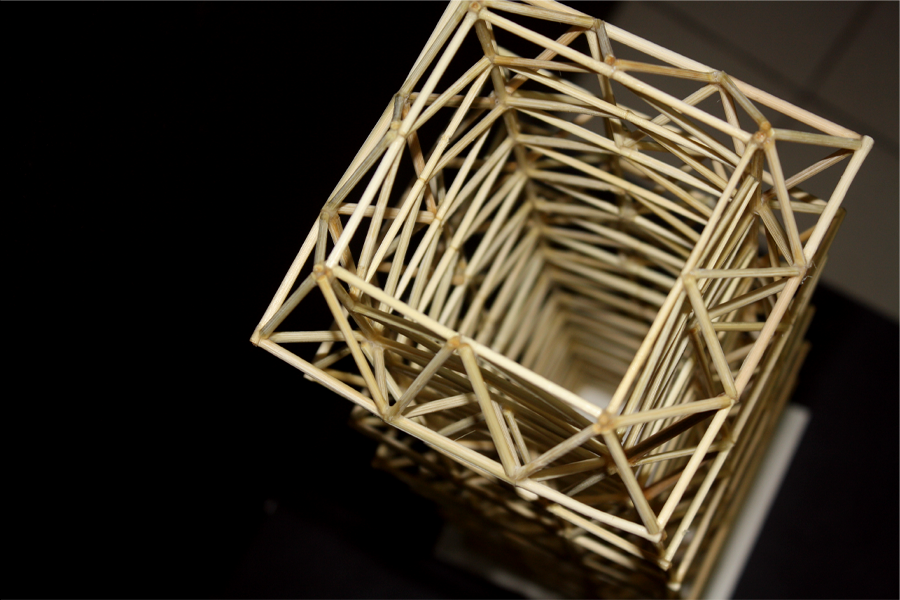
Structural development of tall buildings has been a continuously evolving process. Structural system for tall buildings have undergone dramatic changes since the decreasing practice of the conventional rigid frames in the 1960s; such changes in the structural form and organization of tall buildings were necessitated by the emerging architectural trends in design in conjunction with the economic demands and technological developments in the realms of rational structural analysis.

The primary structural skeleton of a tall building can be visualized as a vertical cantilever beam with its base fixed in the ground. The structure has to carry the vertical gravity loads and the lateral wind and earthquake loads. Gravity loads are caused by dead and live loads. Lateral loads tend to snap the building or threaten the structure to fall down. The building must therefore have adequate shear and bending resistance and must not lose its vertical-load carrying capability.

This project of designing structural formwork involved students as a preparation for the high-rise project design; students here built a scaled model of the structure with the help of a specified structural member. The structural strength was judged by field test, which proved its capability of taking compressive and cantilever loads.

While working on the project, students prioritized two aspects mainly: aesthetical beauty and structural strength. Structural aspect involved actual load test and the number of structural members used. Aesthetical aspect involved all usual criteria such as composition and proportion of structural members, solid-void relations, innovation etc. The end goal was to use minimum number of structural members and to support higher load.
Designboom
Decoding Asian Urbanism
DeCoding Asian Urbanism explores those urban interventions that are crucial in shaping the physical and spatial environment of the Asian city. The book showcases interventions that are innovative and transformational in their ability to revitalize, renew and transform the urban environment. Through appropriate interventions in their evolving trajectories, the revitalization of our cities will embrace the vast majority of its citizens to benefit from the wide range of dynamics at these strategic global nodes.
Winners Announced in ‘Urban Oasis’ Student Competition
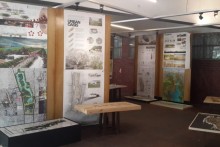
The winners of student Idea competition ‘Creating an Urban Oasis’ have been announced. The aim of the competition was to bring out visionary design proposals appropriate for the existing 415 acres site of Tejgaon Old Airport situated in the heart of Dhaka Mega cities. The competition was organized by BUET Alumni Association in collaboration with IAB, IEB, BIP.
A number of multidisciplinary teams with students from Architecture, planning and engineering of different universities all around Bangladesh has been participated in the competition. The award ceremony held in the premises of BUET Architecture department on a very eventful day of 26 February. Honorable Vice Chancellor of BUET Professor Khaleda Ekram chaired the program as a chief guest. The distinguished Jury member Prof. Dr. Jamilur Reza Choudhury, Architect Shah Alam Zahiruddin, Prof. Nazrul Islam, Prof. Abdullah Abu Sayeed, Architect Rabiul Husain, Prof. Dr. Sarwar Jahan, Prof. Abul Barq Alvi, Prof. Dr. Mujibur Rahman were also present in the occasion.
The first prize goes to the team of Been Sayed Bakhti, Ahmed Yusuf Ibn Kabir Khan, Sadia Humayra Mounata (Architecture), Suvodip Singha (Urban and Regional Planning), Shamima Nasrin (Civil Engineering) from BUET.
Second prize goes to the team of Emran Hossain Suman, Mukti Ara Zaman, Md. Ismile , Sardar Kamal Hossain (Architecture, Bangladesh University), Muhammad Abul Khayer Chishty (Architecture, UAP), Md. Rashed Majumder (URP, BUET) , C M Ehata Shamul Enam (Civil Engineering, WUB).
Third prize goes to the team of Hasib Sarowar, Merazul Islam Bhuyan, Sk. Hossan Al-Tanbin, Jati Mallick, Azima Tabasum (Architecture), Al-Ferdous Ahmed(URP), Md. Hossenuzzaman (Civil Engineering, KUET)from Khulna University.
Visualizing the Future of the City: What will your city look like in 2065?
Cities throughout the world are facing unprecedented changes and the United Nations predicts that by 2050 nearly 70 percent of the world’s population will be urban. We want to know how you think your city will respond to such issues as the pressures of population growth, the impact of climate change and developments in technology.
JUDGING CRITERIA
Entries will be assessed anonymously on the way in which they reflect an understanding of the issues being faced by cities in the future and by the way in which they engage the viewer. They should be imaginative and provocative but grounded in reality and not the work of science fiction.
Your submission will be assessed against the following criteria:
- The extent to which the submission demonstrates a depth of understanding of the issues facing cities in the future
- The extent to which the submission reflects an imaginative response to the challenges and opportunities to be anticipated.
- The extent to which the submission captures issues that are relevant to the city which is being represented
- The extent to which the submission provokes a response from the viewer and encourages them to reflect on the underlying issues.
- The strength of the imagery, the power of the narrative and the clarity of the overall presentation
ELIGIBILITY
The competition is open to students of International Schools of Architecture and your submission should be accompanied by a letter from your university on headed paper.