Echoes of the Estuary: A Tourism Center at Hatiya Dwip

World Environment Day 2026

Urban [Re]Stitch

Coordinated Complex of Public Libraries and National Museum at Shahbag | DCON CUBE JV

Through placemaking we can collectively shape our public realm to maximize shared value. Placemaking facilitates creative patterns of activities and connections in terms of cultural, social and ecological that defines a place and supports its ongoing evolution. The main goal of the proposed design is to create a place that has both a strong sense of community and a comfortable image for all aged people, as well as a setting, activities and uses that collectively add up to something more than the sum of its often simple parts by celebrating the institution of life through democratic participation of the entire city.

When understanding the concept of ‘institution of life’, the first question that derives is ‘what does a library and a museum do?’ Such institution contributes to the society and spread the light of knowledge among people of all age. This enlighten the society through its intellectual attributes which as a whole becomes the institution of life.

Proposed Masterplan ( at Plaza level) © DCON CUBE JV


© DCON CUBE JV
© DCON CUBE JV
© DCON CUBE JV
© DCON CUBE JV
© DCON CUBE JV
© DCON CUBE JV

Shahbag as a public place  has historical, cultural and political significance. The national museum and public library are located at the gateway of this place. So, in the proposal, spatial democracy has been envisaged by providing easy accessibility and freedom of movement through spaces and their connections. Most importantly, the project is designed  to create a multi-scalar, harmonious relationship within the site (between the library and museum buildings) , then with the local place and finally with the entire city and its people.

The existing museum  stands as a monumental icon of the city as well as of the nation. While developing a vision for co-ordinated complex, the challenge was to add new built forms for public library and archival functions  around the museum  block without compromising the monumental nature of the project.

© DCON CUBE JV
© DCON CUBE JV
© DCON CUBE JV
© DCON CUBE JV
Water court © DCON CUBE JV


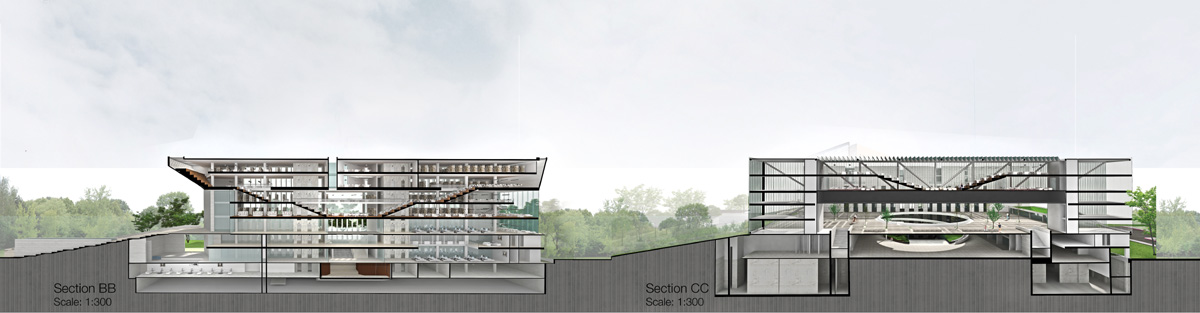
The site originally has the existing museum located at the north. The structure of the museum is kept as it is;  instead the functions of the central court are being relocated to enhance the quality of space. An elongated library building has been placed at the south of the site with the ventilation and perforation to achieve maximum daylights and air in order to serve the required functions. The plaza and the open space connects to the museum that floats on a water body to which the annex building is connected. The annex building is functioning as storage facility for the complex.  The idea to place the annex building to the west is to cut down the maximum heat from west. Large void has been inserted in the annex building in such a manner to ensure the north south ventilation through the void. The annex and museum has been fused with large water body and amphitheatre with a auditorium beneath.

Open spaces connecting one built form to another provide more breathing spaces and  visual connectivity, hence ensure better indoor-outdoor relationship. Large slope of green has been introduced with the city face to create a smooth and flowing landscape which may serve the user for relaxing and casual gathering. Thus it offers a soft and lively urban public space.

The central plaza © DCON CUBE JV
© DCON CUBE JV
© DCON CUBE JV
Library building facing the central plaza © DCON CUBE JV
Circular court in the central plaza © DCON CUBE JV


Plaza as a central element: A central plaza connecting the library and museum buildings holds a central court where people can gather. This is a space for celebrations where social and intellectual exchanges occur and cultures mix takes place.

Cultural corridor: This co-ordinated complex  will host  cultural activities that take place in this area such as Pohela boishakh, Boshonto boron, FIlm festival, Boi mela and many more. It will become the stage for celebrating urban cultural life, simultaneously perform as a focal point of the central cultural hub for the nation.

Linkage with surroundings:. The permeable edge of the complex  provides visual and physical access for the pedestrian, hence encourage public interaction within the site. Its linkage with the surrounding important places such as Dhaka University Campus, Museum of independence, Bangla Academy has created an unique opportunity for the place to become an extended platform for sharing the cultural and intellectual ideas.
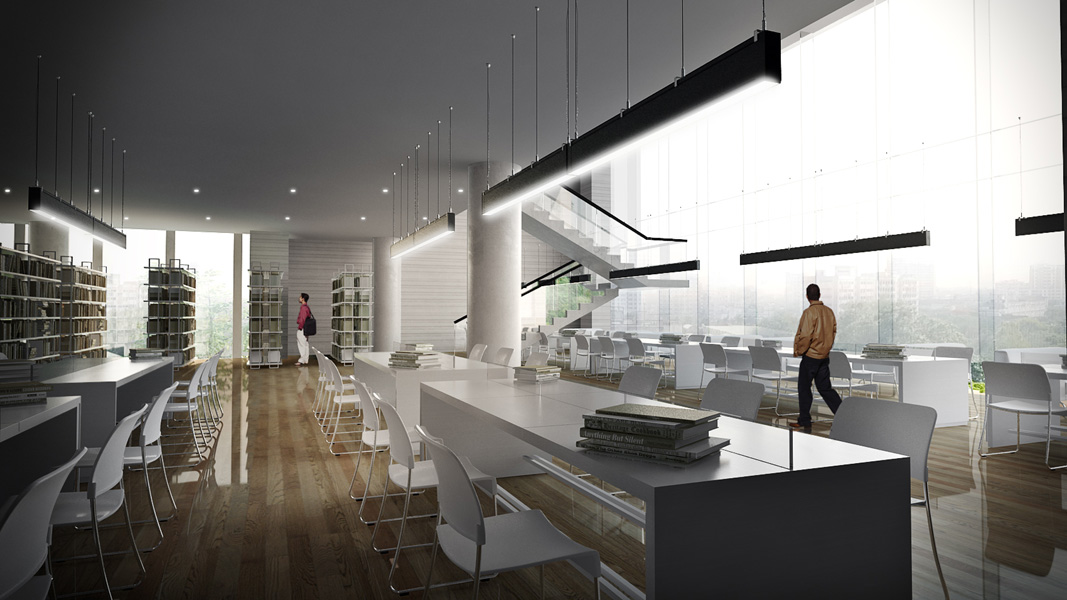
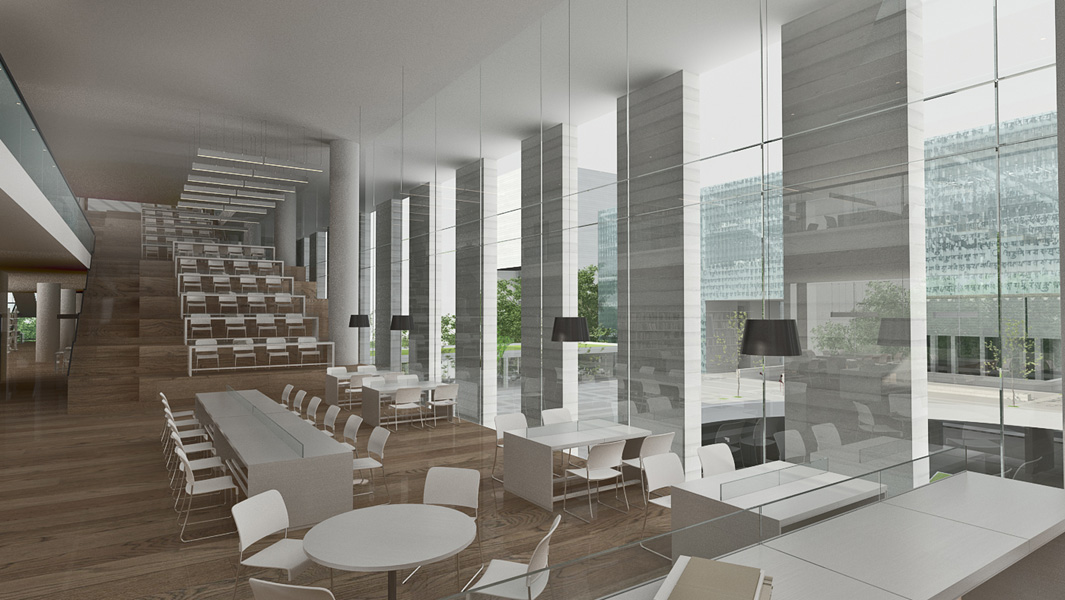
Interior of the public library © DCON CUBE JV
© DCON CUBE JV
© DCON CUBE JV
e-library © DCON CUBE JV

Reincarnation of the rural lifestyle: The circular court in the central plaza is a metaphor of rural gathering place surrounding a large banyan tree. Functionally this works as a place for public events and social gathering .

Interpretation of the riverine territory:  The use of water in the design is to portray the riverine territory of Bangladesh which adds to the environmental value of the site. This water court serves to minimize the heat level by creating a micro-climate.

House of multi-disciplinary events: The outdoor spaces play a pivotal role in serving the locality and its people by hosting multi-events such as, exhibitions, mela, haat and other forms of cultural activities.

Layering of user realm: In the design, the ground layer is used for vehicular movement, parking and administrative offices. The pedestrian movements are in two different layers which do not allow the functions to overlap. The first floor has been dedicated to the plaza which united the built forms and transformed it into a public gathering and sharing spaces.

Museum central lobby © DCON CUBE JV
 © DCON CUBE JV
© DCON CUBE JV
Museum gallery © DCON CUBE JV
© DCON CUBE JV
© DCON CUBE JV


Effective placemaking and identity design happens in collaboration with the people who live in, work in or use the space. At its best, it is a transformative design process that inspires people to create and improve the places where they live, work, learn, exchange, play, and gather. In conclusion, the main motto of the design is to bring people and the city under one platform to celebrate the ‘institution of life’ which is rooted in the culture and heritage of Bangladesh.


Project credit:

Design

Khandaker Ashifuzzaman, Md. Shakhawat Hossain, Arif-uz-zaman

Team leader

Abu Anas Faisal

Design Team

Md. Sharifuzzaman, Ahmed Firoz Ul Hoque, Md. Rakibul Alam

Design Associates

Onie Khandaker, Imran Hasan, Anika Tabassum, Kazi Asadullaj Al Emran, Niloy Nath, Md. Farzad Ghani Azmi, Rakesh Sharma, Usama Ibn Anwar, MH Masud, Sajjat Hossain

Visualization & Post production

Arif-uz-zaman


| Image gallery |

  • CC_DPL_NM_01
  • CC_DPL_NM_04
  • CC_DPL_NM_06
  • CC_DPL_NM_09
  • CC_DPL_NM_14
  • CC_DPL_NM_10
  • CC_DPL_NM_18
  • CC_DPL_NM_DWG_06
  • CC_DPL_NM_DWG_03
  • CC_DPL_NM_DWG_04
  • CC_DPL_NM_DWG_05
  • CC_DPL_NM_DWG_01

CUET hosts lecture by Architect Foyez Ullah

| Sanjida Hasan |

30th of November, 11.30am. Department of Architecture, CUET, was exalted by the presence of one of the preeminent architects of Bangladesh, Ar. Mohammad Foyez Ullah and his prudent conversation on ‘Theory Vis-A-Vis Practice’, based on the relation of theory and its application in professional field. The seminar was coordinated by Assistant Professor, Ar. Sajal Chowdhury and Lecturer Ar. Amit Imtiaz at the presence of  Dean and Head of the department, CUET. Honorable VC of CUET Prof. Dr. Mohammad Rafiqul Alam was the chief  guest of the seminar.

Ar. Foyez Ullah, former academician in BUET, started his professional life as the co-founder of Vistara Architects and eventually he grew his unique ideology and established Volume Zero Ltd. as an individual entity.

He drew his inspirations from Louis I. Kahn, F. L. Wright, Le Corbusier, Tadao Ando, Shamsul Wares, Muzharul Islam etc. He expressed how deeply Ar. Louis I. Kahn has influenced his work through his several quotes and explained them easily to the students to perceive. While explaining the name of his firm ‘Volume Zero Ltd.’ he referred to Kahn saying; “Go back to the beginning”, Exploring and discovering the phase of nothingness is the motto of the firm.

Photo courtesy: Dept of Architecture , CUET
Hand-drafted thesis portfolio by architect Foyez Ullah

Ar. Mohammad Foyez Ullah directed the discussion over the dilemma of theory and its application and strived for its answers in professional practice. His design philosophy is influenced by Sullivan-“Form follows Function” in some extent. Through the years he has developed a flexible, context oriented, modernist work style. ” Theory is abstracted practice, and practice is applied theory“, said Ar. Foyez. He displayed his student projects and portfolio and inspired students to take advantage of hand-drawing to convey emotions in design but not to ignore the blessings of technology. He has also exhibited some of his projects from the time of Vistaara Architects and Volumezero Limited as well. He explained how architects can work in collaboration with professionals of every department, while sustaining their individuality. Some of his renowned works are Bashundhara City Shopping Mall, GP House, Simpletree Anarkali, Akij House, International Convention Centre Bashundhara etc.

He has started the practice of sustainability through energy efficiency, waste water management and rainwater harvesting etc. He shared his views about sustainability through design and materialism in his projects, such as country’s First LEED Gold certified commercial  building ‘Simpletree Anarkali’ project at Gulshan Avenue.

He conducted a very informative question/answer session and summed up the seminar by quoting from Kahn, ” Form is what, Design is how. “

Award receiving from honorable Vice Chancellor of CUET
Ar. Foyez Ullah with participants | Photo courtesy: Dept of Architecture , CUET

He was awarded a crest by the honorable VC of CUET, who thanked him for his presence and valuable speech. Ar. Foyez Ullah expressed his gratitude to the audience for their patience and active co-operation. After a photo session , Coordinator, Ar. Amit Imtiaz thanked the audience for their effort, enthusiasm and hard work to make this seminar a success.


Sanjida Hasan is the student at Dept. of Architecture, CUET.

Photo Credit : Farhan Ishrak Shoumo, Kazi Fahim Nasir, Sheikh Fahim Shahariar Shuvo​

Vertical Village Habitat | Pratt Institute

The ‘Vertical Village Habitat’ is a conceptual supposition addressing the issues of urban density and informality. Conceived as a high-rise microcosm of the city, the mega-structure continuously evolves incrementally to accommodate, shelter and sustain. Verticality was the outcome after considering the notions of the informal legitimacy, and the tension of their footing, not only on the ground, but in their connection to the city as a whole.


The notions of informality and the conditions in which people are forced to exist is a testament to human will. What is considered basic human rights, such as access to food, water, adequate shelter, and so forth is a fantasy in the minds of those living well below the poverty line.

The issues facing the world now and imminently in the coming years will greatly revolve around providing for the growing populations globally, and specifically in urban centers. As people flock en masse to the cities, the infrastructure of what can be supported will be stretched ever thin, especially in those of developing nations, already on the brink of ruin. Record says, 130 people move to urban areas every minute; 1.5 million per week; 170 million per year. In 2007, 1 in 6 people lived in informal settlements and it’s predicted to reach 1 in 4, or about 2 billion people, by 2030 and by 2050 the informal population may be as high as 3 billion, approximately 1 in every 3 people. At these rates, this begs the question of the notion of what is informal. When a majority of not just the city, but the world, lives informal, does it then become, of sorts, the new formal?

Bangladesh is set to be amongst the ‘Top 3 Fastest Growing Economies Globally’ through to 2050, and as the economy of the nation prospers, overall propelling the people forward, the socio-economic disparity is somehow widening at an exponential rate and yet, not globally isolated. Similar social boundaries can be seen all around the world, in cities like New Mexico, Nairobi, Johannesburg, etc. This is clearly seen in a visually striking, and unsettling photo series ‘Unequal Scenes’ by Johnny Miller.

Unequal Scene: extreme poverty living on the doorstep of privilege | source: Google earth
Korail slum, Dhaka
Korail slum, Dhaka


Dhaka is a city of over 17 million people, and grows at an hourly rate of an additional 48 people. That’s about 1150 new faces daily. Already an approximate 50-60% of the city’s population live informally, in dilapidated slums, where conditions are terrible, unhygienic and tightly packed. Slum inhabitants continue to live under the threat of eviction, making use of the most basic building materials such as bamboo and corrugated metal sheeting.

The project site is at Korail-the largest slum in the capital Dhaka. The Korail slum covers an area of approximately 150 acres, on encroached government land and houses nearly 200,000 people. It is adjacent to one of the most posh neighborhoods in the city, but located and divided from it by a lake. The stark disparity in its proximity and identity is staggering, and has always led to ponder this closeness. Is it a sort of symbiotic relationship? It’s true, many of the people living in the informal settlements of Korail are employed in the posher parts, but how is that an area, whose land value is so extremely high, and be so close the largest slum in Dhaka? Surprisingly, in a recent study, it was found that the price per square foot in Korail was more expensive than that of the adjacent posh neighborhood of Gulshan even though it lacks the basic civic amenities such as access to clean water, electricity, sanitation, gas, etc.

There are very small roads within Korail, along which are numerous shops and markets. Typically, the housing units can be found on the inner zones, behind these roads. Upon mapping these commercial nodes of interest, contour maps were developed to understand and identify points of high intensity, and the specific site within the slum was chosen accordingly.

 © Amer Abdal Habib
© Amer Abdal Habib
© Amer Abdal Habib
© Amer Abdal Habib
© Amer Abdal Habib
© Amer Abdal Habib
© Amer Abdal Habib
© Amer Abdal Habib


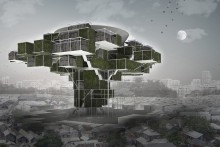
Beyond just the site itself, the design called for an intervention that could also give back to the city at large and lend strength to their hopes of legitimacy. People living informally exist within a strange grey zone, ideologically barely touching the ground, apart from the system the city. Temporality becomes a way of life and a tension exists in their footing. For this reason, verticality was considered. Further to that, the design looks to invert the current trend of “greening” up architecture by the superficial planting of trees along the façade, and to instead create a tree, of sorts, with the housing units embedded in its branches.

People's growth © Amer Abdal Habib
People’s growth © Amer Abdal Habib
© Amer Abdal Habib
© Amer Abdal Habib
© Amer Abdal Habib
© Amer Abdal Habib
© Amer Abdal Habib
© Amer Abdal Habib


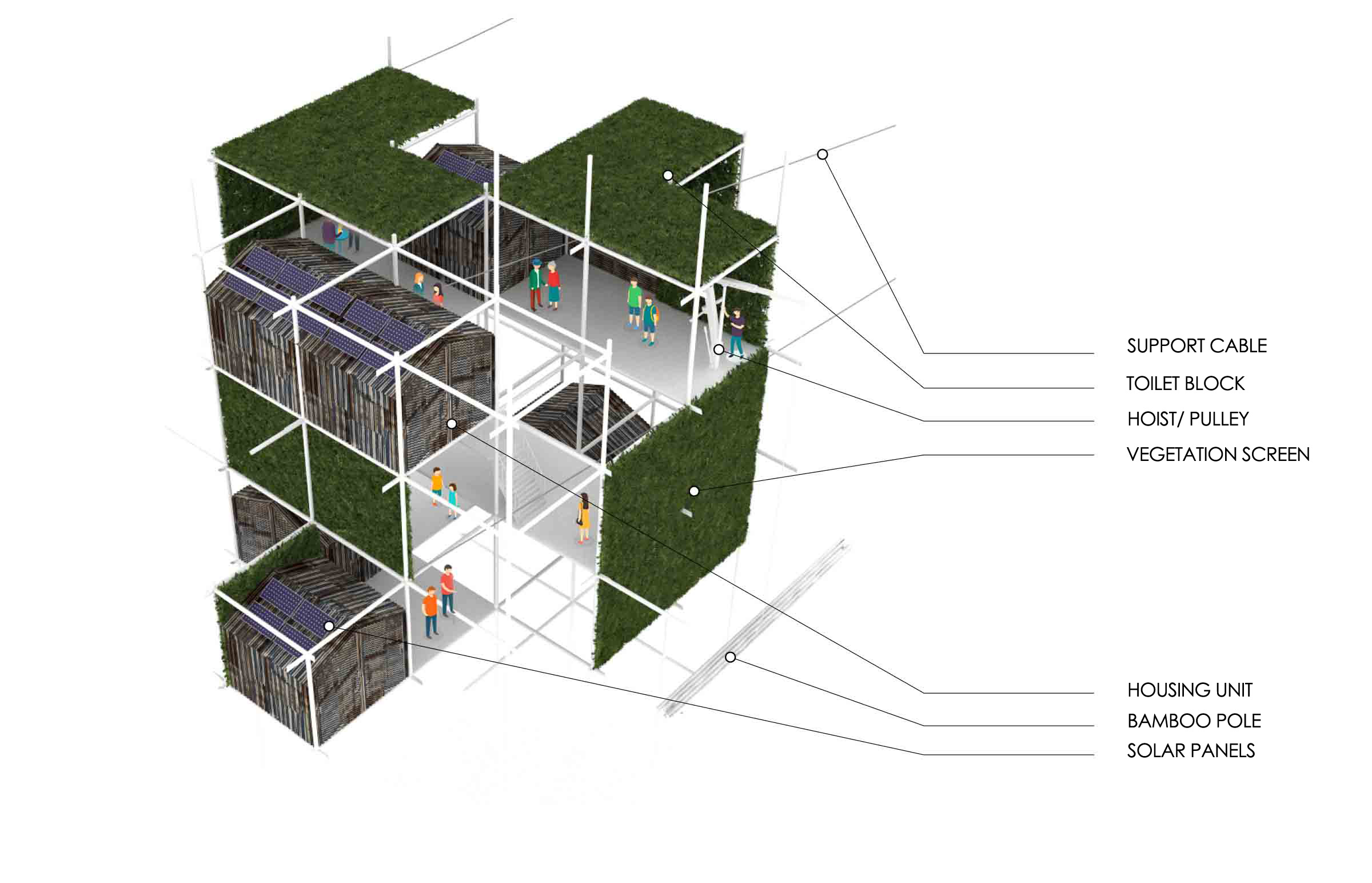
Housing is an expensive investment, for any demographic, so taking example from Aravena’s concepts of incremental housing, the people of Korail slum will build upward using materials they are familiar with, and will feel comfortable using such as bamboo poles and corrugated metal sheeting.

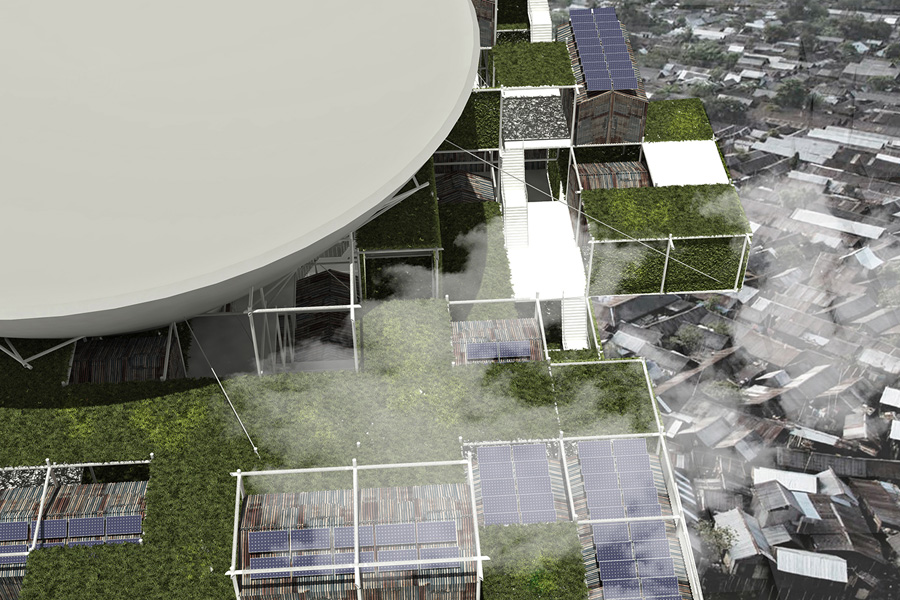
However, without certain interventions from a higher such authority or investment, questions of verticality bring about questions of structure and added cost. The government often builds water tanks to supply surrounding areas with water. Stations are usually set up at the base the tanks to pump water up, which then disseminate via gravity to specific zones. At the eye of one of the intensity zones, it is proposed that the government would construct a water tower, and thus, around which, the surrounding housing units could then shift upward, hugging and taking support from the structure. Like a temporary scaffolding of bamboo and corrugated metal sheeting, the village would grow upward incrementally.

Informal settlements are like microcosms of the city that surround them, and Dhaka being already one of the densest cities in the world, results in a very vibrant myriad of spaces in Korail. The Vertical Village Habitat would thus respect this characteristic of heterogeneity and combine not just home dwellings, but also shops, schools, mosques, hair salons, tailor shops, and so forth.

© Amer Abdal Habib
© Amer Abdal Habib
© Amer Abdal Habib
© Amer Abdal Habib


Removed from the system, and never quite a part of the city’s economics, the habitat strives to be self-sufficient, not only harvesting rainwater from the water tower’s top surface, but also producing electrical power through solar panels as well as growing their own fruits and vegetables via a system of vertical gardening. The plants will not only provide sustenance, but also give back to the city by reducing the amount of polluting in the air, maybe in hopes of lending some legitimacy to their existence.

| Image Gallery |

  • verticl village habitat_07
  • verticl village habitat_10
  • verticl village habitat_09
  • verticl village habitat_08
  • verticl village habitat_06
  • verticl village habitat_05
  • verticl village habitat_01
  • verticl village habitat_feature
  • verticl village habitat_03
  • verticl village habitat_02

School of Visual Arts Tower | Miami University

This is the 2nd prize winning entry of AIA OHIO STUDENT DESIGN AWARD 2017

| From the submission |

The School of Visual Arts (SVA) is a private New York City based ‘for-profit’ art & design school. The school’s curriculum for higher education serves ‘art & design’ oriented students who attend undergraduate & graduate level classes. The school also provides continuing education programs and sponsors art-oriented special events.  Centered in lower Manhattan, SVA’s urban campus stretches the entire length of the 23rd street corridor, one of the City’s main east-west thoroughfares. SVA building will cover 700 -800 Students, student classrooms, galleries, theaters, and dorms. Essentially, these buildings / properties need to stand-alone with the spirit of SVA’s educational excellence as their common bond. How to connect and unify this diverse arrangement in a single building is a constant design challenge.

© Mukimul Islam Khan | Miami University

Design Concept:
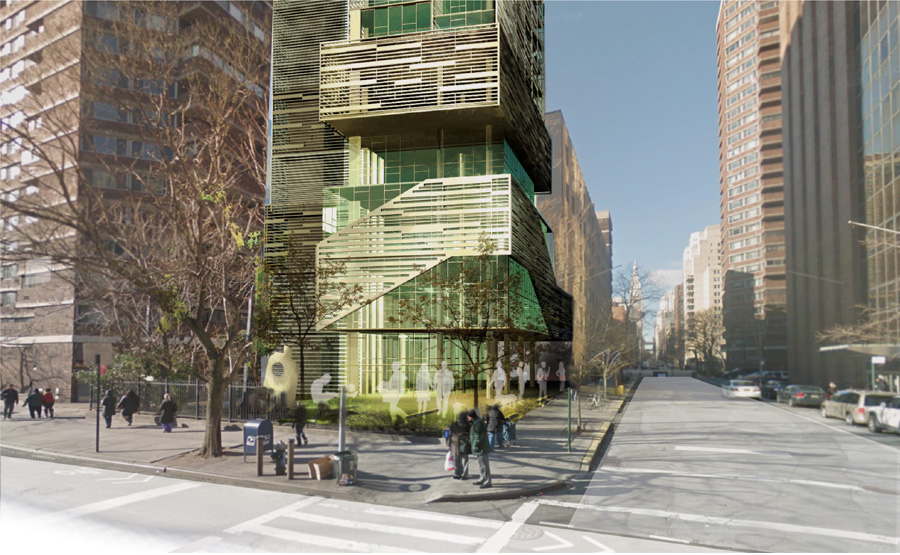
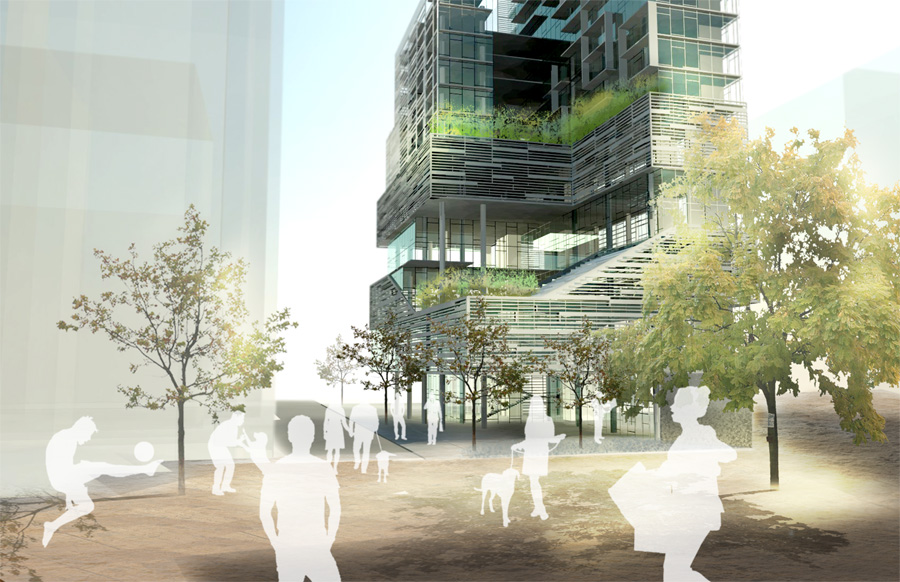
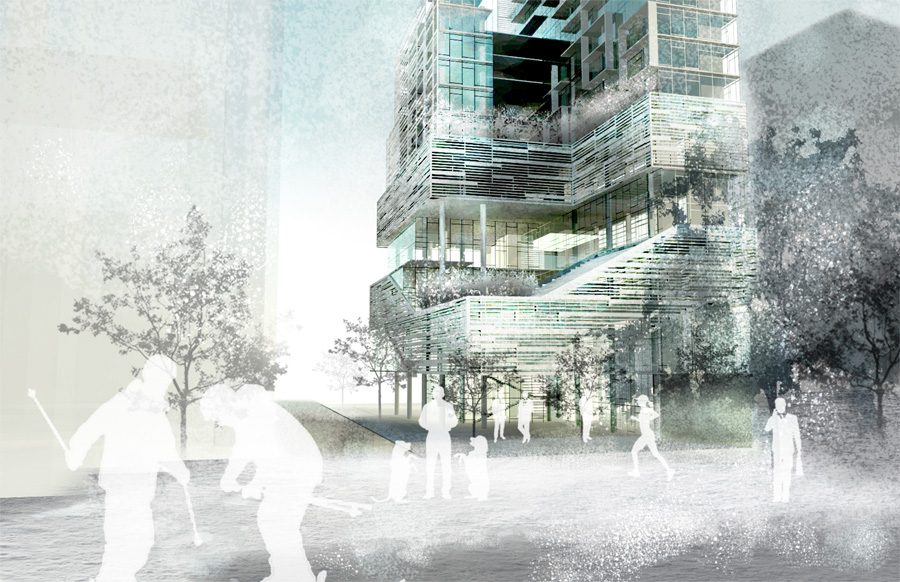
The fundamental concern of this project is not to add another isolated High-rise, but rather to address the interactive street life of Manhattan, and provide a vibrant identity for SVA campus. The site holds 50 years of academic memory and spatial connection of people and built environment. The notion of the project is to transform this relationship into the vertical structure to add another layer of continuation of the memory, diversity, and cultural interaction of future students. The building is articulated based on layers of interactive spaces, as creativity is enhanced through intuitive imagination and sharing. Spaces are programmed and planned to provide external connection through series of vertically stacked atrium and balconies; The transformable building screen is responsive to solar radiation and also represents the emerging symbol of SVA students on Manhattan cityscape

SVA
© Mukimul Islam Khan | Miami University
SVA
SVA in Summer © Mukimul Islam Khan | Miami University
SVA
SVA in Winter © Mukimul Islam Khan | Miami University

Design Development:
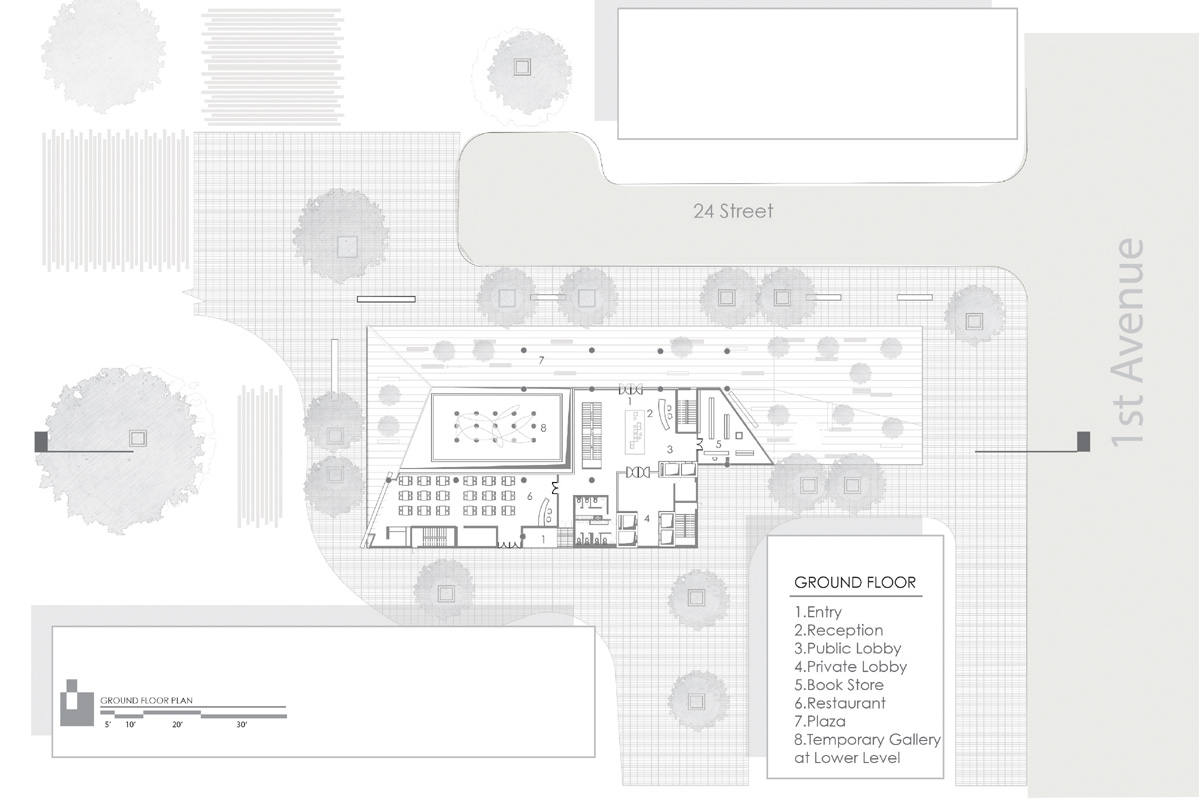
SVA is a multidisciplinary college of art and design institute. The project deals with two contradictory issues one of which is the space requirements of students and the economic aspects of the organization. Therefore the design is highly concerned to the function and space utilization. The streets of Manhattan are always crowded and the site holds more than 50 years of memory. The new SVA academic building will serve as both dormitory and academic purpose as an addition of old campus for future students. The basement and the ground floor are designed in a way to address the public access and to draw them in to the building. Large open Plaza is dedicated to students and public movements as the continuation of old campus.

SVA
© Mukimul Islam Khan | Miami University
visual art school_DD02
© Mukimul Islam Khan | Miami University
SVA
© Mukimul Islam Khan | Miami University

Space Articulation:
The whole space is layered into three levels of functions, public access, semi public access and private space. The Building has urban fabric around its outside elevation and the in middle the portion the building is introverted to bring more personal space for students. Therefore student will get the feelings of their own campus building. The building is arranged with vertical semi open terraces for student’s works. It also helps to have the indoor outdoors relationship throughout the building.

SVA
© Mukimul Islam Khan | Miami University
SVA
© Mukimul Islam Khan | Miami University

Vertical Courts are placed in different level to create interactive spaces for students. These spaces are similar to urban void with in a building. It helps to create introverted spaces for students within the building. The sculpture garden is placed in the 6th floor where the dorm level is placed. The space is acting as the gathering space and open work place to enhance sharing. This place also helps to bring the light inside of the buildings and maintain the indoor-outdoor relationship.

SVA
© Mukimul Islam Khan | Miami University
SVA
© Mukimul Islam Khan | Miami University


The concept of the dorms is derived from the spatial and internal relation of traditional houses. The dorms are arranged in module and they can be arranged horizontally and vertically. Four-occupant dorm room has a internal stair that links two levels.

Building Performance & Strategies:
The Aluminum framed double layer curtain wall is an automated transformable screen. The concept of the screen is developed based on the solar radiation. The southeast side of the screen has horizontal louvers and it transformed its width to length in a way that it gets more vertical in size towards south-west corner. The user of the room will control the screen of his room, and the variation movement of the screen will also create an impression of living building.

SVA
© Mukimul Islam Khan | Miami University

Strategies are considered for overall building structure, Rain and waste water management, and renewable energy. Building Utilities (Water pipe, Service pipe line) are placed along with the screen as a solution of insulation wall by using natural heat. It will help to reduce the demand of HVAC system.


CONTEXT contributing editor : Md Tarek Morad, Architect & Assistant Professor. 

| Image gallery |
  • visual art school_feature
  • visual art school_08
  • visual art school_11
  • visual art school_12
  • visual art school_DD01
  • visual art school_DD02
  • visual art school_09
  • visual art school_14
  • visual art school_05
  • visual art school_04
  • visual art school_03
  • visual art school_01
  • visual art school_02
  • visual art school_BP02
  • visual art school_BP03
  • visual art school_BP01
  • visual art school_06
  • visual art school_07

Education beyond Limitation | AIUB

As we strives for more institutions  for higher education inside the city— the vertical campus is the eventual outcome. Institutions have been forced to build taller building often compromising the spaces for social and intellectual exchanges vital to university education. The growth of small and medium scale private universities in Bangladesh  and their concentration in the capital city  has necessitated  to rethink the genre of campus architecture.

The emergence of private universities in Bangladesh began in 1992 with the enactment of a series of laws governing higher education. In last 2 decades these nongovernmental institutions have become a pervasive part of the academic landscape, capitalizing the soaring demand for higher education (Hopper, 1998). According to private university act 2010, the city campus must comprise minimum 1 acre of land. Considering this limited 1 acre land as a ‘site’, the aim of the project was to conceptualize an urban campus prototype enable to offer improved social interaction and better academic productivity  which is very critical for higher education environment.

© Ahmed Sadman Zaki | AIUB


As of 2006 there were 35  [total 40 in 2017 ] public universities and 54 [ total 95 in 2017]  private universities in whole Bangladesh whereas most of the  private universities are operating only in Dhaka city (UGC enlisted) . As calculated, 1,85,675 students ( 12% of total students who are undertaking higher education) are studying these private universities at a time and the number is growing day by  day. Many of these universities are operating on rental properties with bare minimum facilities. These temporary campuses are nothing but an amalgamation of some isolated multistoried buildings scatteredly  located in a commercial districts and beset by poor standard  educational infrastructures . However, the leading  private universities have already moved to their own campuses and  many others are on the process of shifting. There are still many lefts who are struggling to find a land for their own campus in this over saturated city. As a consequence, quality environment for higher education  currently at stake for a large number of students  pursuing graduation in those universities.

© Ahmed Sadman Zaki | AIUB


The following project seeks to find a balance between limited land resources and quality educational environment by proposing a vertical campus endowed with all the indoor and outdoor facilities. The proposed campus is a compact high-rise structure designed on a site of 1 acre – a minimum land size to establish a city campus for private university. All the functions are vertically stacked around a central core. The monolithic building block is then sculpted to curve out spaces at different levels for outdoor activities. The proposed exoskeleton structural system allows rigid framework for outside and   flexible layout for inside.

© Ahmed Sadman Zaki | AIUB


As stated by Burlge and Brase (1995), campus architecture must pay attention to enhancement of exchanges and visits among all faculty , students and staff. Apart from classrooms and other necessary facilities, the proposed prototype is composed of  programs that are most conducive to greater faculty, faculty-staff and faculty-student meeting and exchanges. Open exhibition spaces, planted terraces, outdoor workshop, free thinking carpet and city observatory are such spaces designed to minimize the fragmentation created by the floor levels , hence  contributing to community building, knowledge sharing , peer learning and scholarly collaboration on campus.


References:

Burlage, J. and Brase, W., 1995. Campus architecture that shapes behavior. Planning for Higher Education3, p.23.

Hopper, R., 1998. Emerging private universities in Bangladesh: Public enemy or ally. International Higher Education, (10).

UGC ( University Grant Commission of Bangladesh) , official website.

| Image Gallery |
  • education beyond limitation_AIUB_10
  • education beyond limitation_AIUB_07
  • education beyond limitation_AIUB_11
  • education beyond limitation_AIUB_01
  • education beyond limitation_AIUB_02
  • education beyond limitation_AIUB_09
  • Feature_education in limitation_AIUB

Modern Masterpieces in Models | Episode 1

In architecture schools, students are taught to make physical model to communicate their design ideas. It is also customary in many schools to offer a studio exercise on the Master Architects using the scale model as a vehicle to interpret their seminal works. The primary aim of such exercise is to give the students an exposure to the works of great architects by engaging them to recreate the harmonic composition of three dimensional volumes and masses. In this process of model making, students are expected to learn the rhythm of solids and voids, creation of an order and spatial hierarchy  between served and service, tectonic expression and  indoor outdoor relationship. In general,  physical models stimulate the understanding which is instantaneous and constant. It also has the ability to convey the sense of depth, dimension and texture. As Peter Zumthor explains, the model is the only way to consider the “atmosphere” of a space. Or, what we like to think of as the best way to design good vibes.

The following model photographs include studio projects form Department of Architecture at AIUB and HSTU. The project was about studying the philosophy of the Master Architects through making the physical models of their famous architecture. Along with the modern Masters and their followers,the studio assignment also includes the works of regional architects like Charles Correa and Mazharul Islam who tried to synthesis the international and modern style and establish a new vocabulary by incorporating local culture and heritage.  Some of these are National Assembly, Dhaka  by Louis I Kahn, Villa Savoye by Le Corbusier , Falling Water by Frank Lloyd Wright, Barcelona Pavilion by Mies Van DerRohe, Riva San Vitale by Mario Botta, Jawahar Kala Kendra, Jaipur by Charles Correa, Fine Arts Institute, Dhaka by Mazharul Islam.

Falling Water; Architect Frank Lloyd Wright | courtesy: Dept of Architecture, HSTU
Villa Savoye; Architect: Le Corbusier | courtesy: Dept of Architecture, AIUB
Trenton Bath House; Architect: Louis I. Kahn | Dept of Architecture, AIUB
Barcelona Pavilion; Architect: Mies Van Der Rohe | courtesy: Dept of Architecture, AIUB
Riva San Vitale; Architect: Mario Botta | courtesy: Dept of Architecture, AIUB
Jawahar Kala Kendra, Jaipur; Architect : Charles Correa
Fine Arts Institute, Dhaka; Architect: Mazharul Islam | courtesy: Dept of Architecture, HSTU


In the age of computer modelling and 3d router or CNC machine, handmade physical models are becoming a lost form of communicating design ideas. Apart from its proven effectiveness as learning and communication tools in the field of design, the physical model is far compelling than realistic render images. Such exercise of model making is likely to foster deeper understanding of the project while improving student’s tectonic skills.


Project courtesy:

  1. Dept of Architecture, Hajee Mohammad Danesh Science and Technology University ( HSTU)
  2. Studio IV, Fall 17-18 , Dept of Architecture, American International University- Bangladesh ( AIUB)

| Image Gallery |

  • Jubilee church_edited_HSTU
  • national assembly_edited
  • national assembly 2_edited

FORM.3 Architects Wins Dhaka Jail Redevelopment Competition

FORM.3 Architects and team have won the much talked about Dhaka Central Jail redevelopment competition. The competition was arranged by the Prisons Directorate, Security Services Division, Ministry of Home Affairs, GOB and Supported by Institute of Architects Bangladesh and Bangladesh Institute of Planners. A redevelopment proposal was invited for the Old Central Jail site with a wide spectrum of objectives notably to Master Plan the Old Dhaka central jail area with preservation of jail life, activity and its history, responsive place making for the communities and tourists, reflecting history and heritage of Old Dhaka, Provide a network of open space within a scheme of landscaping; the focus meant to be on redevelopment of the surrounding area including more efficient traffic pattern. The competition was officially titled as “Historic Preservation and Landscape Design of the Old Dhaka Central Jail and Redevelopment of its Surrounding Area”.

Among the 34 submissions, two of the projects were awarded 1st and 2nd while three others received commendation. Award winners are FORM.3 Architects  and R.E.D Consultant & Zero.D Consultants JV . Marina Tabassum Architects , Ayoteek and Center for Inclusive Architecture and Urbanism at BRAC University won the commendations. The 7 member jury board was comprised of prominent architects, academics, conservationist and bureaucrats.

Glimpse of the winning project | Courtesy: FORM.3 Architects

© FORM 3 Architects
© FORM 3 Architects
© FORM 3 Architects
© FORM 3 Architects
© FORM 3 Architects
© FORM 3 Architects
© FORM 3 Architects
© FORM 3 Architects
© FORM 3 Architects
© FORM 3 Architects
Winning Team_ FORM.3 Architects

At this point of celebration a spokesman from FORM. 3 Architects conveyed the massage to CONTEXT – “Old Dhaka Central Jail has passed many phases as an integral part of the history of Dhaka and has come at the verge of serving the present need. As a transition from the past history to a vibrant future, a design idea was generated that gives the experience of the significant past as well as a relief space, accommodates the vibrant urban life of old Dhaka”

For interested viewers and concerned citizen an exhibition of the projects was inaugurated on October 30th at Bangladesh Shilpakala Academy by Honorable Minister, Ministry of Home Affairs, Asaduzzaman Khan, MP, where he distributed the awards as well.

CONTEXT hopes to publish the winning projects for its audience in due course.

Other Winning Entries: 

2nd Place: R.E.D Consultant & Zero.D Consultants JV 

© R.E.D Consultant & Zero.D Consultants JV (2nd prize)

Commendation: Ayoteek

© Ayoteek (commendation)


Commendation: Center for Inclusive Architecture and Urbanism at BRAC University

© CIAU, BRACU (commendation)