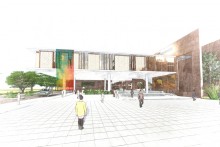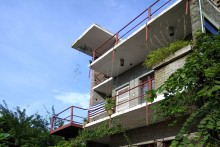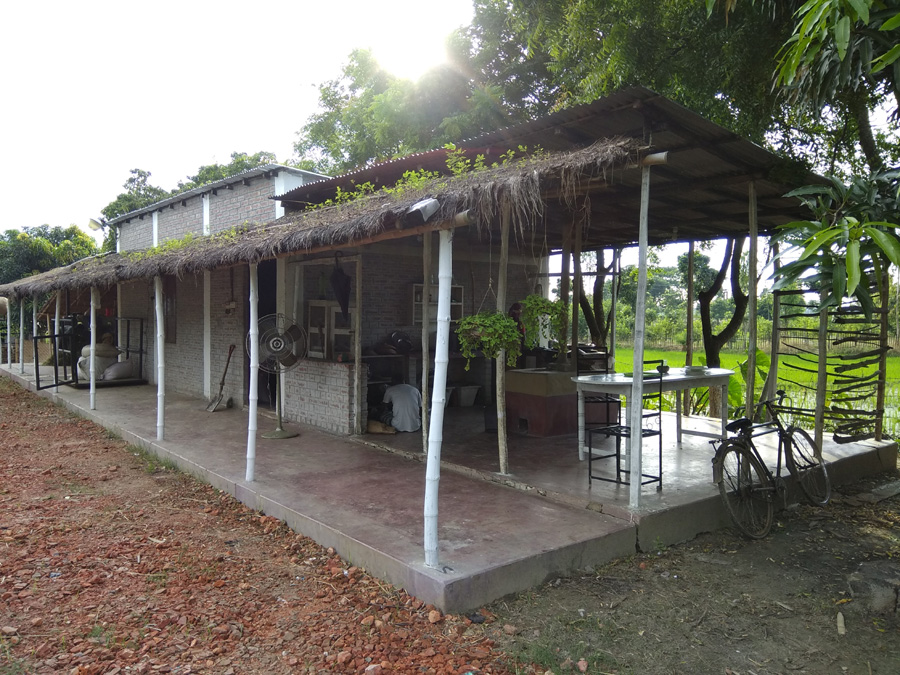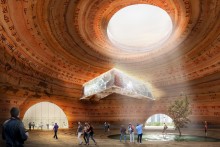
Echoes of the Estuary: A Tourism Center at Hatiya Dwip

World Environment Day 2026

Urban [Re]Stitch

THE BIG FISH | AA School of Architecture

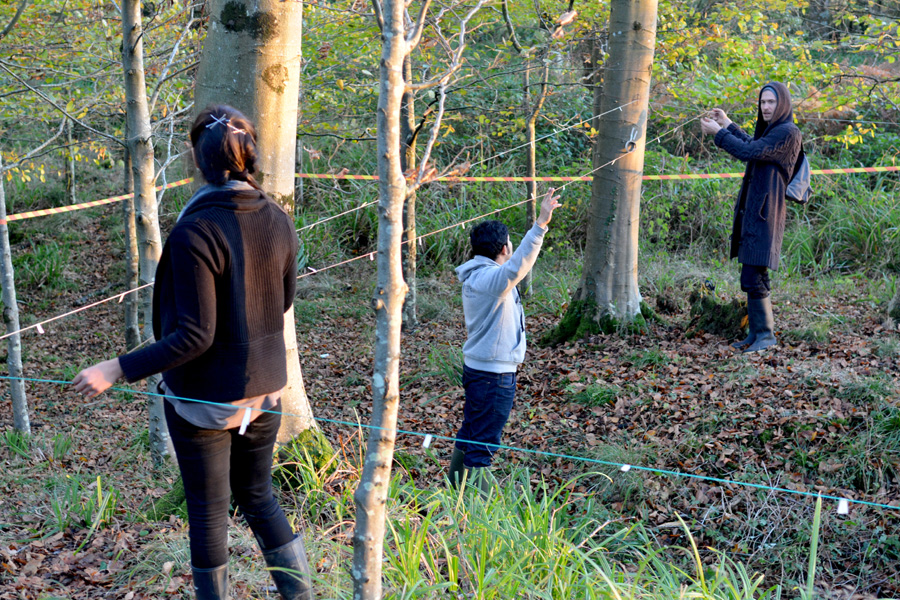
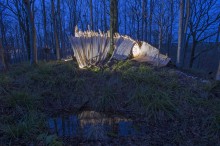
A wooden burrow has been erected by three students from London’s Architectural Association, amongst the trees of Hooke Park, England that nestles amongst the tree-trunks. This wooden shelter was designed and built as part of task on the AA Design & Make MArch 2014-15 course, which took place in that patch of woodland owned by the university in rural Dorset. Led by tutors Toby Burgess and Martin Self, the structure, named ‘Big Fish’ in reference to its shape, was created by students – Mohaimeen Islam, Swetha Vegesana and Sahil Shah during December 2014.

The brief for the project was to design and construct an inhabitable extension to an existing Hooke Park landform, to amplify existing features of that landscape and broaden the experience of the topography of that chosen site, as an attempt to test extremes of the reciprocation between designing and making. The West Dorset landscape of Hooke Park and its surroundings is characterized by a complex topography of valleys, ridges, and discrete hills. We set out to look for a site that should have potential to create a moment on the forest-pathway. After thorough explorations, a site was finally spotted, which was right at the edge of the forest, overlooking the meadows on one-side and the forest on the other. However, the main interest was a concave natural landform on the site, which was actually a seasonal pond.

Site survey | illustration by Mohaimeen Islam
Mock up | photograph by Sahil Shah
Mock-up sequence | illustation by Mohaimeen Islam

To approach with a rational design idea, we wanted to amplify, what generally goes unnoticed. Our intent was to create a built-form that instigates ‘pause’ in the journey for the passerby, to celebrate the event of discovery as they would enjoy the sun set and the landscape around. This built-form should be erected along the curved edge of the concaved water body so that it captures framed view on both the directions and also reflects the concavity of the landform. A ‘pathway curve’, was derived from our movements on site. We identified two specific trees on site to anchor our design first. We explored different ideas that would allow one to sit and observe view of the sunset and the meadows. As such we started to experiment with materials and innovative techniques to develop a method which would give us the freedom to build on-site and the flexibility to obtain the desired curvature.

Onsite construction | photograph by Sahil Shah
Onsite construction | illustration by Mohaimeen Islam

We started with ‘kerfing’ a tree trunk, with the idea that the construction technique is what drives the form of the structure. However, the material i.e. the tree trunk itself became a constraint, due to its variation in size, weight, dimensions, and round surface – which would have made the process extremely slow. Next, we tested light planks as structures, but couldn’t achieve the required curvature. Also, the planks as a system was not structurally stable, and so, we started looking at narrow sections of timber as structural members, which could act as a flexible and stable system and work in combination with the planks. From different analysis, we concluded that ‘KERFING’ was a flexible technique to bend the sections for accommodating the overall form of the structure. We initially kerfed smaller sections of wood and after getting the basic idea, we scaled it up and tried different kerfing iterations on different species of wood to understand the material and system behaviour. The depth of the ‘kerfs’ played an important factor determining the breakability. The distance between the kerfs determined the degree of bend of the sections. The depth and distance of the kerfs varied as per the dimensions of the sections. Species of wood again played a determining role in terms with the flexibility. Ash gave us the best results in this context. Hence, drawing from these conclusions we decided to combine both planks and kerfs, and test this technique by building a prototype to understand it’s stability as a structural system. While making the mock-up horizontal bracing, as a second layer, was added to the kerfed members (ribs) – firstly to lock the curvature of the kerfed members (ribs) and secondly, as a base layer for the vertical wrapping and decking with planks. From the prototype we derived the method and the process of construction on-site with a clear understanding of the fixing.

 Work progress plan | illustration by Mohaimeen Islam
Work progress plan | illustration by Mohaimeen Islam
Plan derived from construction | illustration by Mohaimeen Islam
Section |illustration by Mohaimeen Islam
Detail of site installation |illustration by Mohaimeen Islam

We started installing the kerfs from the central point, which is where the two trees were on site. They were the boundaries for this structure and a pivot point to determine the scale, volume of the structure, as we were looking at progressively opening up the structure on one side and closing the structure on the other. The structure kept on growing and the space changing – during the building process. It was interesting to see the changes in the structure and space as we added more material to it. The more we added, the more it altered our movements of working in and around the structure. The material we used was not in abundance and had limits from Architectural Association, as the school maintains a log on Hooke Park forestry management. Sourcing only the Ash trees were taking more time than expected. So, Larch and Western Red Cedar planks were used along with Ash sections to work within the time frame.

photograph by Sahil Shah
photograph by Swetha Vegesana
photograph by Valerie Bennett
Photograph by Valerie Bennett

Nevertheless, the form of the Big Fish was developed in response to the site topography. Clad with approximately 400 strips of Ash, Larch and Western Red Cedar, it forms a hideaway on the forest floor, but also integrates an outdoor bench. The form only emerged on site during its construction. A series of bendable kerfed timber ribs allowed an armature to the sculpted on site and locked into position. The final form emerged over five days in an ad-hoc process so as to maximize the inhabitants’ experience of the terrain, trees, sunsets, and views. When the passers-by first discovered this installation along the landform, they acclaimed,

“It’s like a Fish in the forest”; “A big fish next to its pond”.

54. the big fish panaroma

55. the big fish panaroma

photograph by Sahil Shah


| Image gallery |


  • for 19th Crit_09_equipment list
  • 03. site survey_sahil shah
  • 27. work flowchart_sahil shah
  • 39. the big fish_ swetha vegesana
  • 38. the big fish_sahil shah
  • Core Studio Dossier_Big Fish progress plan
  • Architectural Association School Life 2014-2015
  • Print

Architecture in Bangladesh | A look back at 2017

Farhat Afzal | CONTEXT

With an influx of exhibitions, design competitions with promising entries that ensure improvement of Dhaka’s urban fabric and noteworthy achievements by the architecture community as a whole, 2017 has undoubtedly been an eventful year. Here is a look at some of those momentous occasions.

Bengal Stream: Exhibition and publication on contemporary architecture scene of Bangladesh at Swiss Architecture Museum

bengalstream_SAM

Bengal Stream‘ an exhibition on Bangladesh’s architecture at  Swiss Architecture Museum is, perhaps, what  the year 2017 will be remembered for. With an aim to disseminate the exemplary work of  Bangladeshi architects in the world, the exhibition brings together more than 60 projects by over 40 established and emerging architects.  In addition to contemporary architecture, the exhibition is also displaying original drawings by Muzharul Islam for the first time at a venue outside of Bangladesh. Inaugurated on 1st of December,2017 the exhibition will continue till 6th of May, 2018 in Basel, Switzerland. The exhibition is  planned to travel  multiple stops before arriving back at its final destination in Dhaka in a couple of years. In addition to the exhibition, a publication of the same name by Christoph Merian Verlag was released. It includes essays by local experts Kazi Khaleed Ashraf, Saif Ul Haque and Syed Manzoorul Islam.

IAB won over China to bring ARCASIA home in 2019

source : ARCASIA
source : ARCASIA

The year also observed a landmark achievement by IAB ( Institute of Architects Bangladesh) to win over its other contender, China to bring ARCASIA home in 2019. At the 38th ARCASIA Council Meeting held on 4th November, 2017 in Kathmandu, Nepal, Bangladesh was nominated to host Forum 20 and 40th Council Meeting in 2019.

Architect Rafiq Azam Won ARCASIA and  Cityscape Global Awards, 2017

FAMILY GRAVEYARD_shatotto

In 2017, the project ‘S A Family Graveyard’ by  Md. Rafiq Azam ( SHATOTTO) won the Arcasia Awards for Architecture. The award is considered as the highest honor for an practicing architect in Asia.
Cityscape Global Awards was another noteworthy achievement by architect Azam this year. The award was given in recognition of excellence in architecture and real estate development. Azam’s residential project, titled Huda’s Skyline was named as the winner in ‘Residential – Medium to High Rise Project Award – Built’ category.

Read more >>

Bangladeshi architects  won JK CEMENT AWARD in FOCUS COUNTRY category

After winning prestigious Asia Architecture Award &  Berger Award for Excellence in Architecture in 2015, once again Archeground hit the headlines of international news media this year. Md. Jubair Hasan form Archeground was awarded as the JK Architect of the Year (Foreign Country) for the project Loom Shed for Amber Denim. Lutfullahil Majid was chosen for the Foreign Countries’ Young Architect of the Year Award for his mosque at Amber Denim Mills Ltd.

Ishtiaque Zahir Titas chosen as Elected Council member by Union of International Architects (UIA)

For the first time, an IAB member held the office bearer position in  Union of International Architects (UIA). UIA announced Ishtiaque Zahir Titas from the Institute of Architects Bangladesh (IAB) as Elected Council member for Region IV and Ehsan Khan as alternate member.

Marina Tabassum  judged the AR Emerging Architecture Awards 2017

Aga Khan Award winner and founder of MTA, Marina Tabassum judged the Architecture Review Emerging Architecture Awards (AREA) at the World Architecture Festival. The festival  took place at Berlin in November, 2017. The Awards grant early recognition to young designers and promote global design innovation and fresh approaches to architecture by emerging architects. Marina Tabassum was joined by other panel members Prof. Martyn Hook and Matthias Sauerbruch.


Alongside these international achievements, the year is also noted for events  and  competitions of national significance.  Throughout the year, architect community was actively engaged to participate in a number of open design competitions organized in cooperation with IAB.

Open Architectural Design Competition for Historic Preservation and Landscape Design of the Old Dhaka Central Jail and Redevelopment of its Surrounding Area

© FORM 3 Architects
© FORM 3 Architects

Open competition for the redevelopment of Dhaka Central Jail was a much talk about competition of the year. The Prisons Directorate, Security Services Division and Ministry of Home Affairs, Government of Bangladesh announced the competition. The competition invited participants to provide master plan of the area, and complete urban, architectural, landscape and engineering design. FORM.3 Architects and team won first place in the competition.

Read more >>

Open Architectural Design Competition for the Coordinated Complex of Department of Public Libraries (DPL) and Bangladesh National Museum

Library building facing the central plaza © DCON CUBE JV
© DCON CUBE JV

Another competition that caught the attention of architect community is  the design competition for Coordinated Complex of Department of Public Libraries and Bangladesh National Museum. The competition was hosted by Department of Public Library and Bangladesh National Museum. The winning design proposal was a joint venture of Cubeinside Design Ltd. and Dcon Design Studio.

Read more >>

UTC (Urban Thinkers Campus) Dhaka 2017

As a part of  global campaign by UN-Habitat, a 3 day event entitled UTC Dhaka 2017  kicked off on November this year. The event was Jointly organized by International Union of Architects (UIA) and Institute of Architects Bangladesh (IAB) and hosted by IAB. The event included round table discussions, base plan workshop and on site urban lab. Speakers at the round table discussions spoke on themes such as good governance and capacity building, climate, resilience and infrastructure, compact development, urban-rural linkage, place making and sense of identity. A workshop to develop town planning was moderated by an international expert and engaged multi-stakeholders’ participation. Conceived in 2014, Urban Thinkers Campus (UTC) is a model platform aims to promote sustainable urbanization through participation of stakeholders and partners and propose urban solutions in addressing urbanization challenges to urban futures.


Further to that, in 2017, on several occasions architecture student projects  stood out in the international competitions.

Bangladeshi student’s thesis project won Tamayouz International Award 2017

Contemplation Shelter © Nishat Tasnim Oyshee | UAP
© Nishat Tasnim Oyshee | UAP

Nishat Tasnim Oyshee from University of Asia Pacific was announced as the winner for Tamayouz Excellence Award 2017. Her graduation thesis project Integrated Development Proposal on an Unclaimed Genocidal Site won her the first prize, beating entries by 468 graduates from 118 universities and 42 countries. The award includes an MSc Scholarship for two years at the University Polytechnic of Milan, sponsored by the Iraqi Business Council in Jordan.

Read more >>

Honourable mention at the Symposium DRIA 2017 awarded to students of BUET

Each neighborhood chunk opens to a social shade, a larger interactive space which will act as a platform for the neighborhood
Soakable Society © Dept. of Architecture | BUET

At the 2017 Designing Resilience in Asia (DRIA) International Competition, held at National University Singapore, students of Bangladesh University of Engineering and Technology were awarded with an Honourable Mention. The competition asked for proposals for designing resilience for a vulnerable site of Indonesia. The design proposal from BUET was based on a concept of “Soakable Society”, where opportunities were created for urban resiliency, socio-economic resiliency, energy generation etc. which would lead to making the society self-sufficient . The team included the following students from batch 2012 – Pankaj Nath Joy, Tanzim Rochana, Shehran Parvez Seyan, Sangeeta Bhattacharjee, Sarah Shehnaz Bipasha and Mahua Chakma.

Read more >>

Student projects from AIUB and BUET got citation award in ACA’S 5th International Design Competition

render 1
© Shafaiet Mahmud | AIUB

Thesis projects by students from American International University – Bangladesh (AIUB) and Bangladesh University of Engineering and Technology (BUET) received citations in the Student Category at Aditya School of Architecture’s (ACA) 5th International Design Competition, in Mumbai, India. S.M. Shafaiet Mahmud from AIUB and Tasneem Wahed and Atiya Nusrat from BUET were the students behind the commendable projects that were honoured with the citation.

Most Visited Student Projects [ 2015-2017 ]

#1 JUM CULTURAL COMPLEX, Rangamati | Jimi Chakma (BUET)

Reviewed by:

Architect Mohiul Motasim | Toronto, Canada

Jum Cultural Complex, a thesis project by Jimi Chakma presented at BUET 2014, is a celebration of the cultural identity of Jumma people and their unique way of life. It tells the story of the diminishing society of the indigenous people of Jumma, the struggle preserving their lifestyle, livelihood, language and identity and an answer to their salvation, an initiation to rejuvenate and re-establish the sense of well-being and secure the cultural identity of Jumma people under an unified cultural complex of their own. The proposed site is located at Manikchari, Rangamati, a hilly area surrounded by natural settings and views, ideal for ‘Jumchash’ which is a local cultivation practice integral to the ‘Jum’culture, a livelihood inseparable from their lifestyle, food habit, festival, dance and music. The designer successfully addresses the need and vision for the local people by carefully organizing the cultural centre along a linear path on the hilly site overlooking the natural view and cultivation land and creates a transitional destination which is common to this local area in the form of bazar and social gathering place. Traditional building technology is being masterfully incorporated with a hint of modern innovation and passive design in the complex and promotes local materials like, bamboo, wood and sun grass. The whole complex is a cluster of smaller structures placed along the path which follows the natural topography and the paddy field and centered around the circular multipurpose hall “the Genhuli Hall” attached to a waterbody providing gathering places for the cultural activities. Typical buildings follow traditional elevated platform construction method with open deck and sloped roof providing openness, green solution and minimum footprint on the natural settings. The overall project is a well-crafted articulation of the designer who truly feels by heart the voices of the “Jumma people” and is an example of true innovation utilizing indigenous design technique and methodology for the survival and preservation of indigenous people and their cultural identity.

Jum Cultural Complex © Jimi Chakma

Read more >>


#2 VERTICAL SCHOOL : REIMAGINING LEARNING SPACE | Mukimul Islam Khan (BUET)

Reviewed by:

Architect Rashed Bhuyan | PhD, CASA, Singapore

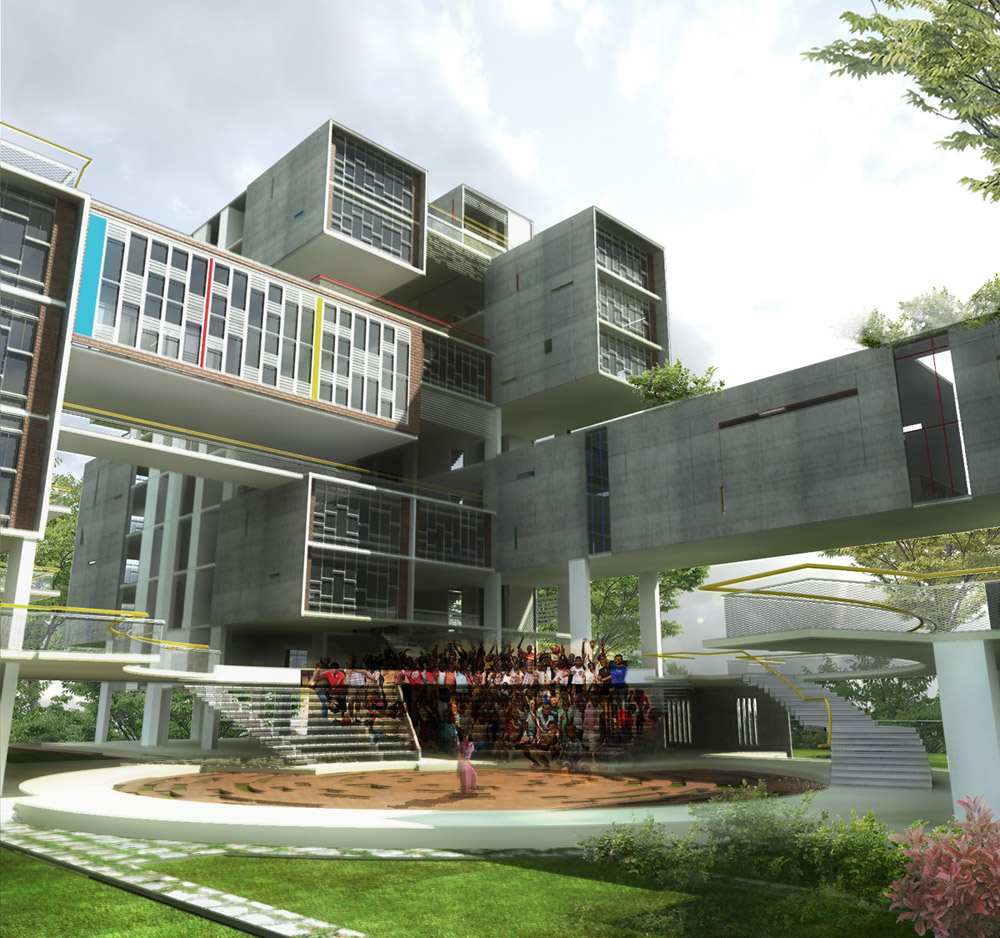
Vertical School is an excellent design work. The design outstands in its formal expression, functional clarity, orientation of masses, zoning, indoor-outdoor relationships, climatic considerations and site-analysis. Although critiqued by ideologists, multi-storied building system seems to be an obvious solution for schools in extremely dense context of Dhaka. In such context, a major problem for architects is to create interesting breathing spaces besides formal classrooms. Vertical School rightly identified ‘passive learning space’ (or the lack of it) as a key design problem and explored all layers of spatial possibilities within a very challenging site-constraint.

I am particularly inspired by the ground level organization and the detailed treatment of individual spaces. At the ground level, the designer created open and semi-open play spaces appropriate for different age groups and placed them beside the adjacent lake. The circular-shaped ‘performance and interaction zone’ perfectly interlocks all the building blocks. Most importantly, the designer dealt each space with detailed analysis and carefully translated that analysis into interesting forms. The designer appropriately utilized modular and clustering techniques to organize functions vertically and achieve coherence in elevations. Artistic rendering of 3D images are wonderful. I believe, if materialized, young learners will enjoy Vertical School very much.


Vertical School © Mukimul Islam Khan | BUET

Read more >>


#3 WILDLIFE CONSERVATION AND MANGROVE INTERPRETATION CENTER, Sundarban | Farjana Rahman (AUST)

Reviewed by:

Architect & Asst prof. Fatema Meher Khan | PhD Researcher, University of Melbourne, Australia

The following thesis project by Farjana Rahman, AUST, in its simplest form, is a ‘visitor information center’ located at the entry point of most wondrous Sunderban in Bangladesh – the largest natural mangrove reserve forest in the world. The stated aim of the project is noble one that is to enhance the visitor’s experience and to increase the visitor’s commitment to conserve the endangered ecosystems and wildlife biodiversity of the forest.

The project turns out to be a successful exercise, demonstrating that nature can be preserved while creating an active environment for people. Interestingly enough, the idea is to reduce the impact of human activity, even though visitors would be coming to the center. This is why the infrastructure is sensitively designed, with materials that are perishable in nature and can be sourced from the nearby sites. The lightweight structures are raised above the ground and connected by the wooden ‘trails’, therefore guaranteeing the protection of the natural base of Sunderban and  allow free flow of flood water during high tides. In architectural sense, the winding pattern of the wooden pathway is stimulating a sensual experience of natural forest trails while functioning like a datum by connecting the functional blocks.

However, large footprint of the project and manifestation of subjective prejudice in selection of form may receive some criticism. The project also lacks important technical insights regarding use of bamboo as a principle building material in a context where it is exposed to saline atmosphere and frequent cyclonic storm.

© Farjana Rahman | AUST
Wildlife Conservation and Mangrove Interpretation Center © Farjana Rahman | AUST

Read more >>


#4 CENTRE FOR PUPPETRY | Md. Asad Hossen ( BRACU)

Reviewed by:

Architect Sami Al Hasan | faculty member, Department of Design, CBCC and CIHE ,  Hong Kong.

Architects in a way contribute to the society by shaping up its built environment and places of social interaction. In such endeavour socio-spatial needs of future generation are much pivotal issue to address. With that in mind ‘Centre for Puppetry’ is appreciably a well-intended project questioning recent trend of raising our children and aiming in facilitating activities for more informal and flexible manner of learning. Choosing puppetry as medium of learning, entertainment and artistry-building is thoughtful and creative in that drive.

The tectonic composure is the strongest part of this project; a cluster of functional blocks juxtaposed with ample space volume in between, which is much appropriate for a public complex.  The formal expression is mainly inspired by the suspending nature of string-puppetry, the very local form of puppetry in Bangladesh. It is a well-judged transformation based on broader understanding of the topic. The complexities of form and space has been well sorted in drawings and model making, especially plans are detailed out in negotiating spatial flow. Programmatically the core functions and basic zoning are much responsive to project’s intention and nature. However detailed programme could pay more attention to context and innovation.

Three areas can be discussed for further considerations. On first, site selection can be argued on a larger urban context. The location basically dedicated to and comprised of administrative headquarters is not the best catchment point for residential population. On other hand as a travelled destination there are no other children and family facilities within walking distance, making it an isolated in the office village; could a more multi-purposed destination or proximity be considered.

As a theme and content puppetry has been considered on a more global perspective. Although concept is directly inspired by local type of puppetry, there is less reflection of local art and crafts. As like the building is more of international, still there was scope incorporating details with visual references from the craftsmanship of ‘putul naach’. Same way in programme traditional putul naach could be part of performance through smaller theatres.

The final point relates back to the primary audience and project objective. As a centre for children of different ages, could spaces be considered from a child’s perspective? How scale of mass could relate and represent the spirit of a playful childhood, could there be better narratives focusing kids, apart from the workshops and theatre could there be more array of micro spaces/functions for kids’ spontaneous play and interact.

Yet, as a B.Arch final studio project overall it is a well done: complete, well communicated, excellent hold on formal languages. The creation externally tends to be an iconic form in the grand part of city with its postmodernist superstructure floated over a public green. While internally it is series of affluent spaces with public-scale volumes and dynamic forms.

Centre for Puppetry © Md. Asad Hossen | BRAC University

Read more >>


#5 THE ATGHAR-KURIANA FLOATING MARKET |  Imran Hasan ( AIUB )

Reviewed by:

Architect & Assoc. Prof.  Ashik Vaskor Mannan | Dhaka , Bangladesh

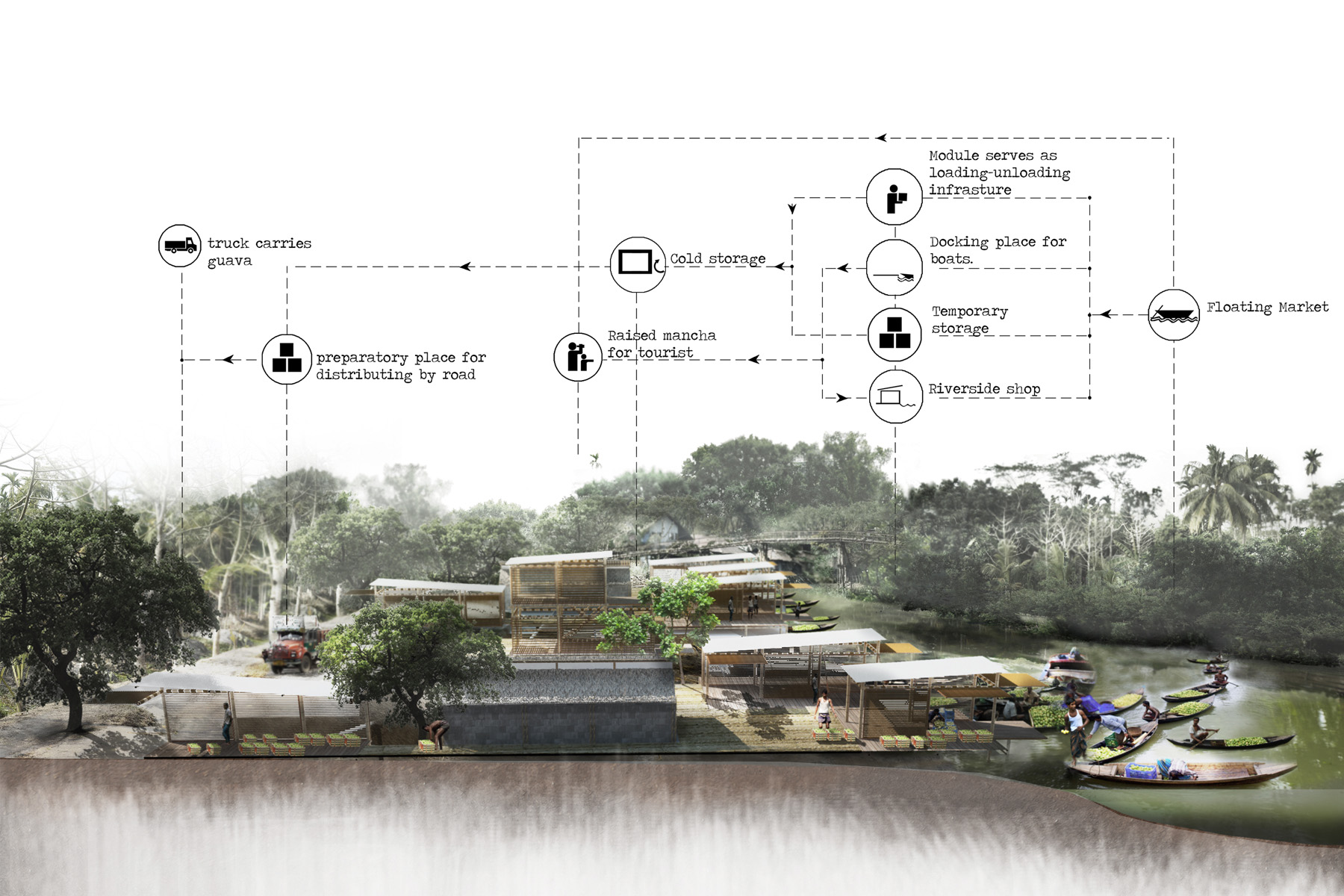
The splendor of this project reflects the affection of the designer with the site, surroundings and the canal life and livelihood of Pirojpur Jhalokathe area. The designer tried to deal with the project wisely. He tried to identify the lack of infrastructure for performing the activities and immediately infill those where needed. Those top down masses never disturb the vivacity personality of greenish Atghar- Kuriana and this is the achievement of this project. The designer didn’t approach with a touristic attitude to invent architecture; rather he tried to find out bottom up answer and encouraged the non hegemonic, subaltern solution for his design. He went into detail- tried and loved to investigate the needs for this Guava boat market and unearth the answer from them. It seems his approach is enhancing to escalate the performance of that space.


© Imran Hasan
The Atghar Kuriana Floating Market © Imran Hasan | AIUB

Read more >>

Zainul Abedin Art Institute | Winning Entry in AYDA 2017

The project won Asia Young Designer Award (AYDA) 2017 (Bangladesh chapter). Launched in 2008, the award program currently spanning across 15 countries in Asia with an objective to inspire architecture and interior design students to develop their skills through cross-learning opportunities and networking with industries in the region. The winner will compete internationally for platinum at March,2018.


Zainul Abedin is the name of a  great maestro of arts in Bangladesh. He played a pioneering role in the modern art movement in this region that began with the setting up of  Institute of Fine Arts  in 1948 in Dhaka. Designed by Architect Muzharul Islam, the institute building is also considered as a masterpiece which basically laid the foundation to modern movement in architecture of Bangladesh as well.  In tribute to Zainul Abedin and his contribution to Bengal art, a new institute is envisioned  at Mymensingh, the birth place of the Master Artist. Total site area is about 6 acre and there is an existing  museum in the site.  The Bramhaputra river is situated on north side of the site. The approach road is from the East side; west and south sides are surrounded by green fields .

© Nadia Afrin Lagno
© Nadia Afrin Lagno
© Nadia Afrin Lagno
© Nadia Afrin Lagno
© Nadia Afrin Lagno
© Nadia Afrin Lagno


Nature, folk life, and daily struggles of  man are the common subject matters of Zainul’s works. His works represent a combination of styles which is realistic in essence but modernist in appearance. The project embraces the ideas of Bengal folk features like pavilion like structures and courtyard as key design elements to articulate the functional spaces of the proposed institution.  Public and institutional domains are clustered  around two large courtyards. The public courtyard is open towards the river and facilitated with ‘Ghat’ – flight of steps leading down to river so that people can celebrate the space with better view. This public court cum open display area can transform itself into a festival ground  and can host diverse cultural events and festivals namely Pohela Boishakh ( Bengali New Year) etc.

© Nadia Afrin Lagno
© Nadia Afrin Lagno
© Nadia Afrin Lagno
© Nadia Afrin Lagno
© Nadia Afrin Lagno
© Nadia Afrin Lagno


For pavilion like structure,  climate responsiveness is one of the key considerations. Voids are introduced for better linkage with the rural surroundings and for better air circulation. This also breaks the monotony of continuous building masses.  Academic  blocks are placed around the rare court fairly segregated from the public arena. Ground floor of the academic block on the riverside  is left open to allow the river breeze and the view. All studios are north-south oriented and of full height windows for natural light and ventilation.

| Image gallery | 


  • Context_ZAart Inst11
  • Context_ZAart Inst04
  • Context_ZAart Inst08
  • Context_ZAart Inst09

Farmhouse at Rajabari, Rajshahi | CHM architects

| From the Architect |

The project is about designing a farm consisting a dairy and cattle fattening provisions. I was initially invited to design the whole master plan of the farm and then they commissioned my office CHM architects to design a small two storied building where the owner can spend some good time and an office downstairs along with residing option for the manager of the farm. Initially I was given a 20’x20′ space for the building that increased to 25’x27′ and a 14’x14′ raised platform is made in front to make the feel of ‘uthan’.

Farm house at Rajabari© Ar. Chowdhury Hysum Muhammad

The client Mr. Tariq Ahmad wanted a place from where he can observe the nature as well as the whole farm sitting on a wooden deck with a cup of tea. In short he expressed his desire to invite the nature into his place rather harming or destroying it. Like I said there was a budget crunch so I decided to make the building with a brick foundation and less RCC works and for openings I chose to put some metal framed windows with clear glasses. For floor finish we used net cement finish with some grid lines on it. In toilets the walls are textured with combs on red plastered surface. Free metal angles are hung from the roof of the verandas and tied with wires to create a green drop wall by linking them with foliage and this wonderful idea was suggested by the client who is a green lover as well. No trees or plants had to die for the sake of the project and that indeed is quite an achievement. Inside the rooms walls are painted white on pointed brick surfaces without putting plasters on.

Farm house at Rajabari© Ar. Chowdhury Hysum Muhammad

A wooden deck is placed with the veranda at first floor framed with metal angles and bars and supported on a couple of metal pipes beneath. On top of the staircase the roof slab is cantilevered on a double height space above deck which makes the feeling of a openness and the slab is slightly perforated with pvc pipes of different diameters. As we have less space inside we made the shading devices outside the exterior wall with ms sheets and bars that looks like a hood. More plantations are done after finishing the construction work. Plants are rather left to grow to fill out the plumbing fixtures outside than creating a plumbing duct to hide the pipes. A jaali of bricks is made at ground floors veranda picked from the local context. Staircase is open from both sides front and back so that the light, air and the beauty of nature can enter.

| Image gallery | 


  • farmhouse_02
  • farmhouse_05
  • farmhouse_08
  • in evening light

National Museum of World Writing, South Korea | Roofliners Studio

| From the Architect|

Let’s think the world without writings. Where we cannot physically express our thoughts, our elaboration, our perspectives; where we cannot document our culture, our social aspect. The world without writing is a world with lack of context to interpret physical evidence from the ancient past. Writing is the only physical manifestation of language through which we express, we develop our foot prints, we roar our existence, it creates a great impact in our daily life sharing our social aspect and culture and emblem our identity. Developing from 35000 B.C by the Cro-Magnon to the modern period we perceive writing in different medium of creative expression from where we get the gesture of our past, their lifestyle, their culture and social aspect. Considering the above consequences we need a space to interpret with the ancient writing, the beauty and medium of their expression. Where we can enhance our quench of knowledge of our past and have a glimpse to our gradual development of writing. Writing museum with different stalking and installation of writing will play a vital role to evaluate and make contrast between past to present both visually and physically.

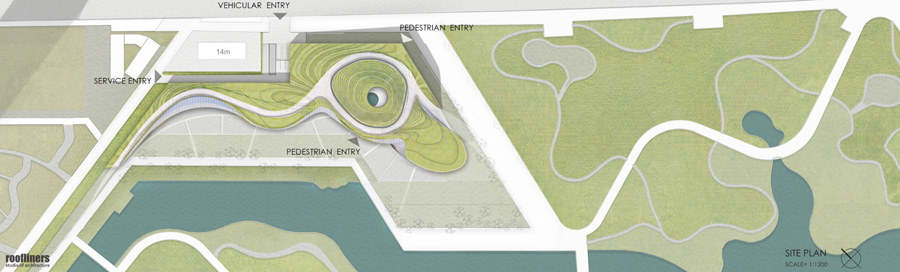
Incheon, Songdo, a city of South Korea, developed from reclaimed land creates an ambiance where the futuristic Songdo meets with old trading. Recently to enhance the public recreational space, local authority took an initiative to install international writing museum to collect, display and perform the ‘writings’ from all over the world.

© Roofliners Studio of Architecture

Acknowledging the history of writings, we found a chronological development by different cultural and social aspect with gradual change of medium trolling with time. The design creates the chronological journey of writing through the space and creates a contrast environment with the past to present style of writing. A person can experience the interior space embedded with controlled lighting, they can evaluate the historical ejaculation in the space, they can express themselves, they can physically interpret with the writing which not only quenches their knowledge but also gives them a different dimension of thinking and clarify the contrast of writing timeline. They also get the essence of the journey of human writing from where we were, where we are now and where we will be.

© Roofliners Studio of Architecture

The idea to assimilate the people in a space apart from the present and take back to a moment of the past; a space is conceived with primitive engraved writing and contemporary fabrication to show the contrast. The ‘cave’ the most integral medium of prehistoric writing, most of the prehistoric hieroglyphics conserved from ‘caves’ where their writings, or their expressions we might say, were encrypted on the cave wall. The hierarchical part of the design expressed as a ‘cave’ enclosed with a dome shaped wall. To explicit the contrast between past to present, a modern bridge fabricated with contemporary materials is lodged and can be discerned from the space symbolizes the present. To feel the piquancy of the space the design conjugated the direct exposition of the space to create appeal from the external part. A person could only perceive the grandeur of the space by their gradual steps towards the museum from the park.

The form was conceived to be ambiguous and curious that invites the visitors to explore and excavate at full extent. The design incorporates the public circulation of the site by confronting constrain the main circulation of the central park and accrue a free flow public circulation amalgamate with the site. To enhance public integrity to the space, two-way circulation space generated from the park and main road end meets a common space, ‘cave’, and creates public congregate to the space.

© Roofliners Studio of Architecture

As the form of the design is free flow and organic, people can explore the continuous circulation from the ground to the ambiguous circulation of the form, exuberance the physical integrity of the form and had a free flow rejoin to the park.

The primary road beside the site acting as an edge line between the site and the cityscape makes a great impact in the design decision to generate the form, considering the edge line the form has a sharp edge bisecting the mountain shaped landscape of the form respecting the cityscape. The main public flow into the site separated from the public vehicular approach subsume obstacle free circulation flow and gather the people from the park approach along with main road approach to the conjunction space known as ‘cave’ creating a stimulating entrance to the museum.

© Roofliners Studio of Architecture

To continue the chronological development of writing, ‘writing museum’ was presumed to be one of the most effective medium of catalyst to the journey of writing. The basic attainment of the design exhibits the harmony of the form respecting the site force and achieving a barrier free circulation.

Accumulation of dramatic entrance was to create public enthusiasm on the form. The mystical decoration of light gives a splendid clarity to the public spaces. Exhibit the beauty of chronological development through sequence of innovative illustration and installation gives a person a clear visual and physical gesture of gradual transformation of writings. Assimilated with the park and its geometrical form depicted the organic form giving the park a high ground prevailing a new perspective. Furthermore the design is perceived as a sustainable, blended with nature, nourishing the people quenching their thirst of knowledge about writing and gives a breathing ground and public space for the people in the concrete jungle.

© Roofliners Studio of Architecture

Design team:

Ar. Monon-bin Yunus, Ar. Rajib Ahmed, Ar. Sarawat Iqbal, Md. Aminur Rahman, Ar. S M Rumman Mashrur Chowdhury, Wasimul Alam, Jahid Ahmed, Md. Tareq Rahman, Kwoshik Kumar, Azim Hossain, Mehedi Hasan Rakib.


CONTEXT contributor: Tabassum Zarin, Architect and Assistant professor. 


| Image galley |

  • contextbd_Museum_World Writing_roofliners 04
  • contextbd_Museum_World Writing_roofliners 10
  • contextbd_Museum_World Writing_roofliners 09
  • contextbd_Museum_World Writing_roofliners 02
  • contextbd_Museum_World Writing_roofliners 03
  • contextbd_Museum_World Writing_roofliners 11
  • contextbd_Museum_World Writing_roofliners 05
  • contextbd_Museum_World Writing_roofliners 07
  • contextbd_Museum of World Writing_roofliners 01
  • contextbd_Museum_World Writing_roofliners 08

Saint Patrick’s Church Complex at Jaflong | AUST

BETTER THE DANCE BETTER THE CROP – a saying of Khasias one of the most ethnic group in Bangladesh. Most of them live in border region, they are fond of hills, mounds, bushes and forest. the villages are the cluster of houses within the cultural boundary of their own community . According to census of 1991 total number of Khasia in Bangladesh is 12300. But Bangladeshi Khasia society claims the number is around 30000. In fact the birth rate is very high among Khasia. They are very much hard working and loving healthy living , holding their culture ,traditions ,rituals they love to be closer to nature. The economic condition is not up to the mark . They usually work  under a king in tea gardens. Betel & Areca-catechu cultivation and selling is their main source of income .

At present 95 % of this communities are Christians and almost every Punji has its own church, they maintain their age-old customs and tradition. The church is the core of Khasias activities, culture, tradition & rituals. So connecting Khasia community of Jaflong at the same platform through religious ideology and creating a space for traditional festival was the prime objective of the project.

© Farhan Al Rafi | AUST

CONCEPT & CONSIDERATION

This is a place where bird sings, wind blows, river flows and life goes on a parallel flow. Among the community I’ve found a peaceful soul, mindful spaces. This place offers a complete feeling of being “INTO THE REALM OF SPIRITUALITY”; I felt so empty while I was walking under the dense trees. The mild sunlight, shadows of leaves has created an abstruse texture on land. Silence, breeze over the trees  and that falling leaves  created an powerful impression on my mind. So I was determined from the beginning the path I have walked through I won’t change during design process rather I assumed people will feel the same way I have felt here during my journey ! I call it as a preparation space, before standing in front of God or in other words this journey is a SILENT DIALOGUE BETWEEN GOD , MEN & SPACE !

© Farhan Al Rafi | AUST

There is an another kind of path way I’ve designed to reach into the main church door which is completely different from the previous one. This is a long suffocated tunnel and 13 doors on the wall , which opens the spaces for meditation. Among these there are  7 shells and 6 open to sky platforms. I call these “A SPACE FOR INDIVIDUAL”. The tunnel terminated by the chapel having a cross upon a  long glass facade. So there are 14 doors, which is a historical translation of 14 stations of crucifixion! The story of every station will be scripted on the walls.

© Farhan Al Rafi | AUST

The church is placed at the peak of the mountain. As a simple metaphor of keeping God above all . So at end of the long path  when the folks arrive to the terminal plaza, two directional walls at the peak of the mountain will be revealed; which create tension, but will be  relieved eventually by the opening the church doors. A long transparent glass facade in front of the seating having a never ending green background. A cross has been placed at the termination of the axis, which can be seen from the narthex and nave.  I call this window as “A LOOPHOLE  INTO THE REALM OF INFINITY” and that cross there creates the impression on the mind of the folk sitting at nave “JESUS IS ALWAYS WATCHING”.

© Farhan Al Rafi | AUST

Apart from the two crosses placed at the termination of meditative space tunnel and church  respectively, there is another cross located at the top of the bell tower which can be seen from long distant. So in-total there are 3 cross used in this project which is the representation of “HOLY TRINITY” means the God is three Consubstantiality persons, i) THE FATHER ii) THE SON ( JESUS CHRIST) iii) THE HOLY SPIRIT as “one God in three divine persons”

Religion or GOD is not confined into a form or structure. “GOD is IN EVERY WHERE” from my personal observation its nature which makes people feel “THE TRUE EXISTENCE of GOD” so it was the priority helping the folk to achieve integrity, to enhance the feeling for GOD through a natural pilgrimage. The hard work they will have to do to reach at the peak of the mountain for every pilgrimage, will give them a little thought about the sacrifice of CHRIST which he had made for their (peoples’)  sins !

You exist in time, but you belong to eternity-You are a penetration of eternity into the world of time –You are deathless, living in a body of death – Your consciousness knows no death, no birth- It is only your body that is born and dies – But you are not aware of your consciousness – You are not conscious of your consciousness and that is the whole art of meditation- Becoming conscious of consciousness itself !

Osho

| Image gallery |

  • Saint patrick church_12
  • Saint patrick church_11
  • Saint patrick church_03
  • Saint patrick church_04
  • Saint patrick church_22
  • Saint patrick church_site plan
  • Saint patrick church_19
  • Saint patrick church_16
  • Saint patrick church_15
  • Saint patrick church_13

MAX Corporate Office | Architect Azrin Alom

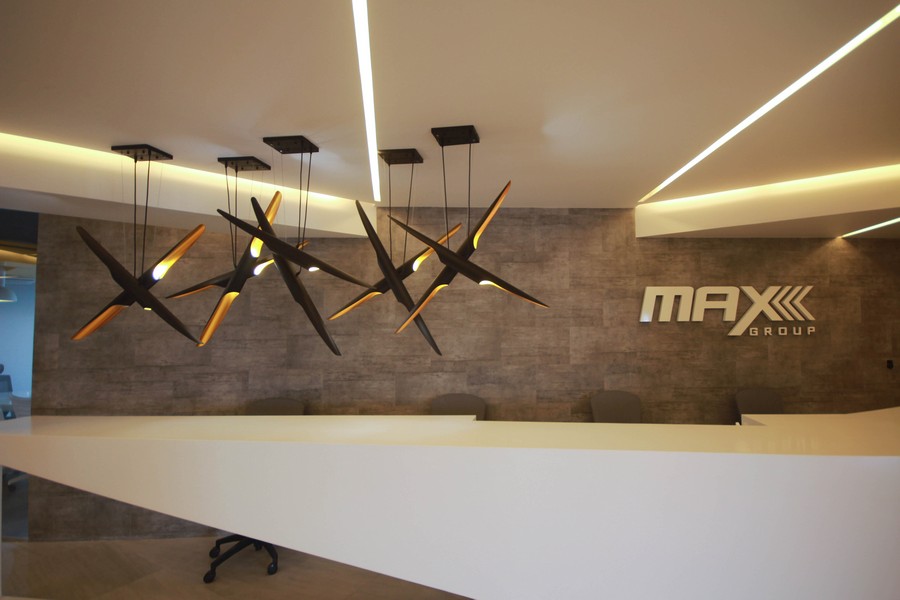
Entrance and Lobby

With the focus on reception desk, the lobby ensures comfortable waiting space while providing brief idea about the office atmosphere.

Max Group Head Office

Max Group Head Office

Max Group Head Office
Max Corporate Office. © Azrin Alom


Office Space

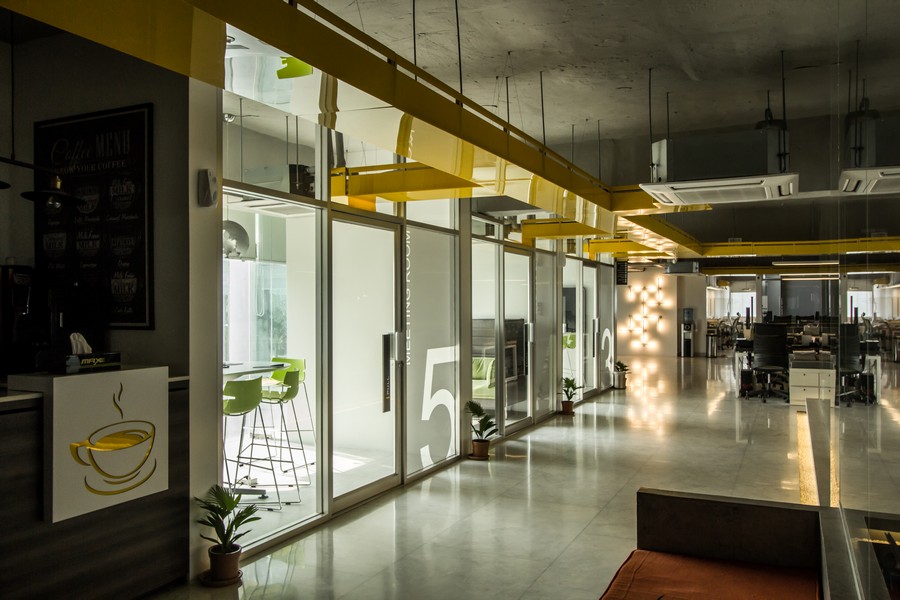
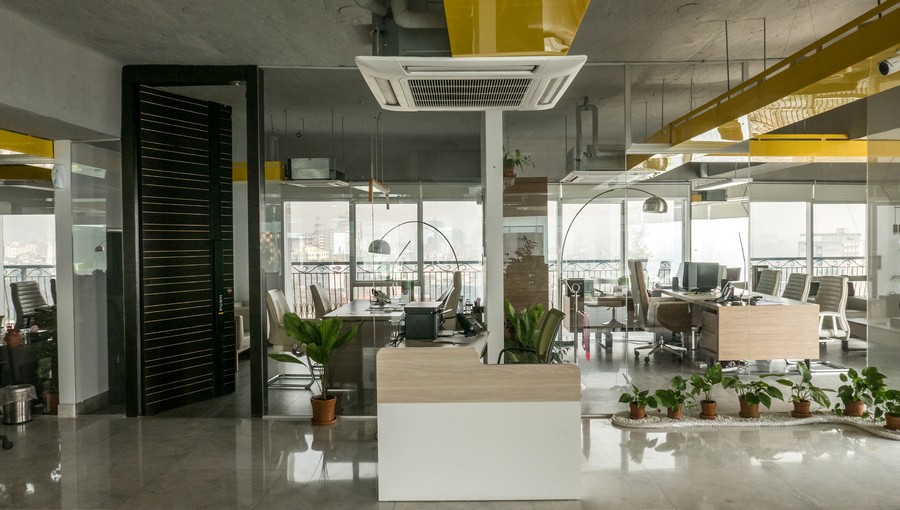
The office layout ensures work-centric space with transparency, a key point of Open Office Planning culture. Deliberately scattered sitting arrangements with coffee kiosk seem to follow the standard health and well being requirements which allow stretching and walking intermittent to work.


Max Group Head Office

Max Group Head Office

Max Group Head Office

Max Group Head Office

Max Group Head Office

Max Group Head Office

Max Group Head Office
Max Corporate Office. © Azrin Alom


Private Workstations and Cozy Meetings

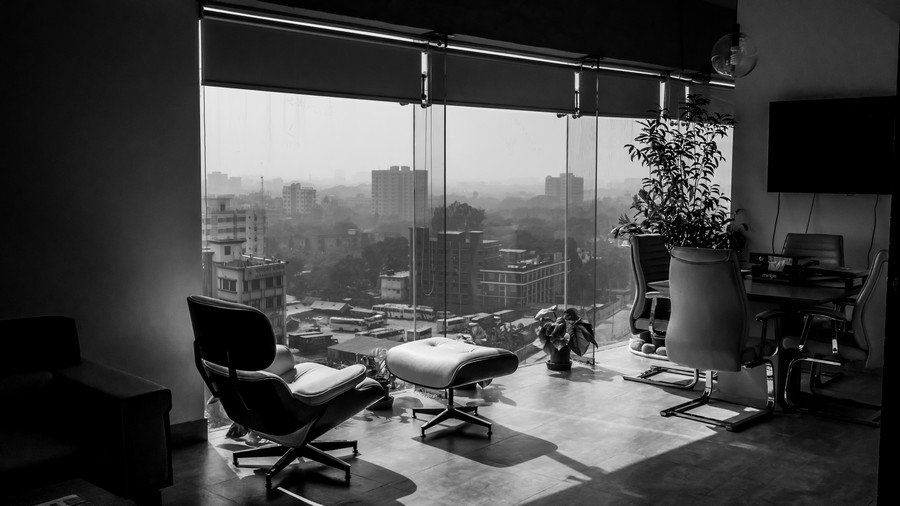
Private workstations are designated and arranged in a way to ensure privacy with opportunities for private business discussions. Variable options for relaxation are also present.


Max Group Head Office

Max Group Head Office
Max Corporate Office. © Azrin Alom
Max Corporate Office
Max Corporate Office. © Azrin Alom


Meeting Rooms

The meeting spaces have enough variants for large and small group arrangements, providing comfortable atmosphere for public and private business discussions.


Max Group Head Office

Max Group Head Office

Max Group Head Office
Max Corporate Office. © Azrin Alom


Cafeteria

The environment of the cafeteria takes one out of the work stress and let him enjoy his meal. It has enough space for arrangement of small office parties and after office/weekend mingling.

Max Corporate Office
Max Corporate Office. © Azrin Alom
Max Corporate Office
Max Corporate Office. © Azrin Alom


Terrace

An utmost attraction, the green terrace with the city view relates the office users with the bustling outer world and let people take a breath in the fresh air.


Max Corporate Office
Max Corporate Office. © Azrin Alom

| Image Gallery | 

  • IMG_8077
  • _MG_3650
  • L9850537 (3)
  • L9850537 (2)
  • IMG_0109
  • L9850958
  • cafe02
  • _MG_3548
  • 3_Resized