Representing the 2.5 percent of the world’s mangrove forests, the Sundarban is the largest Contiguous block of mangrove forest in the world covering some 900 thousand hectors. The Sundarban reserve forest (SRF) of Bangladesh represents the majority of this area (62%). The combined SRF project area is 6,017 sq. km. Visitors and conservation centers are currently being developed/ redeveloped at Khulna and Karamjal and are recommended for development at Katka, Nilkomol, Srankola and Burogalini. Karamjal is the most important site to develop/redevelop as it is the entry point of the SRF.
Sundarban : the largest mangrove forest in the world
The project is designed to achieve the development of a sustainable management and biodiversity conservation system for all resources in the project area. The objective of the center is to enhance the visitor’s experience and to increase the visitor’s commitment to the conservation of the SRF. The center will disseminate updated information on the SRF ecosystem, conservation concerns, local culture and appropriate conduct for visitors. The project aims at creating new possibilities and alternatives for leisure and nature enjoyment while raising public education and environmental awareness of the visitors of the Sundarban.
`Going Green’ is the key concept in this project and achieved here with adhering to the context of the surroundings. Serenity of the backdrops, association with nature, sublime structures, rigor of arranging scientific research facilities and dissemination of activities through site visit, is amalgamated in a single complex. The interface is local, activity is world-class, shapes are organic and structures are low carbon. Ultimately, design blended with nature for a sustainable research facility.
Sustainable consideration is started with permeable retaining structures for the site. Wooden platform on concrete footing, bamboo structure with curved roof made with corrugated bamboo sheets, looped wooden trails for ease of access, power generation through solar photovoltaic, eco-friendly composting toilet, rainwater harvesting was the crucial consideration of sustainability.
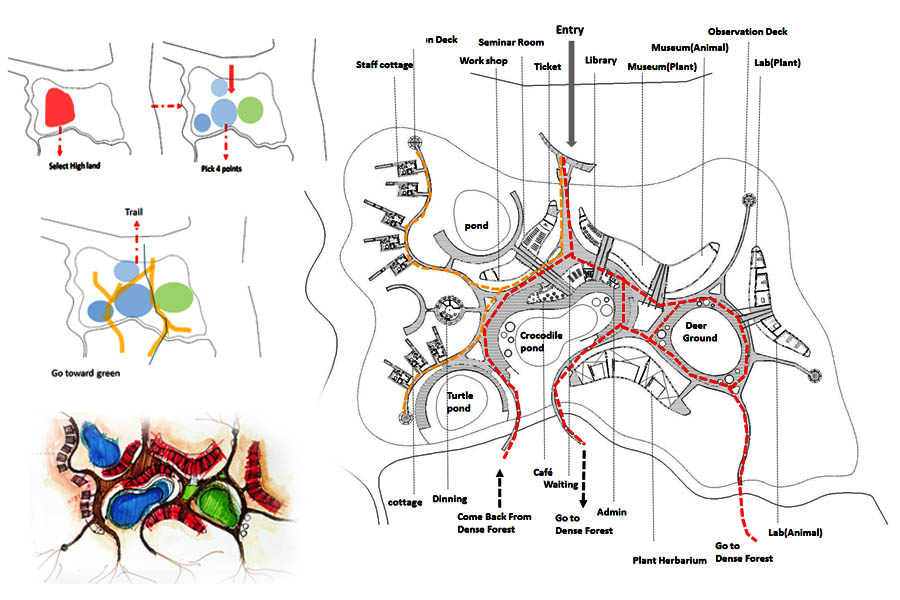
The site is flooded two times in a day. In high tide, site is flooded 2’/2.5′ by water. So, first consideration is to select the four highest points to accommodate the conservation facilities. Then establish the point for Crocodile conservation pond, Deer ground, Turtle pond and an experimental pond. Then proceed to select the entry point. The entry point is almost located in the middle so that all facilities can be distributed easily. The circulation path comes next which is conceptualized to denoted the river of the Sundarban. The circulation is designed with respect of the four points which is assigned the preservation services. The circulation path is called the trail which is 5′ high from the ground so that the tide water can easily flow and the animals can move. The form of the structures inspired from the idea of the boat which is one and only mode of transportation in Sundarban. The form is biomorphic in shape and run through the trail. Every entry point there are semi shaded spaces which is made by bamboo structure and TPU materials.
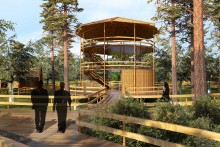
Journey through the site is designed to stimulate the experience of the visitors. There are two loops: one for the visitors and other for the staff. When visitors come, they first drop off on entry deck from the boat. Close to the entry gate there are rest rooms and a café. If turned left, one will find a library, an animal museum and a plant museum. Those three functions are accommodated under a single structure with different entry and exit. Moving forward, visitors can watch deer ground and can experience animal and plant lab.
Visitors can also visit plant herbarium nearby and get back to the trail again. On the way visitors can experience crocodile pond and can move further to the dense forest following the walking trail. While visiting the forest, they will find observation deck and seating arrangement beside the trail. At the end of forest journey, there is a turtle pond inside a compound. The journey takes its final shape at the seminar room where visitors can participated in a seminar on the related issue. By now visitors have reached to the starting point from where they started their journey and completed the loop.
Other supporting facilities like staff cottages and researcher cottages are located at the right of the entry point. With every cottage there is a deck for experiencing the scenery of the forest.
On the eve of its 10th anniversary, Architecture Department at American International University-Bangladesh (AIUB) is pleased to host an Architecture Student Design Competition in association with Institute of Architects Bangladesh (IAB) for young Architecture students envisioning Bangladesh Pavilion at Expo 2020 Dubai UAE.
THE THEME
Expo 2020 will be held in the city of Dubai, United Arab Emirates (UAE), under the theme of ‘Connecting Minds, Creating the Future’ and has three subthemes – Opportunity, Mobility and Sustainability. Expo 2020 will also be the first World Expo to be hosted in the region of Middle East, Africa and South Asia; and the festival will mark the UAE’s 50th Anniversary Golden Jubilee celebrations as well. This design competition aims to look at Bangladesh Pavilion in 2020 Dubai Expo as a successful ‘Nation Branding’ symbol, keeping in relation with the expo’s main themes. The pavilion will celebrate the journey of Bangladesh and its recent economic escalation to a middle-income country in the global community. The pavilion might talk of the glorious past of the Bengal, rich culture and traditions of its people, the uniqueness of the landscape as well as that of its prosperous future ahead. Bangladesh Pavilion in Dubai 2020 Expo might express the country as a technologically advanced nation through large and small-scale display areas- taking visitors on wonderful, interactive journeys of imagination through the pavilion.
Theme and program for designing the pavilion is up to the designers. Site area of the pavilion is limited to 4000 Square meter (80mx50m).
ELIGIBILITY
This international competition is open for individual undergraduate architecture students or a group of max. 2 students from Architecture Schools. Only one submission is allowed from one student or one group. As per IAB policy, local participants must be students from Architecture schools that have IAB accreditation (or currently in the process of IAB accreditation).
REGISTRATION
REGISTRATION IS FREE. A printed copy of the attached registration form should be submitted along with the final submission, on the submission date. Posted entries must reach the submission venue before deadline.
This very project intended to be the place to house the family in greater sense, amidst the vast landscape of the Jute Mill (client-owned) premise. THREE GENERATIONS OF AN EXTENDED FAMILY were to be housed here, to be together and to make this building a home truly. The 5 brothers, one of whom is the client, would come here with their families and the parents, and friends sometimes. It was a challenge to make it a place TO CREATE MEMORIES for all these people who would come here to get rid of urban life’s hustle and bustle in a very remote and serene setting.
The symbol of indigenous craftsmanship amidst vast landscape | photo credit : Md. Didarul Islam Bhuiyan & Imran Hasan
Home away from home | photo credit: Imran Hasan & Mahfuzul Hasan Rana
LOCAL BUILDING TECHNIQUES are the key to the construction of this building. Also only LOCAL MASONS were appointed to complete the job. They had been trained by the architects and engineers to support the whole construction. KNOWLEDGE SHARING with the masons helped to take proper decision and adopt the appropriate construction techniques. Some decisions were made through several TRIALS AND ERRORS like string/cable railing of the stair, offset cut switch boxes in concrete walls etc.
The context falls within the tropic. Key features are BURNING EQUATORIAL SUN and BEATING RAIN. But the tropic covers around 40 percent of the total surface area of the Earth and thus covers around 40 percent, if not more, of the total architecture all over the world. But the characteristics of these buildings vary, as the MICRO-CLIMATE ranges in a huge variety. In this particular case, the context lies in a WARM-HUMID zone. The function of the building here is to modify the ENVIRONMENT. We expect the buildings to keep us dry when it rains, keep warm when cold and to cool us when hot.
The entrance flowing into the central courtyard | photo credit: Imran Hasan
Here the architecture will play ALL THESENSES_ the smell of earth after rain, the sound of birds and the wind in the trees, the texture of the earth and concrete, the transparency of the glass, even the taste of the monsoon rain. The color of the brown (wood) is also present here and there in subtle amount. The grey, the brown and the black all the neutral colors of construction matches and also complements the color of greenery and the color of seasons.
Open to sky court | photo credit: Mahfuzul Hassan Rana
ROUGH WOODEN TEXTURED CONCRETE is selected as the primary material for its expected positive ageing characteristic. It blends with the earth as well as complements with the green surroundings. The sun plays over the rough texture whole day and creates lively exterior and interior spaces. Low maintenance is also a factor for choosing the material. Singularity is expected to be achieved by the use of concrete as floor, as walls and finally roof.
Place of contemplation | photo credit: Mahfuzul Hassan Rana
Locally available MAHOGONY wood has been used for the whole project. It has been selected for its availability and striking natural warm color as a complementary insertion in the grey concrete ambiance. Also, factory-used packing wood has been used to minimize the wastage.
The PARASOL ROOF acts as an insulator for the whole building. The masters who practiced in our country like STANLEY TIGERMAN, CONSTANTINOS DOXIADIS, ROBERT BUI, MUZHARUL ISLAM found the parasol roof to be the most suitable archetype for warm-humid climate. The cooling effect of parasol enhanced by deep and extensive roof gardening.
Green Roof | photo credit: Mahfuzul Hasan Rana
The grass, creepers and any form of vegetation in the lawn and also in the roof level were chosen and taken from the surrounding ground. Therefore, when you look behind the horizon, you see only thin lines of built structure swimming through the GREEN. The ground has been merged and lifted in such a way that it feels like a camouflage.
The place of contemplation | photo credit: Mahfuzul Hasan Rana
photo credit : Mahfuzul Hasan Rana
LIGHT is the most vital element used in here that acts as a building material to reveal all the other materials in their true nature. The building is totally RESPONSIVE TOWARDS THE SEASONS of Bangladesh. As the season changes the tropical garden changes the mood and its color and the garden pavilion house shines within it. Even the selection of the herbs, shrubs and trees i.e. overall vegetation, are guided to act as per nature’s change. Thus, GREEN has also been used as an important building material to accentuate the nature and living condition.
The building has been built with prominently one single material in a word. To create an ACHROMATIC MARK in the abundant green was the intention. Therefore, only grey wood-shuttered concrete has been used as primary material in building the house to match the color of earth, the texture of surroundings and to celebrate sunlight & colors of seasons and nature.
photo credit: Mahfuzul Hasan Rana
Indoor -Outdoor | photo credit: Mahfuzul Hasan Rana
Each space is provided with cross ventilation and ample natural light. Even the roof is designed as a garden that again merges with the surrounding greenery. It’s like living in AGARDEN WITHIN A LARGE GARDEN. The wide projected garden roof is one of the most important single elements in the monsoon climate, giving protection from the burning sun and torrential rain.
The entrance is such that it cannot be defined as a conventional entrance. A door or a gateway can be an entrance to welcome people. And, when there is no door or gateway, there is a void in the house that connects outdoor to the indoor and welcomes you to the home away from home. You won’t even know when you are inside, the outdoor leaks into the indoor in such a way through the ENTRANCE VOID.
The entrance void leads towards the CENTRAL COURTYARD that contains a reflection pool with pebbles, local water-plants, sunken steps and fish. Heading straight, the eyesight goes beyond the building premise into the DENSE WOODS behind, uninterrupted. Also, beside the central courtyard, the reflection pool flows into the interior to create the PLACE OF CONTEMPLATION. You can sit here for hours and you won’t know the time passing by. Even if it is an enclosed and controlled environment, you shall always feel the outdoor and the nature in here.
photo credit: Mahfuzul Hasan Rana
photo credit: Mahfuzul Hasan Rana
The house acts as a LIFE AQUARIUM for the young learners. Here …
Plants bloom.
Fishes vary by their size and numbers, and they grow.
Kalmilata creeps up towards the glass in the monsoon.
The overhanging plants dive towards the water surface gradually.
Family corner | photo credit: Mahfuzul Hasan Rana
photo crdit: Mahfuzul Hasan Rana
The stair, the light holders, the string railing, the doors, the hand-rails of the doors and even the wall-inset switch boards are custom-made. All of the items are CUSTOM-DESIGNED and sometimes they individually took several trial and error phases to reach desired termination. Here, the opportunity to experiment was availed and more like a PRODUCT-DESIGNER ATTITUDE had been adopted.
photo credit: Imran Hasan & Mahfuzul Hasan Rana
The house took time. It took time to be designed and to be constructed and to accommodate the users and their spaces and their time. It took time to be a piece of art, to be a symbol of fine indigenous craftsmanship in course of using the materials and the force of landscapes. And, it is still taking time. It is taking time to grow, and someday it will grow to be the PLACE TO CREATE MEMORIES.
A home, can it be built without emotions? Can it be built without memories? Can it be woven? And can it be built without nature?
As we mentioned before, the intention was to REINSTATE THE LOST INHERITANCE and also, to meet the philosophical and psychological need of the urban people.
The void inside the house connects outdoor to the indoor and welcomes you to the home away from home | photo credit: Mahfuzul Hasan Rana
In the centre there is a courtyard which is accessible from both the main approach and the back garden. It is an AMBIGUOUS PLACE where all the major spaces and levels of the home meet and where light penetrates from different angles all the day and even during the full moon which enliven the major interior spaces. The water container containing greeneries, stones, water, fishes symbolizes the PRESENCE OF LIFE in the whole house. The CHANGING MOOD of the interior spaces was imagined as one of the prior concern of the house.
photo credit: Mahfuzul Hasan Rana
Nowadays cities occupy the centre ground and radiate their grid-like surrounding and their speed, the country means a move towards another type of achieving environment. A desire for isolation from the hassle of everyday life is there to start a dual journey. Proximity is desired to more simple and fundamental things and gradual detachments from urban networks of relationships and obligations.
photo credit : Md.Tauhidul Islam Rifat
The main constraint was to find SKILLED LABOUR and CHOSEN MATERIAL in the locality. But, to attain sustainability, indigenous material and labour were used with utmost care. Local building techniques are the key to the construction of this building. Also local masons were appointed to complete the job. They had been trained by the architects and engineers to support the whole construction. KNOWLEDGE SHARING with the masons helped to take proper decision and adopt the appropriate construction techniques. Some decisions were made through several trials and errors like string/cable railing of the stair, offset cut switch boxes in concrete walls etc.
Opengap invites participants to submit innovative proposals to rethink the workspace of an architect. To propose projects that addresses the architect’s vision of his ideal inspiration and working space. How do you imagine the place from which other spaces are to be designed? How to address a project in which you yourself are the client?
This competition is open to all architects, designers, architecture students and to people around the world interested in the topic. Competitors could subscribe individually or as a team of maximum of 5 people.
The proposal submission consists of two digital panels in .jpg format, not bigger than 4MB each.
AWARDS
_ First Prize: 2500 € _ Second Prize: 1000 € _ Third Prize: 500 € _ Mentions: Mentions will not have an economic prize.
DATES
Beginning of the Competition:09 November 2015
Registration 1st Period:From 09 Nov – 30 Nov 2015
Registration 2nd Period:From 01 Dec- 29 Dec 2015
Registration 3rd Period:From 30 Dec- 22 Jan 2016
Registration 4th Period:From 23 Jan – 18 Feb 2016
Competition Registration Deadline:18 February 2016
Proposal Submission Deadline:until 23 February 2016
According to the 2015 Chicago Homeless Count and Survey conducted by the City of Chicago, 31% of the unsheltered homeless population and 19% of those that are sheltered are between the ages of 18 and 24 years old. Though these numbers are startling, many of the city’s homeless young adults are actively working to improve their quality of life—working toward their GEDs, holding jobs or taking courses in college.
Yet, even when sheltered, these young people are burdened by impermanence: many are forced out of shelters during the day with no place to store their belongings during work or interviews; they have no privacy for studying, let alone space for self-care. Transience means they often lack stable communities for support. Tiny houses can provide solutions for these young individuals seeking stability, support, safety and community.
This competition invites teams from across the country to submit their ideas for a small community of tiny homes in Chicago. Though speculative, the partners involved in launching this competition believe that good design can contribute to innovative solutions, and by engaging the design community in this competition, we are taking steps toward turning these solutions into reality.
ELIGIBILITY
This Design Competition is open to all with the following exclusions:
Entries shall not have been previously published in any competition publication, whether printed, online or otherwise.
Entries shall not have been selected as finalists, winner, honorable mention, etc. in any other competition.
JUDGING CRITERIA
The jury will review the submission and select the finalists based on these criteria:
Compliance with all submission requirements
Adherence to the design parameters
Believable constructability within identified budget parameters
Suitability of design for intended use
Aesthetic merit
Responsiveness to neighborhood and site context
SUBMISSION REQUIREMENTS
_ Online registration form
_One presentation board (24”x36”) landscape oriented at 150 dpi in PDF format and saved as a single PDF file less than 10MB in size. To ensure legibility in jurying and publication, all fonts must be 12 point or larger.
_ If the design is submitted by a team of people, ALL team members must be identified on the application.
The presentation board must contain the following:
_ Narrative of the design (250 words or less)
_ Site Plan 1/16 ” = 1’-0”
_ Housing Module Plan ¼” = 1’-0”
_ (2) Building Sections ¼” = 1’-0”
_ (2) Building Elevations ¼” = 1’-0”
_ High-resolution rendering
_ Cost of Materials List
_Names of contestant individuals or organizations MUST NOT be visible on the presentation board.
AWARDS
_ Winner will receive $5,000 award and opportunity to construct a full-size demonstration unit.
_ Winner will receive an additional $5,000 fee to develop construction drawings. If the winner is not a licensed architect in the state of Illinois, winner must team up with a licensed architect in Illinois to produce the construction drawings.
Today over 3 billion people live in urban areas. By 2050 that will double.
How will the architecture, engineering, construction (AEC) industry meet the demand for affordable and sustainable buildings in this rapidly urbanizing world? At Flux, we believe technology is the answer.
That’s why this year, Flux is calling all students designing in Grasshopper, Dynamo, and Excel to enter our student design competition. Show us what role you think technology solutions can play in accelerating the building design process and increasing the innovation capacity of design teams.
ELIGIBILITY
All currently enrolled students worldwide studying subjects related to the built environment are eligible to participate in this competition.
AWARDS
All winning entries will be featured on the Flux webpage. Receipt of an award in one category does not exclude an individual or team from the receipt of awards in any other category. Award of monetary prizes are subject to US and domestic laws and restrictions.
Most innovative project | 5,000 USD
Best building performance | 5,000 USD
Best digital fabrication using Flux | 1,000 USD
Best use of data harvesting with Flux | 1,000 USD
Best multi-user collaboration using Flux | 1,000 USD
People’s choice for best overall | 2,500 USD
plus honorable mentions
COMPETITION SCHEDULE
November 2 Registration opens
November 15 Early bird registration closes. Register before the 15th to be entered into a raffle for 1 of 4 $50 Amazon gift cards
December 1 Detailed competition brief released (registration remains open)
December 31 Registration closes
January 31 Competition submissions due
February 29 Winners announced
REGISTRATION
Registration is now open! Follow the link below to register.
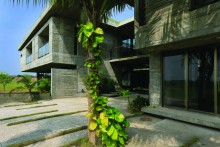
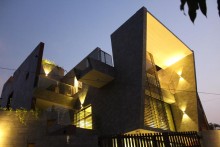
Villa Sonargaon project is located at Mongolergaon village, Sonargaon thana, Narayanganj. The site is surrounded by natural vegetation and waterbodies. Considering the serene views of the surrounding the concept evolves following a conscious approach of design to create a house that faces the nature; to blend with the nature and bring the green inside. The house brings the green inside through transparent large glass panels and thus offers a sensational visual experience of ever-changing seasonal setting from the interior living spaces. Open terraces with sitting facilities, greens and waterbodies at various levels of the mass are created on purpose. Terraces provide maximum and direct view to the surroundings.
The internal arrangement is articulated to separate the functions not by walls but floor levels: ground floor as service, upper floors as served areas. Villa functions are splitted into 2 separate areas: one is the bedrooms- for more quiet & relaxing purpose- are placed on the southern part of upper block for more privacy; the other one is the family space- more functional & multipurpose in uses- is facing the north . These family spaces are connected to the landscape with outdoor terraces.Open terraces are arranged in the northern part to ensure diffuse lighting and proper shading from the built mass.The family spaces are given major importance. A central double height space for living and family living, serves as a core of the house. The dinning, family living, gaming,circulation areas and roof terraces provide the best experiences of the surroundings.
Adequate perforations are made to the building mass to ensure a good bending of indoor- outdoor. The floor to ceiling height windows invite ample natural lights, good air circulations and maximize views. Each bedroom ensures natural ventilation from the south. The cantilevered external structure is composed of a cube volume and perforated metal envelope, inviting the surroundings inside while creating a frame for the outdoor scenic beauty. To minimize the heat gain from the sun, vertical circulation is arranged in the west. Sustainable features like solar panels and water purification systems are incorporated here. A unified structural system of post slab and share walls is applied in the project. Building materials like cladding brick, rustic tiles, metal stairs, aluminum window frame and metal louvers are used.
Tanzila Ahmed, currently a student of Architecture of Bangladesh University of Engineering and Technology makes art with pencils, and has a love for portraits. She gives special attention to details, and targets on making the sketch look as realistic as possible.
‘My love for art started the day my parents took me to the art school back when I was 3! The art school taught me basic paintings, objects and sceneries, but I grew up seeing my father drawing portraits of me. I actually started portraits when I was 21 or something and I understood how to draw them and could gather up the energy and patience it requires! It’s more than the idea and the skill. It’s about time, patience, willpower and proper tools, and you need a balanced mixture of everything to make one good sketch’, as in her own words.
Her sketches are mostly with graphite pencils, on white cartridge as she prefers. She also has a few number of pencil colour portraits. Currently she’s working as an illustrator for a book, where she’s drawing architectural perspectives of historical buildings from around the world.
To her, sketches are a relief. A relief from everyday hassle, studio projects, failures and loneliness. Her other interests revolve around books, architecture etc.
‘You don’t need to be a big fan of art, or criticise them to be able to draw something. Just start it, when you feel like doing something. It’ll go somewhere, and so will you.’