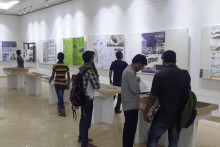
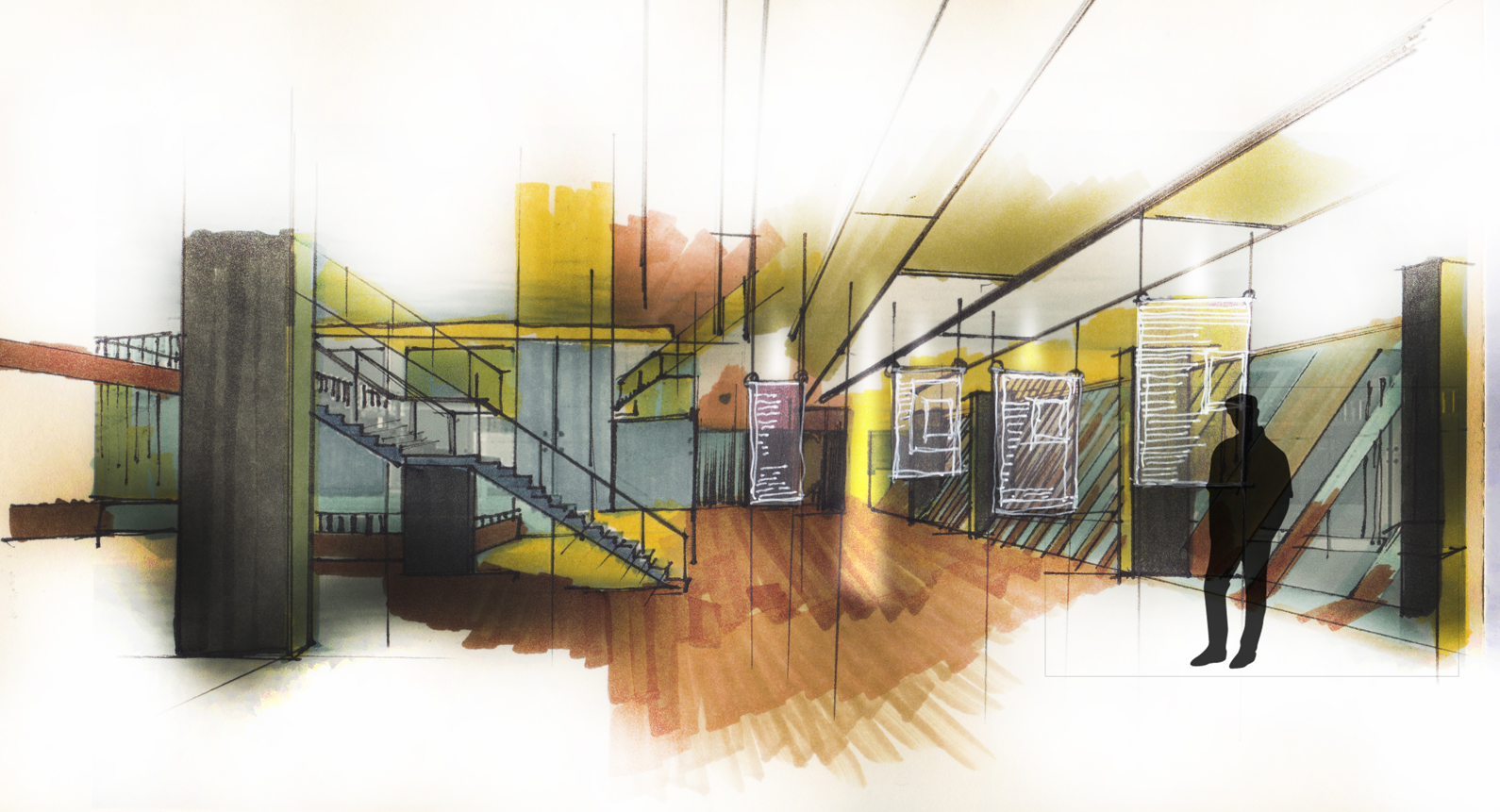
The public exhibition ‘Creating an Urban Oasis’ has created a resurgence of hope that ‘better Dhaka is possible’ among its despair citizen lately . Credit goes to BUET Alumni Association and its collaborative bodies IAB, IEB and BIP for such endeavor. The exhibition presented 31 projects selected form the student competition held earlier in the month of January of this year. The student has expressed their innovative thoughts and ideas to transform the Old Airport site into a vibrant urban space within the congested city fabric of Dhaka.
The idea of this praiseworthy initiative has its foundation rooted deep into the paradoxical ground that Dhaka, being one of the densely populated cities in the world, has large parcel of land remained underused or unutilized for decades. 415 acre Tejgaon Old Airport site, located at the heart of the city, is such an example which has a potential to be transformed into a vibrant public place through innovative and visionary design and planning. This novel intention, however, took shape at the beginning of this year with the launching of Idea Competition, followed by an workshop, engaging students from cross-disciplinary fields to develop visionary design proposals for Old Airport Site as a public space. But what actually makes the whole effort noteworthy is the recent attempt to present these ideas infront of the policymakers and other stakeholders in the format of public exhibition held on 30th Oct to 1st Nov at National Museum in the city.
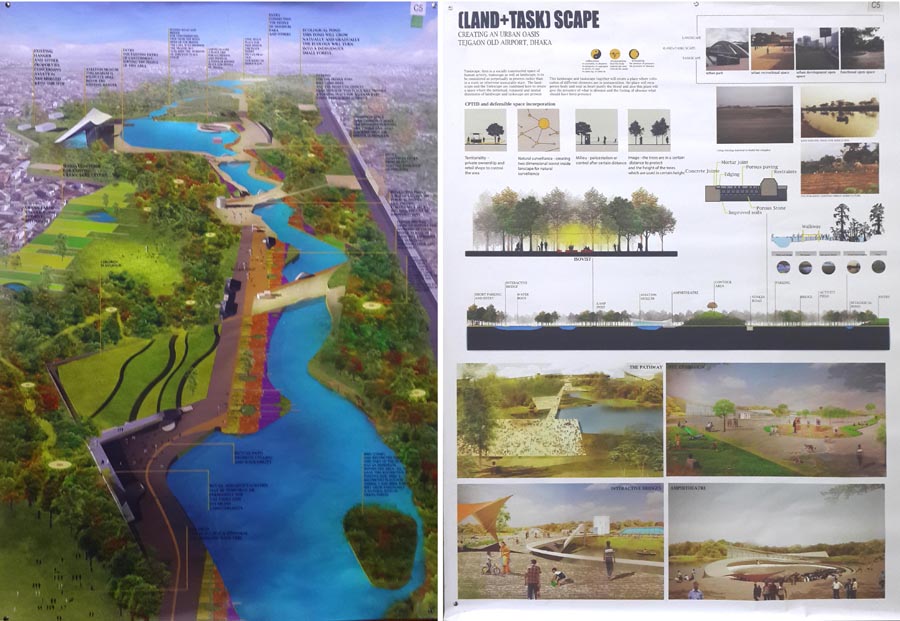
The exhibition displayed projects of diverse ideas to rejuvenate the old airport area as a vibrant public place considering socio-cultural, economic and environmental value of the site. All the projects were exhibited as panel presentation of drawings and visualizations along with cardboard models. Students from architecture, planning and engineering all around the country were participated in the competition which also made the event an inclusive one. A team from BUET : Sadia Humayra Mounata (Arch), Bin Sayeed Bakhti (Arch), Ahmed Yousuf Ibn Kabir Khan (Arch), Suvodip Singha (URP), Shamima Nasrin (CE) has won the first place in the competition.
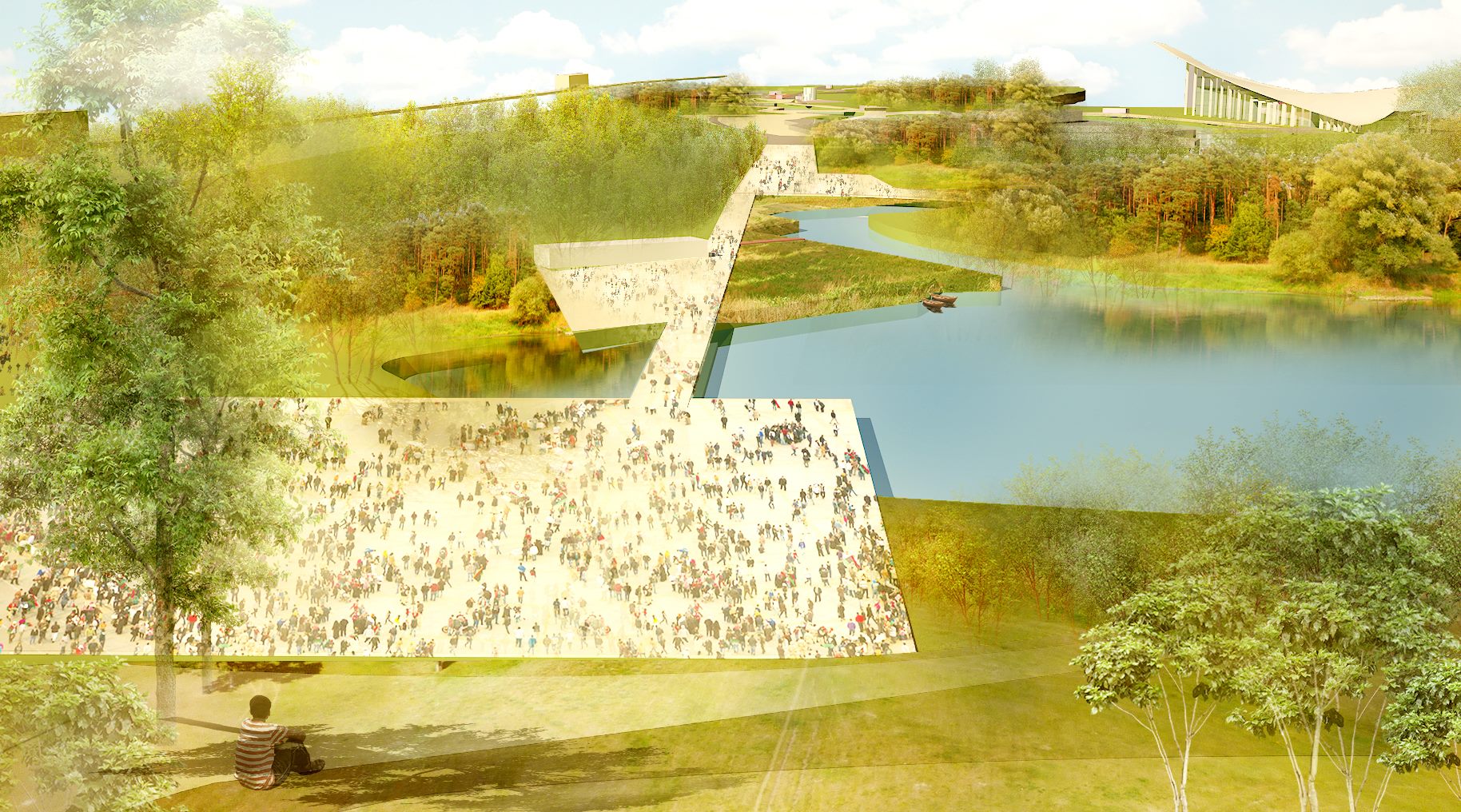
“The project is an imaginative conceptualization and integration of natural, environmental, cultural, social, and historical identities of Bangladesh in the urban context. The aesthetic use of greenery, water and relaxed human activities is particularly noteworthy. The project is particularly implementable and sustainable at reasonable cost” -quoted from the Jury citation of the winning entry.
Honorable Speaker Dr Shirin Sharmin Chaudhury, also chairperson of the Commonwealth Parliamentary Association (CPA) Executive Committee, graced the inaugural occasion as a chief guest. BUET Alumni Association President Prof Jamilur Reza Choudhury delivered the welcome speech, while Dhaka North City Corporation Mayor Annisul Huq , Dhaka South City Corporation Mayor Mohammad Sayeed Khokan, IAB president Prof. Abu Sayeed , BIP president Prof. Golam Rahman also spoke on the occasion.
The measure of any great civilization is in its cities, and the measure of a city’s greatness is to be found in the quality of its public spaces, its parks and squares. – John Ruskin.
Dhaka city is one of the highly dense city along with the other problem like high land-value, the public open spaces there are the precious spaces which we find rarely in Dhaka map. Urban open space enhances the environment, social and economic aspect of life which ultimately helps to grow a sustainable city. If anyone gives a swift glance upon the map of Dhaka city, he/she will readily pick ‘the old airport, Tejgaon’ other than ‘Hazrat Shahjalal Airport’ as the largest open space in whole city, which is practically restricted and underused. As the growth in northern part of Dhaka city, alongside the division of City Corporation in north and south, the old airport is practically becoming the center of the city. This 415 acres should be dedicated for the public use to enhance the quality of sustainable life of Dhaka people.
“We can build systems to engage people, but until we figure out why they aren’t engaged and using the public spaces that they already have today, nothing will change.”—Madison Mayor Paul Soglin on low-income communities & public space.
Though we have a little open left in Dhaka city, if we observe fully we can understand why these open spaces are not used fully. We only analyze about the five major parks in Dhaka city, there are many like that. But the major problem is lack of security also maintenance and that people don’t want to go although they have that eagerness to go there.
Where the urban Open Space failed in Dhaka city, we start from there.
So, by NOT avoiding the present problems which we already have in other public spaces in Dhaka, we learn from it and the focus was to create a place where the problems we already have will not be raised again.We have inspired by the two concepts, these are, ‘The defensible space theory of architect and city planner Oscar Newman’ and ‘Crime prevention through environmental design (CPTED)’
The defensible space theory: by Oscar Newman
Defensible Space relies on self-help rather than on government intervention, and so it is not vulnerable to government’s withdrawal of support. It depends on participation involvement to reduce crime and remove the presence of criminals. The theory argues that an area is safer when people feel a sense of ownership and responsibility for that piece of a community. There are five factors that make a defensible space i.e. territoriality. Natural survelience, image, Mileu and Safe adjoining area are incorporated in the design.
Crime prevention through environmental design (CPTED):
Crime prevention through environmental design (CPTED) is a multi-disciplinary approach to deterring criminal behavior through environmental design. CPTED strategies rely upon the ability to influence offender decisions that precede criminal acts. Generally speaking, most implementations of CPTED occur solely within the urbanized environment.
So, the approach of design is not the focusing ‘CPTED’ or ‘defensible space’ but undertaking these concepts and when designing, the things to keep in mind.
In Dhaka area we have four types of, which included green, recreation and relaxation.
Type of Green Open Space (scale of facilities) are Urban Parks,Urban Recreational Areas,,Urban Development Open Spaces,Functional Open Spaces.The idea is to incorporate these four types of green open spaces in one whole area where juxtaposition of all elements will collocate. Here, landscape and taskscape will join together to create a wholesome place of unity. The term Taskscape is often used by social anthropologist Tim Ingold. As Ingold has described the term: “just as the landscape is an array of related features, so – by analogy – the taskscape is an array of related activities.” Taskscape, then is a socially constructed space of human activity, taskscape as well as landscape, is to be considered as perpetually in process rather than in a static or otherwise immutable state. So here, in Design the two dimension is incorporating where nature and human are existing in temporal and spatial dimensions.
What makes a great public space: Creating it not designing
When, proceeding towards DESIGN phase we kept in mind all that, and wanted to create an integrated design which will be sustainable and will be a step to take a new dimension of designing the public place.
When the incorporation of activity, the activity spaces are created not in a definite area but it is temporal. In the time to time basis, the activity of a certain area in a certain places can be changed.
The accessibility in the site has to come from the outside land-use pattern of the area and the user groups. The entry is given on the basis of people lives or work in the surrounding. There would be two metro stations which will give abundant access to public in the site. So, the major decision was a connecting road to alleviate the huge journey from Jahangir gate to Agargaon point.
As for sociability, the increase of security will increase the participation of public. The use of places in time will change.
Comfort is one of the major point of a good public space. And as for that, natural surveillance, uses of trees with slim and high trunk and a distribution of light density is needed. Because, densified tree area makes a place of crime which make the public insecure.
Isovist is comprising a space from where other places can be seen. This large gathering spaces are the centers directing to the more scale down space which are scattering throughout the area.
Encouraging the present situation is a decision we come to take. When we had a chance to go the north side of the site, we found an existing urban agricultural field with irrigation pond, where a natural ecology has grown. So, this has encouraged us to keep the agricultural field and irrigation ponds.
Reuse of material and reducing CO2 footprint makes a project more sustainable. There was a large strip of runway, which material would be re-used to build the structures in this places.
We can dream big, but we are dreaming by stepping the foot on reality. As for that, realization and dream both are important. But to realize the dream we need to realize the facts. If the place is realize, it will be a place of recuperation, collocation and intimation, where people will come and feel the absence, in the presence of this place, it will experience people the journey of elements which is co-existing and intervening with each other.
Bangladesh inherits the pride of its culture and tradition which is reflected widely in its sports as well. Sport is one of the key factors of Bangladesh that speaks about heritage and culture. As such the government patronizes our National Sports Council for promotion and preservation of it. Here the authority takes initiative for preserving our traditional sports along with international sports as well.
Now the question arises what is traditional sport and why it is important to preserve? Traditional sports are those games which have originated from the ancient age of our rural culture and people. These games are different from international games and still play vital role in our rural area. It enriches our root and must be uphold to our new generation.
Due to the progression of international games people are going to forget about traditional sports. Again these traditional games are invented not only for time pass , most of the time these become a source of their earning as well. As a medium of representation, in this project, Cox’s Bazar has been considered the best site. National Sports Council has the plan to build a stadium at Cox’s Bazar for international games along with traditional sports complex. In Cox’s Bazaar visitors come to enjoy the beauty of world’s longest sea beach. So the tourist spot would be the best node for uphold our traditional sport to the world.
The site is situated near the Laboni beach market and Jhinuk market. As there are so many traditional games existed in our history, it becomes very hard to recognize each and every one. But among them Satchara, Lukochuri, Kanamachi, Choa-chui, Tilo-express, Rumalchuri, Lathikhela, Baghbondi, Ghunti khela, Kathi khela, Putul khela, Latim, Ludo, Caram board, Fulltokka, Bouchi, Kabaddi, Sholjhapta, Gollachut, Daribandha, Ekka-dokka are still the most played games in our country.
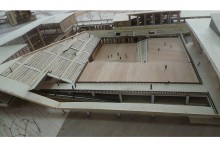
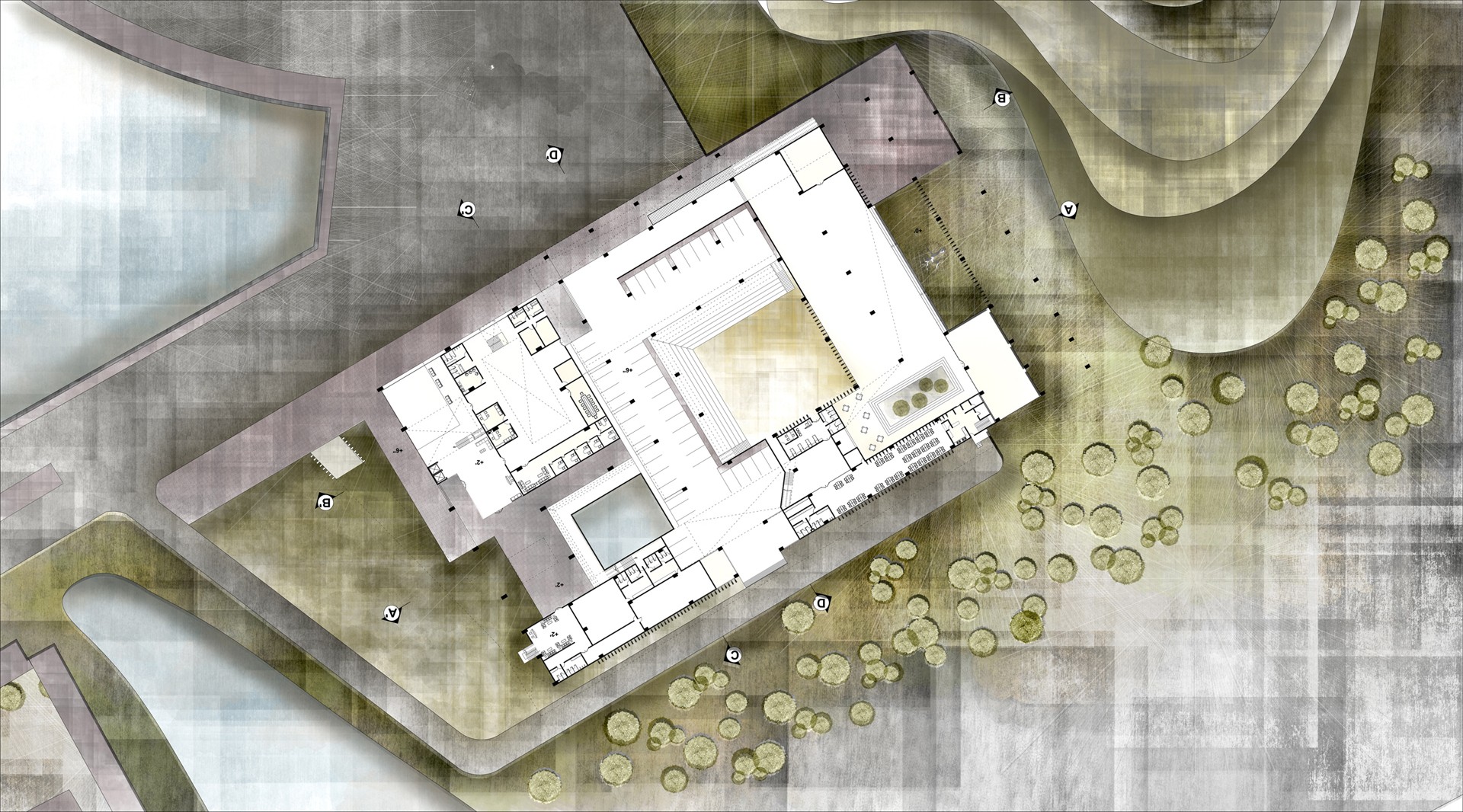
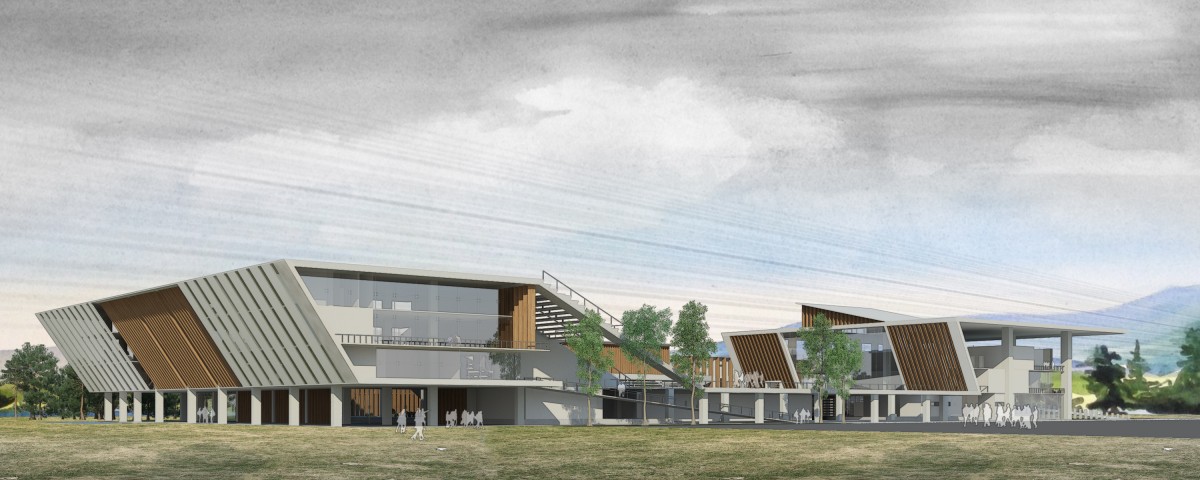
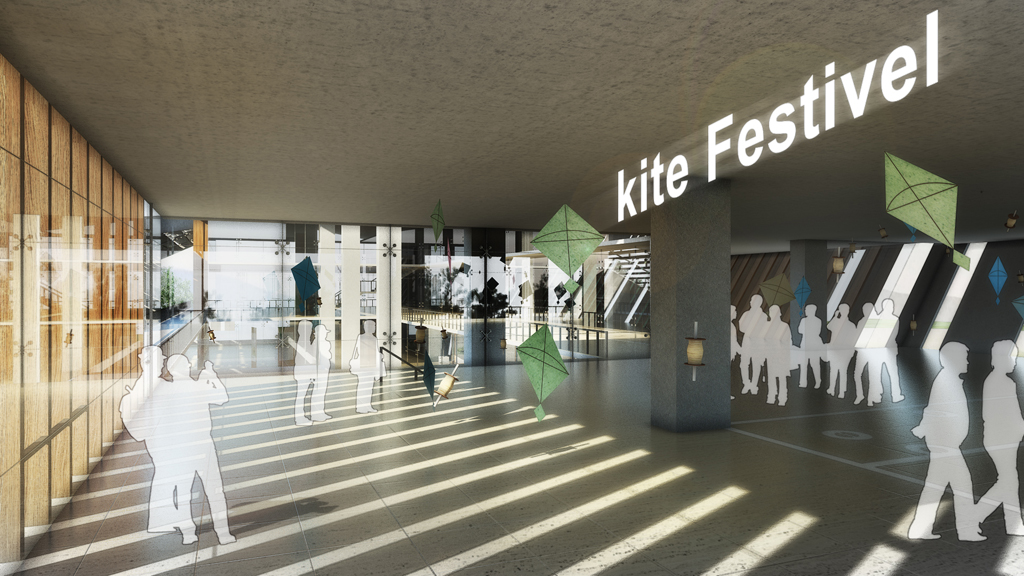
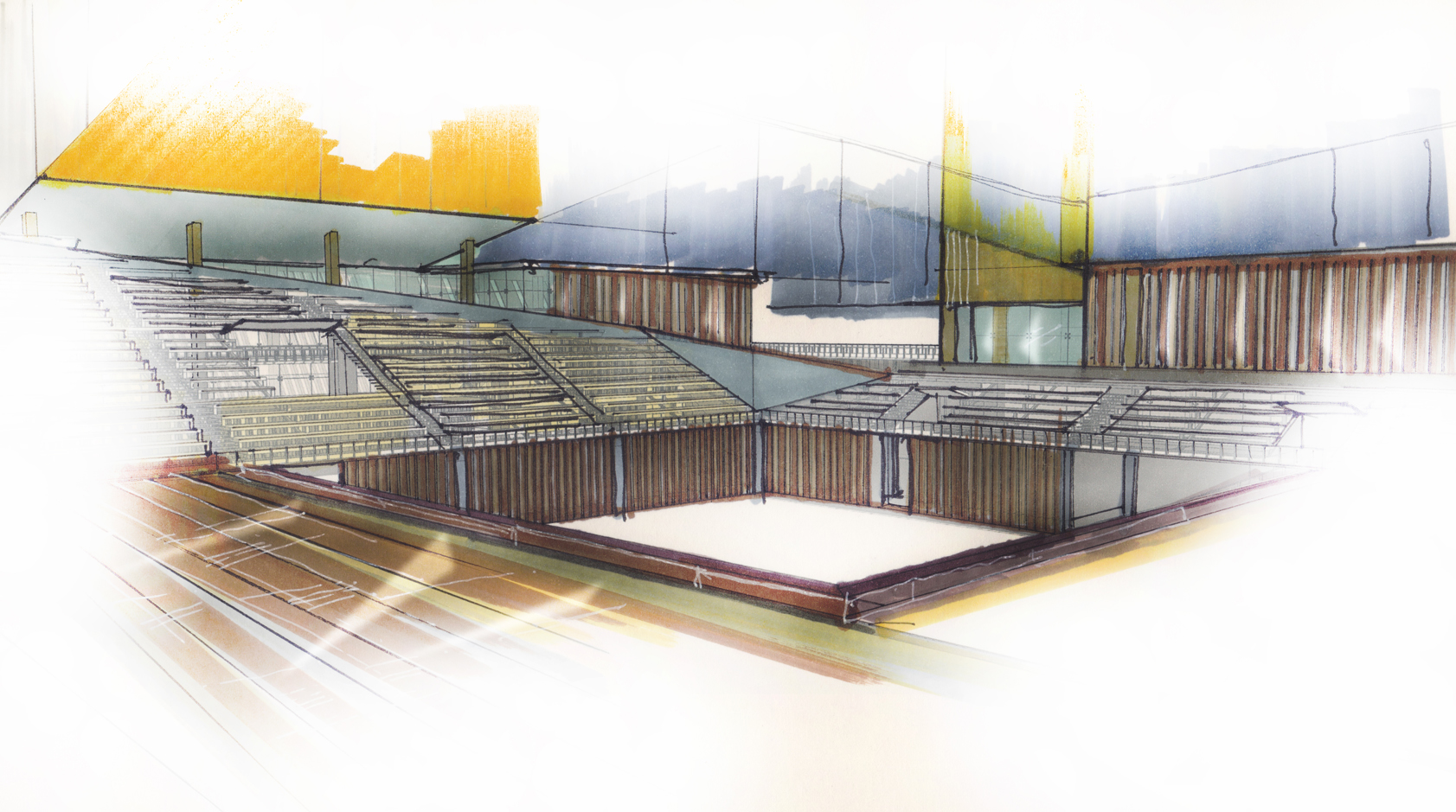
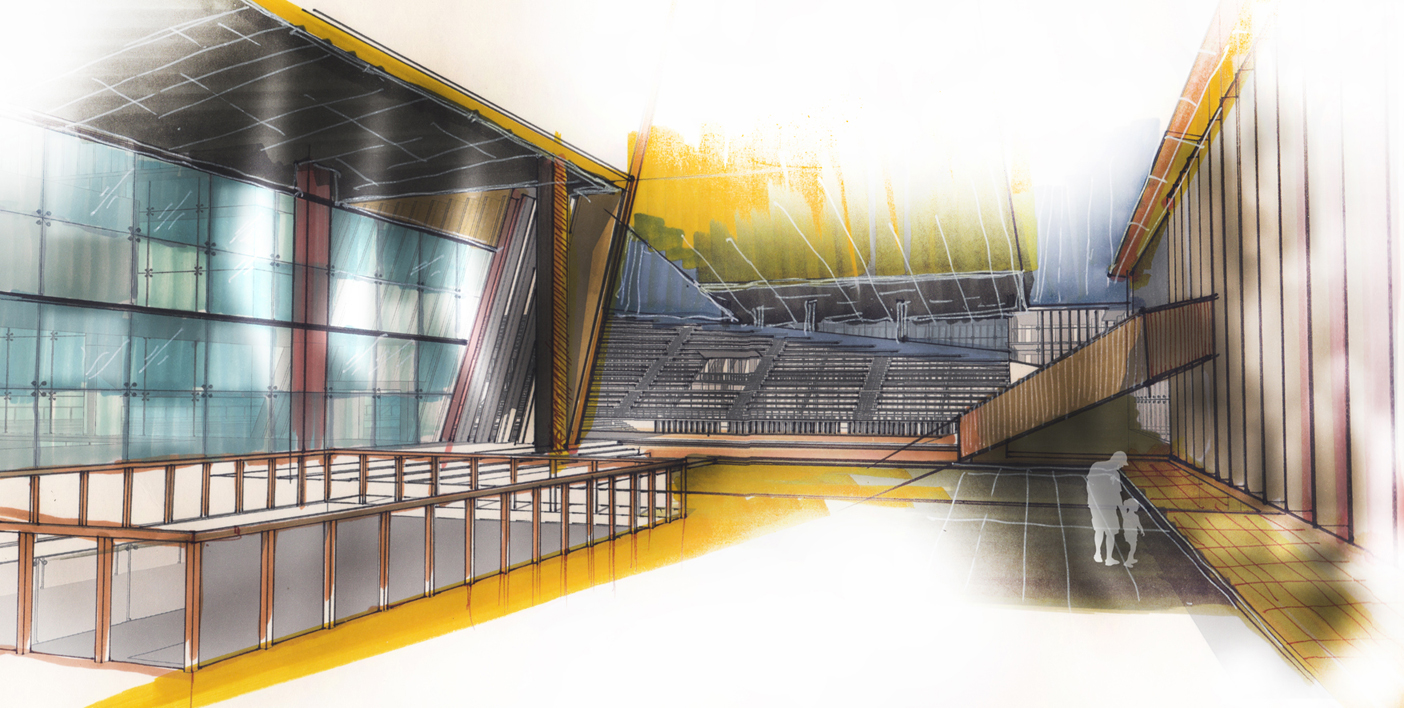
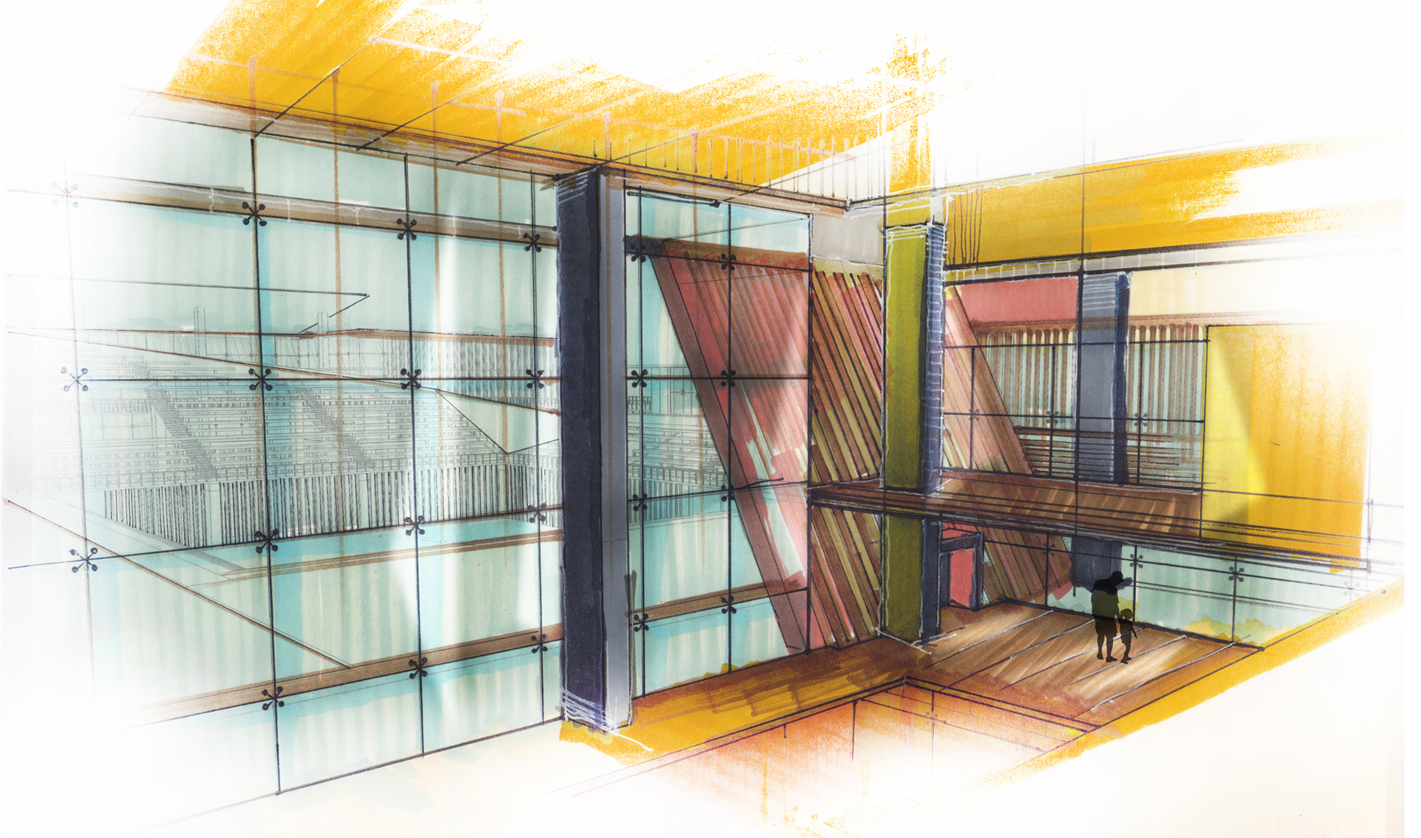
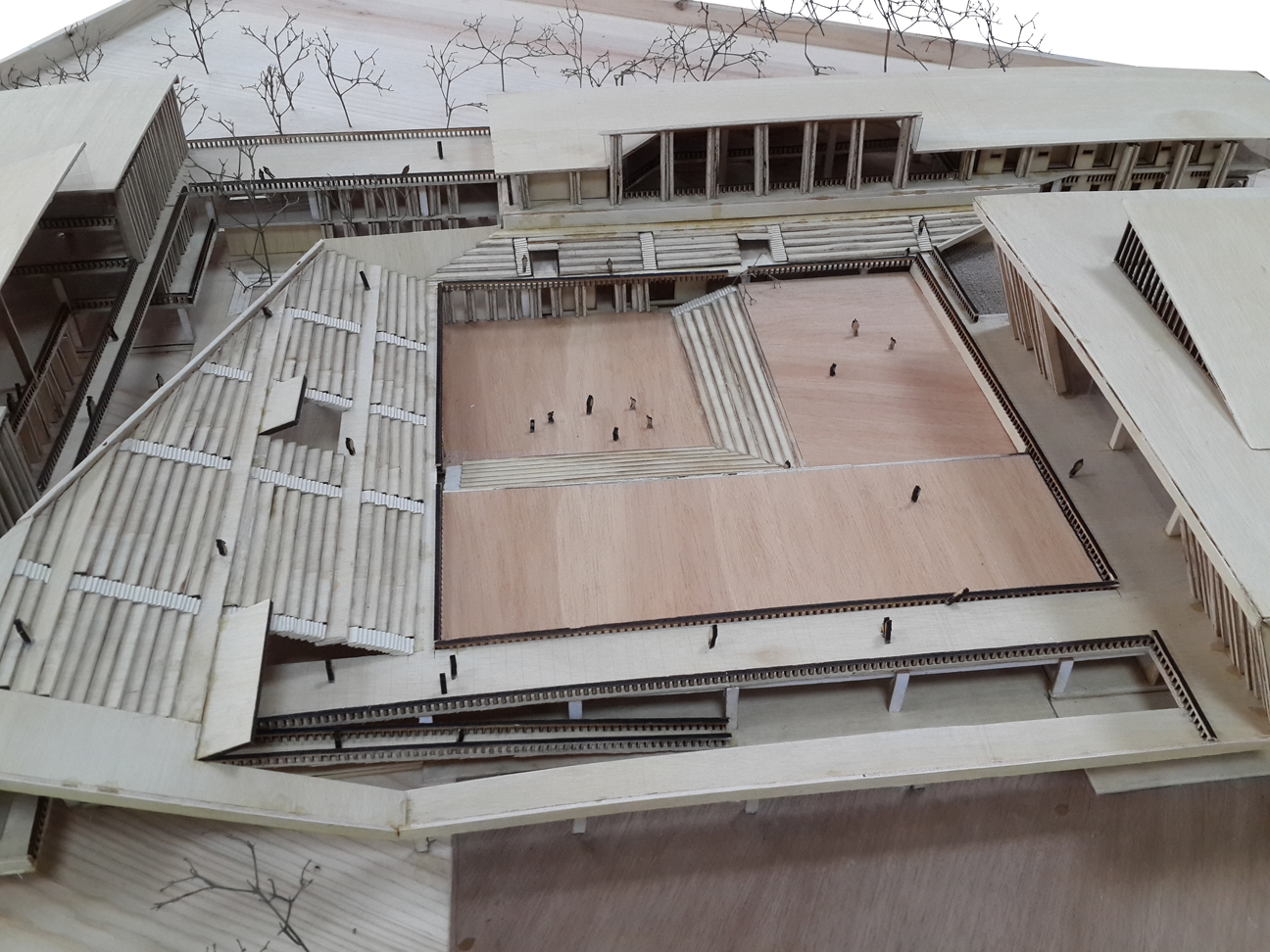
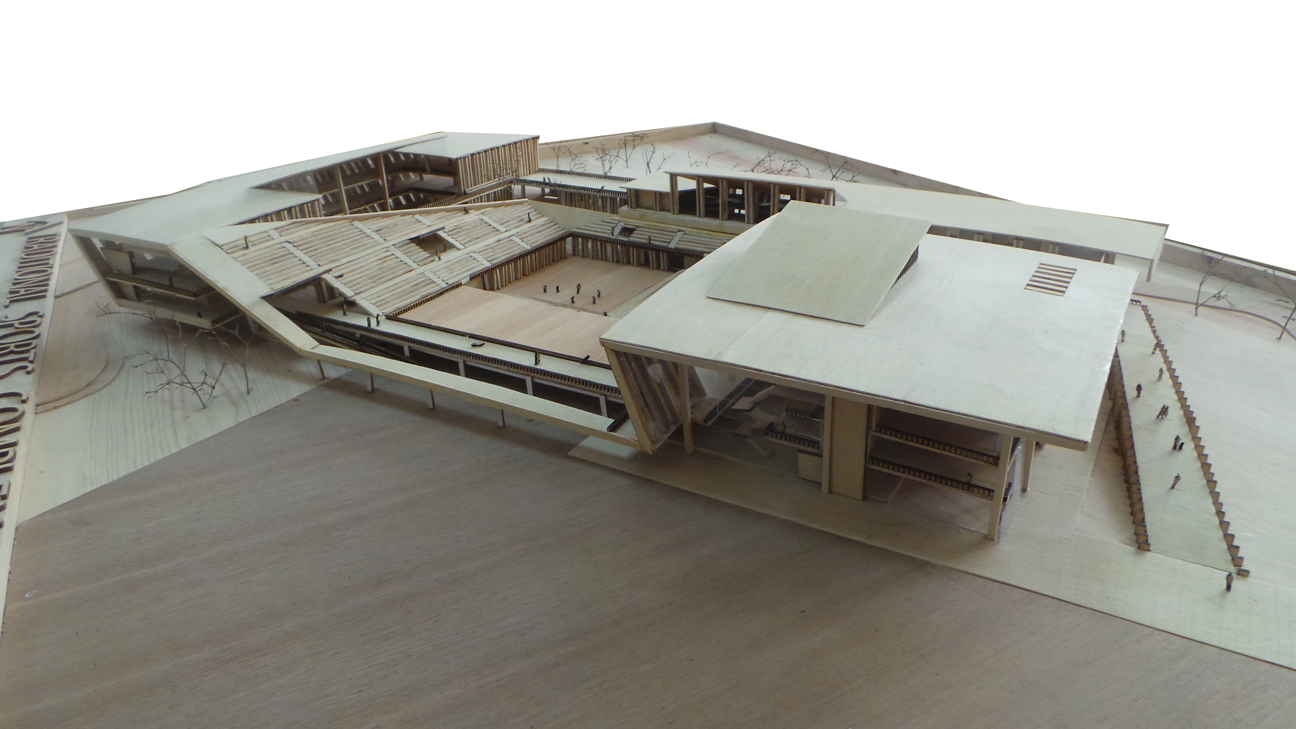
So after a comprehensive research of its origin and present condition, a common ground for these games is conceptualized. As, traditional games requires their own type of playground, so it is obvious to ensure proper grouping of them. Initially the concept originates from a layer of landscape that has all the essence of these games in its every corner. The layer is centered around a courtyard which contains the playground. At the playground, the tournaments and festivals would be performed. The playground measures according to the largest standard of the games. Apart from this playground there is a portion for water games. The layer then continue and folds to create space for semi indoor games inside and spectators gallery outside. To facilitate accommodation, players get dormitory and practice zone.
Again according to the research those games which no more exist are exhibited at the exhibition space. As such visitors would able to know further about those games. Thus, the project aims to create an awareness about traditional sports of Bangladesh and exhibits the games such a way that visitors can experience the excitement and essence of the traditional games.
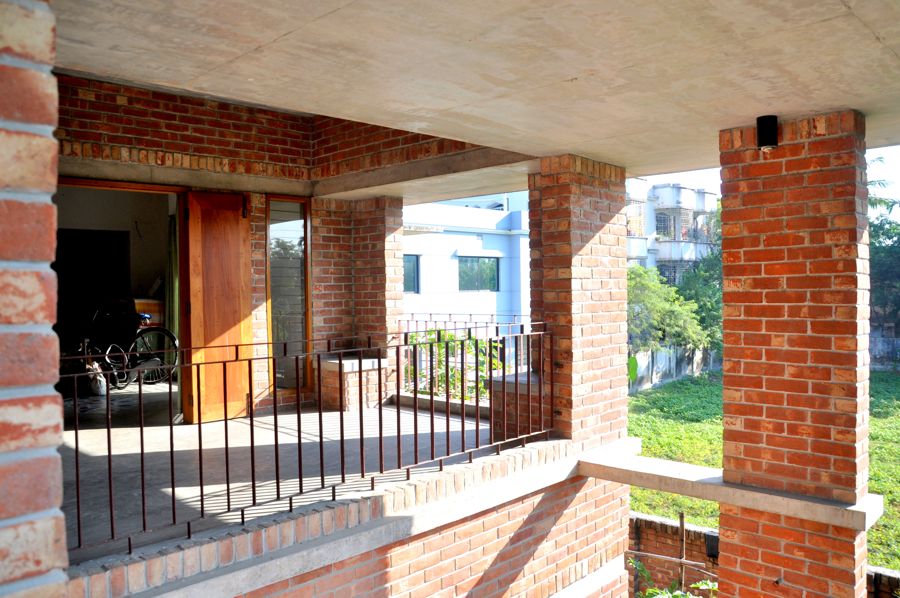
This project is located in a residential area at New town, Dinajpur. Our client, Md. Nazim Uddin Mondal, a government officer, wanted to build a residential building of his own where he can stay with his wife and two sons after retirement. His younger son Md. Mondal Hasan Zahid invited us to design the building for their family. Following the invitation we met with their family and found their living style very simple and polite. His father loves to live with trees around him. So, he requested us not to cut the trees in the site and immediately we responded to this issue. The site had shady trees in western side and we took it as our positive gesture to start the design process.
The program for this building was generated according to their future need. They wanted four bed rooms. One is for Mr. Zahid’s parents; one is for their guests as they host them frequently and other two for Mr. Zahid and his brother. Our client was insisting his sons for getting married after the completion of the residence. In design we considered it and went for a two story unit where Jahid and his brother’s bed rooms were located at upper floor.
They wanted an isolated room as formal living to attend frequent guests. So, we located it in ground floor and placed it according to their need. Eventually the building got its footprint of around 1745 sft in a 5400 sft(7.5 katha) site area. In first floor it has 1098 sft. We tried to open up the building in south east corner under deep shade for light and wind and placed the building at north side of the site to create enough space for a standard badminton court in south. We thought the building would get a visual space as well in doing so.
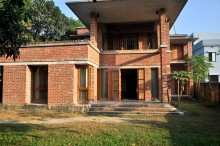
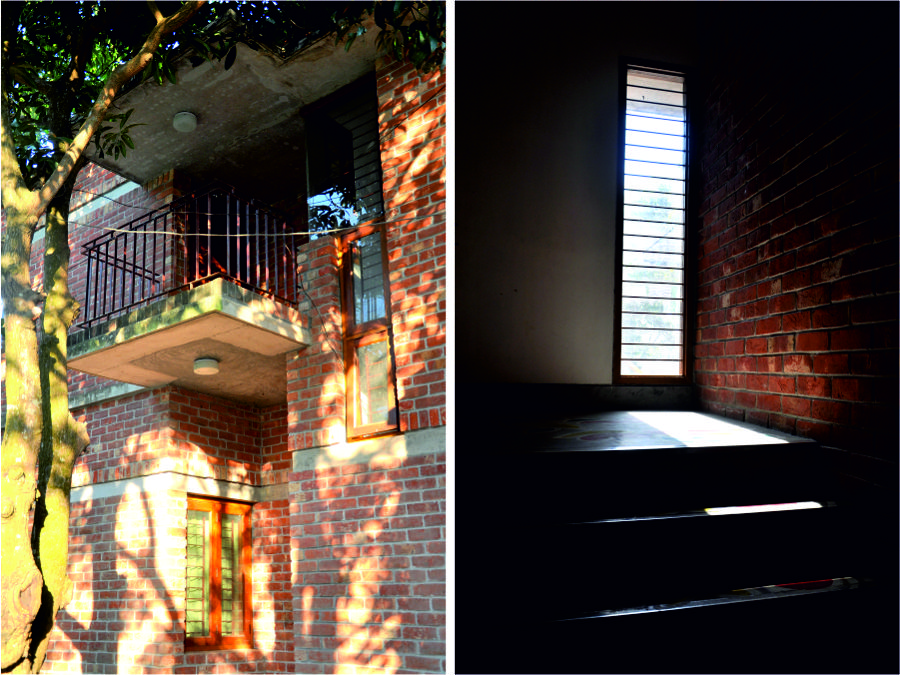
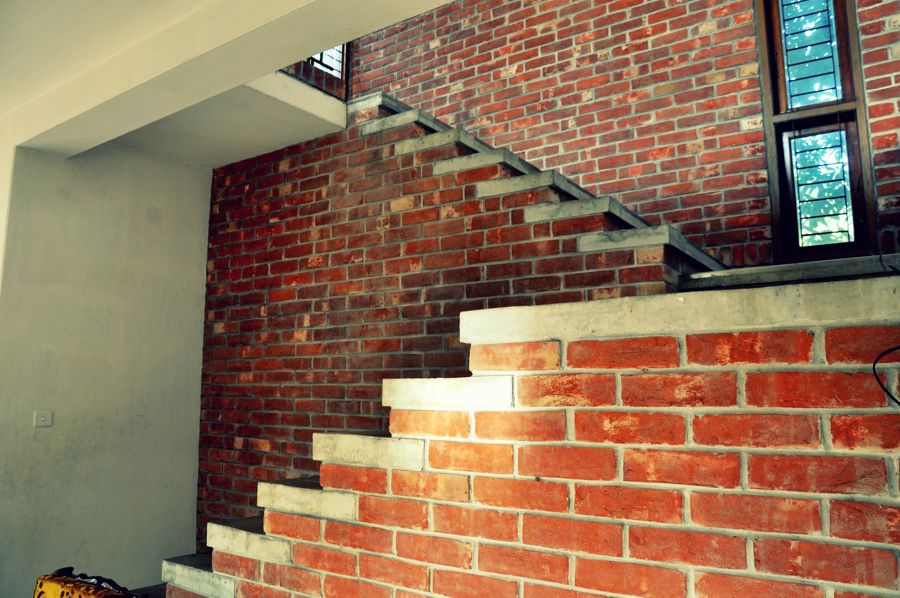
In the design process we constantly engaged ourselves in its construction procedure. We wanted the building to take its own shape according to need and context considering climatic judgement. We did not want to impose anything. For construction economy we opted for brick foundation on the basis of soil test. Then we sorted available bricks in brickfields and selected one. In constructing the building we thought to express its process which would also give a visual clarity in expression.
The project was financed by the client himself. He invested the money which he got after his retirement. The project cost was 28 Lac (approx.) We grant full credit to our client and contractor for their constant effort in the process. It was a cheerful participation for all of us involved in it.
The micro-climate of Dinajpur is extreme in nature. It is very hot in summer and cold in winter. So, the building was shaped (staggered) to allow wind and light from south into every possible space. Services were located in western side to protect western hot sun.
• We wanted to offer spaces for enjoying the seasons in our country; a terrace to enjoy rain and winter and a deeply shaded veranda to enjoy summer.
• Because of getting ample ventilation the building cools down quickly and there is no need for artificial light in day time which significantly reduces its energy consumption.
• We hope the play area in front of the building will allow many happy moments for the generations to come into their family.
The northern side of our country was famous for their masonry work as their craftsmanship was remarkable. But while visiting there we saw degradation of their pride as the recent builders are not focusing on their craftsmanship but considering profit only. We wanted to promote their knowledge in brick work so that it may continue to generations.
Energy efficiency, Play area and scope of plantation was the key considerations in the design process.
Densely Populated Dhaka city often fails to adequately meet the educational and recreational needs of marginalized community, who often lack spaces for carrying out those activities whether it is in their house or in their local arena. Due to high land demand in the city, it is not sensible to accompany these activities through the proposition for new structures in the city.
The Tejgaon Flyover site was the first initiative to restore existing underutilized by giving them some purposeful meaning. This site was deliberately chosen due to the presence of a large number of marginal people in the neighboring Tejgaon Industrial Area. As the flyover stands next to a residential and industrial area, the underneath road devoid heavy traffic circulation and that creates some opportunity spaces under the flyover to be used for community service.
Construction phase | Photo credit : Srijon Barua
The research was a part of a master’s thesis and the design came out from an extensive ethnographic fieldwork with the poor settlers in the Tejgaon Industrial Area. design is done from the perspective of these special group of children whose needs and behavior are obviously different from formal school children. It proposes educational facilities for both the disadvantaged children living in the area, who cannot afford to go to a formal school as well as the underprivileged men and women workers from rickshaw pullers to industrial to workers to domestic workers as well. The goal of the project is to provide education along with art, music, recitation and dramas and so on. Project uses prefabricated structural features which was specifically used for easy transportability. Construction Materials were bamboo wood and board panels .
Photo credit : Srijon Barua
Photo credit : Srijon Barua
Photo credit : Srijon Barua
Photo credit : Srijon Barua
Project background and team profile:
Deyal Kotha started as a design intervention project that promotes interactive education for the disadvantage communities living next to the Tejgaon Flyover in Dhaka city through an amalgamation of artworks and cultural activities using the underutilized wall underneath the flyover. The research for the project was first initiated under the supervision of a master’s thesis project at Harvard University Graduate School of Design.
Deyal Kotha begins | photo credit: Srijon Barua
Deyal Kotha begins | photo credit: Light of hope
Deyal Kotha begins | photo credit: Light of hope
The project was funded with the Edward M Kennedy Center Small Grant in 2014. ASF-AWARD-2015 which honors initiatives to improve public spaces globally and Walk21 Vienna: the Walking Visionaries Award for Planning and Design for Livable Public Spaces. The design was developed by a team of young architects namely Srijon Barua, Samain Sabrin and Naziha Mohammed under the supervision of Sahjabin Kabir and Tanzia Islam and implemented by Avantgardes, a non profit organization in co-operation with DCC North and EMK centre Dhaka . The name was suggested by one of our designer , Srijon Barua. Teachers who are working here, are volunteers from the NGO “ light of hope”. Other project partners are Germanprobashe and Voices of Bangla (VoB) .
A two day long event titled ” An architectural walk through: M. K. Palash in town with Vistaara” took place on October 23-24 at port city Chittagong. Crowded with architecture aficionados of the city, the program started with the launching of the inaugural issue of DOT, a quarterly published magazine edited by celebrity architect Mustapha Khalid Palash, at the A. K. Khan Memorial Auditorium of Fulki.
An architectural presentation by the architect himself followed by an exhibition of his architectural works also marked the event.
In his presentation Architect Palash talked about architecture and its impact on city. Referring to rapid urbanization and uncontrolled growth of Dhaka he argued that life still exists in the so-called unlivable city of the world. He suggested young students, architects and planners to design more sensibly for not to destroy the natural settings of a context. He also requested architects to be more socially responsible in designing structures. Then he presented his first sustainable building of the country “GP House” with its salient issues along with Basundhara City, Radisson Blu Chittagong Bay View hotel and his other tall building projects.
The following day Architect Palash guided a tour through his newly completed multistory five star hotel Radisson Blu to describe his mastery display of architectural work. He revealed each and every detail behind his iconic work started from planning level, the selection of finished material to furniture and light shade design.
The event was organized by Bistaar: Chittagong Art Complex in collaboration with the Institute of Architects Bangladesh, Chittagong Chapter and sponsored by Confidence Cement.
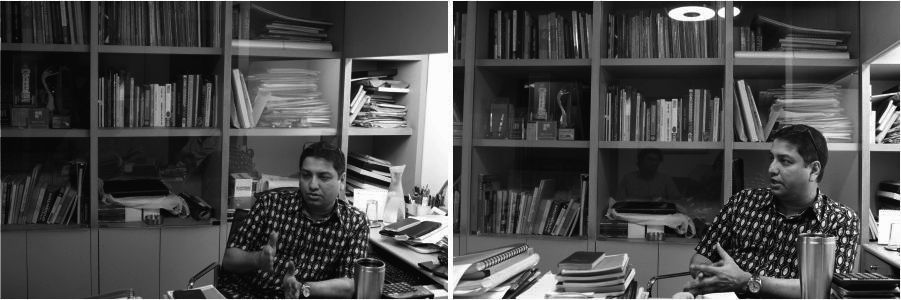
Ar. Mamnoon Murshed Chowdhury is currently serving as the Assistant General Secretary of the Institute of Architects Bangladesh (IAB). He had earlier served two terms in the IAB Executive Council as the Secretary Professional Affairs. Ar. Chowdhury is a Partner of the renowned and award winning architectural practice DWM4 Architects. Along the service period of twenty years, DWM4 Architects has produced numerous well appreciated projects such as Bishwo Shahittyo Kendro Bhobon in Bangla Motor, Bay’s Edgewater in Gulshan, Junior Laboratory School in Dhanmondi. Ar. Chowdhury is also a Visiting Faculty at the University of Asia Pacific, Dhaka. Context team met him last month at his workplace and had a vibrant, thought provoking discussion on professional and academic issues relevant to architecture in Bangladesh.
1. IAB has been widely overhauled in last few years and ever more active now considering how it used to operate in earlier days. What is your look at the progress situation?
Actually the change was inevitable. There was no option left as the number of architecture graduates and members had increased a fair count in past few years. IAB had to improve it’s efficiency. Unlike organisations where government appoints the operational body, IAB is run by an Executive Council which is elected by its members. Therefore, it has accountability as the performance is evaluated by the general members. Therefore, we got to be responsive. There had been significant changes in leadership as well; we had visionary people on board. Additionally, in last ten years, members of similar vision got elected in due intervals. There is criticism regarding this phenomenon though; some members would say the opposite might be better. From my personal point this was positive – this trend allowed enough time for the subsequent elected committees to initiate a positive change as they shared mostly similar agenda. We definitely needed continuity. But as I said before, the modification did not entirely occur due to visionary leadership; rather it happened eventually as per need of the architecture community.
On a separate note, I think our progress lies in establishing our position with respect to related government organizations. We have been able to convey the importance of the profession and place ourselves in a position where they don’t think of taking a major decision without consulting IAB. Credit must be given to the figure heads. I must acknowledge efforts of architects like our Immediate Past President Ar. Mubasshar Hussain. As President he had a powerful presence in the community and made our presence inevitable as well. He raised the impression of architects among the social and government bodies. As a result, in spite of being a very small community compared to other professionals like engineers, lawyers or doctors, architects’ opinion is given considerable weight at the policy making levels. Architects who are activists in the area of environment, conservation etc. fields have also helped to raise the image of the profession. Now we have been able to get into a point where mayors of major cities consider our opinion before taking important decisions.
2. What, you think, could be key factors for further development/improvement?
Well, for a positive change, at first you need vision, to realize vision you need leadership and to execute leadership, one requires efficient management and administration. A lot depend on leadership. Leaders need to spare time and lead from the front, not like those online cartoons where you see people being pushed by their leaders from behind. Leadership by example is what we need. If you see sector wise graphs of performance in IAB Executive Council, you might get a Manhattan skyline. This is because of the difference in level of time and effort given by different members to their respective areas . Sectors, where individual EC members are allocating more time and effort, are doing well and good. But sectors that lack the necessary time input are lagging behind relatively.
But you have to realize that this is a volunteering position. All EC members survive on full time jobs or practice. They have limitations in terms of how much time and effort they can actually afford. So expectations need to be realistic also.
3. Referring to your previous answer, how can we bring consistency and coherence in development of all sectors covered by IAB?
That’s obviously difficult an issue to fix. A way to solve the problem might be to have an efficient workforce employed. There has been much talk about it. For example the administrative head of Malaysian institute of architects is ranked as CEO who is paid a salary and works for the institute full time. He has supporting administrative and technical staff for standard operation. But you need money for that type of framework. We get a certain amount from the government and raise some from membership fees. Yet that’s not sufficient. Therefore, we have to look for sponsors; and that’s not only for smooth operation but for arranging CPDs, lectures, seminars etc. as well. But then there is criticism questioning why some events arranged by IAB are labelled as powered by certain sponsors or why sponsors are given opportunity to talk in the seminars in between lectures. We have got to realize that in the era of globalized capitalist economy, you have to look at corporate sponsors to execute an event. Allowing a slot in between lectures in a seminar is like having an advertisement in a page of a printed publication within articles.
Anyway, my personal point of view is that we have miles to go to achieve optimum management efficiency. We are not up to the mark yet in terms of service to IAB members. We have to increase number of professionally trained staff along with many other necessaries like automation, logistics etc.
4. One of the significant changes in past few years has been to introduce membership exam. There have been opposing comments on this. Let us know the vision behind such initiative.
I do agree that membership examination created large debate. We have overcome the first hurdle which is to establish the necessity of such exam among the architects and it finally started.
However, the format and content of the exam might require further thought. Throughout the world it is established that there should not be a qualitative judgement through this exam. The main objective is to test if an architect is aware of the basic points of practice mainly focused on health and safety issues and building regulations. Areas that involve interface between related professionals and architects are also featured. One has to realize, it is not an exam of design excellence. It is assumed that you have learnt your design basics and architectural capacity in the academy, the credentials of which is again evaluated by IAB through the accreditation process.
The issue that comes next is the test of basic qualitative knowledge like history, culture, trend etc. I have seen architecture graduates who are not aware of simple things related to our architecture or history. At some point we might have to think whether we will put another archway on the path to become a practicing architect by incorporating general cultural, historical or even design capacity issues. To be specific, right now we conduct exam on ‘code of ethics’ and ‘Bidhimala’ only. In future, it may become imperative to broaden the area.
Saying that, I must agree we don’t have the logistics and administrative manpower to take the standard of the exam at an optimum level. Say for example, we don’t even have a situation to enforce proper exam conditions in practice; we are unable to provide enough spaces for the examinees. We have to work a lot on exam matters as a whole; no doubt, only then we will overcome all criticism.
5. Taking the point of criticism, there is a circulated commentary regarding how IAB should operate- as a professional body or as a social entity. Many probably look at IAB like a social body for regular communal activities. Seeking your opinion in this regard.
We have discussed about the growth of activity areas of IAB. It is my observation that the generation of architects who graduated around 80’s had guided IAB to more institutional format. They could manage to have an office for IAB, recruited couple of full time staffs. I should say they took the first step towards professionalism. We are working in continuation to that effort. However, many architects still think we should operate like early days when there were few architects and social programs like picnic, cultural events etc. should feature among the primary agenda of IAB. To them it might still be an entity promoting social communication.
Then there is also a differing opinion to which I subscribe to. We emphasize on IAB being a professional body with a fast increase in membership volume. It cannot host activities carried out by a club or an alumni association. The difference between a club environment and a professional one has to be accepted. I don’t see there is a reason for IAB to act as a social organization. It is essentially a learned body. There are alumni associations that can act as social organizations instead.
Having said that, there may be limited social activities, but we have to prioritize. If you have limited budget, time and energy to allocate, then 90% of it should be spent on professional development.
Mamnoon Murshed Chowdhury (5th from the left, standing)taking oath as the AGS of 21 EC of IAB. Photo Courtesy: IAB (Used from the photo archive of CONTEXT)
6. What is the possibility of an ‘Architect Registration Board’ as exists in some other countries?
I hardly see the possibility in near future. The examination system IAB is trying to develop is being done with a similar vision, the licensing process will be further strengthened if and when the new version of Bangladesh National Building Code is published, where IAB has strived hard to establish the rights and scopes of architect as a professional. I would like to mention another thing in this regard – our predecessors worked hard to establish an ‘Architects Council’. I think at times this was the first and foremost agenda of IAB. But when we looked at the formation, we found, it had an ineffective charter. Within the proposed charter, the Council would be a politicized institution as the head will be appointed by the government and some other posts would have government officials as well. That might create a scope for political control and domination. Till now IAB is the only professional body that is not yet politically divided and we must keep it like that. There are however very positive aspects of the Council. But if the rights of professionals that the Council could ensure, is achieved in various other means, then it is better to avoid the risk of becoming a politically motivated organization.
7. Can IAB provide professional service?
I think an article in the IAB constitution can be loosely interpreted as allowing such service. But we are against it. Let’s leave the professional services to the professionals. IAB should concentrate on the well being of the professionals as clearly specified in the constitution and should not look for work.
8. There are a number of practicing firms in Dhaka, many of them are doing really well. Yet there is a commentary circulated among us that construction industry is in a downturn. Especially developers, one of our major development partners, are complaining about the downfall in recent years. Therefore, where are we standing at the moment?
It’s very true that there is a stagnant situation in the construction industry. As indicators, price of apartments could be one to pinpoint the downturn. Price of both land and apartment have been standstill for a long time and there is a visible recession in this sector.
The situation in practice is not bright at all – work load is definitely reducing. A large number of our clients are the real estate entrepreneurs. They are not taking up new projects for last couple of years. My practice is affected first hand by that. Architects are probably moving into new avenues, for example turn-key interiors, landscape, material import, graphic design etc. I don’t think it’s a good indication for the profession.
Further, you can see we have not been able to increase architects’ salary for a while. Our salary is way less than the business graduates and things are not improving at all. To my information, few firms have closed down and few are being downsized. To tell the truth, in last 30 months our firm is in a break even situation. We have separated interior design section from the building section just to reorganize overhead. Couple of experienced architects from the office moved out. But we could only replace them with junior architects. We had to think financially, not in terms of work efficiency.
9. Is there any possibility that some architects/firms are not providing full service( yet partial) and sort of sneaking through the gate with a low fees ?
I will tend to differ. There are two groups doing well. One is who are doing good work and getting new jobs by reference. Other is working more on the business side and probably taking more turn key projects, and thus getting some profit as contractors. Now a day it’s difficult to succeed by delivering less. One may sneak in due to low fee, but only to realize that professional services cannot be afforded with that fee – so a compromise has to be made. In long run, that is hardly a strategy for success.
NC Residence at Gulshan (left), a book store at Shantinagar (right) designed by DWM4 Architects. Photo Courtesy: MMC
10. Let’s talk about the bridging of architecture education with profession in the country. You have been at the top of a well known and busy practice for number of years. To your opinion, are we up to mark with curriculum etc. and capable to produce quality graduate to serve different stages of the profession?
I think learning of an architect happens in two stages. First within the precincts of formal education and then in the professional arena, which is a lifelong one. I can’t expect someone to come into practice with every skill and knowledge necessary. It will not be very good if schools start to produce architects entirely to meet industry demand. I think schools at some point, probably nearing the end of the Bachelor program, may open up avenues for students. They should be given opportunity to choose a direction like research, practice, or even project/construction management etc. Otherwise I have seen efforts are often in vain. Why someone interested in construction management would put tremendous effort in final year design thesis? On the other hand I have seen good designers becoming ‘history and theory’ specialists later on. Students should be guided and mentored to decide, at least in the final years of studies, what they really want to do as an architect.
It is very important that universities put in their own quality control measures. Because many students are enrolling without knowing what they want, why they should study architecture! Many might not stay in the profession after graduation. Often you will sense architecture graduates not having the pulse of an architect. I think universities should look to address the existentialist questions like what it means to be an architect firmly and clearly with foremost importance. The essence of architecture has to be imprinted in a graduate’s mind in school. The rest could be done by the practices.
11. In the curriculum do you think some courses should be given priority over other? We mean courses which might be beneficial for practice. There is a general commentary circulated by the structural engineers that architects struggle with their structural knowledge.
I have also heard structural engineers complaining about lack of basic structural knowledge of some architects. But I don’t pay much heed to that. Give me names of five engineers who are qualified to comment and see if they are the actual persons passing these comments. I think it’s mostly the mediocre engineers who make such accusations. Some engineers become stressed when approached with out of the box concepts. Many structural engineers can’t deal with experimental works. It’s a globalized world and our architects are also coping with the present advanced trend. But engineers are not advancing that much to keep up and support creative thinking. They should put more effort to solve challenging structures rather than to just make generalized comments. A solution to changing their mindset lies in modifying the engineering education curriculum – that is, to insert more creative design and architecture appreciation courses so they understand the thought process of the architect and the inspiration that generates creativity.
12. In which sectors universities or graduates should focus in terms of job prospect?
In future decades there will be tremendous economic development in Asian region and Bangladesh is also working to become a part of it. There are investors in the world market who are interested in Bangladesh. We have a consistent GDP growth rate. So effectively there will be construction activities like industries, power plants, real estate etc. You have to improve your own skill to cope with the emerging demand. Otherwise foreign companies will start to snatch jobs eventually.
I am bit disappointed on the fact that so many of us go abroad to do Masters in Urban Design but none for a professional certificate in LEED, yet that might be considered more applicable in terms of regulatory demand. This is just one example. For many large and specialized projects like hospital, stadiums, terminals we don’t have qualified persons. These jobs will go to foreigners. I personally think ‘architect project managers’ are far more efficient than their engineer counterparts, but do we have a lot of them? We should look for more applicable qualifications.
Ar. Chowdhury at Kimbell Art Museum. Photo Courtesy: MMC
13. Competitions are very popular platform to flourish for young practices. In recent years young talents got their hold on the profession through competition and the trend is rising. Do you think the process is enough competent, systematic and productive?
Competitions have been more frequent in last decade. Young architects are coming through it. Especially open design competitions are like anybodies call, in most cases regardless previous experience or office size. Projects like Shadhinota Stombho, Liberation War Museum, Anjuman-e-Mufidul Islam headquarters buildings are being implemented while some others did not come to surface at all. We certainly have few jurors and same persons are doing the job repeatedly. Therefore, there is also a trend of typicality in selection.
For a young architect winning a competition, things actually become tough from the stage of deciding on fees and tougher when service delivery starts. In my view in the construction phase it gets even more complicated. You have to deal with contractors and other professionals and there lies possible corruption issues as well. None the less, in the end design excellence will also be evaluated by the community and users. Talented designers having management skills can overcome these problems if they are focused. There are examples like Liberation War Museum where the architects had to go apply patience and tenacity to see the design come to life in its original essence.
14. Your comment on the future of architecture as a profession/how would you like to see progress of this profession in the country?
Within few years we will be getting around 500 architects every year. I think image of architects in our society will be of great importance in near future. IAB has a major part to play here. IAB has to be firm in ensuring that Architecture as a profession operates ethically and contributes to society, while in schools students must learn the essence and core values of architecture.
As a professional entity we are yet to become socially inevitable. We are still unable to touch life of mass people. We need to increase our participation in the development of public life. Only when our service will able to reach mass people, we will be paid a better return for our effort. Architects have to come to a position when society will know the importance of nurturing architecture as a profession. I must agree as a nation we have been facing a social degradation in course of time. There is an influx of corruption in every sector. Apart from government sectors, private sectors are also affected now. This, I interpret as the crisis of capitalism without having gone through the phase of enlightenment. At this tough time, it is tougher to establish ethical standards among the architects. We must remember that architecture will always reflect the society; it is not a profession that can be practiced in isolation. If society does not nurture good practice, does not show cultural enlightenment, you cannot expect architects to be the last persons standing where possibly everyone may become corrupt. With the current social trend, we might find 4-5 boutique – practices every year, the rest would be mediocre or even less than mediocre. Architects need to carefully observe such phenomenon.
Delivering speech at TEDxDhaka, 2013. Photo courtesy: MMC
In future, projects will require more specialized service. Consolidation of skills is very important. Architects have to establish their expertise among certain sub-specialties like industrial design, healthcare facilities etc. utilizing emerging technologies. Urban and environmental issues are becoming more important. Architects needs to work on the issues where planners have shortcomings. We have qualified people but they are not getting scope. IAB needs to work on issues that create such scopes. With financial development of Bangladesh, improvement in infrastructure and services is also inevitable, and we have to address that phenomenon straightaway.
Future of this profession i.e. growth, survival, whatever you calculate, depends a lot on participation of private architects in public sector projects. There is huge development potential in public sector and funding is there as well. Government has to be convinced to play a part. Good public projects create way for more good architecture in other domains. City centers, museums, art galleries, government offices, public housing – these are projects that create scope for excellence in architecture, and eventually they make an excellent city. IAB needs to prioritize the participation of private practices in important public projects. If it is successful in doing that, I think the future will look good for us.
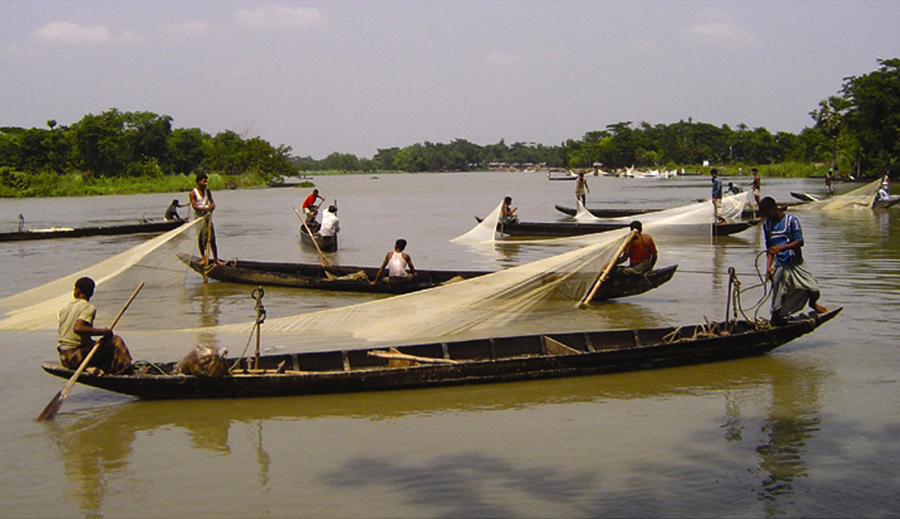
River Halda, originates from the hill-tract district of Khagrachari, Chittagong. It flows along the south west part of our country and confluences into the River Karnaphuli. Known as a fish-mine of Bangladesh, River Halda is very closely linked in the genesis of Rohu, Catla Catla, Mrigal and Kalibaush.
One focal physical feature, the ox bow bends of this river, combined with various other chemical and biological features make it unique. This is because the swirling movement that generates at the bends allows the river to generate the favorable conditions needed for the spawning of the carps. The River Halda, is believed to be one, out of only four rivers in the world, that can sustain the spawning process of these four major carps of the subcontinent naturally.
In the 1960s, River Halda produced about 3 times more the volume of fish than it does now, initiating a much greater scale of activity and a larger economic value in the world market. However, some interventions along the river edge led to the major degradation that the river faces today. Its deterioration is purely a cause of lack of awareness amongst locals residing along the edge, and the negligence from the government institutions to cause wakefulness locally and throughout the country. Amongst the many reasons, straightening of the river’s ox bow bends to control and tame the river flow, adaptation of improper methodologies of river edge protection to prevent homesteads and properties from getting destroyed by river edge erosion, illegal fishing of the brood fish when they migrate to the river during the spawning season, are the most effective ones in disturbing the balance of the ecosystem. A slow decrease in the economic graph follows as a result of these practices. This in turn acts to make the river a decreasing opportunity for fishermen, who are involuntarily led into changing from fishermen to agricultural farmers. And those few passionate ones left behind face extreme hardship and competition to earn a living.
Fishing in Halda River during Spawning Season| image source: bangladeshinformation.info
Concept :
People today know very less about our rivers, their ecology, and little do they realize how dependent our daily lives are on these water bodies. This is primarily due to limitation of access and interaction amongst the river, its community and us. River Halda awakening is a project that generated from the original of providing a platform to this river. The project is about helping one relate to the systems, lifestyles, economy and many more that grow from and around the River Halda, by promoting awareness and sharing knowledge, research, thoughts on local and international scales. It is an effort to enlighten the society of river life and its community.
Thus the project was functionally developed on the rationale of providing River Halda its earned status as a national river. Structuring spaces of training, awareness programs, and forums for the fishermen and locals on how to cope with the river in environment friendly ways, on maintaining the balance of the river ecosystem, on conservation process of the river bank treatment and many more, was one of the focuses. One other was to include spaces that would bring this community into light, allowing interactive activities that generate interest and wakefulness amongst all people. This was achieved through providing spaces for community decks where people could have hands on experience with the fishermen in their daily life activities, allowing guided visits to fishermen’s homesteads nearby, building up a restaurant space surrounded by farmed landscapes which would involve the consumers directly into understanding the ways of farming and cooking in ways that does not harm the river. Providing a ground for intellectuals, allowing them into further research, was amongst one of the important functional necessities. This would give an understanding of what should be farmed along the river edge could be matured along with many other studies.
River Halda research, training and awareness centre was thought to be implemented very near to the river itself allowing maximum experience of its natural forces and wonders of the river life. The spawning ground of the carps is tested to lie within a certain 20 km of the river course, approximately from Sattar ghat to Moduna ghat as the locals and researchers suggest. The site was therefore chosen well outside this sensitive zone, very near to the confluence with River Karnuphuli. The potential area for human intervention is surrounded with government hatcheries, fishermen’s habitats and a proposed ecology enhancement zone. All these features were added up into a loop of experience for someone eager to gather an understanding of the subject. The formal implementation of the spaces was to establish an environment friendly approach. These would then be governed by the local people, welcoming rather than imposing them into the functions that would help them build up.
As river erosion is a crucial natural process to be addressed, the project was thought of to acclimatize the people with two methods of river edge protection. The idea was to plant Vetiver grass along the edge of the river bank allowing the tree roots to trap the soil preventing it from being washed away by the rivers flow. This would also mean that the existing vegetation be left untouched as much as possible, because cutting the large trees would loosen the existing soil structure.
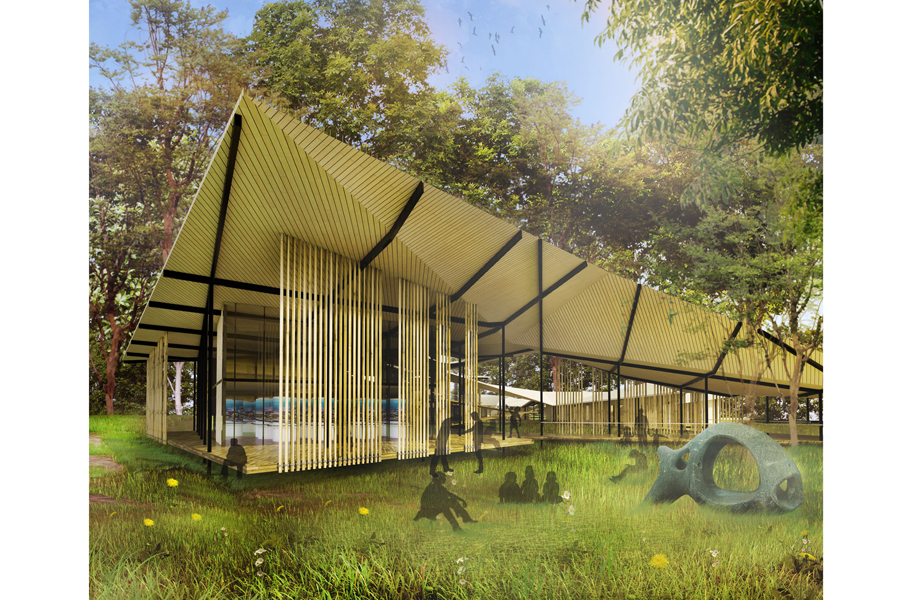
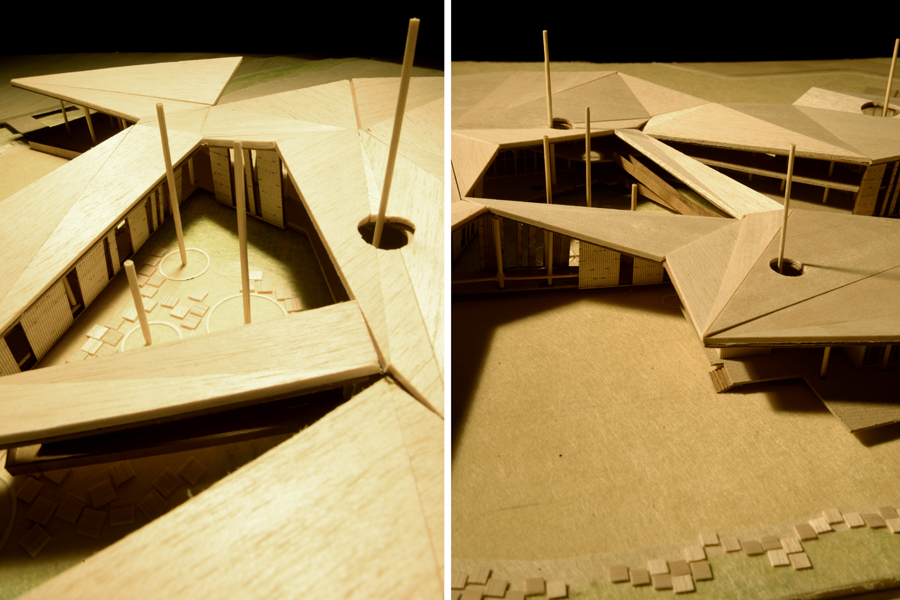
In mathematics, a Voronoi diagram is a way of dividing space into a number of regions. A set of points (called seeds, sites, or generators is specified beforehand and for each seed there will be a corresponding region consisting of all points closer to that seed than to any other. The regions are called Voronoi cells. In order to adapt to an eco-friendly course of action that would keep as much of the site intact, the whole site is overlaid in the Voronoi geometry. This is achieved by considering each tree trunk as a seed, connecting them first in triangulation and then by the midpoint method to form the Voronoi cells. Following this geometry allowed an understanding of the void spaces within the trees in which the architecture took shape. Each functional zone formulated into a polygon, with the sides placed in an away so as to allow maximum experience of the surrounding space that is lies adjacent to.
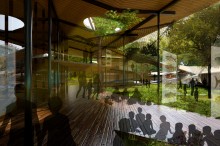
The undulations in the roof followed the principle of providing shade, going low where required, while going up to create generous views of the outdoor where necessary. The idea of “touch the ground lightly” is followed throughout the architectural process, with extensive use of materials that help blend into nature. Bamboo, mud and recycled wood, collected from the ship docks nearby, primarily define spaces, only with glass being introduced where there is an absolute necessity of temperature control and metal for structure.
This project was aimed to making people aware of one small process of nature and how dependent we are on each other. Crafted in a way so that it leaves a lasting effect of experience, knowledge and appreciation on people, the architecture was thought to create a dialogue in nature, helping people relate to bigger issues of everyday life that we neglect.
The inaugural occasion of Asia Architecture Award 2015 will be remembered for the glorious presence of Bangladesh in the arena of architecture in Asia. Out of 613 projects submitted from all around Asia, Bangladeshi Architects take out two spots including first place in Commercial category in 2AAA , 2015.
The theme for 2AAA, 2015 was “The Emergence of Contemporary Architecture in Asia”. The award recognizes projects that are driven by significant design innovation supported by contextual analysis and studies and which showcase technical advancement, innovative use of material , reflection of sense of place and ecology, reflection of cultural identity etc. This year, the award has been given to 29 projects in 7 different categories.
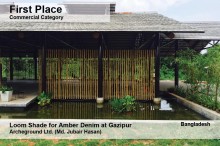
“Loom Shade for Amber Denim at Gazipur” desgned by Archeground Ltd. from Bangladesh has won the first prize in Commercial category. On behalf of Archeground architect Jubair Hasan received the award at a ceremony on 16 Oct, 2015 held at Istanbul, Turkey.
source: 2A magazine ( www.asiaarch2a.com)
The project Loom Shade for Amber Denim took its inspiration from the vernacular architecture of Bangladesh while it is modern in stylistic expression. The humble structure with modern amenities inside is fabricated with the locally available materials both natural and crafted. The lily pond and vegetation around the loom shade reflects sense of place in the truest sense.
“Keeping the project cost low was a challenge which was worked out throughout its completion. As for running expenses the introduction of watrebody, bamboo screen, high ceiling and other vernacular elements substantially reduces electricity cost by eliminating the need for air conditioning and artificial lighting and makes the space cool and comfortable to work in. The main intention is ease of use and comfort.” – Archeground (quoted from the presentation panel).
Another project that took the attention of the honorable Jury is “Friendship Centre” designed by Kashef Mahboob Chowdhury (Urbana). The project received 2nd prize in Urban/ Rural / Landscape category.
Under the organization of 2A magazine and presence of Ahmad Zohadi (CEO of 2A magazine and chief organizer of the award) the 2015 jury, Romi Khosla, Bahram Shirel, Seung H-Sang, Sinan Mert Sener, and Yavuz Selim Sepin decided on the winners for each category.
Congratulations to all the award recipients and specially to Archeground and Urbana for their outstanding achievements.
Click here to read more about the winners and honorees of the 2AAA Awards, 2015.
IAB announces a CPD course on “Imarat Nirman Bidhimala, 2008” on Saturday, October 17, 2015. All members are especially encouraged to register for the course for its current relevancy to the professional context.