Echoes of the Estuary: A Tourism Center at Hatiya Dwip

World Environment Day 2026

Urban [Re]Stitch

Dept of Architecture, AIUB Celebrates its 1st Decade with D. K. Ching

| Ar. Tarek Morad |

Stepping into 10th year of maneuver with success Department of Architecture, AIUB organized an event entitled “AIUB Architecture Week 2016- Celebrating 10 years of Architecture at AIUB” from 4-7 January, 2016. The occasion was to rejoice the sublime decade as an architectural school in Bangladesh but the subliminal notion was to share the pride and triumph of the department.  The main attraction of the event was the presence of renowned author and Professor Emeritus, Francis D. K. Ching, of University of Washington, Seattle, Washington, USA who is the cult figure in the architecture education in Bangladesh. This was also Professor Ching’s first visit to Bangladesh. The four day event comprised of International Student Design Competition, Lectures and Workshops by international and local experts, Student Work Exhibition, Publications, Cultural programs etc.

A month before the main event, Department of Architecture, AIUB in association with Institute of Architects Bangladesh (IAB) commenced an International Student Design Competition. The competition addressed the theme of “Pavilion for Bangladesh at EXPO 2020 DUBAI, UAE”. More than 30 participants submitted their creative ideas and designs for Bangladesh Pavilion. A distinguish jury panel consisted of Professor Francis D. K. Ching, Professor Dr. M. Saleh Uddin, Ar. Mustapha Khalid Palash, Ar. Mahmudul Anwar Riyaad and Ar. M. Arefeen Ibrahim selected three winners and one honorable mention from the submitted designs.

01 Jury
Jury session of International Student Competition PAVILION FOR BANGLADESH AT EXPO 2020 | Image Courtesy : Dept. of Architecture, AIUB
02 Winner
Winners with the Honorable Jury Members and Distinguished Guests | Image Courtesy : Dept. of Architecture, AIUB

On the first day of the celebration, January 4th, 2016, an inauguration ceremony and a festive rally were organized by the department faculties and students. RAJUK chairman GM Jainal Abedin Bhuiyan, AIUB Vice Chancellor Dr. Carmen Z. Lamagna, IAB president Ar. Abu Sayeed M. Ahmed and AIUB officials were present at the event. On the same day, a workshop, “MOVING ENTOURAGE IN ARCHITECTURAL ANIMATION” instructed by Professor Dr. Saleh Uddin took place in Department premise. Professionals and students from different universities attended the workshop.

The main Celebration Ceremony took place at IAB Center, Agargaon on 5thof January, 2016, where the   main attraction was the lecture by Professor Francis D. K. Ching. Honorable Science and Technology Minister of Peoples Republic of Bangladesh, Yeafesh Osman inaugurated the ceremony. More than 600 guests, comprising of Architecture students, alumni and faculties from AIUB and other universities, Architects and other related professionals of the country attended this event which made it more purposeful. ‘Seeing, Thinking, Drawing’ was an eclectic speech from Professor Ching regarding drawing skills and methods.His valuable speech and the affluence of his experienced words certainly enhanced the joy of the ceremony and also encouraged the students and the guests as well. The Celebration Ceremony also included several other events like, Launching of Steps 3: a student work publication of Architecture, AIUB, Result announcement and award giving of International Student Design Competition ‘Pavilion for Bangladesh at EXPO 2020 Dubai’, Launching of event souvenir booklet, Exhibition of the shortlisted entry of the competition and a unique Cultural program, and the Grand dinner.

Image Courtesy : Dept. of Architecture, AIUB
Lecture by Francis D. K . Ching at Celebration Ceremony | Image Courtesy : Dept. of Architecture, AIUB
Image Courtesy : Dept. of Architecture, AIUB
14 Main Event
Colourful cultural program | Image Courtesy : Dept. of Architecture, AIUB
18 Main Event
Honorable Vice Chancellor of AIUB Dr. Carmen Z. Lamagna is delivering her speech | Image Courtesy : Dept. of Architecture, AIUB


12 Main Event

Image Courtesy : Dept. of Architecture, AIUB
Student work exhibition| Image Courtesy : Dept. of Architecture, AIUB

ex

Image Courtesy : Dept. of Architecture, AIUB
Student work Exhibition | Image Courtesy : Dept. of Architecture, AIUB
Image Courtesy : Dept. of Architecture, AIUB
STEP 3 – Student work publication | Image Courtesy : Dept. of Architecture, AIUB

As part of the celebration program, a workshop ‘Drawing Dhaka’was conducted by Professor Francis D.K. Ching on the next day January 6, 2016, at National Assembly Building, Dhaka. This interactive and hand to hand workshop gave the participants a perception about what to “observe” while “seeing” something and how to interpret those observations in sketch book. Participants, who included students, faculties and professionals got the rare chance to draw and express their ideas behind the drawings to the pioneer D.K. Ching himself.

workshop_ching
D. K. Ching at the workshop | Image Courtesy : Dept. of Architecture, AIUB
Image Courtesy : Dept. of Architecture, AIUB
D. K. Ching at the workshop | Image Courtesy : Dept. of Architecture, AIUB
Image Courtesy : Dept. of Architecture, AIUB
D.K. Ching at the workshop | Image Courtesy : Dept. of Architecture, AIUB

Moreover, at the afternoon of the same day, a lecture series took place at AIUB auditorium. Founder Head and Advisor of the department of Architecture, AIUB, Professor Dr. Saleh Uddin and renowned Architect Mustapha Khalid Palash gave lectures on Architecture education and current practice in the field of Architecture in Bangladesh. Students from Department of Architecture, AIUB asked questions about global and local scenario of Architecture regarding economy, culture and social aspects. Professor Francis D. K. Ching, Chief Architect of Government of Bangladesh Ar. Kazi Golam Nasir, Head of the Department, Architecture, AIUB Ar. M. Arefeen Ibrahim were also present in the occasion.

“The reason for arranging this eventful program is to give confidence to the students so that they could go further, dream big, and be the part of socially responsible, culturally sensible Architecture community”-says M. Arefeen Ibrahim, Head, Department of Architecture, AIUB.

  • 11 Main Event
  • 06 Main Event
  • 10 Main Event
  • Opening 01 (1)
  • 17 Main Event
  • 15 Main Event
  • IMG_6630
  • workshop 1b
  • workshop 1a
  • Opening 01 (5)
  • 07 Main Event

Celebration of the Third cycle of ‘The Noman Award for Excellence in Design’ (NAED) 2015

| Ar. Saiqa Iqbal Meghna,  BRACU |

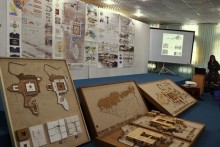
Department of Architecture, BRAC University celebrated the third cycle of the ‘Noman Award for Excellence in Design’ (NAED) 2015 on 17th January 2016. Through this event the department celebrated the best design from the graduating batch of 2015. The Award Giving Ceremony was followed by an Exhibition of the shortlisted projects. Vice Chancellor of BRAC University Prof. Syed SaadAndaleeb, Chairperson of Department of Architecture Prof. ShahedaRahman,Ar. KhaledNoman AIA (American Institute of Architects) and Ar.Jalal Ahmadgraced the occasion. Eminent architects Ar. SaifulHuq, Ar.KaziKhaled Ashraf were also present at the event.

Nine projects were selected from two final year studios completed in 2015. Nominated Students were Mohammad TaifHasasn, RiffatFarjana, Md. ShaifurRahman, TurjoyChowdhury, Md. SiddiqulMowlaRonggon, Md. AshrafulAlam, Afreen Ahmed Rochana, Rayeed Mohammad Yusuff and KaziNajeebHasan.

A jury panel containing eminent architects have reviewed all the nominated projects and selected the project titled ‘People of the Water’ by KaziNajeebHasan as the winning project.Prof.ShahedaRahman,Prof.Fuad H. Mallick, Ar. KhaledNoman AIA, Prof. Zainab F. Ali, Ar. Jalal Ahmad and Ar. Mohammad FoyezUllahwere the members of the Jury Panel. The Jury Session, Exhibition and Award Ceremony were coordinated by Ar. SaiqaIqbalMeghna, Senior Lecturer of Department of Architecture, BRAC University.

This Award is being generously awarded since 2013 by KhaledNoman AIA, an architect of Bangladeshi origin, living and practicing in Chicago, USA. The award is given once every year to a student with the best graduating design project from the Department of Architecture, BRAC University, to enhance student’s active participation in architecture design process. Final year projects are short-listed by the respective studio teachers and a Jury Panel containing external critics reviews and selects the winning project from the nominated projects.

Tanzina Binta Harun © Department of Architecture, BRACU
Image Courtesy : Tanzina Binta Harun © Department of Architecture, BRACU
© Department of Architecture, BRACU
Image Courtesy : Tanzina Binta Harun © Department of Architecture, BRACU
© Department of Architecture, BRACU
Image Courtesy : Tanzina Binta Harun © Department of Architecture, BRACU
© Department of Architecture, BRACU
Image Courtesy : Tanzina Binta Harun © Department of Architecture, BRACU
© Department of Architecture, BRACU
Image Courtesy : Sumaiya Ara Simi © Department of Architecture, BRACU
© Thesis Panel of People of the Water by Kazi NajeebHasan

Chandigarh Unbuilt | Entries from AIUB

Competition Background: 

The international idea competition ‘CHANDIGARH UNBUILT: Completing the Capitol’ hosted by archasm, India in 1st August 2015, this was an open International Competition to generate progressive design ideas from students , architects, engineers, designers, artists and philosophers all over the world. The competition was organized for education purpose only.

As designed by Le Corbusier, the Capitol Complex is currently not completed, three buildings at the complex have been built according to Le Corbusier’s plans—the Secretariat, Assembly Hall, and High Court—but the fourth and final building, called the Museum of Knowledge(MoK), has yet to be conceptualized. Archasm was looking for designs that will serve the purpose of a knowledge and connaissance museum in the context of the 21st century, while also considering the “importance of Le Corbusier’s version of modern architecture,” as well as the use of surrounding public space and its affect on the community.

Entry from AIUB | Shortlisted (top 50)

Team Member: Tabassum – Ul- Zannat [Team Leader], Md. Ruhul Quddus, Farzana Yesmin

Elevation Render

site plan_small
© Tabassum – Ul- Zannat [Team Leader], Md. Ruhul Quddus, Farzana Yesmin
Theme:

Inspired from the unique poetics of machine and metaphor developed by Le Corbusier, the idea was to conceptualize the project ‘Museum of  Knowledge ‘  metaphorically following Cobusier’s notion of visual and spatial analogy.

Knowledge is a journey of life which starts with curiosity and gained by the experience. Curiosity begins at childhood; a child wants to know his world, wants to explore the surroundings. Metaphorically this phenomena can be compared with fluidity, layering, colorfulness in spatial terms.

Whereas Experience refers to the act or process of gaining  knowledge, maturity and skills through direct practical contact or observation. Knowledge acquired by experience is factual as it is based on past event. in other words it stands firm foundation of factual evidence. So the possible connotation of Experience can be Boldness and solidity in  Architectural language.

masterplan_all

INTERIOR

© Tabassum – Ul- Zannat [Team Leader], Md. Ruhul Quddus, Farzana Yesmin

CHECK THE COMPETITION WINNING ENTRIES HERE 

Other Entries from AIUB

combind high

combind high
© Hossain Rayana and Kafil-Saddam


Ibrahim Faez_Tanvir Md._Sarker Rasel-2

Ibrahim Faez_Tanvir Md._Sarker Rasel
© Ibrahim-Faez, Tanvir-Md. , Sarker-Rasel


Mila Siratun Nesa_Jahir Nabila Binte-1

Mila Siratun Nesa_Jahir Nabila Binte-2
© Mila Siratun Nesa and Jahir Nabila Binte


finale

finale
© Muktadir-Abedin, Rabbi-Ahmed and Karan-Srijan

KYM Field School | International Competition Entry from KUAD

Competition Background :

KimseYok Mu (KYM) Solidarity and Aid Association was established as a NGO on 18 January 2002.KYM has started the TEAVUN (Charity) project to support the development of Africa, where it carries out several humanitarian aid activities. Under the TEAVUN Project; it will support sustainable development in Africa with KYM Field Schools, KYM Agriculture, KYM Vocational Schools and KYM Clean Water Programs. With the KYM Field Schools program which has started in 2015 and will continue for 5 years, several schools will be constructed and released to local authorities. For this KYM has arranged a design competition for prototype field schools. The competition was open for architects and architecture students.

KYM

The Project:

The proposed prototype school is conceived to grow up with the community and the children. So designer’s first concern was to keep the scheme for the school as simple as possible. Perhaps so simple that it could be built by the community people with their local construction materials and local knowhow. Except the roofing panel Industrial material was avoided intentionally. The main construction material is compressed earth brick (CEB) which is used for walls. Locally buildings are constructed of this material in a very low cost. No external material is needed, as the building is made of earth itself. No need to burn the mud as there is very low rain and the earth is very hardy.

p4444

© Muhaiminul Islam Rahi and Team


Secondly the school should have enough scope to grow up when the student number increase. The program said to design considering 60 students. But the school is designed with a scope for vertical extension so that when student increases more classrooms can be added. A library is also proposed at the extension phase.

dasrf
© Muhaiminul Islam Rahi and Team


Thirdly the design is based on considerations of Savanna climate. Thick Compressed earth brick(CEB) walls with perforations at upper level for proper ventilation and a large overhang  roof to cover total mass to protect from the sun.  The posts are of Eucalyptus tree which are commonly available at those countries.

fgd
© Muhaiminul Islam Rahi and Team

International Design Collaboration for Kenya | UNHABITAT


URBAN PROFILES & SITES The towns included in the competition differ in size, location and character; hence, the issues of each town differ. The above provides an overview of the different sites | © unhabitat
URBAN PROFILES & SITES
The towns included in the competition differ in size, location and character; hence, the issues of each town differ. The above provides an overview of the different sites | © UNHABITAT


UN-Habitat in collaboration with Ministry of Land, Housing & Urban Development: Urban Development Department, Kenya, is looking for creative planning and design ideas for sustainable urban development in Kenya. Students from around the world are below invited to participate in a student design competition for Kenya’s towns.

THE THEME

In 2006, the government of Kenya launched Kenya Vision 2030, whose agenda is to transform Kenya into a middle-income economy country. This vision acknowledges that urbanization will play a vital role in transforming Kenya’s social, political and economic landscapes. However, if current and future urban centers are not well planned and designed, effectively governed and managed, investments in infrastructure up-scaled and or matched to the desired levels, they will be incapable of driving this transformation. Whereas Kenya Vision 2030 has set the roadmap at the national level, only a few individual urban centers in the country have formulated development plans to guide the realization of Vision 2030. However, with a devolved government system that tasks governments with mandatory urban and regional planning, it is expected that urban centers will increasingly prepare development plans.

A combination of factors has resulted in the numerous challenges faced by Kenya’s secondary cities and intermediate towns. These include:

  • Spontaneous growth, resulting in urban sprawl, informal developments, environmental degradation, ineffective urban form with inadequate public spaces, unequal distribution of social and commercial services, and overall unsustainable urban growth;
  •  Inadequate infrastructure such as roads, water and sanitation, solid waste management, electricity, recreation facilities, parking spaces etc.;
  • Inadequate housing (especially affordable low-cost housing) and public amenities (e.g. public space, recreational parks, health and education facilities, social halls etc.);
  • Ineffective land administration and land-use planning, characterized by illegal/informal land subdivisions that have contributed to a fragmented urban form, poor street network & connectivity, poor plotting pattern, and unplanned conversion of prime agricultural land to urban real estate;
  • Inability or lack of integration of informal economic activities and increasing competition over urban space between “formal” and “informal activities”;
  • Proliferation of informal settlements and their deteriorating conditions of living, often characterized by socio-economic deprivation;
  • High unemployment rates, urban safety challenges and related social issues;
  • Ineffective planning and governance institutions, characterized by inadequate capacity to plan and implement urban plans.

To address the above challenges the KMP undertook to formulate ISUDPs for selected towns in various counties in Kenya. This process is scheduled for completion in the last quarter of 2015. The competition aims to contribute to these ISUDPs by demonstrating the value of urban design in tapping the inherent potential of the towns and in addressing various challenges, including that of ineffective implementation of previous plans.

Each team is required to undertake urban design for one out of the 9 towns listed below.

1.Embu 2. Kitui 3. Machakos 4. Malindi 5. Mombasa 6. Naivasha 7. Nakuru 8. Nyeri 9. Thika

ELIGIBILITY

The application is open to students of Urban Planning, Urban Design, Architecture, Landscape Architecture, Urban Economics and any other relevant discipline globally.

Applicants from a specific school may apply as individuals or as a group. An applicant must be enrolled in a certified program during the 2015/2016 academic year at Bachelors (preferably those past their midlevel of their program), Masters, or Ph.D. levels.

Applicants whose choose to apply as a group can do so. Group sizes are open and an entire studio class from a specific university can register as a group, but this group, just like individual applicants will have to be paired with students from another university (based in Kenya or based outside Kenya, accordingly), to form an International Competition Team. All Teams must comprise students from both Kenyan-based universities and students from a university outside Kenya.

REGISTRATION

Each student need to register themselves via the online registration form, where they will be asked which option they wish to apply under. Please be prepared with:

A proof of your student status

The name of your fellow applicants (only if you apply as a local group or as an international competition team)

The name and email of your selected group or team leader (only if you apply as a local group or as an international competition team)

An agreed common name for your group or team (only if you apply as a local group or as an international competition team)

Please register for the competition HERE

IMPORTANT DATES 

Competition announcement – 11 Jan 2016

Questions to Secretariat and Answers – 11 to 23 Jan 2016. Answers will be provided on the website on 25th January 2016 and thereafter on a continuous basis until the competition ends.

Registration 11 Jan – 1st Feb 2016.

Registration deadline – 12:00pm/24.00 hrs. on 1 Feb 2016 (Nairobi time)

Notification of acceptance & teaming – 8 Feb 2016

Commencement of actual design work – 12 Feb 2016

Submission deadline – 12:00pm/24.00 hrs. of 10 April 2016 (Nairobi time)

Competition results and shortlist of best proposal for each town/site – 2 May 2016

Announcement of overall winner, exhibition and presentation of awards – 6 May 2016 (to be confirmed)

AWARD

The jury will select the best proposal from each of the 9 towns/sites. Out of these 9, the jury will select the overall best design proposal. The team with the overall best proposal will be the Competition Winning Team. The other 8 proposals will be runners-up.

The Competition Winning Team will be awarded $10,000 US. The Organizer will partly fund nominated member(s) of the team to participate in the Habitat III Conference in Quito, Ecuador from 17-20 October 2016.

Fashion Technology Park | BRACU

The Project has been envisaged in view of the current state of fashion and related industries in Bangladesh and the integrated development would provide commercial, industrial and residential spaces. And to integrate and synergies Fashion Business with economic growth of the nation and help it to convert its dream of becoming the largest economic powerhouse of the world in near future into a reality.

© Farzana Shahrin, BRACU


Everyone thinks Bangladesh is a poor country. For me – it’s rich in culture, fashion and everything. It gives me a lot of energy’……BIBI RUSSEL

Fashion is the need of the society; fashion is the mode of action, method of conduct, manner, custom, sort and way. Fashion is not only the method or the way how one is dressed up but it is also the style, what makes difference is the type of fabric, usage of threads, the combination of colors. It is important to prepare dresses as per the celebrations, customs – traditions; prevailing weather and the atmosphere. Today we need creativity; art and fashion. Fashion is a way of expressing oneself through carefully selected threads that cover our skin projecting out our inner thoughts and expressing our feelings. Hence designing a facility to promote fashion industry requires thoughtful integration of art and technology which makes the project unique from the other commercial complex.

© Farzana Shahrin, BRACU


In Bangladesh the textile manufacturing industry is a large scale industry, which is hungry of proper services- Designing, Sample-making ,Sample testing and Workshop. Proposed as an integrated development catering to the textile/fashion industry’s requirements of Bangladesh as a ‘one-stop-solution’ which also work as a “HUB”, the project Fashion Technology Park would be developed on a commercially self-sustaining format.In addition to that , there is a growing need for the development of Fashion Business and in Education in Bangladesh & particularly in this region. Based on this, it was felt that both the groups should be able to meet & fulfill their mutual needs at one place. Fashion Technology Park came in to existence as an answer to those needs.

The Fashion Technology Park in BANGLADESH will act as HUB will become a point of contact for manufacturers, retailers, designers and students

© Farzana Shahrin, BRACU


© Farzana Shahrin, BRACU


The global scenario of Fashion Business in a liberalized market is another propeller as the competition in quality and pricing is tough to go through. The proposed facility will help to improvise the fashion as fashion institute and industry of quality design intervention and competitive price. With this the manufacturers especially the textile manufacturers will be able to go for mass manufacturing.

51
© Farzana Shahrin, BRACU

Residence at Shahbazpur| Ar. Rajon Das

|Text from the architect|

General info:

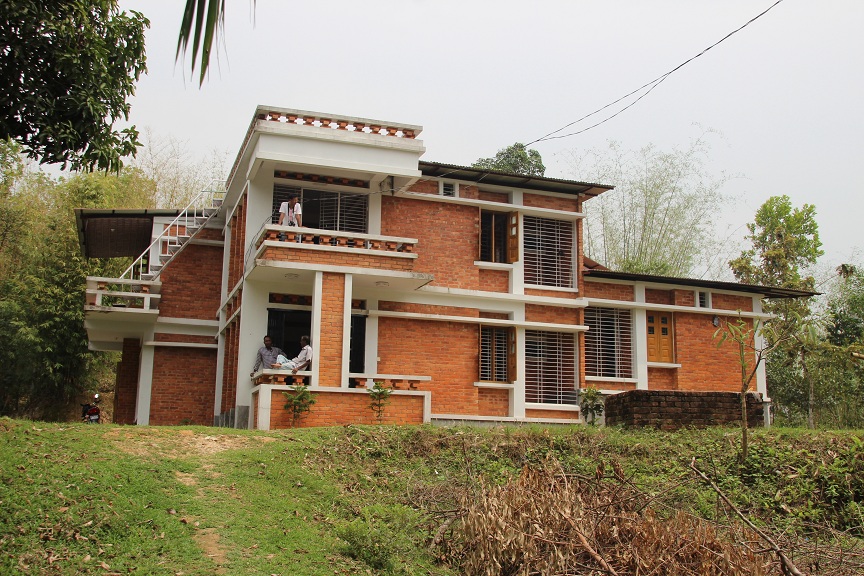
The building is situated in a hilly area of Shahbazpur of  Moulvibazar district. The elevation of the site is above 20’-0” from the existing road level. As the site is situated in between contour, the building placed parallel to the contour to avail maximum use of land. For the hilly topography it is a common fact of this region that almost every households are Isolated Cluster type with a long approach road from the inter-district road . This project was designed considering this very fact. It is the village home of Mr. Tabarak Hussain.

Inspiring Scenario of Our Courtyard House Type© Rajan Das
Inspiring Scenario of Our Courtyard House Type © Rajon Das


Zoning:

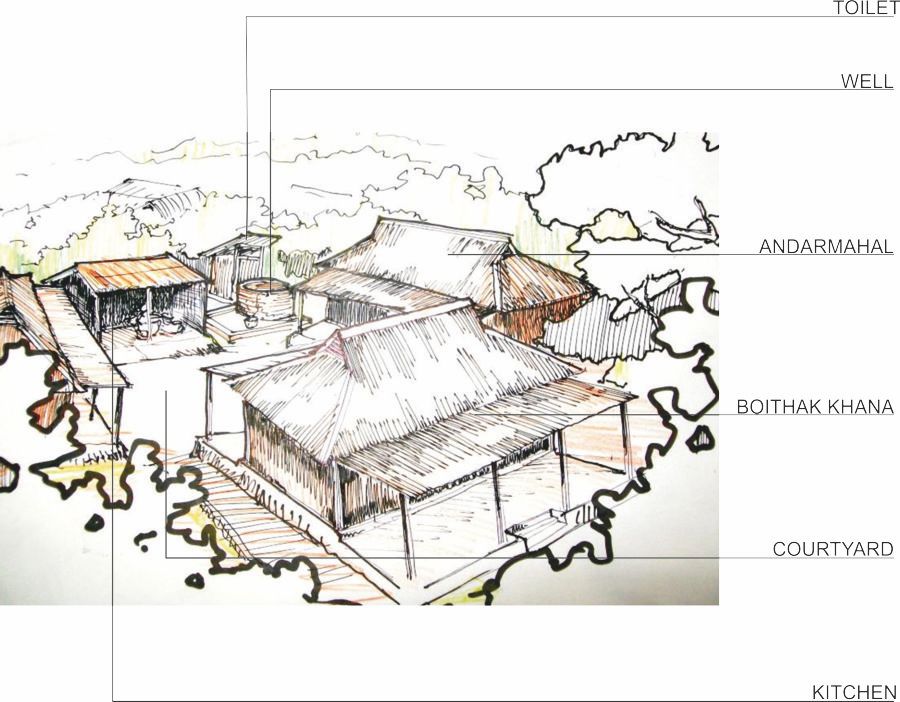
The overall zoning is arranged around a courtyard-like family gathering space inspired from the settlement pattern in rural areas of Sylhet.

Basic Zoning of the House © Rajan Das
Basic Zoning of the House © Rajon Das


Description :

It’s a single family residence in duplex formation.

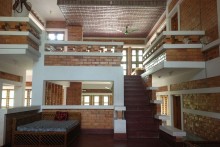
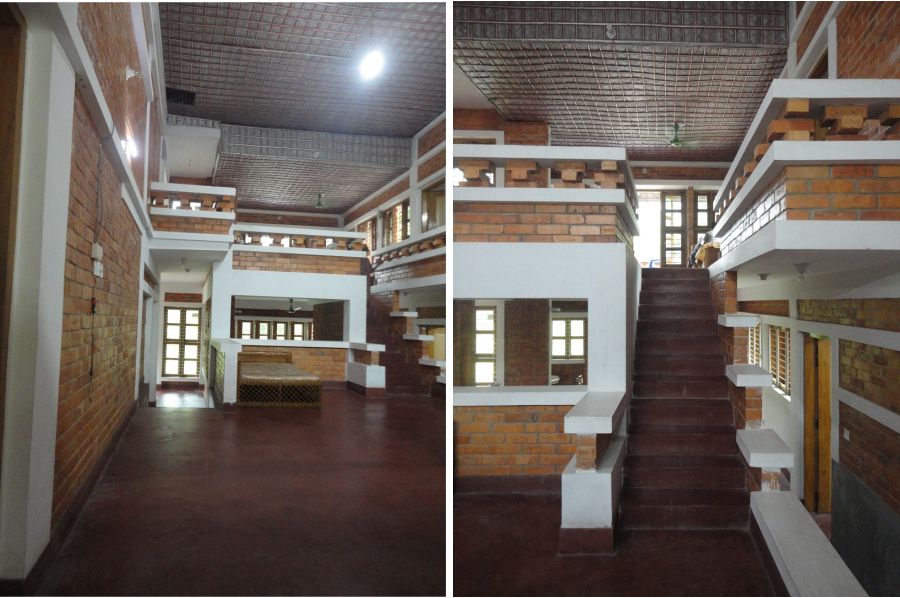
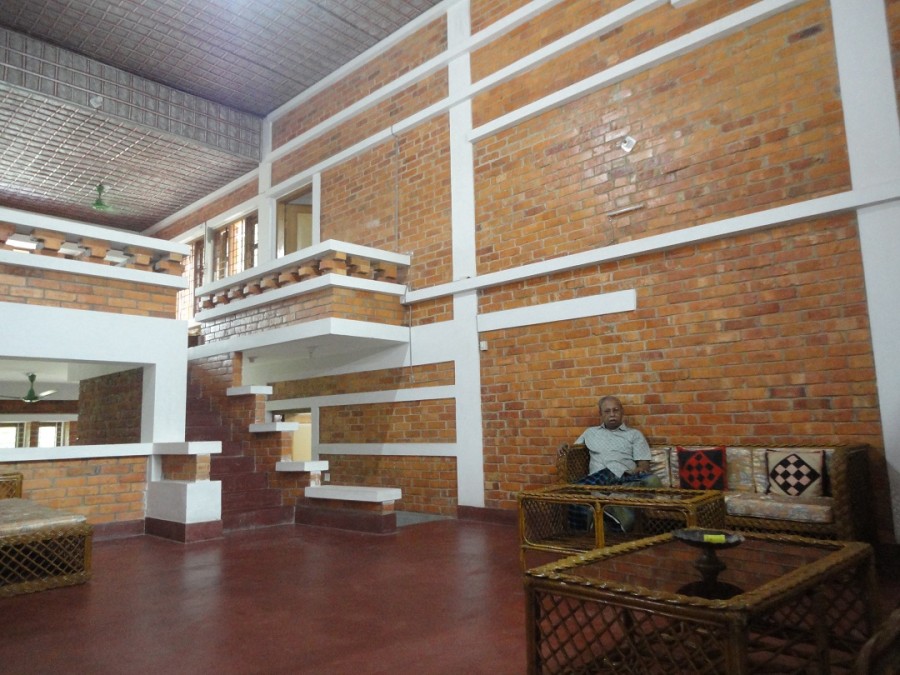
This building consists of 4 bed rooms with attached toilets, a living space, a dining space, kitchen with verandah and store. There is also a family lounge which  is situated at the center of the house in a double heighted space. This double heighted space resembles as a traditional courtyard. All spaces are well ventilated and having adequate natural light.

© Rajan Das
© Rajon Das
Ground and first Floor Plan © Rajan Das
Ground and first Floor Plan © Rajon Das

Section AA © Rajan Das

Section BB © Rajan Das
Section AA and BB © Rajon Das


Construction method & Materials:

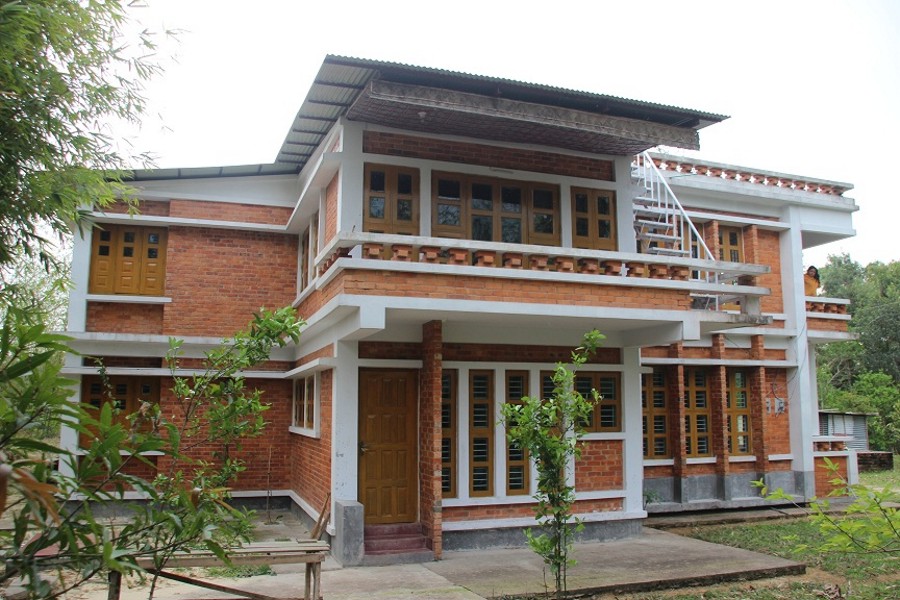
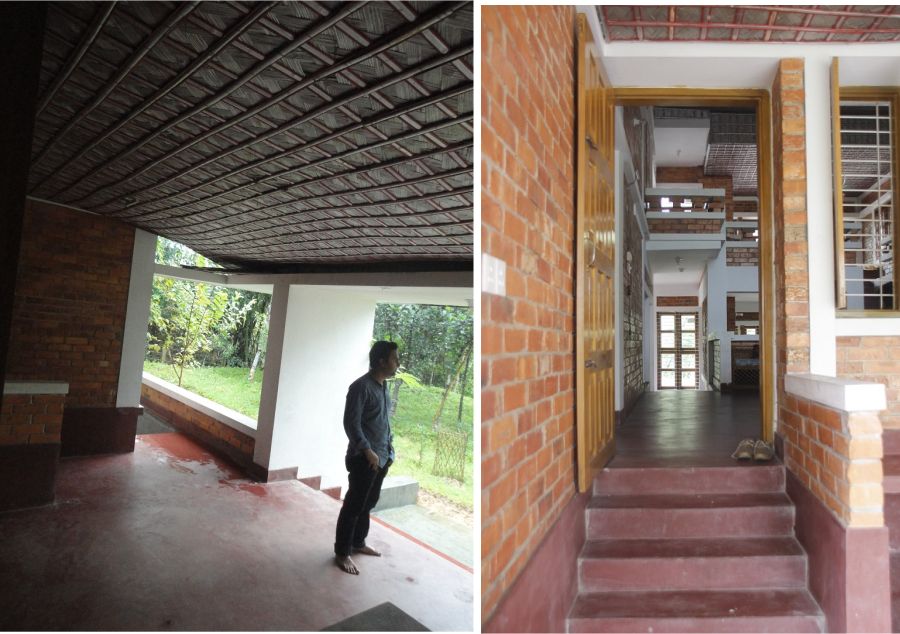
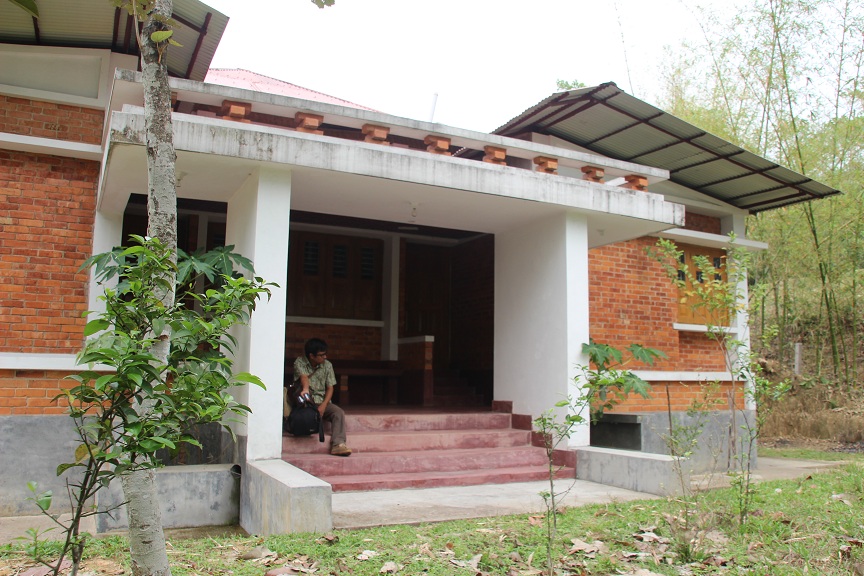
By nature of construction it can be considered as a composite type of building where concrete, brick, wood, bamboo, glass and corrugated sheet etc. are used as building materials. Mainly the facades are brick facing and at the top corrugated sheet is used for roofing.

Conventional construction method is applied in this project, that means, the structure comprises of post and lintel system where brick used as infill materials.

Bamboo-made false ceiling and red colored neat cement finish were used

© Rajan Das

© Rajan Das
© Rajon Das

Ventilation:

North-south oriented ventilation system is applied.

Special Feature:

To save the brick faced walls from rain the slab, lintel and seal are extended towards outside.

Ventilation © Rajan Das
Ventilation © Rajon Das
© Rajan Das
© Rajon Das

Architectural report:

  • In this design, the various parts of a traditional courtyard house are represented by each section of the interior space.
  • This split of levels is designed to represent the two sections of a courtyard house; an exterior part termed as “Baithok-khana”(public zone) and an interior part termed as “Andar-mahal” which also used to divided into 2 parts, semi-public and private. At the middle of that two section a double height space is created to represent the “Courtyard”. This double height space enhances the visual connection of the whole interior. Numbers of stair-ways has been introduced to connect different levels.

© Rajan Das

© Rajan Das
© Rajon Das
  • The use of local materials (brick, concrete, wood, bamboo, cane etc.) in various parts of the interior is an attempt to regenerate the building practice of our traditional culture.
  • One of the important things is, the project is done with higher simplicity considering the economic matter. This is done by the approach of construction and use of materials. Such as only 5 inch masonry wall with exposed brick (one side remain unflustered) used. Besides this, there is no application of special brick bonding which may increase the cost.
  • No extra materials (tiles, marble or wood etc.) are used on the floor except red colored neat finish with white border which was able to harmonize with the simplistic approach.
  • Typical post and lintel system was followed with presence of walls and slabs. The true expression of vertical and horizontal elements is the inspiring side of the whole project.
  • The main intention was to avoid any presence of luxurious outlook or expression.

© Rajan Das

© Rajan Das

© Rajan Das
© Rajon Das


Constrains and solutions:

Scarcity of expert masons was a problem at the beginning. So we had to heir only two masons from outside Shahbazpur and surprisingly they had made it possible using a few numbers of extra labors occasionally.

© Rajan Das

© Rajan Das

© Rajan Das
© Rajon Das

Project Details at a glance: 

Residence of Mr. Tabarak  Hussain

Location: Vill: Nandua, P.O. East Shahbazpur, P.S. Borolekha, Dist: Moulvibazar, Bangladesh.

Land area: 9 Katha (6480 Sft.)

Total floor area: 4316 Sft

Construction cost: 40, 00,000.00 BDT (i.e. 927.00 BDT per Sft

  • concept_02
  • concept_03
  • plan drawings
  • Model
  • Model
  • 16
  • 23
  • 22
  • 21
  • 18
  • 15
  • 14
  • 12
  • 11
  • 05
  • 08
  • 03
  • 04
  • potrait 1
  • potrait
  • 25
  • 06
  • 02

First Grand Jury Celebrated at CUET

| Tahsin Nurun , CUET |

Architecture discipline of Chittagong University of Engineering and Technology (CUET) celebrated the big moment of Thesis Jury of its first graduating batch. The three daylong grand festival, started from 31 December 2015 to 2 January 2016, was inaugurated by the Dean of the Department of Architecture and Urban and Regional Planning Dr. Md. Mostofa Kamal. The presence of renowned persons from academic and professional field  made the event a success.

Almost every project presented in the jury session led to lively discussion that enhanced the essence of the jury as a learning process. The students skillfully explained their projects with sketches, drawings and models. Thoughtful analysis was the counterpart from the selection to solution of every project. Some highly appreciated projects were “Retrospective of Modern Art” designed by Qazi Shamsud Tamzeed, “Resettlement of a Riverine Fisherman Village” by Sarah Binte Haque “Breathing Hydrological Infrastructure” by Amit Imtiaz, “Reviving an Ancient City (Devaparvat) through a central masterplan at Shalban Bihar” by Nusrat Jahan Nipu, “Halda river research station” by Sayma Sultana Guria.

The distinguished guests were Dr. Farida Nilufar (Head and Professor, Department of Architecture, BUET), Dr. Shayer Ghafur (Professor, BUET), Ar. Jalal Ahmed, Dr. Khandaker Sabbir Ahmed (Professor, BUET), Dr. Zakiul Islam (Professor, BUET,) Ar. Harun-Ur Rashid (Professor, NSU), Ar. Uttom Saha, Ar. Adnan Morshed (Associate Professor, CUA), Ar. Mahmudul Anwar Riyaad (Assoc Professor, BUET),  Ar. Abu Sayeed Mostaque Ahmed, Ar. Pattrick D’ Rozario (Asst. Professor, BUET) Ar. Bidhan Barua, Ar. Faruq Ahmed, Ar. Kazi shams Touhid, Ar. Nazma Suriya Khan, Ar. Imanul Haque, Ar. Ashik Imran, Ar. Asad, Ar. Shovon and many others. Design studio mentors were Ar. Najm-ul Latif, Ar. Shajib Paul and Ar. Debsree Mandal.

The long event was concluded with book giving ceremony by Ar. Jalal Ahmed for the Department followed by a note of thanks by the studio tutors.

Congratulations to the fresh graduates and best wishes for the bright future ahead!

More images of Jury Event

  • feature
  • DSC_0117
  • DSC_0138
  • DSC_0269
  • DSC_0538
  • DSC_0377
  • DSC_0390
  • DSC_0740

Master Architect, Muzharul Islam Revisited | N. R. Khan

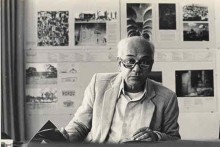
Perhaps today, in remembering architect Muzharul Islam, the one thing that stands out the most, is his tremendous sense of “duty”, since that is what we see lacking in most of the work that populates our cities.

We today in our euphoria to build “attractive buildings “ have  succumbed to the lure of  the “image” the “façade” the “form”, without seriously thinking about what is the purpose of our architecture and to what great end are we heading to with our work.

Institute of Arts and Crafts , Dhaka (1953-54)
Institute of Arts and Crafts , Dhaka (1953-54) | ©Muzharul Islam Foundation


Muzharul Islam never said “I wanted” in describing his work, he always said “what should be done”. This position is a total shift from the inflated “architect ego” that we are so fond of projecting. To me this seems like the fundamental core from which his profound thoughts on architecture stems from, a sense of “duty” and an architectural value system, that is uncompromised by any pressure or self propagation. Today most architects are attracted to the idea of “fame” rather than responsibility. Presentations, awards, publications, and a “busy practice”. Media, and even Universities find it easier to work with the idea of “famous” architect or “upcoming architect”. But till today we have not had a publication with which is about critical analysis, architectural criticism, and thoughts about architectural direction both in the profession and academia. In the absence of criticism and any real sense of “duty” what we have today students” borrowing” forms and seducing teachers with presentations, and architects often compromising the program and the need of the users for their own propaganda in the form of form façade and architectural rhetoric.

Jahangir Nagar University Master plan (1968-71)
Jahangir Nagar University Master plan (1968-71) | ©Muzharul Islam Foundation


Architects in our cities today are busy in putting up their billboards in the form of projects, picturesque and selfish. Very few are even attempting to struggle with the idea of how to look at our cities, its people, the socio-economic context that we live in,and  the right kind of architecture that needs to follow. The other problem that seems to have arisen is that  architects loosely throwing around words like “green” and “sustainable” and “ecological” and “culture” while their work does not reflect responsibility of vision but rather shows that all these words have now become the new self marketing phrases.

Receiving independence day award , Bangladesh 1999
Receiving Independence Day Award , Bangladesh 1999 | ©Muzharul Islam Foundation


Muzharul Islam never needed to talk about his work, to publish his work or promote himself in anyway. He did not try to establish a separate architectural philosophy, he had a philosophy of life and his work stemmed from that. He looked at every work with a tremendous sense of responsibility to the client, the project, his own sense of duty, and to architecture itself. He spoke with his work, and in his work he left behind extremely articulated thoughts and profound vision of how to work in our cities , our society and in our economy. His work is void of showmanship, pseudo intellectuality, and superfluous imagery, they are profound , timeless masterpieces, and of architectural quality that has not been equaled by anyone in this country till date. Just because most of his work due to neglect looks rundown, we will only demonstrate our shallowness if we think that any of the new “attractive” work that surround us is anywhere near to any of his work. His Patriotism surpasses his own self by so far that he has only thought of how to take the architecture of this country forward and what should be the right kind of thought in architecture for the people of this country. Site, climate, material, technology, heritage, culture , continuity, modernity, economy, way of life, philosophy , all seems to find its place in his work effortlessly without him using any of them  to promote his work. If we do not start to look at our work with sincerity and with a sense of duty, our work will only be like architectural “images” that are selfish and weak.

Muzharul Islam with B. V. Doshi and Samsul Wares
Muzharul Islam with B. V. Doshi and Samsul Wares | © Muzharul Islam Foundation


Architect Muzharul Islam spoke of “truthfulness”, to be true when we work, not to thing of personal gain but to perform our duty to the client the city the country. He told us to think, to know, to speak up against what is wrong, and to do what is right no matter how hard it is.Today if we embark on the journey of “truth” we will only then see the greatness of his work and also be able to correct ourselves in a time when its “smart” to “promote” oneself.

Muzharul Islam with Author


If we are to remember him today let us remember what he expected of us and the sacrifices he made to see a profession of quality, competence, sincerity and honesty, and his struggle to establish architecture as a profession of dignity and nobility.

In his own words “One has to be creative. One has to love his own land, it’s people and it’s culture and think profoundly about these. The love of one’s own land is the eternal source of creative power, which in turn makes a proper architect”

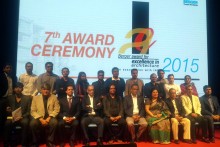
7th Berger Award for Excellence in Architecture, 2015 – Winner Announced

Social responsiveness and environmental sustainability featured highly in the seventh edition of Berger Award for Excellence in Architecture, a program conceived to recognize the architects for their outstanding projects across the country.

Announced on 7 December at International Convention Center Basundhara (ICCB), the 2015 Berger Awards were rewarded to 8 winners out of 61 submissions in 5 different categories: Single Family Residence, Multi Family Residence, Commercial, Industrial and Others. In addition, there was one more category entitled Young Architects’ Award. Handpicked by an esteemed Jury board featuring Ar. Palinda Kannangara (Srilanka), Ar. Mubasshar Hussein, Ar. Kazi Khaleed Ashraf and  Ar. Mustafa Khalid Palash, the winning entries of diverse scale and settings are indeed a testament to the emerging architectural practices in Bangladesh.

In Single Family Residence category, Ar. Lufullahil Majid. was awarded for his project- Vacation House in Rampal, Khulna. Ar. Jalal Ahmed and Ar. Mohammad Shahnawaz received the commendation award in the same category for Subornodighi, Sreepur project.

In the Multi Family Residence category, Ar. Jalal Ahmed and Ar. Rezaul Kabir won the award for Disappearing Lands: Supporting Communities Affected by River Erosion Project at Charitabari Village, Sundergonj, Gaibandha.

Ar. Md. Jubair Hasan was awarded as the winner in the Industrial category for Loom Shed for Amber Denim at Rajendrapur, Gazipur. On behalf of DWM4 architects  Ar. Mahmudul Anwar Riyaad and Ar. Mamnoon M Chowdhury received the award for Bay Edge Water at Gulshan 2, Dhaka in the Commercial category. There were two winners for the Others category: Krishibid Institution Bangladesh (KIB) at Farmgate, Dhaka by Vitti Sthapati Brindo Ltd. and Peda Ting Ting Gallery Cafe at Gulshan, by Ar. Nazmul Haque Sarker. In the Young Architects’ Award category, Ar. Sharif Jahir Hossain was awarded for Ashaloy at Betua, Bhuapur, Tangail.

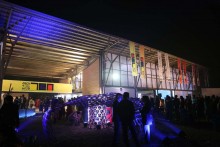
Eminent architects, EC members of IAB and senior officials from Berger Paints Bangladesh Limited were present on this occasion. The event wrapped up with a musical program by famous band Joler Gaan followed by dinner.

SUBORNODIGHI_Commendation ( Single Family Residence) I Ar. Jalal Ahmed Ar. Mohammad Shahnawaz Ar. Nabila Binte Nasir
SUBORNODIGHI_Commendation ( Single Family Residence) | Ar. Jalal Ahmed, Ar. Mohammad Shahnawaz, Ar. Nabila Binte Nasir


DISAPPEARING LANDS_ Winner ( Multifamily) | Ar. Jalal Ahmed and Ar. Rezaul Kabir


edge water_DWm4 Architects
BAY EDGE WATER_Winner ( Commercial ) | DWm4 Architects


loom shed_Ar. Md. Jubair Hasan
LOOM SHED FOR AMBER DENIM_ Winner ( Industrial) | Ar. Md. Jubair Hasan


KIB_Vitti Sthapati Brindo Ltd.
KRISHIBID INSTITUTION BANGLADESH (KIB) _ Co- Winner ( Other) | Vitti Sthapati Brindo Ltd


Luminiferous stance | photo credit: Nazmul Nayeem
PEDA TING TING GALLERY CAFE _ Co- Winner ( Other) | Ar. Nazmul Haque Sarker


ASHALOY_ Winner ( Young Architects ) | Ar. Sharif Jahir Hossain


Other nominated entries:

Category: Single family residence

Vacation House “Jolchobi” – Ar. Farzana Tymus

Faridur Reza Sagor Residence- Ar. Abdullah Yousuf Imam

Category: Multi Family Residence

Bloomsbury Heights- DWm4 Architects

Ventura Rosabella – Ar. Rashed Iqbal, Ar. Faisal Ahmed, Ar. Anwar Sadat

Category: Commercial

Shadhinota Tower – Ar. S M Nazimuddin Payel

Ventura Iconia – Ar. Rashed Iqbal , Ar. Faisal Ahmed , Ar. Anwar Sadat

Category: Industrial Project

Habitus- Ar. Naim Ahmed Kibria, Ar. Syed Mahmud Hossain, Ar. Asia Karim

Genesis Fashions Ltd.- Ar. Abdullah Yousuf Imam, Ar. Alimul Reza

Category: Others

Mukti Shangram Jadughar- Ar. Nahas Ahmed Khalil

Liberation War Monument at Sub sector 01 of 11th Sector- Ar. Rajon Das