From the Architect:
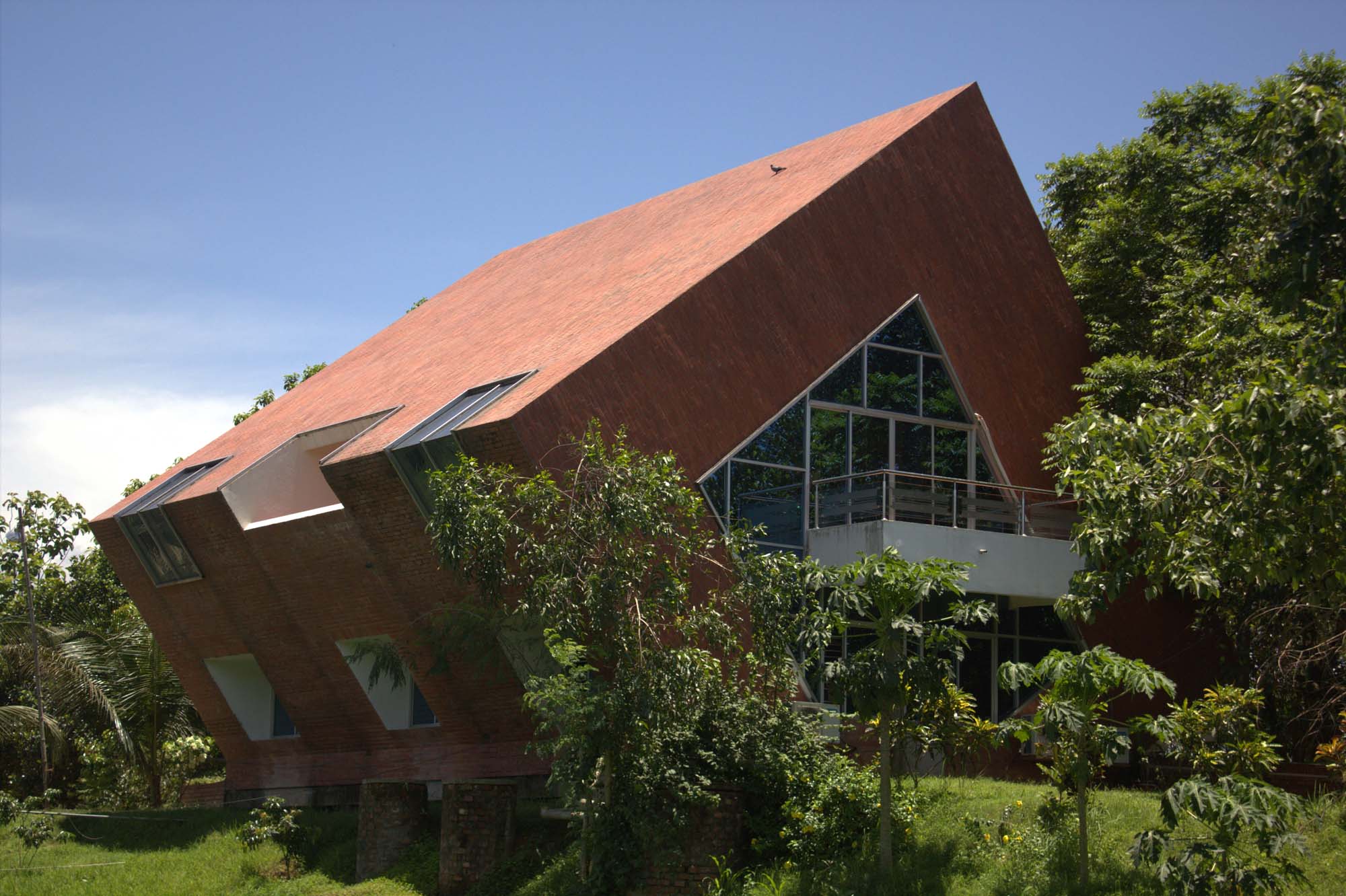
A form, a slanted cube evolved from redish soil of Valuka, Mymensingh ties its knot with the space, the jack-fruit court, thus a relationship grown: an open stair anchors the tilted form with the mother earth, with the shadows of surrounding greeneries. The Guest house of Runner Automobiles ltd. is located at 67 km north of Dhaka city. The house is built at the compound of automobile factory complex of Runner Group.
Architects initial intention was to compose a welcoming court around an existing sappy jack-fruit tree to introduce the foreign guests with the national fruit of Bangladesh, to tender the very welcoming nature of Bangladeshi household.
The Guest house is located diagonally with the cardinal direction, just to maximize the light & wind at all season there.Vertical rotation of entire cubic form creates an unexpected view over the back green field and thoughtful positioning of window at overhead surface makes a dramatic moonlight & raindrop experience to guest.
On the whole, the guest house with the open to sky living space, with multi-textured paves, shadows and greens make a sense of home, a very cordial environment.
The meteorological architecture processes through a chemical dissociation of the space in elementary particles, wavelengths, humidity rate, light intensity, heat transfer coefficient for example, but also hormonal knowledge perceptions.
We are interested now in forms which are no more composed together to create a “whole as gestalt.” We are interested in forms which are dissociated, exploded into fragments of reality, into sensible particles. We are looking for a vaporized tectonic, spectral architecture, decomposed spaces into elementary particles, into wavelengths, humidity, light intensity and heat transfer coefficients, which are then “pose” into a new form, one that is more essential and contemporary.
At first we tried to understand different meteorological processes with child performance in school. How much energy they produce and what are the basic requirements they need for a playful educational environment, were among the concerns. The context was given in Barcelona. The environmental heat exchange was investigated in different seasons with metabolic performance from cloth insulation value to associated external heat gain.
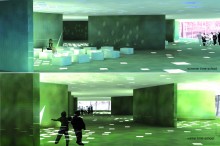
The intention was to create a school with flexible orientation of classrooms regarding summer and winter wind-flow directions. Inner structural L shape walls had been placed according to the average yearly wind flow of Barcelona in summer & winter time. Along with that, such L shape could be able to create semi-isolated spaces supporting all the need of a classroom as well as playful spaces within a precinct. During summer the whole platform could be open and classes will occur in inner space between L angle and during winter the platform will be closed with portable glass and classes will occur in outer space of L shape walls.
The roof had been designed with perforation to get necessary light intensity to read and to ensure class identity. Also arrangement was made to ensure enough noise protection from one classroom to another.
Logical arrangement of interior wall ensures different interactive spaces within school facilities. Such platform can promote flexible uses of single space with periodical needs of summer and winter in Barcelona.
In the evening of Thursday, 4 June Institute of Architects Bangladesh arranged in ‘Chayanat’ a conversation with prominent architect, singer, painter and musician Mustapha Khalid Palash- an event transforming the hot summer evening to a cool and serene ambiance for the audience. The event, though meant for a short conversation, last for an hour and half leaving the audience craving for even more to learn about the architect.
Architect Palash shared amusing stories with the listeners touching different aspects of his venturesome walk though the life. The conversation held at the point of sheer interest of young listeners about the architect known for his apparent introvert conduct. He talked of his early days in BUET, fascination about architecture, starting of his own practice and most uncommonly of some events of his personal life. Memories of his early-life affection to anything about science and buying his first car wondered the audience while they also got an insight about his architectural philosophy and life ideals. The considerate architect drew some light on his thinking process, practice management as well as ‘on and off site’ work procedure which otherwise educated the young architects. He ingeniously infused some important life-skill advices as well for the largely young audience which definitely will help them in their career prospect. The architect was, however, pretty reluctant to name the episodes of his life as ‘stories’.
The event was conducted by Ar. Farhana Sharmin, who at the end conveyed questions from the audience to the architect. She also added a couple of her own relevant to the very interesting and pointful set of questions. Unlike many, Ar Palash did not sidestep the intelligent questions; rather delightfully answered with ethical and philosophical attachment.
The honorable President of IAB , Prof. Abu Sayeed M Ahmed presented the distinguish guest a crest on behalf of the institute as a memoir of the program. The refreshment session was full of choir of the audience chatting and discussing about the conversation and wondering when they might meet the prominent figure again. Good news for them- the renowned architect is expected to present his works soon at another event, details of which can be found in the following link:
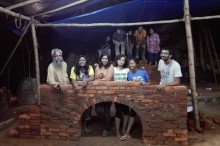
The Bangladeshi young graduates showed great enthusiasm again towards green habitats through participation in Laurie Baker Summer School in India held in May 2015.
The workshop, LBC Summer School 2015, held at Laurie Baker Centre for Habitat Studies, Thiruvananthapuram (also known as Trivandrum) in Kerala, India. Eight Bangladeshi participants Silmi Farah , Nidalia Islam , Azka Eshita, Nuzhat Nabila, Badia Badruddoza, Rahfatun Nisa, Nova Shahriar Mannan, Tanzina Khan from Architecture and allied disciplines attended the workshop with other participants around the globe.
The 14 days workshop from 18th to 31st May had the objective to create the awareness towards green habitat through cost effective building design and construction technique. For this workshop the target group was the young architects and senior students with specialization in architecture, planning, civil engineering, urban and rural studies who have the interest in green habitat and environmental conscious design in the sectors of housing, water, sanitation and waste management. The workshop emphasized on ‘hands on experience’ method and offered practical assignment on new techniques and forms in masonry construction using locally available materials such as mud, brick rubble, bamboo with alternative construction material including concrete. Apart from material issue the participants also dealt with the housing organization considering gender issues, waste management with the concept of decentralized planning. A distinguished team of well known specialists from different disciplines supervised the participants through out the workshop.
It was business as usual for me on 5th April 2012, like it was for most citizens of Dhaka who are not residents of Karail, a 170 acre stretch of land across the Gulshan Lake. Some estimate the population 1,00,000, others up to three times as much. It was the day the Government decided to tear down the shanty town in compliance with an order from the High Court of Bangladesh. As news spread of the demolition drive, I kept on worrying about my friend Architect Khondoker Hasibul Kabir who moved into Karail a few years back. He also teaches at BRAC University, specializing in urban design, slum upgrading /affordable housing/alternative ways of construction/cyclone shelters and the likes .Munni Saha, the eminent journalist made an amazing short feature on where Kabir lived in Karail. It was broad cast on ATN News last year and indeed made quite a stir. (http://www.youtube.com/watch?v=NdbxwPOAzJo) Together with his friends and the children he made a beautiful pavilion made with bamboo on the edge of Gulshan Lake with some amazing landscaping using common plants and shrubs. He also set up a library for the children. The pavilion was a space open for all to use, especially children. Known to them as Mama (maternal Uncle), Kabir called the pavilion Ashar Macha (Platform of Hope). It was tore down about month before the April crackdown.
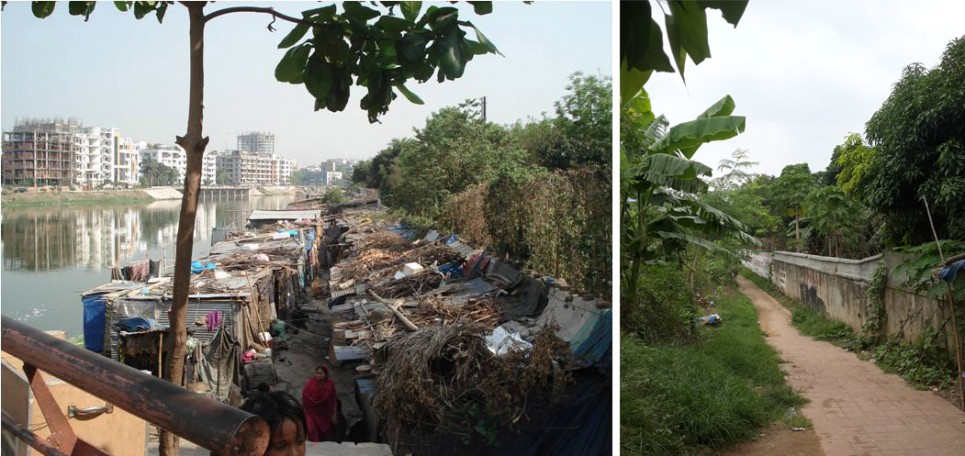
Slum at the end of Road no 11, Banani. Evicted in 2012. Where are they now? | Photo credit: Author
To most people slums are an eyesore, den of social vice, dangerous even during the day, not a place for the ‘gentleman’ to go. “Slum dweller” is indeed a highly derogative term. Yet to those who live in slums, its home. I humbly ask them to watch Munni Saha’s feature. Slum dwellers deserve more than pity or apathy or antipathy, especially since almost every other person who lives in the cities of Bangladesh lives in a slum.
Home in a city which there is work, but there is no proper place to stay for half its population. If you are a domestic aid, garment worker, rickshaw puller, worker at a factory, construction worker or someone who migrated from the rural areas due to natural disasters, you may afford to live in a proper house but the landlords may not be very keen to rent their house to you. A survey conducted by my colleague Associate Professor Architect Shehzad Zahir showed that in a slum, a group of four or more people will occupy a single room and will pay Tk. 8/- per sft a month. Electricity and water are separate. This is more than the average rent of apartments in most parts of the city which is around Tk.6.85/- per sft.
Slums are a convenient means for our politicians to exploit people. In collusion with the local thugs, they protect the slum dwellers from eviction, provide electricity and water and collect rent, votes and people to demonstrate during ‘political showdowns’. They also conduct some illicit activities, although this happens in very few areas.
Slums are nothing new. The city fathers have never been pro- active to ensure the lower income segment proper housing. In the 50’s it was thought that the state could solve the problem by rehabilitation/ relocation. Consequently the Masterplan of Dhaka of 1959 recognized the issue of the perils of overcrowding in the slums of the old city and aimed to create new residential areas for low income people. Mirpur and Mohammedpur are two such areas. “Slum relocation”, “slum rehabilitation” was the buzzword all over the globe then. This mode of operation is still highly popular in countries where governments are less accountable. So if you want to see where the underpaid construction workers from Bangladesh live in Dubai, you would have to take a thirty minute bus ride to the outskirts of town to “see” the “invisible” slum city.
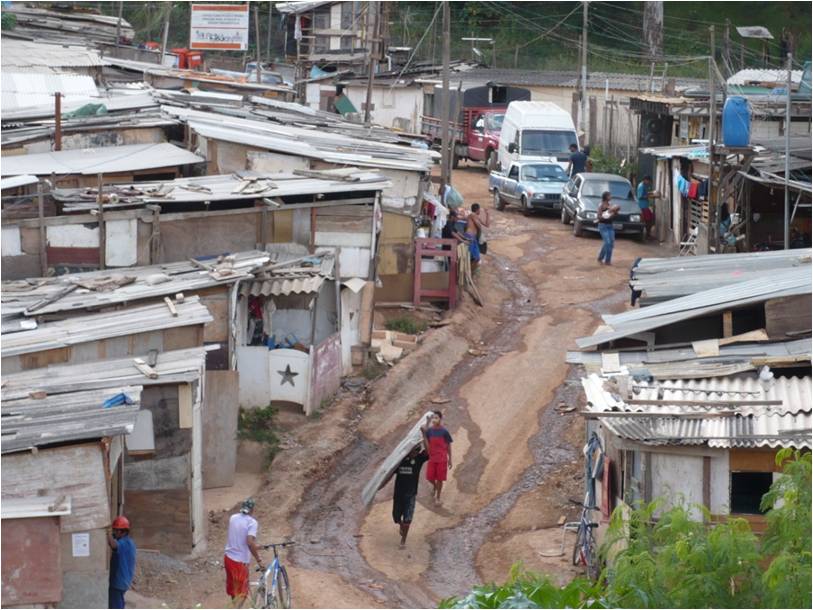
Rapid urbanization and housing issues are global: Sao Paolo, Brazil | Photo credit: Bert van de Wiel
To subsequent governments, both in the pre and post liberation periods, the main objective of urban planning was to improve roads and service infrastructure according to the Masterplan of 1959 and creating new residential, industrial and commercial areas based on acquiring land and redistributing it in the form of plots. Thus Dhanmondi, Uttara, Gulshan, Banani and Baridhara came into existence, along with Tejgaon, and the commercial part of Karwan Bazar. The Dhaka Improvement Trust was entrusted with both planning and selling plots. The other practice that they excelled in over the decades in connivance with the Dhaka City Corporation is to allow changes of intended land use (turning all the major residential thoroughfares into commercial areas) and almost indiscriminately increasing the maximum allowable height of building all over the city with little heed to whether there is necessary roads, services and social infrastructure or not.This highly asymmetric, elite serving policy turned a blind eye to the issue of housing for the people who worked in the city, but were not “fit” either financially and socially to live in the formally planned city.
In the early 1990’s the government started to work on a new Structure plan for Dhaka. At the same time the fall of socialist states paved the way for the free market system and the notion of the state as the provider of housing for all citizens lost traction altogether once and for all.Since the term “slum” is loaded with derogative connotation, the planners call them “informal settlements”. In the Dhaka Metropolitan Development Plan (1995-2015), informal settlements were pushed off the table in unequivocal terms. Ironically it was the decade when democratic form of government took wings in the country.
So while the elite had nice apartments, the lower income segment had to either find housing in the slums or move to the outskirts of the city. Drivers, cooks, domestic aids who worked in Gulshan or Banani lived in adjacent Badda, Shahzadpur and the likes. But as the land become expensive, they were simply pushed further and further away to the eastern and western fringes on ecologically fragile wetlands and agricultural lands on the river banks.
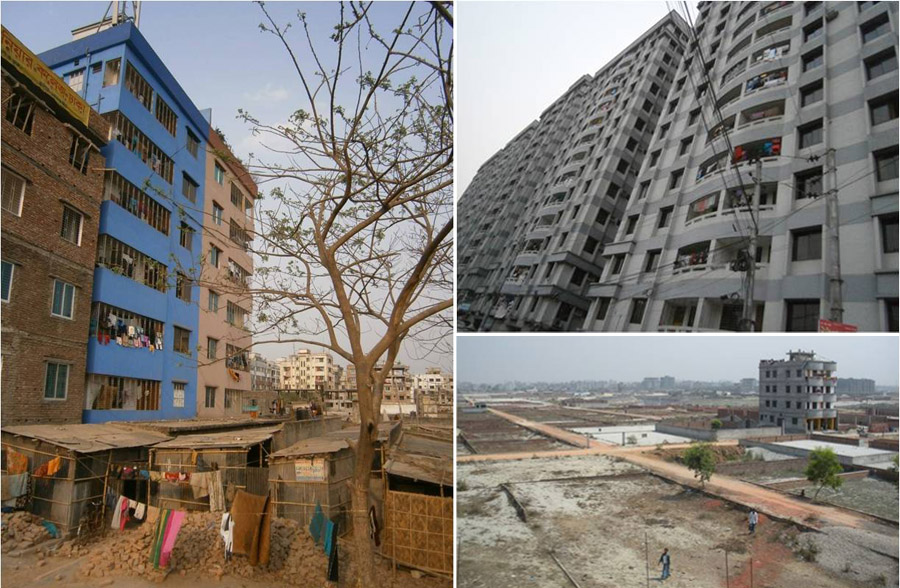
Two kilometers west of Dhanmondi: The city expanding endlessly |Photo credit: Author
Since the mid- eighties, 2000 garment industries have been set up in the city. Where do the 1.8 million garment workers stay? Where do the 1 million construction workers stay? Places like Karail of course. Now similar housing crisis is brewing in the garment industry belt of Savar, Gazipur, Tongi and the likes.
Since there is absolutely no control over land price, the market is completely driven by the speculators. Land with better connectivity and service infrastructure is becoming more valuable as static resellable assets as opposed to the actual return based on economic utility. One recent report published in the DS stated that 10,000 (almost 16 square miles) acres of wetlands and agricultural land around the city are illegally occupied. Could an ecologically less fragile part of that area be allocated for low income people? Even in a quarter of that land half of all the slum dwellers of Dhaka can be accommodated with better living conditions. Over the last decades, most Govt. sponsored projects for the low income group failed. The key reason was that those who got a piece of land or flat sold it off later for a huge profit. I wonder if proper mechanisms could be deployed to avoid such circumstances.
Decentralization is indeed a powerful tool improve to the slum situation. Certainly, if proper, affordable means of transport can be ensured then people will live in satellite cites, reducing the burden on the city.
In Malaysia, land developers have to earmark at least 20% of the land to be developed as affordable housing. In Mumbai and many cities across India, new public private partnerships are changing the slum scenario. The government leases its land to developers, who have to sell/rent half of the built area at subsidized prices to the lower income segment, especially if the project is done in a slum area.
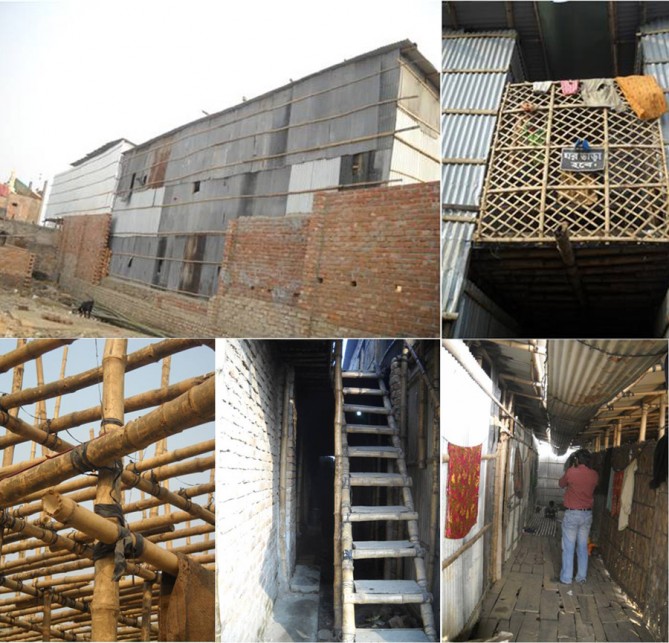
The situation can certainly be improved by new business models as the slum dwellers pay high rents. In the fringe areas of Dhaka, landowners are renting their land to some investors for a 5-10 year basis. The investors build semi permanent two storied buildings with CI sheets and bamboo. Single room apartments with common kitchen and toilets will cost you up to Taka 3000/- (excluding services) depending on the number of people, location etc. One research found that if the cost of the building can be reduced to Tk. 500/- per sft (a typical 6-8 storied apartment building costs about three times as much), the initial investment can be recovered in approximately three years given the current rent. This means that if a landowner rents the land for ten years to an investor, the investor can keep almost 7 seven years of revenue as his income. If three or two storied houses with improved sanitation and services, bio gas plants , rainwater harvesting can be made in that budget (not an easy challenge), living conditions can be improved by creating some open spaces for community use, children’s play area without compromising with the density.
New housing economy: temporary houses along the Shaheed Buddhhijibi Memorial Area built for rental purposes | Photo credit: Author
In a recent workshop held in Dhaka with students from water management, real estate finance, construction technology and architecture from Amsterdam and Dhaka, integrated approaches to slum upgrading /eco urbanism in the fringe areas were focused upon. The people who live in slums are in architect planner and visionary Charles Correas’s words ‘displaced rural communities’. The soft asset that they bring with them is their knowledge of agriculture. If that resource can be tapped slums can be highly productive farms. Floating farms on adjacent lowlands, integrated poultry and fish farms could generate income and employment, provide fresh food and at the same time reduce the growing carbon footprint of the city.
There are means to change the way we live. It’s only a question of collective will. By dint of hard work, we shall be a middle income country in ten odd years. But to build our cities properly, first we need to change the way we think about the people who live in it.
Author:
Sujaul Islam Khan | Architect and Asst. Professor, Dept. of Architecture, Ahsanullah University, Dhaka
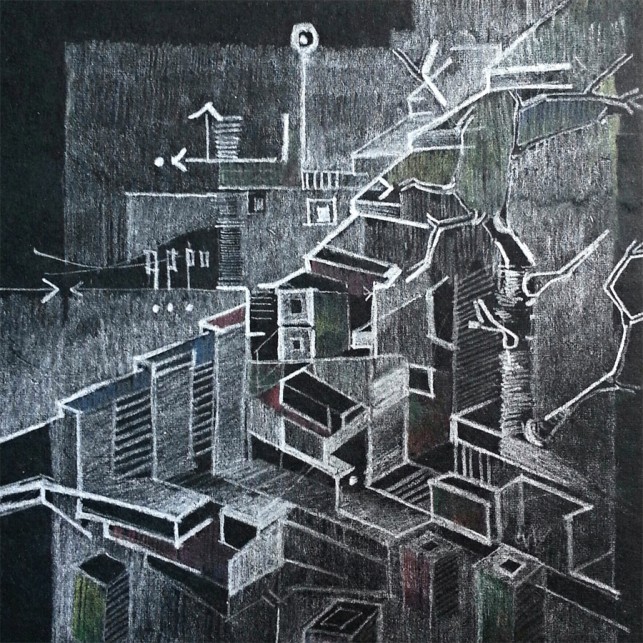
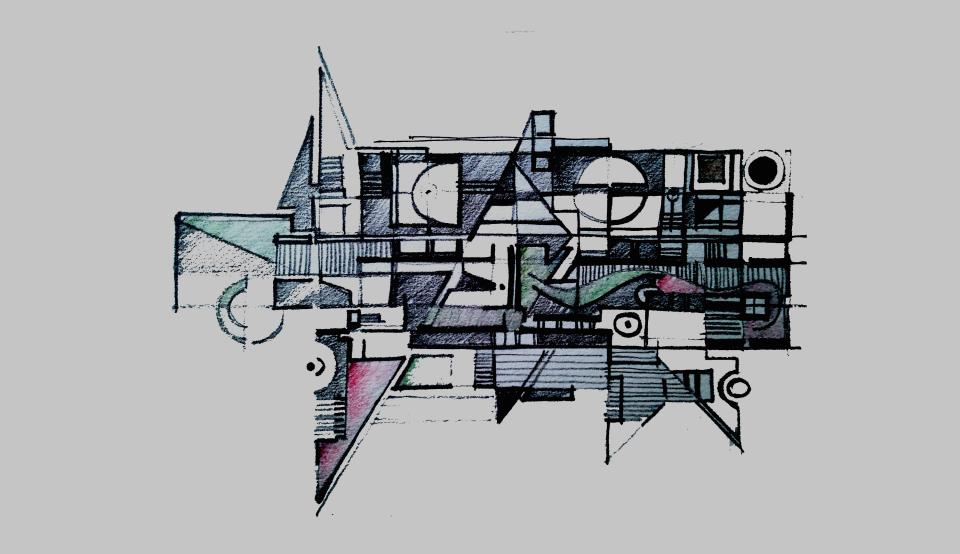
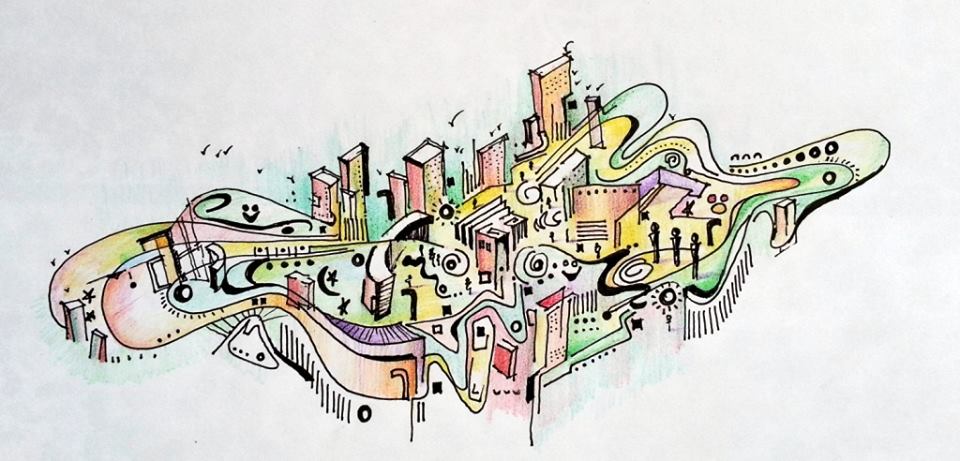
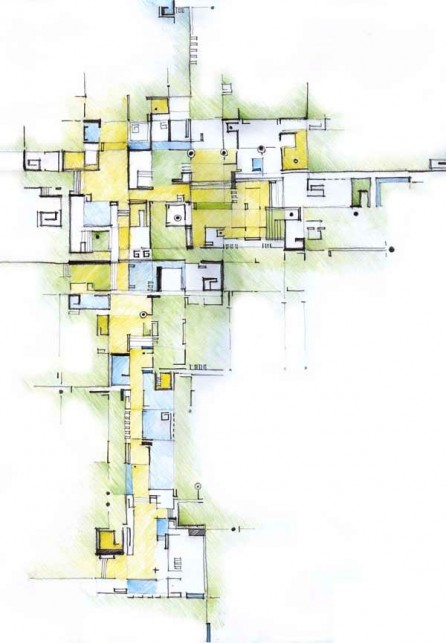
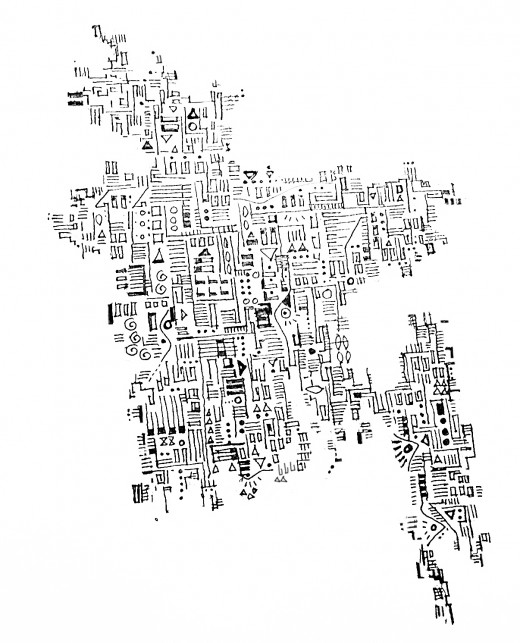
Architect Ashik Ikbal is a facile doodler. Like most of the other doodlers his drawings made at his subconscious mind while preoccupied with other activities like chatting with fellow colleagues, talking over the phone, attending at a meeting or sitting in any passive environment. Though predominantly subconscious, yet most of his doodles show mindful display of spontaneous marks of his intuitive feelings.
Ikbal’s doodle works include patterns and symbols commonly made up of straight and zigzag lines, dots and geometric shapes suggest his architectonic mind to get on with things. In terms of expression they are mostly interesting overlay of soft, free flowing strokes announce somewhat of his latent emotional conflicts or unexpressed feelings in symbolic form. He usually picks up any available media for doodling; a graphite pencil or a very regular pen or sometimes mixing up both. Though doodling is a subconscious work; but for him the act enrapts him in composition what keeps him moving with architectural practice and teaching composition ideas to students.
Ashik Ikbal, is an Architect and Assistant professor, currently teaching in Architecture Dept. of American International University-Bangladesh (AIUB). He is a former graduate of Khulna University, Bangladesh and KU Leuven, Belgium. He has been involved in teaching since year 2000 and his academic interests govern around Psychological Mechanism of Perception & Creation, Education, Urbanism and Urban-Sociology and Responsive Design.
Department of Architecture, BRAC University arranged Certificate Giving Ceremony and Lecture Presentation by the Winner of Rafiq Azam Travel Bursary, 2014.
The Rafiq Azam Travel Bursary, 2014 for the Students of Architecture, BRAC University was awarded to Kazi Najeeb Hasan, fourth year student of Architecture from BRAC University. The travel grant, given out each year to a student from BRAC University’s Architecture Department, aims at a cross cultural learning through visits to other countries. This year, Najeeb travelled to Sri Lanka on a 9 day visit that included touring parts of the island as well as giving a presentation on Bangladesh’s architecture to the City School of Architecture at Colombo, and visiting the other major school of Architecture in Sri Lanka at the University of Morutawa. Najeeb also attended 2015’s Annual Conference of the Sri Lankan Institute of Architects. The highlights of his tour included the 17th century Dutch Fort at Galle, climbing to the top of Adam’s peak at 7359 ft and the architecture of Geoffrey Bawa in Colombo and at Bentotta and Lunuganga.
Department of Architecture, BRAC University arranged an event to award the certificate to Najeeb on 21 May, 2015 upon completion of his tour to Sri Lanka. To share Najeeb’s experience, a lecture presentation was also arranged as a continuation of `Learning through Travelling’ series by the winners of RATB award. Chairperson, Department of Architecture and Pro vice Chancellor Prof. Fuad H. Mallick, Ar. Rafiq Azam, Ar. Mustasim M. Khan and renowned artist Professior Hamiduzzaman Khan was present at the event along with faculties and students of the Department of Architecture, BRAC University.