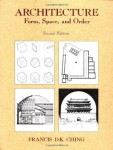
This classic introduction to the principles of architecture is everything you would expect from the celebrated architect, author, and illustrator, Francis D. K. Ching. Each page has been meticulously revised to incorporate contemporary examples of the principles of form, space, and order – the fundamental vocabulary of every designer. The result is a beautifully illustrated volume that embraces today’s forms and looks at conventional models with a fresh perspective. Here, Ching examines every principal of architecture, juxtaposing images that span centuries and cross cultural boundaries to create a design vocabulary that is both elemental and timeless. Among the topics covered are point, line, plane, volume, proportion, scale, circulation, and the interdependence of form and space. While this revision continues to be a comprehensive primer on the ways form and space are interrelated and organized in the shaping of our environment, it has been refined to amplify and clarify concepts. In addition, the Second Edition contains numerous new hand-rendered drawings; expanded section on openings and scale; examples of contemporary architectural design elements; expanded chapter on design principles; new glossary and index categorized by the author; and new 8 1/2 x 11 upright trim. In the Second Edition of Architecture: Form, Space, and Order, the author has opted for a larger format and crisper images. Mr. Ching has retained the style of his hand-lettered text, a hallmark of each of his books. This rich source of architectural prototypes, each rendered in Mr. Ching’s signature style, also serves as a guide to architectural drawing. Doubtless, many will want this handsome volume for the sheer beauty of it. Architects and students alike will treasure this book for its wealth of practical information and its precise illustrations. Mr. Ching has once again created a visual reference that illuminates the world of architectural form.
World Environment Day 2026
Urban [Re]Stitch
Between Silence and Light
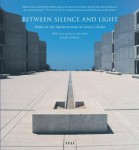
Louis I. Kahn’s influence on American architecture during his life was great, and his influence has only increased in the 33 years since his death – with interest in his work lately moving into the realm of popular culture through the successful film about him, ”My Architect” (New Yorker Films, 2004). John Lobell’s classic work presents stunning black-and white photos of some of Kahn’s greatest buildings, including the Salk Institute, the Yale Study Center and the Exeter Library, combining them with excerpts from his writings that reveal him as a remarkable creative thinker. Kahn searched for beginnings: the origin of joy and wonder, of intelligence and intuition. He sought the basic principles of being, which he called Silence and Light. He spoke of these things with a tremendous yet gentle power. Reading his words and looking at his buildings, we experience him as architect, visionary, and poet.
Beginning: Louis I. Kahn’s Philosophy of Architecture
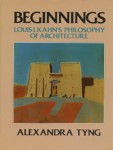
Comprehensively traces the development of Louis I. Kahn’s philosophy of architecture from its beginnings in the 1930s to Kahn’s death in 1974. The author, Kahn’s daughter, provides a unique presentation of biographical information, portions of letters and writings, speeches, photos, and other material inaccessible to other writers. Includes diagrams collected from published and unpublished sources. Shows how Kahn’s personality and background contributed directly to his philosophical principles.
Delirious New York
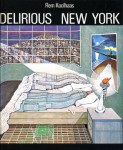
Rem Koolhaas’s ‘Retroactive Manifesto for Manhattan’ posits New York as the arena for the terminal stage of Western civilisation. Through the simultaneous explosion of human density and invasion of new technologies, Manhattan became, from 1850 on, a mythical laboratory for the invention and testing of a revolutionary lifestyle: the Culture of Congestion.
Delirious New York is a polemical investigation of Manhattan: it documents the symbiotic relationship between its mutant metropolitan culture and the unique architecture to which it gave rise – though this book argues that it often appears that the architecture generated the culture. This book exposes the consistency and coherence of the seemingly unrelated episodes of Manhattan’s urbanism: it is an interpretation that establishes New York as the product of an unformulated movement, Manhattanism, whose true program was so outrageous that in order for it to be realized it could never be openly declared. Delirious New York is the retroactive manifesto of Manhattan’s architectural enterprise: it untangles theories, tactics and dissimulations to establish the desires of Manhattan’s collective unconscious as realities in the Grid.
Modern Architecture Since 1900
Since its first publication in 1982, Modern Architecture Since 1900 has become established as a contemporary classic. Worldwide in scope, it combines a clear historical outline with masterly analysis and interpretation. Technical, economic, social and intellectual developments are brought together in a comprehensive narrative which provides a setting for the detailed examination of buildings. Throughout the book the author’s focus is on the individual architect, and on the qualities that give outstanding buildings their lasting value.
For the third edition, the text has been radically revised and expanded, incorporating much new material and a fresh appreciation of regional identity and variety. Seven chapters are entirely new, including expanded coverage of recent world architecture.
Described by James Ackerman of Harvard University as ‘immeasurably the finest work covering this field in existence’, this book presents a penetrating analysis of the modern tradition and its origins, tracing the creative interaction between old and new that has generated such an astonishing richness of architectural forms across the world and throughout the century.
Modern Architecture: A Critical History
This acclaimed survey of 20th-century architecture and its origins has become a classic since it first appeared in 1980. Now revised, enlarged and expanded, Kenneth Frampton brings the story up to date and adds an entirely new concluding chapter that focuses on four countries where individual talent and enlightened patronage have combined to produce a comprehensive and convincing architectural culture: Finland, France, Spain and Japan. The bibliography has also been reviewed and extended, making this volume more indispensable than ever. In the fourth edition Kenneth Frampton has added a major new section that explores the effects of globalization on architecture in recent years and examines the phenomenon of international celebrity architects who are increasingly active all over the world.
PROJECT SHOWCASE _ Open Architectural Design Competition for “Health Complex One Project”
.
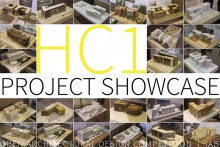
The Result of an Open Architectural Design Competition for “Health Complex One Project” has been announced on Saturday 24 September 2016 at IAB premises. This competition was organized by Grameen Telecom Trust (GTT) and Grameen Kalyan (GK) in association with Institute of Architects Bangladesh (IAB). The Jury has selected 3 projects as winner of the Open Architectural Design Competition for “Health Complex One Project.”
.
1st Place winner : DESIGN LAB ARCHITECTS
Design Team :
Ar. Md. Nazmul Haq Bulbul (B‐024) , Md. Rashidul Hasan Sakib (AS‐293) , Tahsin Amin Niti (AN‐085) , Kazi Abu Imam (AI‐068) , Samiul Alam , Md. Tanveer Hasan

2nd Place winner : DWG
Design Team :
Ar. Tanzim Hasan Salim (S‐063) Ar. Naheed Farzana (F‐010)

3rd Place winner : LINES ARCHITECTS
Design Team :
Ar. Mohiuddin Zilanee (Z‐014) Ar. Shah Fuad Mohammad Cyrus (C‐044) Ar. Reesham Shahab (S‐139) Ar. Md. Fahad Bin Mostafiz (M‐104) Adbana Taj Anis (AA‐234)


<< Image Gallery >>


MRT Station & Transitional Space, Farmgate | KUAD
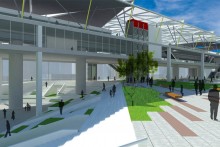
In the past decades, Dhaka city has grown exponentially due to the rapid urbanization. The transportation infrastructure of Dhaka city has become vulnerable and insufficient to serve this huge amount of people. To get Dhaka rid of this problem, certain steps have been taken, such as the MRT (Mass Rapid Transit), BRT (Bus Rapid Transit) and elevated expressway.
The installment of a new transportation system faces many complexities and challenges. Often the plans for the new infrastructural work conflicts with the existing city texture and historic image.


The MRT-6 line runs through a major spine of Dhaka starting from Uttara and ending in Motijhil. On its way, MRT line 6 has encountered some critical spots. While crossing the Begum Rokeya Sharani, the MRT line violates the master plan of national parliament building by Louis I Kahn. With sensitive approach towards planning, this issue can be solved. Also, the area is a major transitional space for Dhaka, which is a major challenge for the project.
The aim of the thesis is not only to design a metro station, but also addressing relevant urban issues concerning the Sher-E-Bangla nagar park and the surrounding area and approach the problems created by the alignment of the MRT line 6 sensitively.

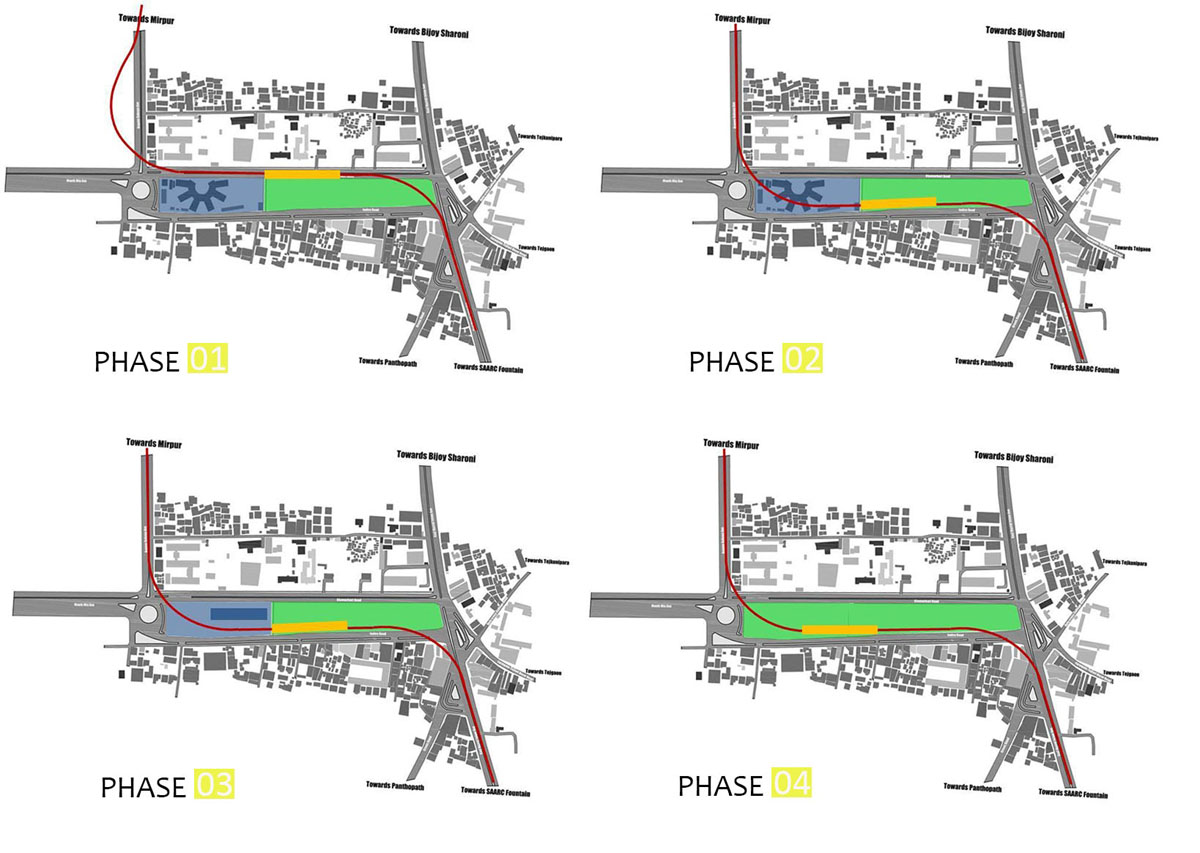
The first consideration was rerouting MRT line-6, which was accommodating in different phases. In Phase-1, DTCB proposal location of the station over Khamarbari road. Phase-2, Realigning the MRT line over Islamia eye hospital and locating the station over Indira road.Phase-3, The station is moved to the southern part of the park and new structure is proposed to replace the existing hospital building due to noise and vibration problem. Phase-4,the station is moved to the south-western part of the park, the hospital is relocated to a suitable location to –1.Avoid noise and vibration problem completely. 2. To provide a new structure for the hospital in a new location as the existing building is almost 60 years old and scheduled to be extended already. 3. Maximize the open space of the park.


The other problem was traffic congestion in the area. Removal of vehicular and pedestrian congestion and conflict, bus stoppage of Indira road is provided under the plaza level to segregate it from the MRT circulation. Eviction of the flower market, haphazard commercial activity, street vendors occupying pedestrian was others problem. Accommodate vendors and flower market inside the project and provide economic activity to make the project economically viable.
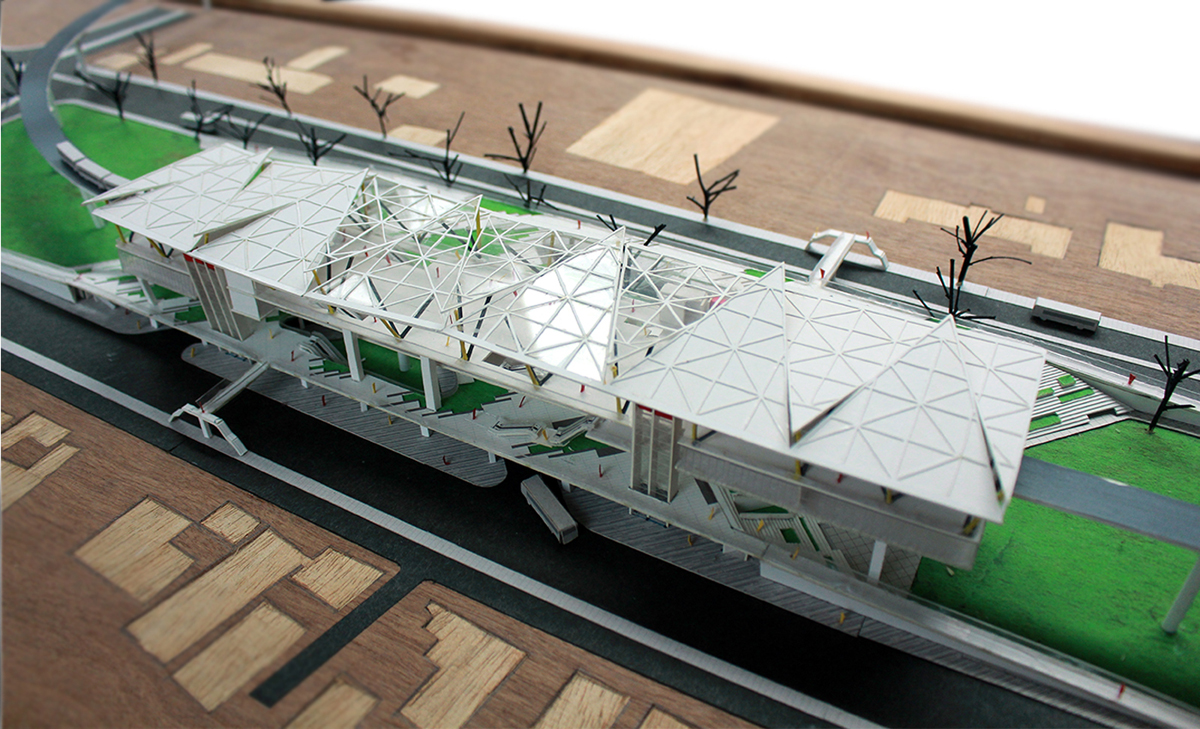


While designing, the first consideration was to preserving the environment of the park. Considering the park, the surface of the park is lifted to provide necessary circulation beneath it. The local context and terminal design trends was following to design a station that reflects the local context and merges with the surrounding and following the general characteristics of terminals of Dhaka as basic forms and repetition.


The New Landscape
Architect Charles Correa describes a simple hierarchy of private/public realm in Dharavi that starts with the private spaces needed for cooking, sleeping and storage, and moves on to those thresholds of intimate contact such as the front door and porch, and then the more public areas where neighbourhood takes place, such as around a well or water tap, and finally takes its largest form in the urban spaces such as the street and park, where residents and strangers alike mix on equal terms. Lack of space in any one of these four areas can be accommodated by an expansion in other areas – the idea of the flexible threshold and elastic space – and the operation of this flexibility is all made possible by a warm climate where people are happy to spend time in the open air and sit on their porches.
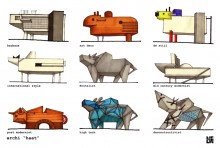
Archi “haat” | Tirtho