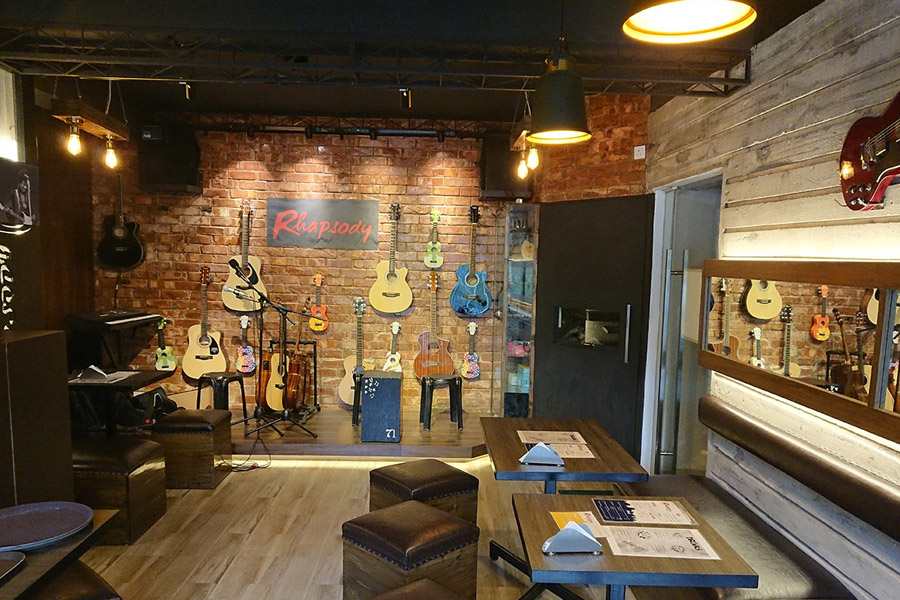
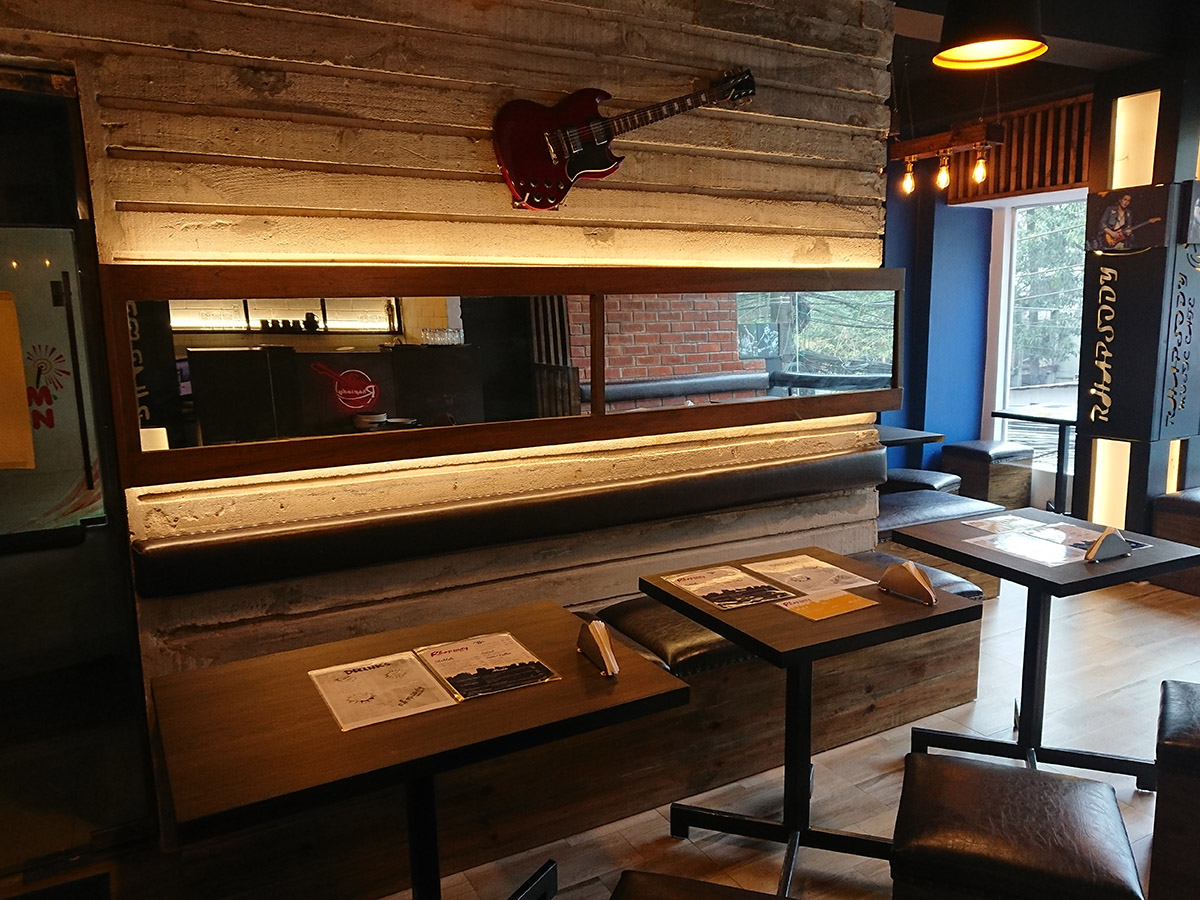
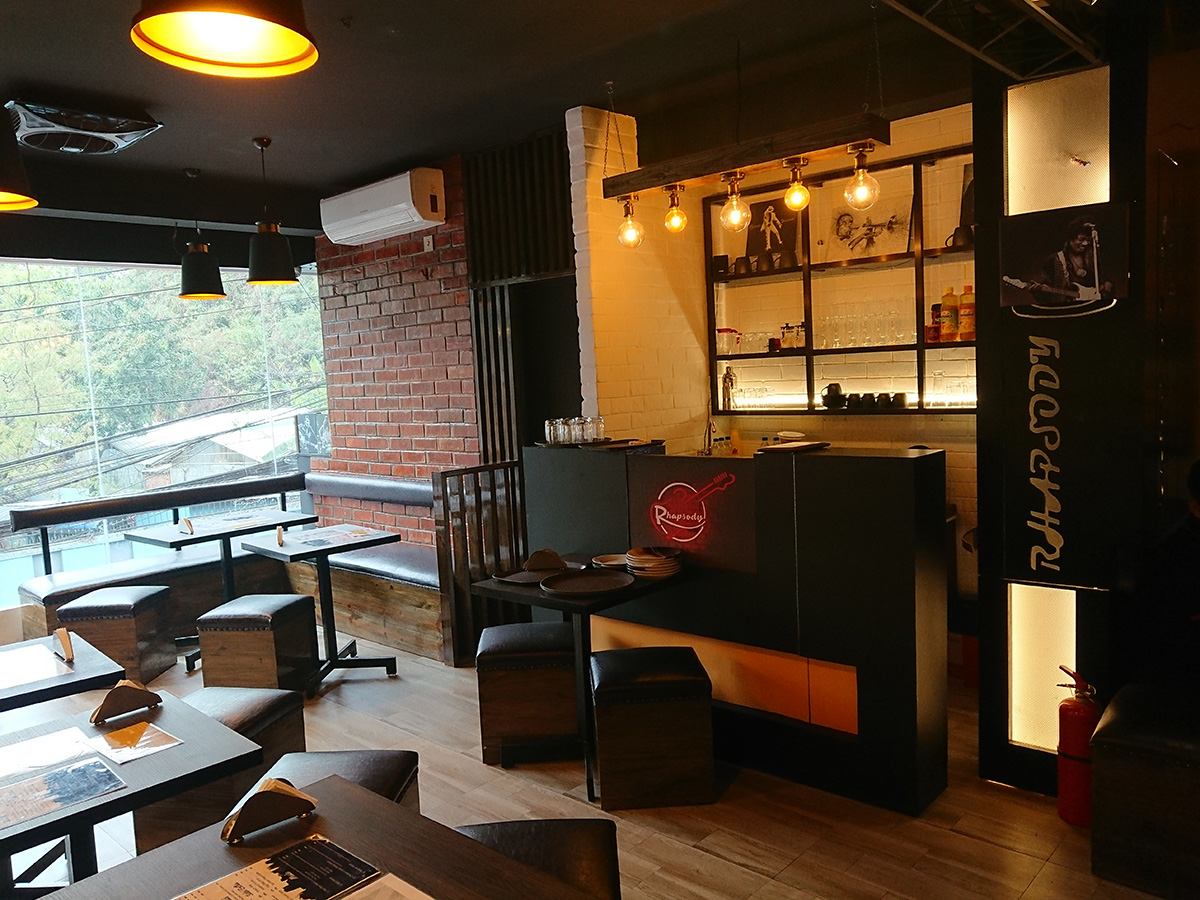
With the rise of cafe business, ‘Rhapsody Music Café’, located at Chattogram city, is somewhat different in its attempt to combine music and food. Many legendary band artists like popstar Azam Khan, L. R. B’s Ayub Bachchu, Nagar Baul’s James, and so forth were inspired by western music, hence created many timeless songs. With the noble purpose of keeping those classical bands alive, when the client consulted with the architect about the interior design of the café, the architect decided that why not Rhapsody Music Café becomes a meeting place for artists and music lovers. So the architects designed the café regarding this concept which makes the interior space delightful.
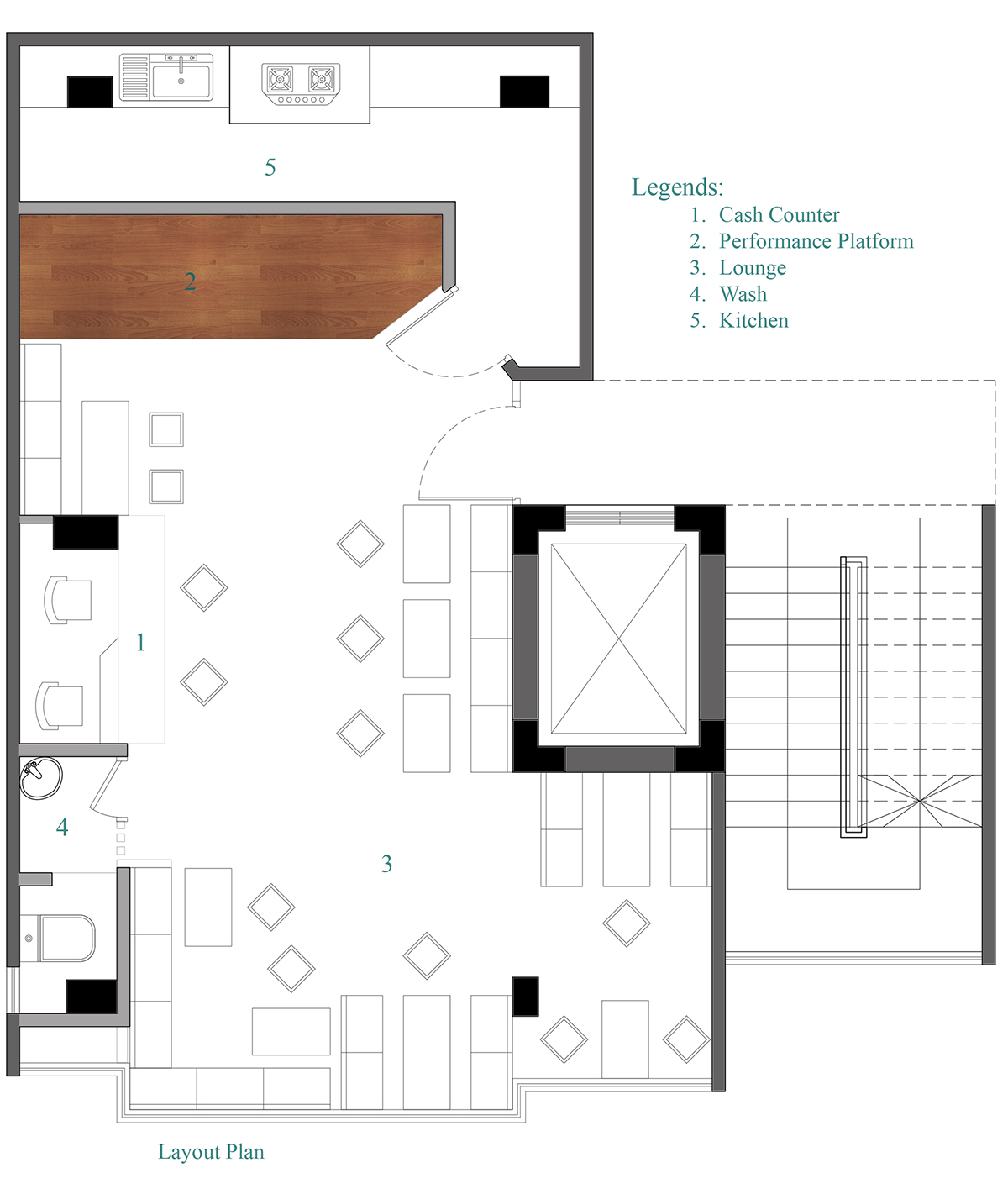
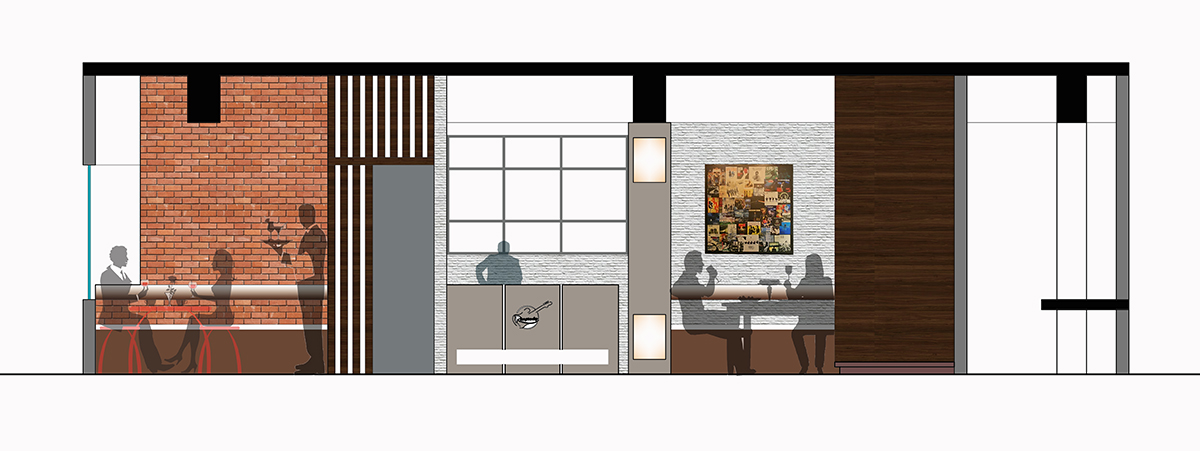
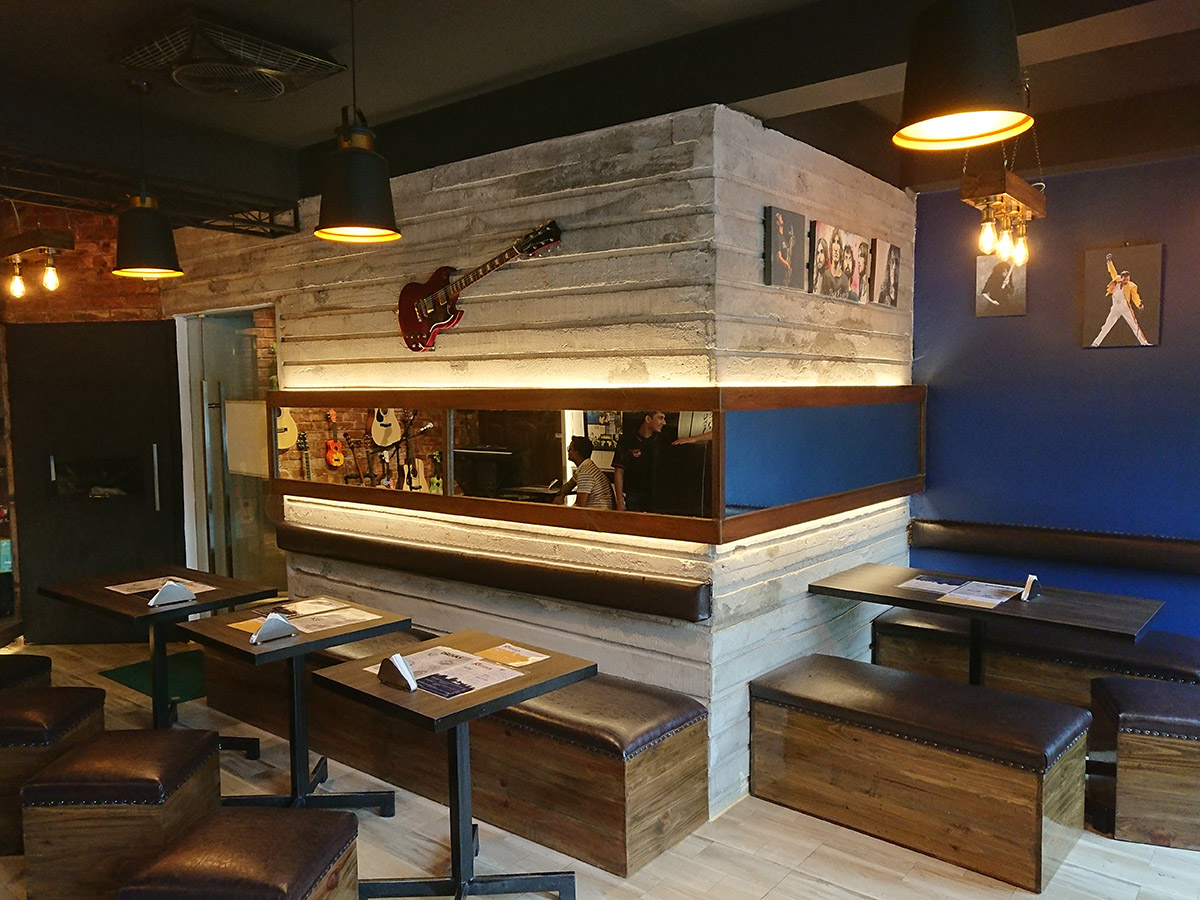
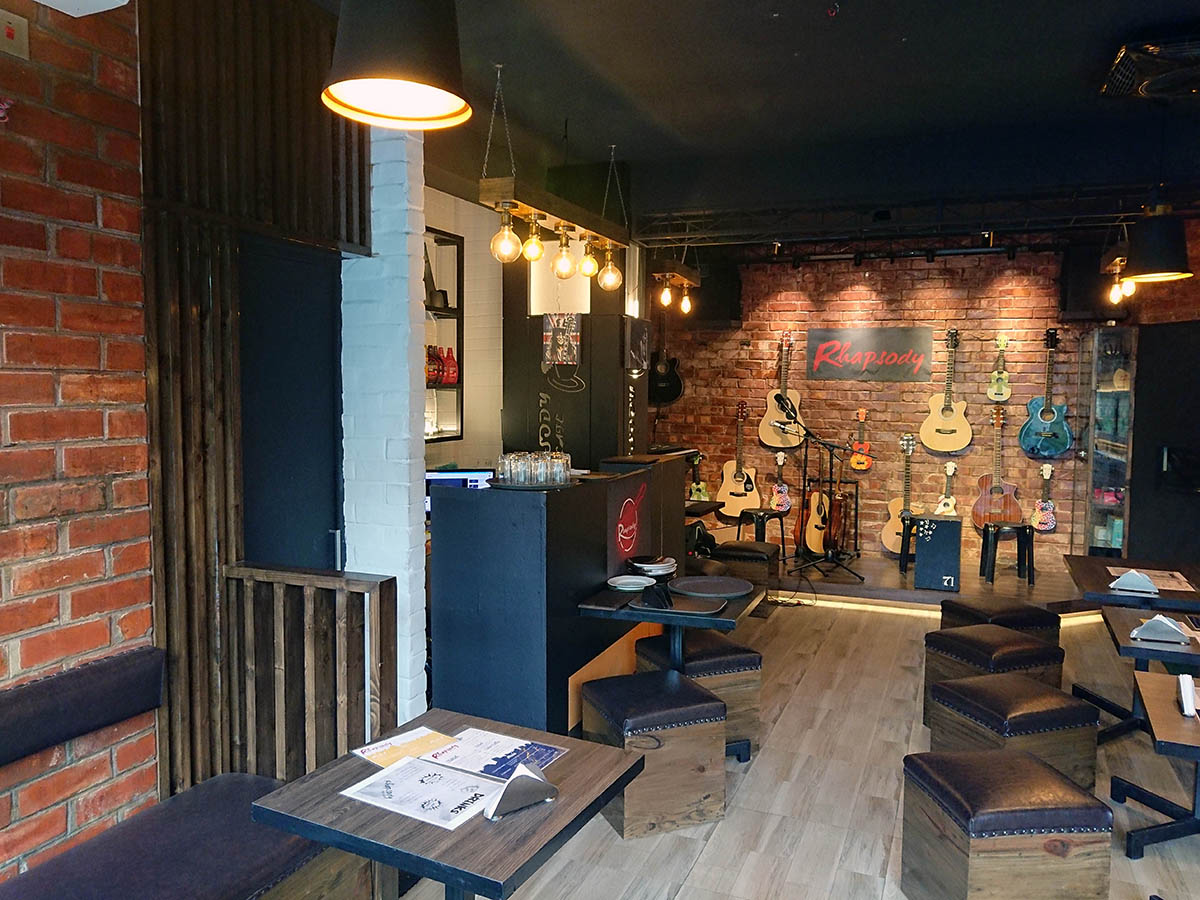
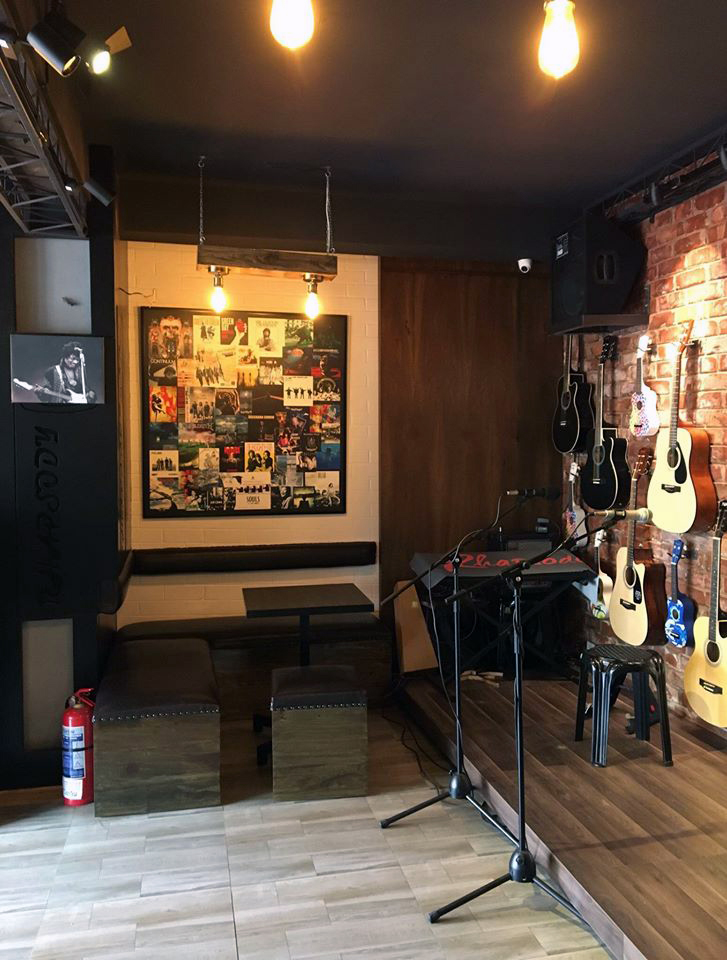
There is a fair-sized stage for music artists to perform. The backdrop of the stage is made up of an exposed brick wall and decorated with a variety of musical instruments used in western music which makes the whole restaurant unique. The other walls are decorated with pictures of various eminent artists to inspire the new generation of music lovers. There is also a bare-faced concrete surface at one portion of the café where mirror glass is installed so that the restaurant looks more spacious.
The interior concepts, wall finishes, minimalist furniture, warm lighting, music, all of these give the cafe a personality which dictates the enjoyable experience that customers look for.
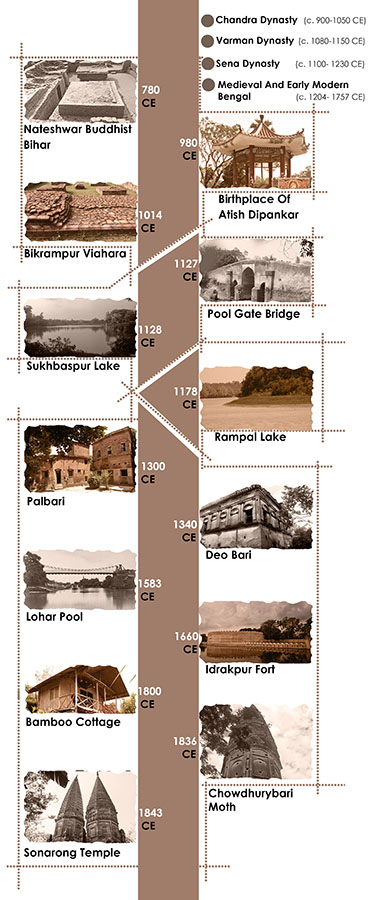
Bengal delta is enriched with natural heritage made up of vast mangrove forests, longest beach, and mighty rivers. The land had no significant tangible evidence of the built-heritage of ancient Bengal until the discovery of the Mahasthangarh ruins in Bogra district in 1931. Later on, the Paharpur Monastery, the Kantajew Temple in the district of Dinajpur and their renovation witnessed the faint evolution of the archeological richness of the land. Nateshwar, a village in Munshiganj, not far from Dhaka, is the most recent in this series of discovery of new sites. The place was once part of a vast area called Bikrampur, noted for being the birthplace of Atish Dipankar (980-1053), the legendary preacher, philosopher and academic.
This project aims to propose an integration of old (ruins) and new (museum). These types of design explorations are crucial to the cultural heritage scenario in Bangladesh. The design successfully negotiates the site’s conditions and has been able to utilize the site’s potential to a considerable extent. The concept of maintaining the strong axis between the ruins and the new building enables for a far more apparent connection between past and present – Editor.
| Notes from the student |
Vikrampur is an important designation in the early history of Bengal. The remains of an estimated 1,000-year-old temple and city have been found in Munshiganj District’s Vikrampur, one of the oldest archaeological sites in Bangladesh. The archaeological site of Nateshwar in Vikrampur has the potential to become a center of Buddhist culture in South Asia, and earn its place as a world heritage site. At present, Vikrampur is located in the Munshiganj district. The recently excavated Nateshwar archaeological site bears witness to the Bengal region’s thousand-year-old history, with its pyramid-shaped stupas, wide walkways, mandaps and households. Ranging from biological remains of flora and fauna to terracotta, metal and stone artifacts and unique architecture, the archaeological findings at Nateshwar paint the picture of an ancient civilization that once dwelled in the country we now call home. For a long period of time, people had been discovering architectural remains, sculptures and other ancient objects from here. Archaeologists discovered parts of ancient architecture by exposing 344 square meters at Nateshwar (Natesvar) duel.
It is believed that the monastery was related to Atish Dipankar Srigyan, a child prodigy like the Lord Buddha, who was born in Vikrampur region during the regime of King Dharmapala (820 AD). Some of the important findings in the excavation were a massive octagonal stupa, a pair of stupas with a four-meter wide wall which was the first of their kinds in the history of the country’s archaeological excavations, discoveries of two roads, a 2.75 meters wide wall to the site’s southeast side speak of a rich urban area of a bygone era and, and some important relics including ash pits, and pottery items.
Vikrampur itself is a historic locale of Bengal, a South Asian region known for its rich literary and cultural heritage. It is considered the oldest capital of Bengal since the Vedic Period. Archaeologists from both Bangladesh and China have expressed hope that these finds would reveal many hitherto unrevealed sides of Atish Dipankar life as well as shedding light on the advent and decline of Buddhism in this region. It is said that some 8,000 students and professors came to the Buddhism education center in Vikrampur from as far as China, Tibet, Nepal and Thailand during the period and Atish Dipankar was the Chancellor of the center.
The city and temple at the known Buddhist site with its strong links to ancient Buddhist scholar Atish Dipankar, makes archaeologists from both Bangladesh and China hopeful that further investigations will shed light on Atish Dipankar’s life and the history of Buddhism in the region. Archaeology is not about things. Or rather, it is not about the objects that we excavate in and of themselves. When a site is excavated and objects are collected and cataloged, the real work of an archaeologist begins, namely putting all the pieces of the puzzle together and figuring out what life was like in the past. A museum can preserve the evidence points to a ‘rich civilization’ in ancient Vikrampur. Historical remains are best to be preserved in their own origin so that visitors get to connect to the history of that place in a better way. This project intends to fulfill this requirement.
Objectives of the project:
To preserve the archeological remains by proposing a museum and to enlighten the people about the history of Bengal. Since Vikrampur was the capital once, it is aimed to give this place an acknowledgment by preserving its heritage, which would also improve its economic status.
To integrate the local people with this project so that the people and the project serve each other.
Concept:
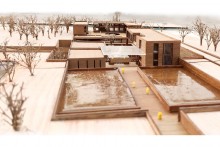
The thought was to create spaces that reflect the ancient Buddhist architecture, and the philosophy of Buddha while narrating the story of his life. At the same time, the form has been derived from the symmetrical approach of the ancient Buddhist Monasteries of Bengal. The new form has been developed by tracing the ancient Buddhist monastery-which we can find in the Paharpur or Maynamoti Bihara. The new museum has been placed with the same axis with the old Bihara-to create a dialogue between the old and the new; to create a continuous story of the ancient ruined with its resource, which will be kept in the museum. The voids have been created to keep up the essence of “nothingness” which connects us to the spirit of Buddha. The water body, the greeneries, the rise and fall of the levels are spatial representations of the places where Buddha used to meditate and seek his ultimate meaning of life by staying close to nature.
The master plan preserves the existing ruins and the future excavation site has also been kept untouched. There is a river in the west which is the site force that complements the master plan. The existing pond on the site has also been kept as it was. The entire master plan is intended to create the co-existence of the human-made elements with the natural elements in the site rather than superimposing the one over another. The main entry is from the east which has the information center and in the west, there is the museum gallery, cafe and accommodation. The accommodation wing has a dormitory, kitchen. It accommodates 2 archaeologists and 1 museum manager. There are 3 rooms for the visitors of the archaeology department. The research wing lies in the north. It has a laboratory for the archaeologists, an office for archaeologists, an admin office, a seminar room, and an office for the Agrashar Vikrampur Foundation.
The coastal human forest interface of the Bengal delta is locally called ‘The Country of Tides’, where an inhospitable saline land of mangrove meets manmade freshwater landscapes in the fractal matrix of countless rivers and channels that are fed by brackish moon tides. To ensure a flood and saline free inland, people had to create control over this landscape and as a result, the interface is divided into polders and forests today. But in this archipelago of loam clay, which is a hotspot for a range of ecological, geomorphic, and cultural diversities, is the answer to the question of how ‘Man Should Meet the Mangroves’, that simple?
People of this area believe in a guardian goddess, who does not belong to a temple. The goddess ‘Bonobibi’ was born in Mecca and was sent to this tide country to maintain the harmony between man and nature. The myth exceeds the borders of polders, extends towards the forests, and has been surprisingly successful in creating a strong communal existence.
Man stopped capturing new forest lands long ago and locked themselves inside the polders, but the rivers still continue to erode and deposit at the polder outsides. Therefore, lands are created in between forests and polders which do not have any clear law about who do those belong to. Mangrove tries to migrate into these parts by sending over floating germinated seeds; while man tries to take control by creating saltwater shrimp ponds.
The project is a garden for the community in one of those ‘Lands without an owner’, where man meets the mangroves and the goddess without a temple tries to create a balance between them by sending over the moon tides.
The Bengal delta is an estuary where the accumulation of water from different sources, especially precipitation from the Himalayas runs over a flat plain and meets the Bay of Bengal. Before meeting the sea, the rivers have to pass through an archipelago of loam clays and mangroves. There lies the Sundarbans with its protector tigers and crocodiles.
The coastal human forest interface of this area is locally called ‘The Country of Tides’, where the inhospitable saline land of mangrove meets the manmade freshwater landscapes in the fractal matrix of countless rivers and channels that are fed by the moon tides. To ensure a flood and saline free inland, people had to create control over this landscape and as a result, the interface is divided into polders and forests today. But in this archipelago of loam clay, which is a hotspot for a range of ecological, geomorphic, and cultural diversities, is the answer to the question of how ‘Man Should Meet the Mangroves’, that simple?
The mythical belief of this area has been surprisingly successful in creating a strong communal existence among the Hindu and the Muslim inhabitants. The guardian goddess ‘Bonobibi’; according to the belief, was born in Mecca and was sent to this tide country to maintain the balance between man and nature. The myth is deeply rooted in the history of early arrival and settling of the Muslim preachers in the Bengal and it is a derivative of people’s struggle to survive in a hostile land. This unique belief gives a powerful notion of a space, which ties up two different religions through the landscape. The subcontinent has seen examples of Islamic gardens and it also used to have Hindu sacred groves from very past already but has seen none of it merged into another. When both of the types mentioned can be considered as attempts to mimic heaven or unearthly pleasure, the myth of ‘Bonobibi’, who belongs to the land and tide, not in an enclosed temple; consistently sticks to the exchange of dialogue between man and nature in the harsh real world.
The mixed diurnal brackish tide that changes salinity every season shapes landscape of both man and mangrove here. Inside the forest, it creates ecologies of the canal, mudflat, ridge, and swamp basins where mangroves with knee, stilt, buttress, and plunk roots stand. Salinity and local elevation create variation in patch formation by species with different salt tolerances. And in the inland parts, polder embankments are made to control the tides from inundating inland to stop the saltwater intrusion. In this landscape, water management such as reserving freshwater from monsoon tides, controlling inland canal irrigation, and closing the sluice gates based on salinity level needs collective decisions.
Man stopped capturing new forest lands long ago and locked themselves inside the polders, but the rivers still continue to erode and deposit at the polder outsides. Therefore, lands are created in between forests and polders which do not have any clear law about who do those belong to. Mangrove tries to migrate into these parts by sending over floating germinated seeds; while man tries to take control by creating saltwater shrimp ponds.
The project is a garden for the community in one of those ‘Lands without an owner’, where man meets the mangroves and the goddess without a temple tries to create balance between them by sending over the moon tides. Seen from a strategic point of view, the project in one hand will belong to the community, which means lesser chance of being occupied by the shrimp industries, and on the other hand it will use mangroves as garden patches which will mimic part of forest ecology. The design will create public spaces inspired by local beliefs and farming methods and it can be seen as a pilot project for lands of this typology along the coastal human forest interface.
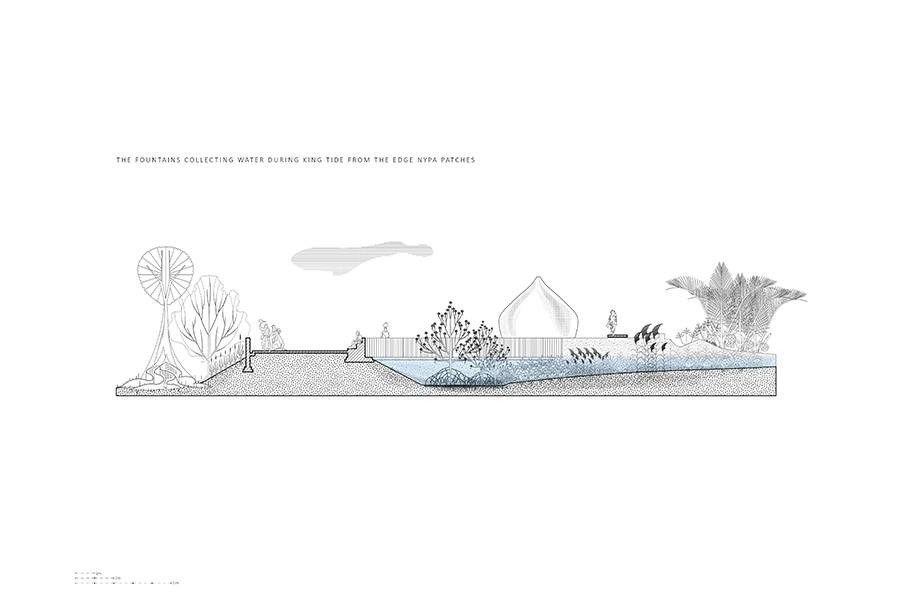
The site is a natural elbow-shaped land that has been used by the small farmers for seasonal rice and shrimp farming. Being in close proximity to the forest and subjected to regular tidal inundation it has a canal, mudflat, and ridge structures that are occupied by thick patches of Nypa palm, a pioneer species of the mangroves. The basin part is sunken and the lowest elevation is almost equal to the river neap tide water level. Tracing satellite images of the local elevation shows a common path of water flow in the inland. The lowest part of the land at the south side is dug and the local dike is breached in the proposal so that the tides can come inside. The tides enter through a mudflat, then go to a tidal pond through a sluice gate, and from there the freshwater and saltwater is separated and goes to different destinations.
The embankments guide to public spaces which become gradually more constructed and controlled following the existing shallow slope of the site from southeast to northwest. The lowest elevated part’s public space is mostly mud and gives an informal expression while the highest elevated part is for more formal gatherings which are more built. The tidal pond works as public space which is in between informal and formal and the rest of the land follows the existing grid of dikes and becomes farms. Finally, at the edges, the existing dike becomes a paved walkway and, in some parts, exaggerated shapes of local elevations are planted with patches of mangroves to mimic the ridge morphic ecological profile of the forest.
During a site visit (Dec-Jan 2019-2020) and after talking to experts who have been actively involved in the polder management and development programs it came out that the people are slowly rejecting salt water shrimp farming and becoming more adaptive to improvised traditional agriculture techniques introduced to them by different government initiatives like the Blue Gold Program. It was also very much clear that the communities with strong bonding are doing better practices. Shrimp farming is more profitable but needs bigger investments and the profit goes to only individual company owners; and on the other hand, communities who have been able to stop the aggression of the shrimp industry were producing crops all year around and earning more than what they would earn as shrimp farmers.
This became a pull factor to shift the focus of the research toward the cultural history of the local community and local farming techniques. Besides, the research area is always seen through lenses of disaster management, ecological conservation and afforestation. This project tries to put a spotlight on the cultural history and practices of this region as well as digging out some exotic spiritual mythical connection of the periods of the arrival of Islam in this part of the subcontinent and trying to conceive the indigenous domain within the design exercise.
Architect Nazma Anwar was one of the three pioneering female students of the Faculty of Architecture in Dhaka established in 1962. Born in 1943 in Rajshahi, architect Nazma Anwar spent her childhood in different places due to her father’s engineering job in the Roads and Highways. Her professional career began with Bangladeshi master architect Muzharul Islam. Later she moved to Mymensingh and served as the project architect for Bangladesh Agricultural University. There she supervised the implementation of the masterplan designed by the world-renowned Architect Paul Rudolph. She is now living in Long Island, New York with the family of her elder daughter.
Architect Nazma Anwar took CONTEXT team on a trip down memory lane as we heard about where her passion for architecture began, her campus life, teacher-student relationships, professional projects, memorable moments, and eventually revealed the picture of 60’s progressive society in Bangladesh.
What inspired you to study architecture? Given your time as you are one of the first female architects of Bangladesh.
As my father was a civil engineer, from youth I saw him designing and planning structures for his clients and his government job. Blueprints were all over our house and I would trace them and try to draw random things. So, when I started studying BSC it didn’t intrigue me much and my father would inspire me to study architecture as I drew well. In my second year, September of 1962, the Faculty of Architecture commenced its journey. Immediately I took groundwork for the admission test. I and Wazeda Zafar took few art lessons with artist Mustafa Monwar (a famous puppeteer and tv personality). The admission was very competitive, out of 800 only 30 of us were selected to study architecture and we both were admitted. Three of us were females and the rest were males. The journey started with enthusiasm full of excitement and new encounters as we were the first batch of architecture students in Bangladesh (then East Pakistan). Our teachers used to discuss with us how to manage the courses. There was an amazing bond between teachers and students. I personally never felt any gender differences nor any special treatment as a female. We, as a whole, were dealt equally with a great deal of appreciation and help for what we were doing.
Offer a proportion of your lovely recollections of your understudy presence with your teachers and classmates back in EPUET now BUET.
If my memory serves me right, the very first class in this journey started with Professor Richard E. Vrooman. On the very first day, he walked in, asked us to settle down and began drawing on the blackboard. He established the basic idea of perspective drawn from a rectangle. Then explained what a vanishing point is and how without it a perspective cannot be drawn. This was the first basic thing we learned about architecture.
We did basic design with artist Hamidur Rahman. We really enjoyed his course. Once he took us to Ramna park and asked us to draw a new leaf in every new minute. We got caught up with discovering leaves and then finish drawing within a span of a minute, it was a spontaneous class. As we were strolling back, the Shaheed Minar was on our way which was designed by Hamidur Rahman. Some of my curious cohorts were asking whether it is a justified representation of the victory of our mother language for which we held our heads high, rather not bowing down like the structure in the middle. He was kind enough to explain his concept with patience, what I can’t recall anymore. We had an astounding bond with him and had a decent amount of fun and learning.
The class of the first batch B.Arch (1961-66): Standing Zahedul Hassan, S A Zahiruddin, Prof.R E Vrooman, Meer Mobassar Ali, Prof. Jack Yardley. In the extreme right, Mrs. Nazma Habib Anwar along with Mrs. Shaheen Westcombe (daughter of prominent politician Habibullah Bahar Chowdhury).
In our first year, Abdullah Abu Sayeed (famous teacher, writer, television presenter, and activist) taught us Dak Ghor by Rabindranath Tagore. His class was fascinating to the point that students from common and different departments would simply come to listen him talk. It was lovely craftsmanship the manner in which he would talk; we simply were astounded by it.
We went to a lot of study trips. Once we went to Cox’s Bazaar and Rangamati with Professor Samuel T Lanford and his wife. I had my mother accompanied us as we needed a guardian for all of us. My mother also threw a dinner to make the trip more memorable for us. She was very creative in setting up the table with a white cloth decorated with ivy leaves and put the dinnerware on top of the leaves. Everyone delighted in and made some incredible memories, Lanford really appreciated my mother’s effort.
Abu Sayed, Hamidur Rahman, Abdur Razzak, Dr. Rashid Chowdhury- I am exceptionally fortunate to have these individuals as my teachers.
Professor Lanford, Nazma Anwar, Shaheen Bahar Chowdhury and Wasifa Rahman during a study trip
Back in the days, Louis I Kahn was working on National Assembly Building and visited your school for a lecture. Share your memory of Louis I Kahn with us.
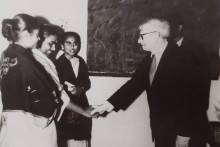
When Kahn came for visiting the school, we three females were the ones to go stand in front of him. I also have a photo with him shaking hands. I do not recall much from his public presentation in our department but meeting a world-renowned architect as students was so fascinating for us!
You worked directly with two world-renowned architects – Paul Rudolph and Muzharul Islam. Can you share some of your experiences working with them?
I took up work from Mazharul Islam’s firm, named Vastukalabid. He taught me a legitimate way of designing and how to start planning something. As in architecture school, we only studied, there was little practical work. He was my dad’s companion and cared for me additionally. I was given the space beside his drafting table, occasionally checking and assisting me with work. Moreover, he took our climatology course from what I could accumulate working by his side. His design style was very simple, true to the purpose of the structure and context. This is why his works never get old. Back then some ongoing projects were Jahangirnagar University and Chittagong University. In 1971, he left for India and his office was looked after by our architect friend Rabiul Hussain. After the war, I re-joined and worked there for a while, then I left for Mymensingh.
It was fortunate to work with architect Paul Rudolph’s design when I joined as the only project architect in Mymensingh University. He had an assistant named Prospero who would drop by often to have casual conversations. I was stunned to see Rudolph’s drawings as we don’t follow this type of technique in our country. Clearly, I had no idea about his style. On top of that, I joined half-way through the project. I used to be at my office from 10 to 4 trying to comprehend his drawings as much conceivable, as I had to administer the project process and make it work in like manner. I have taken in a great deal of brick bonding from him. His designs had highly complex floor plans and details. The ventilator he designed was unique at that time which was mechanically operated and brought from the USA. I had endless learning from his works.
Back when you started women were not seen as having a career and you served as a project architect at Agriculture University, Mymensingh. Was it difficult to establish yourself as a woman?
Well, it was never hard for me to build up myself as a woman. I am frequently posed by this inquiry lately, however, back in my days I didn’t feel such or any gender differences. Our working environment was safe and friendly, everyone around was very helpful and motivating.
Not as a woman but as an architect I confronted challenges while working with Rudolph. As it was a huge project to contemplate and comprehend. It was really intense for me. I was the only architect in my office with no assistant. There was nobody to counsel or ask help from. So, I contemplated everything by myself to comprehend his method and style better. I used to consult in the teachers’ meeting before taking any decision or whenever needed.
Once a project engineer offered me to visit the construction site with him. The site was undergoing roof casting of a three-storied building. There was no stair, a bamboo ramp was used by the laborers to carry the construction materials on their head and to walk up. The project engineer was in doubt whether I could climb the bamboo ramp. I assured him and climbed it at the same pace as others while wearing saree and heels. Everybody in the site stared at me in amazement. On a different occasion, Shamsul Wares (prominent architect and educator) came with his students to show Paul Rudolph’s work. As I was the project architect, he first came to my place then I took the lead to show them around and talk about his work.
I remember, during my undergraduate days, Dunham would take us to random buildings and asked us to sketch them. People around the streets would look at us in wonder as if it was something, they are seeing for the first time. But we never faced any problem. We could always work very independently with respect and appreciation for what we do.
Our environment back in the days was more secure and better contrasted with these days. I have spent some beautiful days back at the time. Nothing stopped or came in my way for my gender.
You have a beautiful family of 3 daughters. How difficult was it for you to balance your work and family?
I have never confronted any issues accordingly. Likewise, my daughters were never an issue for my work. My better half consistently supported me the most and would complete errands and help me as much as could be expected under the circumstances. Bits of help were always around to look after my daughters in my absence. My more youthful sister consistently propelled and bolstered me all through. My family was my backbone always encouraging me and being my greatest emotionally supportive system.
Among all the works that you have done, which project/s are your most valued and why?
My favourite house that I designed was for my father. It was located in Gulshan which later was handed to developers, so it’s not there anymore. It was very different from the typical houses; I experimented a lot and attempted new things. I planned a gigantic round window by the flight of stairs inspired by Louis Kahn’s big arches, round windows of the Capital Complex at Sher – e- Bangla Nagar. The house was made with overburnt Jhama bricks (thrown out bricks) sourced from Mirpur Ceramics at a very low price. When it would rain a lovely reflection of blue and red would play over the veneer.
Family Residence at Gulshan | Designed by architect Nazma Anwar
Family Residence at Gulshan | Designed by architect Nazma Anwar
Among the big projects I designed, Sports Complex for the Bangladesh Agriculture University, Mymensingh is notable. I got the offer after I left the job of the project architect there and moved back to Dhaka. It was a challenging project as the site was tight and surrounded by Rudolph’s designed buildings. There was a vacant space between his designed buildings where I planned the complex.
Sultana Razia hall was additionally designed by me and I quite like it. Initially, a site by the stream side was allotted for the project. But taking the security for young ladies into account, I picked a different site located between teachers’ quarters. It was small yet very much assembled.
I could have worked more and couldn’t do it for my own negligence.
Tell us a little about your time in the USA, as you have visited Falling Water and many other wonderful projects.
The first time I got to learn about Frank Lloyd Wright was before sitting for the architecture admission test. We were asked to study famous architects and their works. Even before I knew him my friend architect Rabiul Hussain from Khustia read about his falling water project in a magazine. He brought along the magazine, which inspired him to study architecture, in the interview at Dhaka. Anyway, recently, I visited the Falling Water with my daughter, she lives in Pittsburgh, Pennsylvania. It is needless to say about the beauty of it. We had taken a car, then from a certain point, we had to walk up to it. From far away you can hear the sound of falling water. The way Wright designed it 90 years back is still the same; very well maintained and preserved. It is so simple, whitewashed plate-like structures looming over the water body. Not only the structure but also the site is exceptionally delightful. The building blends seamlessly with nature. I’m considering myself fortunate to see it. I will probably visit Solom R. Guggenheim Museum, another Frank Lloyd Wright masterpiece, which is yet to be visited.
Architect Nazma Anwar while visiting Falling Water at Mill Run, Pennsylvania, USA
The client wanted an enjoyable workspace, an artwork exclusively for the cafeteria reflecting the varieties of services provided by Uber like ride-sharing, delivery, etc as well as the vibrant culture and lifestyle of Dhaka city with its people and places. Thus the artwork depicts monuments of Dhaka and activities of Uber with colorful fluid shapes to make the office cafeteria a more vibrant and breathing space for the employees.
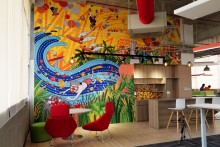
The mural is done for the designer’s workspace in Apex’s Gazipur factory. The intention was to create an enjoyable workspace for the employees, hence the mural depicts vibrant activities and colors. The mural had to accommodate a pantry and coffee station at a corner, thus incorporating the pantry within the artwork was intentional.
The design concept was to focus on all the majors and activities facilitated by the Department of Civil Engineering, BUET as well as major projects and structures of Bangladesh in which the department had been involved. The mural is installed on the large wall along with the lofty staircase in the main lobby of the Civil Department Building. The intention was to create a vibrant ambiance within the lofty space and make the journey by the stairs an enjoyable and memorable one.
The intention was to create an artwork focusing on the identity, goals and vision of JTI, a leading international tobacco product manufacturer, as well as the urban life and local lifestyle of tea stall and cigarettes with vibrant colors and playful shapes. One of the two murals focuses on the ‘Vision 2030’ of JTI. The company emphasizes four focus areas: Products and services; People; Supply chain & Regulatory environment; and Illegal trade, which they consider are essential for the sustainability of the business.
The design requirement was to create an artwork for the cafeteria of UL VS Bangladesh Ltd- Dhaka office of a global safety certification company- which would enhance the ambiance as well as provide a fun breathing space among the offices and laboratories. The design thus introduced vibrant colors, fluid forms, and company’s brand icons.
The client requested artworks for their three outlets in Dhaka which will represent the vibrant urban youth and lifestyle as well as incorporating their product which is ‘Pizza’ in it. The final artwork thus comprised of iconic monuments and places of Dhaka along with the ever-growing ‘pizza culture’ in young lifestyle.
Sailor is a popular clothing brand in Bangladesh. For their new outlet at Wari, a residential area in Old Dhaka, they wanted to put a mural to create the brand identity. The design concept was to depict the vibrant and rich history and culture of Wari as well as the old Dhaka with its people, places and festivals.
ChitoGolpo is a renowned wedding photography and wedding planning service in Bangladesh. For their new office, the client wanted a mural which would depict the traditional weddings and festivals of Bangladesh. Focusing on the cultural aspects of different regions and religions, as well as wedding themes in various locations, the client requested for little details that make a traditional Bangladeshi wedding ceremony so special and vibrant. Another special request from the client was to incorporate their traveling spree all around the globe in the artwork.
Blues Communications is an event and entertainment management agency based in Dhaka. The design requirement was to create an artwork for the workspace in the head office which would enhance the working environment and reflect the various activities happening in the office. Work-Relax-Fun has been the theme of the 40 feet by 23 feet graffiti design. The lofty office space includes work areas at different levels as well as sleeping space over the coffee and drinks bar, book library and reading space, a swimming pool, and a front lawn for outdoor games and activities for the employees. The design concept was to incorporate all these different activities in a single frame to make the workspace more friendly and fun-loving. Fluid and geometric shapes have been introduced accompanying a vibrant colorful pallet in the artwork depicting various activities happening in the workspace to make it more enjoyable and work-friendly.
“This architectural design studio project, Meditation Space Design Inspired by Lalon Shah’s Philosophy by Sabbir H Sujan, is a sensitive attempt to explore the meaning of Fakir Lalon Shah’s legendary works, ideals, and spiritual understanding and express them through context-sensitive architecture in Kustia, Bangladesh. The designer has imagined and presented wonderful spaces (See the wonderful 3D animation) that are modern as well as spiritual. The proposed structures are respectful to the local culture and natural surroundings.
The design of the low-rise complex (27 acres) skillfully represents three stages of human life (innocence > mind > realization) through the sequential organization of activity spaces (e.g. entry/concert stage > central stage on waterbody > the tomb) and with a compelling exposure to the river and the sky. From conceptualization to material selections, the design process reflects an awareness about the users (e.g. followers of Lalon Shah, local residents, tourists, nature lovers), cultural heritages (e.g. activities surrounding the river, ghat, gate, tomb), technical details (e.g. wood as a key construction material, innovative roofing technique) and micro-climate (e.g. seasonal variations, prevailing wind flow, sun positions). These are all essential components of the context-sensitive design.
While this is an excellent architectural design exercise that would inspire future meditation space design among architecture students in Bangladesh, I was wondering whether the design could negotiate more gently with the river, e.g. by reducing the amount of ‘retaining walls’ on flowing water. Also, enormous practicality and contextual constraints are involved in translating such design projects into rural context. For example, large paved and built areas might be considered too costly for the local stakeholders to build and maintain. The designer considered some practicalities and explored why, how, and whether local authorities and users would like to build this proposal.
Overall, I believe the readers would be impressed by this culturally sensitive, spiritually inspired, and locally buildable design.” – Editor
| From the student |
From ancient times, we cultivate and search for our spiritual energy. Every living being has a spirit bonded with its physical existence. Fakir Lalon Shah is a well-known spiritual practitioner who lived and practiced his spiritual journey in Kushtia, Bangladesh. He wrote poems about the spirit, life and social discrimination. He meditated to reveal the connectivity within the human body, soul and cosmic energy. He narrated his findings as lyrics and sang them for people. One of his lyrics talks about the importance of knowing oneself in order to know the unknown:
“একবারআপনারেচিনতেপারলেরে.যাবেঅচেনারেচেনা”
“Once you know yourself, you would be able to unveil the unknown.”
(English translation: Author)
This thesis is an attempt to study and find out the inner meaning of Fakir Lalon Shah’s lyrics through design. The meditation spaces are designed as an integrated place that creates the impression of Fakir Lalon Shah’s lyrics.
The site is located at Cheouria village of Kumarkhali Upazila, Kushtia district and locally known as “Lalon Shah Akhra”. The site is sacred and spiritually connected with the local people and their life. The people of this region are considered as one of the most peace-loving people in Bangladesh. They love to live by respecting Lalon Shah’s philosophy.
The site is highly blessed with natural elements and beautiful surroundings. The design preserves the local environmental elements that inspire deep meditation while developing the meditational environment for modern time. Built forms follow vernacular architecture style on Bangladesh and use materials like mud, bamboos, wood and concrete. The design distributes the position of spaces to achieve proper architectural aesthetics.
Meditation is a balanced connection between time, realization and destination. It is an organized way to understand how we spend our past, what we are now, where we will be. Time and generations are flowing – this is the truth of any entity. Fakir Lalon Shah described and sang for the people and tried to make them understand the true form of religion. His lyrics talk about discrimination and peace. This design is a combined expression of his lyrics into architecture.
“তিনগর্ভেআছেরেএকছেলে,
ওসেসবাইকেকয়মনেরকথা,
আমায়কয়নাপ্রানগেলে”
“There are three wombs that contain the whole of the seed,
It tells everyone the secret,
But never ever let me understand”
Or,
“তিনপাগলেহলোমেলানদেএসে
তোরাকেউযাসনেওপাগলেরকাছে”
“Three essences meet in the vessel
Don’t let yourself go near them”
(English translation: Author)
These thoughts expose three points or phases of life. This project takes the three phases of life as the concept and expressed them through design. This project also attempts to recreate the quality of the environment wherein Lalon Shah’s and his followers used to spread his philosophy to the rural people to help them lead a peaceful life. All these thoughts are designed and idealized considering the present world era.
The project is also an attempt to preserve the history of Lalon Shah’s Akhra Bari, the meditational system, building styles and local rural livelihood. The Akhra Bari was originally the property of Malam Shah. He gave this land to Fakir Lalon Shah to practice his spiritual learning. This place was very quiet and calm with the blessing of nature with some families living here and there.
People of Karigar para, Kushtia are experts in building contextual houses as they are engaged in these jobs for many decades and traditionally aware of creating sustainable buildings. This project may have their concern so that it can be built with the traditional blessings and those people will have financial benefits.
This project has the potential to expose our spiritual resources as well as the richness of our spiritual practitioners to international communities. It makes an offer to the dedicated Lalon philosophers to live and help meditation students to enrich their understandings here. This is also a space to empower the local builders and craftsmen. With finance from the Ministry of Cultural Affairs- Bangladesh, the project construction can be supervised by the Public Works Department (PWD) with the active participation of the local government and the community.
CONTEXT Contributing Editor: Md Rashed Bhuyan, PhD | Research Fellow, Lee Kuan Yew Centre for Innovative Cities, Singapore University of Technology and Design.
On a very sunny late morning, when we entered through the great entrance “Shanku Toron”, named after the young boy Shanku Samajhdar– the first martyr of 1971 from greater Rangpur, it seemed like a large garden house of some aristocrat – a clean soft path by large shading trees and small wooden shops and office rooms on the other side, where you would like to walk on your lazy holiday morning, watching shadows of leaves and sunlight playing on the ground, butterflies flying and birds chirping all around the green. Here and there in that very green garden like place, the workers were having their lunch. Nobody was dropping waste on the ground, no hustle bustle. Sitting beside some small water bodies and bushes, workers were having lunch peacefully, the air filled with the resonance of their chitter chatter.
Photograph by: Junaid Hasan Pranto
I’m talking about a factory that makes rural artifacts like Shataranji, which is identical craftwork of Rangpur area, now hugely being produced by the Karupannya Ltd. inside this enormous green factory of around 3 lac square feet – which is indeed, ‘green’.
The large reservoirs caught my eyes as we were walking up the wide stairs – which have a great impact on the overall design. There are four reservoirs of a total fifteen thousand square feet radius in there – in the lobby at the ground floor of the factory, which can preserve around five lac liters of water at the same time. The first functional benefit of this we could anticipate is that the factory is very well prepared for any kind of fire hazard!
Photograph by: Noshin Tuba
Primarily when you see the green stalks bending upon the water bodies, touching the water slightly, it will remind you the identical image of the ponds of the rural Bangladesh – which was actually the idea of Ar. Bayejid Mahbub Khondker. But when we come to know more about it, the project is far more interesting than only that!
The water condition of North Bengal is slightly iron rich. The fountains placed before the working zone, at first sight, seem to be designed for just beautification, are actually used to drop water from a height with a very force – that breaks the iron bond and makes the water suitable for dying works again. Basically this water comes from the dying section – the water which might go to waste, architect planned to reuse that in a cyclic order. The wastewater of approximately 60 deg Celsius then goes to the ETP and after getting refined for the second time – comes to the pond-like calm, cold reservoirs through the fountains. Due to which only 20% of the groundwater is used, which they had to raise up to 80% before!
Water throwing down to break Iron bond | Photograph by: Noshin Tuba & Junaid Hasan Pranto
The concept I was introduced firstly, now makes sense. The large factory indeed needs proper air circulation through the whole block, as there is no air cooler, or such artificial technology used to lower the temperature, that happens when the outside air comes in through the green layer and touching the water – and blows up through the louvres, just like we see in the courtyard houses. The workers never have to worry about the discomfort caused by the heat in the factory, even in the very mid-noon of April-May of summer. We went to the working section, the workers were knitting Shataranji, putting finishing touches on those and the temperature was there 6 deg lower than outside that they could work whole day long in there without any artificial air conditioning system!
Photograph by Junaid Hasan Pranto
There is also a stage before the main building – surrounded by greeneries and large trees as background, and the wide stairs are used as the gallery. The architect is the magician who could think of that combination of workplace and recreation space for the mass workers. On a sudden evening after work, one of them starts singing on the stage, one by one the others join him/her, and thus they make sudden cultural evenings which need no occasion actually – these very moments also help to build up amicable relationships between the managers and the workers.
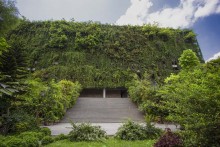
The factory looks like a large green, impeccable mass from outside – there are greeneries on the roof hanging from high, which are placed at least 15 feet distant from the main structure, so there is hardly any possibility of any damage like dampness or structural harm to the main building. Each floor has four feet buffer for the door and windows to be placed, with a green screen outside.
Photograph by: Bayejid M Khondker
Along with the architect, there is another person who helped to make the work so complete – artist Saidul Haque Juise. To accentuate the countryside images and to enhance the lifestyle of the rural craftsmen he added some details here and there in the factory like decorating the wall with Tepa putul, Kula, Pradeep, mud bowls, rural mud house like textured walls, and so on.
Photograph by: Junaid Hasan Pranto
Photograph by: Bayejid M Khondker
Photograph by: Bayejid M Khondker
There is a bit of extended open place on the first floor – which could be left as some negative space, but they made it useful with some greeneries and benches and named it Nandini Park. There is a beautiful spiral staircase going down from the kitchen so that the workers can come with their launch box – through the green straight to the park. Nandini Park is decorated with broken large mud bowls where some Lily and Nymphoides, or floating-heart plants are placed, some broken bricks arranged aesthetically and thus created a little space to get a ‘power break’ for the workers to breathe!
Nandini Park | Photograph by: Junaid Hasan Pranto
In a small room with some seating arrangements, which is kept for some small talks with the guests, I noticed a large blue mask of a female face in the wall – which is inspired from the pattern of the Russian political satire rally held every year in Moscow – reflecting the culture of ours with the golden fibre in hand. The meeting room is on the top floor, the serious thing like business meeting happens here in a very homely environment with the essence of a yard in typical village houses of the country. If you ever engrossed yourself in gossiping in some “Uthan”, you can visualize it better. One side of the conference area is full of artifacts to show to the buyers, and on the opposite wall, there is a large mural with various postures of working hands.
Photograph by Junaid Hasan Pranto
Other than these, there are also some intricate stuff like how the architect designed it to maintain electrical safety at its best, assured the lowest usage of electricity for an industry or like maintaining BOD-COD, beauty salon, café and recreational spaces for the workers etc., which are actually intellectual ideas I must say, but I’m skipping those in this article. The thing I didn’t get the chance to see but heard from my father while he was making the human resource software for the company – that is all the water used in the factory is never let to be wasted, it is used in the fish farming pond basically to give a check that they are not doing any harm to the environment!
But the fact which brings the utmost success to the architect and his team is, it’s not just a factory or workplace to the workers, it’s rather been like a home to them. A home of their own with a touch of green and soil. A glimpse of future Bangladesh.
Where else is there more complacency for an architect?
Project credentials:
Project title: Karupannya Rangpur Ltd.
Location: Alamnagar, Rangpur
Principal Architect: Ar Bayejid Mahbub Khondoker
Sculpture, Installation, Plantation, Landscape & Interior: Saidul Huq Juice
Bangladesh chancery complex is an architectural project of high political and diplomatic importance. In addition to the basic purpose of delegation and representation of nationhood, a diplomatic mission on foreign land is also to build as well as maintain international political and other relationships. The vision, mission, activities of such an establishment depends on the foreign policy of a country whether it focuses on developing on bilateral issues holding equity or become influential and aggressive or remain passive by practicing minimum services and duties. The expression of the political attitude of a nation to another is better exhibited architecturally as a powerful symbol of impression; and as a host, the Chancery Complex might consider the design strategy accordingly. Having the native architectural characteristics and evolution through history as well as contemporary trends in Bangladesh, the project Bangladesh Chancery Complex in Turkey does the job of representing the country on a foreign land very well. Features of various courtyards, zoning sensitivity, timely thoughts on security issues, and finally the architectural form, which is derived from Bengal architecture, are strong elements to represent Bangladesh with dignity and strength. The effort to blend the architectural elements (do-chala roof, connecting bridge, fenestration elements of modern architecture) are praiseworthy considering this a student project, scope is there to bring more maturity in formal expression once time permits. A healthy piece of architecture usually ought to have elements to contextualize to the ground where it is located, unless it wants to make any particular statement while standing out in contrast. Considering the fact that both Bangladesh and Turkey are secular states having a demographic context of Muslim majority (so is the representation on urban grain and architectural practice), the Chancery Complex could have Turkish elements to some extent, to blend in the context and offer a friendly spirit to bilateral interest but this is actually at designer’s discretion and the designer decided not to do so, rather echoing the domestic vernacular abroad, as stated in the project rationale. All in all, the project appears to be strong and bold to represent the country and hold the political spirit to realize the agendas of foreign policy; but sometimes it is the designer’s opportunity to improvise on a nation’s attitude to bilateral cooperation by architectural design and thus make a political statement. -Editor
| Notes from the student |
Chancery complex is the intricate association of buildings that houses a diplomatic mission, such as an embassy. It resembles the nation’s physical embodiment abroad, representing optimistic novelty, straightforward existential fear, unabashed self-interest or national identity, in the modern era chancery architecture as art, proliferates from Dhaka to London to Ankara. In short, in designing a Chancery complex, ‘Form Follows Values’.
Most of Bangladesh’s embassies are hosted in rented houses, but now the government has issued a wave of chancery complexes to be built. Ankara was caught up in the wave and 1.13 acre land was acquired for that purpose through land exchange program. It is a moderate sloping site in the diplomatic zone in Oran of Çankaya district of Ankara, the capital of Turkey. It has a cold semi-arid climate and differs in temperature, humidity and precipitation from Bangladesh.
Chancery complexes in different countries host different programs according to the diplomatic relationship. Ministry of Foreign Affairs, Bangladesh settled upon five wings in Ankara: Consular wing, Diplomatic wing, Commercial wing, Defense wing, Ambassador’s enclosure along with a multipurpose hall and Ambassador’s residence.
Chancery complexes are built while a) relating two countries or b) focusing on the host or c) representing thyself. Bangladesh is represented in this project with her archetype. With a temporal evolution, from Ahsan Manzil to Faculty of Fine Arts, DU to Baitur Rauf Jame Masjid, we find the new energy of changing architecture created by architects while playing with form, materials, aesthetics etc. and mingling with the traditional architecture of this land. Our vernacular archetype or Architecture within Folk Tradition of Bangladesh gives us characteristics to represent our country abroad and it can be adapted with different site conditions.
Shape of the roof has a unique bent in our region. This bent shape roof (aka do-chala) is one of the most important identifying characteristics of Bengal architecture. The use of this element in the building form would carry our native identity.
An introverted courtyard is being considered the essential architectural characteric of our country where the inner court is accompanied by verandas or meeting places. In the design of the Chancery complex, the lounges and two formal living spaces surround the court creating a similar ambiance. The presence of green and water is hard to sustain in the given site in Ankara. But different local climatic solutions provide occupants the opportunity to enjoy nature in an adaptive manner. Connection with open spaces or the presence of semi-outdoor places is created with long glassed openings as long as local climate supports and occupant’s comfort is ensured.
Multiple Forms in a complex are not physically connected in our traditional architecture but the local architectural and urban context usually host a giant form containing all the functions. So in this project bridges connecting different functions gives the essence of multiple forms.
Security of an embassy is one of the topmost priorities and the attitude in designing evolved with time here also. During the 1950s a high walled complex was considered secured and then the terrorist attacks began to increase. Then a full fort-like archetype was considered secured and practiced nowadays also. But it leaves a negative impact in the community’s mind. Different engaging support points and strategical placement of functions lead to a more secured architecture.
Here consular wing’s separate entry and the vegetation alongside give the public a friendlier environment as well as decrease security breach as it diverts the mass people’s entry into the main complex. The green zone as the outdoor of the multipurpose hall also acts as a support zone.
The water sheet in reception and water sheets along the transition of the wings surrounds the administration wing and ambassador’s enclosure and create a float like a plan as it is emerging from the water. The visible court from the sitting areas along with the semi-outdoor essence gives a taste of Bengal in foreign soil which one was expecting while entering the complex with a unique curved roof.
CONTEXT contributing editor: Shajjad Hossain, PhD candidate, University of Evora, Portugal
After rigorous field research, a book titled “The Ruins of Darasbari Mosque- A Visual Diary ” has been published by art historian and architect Sajid Bin Doza. Darsbari is a magnificent historic mosque of the medieval period of Bengal.
The mosque Darsbari belonged to a typical Muslim educational complex located in the southern suburb of the old capital Gaur, presently known as Chapainawabganj District of Bangladesh. This historic site is situated about half kilometre to the west of the Choto Sona mosque. The mosque was built in 1479 AD during the era of Shamsuddin Yusuf Shah and is considered as the largest mosque in the Bangladesh part of Gaur-Lakhnauti.
Dr. Doza who is an architect and art historian has been working on the Darasbari mosque project for the last 11 years. Being fascinated by antiquity, he started to look out this historic beauty after his first visit to the mosque in 2008. He managed to publish a book by gathering his own sketches and paintings done on the site, analytical justifications based on his research and collective observations of the scholars and students. The book carries illustrations and short writings so that the target group of readers would stand from all disciplines.
Once a vibrant ‘place of learning’, the Darsbari mosque is now lying abandoned and locally known as the ‘mosque of silence’. The roof of the mosque was heavily damaged by the earthquake of 1897. The Western wall renovation was executed in 1924; another partial renovation was performed during the 1990s. The author argued, “If Choto Sona mosque would be the ‘Gem of Gaur’, Darasbari Mosque must have that much significance to justify the glorious medieval structure of entire Bengal“. This rare evidence of medieval Bengal is on the verge of total extinction. The author commented, “I wanted the book to be for common people, to let them know about glorious antiquity, a medieval mosque with golden memories dies without maintenance.”
This book, having the quality of visual and illustrative elaboration, is an attempt to showcase the glory and the magnificent craftsmanship of the medieval architecture of Bengal. As well known to the world that Bengal established an authentic style of Sultanate architecture in making mosques and tombs, ‘The Ruins of the Darasbari Mosque’ will remain as an important contribution in the documented history of Bengal and continue to inspire the learners and researchers of all ages.
Temporary architectures have been increasingly appearing and disappearing in urban spaces with transient events and situations. These structures have extended the opportunities for architects to test their understandings of urban spaces and human behavior by challenging the boundaries of architecture. Through the masterplan of Chattagram International Trade Fair (CITF), we have tried to explore the possibilities to integrate contextual analysis into the design and re-evaluate the idea of a Trade Fair to craft an experiential environment for the visitors.
CITF is an annual event in Chattagram city for the last 27 years. It’s the second-largest trade fair of Bangladesh with an estimated 2 million visitors yearly. In contrast to a short construction period (approximately 30 days), the design and organization phase takes several months. The event runs for 40 days.
[Video is shared from architect’s youtube page]
The inception of the design started from collecting memories of the city dwellers through a podcast called Chattagram Echoes. Most of the stories narrated the nostalgia of green terrain landscape, open spaces, less traffic in the city. However, rapid urbanization has barely left any of those memories and places intact. These conversations guided us to pursue negotiations on placemaking focusing on people’s experience in urban spaces.
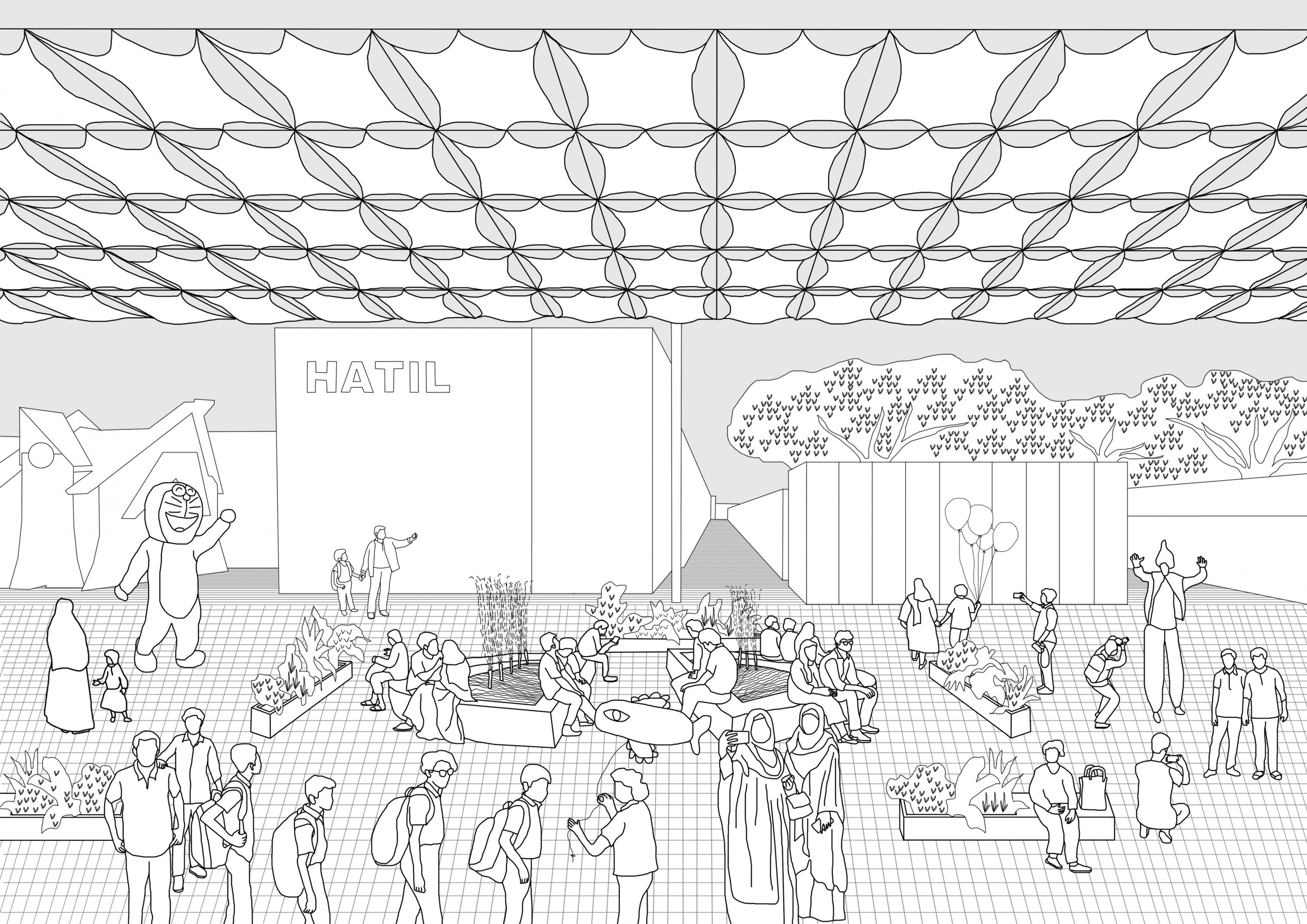
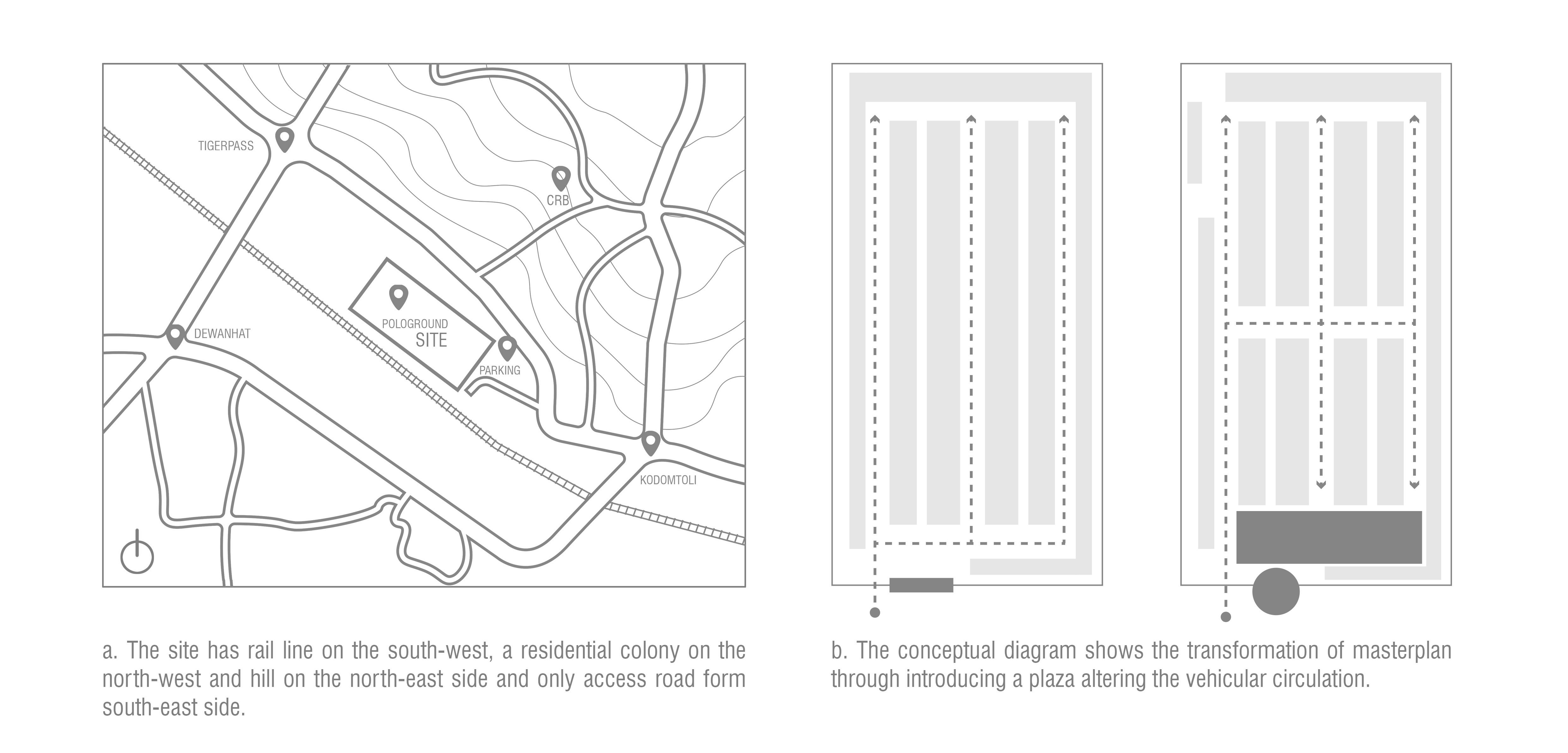
In the previous layouts, all the major access points and circulations were dominated by vehicular movements prioritizing the construction works and daily product supply. We altered the vehicular thoroughfare in the masterplan which allowed us to introduce a 90m X 15m plaza dedicated to the visitors. Under a fabric canopy, the plaza accommodated sitting area, fountain, floor lights, and plants.
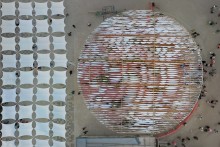
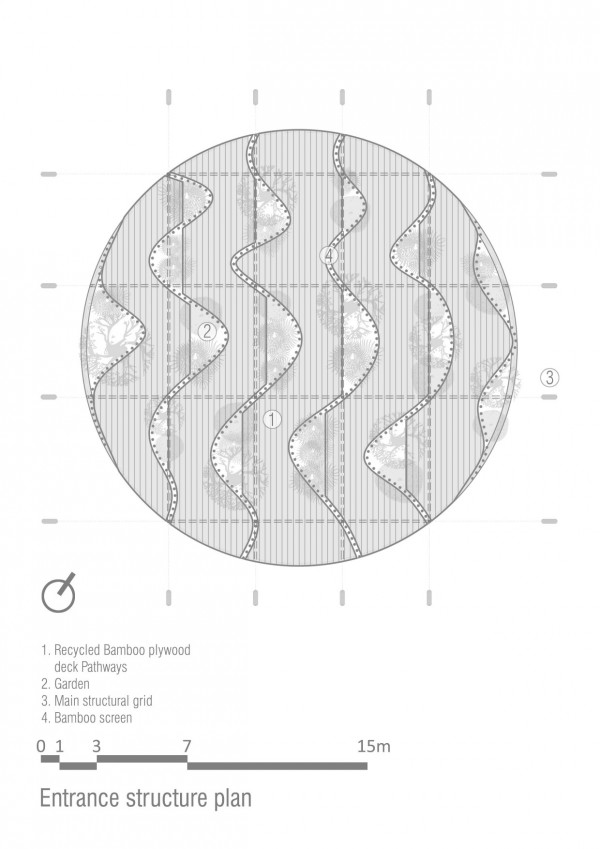
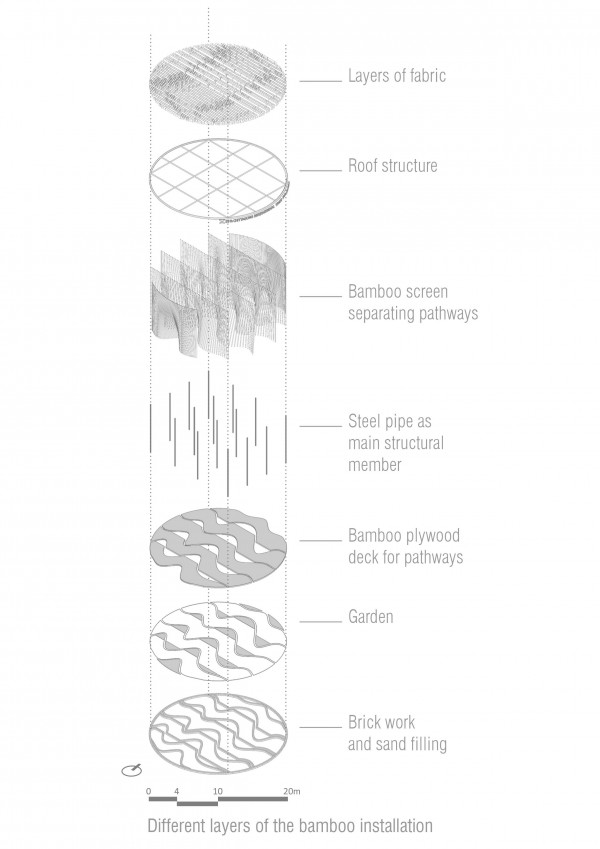
To design the main entrance, we reevaluated the concept of the gate from a doorway to a spatial experience. We designed a circular bamboo installation (20m diameter, 10m in height). This acted as a transitional space to lead the visitors into the plaza. All the materials were locally sourced and reused after demolition.
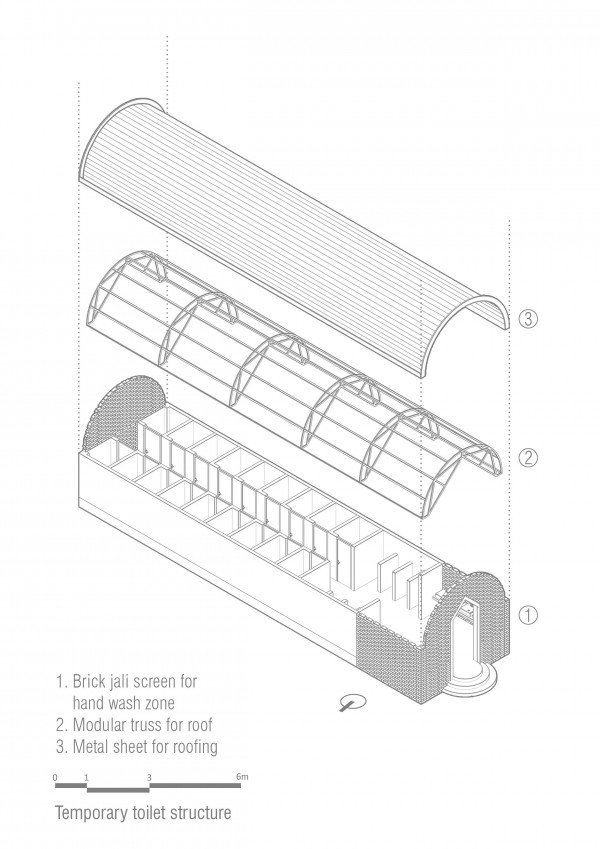
The masterplan included 20 pavilions, 200 stalls, international zone, associate country zone, food court, gaming zone, prayer space, toilet facilities for male and female, car parking, security booth, admin office, fire service, police security booth and power supply station. The design process was flexible to address the challenges during construction and to collaborate with various professional and local technicians.