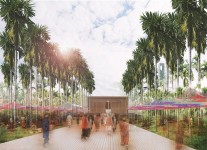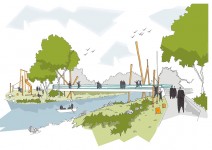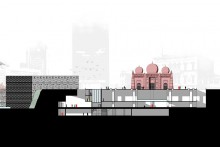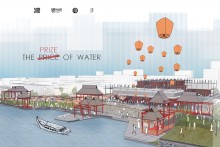
Echoes of the Estuary: A Tourism Center at Hatiya Dwip

World Environment Day 2026

Urban [Re]Stitch

Architect Bashirul Haq (1942-2020): Life, Death and Tears

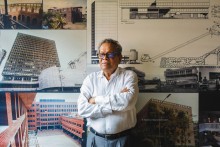
On April 4, many architects, including me couldn’t hold back tears after the heart-breaking news of Architect Bashirul Haq’s demise. It’s during a time like this when many people stop to reflect on life and the realization that at any moment it could be your last day to spend time with a loved one or family member.

Architect Bashirul Haq, the country’s one of the pioneers of profession, was an inspiring personality and beloved mentor of many. His death has devasted architect community and sparked grief in social media. Community leaders, institutes and individuals have published condolence notes in their respective official pages and websites.

 বাংলাদেশ স্থপতি ইনস্টিটিউট গভীর শোকের সাথে জানাচ্ছে যে বাস্থই ফেলো, বাংলাদেশের স্থাপত্য চর্চার অন্যতম পথিকৃৎ, স্থপতি বশিরুল হক (H-008) .. ঢাকার গণস্বাস্থ্য নগর হাসপাতালে চিকিৎসাধীন অবস্থায় মৃত্যু বরণ করেছেন (ইন্নালিল্লাহি…… রাজিউন) তাঁর মৃত্যুতে এদেশের স্থাপত্য চর্চা শিক্ষাক্ষেত্রে অপূরণীয় শূন্যতার সৃষ্টি হলো। বাংলাদেশ স্থপতি ইনস্টিটিউট এই কালজয়ী স্থপতির প্রতি শ্রদ্ধা নিবেদন করছে এবং তাঁর শোকাহত পরিবারের প্রতি আন্তরিক সমবেদনা জ্ঞাপন করছে। -Institute of Architects Bangladesh


We deeply mourn the passing of Bashirul Haq, one of the most respected architects of Bangladesh, and a beloved mentor to many..Our condolences to his family, friends, and everyone who drew inspiration from his remarkable works and teachings- Bengal Institute

Architect Bashirul Haq’s self-interest was subordinate to his patriotic affection. Moved by his ardent attachment, he declined the offer from the world’s leading architectural firm Skidmore, Owings & Merrill (SOM) in his early career and flew back to Bangladesh and established Bashirul Haq & Associates in 1977.

[ Suggested for you Knowing Bashirul Haq – An Architect, a Thinker, a Critic and More ]

In his lifetime Bashirul Haq designed many architectural marvels including some of the most notable buildings of post-independent Bangladesh. His works are well documented and published widely. He has left his mark in diverse fields of architecture ranging from urban apartment housing to emergency shelter in disaster risk areas. The cyclone shelters designed by him in the coastal regions of Bangladesh received global acclamation and documented in the book Battling the Storm – Study on Cyclone Resistant Housing, published by the German Red Cross.

A recently published monograph of his works and philosophy, has also documented architect’s selected works. The editors noted, “Bashirul Haq is undoubtedly is one of the most critically acclaimed contemporary architects of South Asia. His most significant contribution to Bangladeshi architecture is establishing a deep-rooted connection with the local context with a rich blend of tradition and modernity, finding a language that is contemporary yet responsive to local culture and climate, creating contextual forms.”

[ Interested readers can find his works on the Facebook page: Architect. BASHIRUL HAQ  ]

Bashirul Haq Architect- a monograph of his works and philosophy published in 2018 | Courtesy: Ar. Mohaimeen Islam Badhon


We all know death is a part of life, but that doesn’t prevent us from experiencing the emotions that come into our lives when the loss hits. The death of Architect Bashirul Haq will be followed by an extended period of grieving and sadness. He will be missed but not forgotten and his architectural legacy will remain forever as an unbound source of inspiration for many young architects. Rest in peace my architect, our architect!

Architect Bashirul Haq in his home studio | Source: Ar. Shafique Rahman


Biographical timeline of Architect Bashirul Haq

1942– born 24 June in Brahmanbaria

1964– completed his Bachelor of Architecture from National College of Arts, Lahore, Pakistan

1971– received John Heinrich Tuition, Scholarship and Teaching Assistantship at the University of New Mexico, USA

1975- completed his masters in architecture from the University of New Mexico, USA

1977- established Bashirul Haq & Associates

1989- visited Massachusetts Institute of Technology (MIT) as an invited design critic.

1999- co-authored the book Battling the Storm – Study on Cyclone Resistant Housing

2018 –Bashirul Haq Architect, a monograph of his works and philosophy was published.

2020-  took his last breath on 4 April.

Early Works

[Source: Bashirul Haq architect, Editor: Iftekhar Ahmad & Sheikh Rubaiya Sultana]

1978-82   Chowdhury residence

1979-81   Architect’s family home and studio

1983-87   BCIC Head Office building

1989   Bhatshala House

1989-92   Kalindi Apartment complex

1991-92  Shabuj Shona centre

1992-94 Community development centre and Cyclone Shelter

1994-97 Dhansiri apartment complex

1995 Gulshan pride apartment complex

1998-99 Cyclone shelter / School for DASCOH

Later works 

[Source: Bashirul Haq architect, Editor: Iftekhar Ahmad & Sheikh Rubaiya Sultana]

2000-03 ASRA apartments

2003 Traning centre for Nijera Kori

2004-06 Chhayanaut Bhaban

2006-07 Sunbeam school

2009-12 East West University

2010-15  A K Khan Ain  Bhaban, Chittagong University

COVID-19 crisis: Our responsibilities – today and tomorrow | Message from Architects

With this instinctive feeling for social solidarity, eminent architects and activists of Bangladesh have also come forward to offer their empathy and support to overcome these challenges. The video is compiled by Ar. Shafique Rahman.  Shafique is currently teaching at Ahsanullah University of Science and Technology. He has completed his graduation from Khulna University and Masters from the University of Sydney, Australia.
 

Architects’ response to COVID-19 crisis: An interview with Nurur R Khan

Architect Nurur Rahman Khan, a renowned educator and practicing architect, speaks with Context team about challenges brought by COVID 19 pandemic to the built environment professionals in Bangladesh. Architect Khan is a Partner of Tanya Karim N R Khan and Associates and has taught in various universities like BUET, BRAC University, UAP, NSU, Stamford University, Bangladesh University, and IUAV in Venice in different capacities. He has also given talks in MIT, RISD, YALE, NUS, IUAV, CEPT, and many other international platforms.

Q. To cope with COVID 19 outbreaks and as a measure of social distancing, many architecture offices have already moved to the home office scheme. Considering the uncertainty of the outbreak and its duration, do you think working from home is a feasible alternative to keep the business running?

Yes, architects can develop the design and show ideas on a virtual platform, but our work at the end of the day is a physical work, it is on site. So, our real concern has to be that when things are start locking down, and it will, the work will not progress on site. As we know most of our payments are connected to the progress of work, contracts or tender being awarded. And there is a high probability that our payments will get stuck at one point. Working from home may let us to progress with developing design and drawings, but outbreaks will significantly disrupt the work on site which in turn leads to partial payment or no payment at all. If the work does not proceed, tender doesn’t proceed, contracts do not proceed, the client will eventually stop payment. And that will be the real challenge. We have not stepped into this scenario yet but that is about to come.

Secondly, a lot of us may be in the project stage and the project actually requires that we still interact with the client, or we still need to go to the site. In some cases, we still need to meet with clients and visit the site. We are not so equipped to handle the site virtually. Neither that all clients meeting that can be handled virtually. And even the client may go into quarantine. Then the project will not proceed. So, for architectural firms, extremely difficult time is about to come, and this is a matter of serious concern.

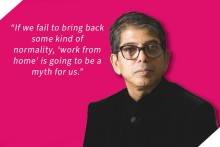
Collectively architects need to build awareness and put civic pressure to start the containment as soon as possible. If we fail to bring back some kind of normality, ‘work from home’ is going to be a myth for us.

Q. As we’ve seen under an economic downturn, which is anticipated to follow COVID 19 pandemic, it is the employee who is most at risk of job termination. Do you think, architects might have to face similar faith? Do you see any difference in capacity between the big offices and small offices to adapt to this crisis?

Frankly speaking, it is the employees who are at a high risk of not getting paid. Many offices will not be able to sustain payment if the situation goes for long. Employers will also be hit hard because they will have to dig into their savings.

The big office has a huge liability to its lots of employees. The rent is higher, costs are higher, everything is higher.  When things will come to a stop, it will be difficult even for the big office to manage the running cost. On the other hand, small offices with one or two employees might be able to survive the situation as they have less liability. In other words, it depends on what fallback options are available for the offices. The ability of the offices to fall back onto some kind of savings is going to be the real issue here. However, their structure may differ between big and small offices. For instance, big offices may have good savings but at the same time its liability also high. On the other hand, small offices usually have less liability, but it may have small savings.

Architect Nurur Rahman Khan

Q. In response to this crisis, do you think, the architect community as a collective body has a role to play?

Organizations like the Institute of Architects or Alumni Associations also have a role to play. Such organizations can come forward by organizing competitions for designing containment shelter or makeshift emergency treatment facility. In fact, the BUET alumni association of engineers has already stepped forward with various initiatives. I think, to tackle this unprecedented challenge, a lot of design-related brainstorming is necessary now. Architects have already come forward in helping to fund or co-ordinate emergency equipment like PPE and face shield. Members of ArcAAB have also been very active in this matter. I feel extremely proud to see so many architects already helping out in so many ways. But I also think we can contribute to giving retrofitting places to work as emergency isolation and treatment facilities and also ideas isolation and treatment facilities. We are a huge community with a lot of creative power that we can put into motion in different aspects like coordination, fundraising, development of products, and design of facilities. These are difficult and worrying times and I think if we put our minds to work, we not only can contribute but also stay active and positive.

Architect Nurur Rahman Khan


Q. Do you have any message for your colleagues and the architect community in general?

We all need to be well prepared for total lockdown; protective measures won’t be enough at some point. Perhaps it’d be wise to do it phase by phase rather sudden closure. Offices that are still operating should keep in mind that every employer is responsible for every employee, every employee is responsible for their colleague, and we are all responsible for our family and friends.

Besides our own professional crisis, we have to also understand that it is much bigger than our work and our self-sustenance. We have to be selfless and start to care about our whole country and help out in this crisis every way possible.

At the end we are also an intellectual body, can guide, inspire and set examples by our actions, and as responsible citizens, we have a duty to do so.

May Almighty help us all get through this.


Saimum Kabir is the founding editor of ContextBD and PhD fellow at the University of Melbourne in the Faculty of Architecture, Building and Planning.

How architects are coping with COVID-19 pandemic: An interview with Mamnoon Murshed Chowdhury

ContextBD team talked with architects to learn how architecture offices are coping with COVID 19 outbreak in Bangladesh. The following interview features architect Mamnoon Murshed Chowdhury who his currently the Vice President [National Affairs] in the Institute of Architects Bangladesh – the professional body of architects in the country. Ar. Chowdhury is one of the founding Partners of DWm4 Architects. The 50 plus member firm is among the leading practitioners in Dhaka and has won laurels in awards and design competitions.  He is also involved in teaching as a visiting faculty at the University of Asia Pacific and BRAC University.


Q. The world is passing through a difficult time. COVID 19 pandemic has brought an unprecedented challenge to keep things moving as usual. Some are also predicting the outbreak will be followed by a serious economic recession. As an employer or office owner, what is your biggest concern?

My primary concern is the economic recession that is about to hit us. As we know, globally construction is the first sector to get shut down, when the economic recession happens. Anticipating such a crisis, some of the offices including us have already adopted work from home scheme. We have also started to think about the long-term plan by identifying the potential sectors to focus on in order to stay off the crisis for a longer period. For instance, we are trying to identify the projects that are at risk of slow payment or no payment at all.   Based on risk factors, current savings and possible revenue, we will try to outline a financial plan for salaries and other running costs. Only in the worst-case scenario, we might need to think of overhead cut down as employers usually do.

Q. As you mentioned, many architecture offices have already moved to home office scheme, some are on the process, considering the uncertainty of the outbreak and its duration, do you think working from home is a feasible alternative to keep the business running?

Well, I don’t think we have any other options at this moment. It has to be the alternative. Perhaps, it will help us to keep going if we can find some positive things out of it. Say for example, if we are able to make this scheme work, with a reasonable amount of efficiency and productivity, and we overcome the problem of communication within ourselves and with the client, we can actually think about the home office as an alternative even during the time of normalcy. Specially in Dhaka, where traffic congestion and exposure to pollution is a matter of huge concern, many of our workforces can actually keep continuing work from home. Not everyone in the office has to face the client  or has to  visit site and many of us always work on the desk –  so there is no reason why these persons cannot work from home if both employee and employer show some sort of responsibility and if the technology supports us. Now, for an indefinite period of time, this is the only alternative that we have, we don’t have any choice. We cannot start physical office as it will going to expose ourselves or our colleagues to a huge risk. On top of that, offices like ours don’t have the financial ability to cover the damages if anything goes wrong.

Architect Mamnoon Murshed Chowdhury


Q. We came across the information that your office has prepared a policy for work from home scheme. Would you consider sharing some points that you think relevant to others?

It was a very hurriedly drawn policy. We prepared it based on common sense. The main issue was to create a guideline for the virtual office without compromising the efficiency of the physical office environment as much as possible. The first target was to create a mechanism to record the office timing and ensure teamwork. We are using applications like TeamViewer, Whats App and Google Spreadsheet to track the operational progress. Every employee who works from home is liable to report to his or her immediate supervisor. Secondly, policies are outlined to provide support in three primary logistics: hardware, software, and the internet. However, there are some practical challenges. Many of my fellow colleagues are not well equipped at home, so we let a few of them take the office PC at home. We find internet speed is also a big obstacle to use an application like Team Viewer. Our office is also providing extended support to its employees to avail high-speed internet at home.

Architect Mamnoon Murshed Chowdhury


Q. We are also observing, in response to this crisis, alumni association of engineers has stepped forward to produce emergency equipment like PPE and ventilators. Do you think, the architect community as a collective body has a role to play as well?

Definitely. Institute of Architects Bangladesh (IAB) has already taken some initiatives; funds are also mobilized. It is now almost confirmed that on behalf of the architect community IAB is going to financially contribute to import PPE and masks from China. We are also actively considering to extend our support towards the disadvantaged population of the country. We’ve made the decision to take part in the emergency relief activity through local NGOs. We have contributed to funding relief package comprising soaps and dry foods to the vulnerable groups.

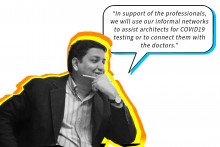
In support of the professionals, the two working groups are being formed. One working group is responsible to provide advisory and counseling support if anyone in the architect community gets sick. We will use our informal networks to assist the person for COVID19 testing or to connect them with the doctors. Another working group will oversee the issues related to the professions by providing up to date information from time to time. We’ve also brainstormed the possibilities to negotiate with the government for a stimulus package for the architects for post COVID19 time, but it’s just an idea, nothing finalized yet.

Q. Do you have any message for your colleagues and the architect community in general?

Individually or as a collective group, we should prepare for the worst. At the same time, we should also keep hoping and praying that the worst does not happen. We have to be proactive. Apart from architects, the building industry involves other supporting sectors and professionals like engineers, contractors, subcontractors, vendors, suppliers, etc. If we plan ahead, in a coordinated manner, there is a better chance to limit the damage. Further, the global economic downturn will bring serious challenges for Bangladesh as the country’s major revenue comes RMG and remittance; and both sectors are extremely affected by the COVID 19 outbreaks. These are some factors of international significance, where we don’t have any control. But we should not sit back and watch rather we should try to find a way forward and learn to absorb or mutate this in our practice. We may also need to adapt, particularly the younger professionals, to seek new opportunities that partially match their skill sets. It’s important to think ahead so that we can bounce back quickly.


Saimum Kabir is the founding editor of ContextBD and PhD fellow at the University of Melbourne in the Faculty of Architecture, Building and Planning.

An Enclosure of Permeability and Aperture: ARCASIA Pavilion at Dhaka

“We don’t ask to be eternal beings, we only ask that things do not lose all their meaning.”_ Antoine de Saint-Exupery

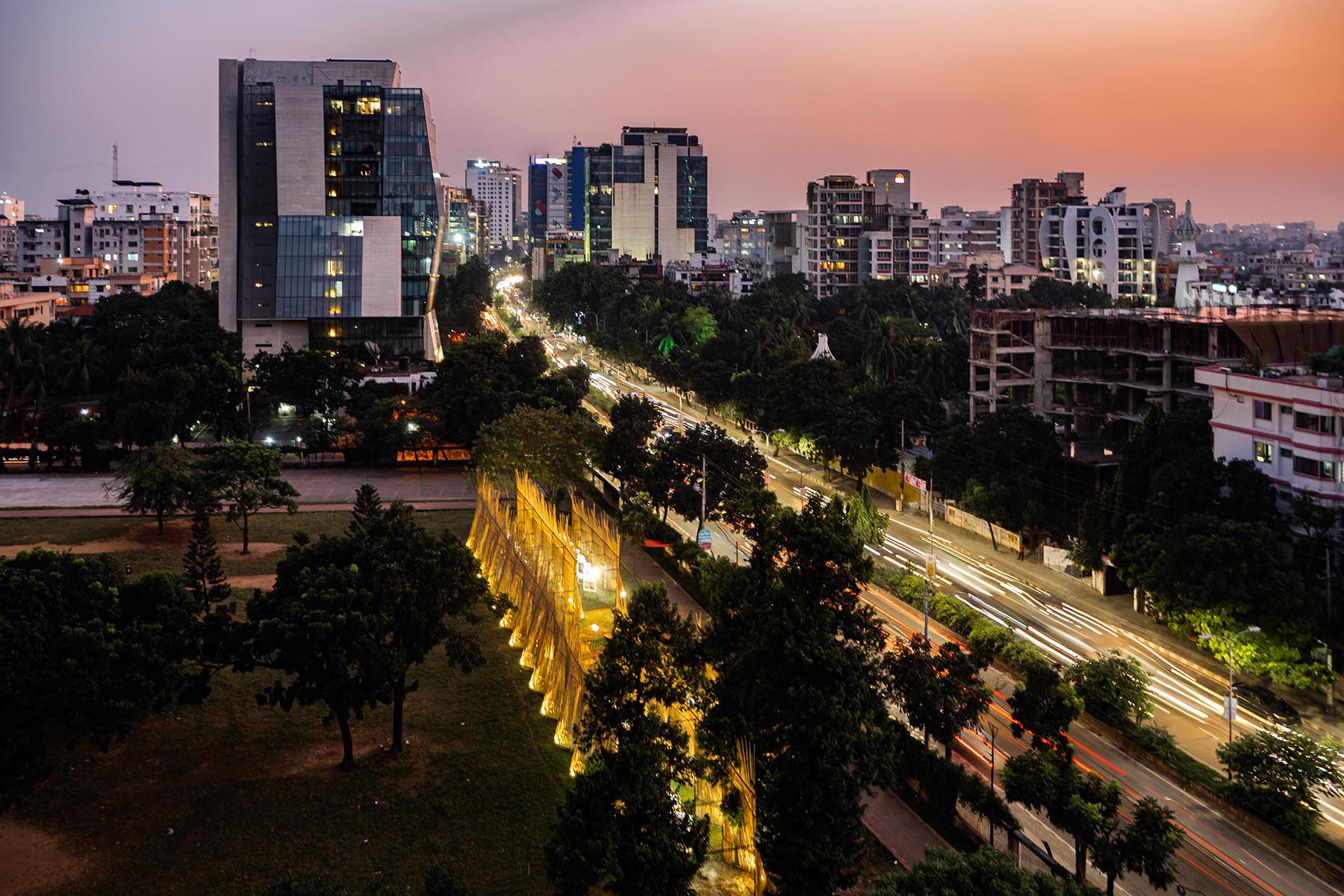
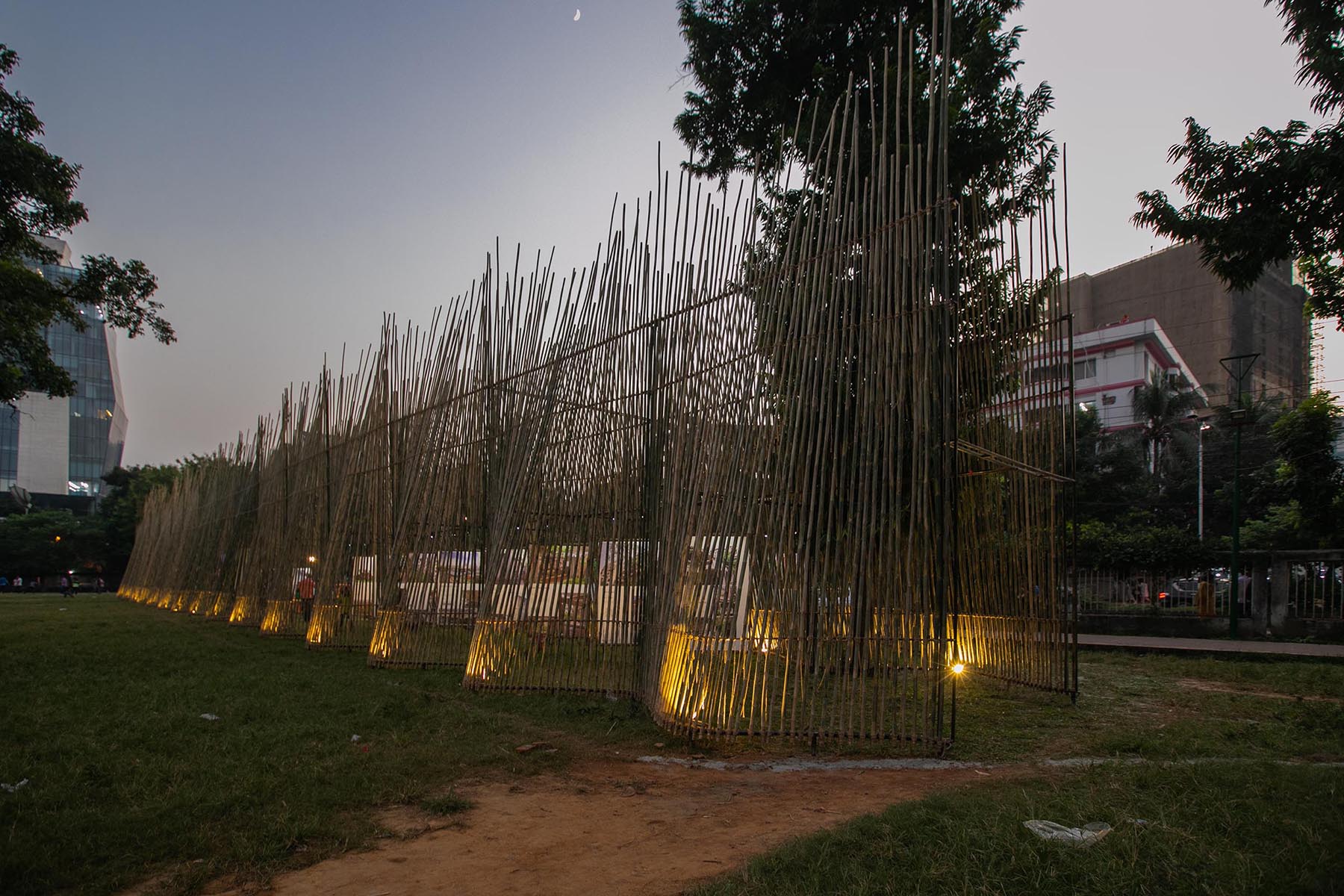
The pavilion titled ‘An Enclosure of Permeability and Aperture’ is constructed at Gulshan, Dhaka for holding ‘The Pubic Exhibition on Architecture of Bangladesh’ which has been arranged on the occasion of ARCASIA (The Architects Regional Council Asia) Forum 20 held in Dhaka in November 2019. The temporary exhibition pavilion, commissioned by the Institute of Architects Bangladesh, is designed by architects Saiqa Iqbal Meghna and Suvro Sovon Chowdhury as part of the exhibition committee of the event which was led by Ar. Ehsan Khan.

ARCASIA Pavilion at Dhaka © Sthanik Consultants and Studio Morphogenesis Ltd.


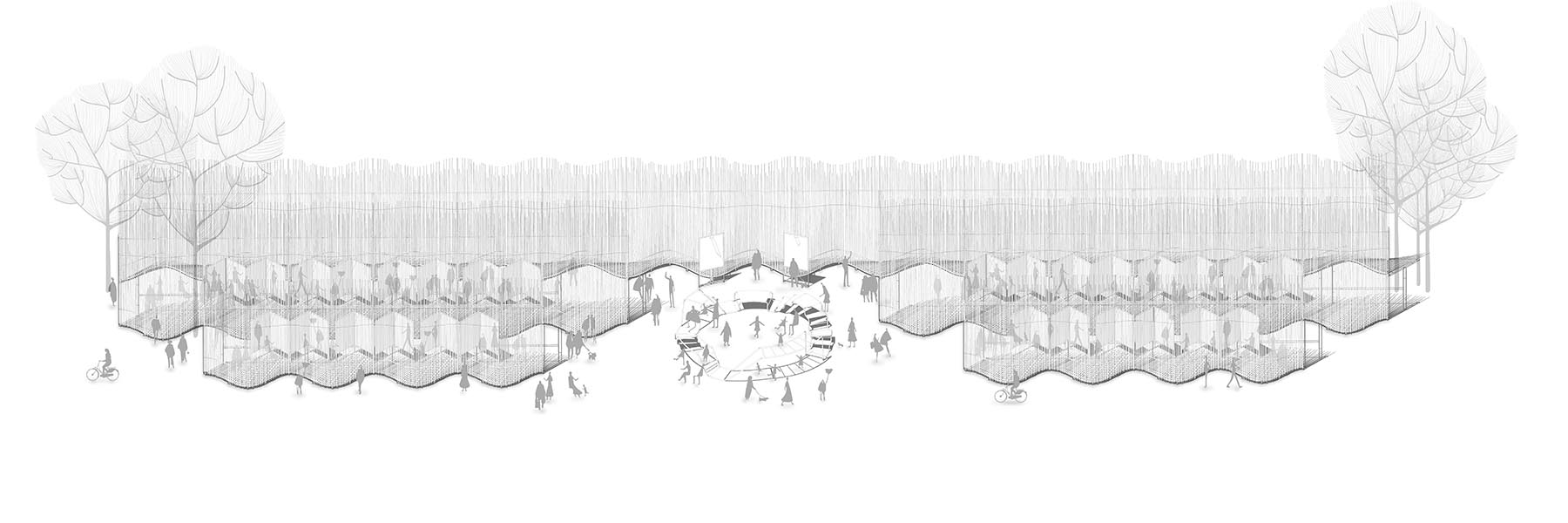
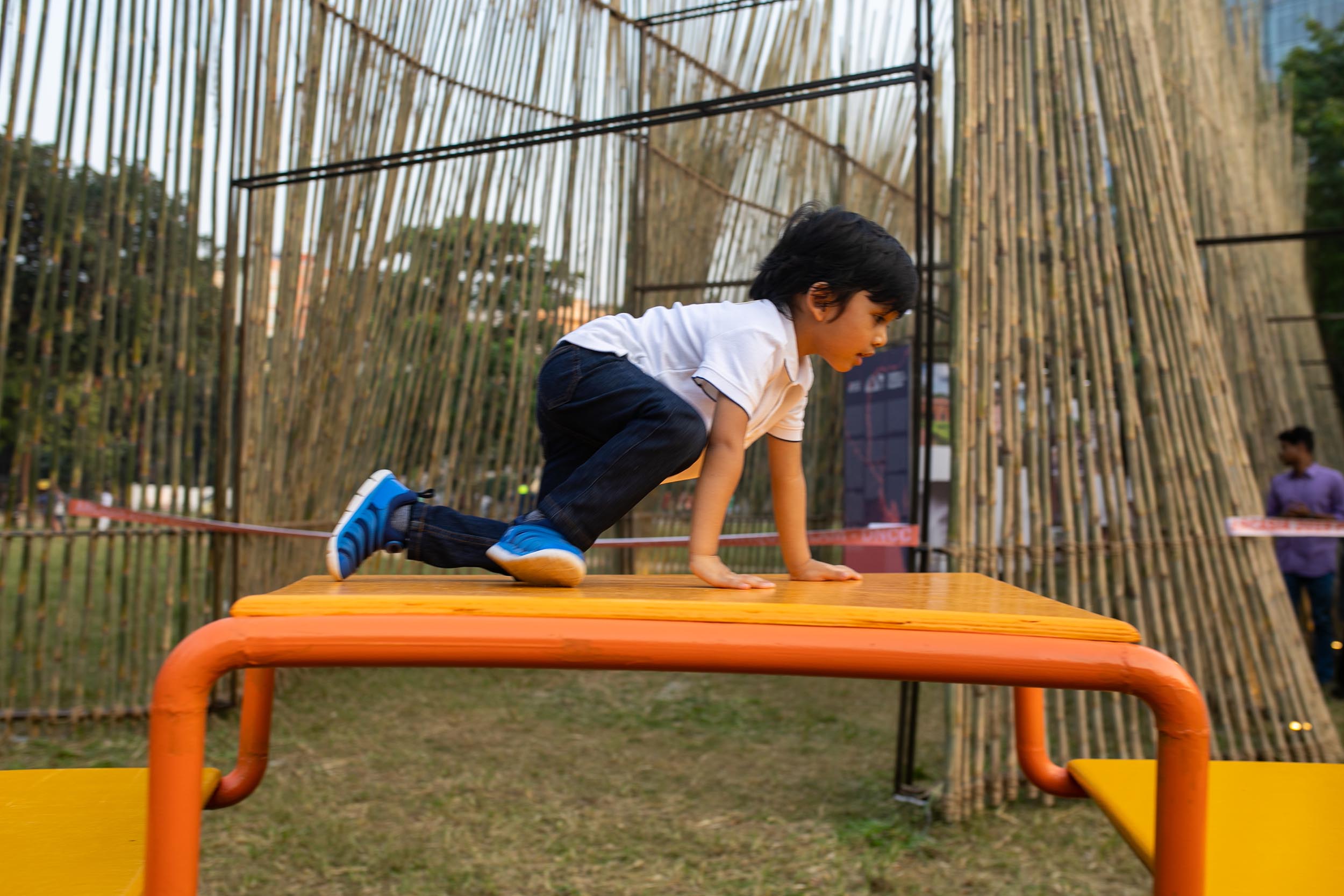
 The pavilion is constructed by a joint venture of Sthanik Consultants and Studio Morphogenesis Ltd. The pavilion is accompanied by a ‘playscape’ for children to enhance the essence of the park by engaging the future generation to develop a sense of belongingness among them. Two circles of different radii span the area for the playscape which is strategically placed in the middle of the exhibition pavilion as a breakout zone. This circular play zone, designed as a landscape design element, successfully engages the children as well as their parents and other adults by enhancing a positive interaction among people of all ages.

.

ARCASIA Pavilion at Dhaka by Sthanik Consultants and Studio Morphogenesis Ltd | Photo Courtesy: Maruf Raihan


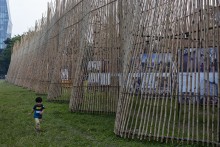
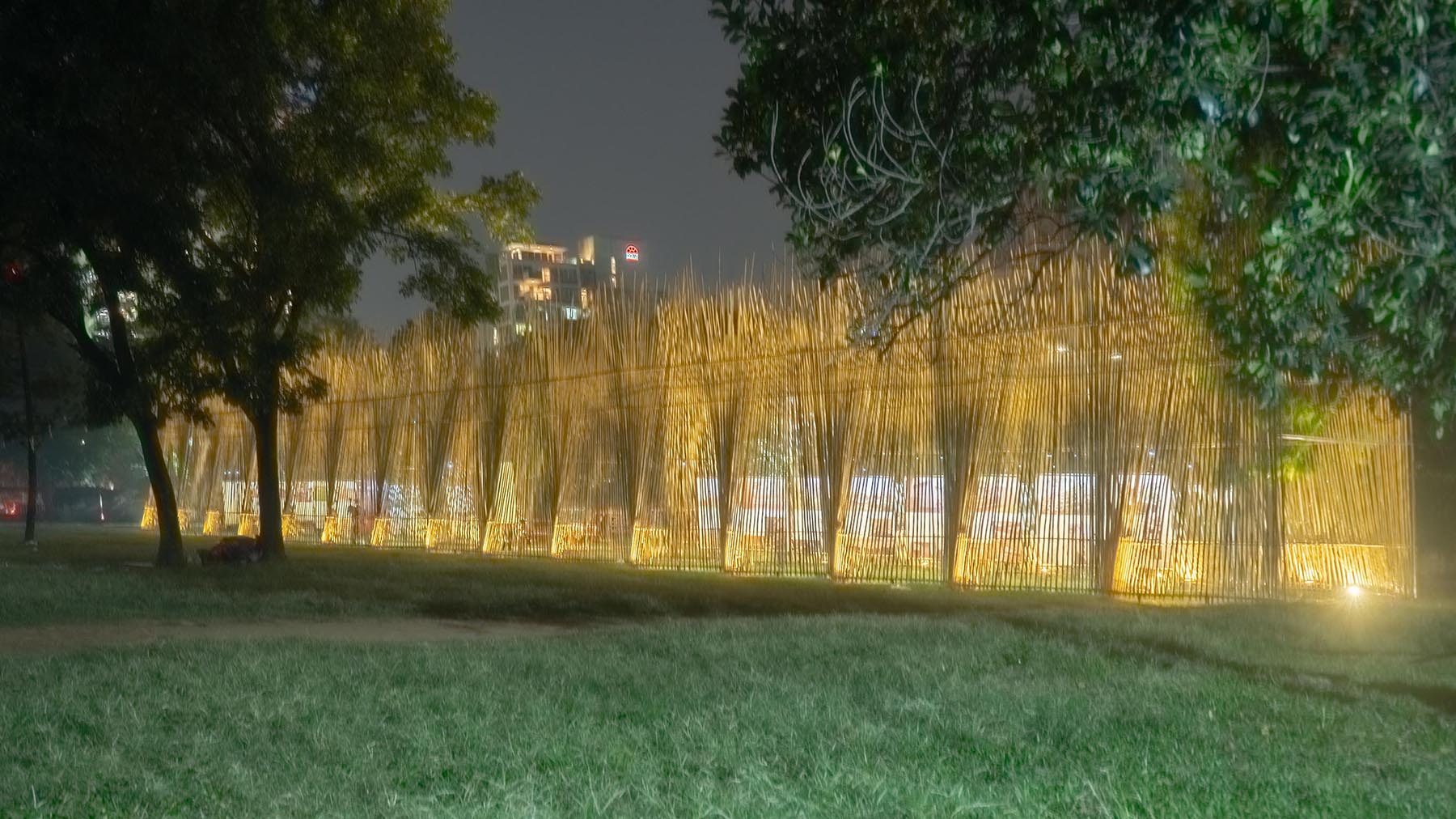
.The set-up is dealt as an in-between space where thin layers of undulating surfaces form the open to a sky exhibition gallery, an atmospheric experience for people, where they can engage themselves with the vibrant realm of architecture. The design idea of this translucent pavilion is deeply rooted in the desire of engaging people with ease and simplicity. The interplay of light and shadow, the flow of wind, the sound of leaves and flights of birds, all accentuate a deep sensory perception.

.

ARCASIA Pavilion at Dhaka by Sthanik Consultants and Studio Morphogenesis Ltd | Photo Courtesy: Maruf Raihan


.The selected site is the prominent breathing space both for the residents living around and the inhabitants/users of the commercial hub. The park is set parallel on an urban thoroughfare which is predominantly commercial and surrounded by residential fabric on three sides. It is quite unique with its scale and spread with accessibility and permeability. The location itself has a given vibrant image that has to be dealt with a ‘subtle contrast’. A sensible choice of material and scale were to be given criteria for this site.

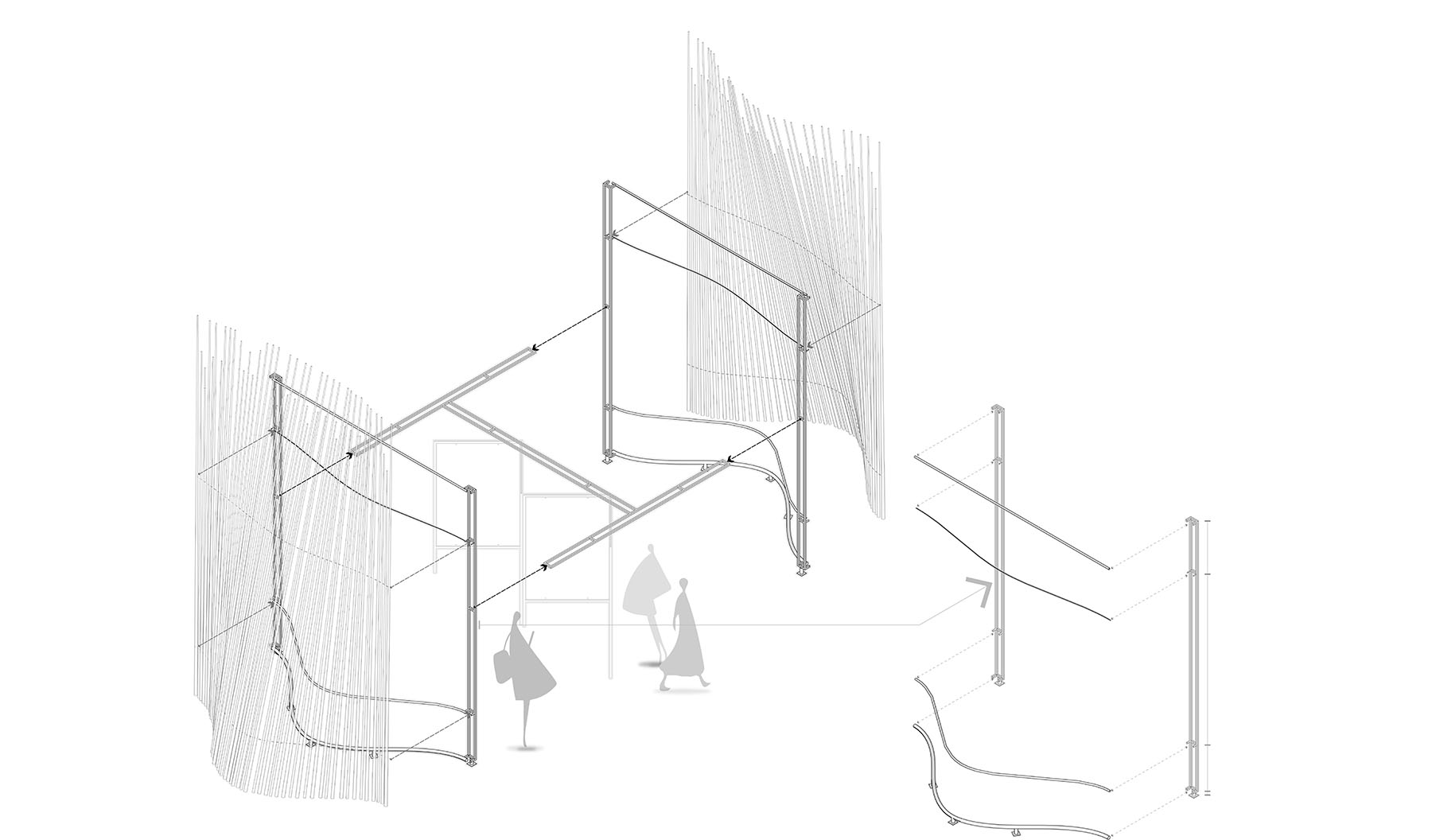
As mentioned an idea of installation on/in a site as such requires minimal intervention with maximum impact. In contrast with the general practice disturbing the ground and leaving scars the idea was to do an installation that will rather rest on the ground. As a public, the visual permeability was to be kept and the idea of a ‘screen’ as a boundary was established. The installation was a boundary set up on the open field where every other activity around was celebrated while the exhibition was happening and the scale was something that added with nature.

.

ARCASIA Pavilion at Dhaka by Sthanik Consultants and Studio Morphogenesis Ltd | Photo Courtesy: Maruf Raihan


The design idea emerged from the necessity of creating an open-air gallery space within a limited budget constraint. The designers wanted to create something easy to build yet display the strength of local craftsmanship. Layers of undulating ruled surfaces are formed of repetitive sine curves and straight lines to achieve a contemporary gallery space.

Local material Bamboo is chosen to pose a stark contrast in the area which is full of high budget, often extravagant commercial and residential buildings displaying the vendor-oriented aesthetic influence of imported materials. The materiality of the pavilion gains its subtle elegance through the delicate details of the rope tie with loose ends, the rawness of the metal and uncut bamboo of varying lengths.

.

ARCASIA Pavilion at Dhaka by Sthanik Consultants and Studio Morphogenesis Ltd | Photo Courtesy: Maruf Raihan
ARCASIA Pavilion at Dhaka by Sthanik Consultants and Studio Morphogenesis Ltd | Photo Courtesy: Noufel Sharif Sojol

.

.As opposed to the raw texture of the bamboo pavilion, the playscape is painted in a bright orange tone.  The playscape is designed as continuous folded curves forming a concentric ring catering interaction between different age groups. The exhibit does not take away the essence of the park, rather enhances people’s leisure time.

.

PROJECT INFORMATION:

Name of the Project : An Enclosure of Permeability and Aperture: ARCASIA Pavilion at Dhaka

Location : Shahid Tajuddin Ahmad Smriti park, Central Gulshan

Commissioned by : Institute of Architects Bangladesh

The total built-up area of the Project : 6,600 square feet

Construction Period : 23 October – 01 November 2019

.

PROJECT TEAM:

Design : SthaNiK Consultants

Lead Architects : Ar. Saiqa Iqbal Meghna and Ar. Suvro Sovon Chowdhury

Construction : Studio Morphogenesis Ltd.

Team Members : Rahat Ibna Hasan, Ar. Bhuiyan ARM Riyadh and Ar. Sumaiya Ara Simi

Site Engineer : Md. Shirajul


ALL DRAWINGS TO BE CREDITED : © Sthanik Consultants and Studio Morphogenesis Ltd.

PHOTOGRAPHS : Noufel Sharif Sojol, Maruf Raihan and Fahim Shahriar

Gallery |

  • ARCASIA Pavilion at Dhaka
  • ARCASIA Pavilion at Dhaka 21
  • ARCASIA Pavilion at Dhaka 19
  • ARCASIA Pavilion at Dhaka 20
  • ARCASIA Pavilion at Dhaka 18
  • ARCASIA Pavilion at Dhaka 1
  • ARCASIA Pavilion at Dhaka 3
  • ARCASIA Pavilion at Dhaka 2
  • ARCASIA Pavilion at Dhaka 5
  • ARCASIA Pavilion at Dhaka 7
  • ARCASIA Pavilion at Dhaka 8
  • ARCASIA Pavilion at Dhaka 6
  • ARCASIA Pavilion at Dhaka 9
  • ARCASIA Pavilion at Dhaka 4
  • ARCASIA Pavilion at Dhaka 10
  • ARCASIA Pavilion at Dhaka 12
  • ARCASIA Pavilion at Dhaka 13
  • ARCASIA Pavilion at Dhaka 14
  • ARCASIA Pavilion at Dhaka 15
  • ARCASIA Pavilion at Dhaka 16
  • ARCASIA Pavilion at Dhaka 17
  • ARCASIA Pavilion at Dhaka 22
  • ARCASIA Pavilion at Dhaka 23
  • ARCASIA Pavilion at Dhaka 25
  • ARCASIA Pavilion at Dhaka 24
  • ARCASIA Pavilion at Dhaka 26
  • ARCASIA Pavilion at Dhaka 11


Baad Ijtema | NSU

Within the bustle of the overpopulated metropolis, Dhaka prominently lacks adequate space which generates and celebrates public activity. Uttara and adjacent Tongi areas form an important urban center of North Dhaka. The area is connected with the rest of the country by the vast and complex river system of the delta via Turag River. Ijtema maidan – a place hosting second large Islamic congregation after Hajj is a massive area of land adjacent to the riverbank of Turag.  The place remains active during this annual event which is hardly 30 days in a year. For the rest of the 335 days, the place has almost zero to negligible use. This project rethinks Ijtema maidan as a year-round multipurpose public space while fulfilling its periodic function during Ijtema time. The neighboring area lacks ample recreational space for its inhabitants, a deficit that can be fulfilled by this open large space and the river bank. It possesses the potential to be a part of the urban life where the subsidiary public programs can additionally be utilized during the period of Ijtema. These public functions can be crucial in helping the social, economic and environmental development of the area.

© Akash Kumar Das
© Akash Kumar Das
© Akash Kumar Das
© Akash Kumar Das


At present, the connection between the field and the river bank with its surroundings are essentially inadequate. This project adds values in addressing and solving this challenge. This project also holds tremendous potential in aiding the revival of the Turag River. There exists a tremendous and overwhelming traffic problem in this area that not just manifests during Ijtema time but also regular days. The project aims to formulate the framework for this 216 acres site to make it useful for the rest of the time of the year and fill up the basic need for the people during Ijtema.

© Akash Kumar Das
© Akash Kumar Das
© Akash Kumar Das
© Akash Kumar Das
© Akash Kumar Das
© Akash Kumar Das


The programs of the project are multiverse. There are a set of functions that aim to serve the regular people on an everyday basis and additional functions for Ijtema which are at the heart of the project. To address the needs of the surrounding communities, circulation has been carefully devised to maintain connections throughout the site with their adjacent blocks. A peripheral pedestrian walkway has been added to aid the movement of passersby.

© Akash Kumar Das
© Akash Kumar Das
© Akash Kumar Das
© Akash Kumar Das
© Akash Kumar Das
© Akash Kumar Das


A singular masjid in the north of the site acts as daily prayer use, while the annex acts as the segregated block for the foreign pilgrims during the Ijtema period. To the north, there are also platforms that serve as car parking. The west block of the site consists mostly of recreational activities. A grand open park with a multipurpose shaded space that can be turned into spaces for cultural activities, schools, learning and performance of the arts and crafts.

© Akash Kumar Das
© Akash Kumar Das
© Akash Kumar Das
© Akash Kumar Das
© Akash Kumar Das
© Akash Kumar Das

A water activity deck that offers boating is one of the many public functions designed for its’ users. No solid obstructions have been placed near the river so as to not interrupt the natural flow of the river. Strategically placed trees not only act as barriers to sound, noise and pollution. But they can also help the growth of the ecological landscape and help revive riverine ecosystems.

© Akash Kumar Das
© Akash Kumar Das
© Akash Kumar Das
© Akash Kumar Das
© Akash Kumar Das
© Akash Kumar Das

The main field and additional shaded fields reside next to the open amphitheater. Indoor spaces have been placed into the design as well, along with toilet washroom and locker room services for use.  As a recreational function, multiple pavilions have also been articulated within the site; which on regular days shall host local markets and in the times of Ijtema, they can be used for service purposes. Encapsulating and surrounding all these is a two-layered both-way walkway acting as bridges and connections.

© Akash Kumar Das
© Akash Kumar Das
© Akash Kumar Das
© Akash Kumar Das

When addressing the needs of the Ijtema, the aim was to solve and fulfill the 5 basic functions essential to the services and carrying out of Ijtema. They are circulation, food, shelter, toilet, and emergencies. Within the 135 acres of Ijtema field where the Muslim pilgrims gather, Shupari (betel nut) trees were planted. The idea generates from the 5×7 module generally granted by the council for an individual person. The trees can be used to tie up tents or shades at different height as they grow vertically upwards. Traffic congestion and entrances to the site were the main problem points that came up during the site survey. To solve these problems, roadside drop-offs were designed, along with multiple service roads which could also be used for fire and medical emergencies. To maintain security throughout the year, five watchtowers have been placed throughout the site – an absolute means of crowd control and safety.

© Akash Kumar Das
© Akash Kumar Das
© Akash Kumar Das
© Akash Kumar Das
© Akash Kumar Das
© Akash Kumar Das

The project essentially arises from the needs and demands of the users, who reside adjacent to the site. The topic aims to solve these problems in a unique, interesting, playful and harmonious method, both during the times of Ijtema and throughout the rest of the year. Extreme efforts were given to use the prevailing natural elements, and use them to their full potential by channeling activities that help in their revival and maintenance; alongside them acting as the primary agents of change through their fulfillment of various functions within the site.

Reviving A Sleeping River | Hochschule Anhalt, Germany

There are many cases when the city development neglects the full potentialities of the river and the city uses it as a backyard; specially rivers with the smaller widths. This thesis aims to find a micro-scale design solution to bring back the river from the “backyard” to “frontyard” by using River Emscher as a framework.

© Nakib Sadat Chowdhury


Since the early 1990s, efforts to restore the Emscher to its natural state have been making progress and with that, a group of cities is going through a shared, simultaneous and comprehensive transformation. It is more than a hundred years since a populated agricultural landscape was transformed into an industrial metropolitan area, and the naturally flowing Emscher became a manmade system of open sewers. The end of mining subsidence now also makes it possible in this region to transform the river and it’s subsidiary waterways into near-natural bodies of water. This transformation offers a chance to give a new face to the urban landscape of the region.

© Nakib Sadat Chowdhury


Henrichenburg, a city in the North-Rhine Westphalia area of Germany, transformed from a small village into a city after the beginning of the mining of coal and the production of coke and steel within the last hundred years. Like other cities in this revolution, the Emscher near Henrichenburg also faced the same fate of being a sewer system. In the present day, the river Emscher still in a process of getting cleaned and within three years, the Emscher will not radiate anymore. So, it creates vast opportunities to wake this sleeping river up again. Based on these opportunities, there can be a lot of scopes for urban planning and landscape designs. This study will aim to conserve the potentials and challenges to create a connection between the city and the river.

© Nakib Sadat Chowdhury

Starting the design process, the main goal was to realize a flexible activity module to regenerate the riverfront. The proposed modular unit is adaptive to context and can be used according to users‘ needs. Working with this idea, two simple solutions were developed.

  • The elements of each module have a universal design language but can be made of various alternative materials. The unit has diverse functional affordability. It allows the users to become part of the design process by engaging them from assembling to the positioning of the modules on the site. Further, it has the potential to involve users in the maintenance process by creating a sense of ownership.
  • Modules can be split up or combined to provide a fit-for-purpose design solution respecting the site, surrounding and ecology.


© Nakib Sadat Chowdhury


অনুরণন: Revival of Anderkilla Shahi Jame Mosque

The Ander Killa (meaning “the inner fort”) Shahi Jame Mosque is a 362 years old mosque of Mughal era standing at 32 feet high from the ground on a hilltop. Over time many alterations took place in the mosque. The visibility of the Mughal mosque has been cloaked completely due to the extension of the mosque and surrounded buildings. This design proposal thrives to meet up its functional necessity while restoring the original Mughal structure.

© Ramisa Yeameen Chowdhury Eva | BRACU


The Anderkilla Shahi Jame Mosque was built during 1667 AD by Umed Khan, son of Nawab Shayesta Khan, as a symbol of triumph of the Mughals’ over the Arakani Moghs and Portuguese pirates in 1966 AD. The mosque stands 30 feet high from the road level; a two-storied book market is located underneath the plaza which was purposefully built for its finance and welfare. The challenge was to re-design the complex in a manner so that both work discretely, yet together, without interrupting each other functions.

© Ramisa Yeameen Chowdhury Eva | BRACU


Currently, the mosque is the only antiquity of Ander Killa (the inner fort). On the wall of the main mosque, the construction year is mentioned as 1078 Hijra in an inscription stone. The space available for praying is not working effectively for the increased number of populations in Muslim communities. The mosque is also restricted to female devotees.  In addition to that, haphazard developments inside and surrounding the compound have cloaked the view of the mosque. Chittagong Development Authority (CDA) has taken a project of Tk 200 crore to expand and reconstruct Anderkilla Shahi Jame Masjid. CDA plans to preserve and conserve the mosque by keeping its original shape unaltered.

© Ramisa Yeameen Chowdhury Eva | BRACU


This project is envisioned to go beyond the conventional approach of conservation through structural retrofitting and facelifting, rather it advocates an unorthodox approach to rejuvenate the whole area while uplifting the true spirit of Islam. The proposal also seeks full equality of women and men in the public sphere. In addition to that, it would also be a place for the tourists from all around the world to come, feel the essence of the Mughal period mosque, and be conscious about the Islamic heritage.

© Ramisa Yeameen Chowdhury Eva | BRACU


The concept is derived by splitting the site into two. One, a hill, which revives the Mughal era mosque and the other, man-made mound, encompassing other functions such as school, market, Islamic foundation, visual entertainment hall, and library. The major pedestrian routes connecting the neighborhood become the guiding element in the form derivation process.

It is disheartening to witness our diminishing sensitivity towards history and heritage, which reflects the roots of us as a nation. In addition to government conservation efforts, the urgent initiative is needed to raise social awareness while engaging the local community both materially and spiritually.

The Prize of Water: Designing Resilience in Asia 2018 | BUET

“A loss of USD 46.5 Billion” is one of the most prominent clauses when talking about the 2011 Bangkok flood. The city, undergoing rapid urbanization and a transformation from agriculture-based to the industry-based economy from the ‘50s combined with its ever-growing tourist sector is making it one of the most money-driven piece of land in the world. Bangkok has been witnessing the adverse effects of these as the city grew over time neglecting, disrespecting and disregarding nature. What had been once a breathing piece of land with water networks and fertile land is now an impermeable cover of hard concrete with little or no trace of green in it.

Bangkok
Bangkok
Problems
Problems

Whereas resiliency aims at achieving a sustainable solution integrating nature and humans alike, the question remains, in a metropolis like Bangkok, can the ever-growing economy be ignored while aiming for a sustainable resilient solution? Or whether an interdependent system addressing the nature, human involvement and economy alike can be the best possible solution for achieving resilience in a city like Bangkok?

© Ahnaf Akif Siddique, Khairun Fahmi, Fahim Faisal Khan, Najmush Shaker | DoA, BUET
Proposed strategic approach


From site observation, we found that more people can be engaged in a resilience plan involving direct, quick return policy. Adding value to interventions made at different scales is the main objective. In times of disaster, Bangkok’s people suffer economic loss as well as ecological and social. So, the conversion of that price they pay into the prize is the cornerstone of our proposal.

The Chao Phraya River flows through the city, and the city is facing the adverse effects of climate change in the form of natural calamities like floods. Also, Bangkok being only 1.5 meters above the sea level at places is in risk of being affected by the coastal flood. On top of that city’s impermeable hard surface areas are making it impossible to soak up run-off water which results in areas being submerged during a flash flood. As in any other metropolis, Bangkok’s resilience is being hindered by multidimensional problems. The proposal decides to break the situation in 3 scales to build up a new flexible development system.

Macro-scale intervention

Meso-scale intervention

Micro-scale intervention

Rather than solving the inter-scalar problems one by one, we propose to create an interdependent interface that is not only beneficial for one specific scale but the intervention for one scale also delivers return benefits to immediate lower scales. This procedure integrates different scales together and ultimately links the whole interface making it a single unified interdependent system.


Macro-scale interventions

Northern Thailand

Macroscale interventions are intended to lessen the impact on a city scale. In regional upper catchment areas indigenous “monkey cheek” retention points are established and maintained to hold water during a heavy flood in northern Thailand reducing the volume of water Chao Phraya carries to the city during the rainy season. The upstream water that results in a negative effect on city scale can be used for industrial use, agriculture, hydroelectric power production, and fisheries to add positive value. This way the user groups benefit from this intervention and will be eager to invest in this proposal and pressure on groundwater created mostly by industries lessens. These volumetric amounts of reduced floodwater lessen the chance of a flood in the city as return value and investments for intervention can focus on reviving the canals to mitigate flood.

© Ahnaf Akif Siddique, Khairun Fahmi, Fahim Faisal Khan, Najmush Shaker | DoA, BUET

Thailand shoreline

The coastline is to be treated with mangrove forest and reef balls in alternation to their proposed seawall to protect Bangkok from tidal surge and filtering coastal and estuarine waters. Through this process, natural fishing can be enhanced in the area along with the desalination of the Chao Phraya River water at its mouth.

Lower Bangkok

Through the process of reviving the canals and connecting the city sewage to suburban wetlands where the wastewater is naturally filtered. These unique wetlands receive the city’s sewage, organically treat it with the help of sunshine, oxygen, and microbial action and turn into a productive fish habitat – nothing short of ecological magic. At present the negatively addressed still water of canals-capillaries are caused by garbage disposal and by staging this process water system is re-established and in terms, canals are revived and turned into more positively valued space. Runoff water from the city’s hard surface flowing into canals works its way slowly through wetland soil and vegetation, and many of the impurities are trapped. This builds up unique micro-climate in suburb eco-system, connects the green-blue and helps in agriculture. These also help in flood mitigation as the wetlands serve as a natural spill basin, a giant sponge of sorts for the city’s runoff water during heavy rain and flood.

Meso-scale interventions

Bangkok is a saturated city with its densely populated central area, increasing traffic problems and lack of quality social space in neighborhood scale. Revived canals introduce transportation possibilities and reconnect the suburb to the city. With canals now more easily accessed multi-modal transportation points integrate waterways with BTS, MRT and road networks and creates a network for tourist sites and day to day movement. This proposal aims to promote water transportation which is faster, reviving previous historic waterways- free of cost for locals and reduce pressure on land traffic. Increased city-suburb connectivity will increase the potential land value of suburban areas and therefore de-concentration of the city.

DECONCENTRATION © Ahnaf Akif Siddique, Khairun Fahmi, Fahim Faisal Khan, Najmush Shaker | DoA, BUET

The Chao Phraya

Bangkok has turned its back towards Chao Phraya leaving no setback space and taking up what was naturally supposed to be room for the river. This situation is addressed with riverfront policies and through phasing, by phase intervention, the riverbank is converted to a democratic public hub turning it as the front of the city. This phrasal intervention re-thinks land use and merges the existing flood wall to be a part of the riverfront rather than an obstacle.

Proposed BRT and MRT lines hold the selected site and accommodate two multi-modal transportation points to connect land and water transportation.

The three most popular tourist places in the selected site are integrated by a natural berm in the form of public space. Such natural democratic public space integrating the now much isolated tourist’s spots ensures the addition of social and ecological value.

© Ahnaf Akif Siddique, Khairun Fahmi, Fahim Faisal Khan, Najmush Shaker | DoA, BUET


Canals in Bangkok

Revived canal-capillaries work as intervention a line for the neighborhood. Canals re-establish easier access for water transportation and introduce flexible pier structures as well as community space. Also, Canals can be used for walkways, community farming spaces, and micro-scale hydroelectricity generator zones.

Canals of Bangkok
Canals of Bangkok
© Ahnaf Akif Siddique, Khairun Fahmi, Fahim Faisal Khan, Najmush Shaker | DoA, BUET


Micro-scale interventions

The housing development phase grows respecting the ground area and develops vertically through give and take process with government and other stakeholders. Open spaces are protected, reused and enhanced as these acts as detention basins. Community and individual level rainwater harvesting ensures the economic value addition of natural water. The first layer of existing temporary riverfront houses gets relocated through gradual phasing.

12

© Ahnaf Akif Siddique, Khairun Fahmi, Fahim Faisal Khan, Najmush Shaker | DoA, BUET


Gradually transforming hard surfaces, parking spaces, paves to a pervious surface and integrating the areas blue-green space and community space is increased ensuring social value in the neighborhood. New housing units grow vertically following policies to acknowledge flood and subsidence issues along with conserving their present housing culture.