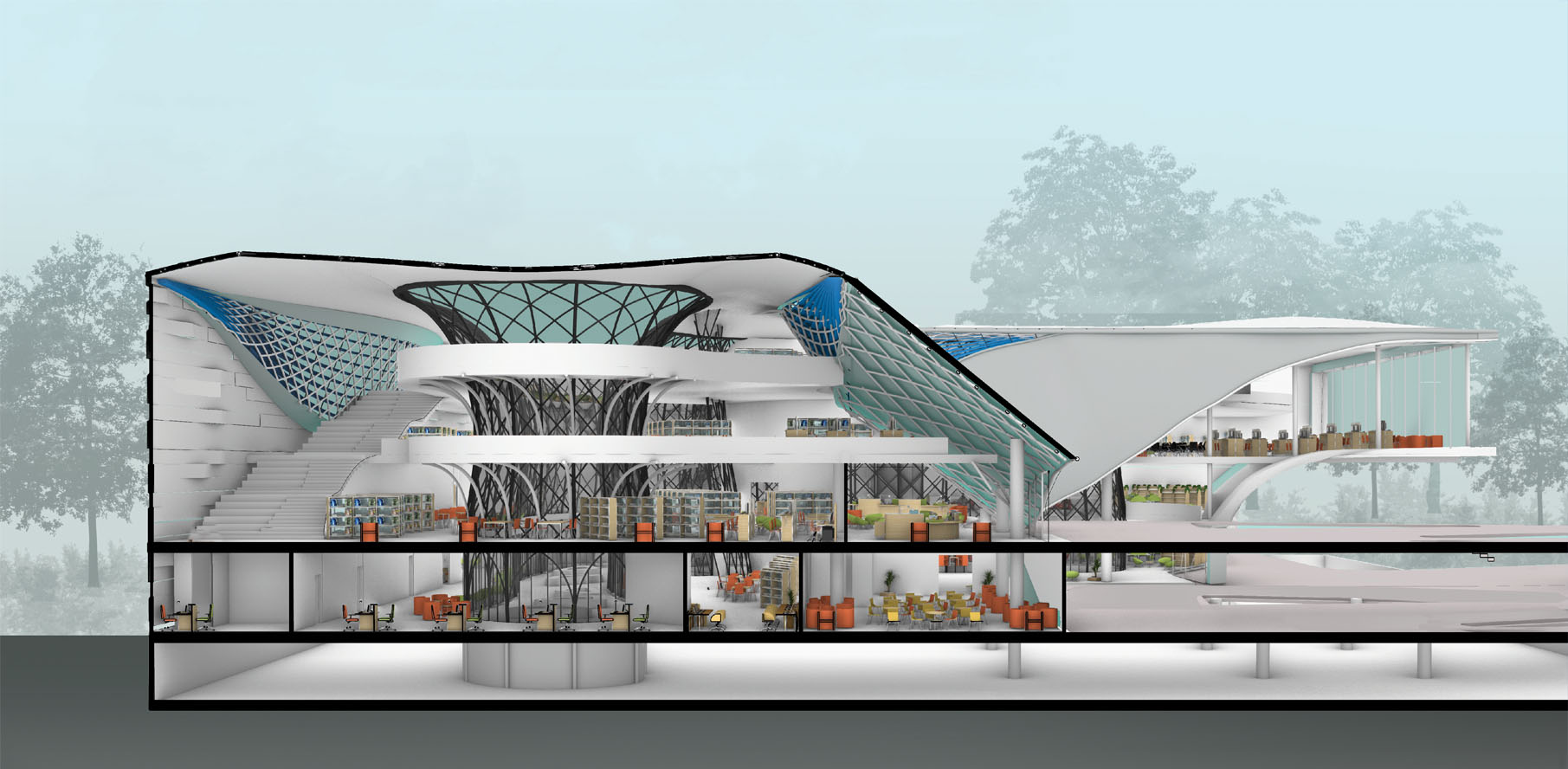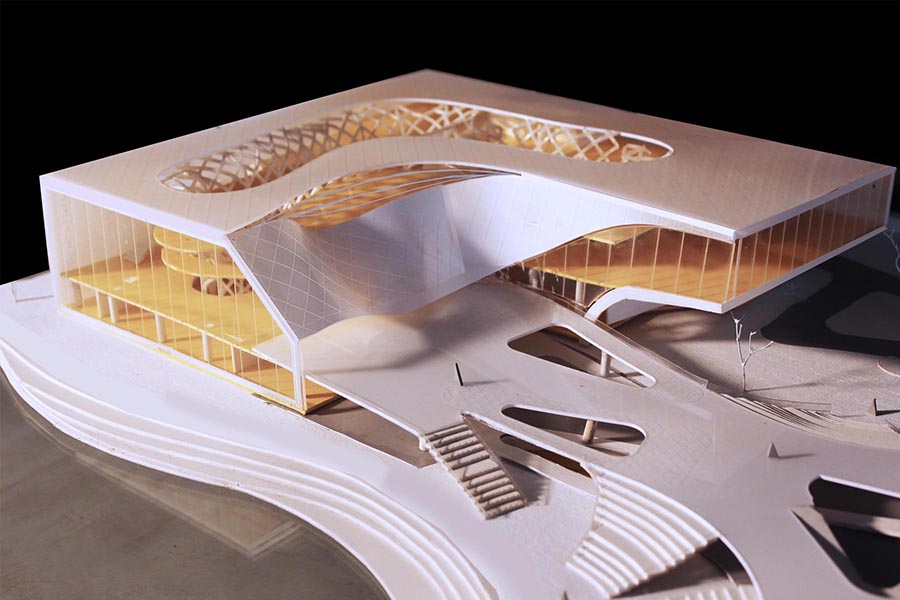
Echoes of the Estuary: A Tourism Center at Hatiya Dwip

World Environment Day 2026

Urban [Re]Stitch

স্থাপত্য ও আমার ভাবনা – কেনগো কুমা (Architectural Deliberation of Kengo Kuma)

স্থাপত্য এমন একটি বিচিত্র মাধ্যম যা নিঃশব্দে আমাদের হৃদয় স্পর্শ করতে পারে। সুন্দর কোন স্থাপনা দেখলে আমরা নিজেদের অজান্তেই তার প্রতি আকৃষ্ট হই। আর, একজন স্থপতি হচ্ছেন সেই ব্যক্তিত্ব যিনি তার কাজের মাধ্যমে ধর্ম-বর্ণ-গোত্র নির্বিশেষে সকল মানুষকে অনুপ্রাণিত করতে পারেন।

শুরুর গল্প; গল্পের শুরু

যখনই আমি কোন নতুন প্রজেক্ট শুরু করি, আমার সর্বপ্রথম কাজ হচ্ছে সেই প্রজেক্টের জমির  উপর দিয়ে হেঁটে বেড়ানো। যাতে আমি জায়গাটার পারিপার্শ্বিক অবস্থা ও আনুষঙ্গিক প্রেক্ষাপট সম্পর্কে সুস্পষ্ট ধারণা লাভ করতে পারি। আমি মনে করি, প্রত্যেকটি জায়গার একটি নিজস্ব গল্প থাকে। একজন স্থপতি হিসেবে আমার সেই গল্পটা বুঝার চেষ্টা করতে হবে। আর এজন্যে আমাকে অবশ্যই সেখানে হাঁটতে হবে- নিজের পায়ে সেই জায়গার মাটি স্পর্শ করতে হবে; নিজের হাতে সেখানকার গাছগুলো ছুঁয়ে দেখতে হবে; গাছের পাতাগুলো অনুভব করতে হবে। এর মাধ্যমে জায়গাটার সাথে আমার কথোপকথন হবে, বোঝাপড়া হবে এবং সর্বোপরি আমি বুঝতে পারবো এই জায়গার মাটি কি চায়; এবং আমার প্রজেক্টটি ঐ চাহিদার প্রেক্ষাপটে কিভাবে শুরু করতে হবে।

স্থাপত্যে প্রজ্ঞা ও কৌশল

আমার ডিজাইনের দর্শণ বা মূল লক্ষ্য হচ্ছে এমন ধরনের স্পেইস (space) তৈরি করা যেখানে প্রকৃতির সাথে মানুষের আত্মিক সম্পর্ক তৈরি হবে; এবং যেখানে মানুষ বসবাস করতে স্বাচ্ছন্দ্যবোধ করবে। সত্যি কথা বলতে, হাইরাইজ বিল্ডিং বা সুউচ্চ বহুতল ভবনের প্রতি আমার আগ্রহটা একটু কম। বর্তমান সময়ে টোকিও থেকে শুরু করে বিশ্বের যে কোন শহরে ঢালাওভাবে বহুতল ভবনের উপস্থিতিকে আধুনিকতার অংশ হিসেবে গণ্য করা হয়। অথচ, আমার কাছে এ ধরনের স্থাপনাগুলোকে শহুরে জঞ্জাল মনে হয়, যা বিগত বিংশ শতাব্দীর প্রতীক হিসেবে দাঁড়িয়ে আছে। একটা সময় ছিলো, যখন জায়গার সংকটের কারণে শহরকে সম্প্রসারণ করার জন্য বহুতল ভবন নির্মাণের কোন বিকল্প ছিলোনা। কিন্তু আমি মনে করি, বর্তমান সময়ের প্রেক্ষাপটে উর্ধ্বমুখী নগর সম্প্রসারণের এই ধারণা থেকে আমাদের বেরিয়ে আসার সময় হয়েছে। মানুষ এখন আকাশ দেখতে চায়; বুক ভরে নিঃশ্বাস নিতে চায়। ব্যক্তিগতভাবে আমি লো-রাইজ বিল্ডিং বা কম উচ্চতাবিশিষ্ট স্থাপনার প্রতি আগ্রহী, যেগুলো মাটির খুব কাছাকাছি থাকবে এবং স্থানীয় ও সহজলভ্য উপকরণ দিয়ে তৈরি হবে। ফলে প্রত্যেকটা শহরের একটা আলাদা নিজস্ব ইমেজ বা স্বরূপ গড়ে উঠবে; এবং কালের বিবর্তনে স্থাপনাসমূহ ঐ শহরের অবিচ্ছেদ্য অংশে পরিণত হবে।

ভৌগোলিকভাবে জাপানকে ভূমিকম্পের দেশ বলা হয়। তা সত্ত্বেও, আমাদের গ্রামীণ অঞ্চলগুলোতে স্থানীয় রাজমিস্ত্রীরা হাজার বছর ধরে নিজস্ব কৌশল ও উপকরণ ব্যবহার করে এমনভাবে তাদের বাসস্থান তৈরি করেন, যা ভূমিকম্পপ্রবণ এলাকাতেও যুগের পর যুগ টিকে থাকে। নির্মাণশিল্পের এই আদি ও অনন্য কৌশল আয়ত্ত্ব করার লক্ষ্যে পেশাগত জীবনের একটা পর্যায়ে আমি গ্রামে চলে যাই। সেখানে আমি স্থানীয় মানুষদের সাথে থেকে তাদের চালচলন-জীবনযাত্রা খুব কাছ থেকে দেখি, এবং তাদের কাছ থেকে স্থানীয় উপকরণ ব্যবহারের মাধ্যমে বাড়িঘর নির্মানের যে সহজ কৌশল, তা শিখি। পরবর্তীতে আমি আমার পেশাগত জীবনে বিভিন্ন প্রজেক্টে এবং বিভিন্ন প্রেক্ষাপটে এই কৌশলসমূহ প্রয়োগ করার চেষ্টা করি; যা সন্দেহাতীতভাবে আমার ব্যক্তিগত জীবন ও দর্শনকে গভীরভাবে প্রভাবিত করে।

উপকরণভিত্তিক সমাধান

বিজ্ঞাণ ও প্রযুক্তির এই যুগে শহুরে যান্ত্রিক জীবনে মানুষ হাপিয়ে উঠেছে। এখন বেশিরভাগ মানুষ ইট-কনক্রিটের বেড়াজালে আবদ্ধ না থেকে নির্মল প্রকৃতি ও মুক্ত বাতাসের সান্নিধ্যে থাকতে চায়। প্রকৃতি ও মানুষের এই সহজাত সংস্পর্শের কথা মাথায় রেখে আমি আমার ডিজাইনে কাঠ ও বাঁশের মত প্রাকৃতিক ও সহজলভ্য উপকরণ ব্যবহার করার চেষ্টা করি। যাতে স্থাপত্য ও তার পারিপার্শ্বিক প্রকৃতির মধ্যকার দূরত্বকে যথাসম্ভব কমিয়ে এনে- একে অপরের পরিপূরক হিসেবে প্রতিষ্ঠা করা যায়।

আর এ ধরনের প্রাকৃতিক উপকরণ ব্যবহারের কিছু প্রায়োগিক সুবিধাও আছে। যেমন, কাঠ বা বাঁশের তৈরি কোন স্থাপনায় আপনি কোন একটা অংশ পরিবর্তন করতে চাইলে, খুব সহজেই শুধুমাত্র ওই নির্দিষ্ট অংশের কাঠ বা বাঁশের টুকরাটি খুলে নতুন আরেকটি টুকরা দ্বারা প্রতিস্থাপন করতে পারবেন। অথচ, কংক্রিটের তৈরি কোন স্থাপনায় এভাবে ক্ষুদ্র অংশ প্রতিস্থাপনের কোন সুযোগ নেই। সেখানে পরিবর্তন মানেই হলো সম্পূর্ণ স্থাপনাটিকে ভেঙ্গে নতুনভাবে পুনঃনির্মাণ করা,  যা অত্যন্ত সময়সাপেক্ষ ও ব্যয়বহুল।

স্কেইল ও সৌন্দর্য্য

আমি যেকোন স্কেইলের স্থাপনা নিয়ে কাজ করতে আগ্রহী। সেটা ৩২ বর্গফুটের ছোট্ট টং দোকান কিংবা ২০২০ অলিম্পিকের জন্য প্রস্তাবিত নতুন জাতীয় স্টেডিয়াম যেটাই হোক না কেনো! প্রস্তাবিত স্টেডিয়ামটি নিঃসন্দেহে একটি সুবিশাল স্থাপনা। তাই আমার নিজস্ব দর্শন অনুযায়ী স্টেডিয়ামের মত একটি বিশাল স্থাপনা দাড় করানো আমার জন্য সত্যিই অনেক বড় একটি চ্যালেঞ্জ। এর মধ্যেও আমি চেষ্টা করেছি স্টেডিয়ামটিকে যতটা সম্ভব হালকা করার! এখানে আগে যে স্টেডিয়ামটি ছিলো তার উচ্চতা ছিলো ৬০ মিটারের বেশী। আমি আমার ডিজাইনে এর উচ্চতা কমিয়ে ৫০ মিটারের মধ্যে নিয়ে এসেছি। এছাড়াও এখানে আমি স্টেডিয়ামটির বাহ্যিক অভিব্যক্তিতে উল্লম্ব অভিব্যক্তির (vertical expression) পরিবর্তে আনুভূমিক অভিব্যক্তি (horizontal expression) আনার চেষ্টা করেছি। আর স্থাপনাটির প্রধান উপকরণ হিসেবে কনক্রিট বা ইটের পরিবর্তে বেছে নিয়েছি কাঠ। এমনকি প্রধান স্ট্রাকচারাল অংশগুলোকে আমি ছোট ছোট খণ্ডে ভাগ করে সেখানে কাঠের পাত ব্যবহারের মাধ্যমে পুরো স্থাপনাটিকে দাড় করিয়েছি।

আমি আমার ডিজাইনে তাক লাগানোর মতো কিছু করতে চাইনা; কারণ চোখ ধাধানো বা মন মাতানো কিছু করা আমার কাজের লক্ষ্য নয়। ফর্ম (form) কেন্দ্রিক ডিজাইনের প্রধান সীমাবদ্ধতা হলো তা স্থাপনার ম্যাটারিয়েল বা উপকরণের অকৃত্রিম সৌন্দর্য্যকে অনেকটাই ম্লান করে দেয়। তাই, ফর্ম নাকি উপকরণ কোনটাতে বেশি গুরুত্ব দেয়া উচিত- এধরনের বিতর্ক আমি সবসময় এড়িয়ে চলি। ব্যক্তিগতভাবে আমি ফর্মের অনাড়ম্বরতায় বিশ্বাসী। আমি চাই খুব সাধারণ ফর্মের মধ্যে ম্যাটারিয়েলের ভারসাম্য বজায় রেখে কাজ করতে। কারণ আমি মনে করি, সৌন্দর্য্য শুধু ফর্ম বা মাসিং এর জৌলুসের উপর নির্ভর করেনা; বরং, কোন স্থাপনার ফর্মকে যথাসম্ভব সূক্ষ্ম রেখে, তার ম্যাটারিয়েলের গুণগত বৈশিষ্ট্য যত বেশি প্রকাশ করা যাবে, আমার মতে সেই স্থাপনা তত বেশি সুন্দর হবে।

স্থাপত্য; কিংবা সময়ের প্রতিচ্ছবি

সময়ের প্রেক্ষাপটে স্থান ও অবস্থানের সংজ্ঞা সর্বদা পরিবর্তনশীল। আমরা চাইলেও সময়কে নিয়ন্ত্রণ করতে পারিনা। কথায় বলে, সময় ও নদীর স্রোত কারো জন্য অপেক্ষা করেনা। সময় সর্বদা গতিশীল। আর, সময়ের সাথে সাথে স্থাপত্যের পরিবর্তনও অবশ্যম্ভাবী। এক সময় এই নশ্বর পৃথিবীতে আমি, আপনি বা আমরা কেউ থাকবোনা; অথচ কালের সাক্ষী হয়ে যুগের পর যুগ টিকে থাকবে আমাদের স্থাপত্য! এক্ষেত্রে আমরা আমাদের স্থাপনাসমূহকে কালের নিদর্শন হিসেবে তৈরি করতে পারি; যাতে সময় ও স্থাপত্য একে অপরের পরিপূরক হয়ে একটি একক স্বত্ত্বায় পরিণত হয়; এবং অদূর ভবিষ্যতে আমাদের তৈরি স্থাপনাসমূহ বর্তমান এই সময়ের প্রতিনিধিত্ব করতে পারে।

যদি আমরা স্থাপত্যকে সময়ের প্রতিচ্ছবি হিসেবে প্রতিষ্ঠা করতে চাই, তাহলে পরিবেশবান্ধব ও টেকসই স্থাপত্যচর্চার কোন বিকল্প নেই। এক্ষেত্রে আমি দৃঢ়ভাবে বিশ্বাস করি, মানবজাতির অস্তিত্ব টিকিয়ে রাখার স্বার্থেই আমাদেরকে আকাশ ছোঁয়ার স্বপ্ন বাদ দিয়ে মাটির কাছে ফিরে আসতে হবে; খুব বেশি দেরি হয়ে যাওয়ার আগেই।

Source:

  1. How Sustainability Is Bringing Architecture Back Down to Earth by Great Big Story
  2. Kengo Kuma – Time Space Existence


About the Author(s): 

Mahin is a passionate writer and architecture graduate from Shahjalal University of Engineering and Technology (SUST), Sylhet, Bangladesh.  Mahin’s blog:  https://mahinique.wordpress.com

Ziaur is a rising digital artist and architecture student of SUST. Ziaur’s blog : https://www.artstation.com/ziaurovi


Living between Walls | AIUB

| Notes from the studio tutors |

Buildings with shared walls are not uncommon around the world. They are generally known as ‘Row Houses’, where both sides remain closed, and the openings are available in front, back and towards internal courtyards. Typically, this type of house is meant to be a single-family dwelling; however examples of multi-family row houses are also found particularly in dense urban areas. Row houses offer both challenges to provide daylight, ventilation, openings, vista and semi outdoor spaces; and opportunity to create liveable space having courtyards, split levels and terraces, while both sides are closed by walls.

© Faisal & Nahidur | Department of Architecture, AIUB


During the Mughal period, a row house settlement was evolved at Shakhari Bazaar, and later flourished as multi-storied, multi-family residents in row house formation. At some part of Panam Nagar, similar pattern of row houses were also found, which were built in more elegant manner, having internal courtyards to define different zones and a service yard at the back.

© Mohaiminul & Tasmim| Department of Architecture, AIUB


Architect Charles Correa Designed the ‘Tube House’ in 1961. It was the first prize winner in an All-India competition for low-cost housing organized by the Gujarat Housing Board. Though the programme specified walk-up apartments, these row-houses provided the same density and larger living space per family. Later, the architect adopted the concept of tube house to design Ramkrishna House (1962-64) and Parekh House (1966-68), and both were single family dwellings.

© Sumaiya & Onti| Department of Architecture, AIUB
© Anup & Kayes | Department of Architecture, AIUB
Courtesy : dept of Architecture, AIUB


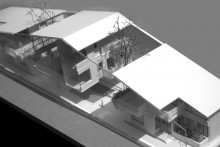
The students of Studio VIII (Fall 2019-2020) at Department of Architecture, AIUB, were assigned to design a row house module as part of their Housing Studio warm up exercise. In a given site, the task was to design a  house for 3 to 4 families without compromising basic human needs like, daylight, ventilation, openings, vista and responsive semi outdoor spaces, and, to create spaces inside, which will enhance community activity and interactions. The students worked in 2 person’s group and the project duration was 2.5 weeks. The project outcomes reflect the sensitive thinking to create interactive spaces and responsive outdoors while maintaining the basic requirements for compact living inside a 65 sqm to 80 sqm dwelling units.

|More images | 

  • TOWFIKA & SONDIPON_ Section
  • TOWFIKA & SONDIPON_ model
  • Maruf & Jihan_model 01
  • Sumaiya & Onti_SECTION DD
  • Maruf & Jihan_Sectional Perspective 01
  • Maruf & Jihan_Sectional Perspective 02

Architect Rabiul Hussain (1943-2019): The Life of a Polymath

Architect Rabiul Hussain, a polymath, who excelled across a diverse field of ‘intellectual enterprises.’ He was not only a veteran architect but also an eminent poet, prolific writer, art critique and cultural activist. He led the architect community as the president of the Institute of Architects, Bangladesh (IAB) for four terms. At international level, Rabiul Hussain served as the vice-chairman of ARCASIA (Architects Regional Council of Asia), vice-president of CAA (Commonwealth Association of Architects) and president of SAARCH (South Asian Association for Regional Cooperation of Architects). He was a trustee of the Bangladesh Liberation War Museum and an executive member of the Ekattorer Ghatak Dalal Nirmul Committee.

Since his early career as an architect, Rabiul Hussain was involved in designing a number of public buildings of national interest. His works include, among others, Shaheed Minar on Jahangirnagar University campus, Agriculture Research Institute (with architect Mazharul Islam), Bangladesh Agriculture Research Council (with Shaheedullah and Associates), Hajee Mohammad Danesh Science and Technology University in Dinajpur, Polytechnique Institute in Chittagong and Khulna, Gateway of Dhaka University.

This true to the heart person took his last breath on 26th November 2019 at the age of 76. His death has been widely mourned across the nation.

Biographical timeline of architect Rabiul Hussain

  • 1943- Rabiul Hussain was born in Shailkupa, Jhenaidah.
  • 1961- He got himself admitted to architecture discipline in EPUET (now BUET).
  • 1965-He started working with architect Mazharul Islam on part-time basis while he was a third-year student and continued till 1971.
  • 1968-He graduated from BUET.
  • 1975-76- He started his practice with Shaheedullah and Associates as a partner architect.
  • 1979- He got married to Nurjahan Begum. His better half passed away in 1998.
  • 1982-  Construction of Bangladesh Agriculture Research Council (BRAC) at Farmgate, Dhaka – one of the milestone projects of his career.
  • 1987- He published his book on architecture titled বাংলাদেশের স্থাপত্য সংস্কৃতি.
  • 2009- He was awarded Bangla Academy Award for his contribution in Bengali poetry.
  • 2016- IAB gold medal was awarded to architect Rabiul Hussain for his lifetime dedication to connect the secular, progressive, yet culturally sensitive modern-day spirit of Bangladeshi architecture.
  • 2018- He was awarded the একুশে পদক (Ekushey Padak) for his contributions to language and literature.
  • 2019- Took his last breath on 26th November.

Sources: Architect’s own account (recorded), Institute of Architects Bangladesh, Dhaka Tribune, The Daily Sun, Interview with BTV (কীর্তিমানের গল্পকথা/ Keertymaner Galpokatha)


Disclaimer: Information used to prepare the biographical timeline is collected from available  secondary sources mentioned in the footnote. CONTEXTbd is not in any way liable for the accuracy of any information presented. For reporting any error, omission or misrepresentation in the information, please contact context.editor4@gmail.com

Beyond Survival: A Safe Space for Rohingya Women and Girls

| Notes from the Architect |

How fast a landscape changes is quite astonishing to witness and how fast people cope up is more of a surprise. The influx happened in August 25 of 2017 and since then Rohingya refugees, local hosting communities as well as the reserved forests of Teknaf area have gone through unimaginable changes.

© Rizvi Hassan and Team
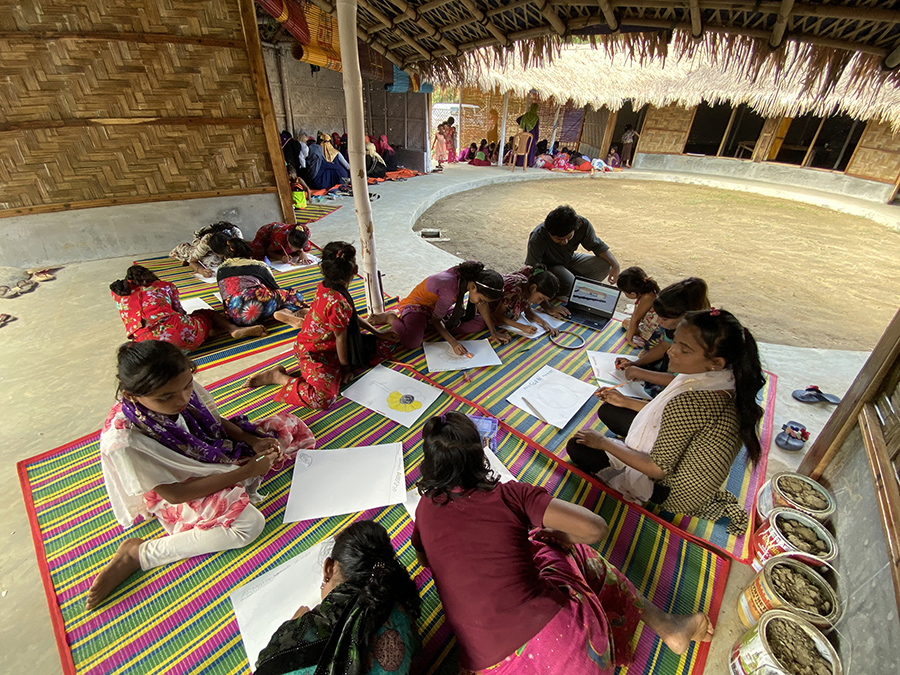

Rohingya refugees have been fighting with vulnerabilities in terms of basic shelter, health, nutrition and emotional state for a while now. Since the influx, Rohingya refugees took shelter on 4300 acres of hills and forests in Ukhiya & Teknaf and the region has been more caring of a host than any other places in the world. One of the largest and most dense camps have become temporary home of almost a million refugees. That includes hundreds and thousands of young minds who are going through the most vital changes in terms of age and current state. The days they pass in the camps will shape them, who they will be in near future.

Shaded areas for multipurpose use © Rizvi Hassan and Team
© Rizvi Hassan and Team

UN agencies, Bangladesh Government and other organizations are supporting them in this difficult time so that in future they become less of a burden rather healthier minds that are ready to contribute. Thus safer spaces for young boys, girls and women play crucial roles in the camp environment.

For adolescent girls and women from the surrounding camp area, the centre offers a place to have a good bath a day, a place to complain about abuse and violence and a place where they can learn to create and share, thus a safe home. Managing social conflict between the refugees and host communities is also an issue in this context; and in our belief being a good host and sharing ethical ideologies will act as small efforts to prevent conflicts.

© Rizvi Hassan and Team

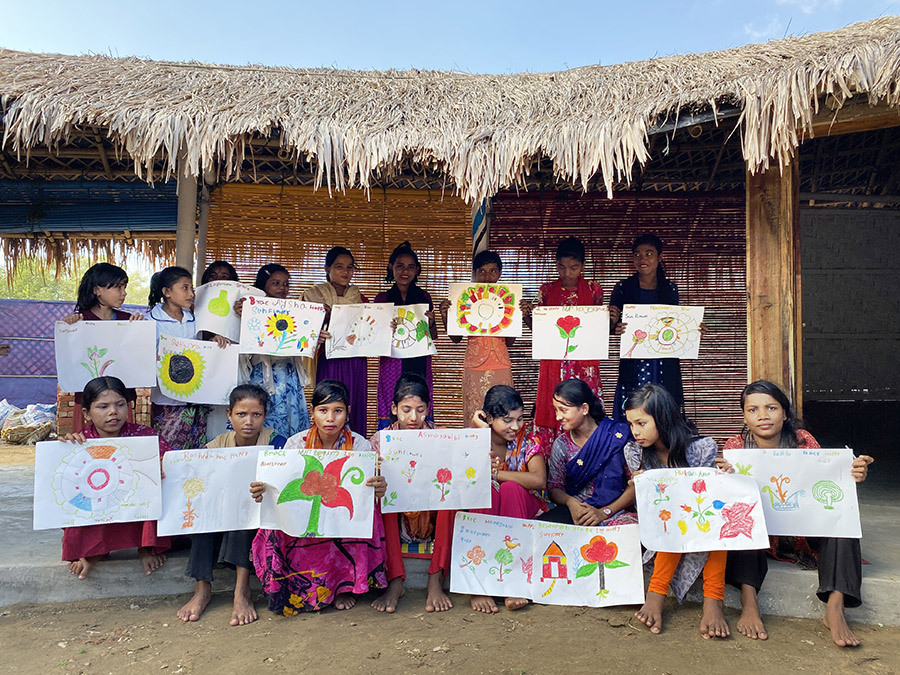
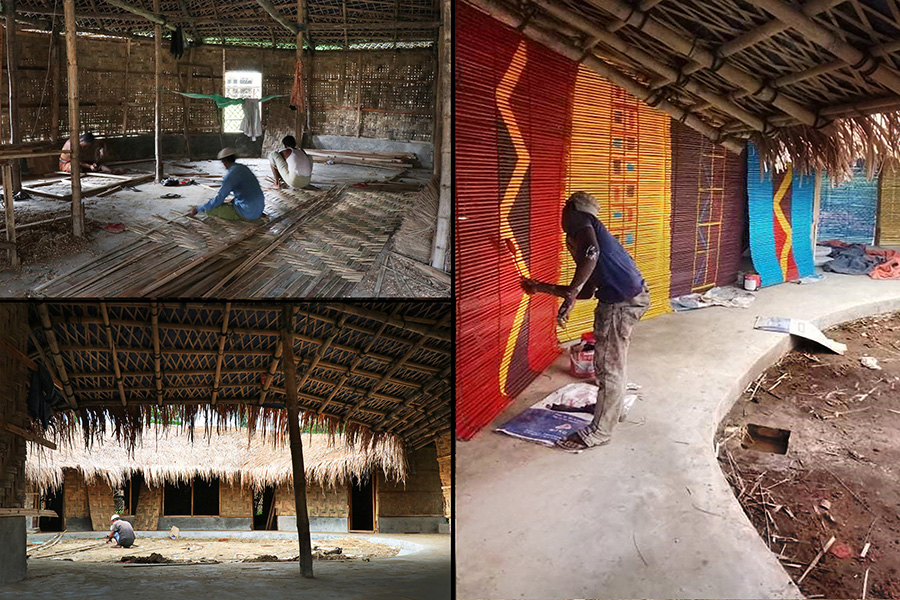
Socially engaging design and building process may benefit the participants in several ways. In our case, the outcome we noticed was that the male participants from the camp were eager to get their family members (wife, daughter, mother, sister) involved with the centre activities whereas there have been reports about restrictions and unwillingness in other centres. The centre becomes more vibrant and personalized by the colorful patterns painted by the community.

Rohingya Girls with their drawings

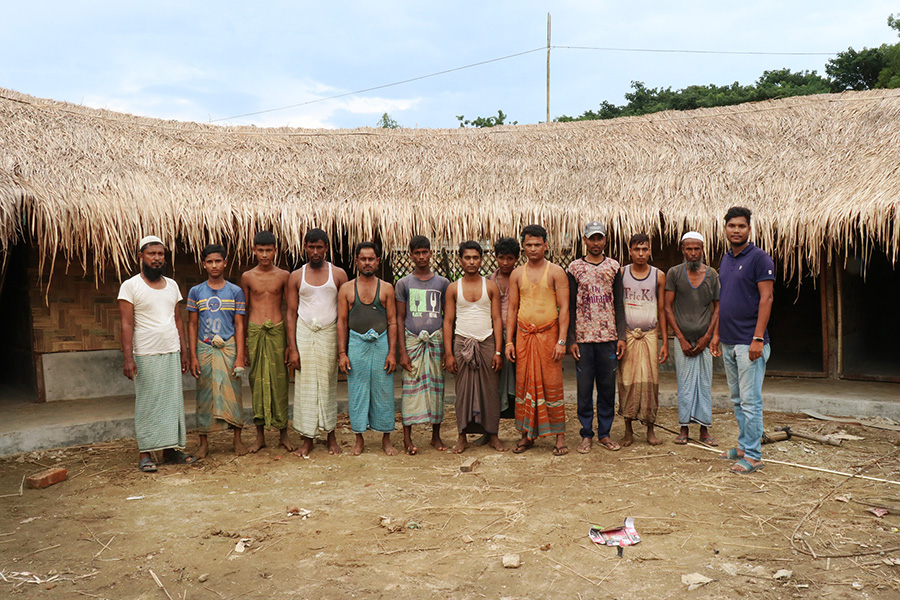
An opportunity to spend the day with the fellow women in the camp can bring psychological change and even their attitude towards their family members. “Quarrel among women and neighborhoods are a common scenario in the camps. I believe if women get the opportunity to gather in a centre like this, they will learn to keep peace wherever they go or live’’ -says Kala Hossain, one of the masons as he worked with us during construction.

Materials used in Safe Space for Women and Girls are very basic and available nearby. Untreated bamboo (as built on emergency basis and will decay in few years and need to be replaced with treated bamboo) as structure, straw/hay with tarpaulin as roofing material (requires change in 1 year interval and can be replaced with alternative durable materials for longer use). The site falls within a cyclone prone area and so we had to avoid materials that can be hazardous during cyclone.

Plan © Rizvi Hassan and Team
Plan perceived by Noor Kayes, a young refugee girl

It is also very near to Asian elephant habitat and one can often see elephants getting down from the hills at the backgrounds. The material and exterior scheme avoids disturbance for elephants. In most of the structures in the camp areas, blue and pink colours are used as a common scheme which is conflicting to human-elephant co-existence. We had to negotiate and avoid these colours in exterior surfaces. We rather keep the natural textures to merge the structure with the surrounding landscape. However, red and yellow colors don’t distract elephants either, so were used for interior court and several openings.

© Rizvi Hassan and Team

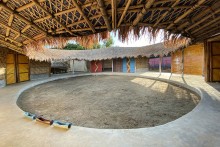
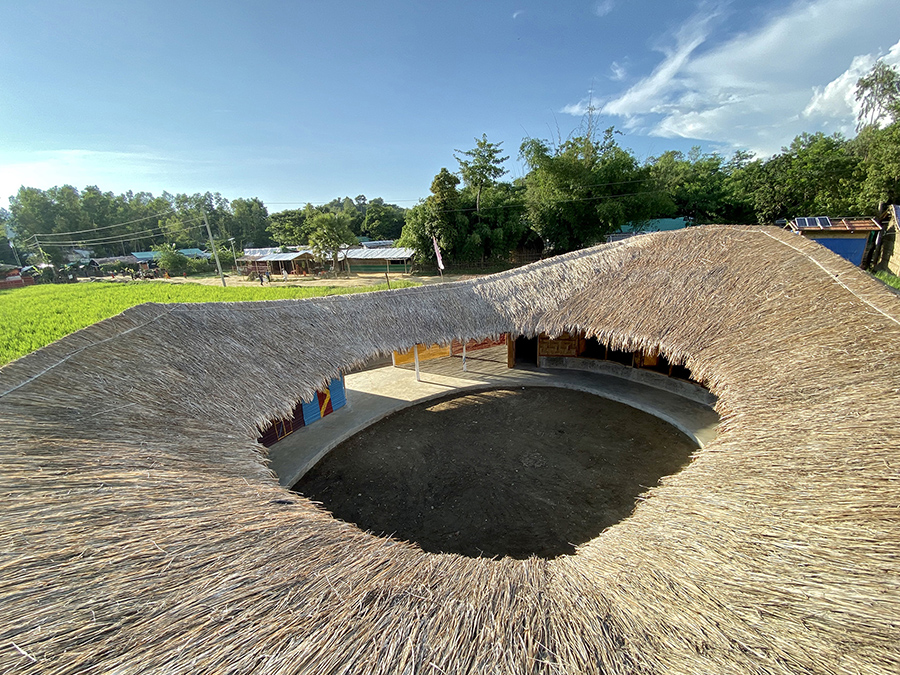
Power of form is universal and timeless. A very basic introvert court ensures privacy and freedom for women of comparatively a conservative society. The interior court connects the surrounding rooms into one space. The activity space and rooms are comparatively smaller than other centres but openings towards the courtyard give the essence of a larger space.

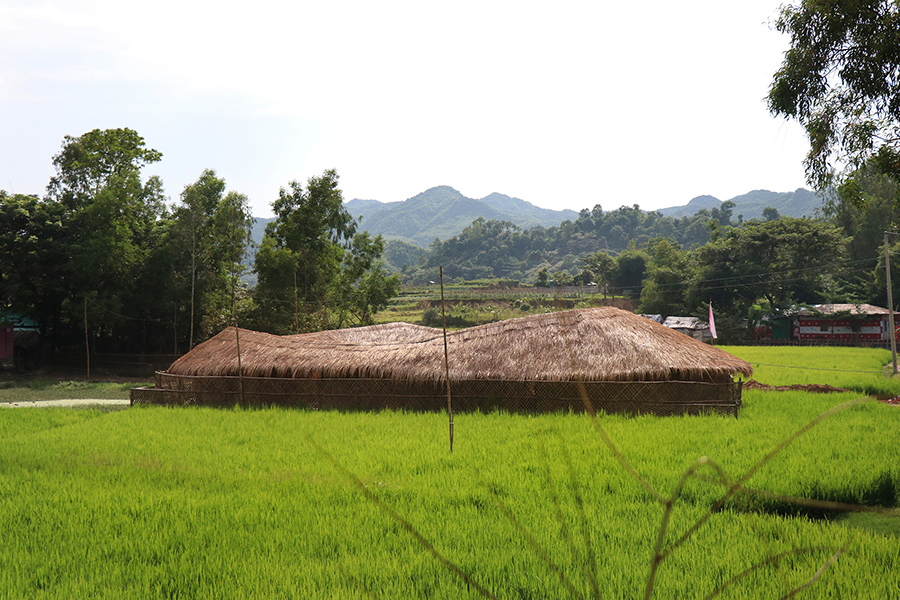
The exterior of the structure is ragged and tries to blend within the context. The texture, colour and setting are inspired by often seen ‘Paner Boroj’ (Betel leaf shades) within rice fields. On the other hand, the interior has the colours vibrant enough to make a cheerful essence. The pocket spaces within the form create opportunities to have the freedom and choice of spaces for the beneficiaries.

Project team
Project team

Aids from outside won’t continue for long. These displaced people even know that they won’t be here for long either. All they will be left with is themselves and each other’s help. And a centre like this can be instrumental in building tolerance and to become co-operative and empathetic, so that in the worst surviving days, they could resist the brutality of the world a bit more.

We have heard stories, how women of the community went through brutality and sacrifices to save their family. And then it is relieving to see their men working with love to make safer spaces for them.

-Rizvi Hassan
Sector Specialist (Architect)
BRAC Humanitarian Crisis Management Programme


Team:

Abdur Rahman, Kala Hossain, Anwar & others (refugee masons)
Abdullah Al Mamun
Biplob Hossain (Engineer)
Saad Ben Mostafa
Rizvi Hassan


| Image gallery |

  • 08_All with drawings!
  • 07_Mukkarama with her drawing
  • 13_Rohingya Girls in SSWG
  • Model
  • 10_Plan perceived by a young refugee girl
  • 05_Adolescent girls in the centre
  • 06_Adolescent Girls in the Center
  • 04_Shaded Areas for Multipurpose Use
  • 02_Safe Space for Women & Girls
  • 03_Courtyard & Surrounding Area
  • Feature_safe sapce for rohingya women
  • 11_Construction Time
  • 12_Team

Recapping ARCASIA Forum 20: City Branding Installation

Citizen of Dhaka recently witnessed one of the vibrant events of Asian architects well known as ARCASIA Forum 20. To make the event engaging, the organizer, Institute of Architects Bangladesh (IAB), invited nine architecture schools to take part in the City Branding Installation. Group of students from AIUB, BRAC, BUET, NSU, Stamford University, State University, SUST, UAP, Southeast University participated in the event and put up ten installations at different important nodes of  Dhaka. The whole process from design to construction was supervised by a creative team comprising the faculty members of respective institutions and members from IAB.

City Branding Committee: Ar. Masudur Rahman Khan (Convener), Ar. Bikash Saud Ansary (Co-convener), Ar. Abu Anas Faisal (Member Secretary), Ar. A K M Mahfuzul Haque Zaglul, Ar. Nazmul Haq Bulbul, Ar. Md. Alamgir Jalil, Ar. Mohammad Maruf Hasan, Ar. Md Shahid Hasan Rabbani, Ar. Tabassum Rifat Saikat, Ar. Md. Anwar Jahed.

AIUB_01

AIUB 02

University: American International University-Bangladesh

Supervising Faculty: Ar. Tabassum Zarin, Fauzia Rahman Mouri

Location: IAB- West and South Road, Agargaon, Sher-E-Banglanagar


BRAC_01

University: BRAC University

Supervising Faculty: Ar. Shams Mansoor Ghani, Ar. Smiur Rahman

Location: Gulshan Circle 1, Dhaka


buet 01_low

University: Bangladesh University of Engineering and Technology (BUET)

Supervising Faculty: Dr.Nasreen Hossain, Ar. Md. Tarek Haider, Ar. Meherul Kader Prince

Location: Bijoy Sarani East Circle, Dhaka


NSU_1

University: North South University  (NSU)

Supervising Faculty: Ar. Tasnuva Sabah

Location: Radisson Blu Dhaka Water Garden Dhaka


stamform uni_01

University: Stamford University Bangladesh

Supervising Faculty: Ar. Mashudur Rahman Fahim

Location: Bijoy Sarani- By Pass West Triangle Corner, Dhaka


state uni 01

University: State University of Bangladesh

Supervising Faculty: Ar. Dr. Sajid Bin Doza, Ar. Kabir Redowan

Location: Gulshan Circle 2, Dhaka


southeast_01

University: Southeast University

Supervising Faculty: Ar. Masud Rashid, Ar. Faysal Karim Bhuiyan

Location: Press Club Island, Dhaka


SUST

University: Shahjalal University of Science & Technology (SUST)

Supervising Faculty: Ar. Kawshik Saha

Location: Kamal Ataturk Avenue Dhaka

UAP 01

UAP 02_low

University: University of Asia Pacific (UAP)

Supervising Faculty: Ar. Ziaul Islam, Ar. Ehsan

Location: Manik Mia Avenue East Circle, Dhaka


Photographs and information courtesy: Ar. Abu Anas Faisal

Pop-Up Exhibition on Architecture of Bangladesh

This year’s five-day annual forum of Asian architects, known as ARCASIA is hosted by Bangladesh in its capital Dhaka. The event was inaugurated in 3rd November at Bangabandhu International Conference Centre. The Architects’ Regional Council of Asia abbreviated as ARCASIA is a Council of the presidents of the National Institutes of Architects of twenty-one Asian countries that are members of ARCASIA. Every alternate year, ARCASIA FORUM is hosted by one of the member countries of ARCASIA. The Institute of Architects Bangladesh (IAB) is hosting ARCASIA FORUM 20 this year and the theme is “Architecture in a Changing Landscape.” IAB is also holding an exhibition of more than 100 national and international award-winning architecture projects in two venues in Dhaka along with other events.

The official write up that CONTEXT received from the exhibition committee with credits are posted here to give a broader holistic picture of the themes and arrangement of the exhibition.

[Information Source: Tabassum Zarin Tithi, Photographs by : Rafi Sadman and Sayed Mohit]

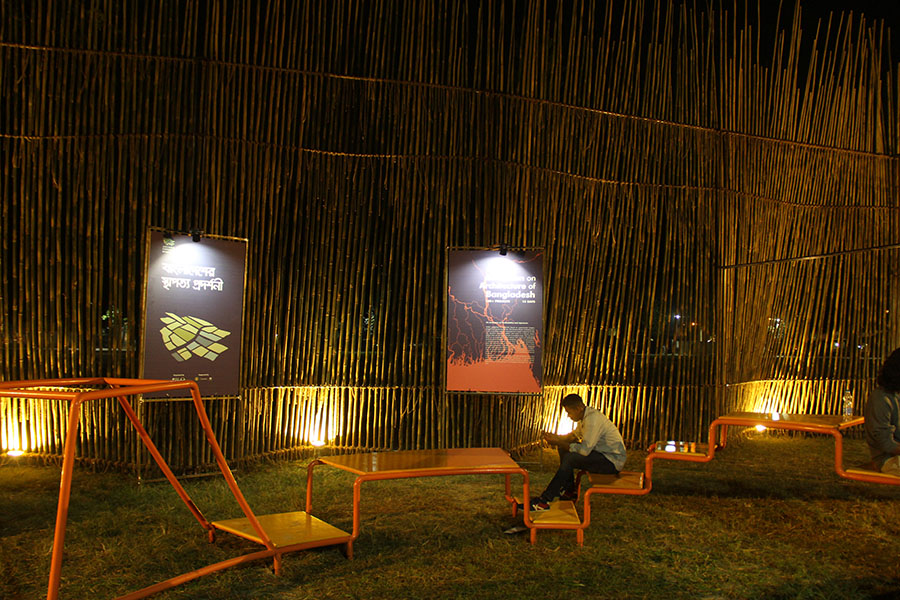
On the event of ARCASIA Forum 20 in Dhaka, also marked by the celebration of the 50 Years Celebration of ARCASIA, IAB has organized an architecture exhibition for the first time addressing the mass community of Bangladesh alongside the architects, artists and other professionals of building industry. The event will take place from 31stOctober to 15th November 2019. This exhibition is a compilation of various national and international award-winning projects in contemporary Bangladesh. It traces the trends of architecture that have invariably developed with the country’s passage.

The inclusion of our glorious historical trail and modern masterworks, architectural photography made the exhibition a more communicative one. The exhibitions are arranged in different pavilions located at significant spots in Dhaka which are Manik Miah Avenue, Shahid Tajuddin Ahmad Smriti Park at Central Gulshan, Bangabandhu International Conference Center at Agargaon, Bengal Shilpalaya at Dhanmondi and Army Golf club.

The vibrant urban platforms of these exhibitions will create a common ground, where the whole society can engage with the national and international award-winning architecture of Bangladesh. The exhibition spaces have been chosen to be in major urban spots of Dhaka where social gathering can happen which will allow a better understanding of contexts and ideas those attract people of all ages. The key idea of the exhibition remains to reach, connect and engage beyond the interprofessional to the larger common mass of people.

The dialogues from the exhibition will show that the architects are connecting not only with the formation of urban settlement also sensibly engaging with rural settings and landscapes. This episode creates an aspiration in creating awareness about our own cultural value as well as our dynamic environment.

The exhibition events welcome the urbanites to connect with the compilation of the award-winning projects including the heritage, modern architecture and related installations that will generate robust solutions in the quest for aesthetically pleasing, sustainable and socio-culturally adept architecture. We hope to orient future architects, society, and the global arena at large, of what Bangladeshi architecture constitutes in this evolving region. We seek to provide a platform and starting point for our policymakers, development agencies, and user groups, and professionals abroad about the architectural trends of our region. The rapid changes in the Bengal region are supplemented and influenced by the dynamic architectural activities of the region and we welcome you to join us in a meandering journey of architecture and its trends in Bangladesh today.

Concept: Manik Miah Avenue

The display of architectural works, when housed in a designated space and targets a specific kind of audience, misses out the general public and their pulse. As a matter of fact, architects do not work for themselves but for others and it is the people to whom the buildings and the places are supposedly serving. The exhibition entitled ‘Exhibition on Architecture of Bangladesh’, showcasing more than a hundred rich and dynamic built projects of our country is an attempt to shift the paradigm of the exhibition from a bound space to the public realm to become part of general people’s collective experience. The exhibition has been brought outside of formal space of any sort and placed strategically at one of the most popular public plazas within the territory of the National Parliament Building of Dhaka. However, from the sustainability point of view, we found choosing Containers and reusing them would be the best possible option for accommodating an exhibition that is temporary in nature. The containers are placed at the site in such a manner that they create a wall without interrupting the ease of movement of the regular users of that public plaza. Artworks on the container walls, depicting the vibrant city life of Dhaka, are hoped to further connect people’s emotion in varying degree.

Concept: Central Park, Gulshan

An enclosure of Permeability and Aperture:

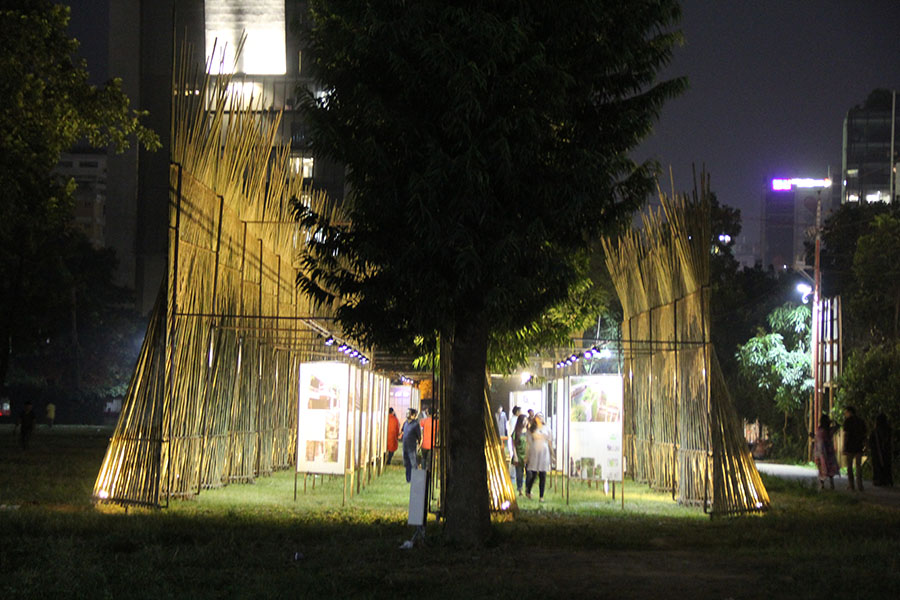
The public exhibition is evidently based on experiential images, images that create memories. The Arcasia Dhaka  Exhibition pavilion in Gulshan park is conceived as a poetic response to the city dweller’s desire to gather and meet in a vibrant atmosphere that can be experienced in multiple ways. The set-up is dealt as an in-between space where thin layers of undulating surfaces form the open to a sky exhibition gallery, an atmospheric experience for people, where they can engage themselves with the vibrant realm of architecture. The design idea of this translucent pavilion is deeply rooted in the desire of engaging people with ease and simplicity. Simple ruled surfaces of repetitive sine curves and straight lines form a contemporary gallery space which is achieved with the use of traditional material bamboo.

In weather full of autumnly vibes, an open exhibition in a city park is perceived as a translucent ‘enclosure’ of permeability and aperture. The dissolving boundary awaits to offer a spatial experience of ‘architecture in a changing landscape’ for the citizen.

Exhibition Credits

Exhibition Committee for Arcasia Forum 20 Dhaka 19

Convener : Ehsan Khan Member

Secretary: Nabi Newaz Khan Shomin

Member: Jubair Hasan; Lutfullahil Majid Reaz; Didarul Islam Bhuiyan; Suvro Sovon Chowdhury; Saiqa lqbal Meghna; Khandaker Ashifuzzaman Rajon; Tabassum Zarin Tithi; Reesham Shahab Tirtho; Irteza Ameen; S. M. Ehsan UI Haque Shawpnil; Salman Rahman; Sabrina Sumona

Location 1: A Public Exhibition on Architecture of Bangladesh at Manik Miah Avenue

Installation Design : Md. Jubair Hasan, LutFullahil Maki

Graffiti: Reesham Shahab Tirtho

Display Panel (Graphics and Installation): Khandaker Ashifuzzaman Rajon, Tabassum Zarin Tithi, Irteza Ameen

Support: S. M. Ehsan UI Haque Shawpnil, Golam Mahmudur Rahman, Farzad Ghani, Amit Krishna Sarker, Tarif Tasneem Araf, Md. Atiqur Rahman Khan, Arafat Nawaj Aunkur

Photograph by: Sayed Mohit


Location 2: A Public Exhibition on Architecture of Bangladesh at Shahid Tajuddin Ahmad Smriti Park, Central Gulshan

Installation and Playscape Design : Saiqa lqbal Meghna, Suvro Sovon Chowdhury

Graffiti : Kazi Istela Imam, Sayeef Mahmud

Display Panel (Graphics): Khandaker Ashifuzzaman Rajon, Tabassum Zarin Tithi, Irteza Ameen

Support: Sumaiya Ara Simi, Bhuiyan ARM Riyadh, Rahat Ibna Hasan, Md. Sirajul Islam, S. M. Ehsan UI Haque Shawpnil, Farzad Ghani, Amit Krishna Sarker, Tarif Tasneem Araf, Md. Atiqur Rahman Khan, Arafat Nawaj Aunkur


Photograph by: Rafi Sadman

Image gallery 

  • container_01
  • container_02
  • container_07
  • container_04
  • container_03
  • container_08
  • IMG_8007
  • IMG_8014
  • IMG_7987
  • IMG_7954
  • IMG_7972
  • IMG_7919
  • IMG_7812
  • IMG_7902
  • IMG_7887
  • IMG_7769
  • IMG_7852
  • IMG_7877
  • IMG_7736
  • IMG_7705
  • IMG_7693
  • IMG_7588
  • IMG_7569
  • IMG_7589
  • IMG_7594

Bionic Transmutation: A Vision for an International Airport at Rajshahi

This thesis project is about the design of Shah Makhdum International Airport, which is the most cherished one for the development of the economic strata of Rajshahi division in Bangladesh. The concept is to mimic the natural element into a technological form which will contain the aura of nature transmutated into a more functional space by creating a comfort zone and a memorable experience for the passengers.

The project story draws a metaphorical connection  with travel experience at ancient time when people used to move from one place to another on foots. The shaded space under the trees was their resting place—a comfort zone, a part of their experience. The penetration of light as rain through the leafs and interplay of that light and shadow made it a place of spirituality, a place for meditation, a place the coolness of mind.

 © Rafiud Darazot Saad, AUST
© Rafiud Darazot Saad, AUST
 © Rafiud Darazot Saad, AUST
© Rafiud Darazot Saad, AUST
 © Rafiud Darazot Saad, AUST
© Rafiud Darazot Saad, AUST


An airport terminal is a place where a journey begins, a journey ends and a place for taking short break for further destination. An airport occupies a considerable part of a total journey experience; it provides a transition towards another new experience, sometimes a longer one. Hence, the airport is conceived as an element of experience with an aim to offer a pleasant memory to the travelers.

Arrival floor plans © Rafiud Darazot Saad, AUST
Departure floor plan © Rafiud Darazot Saad, AUST
Section © Rafiud Darazot Saad, AUST


The airport is meant for the city. It is often designed to reflect the image of the city. Rajshahi is a city of spirituality, a city of silk; its legacy provides the inspiration for this airport project. The design has emerged from the articulated juxtaposition between local culture and global technology.  The microscopic image of the silk cocoon has inspired the designer to create a cocoon like structure which is light in weight and penetrates light in a such a way a tree does through its leafs. It is a transmutation of nature into technology, referring here as a Bionic Transmutation.

Interior view of the terminal building © Rafiud Darazot Saad, AUST


It is also expected that the building intelligence will keep the interior space of the terminal structure cooler than the outside summer heat, hence will reduce the energy need.


To submit your project, send email to context.editor4@gmail.com

Rethinking Rajshahi Divisional Public Library | An Interactive Learning Platform | BUET

| From the Author |

Today we are living in a world where distance is not an issue. This is because knowledge and information are in our grasp as we move from an information age to the digitally networked age. Book as our traditional sources of knowledge is housed in the library. Now spaces in which we access information are also changing. We can access information almost anywhere in the world from our cell phones. So we are connected to the world’s knowledge. Yesterday’s library was silent but today the library should be more vibrant so that people can share their knowledge and information among themselves. People should feel more welcomed to take part in knowledge sharing activities.

© Baichi Chaki
© Baichi Chaki
© Baichi Chaki
© Baichi Chaki
Exploded View © Baichi Chaki


The main focus of this project is to create a public platform for learning, interacting and sharing knowledge among the people of Rajshahi. A library is a place for all types and all aged people. The library is intended to design as a civic space so that people can maximize their shared ideas, knowledge and information for their betterment.

.

Rethinking Rajshahi Divisional Public Library © Baichi Chaki
© Baichi Chaki
© Baichi Chaki


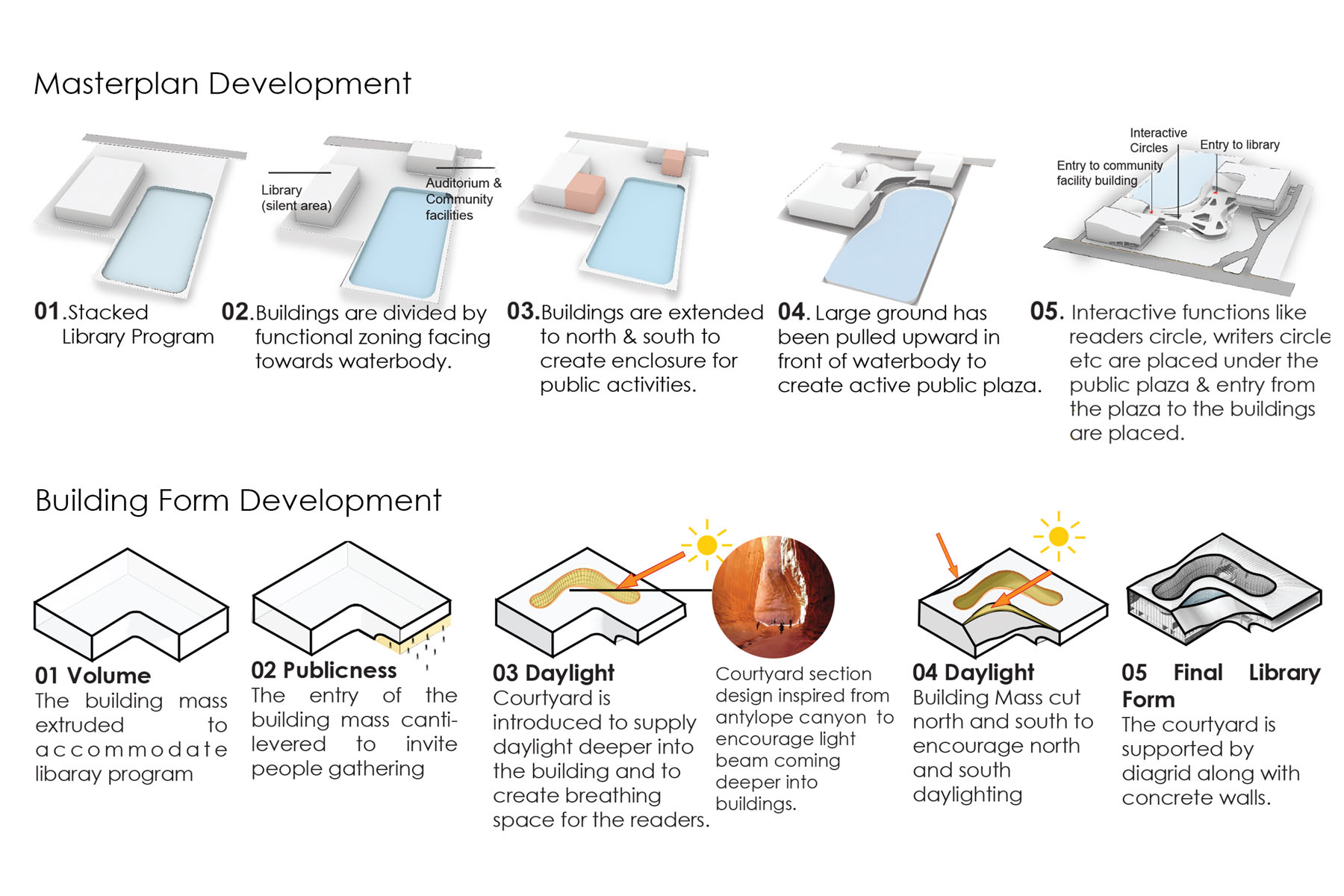
The site is located at Laxmipur in Rajshahi district which is surrounded by the institutional and hospital buildings. In such a context, two L-shaped buildings, an auditorium, and a library are placed to create an enclosure for public activities. A large ground is uplifted to house interactive activities for the community holders. For example, readers circle, writers circle, drama circle, music circle, poetry circle, etc. These interactive circles generate public activities that help to create an intellectual society. Moreover, We have a very rich book culture. Ekushey Book Fair, one of our most vibrant books related activities can also be held on this public platform. An open amphitheater is placed in front of the water body so that different occasions on national days can be held.

.

Elevation © Baichi Chaki
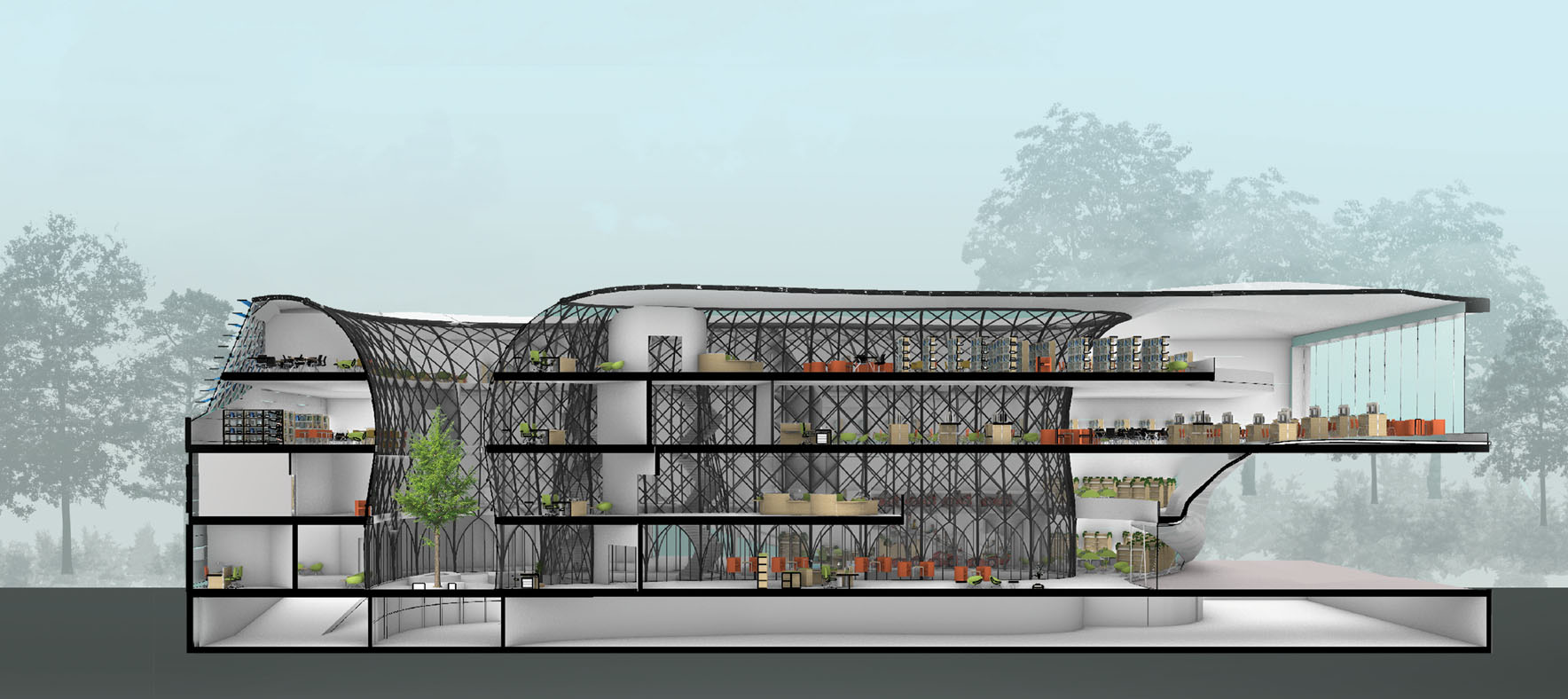
Section © Baichi Chaki


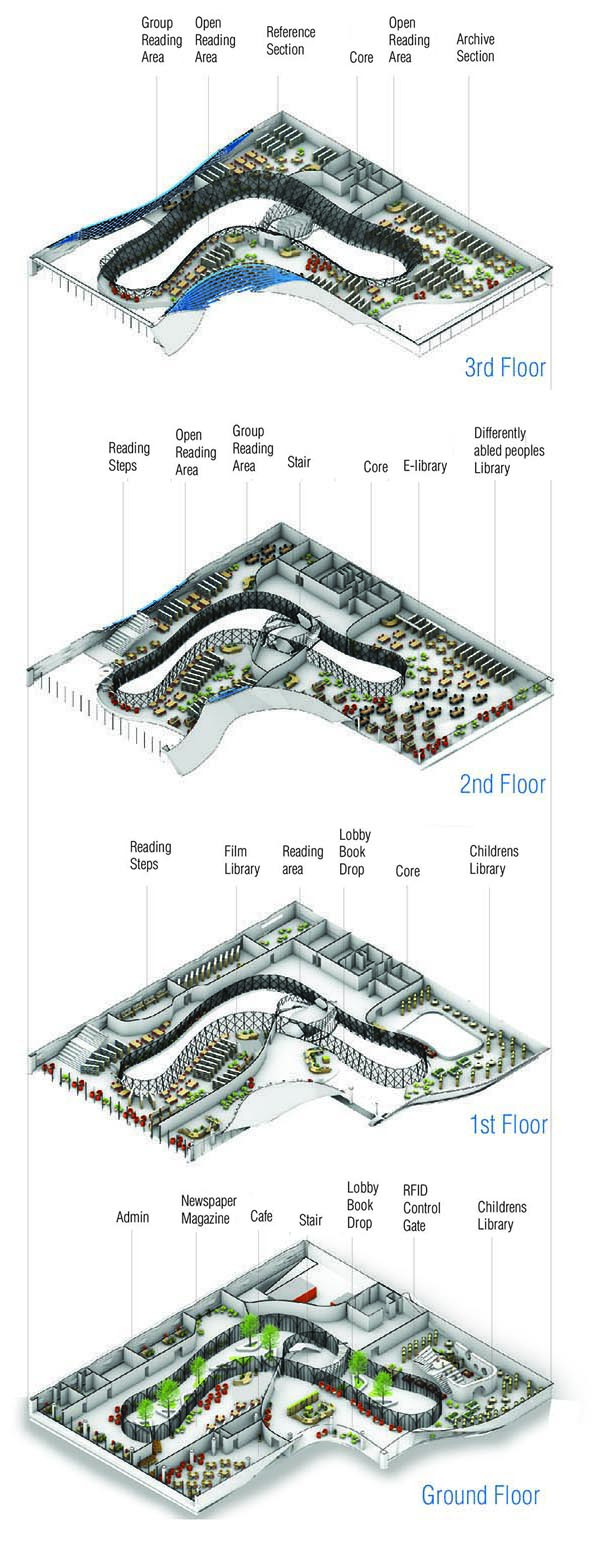
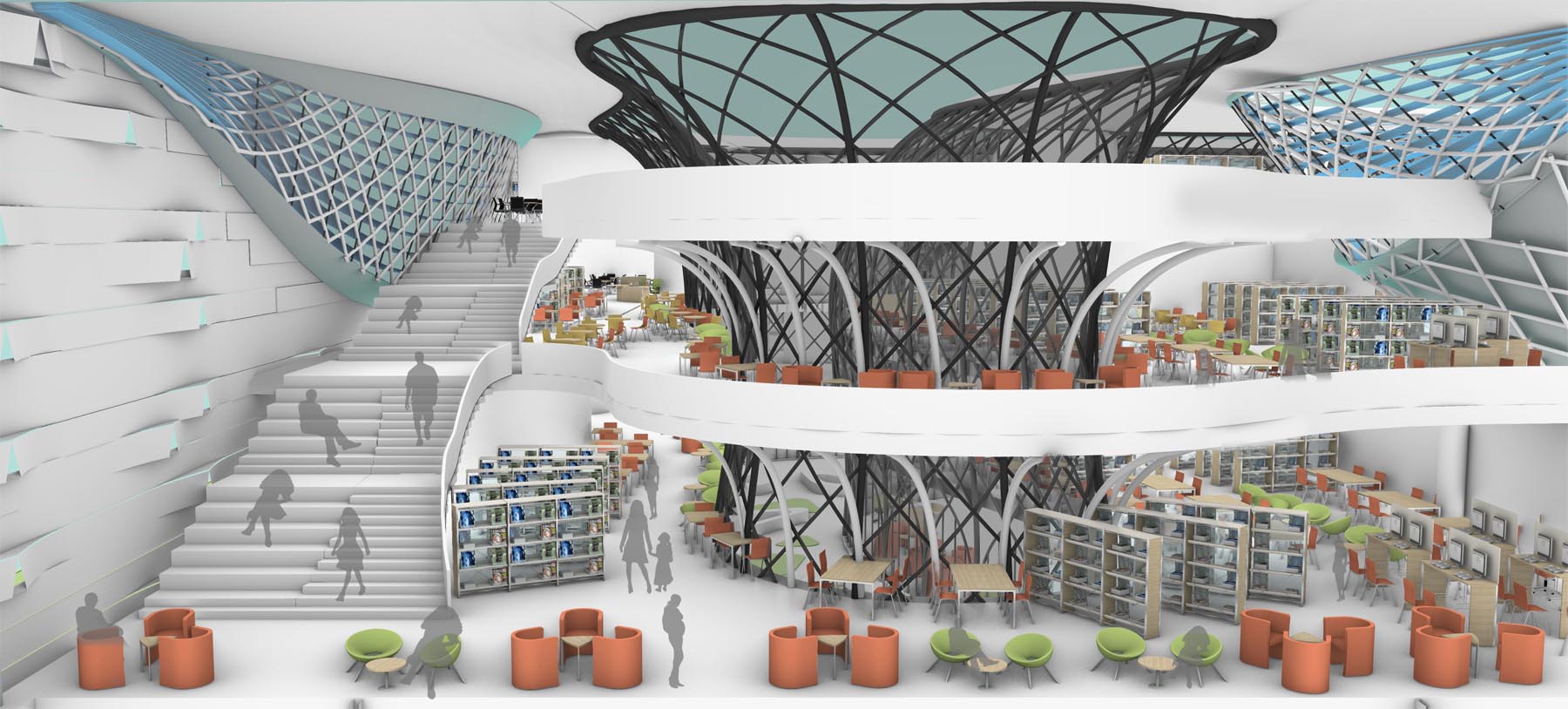
The program is comprised of multifunctional reading spaces, archives, a reference section, children’s section, e-library, administration and accounting section, auditorium, seminar hall, exhibition spaces, cafeteria, and other ancillary functions. These functional volumes are clustered and arranged in two building masses which are library building and auditorium building. The building forms are intended not to create any room; rather it is intended to create flexible spaces that can be changed according to the need of the future. The contemporary fluid building form gives an inviting appearance for urban dwellers to enter and participate in the vibrant reading activities.

.

© Baichi Chaki
© Baichi Chaki
© Baichi Chaki
© Baichi Chaki


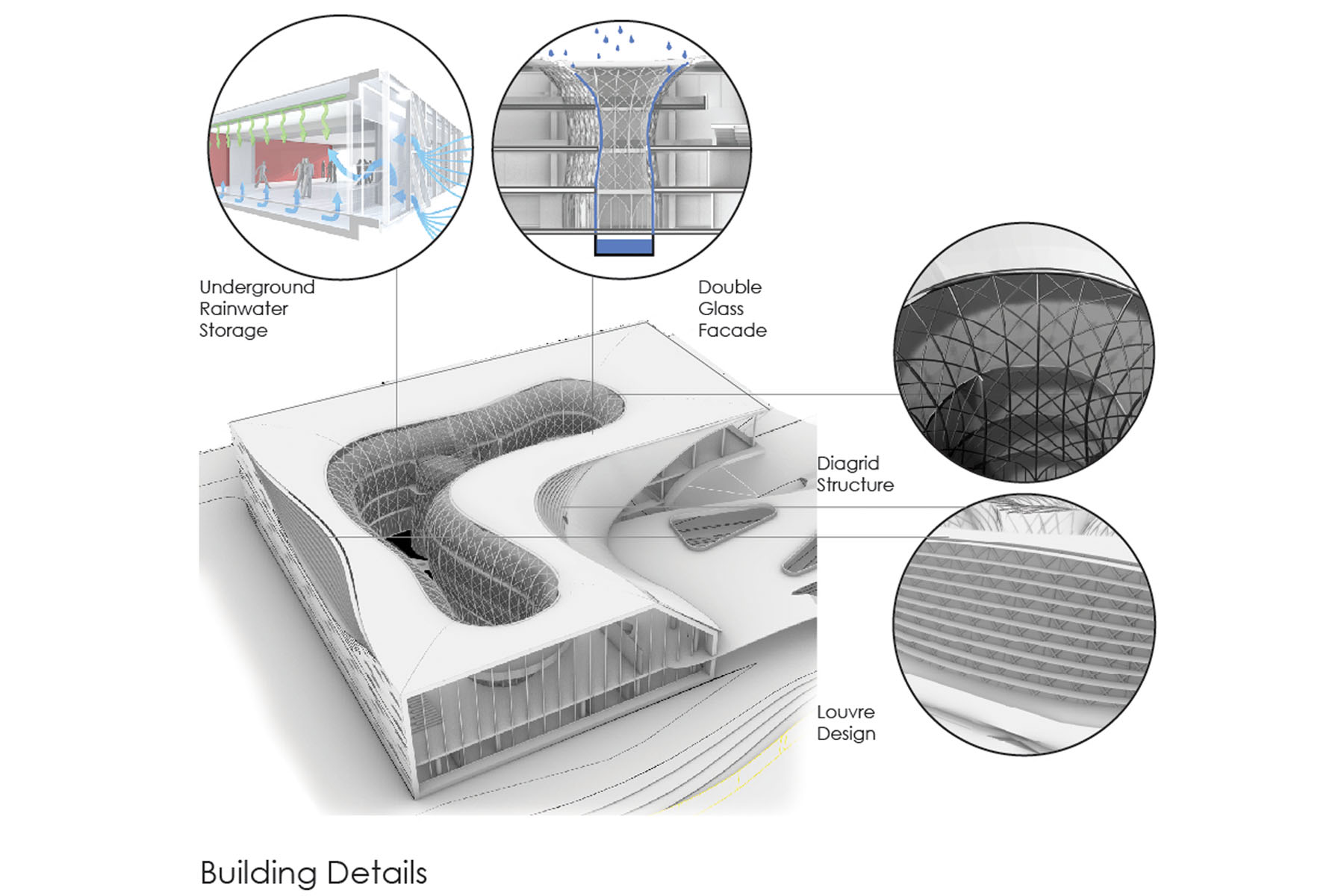
The library building is designed in a sustainable way so that a maximum amount of daylight can be used in the reading area. The L-shaped building mass is cut north and south to encourage northern and southern daylight. A courtyard is introduced from the inspiration of daylight coming into the cave to light deeper into the building. Velux daylight autonomy analysis shows that most of the part of the library is daylighted. The courtyard inside the library also served as a breathing space for the readers.

.

Structural Model © Baichi Chaki
Model © Baichi Chaki


The open reading space is designed in front of a water body in a flexible way so that almost any activity can occur. The cornerless spaces create vibrant spaces for the readers of any age or type. Finally, The library is redefined as an institution which is not only dedicated for books but also as a store of information where all potential forms of media can be showed and the public plaza acts as an interface to learn, interact and share their ideas and knowledge as well as develop themselves for collective manner.

| Image gallery | 

  • top view render
  • 1.concept
  • 9.building details-01
  • Diagram
  • Master Plan
  • Exploded View
  • Rethinking Rajshahi Divisional Public Library
  • 4.sectional axono
  • 13.interior render (2)
  • 12.interior render
  • 11.interior render (1)
  • 4
  • Section
  • 3
  • 2
  • Elevation
  • 14.IMG_6123_N
  • 16.IMG_6081

Zulrin: A Weekend Retreat Fused in a Bucolic Landscape

| Notes from the Architect |

Renzo Piano once stated “Architecture is a very dangerous job. If a writer makes a bad book, eh, people don’t read it. But if you make bad architecture, you impose ugliness on a place for a hundred years.”

We can’t agree more with this notion. However, it’s not only about imposing ugliness, it’s also about the human experience of the building and associated health and comfort of the occupants. Living in 21st century, we still tend to strive for radical simplification of form, a rejection of ornamentation, use of universal building material and aggravate “placelessness”  through universal modernism. These acts  often criticised for causing a setback to regional culture and identity. To counter the modernist approach, a new discourse, termed as Critical Regionalism, has emerged that put emphasis on the understanding of place and tectonics, its  spatial and experiential qualities. It advocates for architecture that is responsive to local context and sensitive towards materials.

Library that floats © Abdul Kader Zeeshan & Ridwan Tanvir
Library that floats © M A Kader Zeeshan & Ridwan Tanvir

Following the same line of thought, we believe, architecture that strongly responds to the nature, becomes part of the landscape through its expression, and evokes a sense of belonging to its occupants. The level of abstraction and universal behavior could be achieved by recognizing the regional context, culture and vernacular strategies.

Rural horizon view © Abdul Kader Zeeshan & Ridwan Tanvir
Rural horizon view © M A Kader Zeeshan & Ridwan Tanvir
Connection between spatial elements © Abdul Kader Zeeshan & Ridwan Tanvir
Connection between spatial elements © M A Kader Zeeshan & Ridwan Tanvir


When the project was first commissioned, the program was just like a simple house with some additional functions. Initial program included 4 bedrooms, living space for a large gathering, dining space, study room, kitchen and caretaker room. Then we took the challenge of reformulating the program in a different way. Instead of 4 bedrooms, we proposed 3 bedrooms and an additional family living which would work as a makeshift sleeping space at night. We took the study room out of the main building and intended to make it a separate entity with a strong identity.  We desired to reduce building footprint, through compact design and put more importance to semi outdoor spaces (e.g. veranda) that creates the dialogue between building and nature. A compact design would help to leave the whole site as green as possible.

The main building is east west oriented to catch the prevailing breeze from the south as well as to reduce the solar heat gain. However, this orientation exposes the building to the south sun and driving monsoon rain. Since this is a weekend house, we focused more on public and semi-public spaces like living, dining space etc. instead of bedrooms. The central living and dining space are the kernel of the building that has been accompanied by verandas in the southern periphery. Veranda works as a buffer space and protect the living space from direct sun and rain. This central double height space always stays cool due to its huge volume and constant cross ventilation. Operable high windows on the north side allows rising heated air to go out and induce a pressure variation inside that draws the south wind inside to create the constant cross ventilation.

Schematic master plan © Abdul Kader Zeeshan & Ridwan Tanvir
Schematic master plan © M A Kader Zeeshan & Ridwan Tanvir
Section: Connection between spatial elements© Abdul Kader Zeeshan & Ridwan
Section: Connection between spatial elements© M A Kader Zeeshan & Ridwan Tanvir
Zulrin: A weekend retreat © Abdul Kader Zeeshan & Ridwan
Zulrin: A weekend retreat © M A Kader Zeeshan & Ridwan Tanvir
Blend it with nature © Abdul Kader Zeeshan & Ridwan
Blend it with nature © M A Kader Zeeshan & Ridwan Tanvir
As seen from the Library © Abdul Kader Zeeshan & Ridwan Tanvir
As seen from the Library © M A Kader Zeeshan & Ridwan Tanvir


Traditionally, “Kachari Ghar” concept was a widespread practice in rural architecture of Bangladesh. This project carries that idea in the form of a library. This single room seemingly floats over the water body, creates a sense of tranquility in and around the place.

Outdoor environment of the project is full of natural elements. The initial zoning of the master plan was done keeping all existing planted trees in mind. Landscape was recreated with common trees and plants, which were selected as a subtle blend to the local environment.

The best place to be in the late afternoon or early mornings in this warm humid region is the semi outdoor and outdoor space often open to sky. It has plenty of spaces like veranda, terrace, courtyards etc. The project displays several variations of spaces in different locations to have different feelings in different parts of the day.  In addition to typical shaded veranda, we provided a double height veranda that add a grandness in the formal impression as well as in spatial experience. It also allows the tilted winter sun light to penetrate through the louvre. There is another terrace on the north side adjacent to the family living space which overlooks the green paddy field behind the site.

The prime building material is gas burnt brick which is sourced within only 50km of the site. Brick is a very low embodied energy material. Aluminum section as the window frame. And woods (Shegun, Loha kath, Gorjon, Kerosin) for doors and furniture. All the furniture is custom made and built in the site. Besides, we used the leftover, broken bricks to cast landscape pavement blocks in the site.

The main structural system is basically a column- beam frame with supporting load bearing walls.  Since we wanted to maintain the true expression of brick throughout, it was challenging to address the requirement of RCC in the columns. Hence, we came up with an idea of composite column that will have RCC surrounded by one layer of bricks. The roof is supported by inverted beam and its benefit is twofold. First, it gives a beam free clean ceiling especially in the double height section. Second, the inverted beam on the roof helps to retain filled earth for roof top green and planting.

The lofty interior © Abdul Kader Zeeshan & Ridwan
The lofty interior © M A Kader Zeeshan & Ridwan Tanvir
Interior showing interaction between private-common zones © Abdul Kader Zeeshan & Ridwan
Interior showing interaction between private-common zones © M A Kader Zeeshan & Ridwan Tanvir

As we wanted to design the reading space as a separate yet independent entity, we take it out from the main building and placed it along the west side boundary of the site with a water body right in front of it. The reading space has book storage facility and a small toilet with it, which now has its own quiet territory to focus on reading. We are terming it as library which has an open deck extending over the water body that give the chance to enjoy the subtle ripples on the water surface. The coolness due to the water body, the rhythmic reflection of water on the ceiling, and proximity to nature is a significant visceral experience that we wanted to create.

Study room at night © Abdul Kader Zeeshan & Ridwan
Study room at night © M A Kader Zeeshan & Ridwan Tanvir
Zulrin: A Weekend Retreat © Abdul Kader Zeeshan & Ridwan
Zulrin: A Weekend Retreat © M A Kader Zeeshan & Ridwan Tanvir

Project Team:

Lead Architect[s]:

M A Kader Zeeshan

Ridwan Tanvir

Consultant[s]:

Structural Consultant: Engr. Rakibur Rahman

Electrical Consultant: Engr. Niloy Das & Engr. Humayun Kabir Biddut

Interior Design:  M A Kader Zeeshan & Ridwan Tanvir

Landscape Design:  M A Kader Zeeshan & Ridwan Tanvir

Photographer: Noufel Sharif Sojol

| Image Gallery |

  • 01 Display photo
  • 15
  • 09
  • 06
  • 02
  • 14
  • 10
  • 11
  • 12
  • 07
  • Print
  • Model
  • 13
  • 03
  • 04


CONTEXT contributing editor : Md Tarek Morad, Architect & Assistant Professor. 

Architectural Excellence Addresses the Need and Aspiration of the Locality

Azizul Mohith / CONTEXT

Arcadia Education Project by Architect Saif Ul Haque in South Kanarchor, Bangladesh has received much acclaimed Aga Khan Architecture Award 2019 along with 5 other projects spread around the globe. It is a proud moment for Bangladesh as this the fourth award cycle where a project from Bangladesh has received this award, taking the number of projects to six. Bait-Ur-Rouf Mosque near Dhaka and Friendship Centre in Gaibandha received the award in 2014-2016 cycle. Previously Grameen Bank Housing Programme and National Assembly Building of Bangladesh received Aga Khan Architecture Award in 1987-1989 cycle whereas METI School at Rudrapur, Bangladesh was honored in 2005-2007 cycle.   Since 1977 The Aga Khan Award have been rewarded to architectural built projects that successfully address the needs and aspirations of respective context and culture in the fields of contemporary design, social housing, community development and improvement, restoration, reuse and area conservation, as well as landscape architecture and environmental restoration efforts. It is worth to mention, in the 2017-2019 cycle another Bangladeshi project is shortlisted- the Amber Denim Loom Shed by Archground / Jubair Hasan.

Architect Saif Ul Haque is receiving the Aga Khan Award | Photo courtesy : Jubair Hasan and Tahmida Afroze
With other shortlisted participants | Photo courtesy : Jubair Hasan and Tahmida Afroze


The six winning projects of the 2019 Aga Khan Award for Architecture (AKAA) were awarded on 13 September at a ceremony held at Kazan’s Musa Jalil State Academic Opera and Ballet Theatre.

The six projects selected by Master Jury to share the US$ 1 million prize are-

  • Revitalisation of Muharraq, Bahrain
  • Arcadia Education Project, South Kanarchor, Bangladesh
  • Palestinian Museum, Birzeit, Palestine
  • Public Spaces Development Programme, Republic of Tatarstan, Russian Federation
  • Alioune Diop University Teaching and Research Unit, Bambey, Senegal
  • Wasit Wetland Centre, Sharjah, United Arab Emirates
Arcadia Education Project by Architect Saif Ul Haque | Photograph by Sayed Mohit


The story behind the inception of Arcadia Education Project is probably as appealing as the project itself. It all began when Razia Alam, a Bangladeshi origin teacher from United Kingdom returned to her home country and decided to build a school for underprivileged children. She was ready to spend the savings accumulated from her 40 years of teaching career. For certain considerations like fund restriction and her willingness to establish the school near riverside, she purchased a land close to river in Kanarchor. It turned out that the land remain under three metre of water one third of the year. That is when Architect Saif Ul Haque devised the solution of a structure which would sit on ground and float on water based on the water level. Three multipurpose spaces used mainly as classrooms; office; open-topped platform; toilet/bathroom structure; septic tank and water tank structures; and a single corridor offering access to all spaces are kept anchored with ground in dry season with bamboo posts, while  steel drums placed in bamboo frames supposed to help it float when water level rises. The bamboo was collected form localities and treated with liquid extracted form a local fruit. Most of the joints are rope-tied. Bow-arched bamboo roofs allows for free classroom space.

Photo courtesy : Jubair Hasan and Tahmida Afroze


The “Loom Shed”, another shortlisted project from Bangladesh, employed “traditional Bangladeshi residential architecture with contemporary elements that give it a modern twist.” This project is also a recipient of several local and international award.