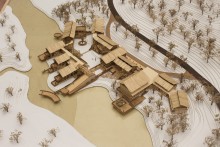
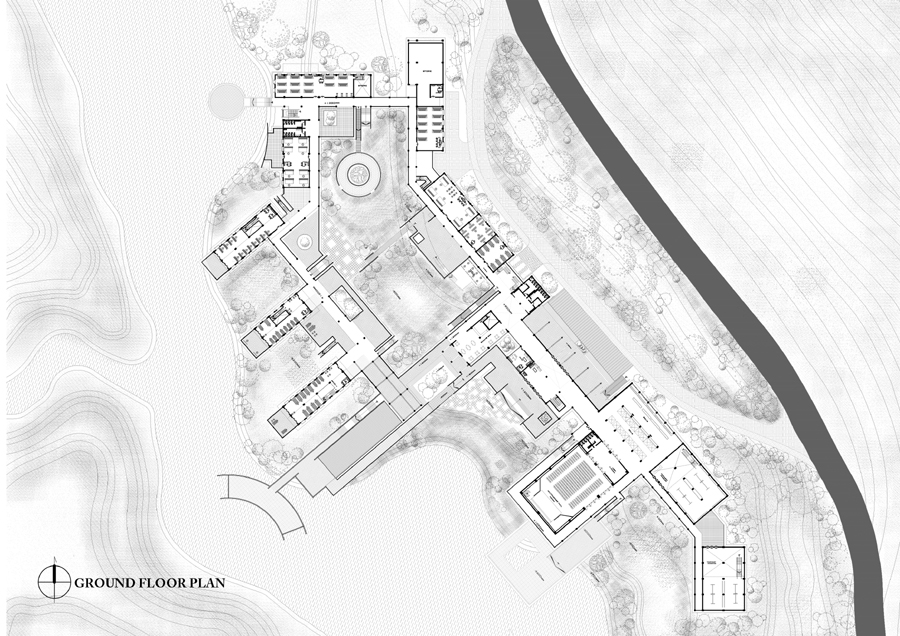
The proposed facility is designed for the preservation, promotion and proliferation of traditional handloom industry of Chittagong Hill Tracts. The project is sensitive to rich cultural identity of the tribal people and aims to contribute in sustainable living practice in the south-east region of Bangladesh. It also aims to promote local tourism and empower the local community by offering training and life skills.
Housing typologies at Chittagong Hill Tracts
Bangladesh Small Cottage Industries Corporation (BSCIC) provides support services to indigenous craft including weaving industries. Rangamati Handloom, specially Kamar Tant is amongst the most important traditional crafts which is under threat of extinction. One of the aims of this project is to preserve these traditional crafts by transferring the knowledge to the youths through training and awareness program.
Usually a raised platform containing open and semi open terraces is the common feature of the tribal houses of hill track areas. The houses are constructed of local materials such as bamboo, wood, grass, and these materials are abundantly available in the hilly areas. The settlement pattern is eked out of the natural settings and contour characteristics of the hill. Therefore, most of the houses are organized along the pathway, creating linear settlement patterns. The varied size pathways create scopes of gathering and activity spaces for the inhabitants. Veranda and decks are aligned to the pathway and oriented towards the natural view.
Surrounded by hills and a narrow channel of Kaptai lake, the proposed site is gifted with a scenic view of nature. The project is designed consciously to celebrate the nature. The design and layout of the proposed facility respect the topography and other natural features of the site. Conceptually, this design approach is not divergence to its nature and appraises vernacular method of building and construction.
Further, the valley is 1800 feet above sea level so that it holds more humidity. Considering comfortability, all the walls are designed as perforated and roof section is kept open toward wind directions for cross ventilation.
Building materials of this project are chosen carefully respecting the local tradition. The bamboo walls and posts are set on concrete base for longevity. Joints are made of steel so that any replacement of bamboo set can be made easily. Extended roofs are supported by inclined bamboo poles for preventing driving rain water.
The production spaces for fabric are very simple. Traditionally, local people use their courtyard, or any enclosed area as outdoor working spaces; and indoor works are mostly done in their veranda or semi-shaded spaces or on their raised platform, known as macha. The proposal adapts this practice into design and has envisioned production spaces of similar nature.
Amongst the various categories of loom, this project is mainly focused on Handloom, Power loom and Kamar Tant. In order to increase the efficiency of production, research lab, classrooms, training facilities and workshops are provided to explore and innovate extensive opportunities to make best use of these crafts to a wider extent of possibilities. Apart from all these training and research facilities, there are designated spaces for exhibition, multipurpose activities, sales and display. These facilities will aid to trigger the engagement of the tourists with the local craftsman.
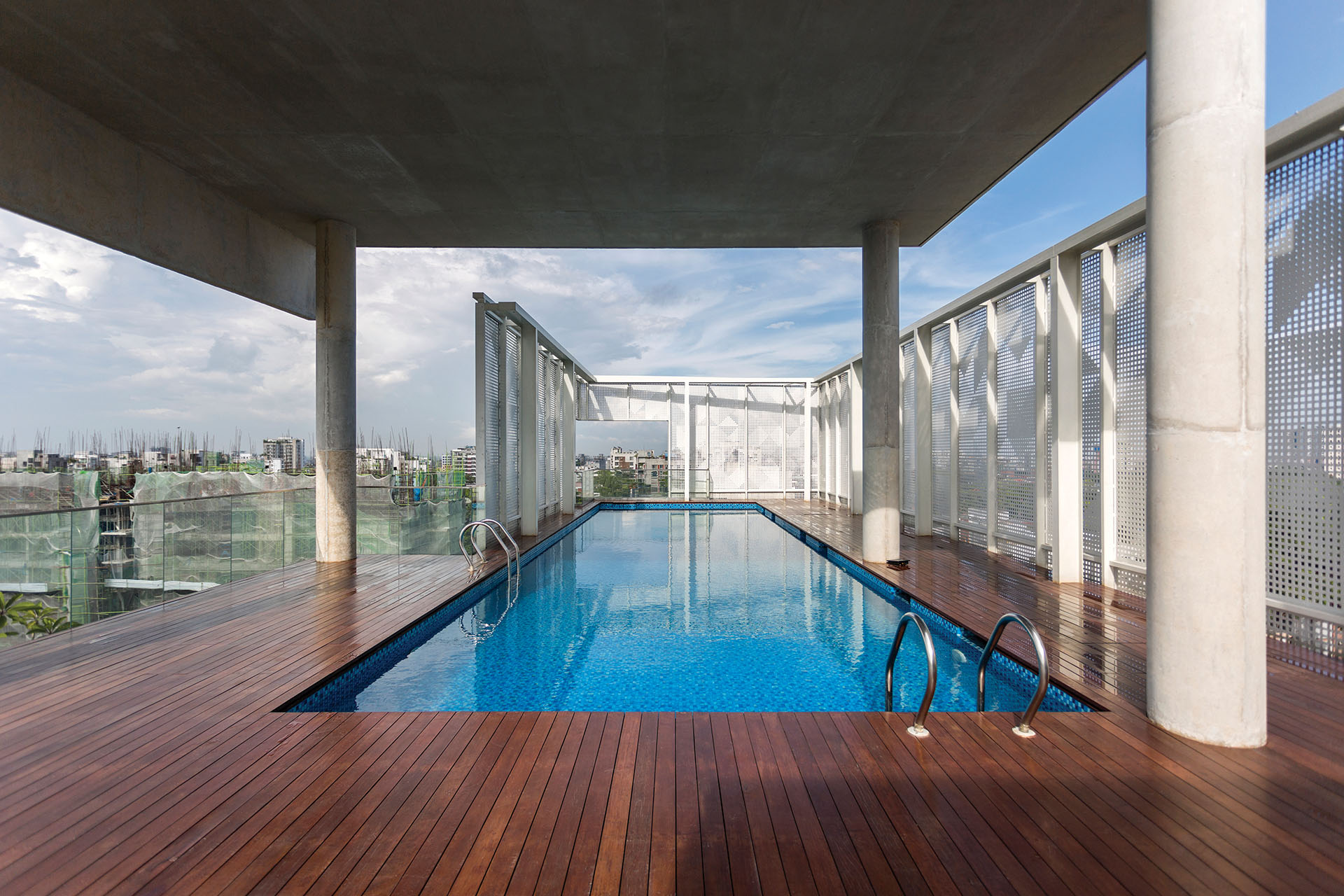
The client, namely Eastern Housing Ltd, considered this project as their most premium luxury development. The land was purchased at a very high price and it is situated in the most prestigious and exclusive part of Gulshan. It was emphasized that the project should be one of the landmark projects of EHL‘s new branding as one who undertakes high end luxury developments along with their mid-range and low- range projects. The high cost of the land also demanded that the quality and pricing of the apartments be exceptional to allow the project to be financially viable.
The client did not restrict the building within any particular typology, which allowed us to explore the opportunity to ‘break the mold’ of the typical residential buildings of Dhaka inspired by an unorthodox and innovative idea. However, the narrow, linear parcel of land presented formidable challenges in designing spaces and services.
An essentially modernist approach brought us to design residential units with clearly defined shared spaces and private zones. The ‘extrovert’ and the ‘introvert’ zoning of the plan are translated and reflected into building aesthetic. The building with slender proportion evolved as two definitive shells: one being a glass box at the north hosting the public and entertainment zone, namely the living, dining and TV lounge; and the other the screened box on the south hosting the private zone, namely the bedrooms. Large facades of glass using curtain wall at the north elevation creates dialogue at the urban scale. An ‘island’ of services comprising a store room, kitchenette and powder room separates and screens the private zone from the public.
A single large verandah gives each apartment a generous outdoor space for relaxation and fresh air. The kitchen is at the far western corner creating the only solid mass made of finished concrete.
The base challenge was to introduce curtain glass system in a formidable scale for a residential building in a context like Dhaka. The transition and termination were carefully handled both during design detailing and execution.
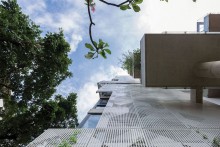
The screen façade was another part where cutting-edge technology were introduced. Apart from the basic paneling system a lot of thought was given behind the fixing technic and installation. The pattern was also formed through a parametric design process where the patterns for each panel were set from simulation.
However, constraints were evident with the unconventional dimensions of the site, with a long façade with much lesser depth and apparently very narrow façade with elongated stretch created challenging scenario for achieving standard solutions.
The target was later achieved through simplest solution by dividing the spaces into 2 to 3 zones arranging along the circulations. Instead of having segmented hierarchy of spaces the planning was done through a layered hierarchy. For some parts, the planning might reflect on the living pattern.
Our intention was to build a new image where the contextual pre-requisites of residential building was questioned. We emphasized to the developer to pitch the apartments to the buyers as a choice of lifestyle. In using unorthodox materials and planning we pursued our intention of designing an experimentally innovative residential building.
The 23rd Executive Council of IAB is delighted to announce that, a Student Awards Program is to be introduced from this year ‐ 2019. IAB is happy to have KSRM‐ a leading steel manufacturer of Bangladesh, as the sponsor for this noble initiative. In the name of “KSRM Awards for the Future Architects”‐ in association with IAB, is intended to recognize the best thesis/final projects of the graduating students of IAB accredited architecture schools of Bangladesh, to honor the studio teachers, the schools and to showcase the selected exemplary thesis/ final projects of the architecture schools.
Students who have completed their final year thesis or project within the last one year and short listed by their respective schools of architecture are eligible to participate in this Award program. Each school would be able to submit maximum 3 (three) projects in each award cycle (from July to June of the calendar year). The Award program shall be held once in a year, beginning from 2019.
IAB is now calling for entries from the architecture student community to design an appropriate Logo in the name and style “KSRM Awards for the Future Architects” for the aforesaid program that embodies the spirit of the event and creative potential of the graduating future architects.
ELIGIBILITY
Any current student from IAB accredited B. Arch programs of Bangladesh
(Individual submission)
SUBMISSION
Saturday, September 14, 2019
Submission ONLY through email to: logocompetition.iab.2019@gmail.com
Jpeg/Pdf version of each proposed logo with Design Concept in one A4 size file
(Concept in not more than 200 words) not more than 10MB in size
A copy of valid University Student ID (both sides) attested by Head of Department
A copy of the filled up Declaration Form with signature
AWARDS
1st Prize: Tk. 25,000/‐ and a Certificate
2nd Prize: Tk. 15,000/‐ and a Certificate
3rd Prize: Tk. 10,000/‐ and a Certificate
RULES & REGULATIONS
Participants can only submit individually.
Any participant may submit maximum 3 entries separately.
An entry may be disqualified if:
The eligibility requirements, submission requirements and submission deadline are
not followed.
There is any attempt to influence the decision of the Jury.
PANEL OF JURORS
Ar. Ehsan Khan Vice President, International Relations, IAB
Ar. Mamnoon Murshed Chowdhury, Vice President, National Affairs, IAB
KSRM Representative
JURY’S DECISION
The panel of Jurors reserves the right to select the winners of the competition. The
panel has also the right to decline to choose from any submitted proposal if deemed
NOT UPTO THE STANDARD OF EXPECTATION.
By participating in the competition, participants confirm their acceptance:
to the guidelines & regulations of the competition as specified above and the decision
announced by the panel of Jury.
to incorporate the suggestion from the panel of Jury to improve the proposal to
qualify as possible winner/s.
The proposal of the 1st WINNER shall be accepted to be used as the official Logo of the
Award program with necessary revision according to the suggestions from the panel of
Jury.
The result will be announced on a suitable date after the jury session is over.
For any further inquiry please contact:
Ar. Arefeen Ibrahim MIAB
Competition Director
Email: mail@iab.com.bd
IAB Centre, Plot 11, Block E, Road 7, Agargaon, Sher‐E‐Bangla Nagar, Dhaka 1207
That man behind Louis Kahn is Imhotep- architect of ancient Egypt.. while making the model of Bangladesh’s Parliament Building Kahn fall asleep…and in his dream Imhotep came and pressed his shoulder and encouraged him.
Disclaimer: This is an original storyline and artwork. Do not publish, copy or alter the art work without the permission of the artist .
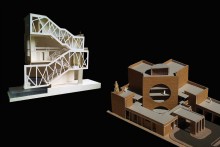
The following student projects are the examples of two residential buildings designed to meet specific purposes and user needs. The context for the first project is urban with strong historical significance and site forces. In contrast, the second project is situated in a relatively green field context (suburban university campus) and designed primarily for the visitors (guests). However, both the projects deal with natural light but take different approaches which makes it particularly interesting to read.
SHOPHOUSE AT OLD TOWN | Md. Asifur Rahman ( CUET)
The proposed shophouse is located in a narrow plot of 15’ by 50’ in the Old town of Dhaka. The site is neighboring with 5 and 6 storied building on the east and west side respectively. The house is designed for a single family with a shop at the ground level.
Shophouse, in simple terms, is a specific building type that combines dual function i.e. residence and commerce in a single building unit or plot. Typically shop, workshop or other type of trading functions is located on the ground floor and living quarters on the upper floors. Shophouse is the generic typology of historic settlement of Dhaka. Traditionally, the shophouses provided opportunity to live and work in the same place and created active street frontage by attracting visitors.
Considering the site constrains, this idea project has an emphasis on vertical organization of spaces and their connectivity. To keep consistency with the historic urban fabric, the shop is located at the ground floor facing the street. Living functions are vertically distributed in a sequence of semi-private to private functions. The connection is made through a straight run stair weaving the functions at different levels. The project gets over the challenges of cross ventilation and daylight penetration by creating inner light well and centrally located double height space.
GUEST HOUSE AT UNIVERSITY CAMPUS | Md. Raihanul Hai (SUST)
The University Guest House offers short-term accommodation for the invited guests or visitors. The site of this project is in the existing guest house area of Shahjalal University of Science & Technology, Sylhet. The basic program includes 20 bedrooms for the guests, waiting room, dining facility, kitchen, library, recreational room and rest room. The guest house is four storied having wall-slab structural system.
As it’s a guest house project of a university, there should be a great concern to facilitate the guests with the best pleasant environment. The first impression of a building is very effective to connect the person with the building psychologically. If that impression is gained properly, then raised the desire to explore more or stay there. So that, my very first concern was to attract & connect the people with the building at first sight. Then after the entrance, all the other spaces will be pleasant with the game of natural light & shadow.
Following Louis Kahn’s notion of “structure is the giver of light” , the idea project strives to create an interplay of light and shadow. The expressions of wall-slab structural system are tried to achieve through the brick arches, circular punches in brick walls, rows of thick load bearing brick walls extended from the concrete slabs to give the true expressions of materials. The circular punch makes the connection between the people and the building.
A courtyard of water tank forms the core of the building. The horizontal circulation is provided around this central space where the guests can spend quality times reading books or interacting with each other. The vertical circulation is designed with a single sculptural staircase. There is also a small backyard for the guests who want to have some time of their own.
This memorial complex is proposed to commemorate Comrade Moni Singh, a preeminent Communist leader in greater Bengal. He was the mentor of the Tanka/ Tonko and Tevaga Movements and founder of communist party in pre-independence Bangladesh (the then East Pakistan).
Timeline of political life of Moni Singh
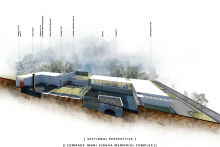
The monument is purpose-built to create an experiential journey for visitors. Spaces are articulated to portray Moni Singh’s revolutionary political life during pre and post-independence of Bangladesh.
Moni Singh’s political life spanned across British Period, Pakistan Period, Independent Bangladesh Period. His contributions in each period is showcased through a system of spatial zoning. In their journey to the memorial complex, visitors first come across Moni Singh’s early life and political movements during ‘British Period’. The journey then continues to the next zone featuring ‘Pakistan Period’ followed by the ‘Bangladesh Period’.
Moni Singh was a leader of the proletariat or working class. He stood for the rights of the farmers and peasants and devoted himself to bringing about revolutionary changes in the society. The farmers live entirely from the sale of its labour and does not draw profit from any kind of capital. Their sole existences depend on their hard labour in the paddy fields. In these senses, the paddy fields are the determinants of the farmers weal and woe, life and death. Hence, this project interprets the communist ideology through the patchworks of agricultural landscape.
The design takes help of metaphor to symbolize the important communist movements led by Moni Singh. During the colonial British period, the most significant movement led by Moni Singh was ‘Tonko’ Movement which was initiated to ‘protect rice’. To symbolize ‘Tonko’ Movement, an outdoor space with a large tree at the center surrounding by a semi-circular wall of inscription has been designed.
Another significant movement led by Moni Singh was Tevaga Movement. According to Tevaga laws, Zamindars took two parts of the cultivated crops as revenue and give only one part to the farmer.This unjust exercise of power oppression is symbolized through a tiny red block compressed in between two overpowering black blocks.
The transition from ‘Colonial’ to ‘Bangladesh’ section is guided through flights of descending ramps and steps that represent the nation’s struggle for independence. The journey finally ends up to a vertical structure rising with pride to a total height of 60 feet. As the structure is partially submerged, at the foothill of the tower, the visitors will find themselves isolated from the material world largely built upon capitalist ideology. Thus, it offers a renewed perspective of an independent communal Bangladesh where equal rights and opportunities for everyone in the society are favoured.
Further, water is used to imitate the deltaic landscape of Bangladesh as well as a guiding element. Water channels and the sound of water flows guide the visitors to the end of journey- a terminal place to evoke a sensual emptiness that reminds the absence of Comrade Moni Singh.
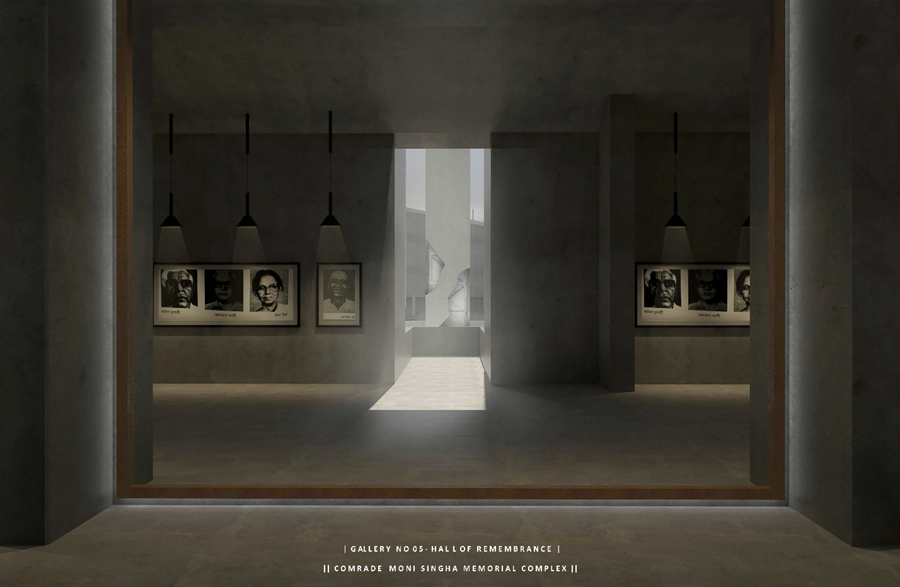
The complex also includes a museum. The museum block has 5 galleries: Gallery 1 -British period, Gallery 2- Pakistan period, Gallery no 3- War’ 71 period, Gallery No 4- Independent Bangladesh and Gallery no 5 is the Hall of remembrance.
The proposal “Chennai Chooses” was one of the three special mentions by the jurors in the design competition Designing Resilience in Asia (DRIA) 2019 and was appreciated for the social innovation. The annual DRIA international design competition encourages foresighted urban and architectural design proposals, as well as promotes innovation in building technologies to ensure a specific community’s resiliency particularly prior to and during a disastrous event. A different community in Asia is picked every year as the competition’s test site through careful joint research. This year the event was organized by Department of Architecture, National Cheng Kung University (NCKU), Taiwan and the international competition took the theme of “GROWING CITIES, SHRINKING WATERS: Re-think the growing Chennai, Re-imagine the shrinking Pallikaranai marsh.” The proposal was presented before an international jury board including- Oscar Carracedo (Director,DRIA International Research Programme), Sean C.S.Chiao (President, Asia Pacific, AECOM), Brian McGrath (Professor, Urban Design, Parsons School of Design), Chang Ching-Hwa (Founding partner, Bio-architecture Formosana), Renee Y. Chow (Chair, Department of Architecture, UC Berkeley), Huang Sheng-Yuan (Founding partner, Fieldoffice architects), Ranee Vedamuthu (Professor and Dean, Anna University, Chennai).
In 2015, Chennai made the headlines of the international media after it faced one of the most devastating floods in Indian history. At the same time, India saw its first crowd sourced flood map, a map that took information from people to mark inundated roads and relief centers. The history of Chennai shows an intimate relation between the people and their surroundings. But in the process of rapid urbanization people lost the feeling of ownership to their city which resulted into societal reluctance. The city wide development plans could be much more spontaneous and efficient if people participated in the design process.
This idea sparked the inspiration to create a mobile phone application where people can come together and actively participate in city decision making. A platform has been proposed which will empower people and put them in the driving seat, a platform where Chennai chooses.
A comprehensive interface will guide users through three different scales where they can participate. In order to achieve a resilient city resilient homes are the first step. Therefore, the process starts from home and follows a bottom up approach.
In the Your Home section, the interface will show the user three options. Garbage, rainwater and soakability.
In the Garbage option people are shown how they can participate in the overall waste management system by sorting their household trash.
In the Rainwater section a user is shown the ratio of rain water to ground water consumption. The interface takes information from user and calculates the capacity of the rain water tank.
The Soakability section shows the ratio of hard surface to permeable surface in a household. A user can increase soakability by rooftop and lawn gardening, vertical farming, etc. People’s participation in the home scale will be rewarded in cryptocurrency which can be used to attain everyday commodities.
In the Community section the user will find the ongoing projects in their locality and the prospects of those projects. The users will get to up-vote and down-vote the projects and choose from different options provided to them by the designer.
As a model community, the Pallikaranai area has been taken and the design strategies proposed interventions in this community has been shown through the interface.
The first intervention is the proposal of reviving the nearby Buckingham canal edge where the programs of the public spaces will be generated by crowd source data to create spontaneous activity zone. The city will act as a backdrop and the architecture as an accessory to bring the landscape to the foreground and reengage the people with their surroundings.
The next intervention is the Dump Park which will be situated at the Pallikaranai marshland. The perungudi landfill, at the heart of the marshland has reached its capacity and a Government proposal for a waste to energy plant is in place. The idea of integrating a public space with a WTE plant has been explored here so that the people of the nearby neighbourhoods can be aware of the waste management process that started from their household by sorting their trash. An uninterrupted walking trail is proposed to conserve this the marshland, one of the last remaining wetlands of Chennai.The waste to energy plant is connected to the walking trail and accommodates public activity on the roof thus the architecture facilitates an uninterrupted flow of nature.
Next a sponge park is proposed where the community parks can be transformed into rain catchment basins. These parks will act like sponge and absorb excess rain water and recharge the level of ground water. These parks will serve differently in dry and wet seasons.
Apart from these proposals, increasing permeability of the streets with the help of permeable paves and layers of vegetation can add to the water system.
The example of Pallikaranai can be treated as a pilot project to be replicated around different points in Chennai. The city option of the app, shows the scope of replication of the smaller design interventions around the city, in a larger scale.
Under this section the first proposal is a city wide sponge system where the percentage of hard surfaces are reduced both in home and community scale to start forming a city wide network.
The second proposal is the transformation of the Buckingham canal edge by replacing the flood wall with a natural slope or berm. This can increase the infiltration of the soil and the over flow of flood water can be slowed with the help of a vegetation layer.
The Buckingham canal can be divided into four zones after examining existing land use, activity pattern and natural advantages. In each zone a variety of activities are proposed from which people can choose and which will form the future image of the city.
Similar to the canal edge, the riverfront can be retrofitted with a plantation buffer which will help the rivers to grow
The garbage network that has been proposed in the pallikaranai area, can be replicated and effectively applied in various other points across the city
Taking note from Chennai’s past the future growth of the city will be directed towards landscape oriented development through crowd sourcing.
This platform will inspire Chennaiets to raise a wave of brainstorming regarding their city. As a result the city will start to think for itself and learn how to make the best use of its work force to solve its own problems. Inclusive and transparent collaboration among all stakeholders will pave the way to the future vision of Chennai, a future where Chennai will choose to be resilient.
In my childhood I used to think that only the people who were going to die had to do X-rays. At that age, death was not thought provoking to me; the only concern was if any close one got X-rays, I could have a chance to play with them. Now X-rays make me anxious because of knowing the reasons of them. These X-ray plates are from very close ones of mine, from- my father, grandmother and friends. Reasons of doing these aren’t very pleasant memory now. I tried to express the emotion and motives of these lifeless X-rays by adding something very much natural that will complement the reasons and character of those organs and tell us a story.
Fahmida Hossain is inquisitive to explore the artistic side of Photography and Visual Arts. She has completed Bachelor of Architecture from Bangladesh University of Engineering and Technology (BUET) in 2018. In her undergraduate, she was one of the member of BUET Photographic Society (BUETPS). Through her photographs, she likes to express the emotions in human life and provoke thoughts in viewers’ mind.
The project site is at Banur Bazar, Bhatiyari located not far from the central Chattagram. It is situated beside the Dhaka – Chattagram Highway and very near to the Bay of Bengal. There was a humble and modest village home in the compound with a large open front yard and orchards of Jackfruit, Mango, Coconut etc. trees. This village home holds many pleasant memories of the client; however, the client requirement was to build a new house to meet the growing demands of the extended family members.
The client is a decedent of traditional venerable Muslim family. The new house is designed for three brother’s family and their parents for joint living. There are three independent units for three brothers and their families. The ground floor remains for the parents and common uses.
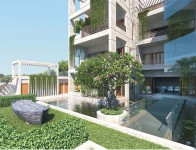
Spaces are articulated to enrich the sensory experience and celebrate the life in six seasons and festivals. For this, the main intention of the design is to create good indoor-outdoor relationships with its natural surroundings providing different framing experience. The building covers 24.64% of the total land area and the rest of the area is left undisturbed for green and breathable space. This large space represents culture of “Uthan” and is reclaiming children play space. The entrance is desperately elevated to create the fantasy of walking over the transparent bridge across the reflection pool with Plumeria flower (Kath Golap) pebbles, local water-plants, sunken steps and fishes. The reflection pool flows into the interior to create the “place of contemplation“. The journey from outdoor to indoor led by reflection pool, transparent bridge and the Plumeria flower tree evoke a romantic and refreshing user experience.
The building is designed with prominently large terraces and verandahs, which create a dialog with site surroundings and buffer from external environment. Green creepers and plantation provide environmental benefit and ensure the privacy also.
The south and south-east façade are designed to bring cool breeze in during the hot, humid summers and the warmth of the sun during the winters. The central water court acts as a natural exhaust filtering system, allowing hot air to escape and making the middle court a cool sanctuary.
This architecture offers an inspiration of fresh new lifestyle with their traditional bonding. In another way, it could be considered as the cross point of modern and natural life which can be perfectly compatible with each other.
About the Architect’s office:
SANMAR Interior & Architecture was formed in 2014. This very young but promising firm is now evolving with various types of projects such as residential, commercial, industrial, institutional, hospital and of course with various interior design & execution both in Dhaka and Chattogram.
Everyday we use numerous products. We get to see diverse products while visiting a shop, but only pick those we need, fit our requirements, meet the ergonomics of our body and match the expected price. The featured works by the Architecture students of CUET demonstrate the creative process of product design involving brainstorming of ideas, making prototype and testing.
As a part of their design studio project, students from Chittagong University of Engineering & Technology (CUET) have made a few essential tools for daily life. Like backpack, travel bag, chair, foldable rack, Study table, Kitchen spice holder/ jar, Foldable workstation for the carpenter, Clothing rack with an Iron Board. They are second-year architecture students from CUET. These products were made under the supervision of Faculty member Nusrat Jannat and Amit Imtiaz as a part of the design studio. Aim of the studio was to understand human ergonomics in relation to the product we use in daily life.
One of the team came up with an idea of a bag for architecture students. Named “Three Pocket Bag” one can carry the essentials in three separate pockets. The upper one is used for Lighteraccessories like pen, pencil, Drafting pen, cell phone, tab, shades, built in the USB power bank. Middle one used for the sketchbook, set square with triangle shape sleek pocket, and a triangular scale chamber. The third one is used for a laptop.
On the upper surface, it has an integrated cutting matt hidden under a secret zipper. For rain protection, there is a small chamber for rain cover at the bottom of the backpack. The backpack can be shrunk with the help of a button if a laptop or other things are not carried.
The backpack fits the basic human dimensions. It got a detachable neck pillow above the bag so one can rest when tired. It will cost 20$ someone to have this backpack. This backpack was designed by Anushila Roy, Faria Matin & Sidratul Muntaha.
Another group came up with a travel bag design that fits the ergonomics of a travel backpack. The main idea was to make the backpack portable. It is divided into three detachable parts which make the bag as a whole. One small camera bag attached atop a laptop carrier and one blazer or clothing carrier works as a support for carrying all the three.
If one only needs the camera bag or the laptop carrier or the clothing backpack they can carry any one of them. They are easy to detach or attach with the help of straps. This backpack is easy to use as it fits very well.
It can be used as a backpack for office or class purposes. But when you are on a tour, this backpack suits one for a perfect holiday companion. Making cost for this bag was 25$. The bag was designed by Jannatul Naim Ismi, Retika Biswas & Radyah Nizam.
Another notable project is the golden rectangle study table with a chair. The group designed a table with a top which is an exact golden rectangle. The table top was divided as the golden rectangle proceeds. There are two hidden drawers accessed from the top of the table, one for keeping things with quick access and one for the electrical socket for charging and plugging in. There is a box at the end of the table for hiding a lamp.
The drawers can be operated using a human finger. The table top is made with processed wood and the feet were made with old iron pipes. T-joints and flanges used for joints and ends. This product costs 80$. The product was designed by Jannatul Ferdous, Nazia Zaman & Upama Talukder.
During their jury, all the group presented their idea with drawings and practical models in front of external juries. All the designs address the basic human-centric ergonomics. Students developed the ideas in the studio later worked in the workshops to realize the products. All the products were later exhibited and kept for public viewing. Studio mentor Amit Imtiaz quotes, “In the studio, we experimented and searched for human anthropometry in a different way. We made numerous models to see how it works. It was really satisfying to see how the design has evolved through the process of trial and error ”.