
World Environment Day 2026
Urban [Re]Stitch
Sculpture House by Cubeinside
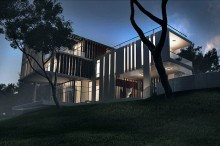
From the Architects :
The beauty of an intelligent design scheme lies in its invisibility, this core idea works behind the formulation of each design by Cubeinside team. The principle aim of this plot is only to preserve and perpetuate beauty in its natural form of drama and picturesqueness- to give the landscape room to grow into a living space. Sculpture House in Gazipur, this vacation house is designed for a family of 7 people which is located at Islampur, Gazipur –a sub urban/industrial area near Dhaka. The 4 acre site has a plenty to offer for a placing a vacation house, where the final location of the building mass was selected in such a way that it could get the highest exposure to the surroundings and also creates a sense of authority over the site, which was a primary concern of the client. The project was named Sculpture House, as the client’s idea was to create a vacation house having a lot of sculptures around it, to make the line thinner between reality and imagination.

To draw the most out of the surrounding micro climate, a simple rectangular mass was drawn by the Cubeinside team which is elongated towards east–west, ensuring the highest north–south exposure. Several smaller masses were added and subtracted as well to articulate the mass, as well as to create a fine balance of solid and void.


Climatic responsiveness was considered as the other primary key which is also adds value to the aesthetics. Framing the views of the site has also been thought very carefully.

Poetry, expediency, context and economy are employed in combination to retain the nature of the site and grow the design interventions on it naturally.


Project Team:
Lead Architects: Ar. Khandaker Ashifuzzaman, Ar. Shakhawat Hossain Rocky, Ar. Ahmed Firoz Ul Hoque Robin, Ar. Sharifuzzaman Sajal.
Associates: Arifuzzaman (B.Arch student, BUET), Tazrin Islam Ananya (B.Arch student, BUET), Ahmed Yousuf (B.Arch student, BUET), Ishtiaq Hossain (B.arch graduate AUST)
Narrator:
Ar. Md Shakhawat Hossain Rocky, Ar. Tabassum Zarin


Architecture Admirers
Houdini
Dhaka Bishwa Biddalaya Shadhinota Sriti Shoudha
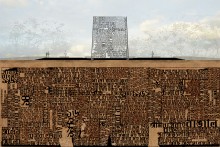
From the Winners
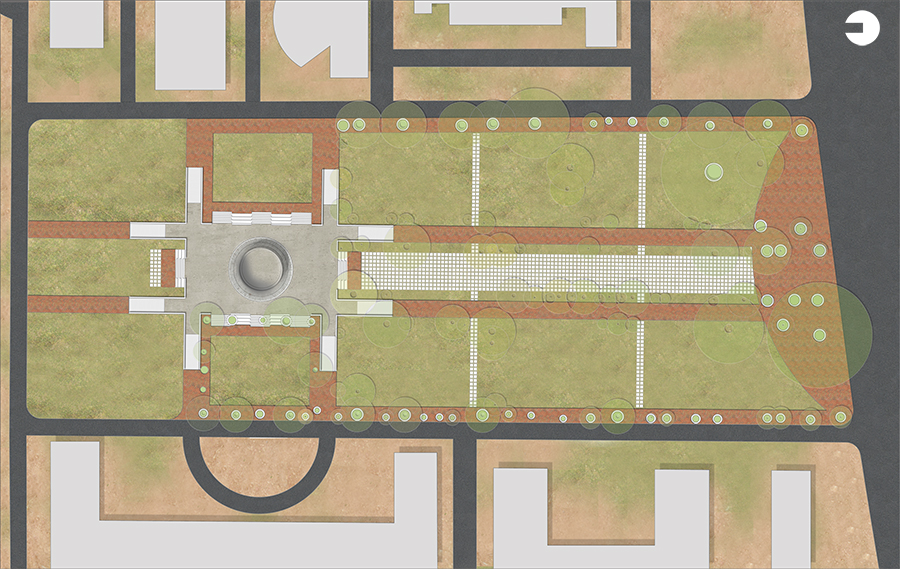
The monument “Shwadhinota Sriti Shoudha” (Liberation Memorial) for Dhaka University is designed to show homage to the Martyred Intellectuals for the sacrifice they made in Liberation War of 1971. Since its establishment, Dhaka University has played a vital role to encourage the whole nation to protect humanity by their leadership and knowledge. And of course, the largest sacrifice made by them was ‘knowledge’. They lost a number of unparalleled intellects in the war. So the design is to create a knowledge square to recollect their memory and to convey their message to our future generation.

We tried to make a monument that is enough informative of its thought itself, which is enough futuristic and unique to match with the choice of the upcoming generation, and of course which merges with the given site of mall area nicely. We tried to minimalize the disturbance to the nature and circulation of the site. In height, material and expression of this monument we tried to achieve the vibe that has given spirit to the fighters at that time and to make a connection bridge to the upcoming generations with the fighters’ souls.
Jury citation
This proposal captures the spirit of the “Dhaka Bishwa Biddalaya Shadhinota Sriti Shoudha” with minimal intervention into the mall site. The form and material of the monument is novel, futuristic and has the potential for cognitive engagement with the viewers for generations to come. The jury strongly feels that this monument design be built be built and has the potential to become a national cultural asset.

However the jury feels that some modifications will be necessary to fine tune the project by adjusting the height of the tower in relation to the base and the base needs to be significantly toned down and made simpler. Of the three projects selected by the jury, this is the only project that fully complies with the TOR set out by the host university.


GHORAMI.JON Makes Their Mark in ASF Award 2015
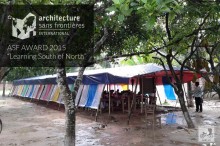
Once again Bangladeshi young architects got recognition at the global arena for their social contribution through architectural practice. Ghorami .Jon, activist architects, won the Architecture Sans Frontières (ASF), 2015 Honorary Mention award for their ‘Transient Classroom for Singra Ramkrishnapur Girls High School’ project.
Architecture Sans Frontières International (ASF Int), in partnership with the South of North network, offered an award to honor the architects creating effective solutions to social, environmental and economic challenges facing the built environment. The goal of the award was to promote and reward those initiatives or practices which will encourage an exchange of ideas and challenge the profession to develop “more inclusive, participatory, relevant, accessible, equitable as well as sustainable” construction of social facilities and infrastructure for the benefit of the most vulnerable sectors of the world’s population. Of 68 submissions around the world, Ghorami.Jon made their mark in the award list.
The three winning projects were: SPACES FOR PEACE from Venezuela and LA PASSERELLE from France won the award for ‘Social Production of Habitat’ and BUILDING TRUST INTERNATIONAL won the award in ‘Challenging Practice’ category.
Congratulations to the award recipients and specially Ghorami.Jon for contributing to the betterment of society through their inspiring and insightful project.
Click here to read more about the winners and honorees of the ASF 2015 Awards.
Dialogue Between Land and River _Cultural dais for Nomads of water (Bede community) | BUET

–
In Bangladesh the Bedes are an ethnic nomad community that has existed for more than 1000 years. In the 17th century, they followed their king Ballal Raja on the waterways from present-day Myanmar to Bengal. Over the course of time, they have become Muslims. They travelled to various regions of Bangladesh and Assam. The Bede themselves are convinced that their community has Arabic roots and that the name “Bede” was derived from the Arabic word “bedouin”.
–

–
They earn their living by selling cooking utensils, self-made seashell and pearl trinkets, fish, spices, and medicinal herbs. They perform animal shows in which they also produce magical tricks and act as fortune tellers and snake charmers. 8 to 10 months a year, the families predominantly live on boats or in tents and tour diverse regions of Bangladesh along the waterways.At the beginning of the dry season they return for a period of roughly two months to a permanent settlement.
–
–
During the last 5 or 6 years more and more families have permanently settled down in land.Their ways of earning a life has changed too today, some Bede exclusively live on boats anchored at the shore while more and more have settled down on land. Thus, by and by new building types have developed out of the boat roofs that were formerly only temporarily placed on land.As basic types; two particular forms can be identified. On the one hand, there are the original boats, and on the other cubic forms that hardly differ from the typical self-built (corrugated iron) huts in Dhaka’s settlements of the poor. In almost all versions, there is a platform superimposed on supports.The construction of these platforms has been adapted from boat construction.

–
Some special types are scattered amongst them which is partly due to the fact that some families own both a boat and a hut. In many cases bamboo and other cheap materials such as plastic sheeting and textile fabrics have been used as building materials. But today, this traditional rhythm is changing. Bangladesh suffers increasingly from the consequences of changing weather patterns.


–
In the last years, unpredictably heavy rainfall has alternated with dry periods. And the waterway network, consisting of rivers, tributaries, and channels, that comprises 7 percent of Bangladesh’s area and has existed for centuries, is now changing too. Of the original 24,000 kilometres now only 16,000 kilometres in the wet season and no more than 6000 kilometres during the dry season are still navigable. The increasing pollution of the water –make travelling on the rivers increasingly dangerous and partly even impossible. While at the beginning of the 1990s all Bede – 1.5 million people – were living on the water, in 2002, only 800,000 of them still lived there, and their number had decreased by further 250,000 people by 2009.

–
9 major clans of Bedes
1) Mal(Kabiraj)(healers) 2) Sapuria,(snake charmer) 3) Shandar(pearl collectors) 4) Toula or Bandarwala,(perform Monkey show) 5) Bazi-gar,(perform magic show) 6) Mirsikari(prevent the evil spirits) 7) Boiral(fishing community )8) Kurindar(pick up lost valuable goods ) 9) Gain(sell betel leaves)
—


–
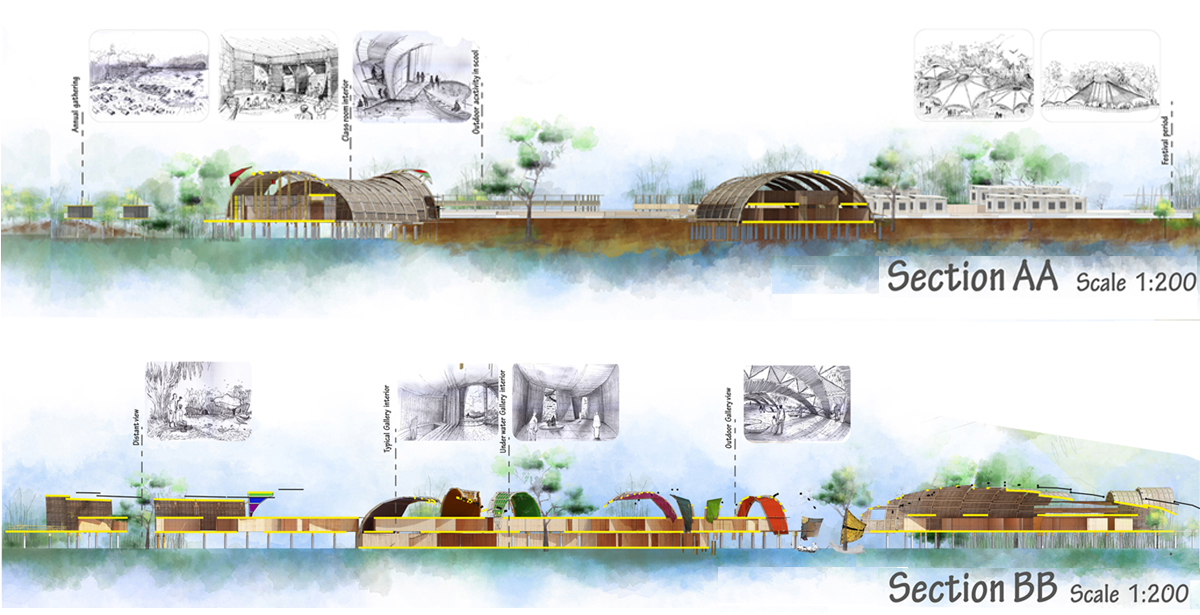
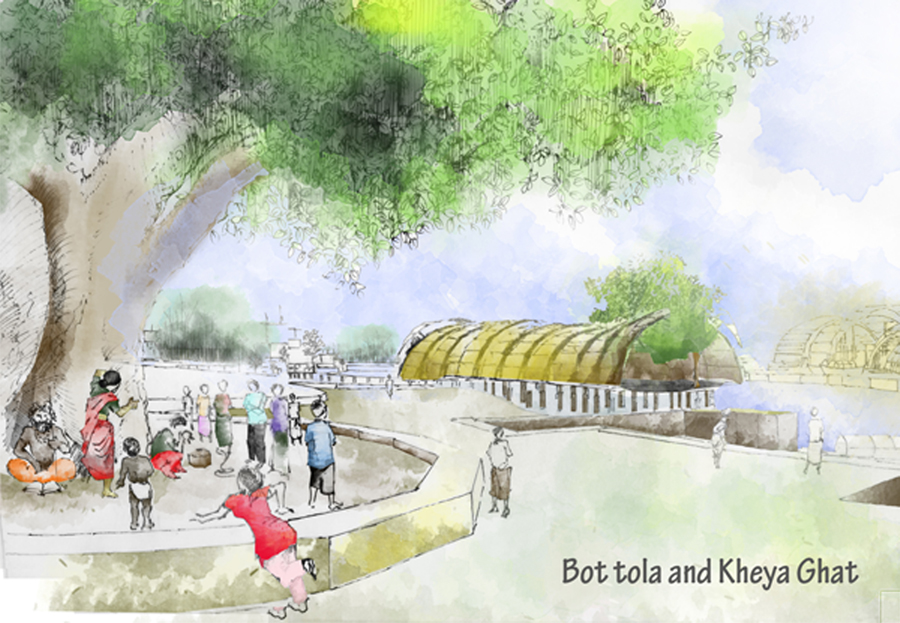
This is a hypothetical project and site is proposed in Louhojong, Munshigonj as they have been living and gathering here for decades.There is an existing Bede Village adjacent to the site where they gather for 2 months and celebrate their marriages, funerals and other festivals. Effort is given to draw the attention of Ministry of Cultural Affairs Govt Republic of Bangladesh to ensure preservation of the cultural heritage of such ethnic nomadic community. And thus, a dais is proposed where a dialogue can be held between nomadic and mainstream sedentary community and minimize the conflict of identity.
There is a constant conflict between Nomads and mainstream sedentary group.Where Nomads have freedom to move anywhere, creativity to adopt changing situatuion as well as multidimentionality, sedentary people are confined to locality like couch potato.Where nomads go with nature, sedentary people restrict the flow in nature. So there is a constant conflict in between these 2 groups. The main goal was to minimize the gap and bring them to a dais having lateral learning and dialogue.


The Atghar-kuriana Floating Market | AIUB
The southern region of Bangladesh is beautifully adorned with numerous rivers, canals and boats. Pirojpur and Jhalokathi these two districts from the southern part are also blessed with the mercy of endless water-site.
Due to the low land topography of these areas, cultivation of guava is very common and popular phenomenon there. Atghar-kuriana from Swarupkathi thana is an important site, among the few important guava cultivation point of that area. For quick and feasible transport, boat is a principle medium for collecting and selling guava in a whole sell scale. That is why this place is well known for the floating market of guava. Local people named it “Noukarhaat”. Native people of this area highly rely on this occupation along with occupations such as fishing, business, and boatmanship. The challenges that farmers facing here are it lacks proper communication and infrastructure including pontoon/dock , cold storage facilities to serve this guava business which results in only poor market price.

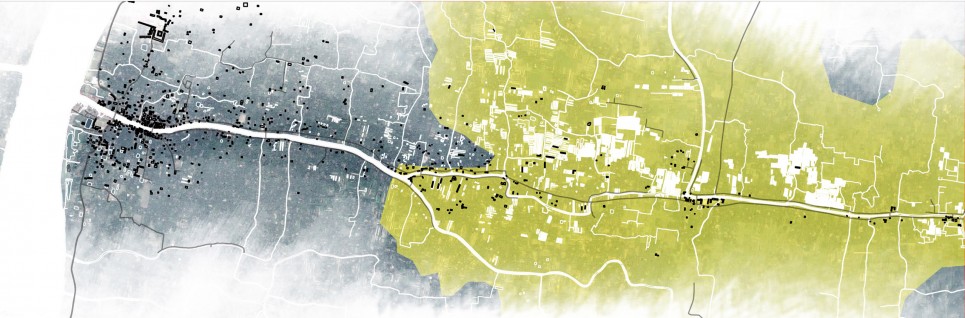


Since there is lack of infrastructure to facilitate the floating market, it has to solely depend on existing small scales temporary structures which play multiple functions during different seasons. In dry period these structures are mostly used as shops, gathering place for native people; during monsoon it eventually converted into temporary market places for guavas.
After thorough study of the site and the cycle of local economy, the project aims to preserve the existing symbiotic and humble relationship between man and nature while doing minimum intervention. An infrastructure module is conceptualized with added pontoon to facilitate boat docking and space for the traders to stand on. The core section of the module may act as a temporary shed for Guava storage and the built “Mancha” may serve as a spot for tourists to stand and enjoy the view. Such structural modules are conceived to work well in both directions: during monsoon, it becomes riverfront and during the dry season it becomes roadfront. These modules, connected by a common platform, can be articulated in various ways to create diverse spaces of varied qualities to serve various functions even on various sites.

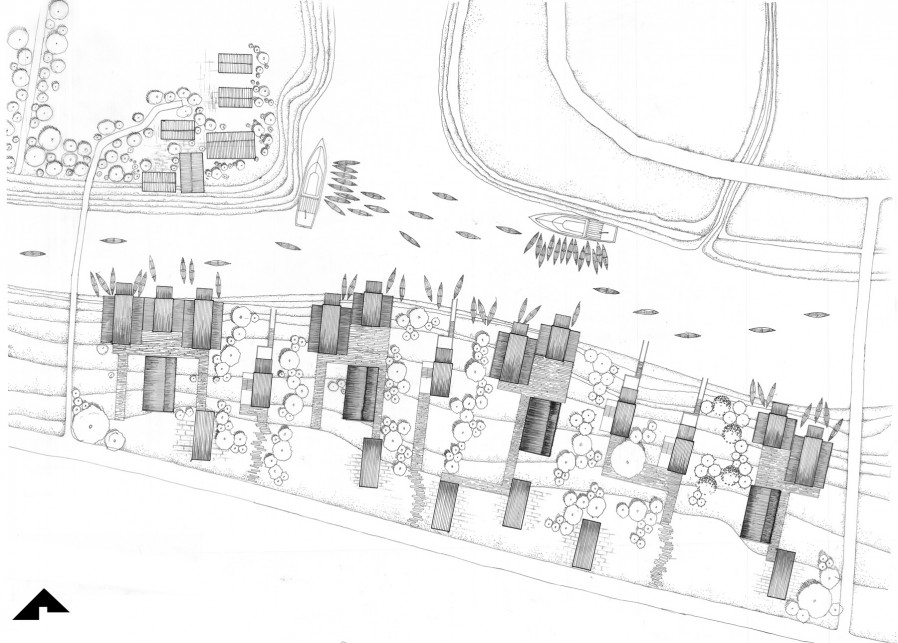
The proposed module, neither too solid, nor too open, is a flexible and multifunctional unit designed with local materials in order to merge with the innate surroundings. Each module composed of a collection deck, docking place for boats, sorting and temporary storing unit and distribution platform with loading and unloading facility. For every cluster, a natural cold storage facility is proposed for long term storage of surplus Guava.

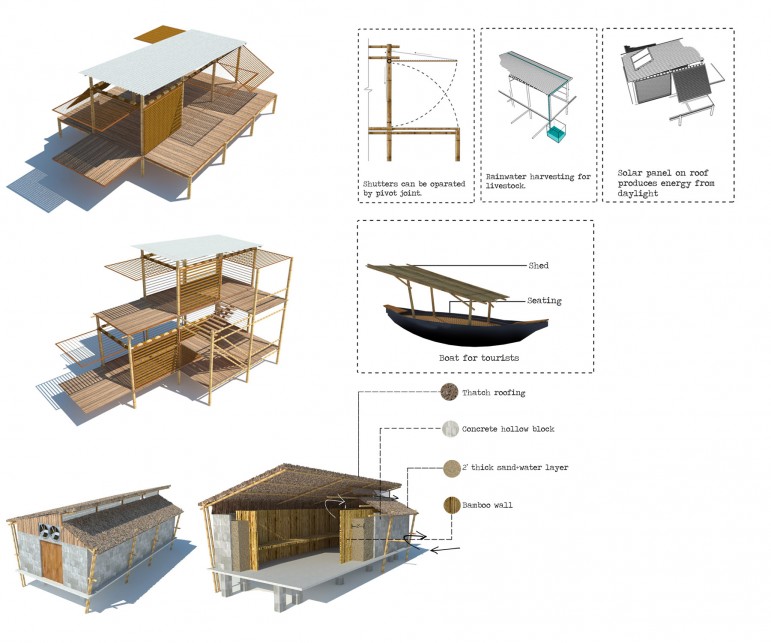
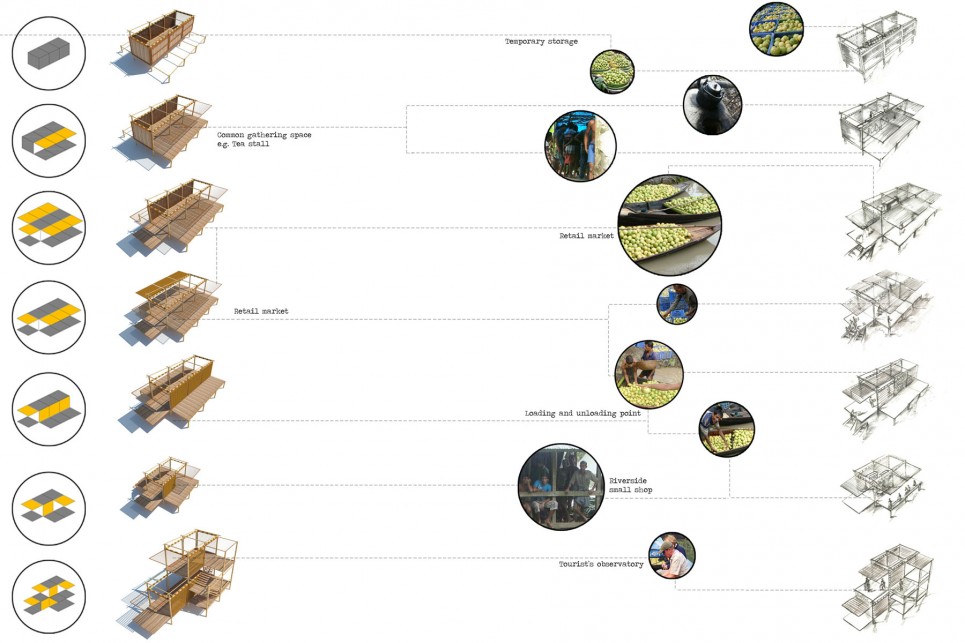
The module is adaptive to season: during monsoon the flexible shutter remains open and serves the purpose of shade over the deck facing the river; whereas in dry period, when the water is not navigable at all, the shutter remains close and serves the purpose of temporary storage and shops. Raised “mancha” over the module can serve the tourist purpose. With these structures a self-sufficient compound can be established. By repeating this cluster at any point of the canal bank a system is formed which can directly help the floating market.


