Echoes of the Estuary: A Tourism Center at Hatiya Dwip

World Environment Day 2026

Urban [Re]Stitch

In Quest of Baker and Brick

17th may to 31st may –this 16 days are gone like a blink of an eye, the duration of summer school-2015 at Laurie Baker Center for Habitat Studies, Thiruvananthapuram, Kerala. We 8 people from BUET and BRAC University participated in this 15 days long workshop. We, Nidalia Islam, Azka Eshita, Silmi Farah, Tanzina Khan, Nuzhat Nabila, Shahriar Mannan, Rahfatun Nisa Nova and Badia Badrudduja were the participants for this year summer school program.

LBC-The Laurie Baker Centre for Habitat Studies (LBC) was created by humanitarian architect Laurie Baker as well as his friends, students and admirers to propagate his philosophy of the concept of sustainable development through research, extension, training, documentation, dissemination and networking.

01
Field trip at CDS complex designed by Laurie Baker |photo credit: Shahriar Mannan

The LBC (Laurie Baker center for habitat Studies)  is established with the active support of the Centre of Science and Technology for Rural Development known as COSTFORD, which was co-founded by late C. Achutha Menon, former Chief Minister of Kerala and a development visionary, late K.N. Raj, one of India’s renowned economists and social thinker, Laurie Baker and by T R Chandra Dutt, social activist for the promotion of appropriate technology for building construction as well as for rural development following the philosophy  of  Lawrence Wilfred Baker (1917 – 2007) popularly known as Laurie Baker  who dedicated his life to the service of the ordinary people primarily through his innovative and environmentally-friendly approaches to the design and construction of buildings. A chance meeting with Mahatma Gandhi inspired and introduced him to India.
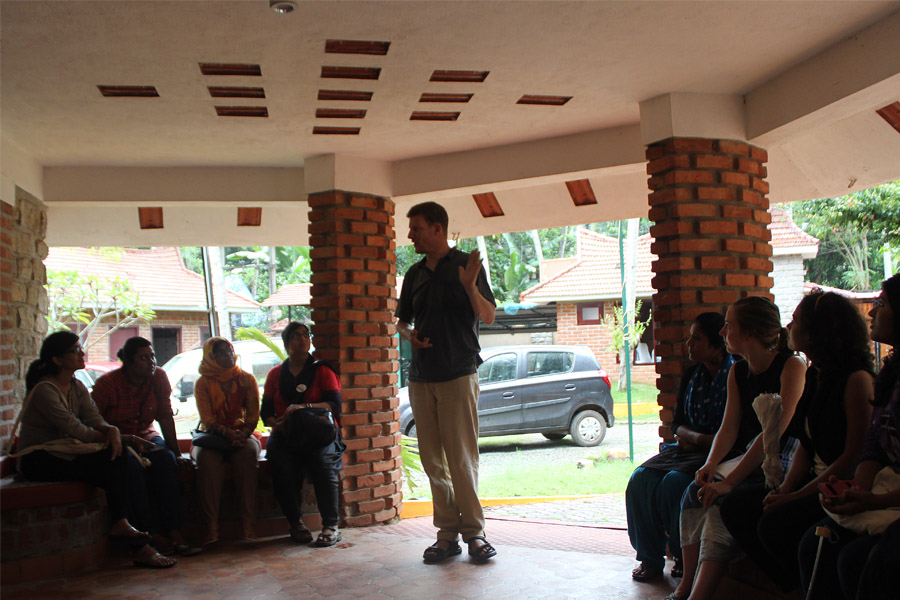
Life Improvement session at Kanthari complex|photo credit: Silmi Farah

The idea of participating in Summer school -2015 came to our mind when we studied Laurie Baker and his design approach, three of our friend also participated in LBC workshop, and their feedback also inspired us. The theme of summer school was to complete a construction with the help of students by following Laurie bakes philosophy so that they became aware of construction technique, Laurie bakers construction approach and other eco friendly and sustainable issue. This year they completed the extension of their kitchen with storage and change room for workers.

02
After we are done with making adobe bricks| photo credit: Silmi Farah

This Summer School Program is designed as four parts. Firstly the theoretical classes, secondly the hands on construction training, thirdly visit to the works of Laurie Baker and other important sites of Trivandrum and finally implementation on a conceptual project.

Our program consists of theoretical classes which introduce us with architect’s philosophy, construction method, waste management, eco friendly and sustainable construction method. And there were hands on training which the real fun part! This is where we get to the construction by our self, of course there are supervisors and instructor. We did the adobe masonry wall for kitchen, learned some bamboo joints, mud flooring and plaster for the storage part. We also learned the brick joining and detail of Laurie baker, learned to construct an arch. We’re supposed to all this by our self in group of at least three people.

03
Arch is built at last after hours long workmanship and mental math |photo credit: Nidalia Islam

So it was real fun part for us, how time went on we never realize. There are people from all over the world, and all of them are not architects, there are urban biologists, interior designer and architect without education! They speak different language; they have their own culture so that’s really an intriguing part where you get the real multi-professional and multi-cultural platform to judge yourself, to verify your view on architecture.

We were divided in two group seniors and juniors- as all the technical detail are not necessary for students but helpful for architects who are in profession. But in dining we’re all together exchanging our experience, views and making jokes on food. Yes, you got to have nerve to sustain on south Indian food for 15 days, so that’s another training indeed! You’ll have refreshing and naive chitchat with young ones; also you get to know perspective of the experienced minds.

Participants at  Laurie Baker Summer School, 2015 | Photo credit: Sharifuzzaman Sajal
Participants at Laurie Baker Summer School, 2015 | Photo credit: Sharifuzzaman Sajal

The senior architecture students those who is going to be graduate within one or two year can find this program very helpful, they will have the confidence how things can be done in site, and of course being aware of your environment, the architecture of aesthetic and massing is long gone, it’s really high time we get aware about our site context, condition and socio-economic issue.

WAF Student Charrette | Anticipating the Unexpected

waf black


WAF STUDENT CHARRETTE | 4 – 6 November , 2015 | Marina Bay Sands , Singapore

WAF’s Student Charrette provides the opportunity for groups of architecture students from all over the world to present live to a panel of WAF’s renowned judges. The organizer is calling for outline submissions from students and universities to be considered to come and present at the World Architecture Festival, Singapore in November! Selected teams will be able to send up to eight students and two tutors to the Festival. There will be no delegate charge for teams (though they will have to pay for accommodation and travel).

THEME | ANTICIPATING  THE  UNEXPECTED

The title for the charrette is ‘Anticipating the Unexpected’. This relates to this year Festival theme, ‘50:50, Looking Forward, Looking Back’, which tries to understand where architecture was 50 years ago, how it has evolved, and where it might be in 50 years’ time. This theme is prompted by the 50th Anniversary of Singapore’s independence, and the way in which its government has planned for the future. We would like students, many of whom will still be working 50 years from now, to consider the future, and in particular how skillful design can anticipate its challenges.

Teams should therefore identify an urban quarter or conceive a new one, with multiple and/or complex uses. It may be a university campus, medical campus, sport and leisure facilities where other uses are included to intensify activity, residential quarters with associated amenities, suburbs or urban ‘polycentres’ (districts planned around local transport hubs which link to other parts of the city), or an area of historic interest.

Having decided on an urban quarter, teams should consider the building types within them that serve its patterns of use, and help to define its physical character now. They should then either show how these building types will continue to support changing patterns of use in the future, or devise new building types more suited to that role. Building types can, of course, change their function over their life: they may start as homes and mutate into offices or vice versa: they may be conceived as warehouses and become arts venues. Proposals may show how existing building types can facilitate change, or they may propose new ones.

Finally, it is also required to foresee how the overall urban fabric of the quarter might need to change in order to cope with evolving uses and new identities.

DATES 

1 July 2015: Launch of call for submissions of interest

31 July 2015: Closing date for submissions of interest (see below for details)

Mid August 2015: Selection of teams announced

3 November 2015 : Teams to arrive in Singapore for final briefing at the venue

4 November 2015 : Festival opens and charrette starts

6 November 2015 : Charrette teams present to jury

The winning charrette team announced at the Closing Reception on the 6 November and will be invited to stay for the Gala Dinner!

SUBMISSION REQUIREMENTS 

Initially interested participants are requested to submit an  outline (submissions of interest ) by 31 July  which respond to this brief and explain how it would be explored. Selected entrants will be notified via email to take part in mid August.There is no set number of words, sides of A4 or illustrations allowed: use as few as is necessary to convey your ideas to us.

NO DESIGN PROPOSAL IS REQUIRED AT THIS STAGE

please submit via email HERE

[ Clearly marking charrette submission in the subject line of the email]

Detail [+]

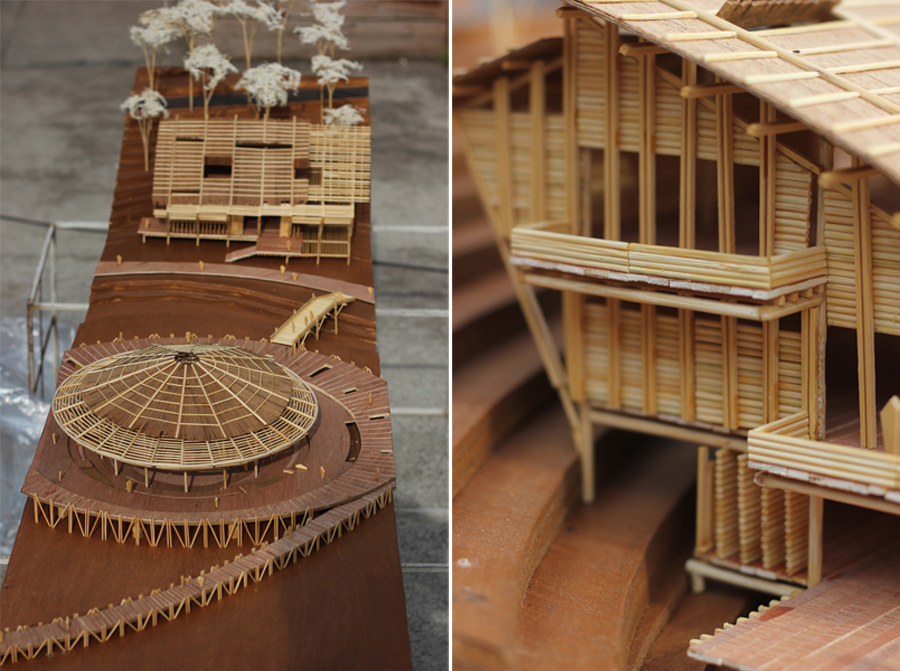
JUM CULTURAL COMPLEX, Rangamati | BUET

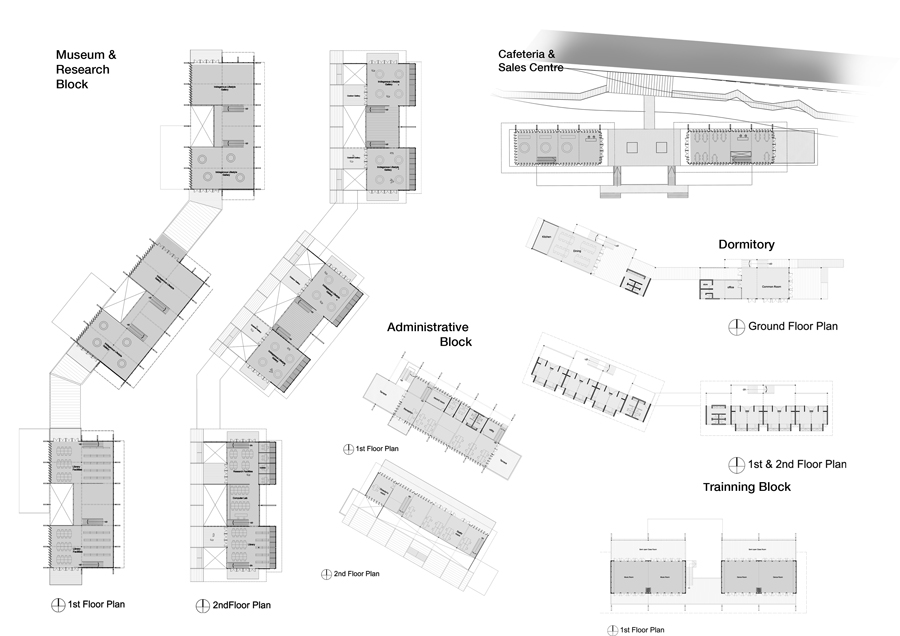
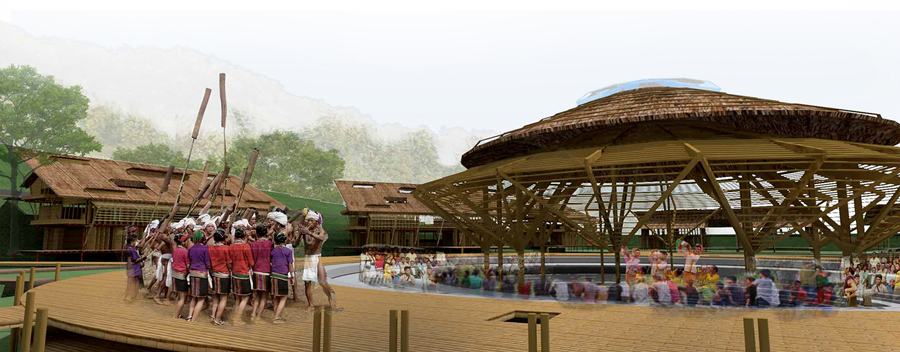
Jum Cultural Complex is a proposed Indigenous Cultural Complex located at Manikchari; Rangamati Bangladesh. It was the Final year (5th year) thesis project of Bangladesh University of Engineering & Technology completed in 2014. Jum Cultural Complex is an initiative for the preservation, development and exposure of Jum Culture which not only promotes culture but also indigenous knowledge of sustainable living.

Jum Cultural Complex © Jimi Chakma

Chittagong Hill Tracts, located in the Southeastern corner of Bangladesh, along the border of India and Myanmar is the home of 11indigenous groups. The Indigenous groups are Chakma, Marma, Tripura,Tanchangya,Khiyang, Chak, Khumi , Mro, Pankhoya, Lusai and Bawm , all are collectively known as Jumma people. Their distinctive culture, language and lifestyle is differs from the majority of the plain land Bengali people.

Jum’ is the traditional Swedish or slash and burn shifting cultivation on hilly area. The Jumma Peoples’ livelihood, music, dance, food habit, festival are directly or indirectly related to this Jum cultivation. So Jum is the common bondage and potential sign of identity among the Jumma People.

Jum Cultural Complex © Jimi Chakma

From the colonial British Period to recent time the Jumma peoples are subjected to eviction from their ancestral land and still struggling to protect their land and culture. The built of Kaptai dam in 1960 in then East Pakistan caused hundred thousand of people evicted from their land. The so called development became the threat and fear of eviction. Recently due to decrease of land, pressure of dominant culture, lack of cultural exposure and development, the Jum Culture is on the way to extinct.

Jum Cultural Complex is an initiative for the preservation, development and exposure of Jum Culture which not only promotes culture but also indigenous knowledge of sustainable living.

Jum Cultural Complex © Jimi Chakma

Features of traditional Houses and settlement Pattern.

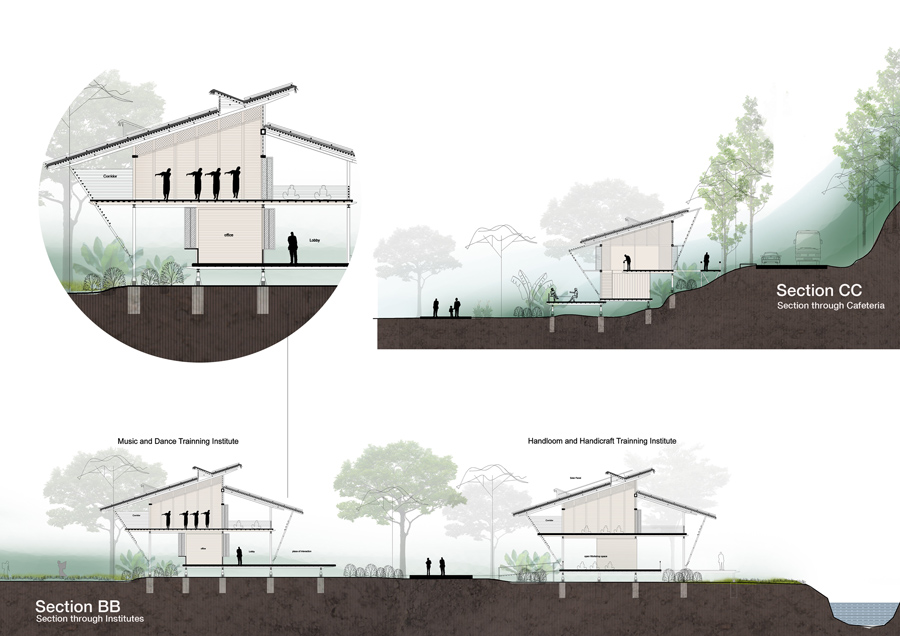
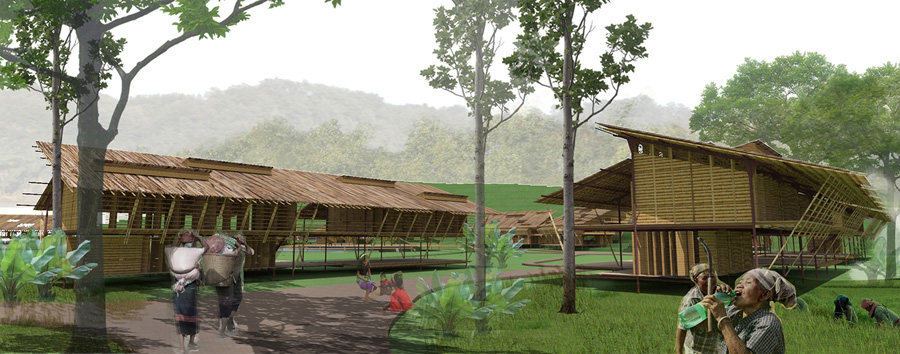
Most common feature of the traditional houses is raised platform with open or semi open terraces. The houses are made of local material like bamboo, wood and sun grass which are abundantly available in the hilly area.

The settlement pattern of the houses is solely dependent on the natural settings and contour of the hill. Most of the settlements are organized along the pathway creating linear settlement patterns. The varied size pathway creates gathering and activity spaces for the inhabitants. The verandahs/decks are aligned along the pathway and oriented towards the natural view.

Sketch of view
Jum Cultural Complex © Jimi Chakma
Multipurpose Hall
Jum Cultural Complex © Jimi Chakma

The utmost consideration for this project was conservation of land, resource and natural settings; use of local material and indigenous building techniques; and mostly creating an indigenous identity.

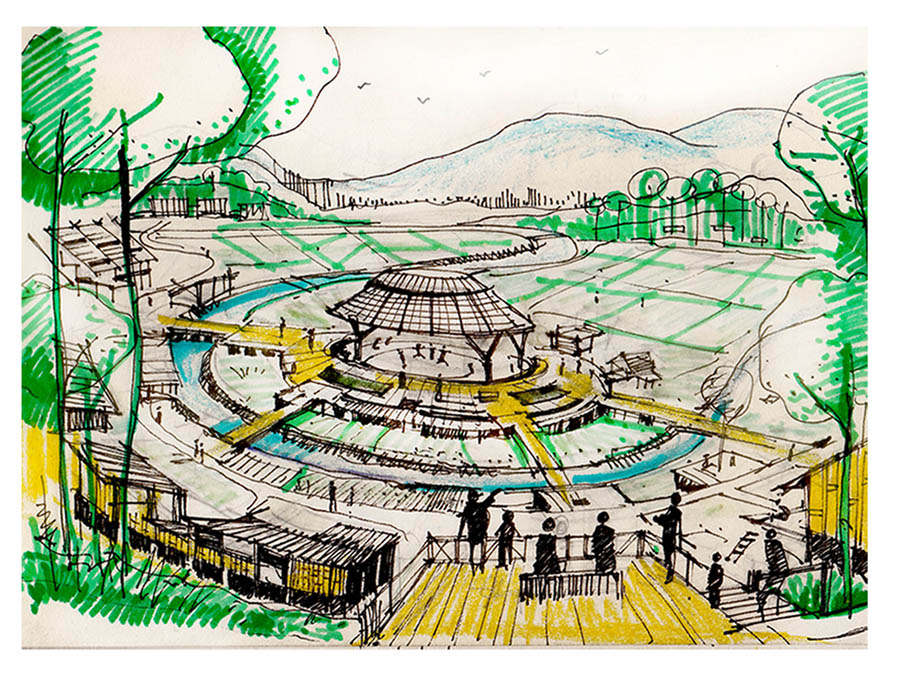
The site (about 25 acre) is located at outskirt of Rangamati City. A spectacular view to surrounding hills and a natural stream running through the site are the major site forces for the design.

Jum Cultural Complex © Jimi Chakma

In the design, most of the land is kept as it was with less intervention to provide ownership of the cultivable land to the adjacent village community. The functional masses are organized along a linear pathway which is connected by local roads of existing villages. The complex has no boundary and connected to village roads so that villagers could commute through the project and feel as their own. The whole complex is centralized towards the “Genhuli Hall”-Circular Multipurpose Hall attached with a water body provides gathering and activity space for the cultural activity. The water body dug for the old brickfield was recreated into a waterfront walkway.

All masses were built on a raised platform with multiple open verandah and terraces just like traditional houses.


  • Model-Museum
  • Master Plan
  • Model-Master Plan
  • model1
  • Blow up 01+
  • Multi Purpose Hall 01
  • Sketch of view
  • panaromic view from entry deck
  • Plans
  • Structural System & Facade Treatment
  • Section through museum & multipurpose Hall
  • Section
  • design sketches
  • Waterfront view
  • Institute view from pathway
  • Multipurpose Hall

E-Library | Faculty of Business Studies, University of Dhaka by SthaNiK

du e 01
E-Library _ Faculty of Business Studies, DU | Image Courtesy : Ar.Mahfuzul Hasan Rana

_

‘I have never produced something saying that this is a work of modern architecture, and I never told anyone that this is what you should do. I have always spoken about creating something contemporary, and in the context of Bangladesh.’ _ Ar. Muzharul Islam

The former library was situated at the western zone of the linear top floor of Faculty of Business Studies (formerly known as NIPA Bhaban) at Dhaka University Campus, a significant architecture, both in terms of Ar. Islam’s one of the master works and a heritage building in chronology of architectural history of Bangladesh. The task was to extend and transform the existing one into an E-Library, first of its kind in context of Bangladesh.

_

du e 02
E-Library _ Faculty of Business Studies, DU | Image Courtesy : Ar.Mahfuzul Hasan Rana

_

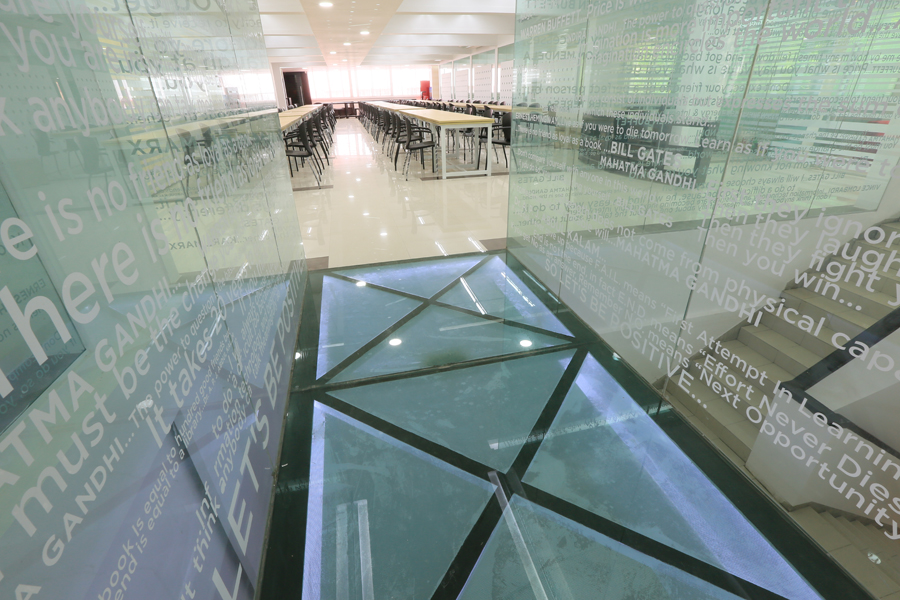
To rejuvenate the very openness of the pavilion structure the first step was to remove all the unplanned walls that were built inside the building to accommodate the faculty’s growing need over time. Two parts, separated with blank walls of an internal staircase,is connected by removing the solid walls and bridging them by transparent glass box containing a glass bridge floating over the void of the stair-case. The Interior of small compartmental spaces, thus, is transformed into a continuous fluid space having the double height sky-lit volume in the middle.

_

du e 03
E-Library _ Faculty of Business Studies, DU | Image Courtesy : Ar.Mahfuzul Hasan Rana

_

du e 04
E-Library _ Faculty of Business Studies, DU | Image Courtesy : Ar.Mahfuzul Hasan Rana

_

du e 05
E-Library _ Faculty of Business Studies, DU | Image Courtesy : Ar.Mahfuzul Hasan Rana

_

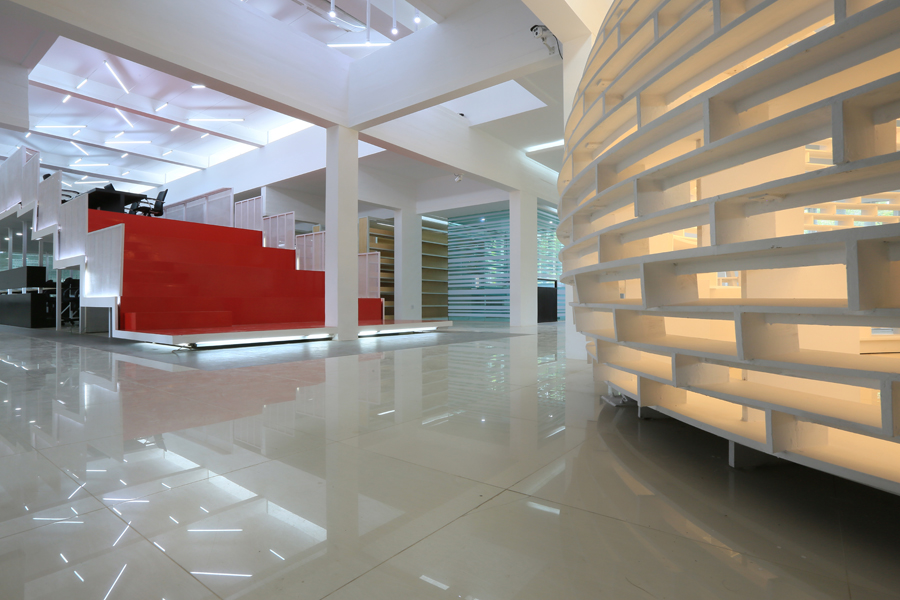
The organization and allocation of spaces are done in a way which will encourage a spacious and volumetric public scale inside the library. Large continuous open spaces are introduced throughout the two-hundred-and-six-feet length of the floor spanning west to east. The areas required to be closed are kept inside patterned glass boxes through which green filigree of outside trees filters inside. The main color scheme is decided to be white to maximize light inside the library. Dark patches in defined areas floats amidst the whiteness of the continuous open plan.Dark Entry-way made with metal sheets etched with the text of history of the Faculty of Business Studies unfolds to a bright open fluid space inside. Module design of the function-specific-furniture ensures maximum openness.

_

du e 06
E-Library _ Faculty of Business Studies, DU | Image Courtesy : Ar.Mahfuzul Hasan Rana

_

du e 07
E-Library _ Faculty of Business Studies, DU | Image Courtesy : Ar.Mahfuzul Hasan Rana

_

du e 08
E-Library _ Faculty of Business Studies, DU | Image Courtesy : Ar.Mahfuzul Hasan Rana

_

du e 09
E-Library _ Faculty of Business Studies, DU | Image Courtesy : Ar.Mahfuzul Hasan Rana

_

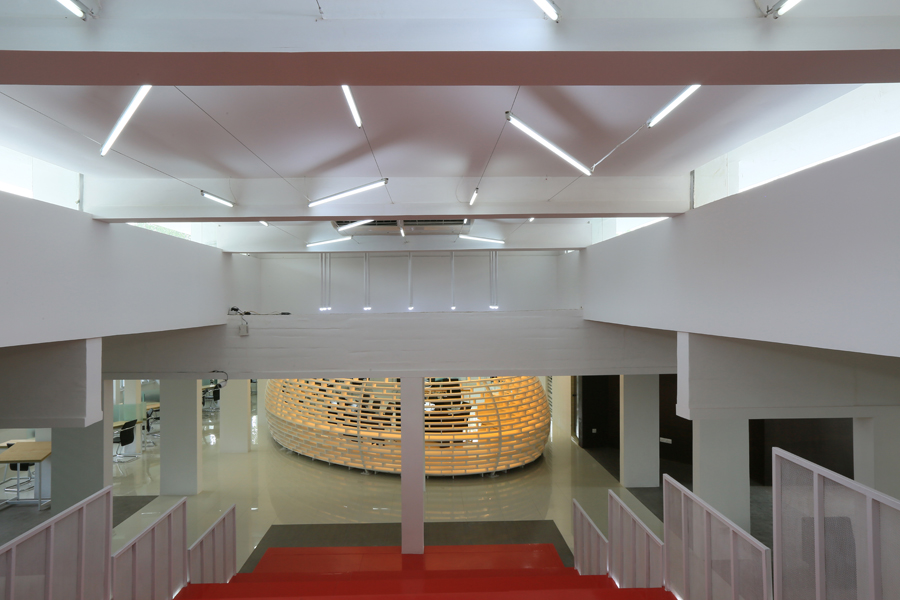
The double height space with the clear-story lighting is enhanced by a bright red floating mezzanine floor. The mezzanine holds the information and issue counter underneath and a silent reading area on the upper level. The mezzanine floor turns into a stepped continuous surface offering informal reading area amidst a somewhat ‘unusual’ volume of space and initiates dialog with the twisted fluid space generated around an elliptical geometry designed as a sculptural installation tohouse the journal section.The ‘Trimmed Egg’ holding the ‘functionality of the journal shelves and reading tables, increases fluidity by changing the geometry of the space and opens towards west to celebrate the dramatic west light double-filtered through densely placed white window grills and the lush green of nature.

_

du e 10
E-Library _ Faculty of Business Studies, DU | Image Courtesy : Ar.Mahfuzul Hasan Rana

_

du e 11
E-Library _ Faculty of Business Studies, DU | Image Courtesy : Ar.Mahfuzul Hasan Rana

_

du e 12
E-Library _ Faculty of Business Studies, DU | Image Courtesy : Ar.Mahfuzul Hasan Rana

_

du e 13
E-Library _ Faculty of Business Studies, DU | Image Courtesy : Ar.Mahfuzul Hasan Rana

_

The ceiling of the library is designed as light as possible using metal mesh and white boards to enhance the exposed beam-column structures rather than hiding them. The composition of the ‘elements’ on the ceiling  follows the existing grids in most zones except the open space around the ‘trimmed egg’ and stepped reading area where diagonal lines in random direction unfolds the zones into multidirectional  openness.

Project Title:  E-Library | Faculty of Business Studies, University of Dhaka

Architectural Consultant:  SthaNiK

Project Team:

_ Lead Architects: Ar. Saiqa Iqbal Meghna and Ar. Suvro Sovon Chowdhury

_ Collaboration: SthaNiK Architectural Consultants collaborated with Ar. Mohammed Emran Hossain and Ar. Shahidullah Faruq for the Construction of Journal Section and Main Entry-way

_ Associates: Saad Ben Mostafa (B.Arch student, BUET), Bin Sayeed bakhti (B.Arch student, BUET)

Location: Top floor of Faculty of Business Studies (Former NIPA Building), University of Dhaka

Area: 12,000 square feet

Project Year: 2015

Photographs: Ar.Mahfuzul Hasan Rana

Client: Faculty of Business Studies, University of Dhaka

  • du e 4
  • du e 8
  • du e 2
  • du e 11
  • du e 5
  • du e 12
  • du e 13
  • du e 9
  • du e 10
  • du e 6
  • du e 14
  • du e 3
  • du e 1
  • du e 7


Archasm | Chandigarh Unbuilt

Chandigarh Unbuilt © Archasm 2015

.

CHANDIGARH UNBUILT     |    01 AUGUST, 2015 – 18 NOVEMBER, 2015   | INDIA, CHANDIGARH

Archasm invites architects, students, engineers, designers, artists and philosophers to send in their entries for our competition.

_ Idea based competition

_ Single stage competition

_ Team of maximum three members

_ No professional qualification necessary for eligibility

_ Teams can be interdisciplinary


THEME  |  CHANDIGARH UNBUILT

We tend to explore and unearth the various characteristics of unbuilt Chandigarh through this competition, that were conceived by Le Corbusier but remained confined to documents, pictures and archives and try to contemplate the possibilities of turning all these visions into a reality for the city, both in their original context and present day scenarios and changes. This competition would discuss the relevance and importance of modernistic principles in a contemporary era where the needs of the city have changed drastically and need to be addressed by a more creative approach rather than a conservative one.

Chandigarh Unbuilt © Archasm 2015

AWARDS

_ First prize- INR 1,00,000/- + Certificate

_ Second prize- INR 60,000/- + Certificate

_ Third prize- INR 40,000/- + Certificate

_ 10 Honorable mentions

Winners and honorable mentions will be published on archasm’s website and several international architecture magazines and websites partnered by us. The jury for the competitions will be done by renowned and eminent personalities from the field of architecture and design, ranging from academicians to established national as well as international architects.

DATES

Registration [+]

Registration open _ 01 August, 2015

 Early Registration until 30 September, 2015

For Indian nationals- INR 900 (per team)

For Foreign nationals- EUR 60 (per team)

 Standard Registration until 30 October, 2015

For Indian nationals- INR 1200 (per team)

For Foreign nationals- EUR 80 (per team)


_ Release of briefs/Start of the competition _  01 August, 2015

Closing day for submission _ 31 October, 2015

_ Announcement of Winners18 November, 2015

 Detail [+]

AIUB-HFBF Hosts Workshop on ‘Safe Sanitation for Our Habitat: Strategies for Architects’

|Department of Architecture , AIUB |

Habitat for Humanity Bangladesh (HFHB) with Department of Architecture, American International University-Bangladesh (AIUB)  organized a three day workshop titled, ‘Safe Sanitation for Our Habitat: Strategies for Architects’ on June 11-14, 2015. The prime objective of the workshop was to train young Architects to develop new understandings about low-income housing communities, and then focusing on sustainable sanitary facility construction policies and solutions that can work in the rural and urban low-income housing settlements.

Providing people place for shelter is a basic need, and use of safe sanitary facilities as a part of living shelters has become unavoidable. Creating sanitation infrastructure and public services for all that keep waste out of the environment is a major challenge in Bangladesh where only 56% of the population estimated to have had access to adequate sanitation facilities by 2010. This has become a responsibility of Architects to come up with design ideas for safe sanitary solutions which should be economically and environmentally sustainable.

Habitat for Humanity- Bangladesh, an International non-profit organization branch, has been working in partnership with poor urban and rural families to build secure homes since 1999; they have also grown expertise in providing safe sanitary facilities for the low-income communities. In the opening session on 11th June, inauguration speech was delivered by Dr. ABM Siddique Hossain, Dean (Faculty of Engineering) of AIUB and Mr. John A. Armstrong, National Director of HFHB. Mr. Abul Bashar, Program Manager HFHB; Salma A. Safi, Architect & Urban Planner, CUS; Mr. Broja Gopal Saha, Asst Director, CDD; Mr. Mujibar Rahman, Program development Manager HFHB; M. Arefeen Ibrahim, Head of Architecture Dep’t AIUB also delivered valuable speech in their presentation. On the second day, the participants visited Bondhon Community Center in Gondropa union of Mymensingh district, and its surrounding housing project sites by HFHB. This successful trip also gave the students a hands-on knowledge on low-income housing scenario in the broad context of the rural Bangladesh. At the end of the trip, participants visited the HFHB office at Mymensingh, and safely returned back to Dhaka. On the concluding day of workshop, June 14, participants arranged into groups and participated in a design charette, where they designed community toilets for marketplace and community toilets and bathhouses for village families. At the end of the day, their design presentations containing innovative ideas and solutions were presented in front of the HFHB officials and AIUB faculties. Many of their design ideas were well appreciated, in fact, some of the design ideas by participants are considered to be built on actual project sites of HFHB if viable. This workshop was co-ordinated by Mania Tahsina Taher, Assistant Professor, Dep’t of Architecture AIUB; and the program ended with certificate-giving event among the participants.