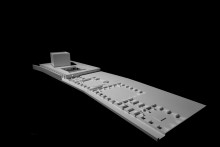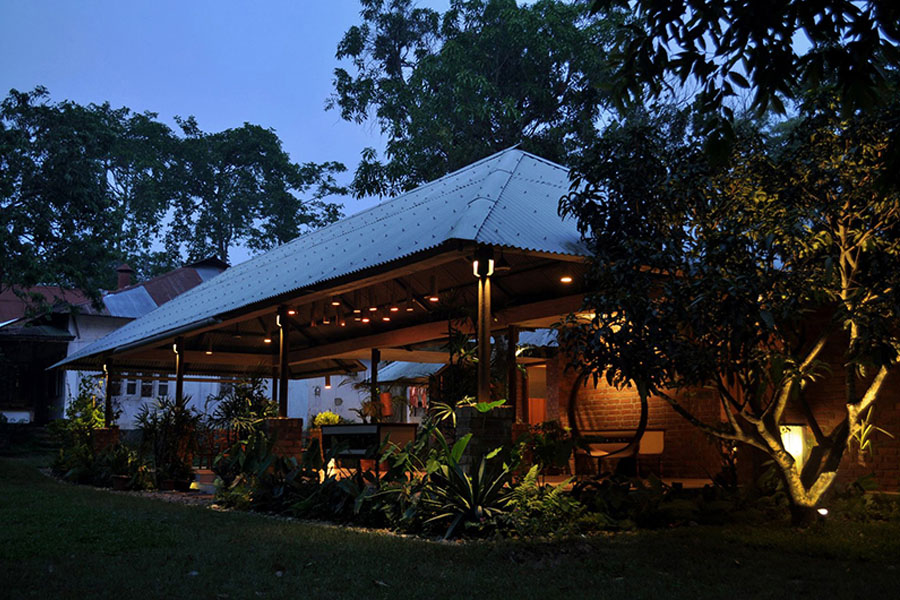
Echoes of the Estuary: A Tourism Center at Hatiya Dwip

World Environment Day 2026

Urban [Re]Stitch

BUET Students Ideated the Future of Airports in Bangladesh

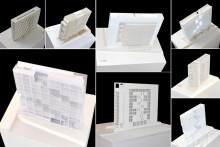
Third year students from Dept of Architecture, BUET showcased their design studio works on ‘airport terminal building’ in a public exhibition called ‘Junction’. The exhibition was held at EMK centre, Dhaka from 9th-15th February. Exhibits included drawings (plans, sections, elevations, and 3D views) and physical models of the terminal building.

People are travelling now more than ever in the history of mankind and a bulk of these travels are carried out by airplane through airports around the world. Now-a-days, for many, journey is not only going from one destination to another one, it has become a way of life. The international Civil Aviation organizations reports that 3.5 billion passengers have travelled by air in 2015. It is expected to grow.

As the economy of Bangladesh is growing so is the number of people travelling by air in this country. In the recent years Bangladesh has observed a rise in the number of home grown private airline operating in the country. Airports are not mere junctions for journeys but they have become commercial, economic, and entertainment hubs.

Students of third year (Department of Architecture, BUET) was challenged to design an airport terminal building in three existing airport’s site (Saidpur, Sylhet, and Cox’s Bazar) of Bangladesh. The students have spent over a week studying different aspects of an airport terminal building (Departure lounge, Arrival concourse, HVAC, Electrical system, fire fighting system etc. They have also visited the Hazrat Shahjalal International Airport terminal building for a full day to understand how it works, what the essentials are, what the required scale of a terminal building is, how the luggage is handled, what the security requirements are etc. The design studio was guided by Professor Dr. M. Zakiul Islam, Dr.Nayma Khan, Tasneem Tariq, Dr.Apurba Kumar Podder, Ahammad-Al-Muhaymin, and Meherul Kader Prince.

Photographs by: Nasif Chowdhury, Dept of Architecture, BUET

junction_02

junction_04

junction_09

junction_08

junction_07


junction_06


junction_05

junction_10


Qibla. Mosque and Islamic Cultural Center for Arezzo

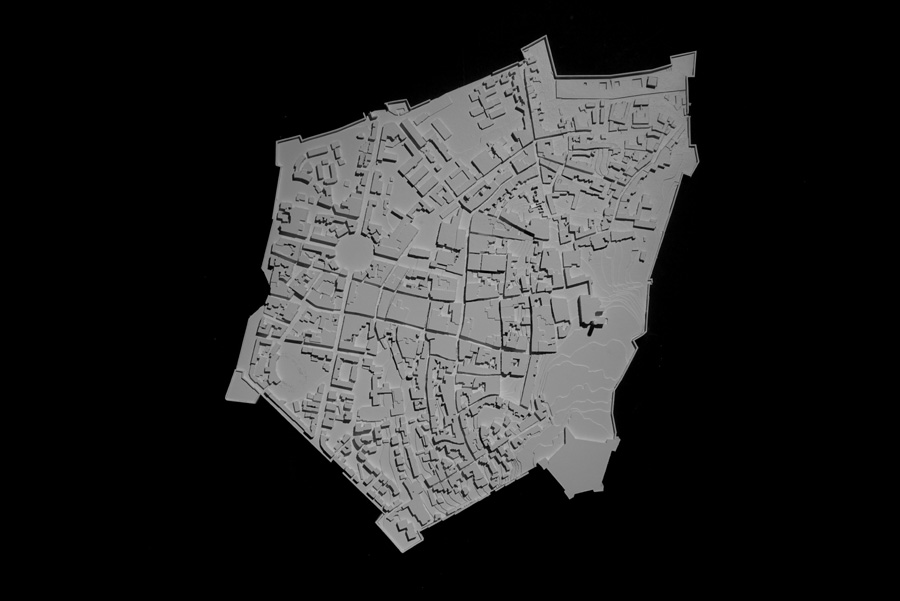
The thesis concerns the design of a mosque and an Islamic cultural center in Arezzo, Italy, mainly intended for the Bengali Muslim community. It represents a proposal for reorganization and enhancement of the area, restoration of the profile of the walls of Arezzo, symbolic inclusion of a foreign community within the oldest part of the city against any attempt at marginalization and in favor of a fruitful contamination between cultures.

© Nayem Mohammad
© Nayem Mohammad
© Nayem Mohammad
© Nayem Mohammad
© Nayem Mohammad
© Nayem Mohammad


The whole project is conceived under the banner of cultural exchange between Western and Eastern, both of which have always been mutually nourished. The plant is configured as a fragment of a city that arises from the hybridization of the urban model of convents and monasteries along the Via Sacra of Arezzo, with the typology of the Islamic city of the most eastern geographical area, from Iran to India, characterized from the succession of buildings to a mainly quadrangular plant court attested along a road or along the spine of a suq.

The project is largely hypogeal. The only element that emerges is the mosque.The Islamic center is made up of a series of hypogean court buildings aligned along a path, a pedestrian street 5 meters wide, narrow between the ancient walls and the new wall that contains the buildings of the complex. The walls, built for defensive purposes, now assume the task of the custody, of the sacred enclosure.

© Nayem Mohammad
© Nayem Mohammad

Qibla_5

© Nayem Mohammad
© Nayem Mohammad
© Nayem Mohammad
© Nayem Mohammad
© Nayem Mohammad
© Nayem Mohammad


The system reconnects to the various points of access to existing urban routes. A stairway that continues the pedestrian road coming from the city center divides the complex into two parts and leads to the share of the road that acts as a distributive thorn.At the altitude of +5 meters from the hypogeum floor, a public garden develops consisting of the alternation of paved, grassy areas and a body of water (corresponding to the space for the ablutions). The accommodation returns the imprint of the buildings below making it readable to scan.

Taking back the characteristics of Islamic architecture, all the buildings are introverted: the library and the madrasa develop each one around their own courtyard, while the space for the ablutions (in direct communication with the courtyard of the mosque) and the hammam have a spatial pivot; a source of light. In addition to the typological nature, all the buildings in the complex have in common the gray limestone cladding and the same structural matrix made of septa that are arranged orthogonal to the perimeter of each building.

© Nayem Mohammad
© Nayem Mohammad
© Nayem Mohammad
© Nayem Mohammad
© Nayem Mohammad
© Nayem Mohammad
© Nayem Mohammad
© Nayem Mohammad

The mosque is a cubic volume, enigmatic, suspended between the ground and the divine: like the Ka’ba it is a stone fallen from the sky that sinks into the earth and becomes urban volume. The stone that covers it is made of larger slabs than the other buildings to underline its significance of out-of-scale monoliths. Its orientation is dictated by the direction of Mecca, to which Muslims turn to pray. No other symbol, except the qibla, or the direction, evokes the function of the building.

The prayer room is a 23-meter-wide, 23-meter-high, completely free space, collected under a large wooden mashrabiyya suspended from the ground and detached from the stone walls, scanned in three orders, at increasing rate with the height, resumes that of the facade of the Romanesque church of Santa Maria Assunta. The facade of a church becomes so ‘internal’ of a mosque.

A ceiling skylight that runs along the perimeter illuminates the grazing light stone which in turn filters through the prayer hall through the mashrabiyya. Along the wall of the qibla a niche lit from above performs the function of the mihrab.

| Image gallery |

  • Qibla_12
  • Qibla_2
  • Qibla_3
  • Qibla_15
  • Qibla_16
  • Qibla_14
  • Qibla_13
  • Qibla_6

Project Showcase: Office Building for BERC

Auritro Architects led by Ar. Mohammad Mahbub Hossain  has been announced the winner of the Open Architectural Design Competition for the design of the Head office for Bangladesh Energy Regulatory Commission (BERC). The winning proposal was unanimously selected by the jury. On the winning list were entries from Axis Design Studio and R.E.D Consultant jointly with Zero  D Consultant. Ten entries were received special mention awards in various categories.

“This proposal bundled up programs clearly and intelligently, thus increasing the possibilities of using interior spaces for such a narrow site. This enables the designers to create sequence of indoor-outdoor spaces (like vertical pavilions), ensuring micro climate of tropics. The team skillfully crafted interior flow of spaces through multiple levels, acting as buffer between spaces used by public office use and spaces supporting office-use .  It activated all corners of the building (on different levels) and the site premise ( ground level making) by giving high attention to all of them. Quality of functional spaces would encourage users to engage more during office hours with comfort and ease. The presentation depicted all intention very clearly.” cited by the jury.

First Winner| Auritro Architects
previous arrow
next arrow
 

[ Press Left/ Right arrow to change the image ]

The proposed building will be situated on a challenging site of 0.245 acres (991.48 sq.m) at 79 at Plot No. F-4-C, Agargaon, Sher-E-Bangla Nagar, Dhaka. It will be the head office for Bangladesh Energy Regulatory Commission (BERC) and meant to be designed as a green building.

The competition was judged by a team of veteran experts and renowned professionals in the field which  included Prof. Jamilur Reza Choudhury,  Ar. Nahas Ahmed Khalil,  Ar. Ehsan Khan, Ar. Nazimuddin Payel and Ar. Emran Hossain.

Congratulations to all winners!


First Winner| Auritro Architects


Second Winner | Axis Design Studio
Third Winner | R.E.D. Consultant & Zero D Consultant JV


Special Mention with Commendation


Special mention
Special mention


Special mention
Special mention
Special mention
Special mention
Special mention
Special mention
Special mention
Special mention
Special mention in recognition of strong idea

Other submissions:


  • other 2
  • other 3
  • others 1
  • other 4


CONTEXT contributors

Photographs by: Ar. Kamrul Hasan

Documentation:  Ar. Md Shahid Hasan Rabbani


LHTE Guest Bungalow Extension | SILT

© Arc-Silt consortium


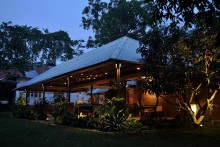
The key idea behind this project was to design three connected yet separated pavilions to cater for the need of a guest bungalow. The most prominent feature would be the grounded feeling of this project, to ensure that no part of the project feels alienated from its surrounding beautiful and lush landscape of the tea estate. As designers, we were very keen not to design a built form that would stand out arrogantly and induce a feeling of disparity between the owner and the workers living nearby; without compromising the comfort that was warranted.

.

© Arc-Silt consortium


Sensitively chosen local materials which are very commonly used for nearby structures merges the project with the overall atmosphere and creates visual coherence. Local mud plaster technology has been used for interior wall finishes and locally sourced woven mats, also known as “Sheetal Pati” made from Murta plants (Schumannianthus dichotomus) as a ceiling to create thermal mass (air) below the roof. Using indigenous materials as such gives a sense of familiarity and sense of belonging to the project.

.

© Arc-Silt consortium


The structure blends with nature both physically and psychologically. The merging with nature has been reinforced by the non-existence of spatial boundaries between semi-open and outdoor areas as well as the minimal scale of the project. The built form has been designed and placed around four trees, two of which are placed inside the central court, guiding the scale and proportion of the built form, one to the west determining the western edge of the veranda by placing the tree centrally behind a swing. And the fourth to the south-eastern edge of the western guest room. A small pool of water acts as both a collection tank for surface runoffs and rainwater and also as a thermal cooling source to induce microclimatic comfort.

.

© Arc-Silt consortium


The integration with site happens on another layer by reusing as much construction material as possible. We sourced most materials locally, and mostly from the central junkyard of the tea estate. Almost all light fittings used in this project were re-purposed from another project. We recycled local fish traps, woven dustbins, and discarded generator air filters to make stand lamps. We have even used the “tagar” mortar mixing pan used by the brick masons to make exterior wall lamps. We have extensively used old and discarded irrigation aluminum pipes and its joinery to make drainage gutters, spouts, and pendant lights. We have also used up all the residue MS “L” angle and Box sections to make column lights, downlights, and small spouts. Even the landscaping of the project has been done with locally available plants, all our plants were sourced from a 500‘ walking radius.

.

© Arc-Silt consortium


Our efforts were focused on making the structure as less intrusive as possible while focusing on occupant comfort so that the occupants are induced with a feeling of living amidst nature, engulfed and surrounded by it.

DESIGN TEAM
Arc-Silt consortium
Nahas Ahmed Khalil
Razib Hassan Chowdhury
Mumtaheena Rifat

LANDSCAPE DESIGN
Naheen Nuruddin


| Gallery |

  • 14 LHTE Guest bungalow Extension
  • 11 LHTE Guest bungalow Extension
  • 6 LHTE Guest bungalow Extension
  • 7 LHTE Guest bungalow Extension
  • 3 LHTE Guest bungalow Extension
  • 2 LHTE Guest bungalow Extension
  • 15 LHTE Guest bungalow Extension
  • 13 LHTE Guest bungalow Extension
  • 4 LHTE Guest bungalow Extension
  • 5LHTE Guest bungalow Extension
  • 10 LHTE Guest bungalow Extension
  • 12 LHTE Guest bungalow Extension
  • 1 LHTE Guest bungalow Extension

শ্রীহট্ট নন্দন: Redevelopment of Sylhet Old Central Jail

The old Central Jail in Sylhet is more than 200 years old, and was the first jail in Bangladesh. Since its inception in 1889, it has great significance due to its core geographical location with heritage value and as an urban space. After the relocation of central jail, the vacant land left behind, has created a great opportunity for civic life. Sylhet City Corporation (SCC) planned to create an urban park by demolishing all the historic buildings in the area. This thesis project challenges the SCC concept and put forward the idea that the site can be redeveloped as a high performance urban space by conserving the century old urban image of the area while connecting and integrating the jail area with river front, historic core, as well as the surrounding areas. The redeveloped place will have a new look satisfying the local and city level needs of a contemporary vibrant city.Using the historic environment as an asset, and giving it a new life, it will be one of the cornerstones of the economic and social revival of the Sylhet city. Old Central Jail has the potential to play an important role as a catalyst for regeneration of the entire area.

History of Sylhet © Md Nur Alam Siddiki


© Md Nur Alam Siddiki

The Sylhet Old Central Jail was established almost two hundred and fifty years ago adjacent to the historic Shillong road. It was a major establishment at that period which along with the supportive structures has created a place identity and image. Since there is a need of large open public space for the people, soon after the decision of relocating the existing premise, the authority decided to demolish all the buildings of the jail complex and proposed an open park over 25.5 acre land. This decision of the Sylhet City Corporation (SCC) was considered non-pragmatic in a sense that old historic and socio-cultural value of the central jail went unrecognized, therefore, this thesis challenged the SCC concept. The primary objective of this thesis was to put forward a generic response of integrating a threefold functions of conservation, creation of a public realm and urban recreational breathing space so that the cultural identity of the Sylhet urban society is retained and a vibrant urban space is created.

© Md Nur Alam Siddiki


The landscape of Sylhet has provoked the creative imagination of the famous literary persons like Baul Shah Abdul Karim and Hason Raja, which have the potential of creating place identity at the base of Assamese Plateau through sensitive design intervention. The famous phrase of “শূন্যেরমাঝার” or “EMPTINESS” was the baseline of the design philosophy in this thesis project. To retain the cultural value and identity of the area, the old buildings of jail were decided to be given adaptive reuse thus retaining the tactile surfaces, inviting proper lights to create the old and original atmosphere and by creating openings to establish relationship with new public spaces. The public realm is decided to be created subtly which can be blended with the context without interfering the dual identity of ‘Old versus New’. The design decisions incorporates urban interventions as a solution to the existing problems like accessibility, traffic flow, integration with the setting and public circulation system.

Adaptive reuse of Old hospital as Restaurant and Information center © Md Nur Alam Siddiki
© Md Nur Alam Siddiki
Main Public Plaza (existing jail entry) © Md Nur Alam Siddiki
work-shed for prisoner © Md Nur Alam Siddiki
Barrack interior © Md Nur Alam Siddiki
Sylhet Jail redevelopment proposal © Md Nur Alam Siddiki
 © Md Nur Alam Siddiki
© Md Nur Alam Siddiki


| Image Gallery| 

  • Bambu kol_water pump by handler
  • Water pump
  • General Barrack Entry
  • CELL_Conservation
  • Landscape Design
  • Bongobondhu cell conservation
  • Sylhet city corporation(SCS) proposed  plan
  • CONSERVATION STRATEGY 1
  • Model Picture 4

In love with Dhaka

| From the Artist |

I am an architect by profession and an urban sketcher by enthusiasm. As a commoner, while walking alone in the streets of Dhaka, I try to visualize the shapes of the urban environment and its surrounding activities and capture the stories quickly by loosely drawn pen and ink sketches on paper. To me, the choice between what elements and activities to draw and what not to is the most important part of urban sketching that brings out the true essence of a place. I consider my architectural design projects as an end product of a story that starts with my observation of a place through on-spot sketches.

Ruplal House, Old Dhaka © Sheikh Rishad Ahmmad Aurnob
Beauty boarding, Old Dhaka © Sheikh Rishad Ahmmad Aurnob
Farashganj, Old Dhaka © Sheikh Rishad Ahmmad Aurnob


From an early age, I used to draw whatever attracted me. While travelling somewhere, I was interested in observing the vehicles, places and activities. And once I was at home, I used to memorize the places and draw them. I never had any formal education in drawing such as an art school, but it was something that I always cherished.

During my architecture education, I continued to practice on-spot sketches as a part of my studio projects. In 2015, I got the opportunity to participate in a 7-day long on-spot sketching workshop.  As part of this workshop, we traveled to different parts of Dhaka city to observe and sketch the places and activities of the urban environment. The workshop brought back memories from my childhood and since then, I have been continuing sketching urban environment of Dhaka, which has become an integral part of my architectural design process.

Jigatola, Dhaka © Sheikh Rishad Ahmmad Aurnob
Kawran/ Karwan Bazar, Dhaka © Sheikh Rishad Ahmmad Aurnob
Nilkhet, Dhaka © Sheikh Rishad Ahmmad Aurnob


Urban sketching means to draw on location, indoors or out, capturing what someone sees from direct observation. The drawings tell the story of our surroundings, the places we live in and the places where we travel. Hence, the drawings are a record of a specific time and place. As an architecture student and now an architect, I have found that urban sketching has a very deep impact on my architectural design process. Drawing on-spot requires the ability to read and interpret the real world. Therefore, a sketcher gradually develops the skill to filter out the things that truly define the essence of an environment. Thus the on-spot sketches of a project site work as a point of reference for the architect. To me, it leaves a deep impact on the final output of the design, reflecting the spirit of the people, place and their collective memory.

Tallabagh, Dhaka © Sheikh Rishad Ahmmad Aurnob

About

Sheikh Rishad Ahmmad Aurnob graduated from the Architecture Discipline of Khulna University in 2016. Besides practicing as an ‘architect’, he is currently working as a faculty member in the Department of Architecture of Ahsanullah University of Science and Technology.


To submit project in CONTEXT send your project materials (images and text as separate attachments) to context.editor4@gmail.com

Project Showcase | IDCOL Green Building Design Competition 2018

On December 15,2018 , IAB has announced the result of  the open architectural competition for the design of multistoried Commercial ( Office) Green Building for Infrastructure Development Company Limited (IDCOL). Studio Morphogenesis Ltd (Ar. Minhaz Bin Gaffar, Ar. Shahia Karim Kabir and Ar Gautam Adhikari ) has secured the first place and the project commission. The 2nd and 3rd place went to Roofliners Studio of Architecture ( Ar.  Nazmul Ahsan, Ar. Sarawat Iqbal and Ar. Monon Bin Yunus) and Axis Design Studio ( Ar. Tanvir Mahmud and Ar. Rashidur Rahman) respectively. Six proposals have received the special mention award. The recipients are Indigenous, Ayoteek, Ar Emran and Associates, Metaform, SAA and Deshar Works. Ar. Prof Harron Ur Rashid, Ar. Mohammad Foyez Ullah, Ar Mohammad Shoeb Bhuiya, Ar. Md. Jubair Hasan and Mr. S M Monirul Islam were among the honorable  Jury members.

First place| Studio Morphogenesis Ltd
previous arrow
next arrow
 

[ Press Left/ Right arrow to change the image ]

Earlier, in the month of August, IDCOL in association with IAB announced the competition and called for the design proposals.  IDCOL, a non-bank financial institution owned by the Government of Bangladesh (GoB), is the largest energy and infrastructure financing company in the country. The company is planning to establish a commercial green building on .164 Acre plot at Agargaon, Sher-E-Bangla Nagar, Dhaka for using as office spaces with the objective of achieving Leadership in Energy & Environmental Design (LEED) platinum certification.

Congratulations to all winners!

First place| Studio Morphogenesis Ltd


Second place | Roofliners Studio of Architecture
Third place | Axis Design Studio
Special mention
Special mention
Special mention
Special mention
Special mention
Special mention
Special mention
Special mention
Special mention
Special mention
Special mention
Special mention


| Image Gallery | 

  • 4W2A0092
  • 4W2A0091
  • 4W2A0094
  • 4W2A0249
  • 4W2A0237
  • 4W2A0275


Photographs by: Kamrul Hasan (Architect, LGED)

CONTEXT contributors: Ar. Md Shahid Hasan Rabbani &  Ar. Shuva Chowdhury 


Annex Building for Rughunathpur High School, Khulna

| From the Architect  |

Mr. Monir M Islam, an alumni of Rughunathpur High School, wanted to do something for his school. The school had no specific building for science group students and he agreed to contribute for the science building.

The given site of the proposed building is regular in shape with an area of 1885.495 sft. The site is surrounded by a four storied academic building on the north side, a single storied building on the south and a play field on the west side.

© 3 POINTS CONSULTANT


The primary design decisions of this annex building are articulated around the ideas like simple form, legible layout, environmental responsiveness, shared facilities etc. In style, the project follows the ideology of ‘Critical Regionalism’ by reflecting the local culture and tradition through its design and materials.

This small scale project demonstrates  how to use brick as both aesthetic and environmental purposes. The brick jali on the corridor wall breaks the monotony of the vertical array of classroom functions. Functionally, jali walls cut the glare of west sun. The brick surface also absorbs the heat and the corridor creates a buffer.  This corridor is mainly used for circulation and a connector with the existing building as well as relief space. The east and west repetitive liner openings reduce the glass surface. The project makes use of the existing staircase to ensure maximum utilization of the available site areas for classroom functions. In the ground floor there is a connecting corridor with the existing buildings.

© 3 POINTS CONSULTANT

The building is designed for 70 students. The ground floor is mainly used for lab function, 1st floor for class IX and 2nd floor for class X. In addition, a student’s common room has been designed as the school has no such facility. This room is used as a knowledge sharing room as well as social space. The separate library room for science students encourages good reading habits.

© 3 POINTS CONSULTANT

Using the stair of existing four storied building makes the construction cost low and  also creates a relation with existing building. Construction technique is very simple and local materials and labors are used in this project. These also make the cost of the project low.

© 3 POINTS CONSULTANT


Project Credits:


Consultant: 3 POINTS CONSULTANT simple planning…greater impact

Principle Architect: Ar. Tapon Kanti Sarker

Associate Architect: Ar. Md. Tanveer Hasan

Project Architect: Ar. Redowanul Haque, Ar. Mithu Hossain

Project Brief: Ar. Tanveer Hasan

Location: Shahpur-Fultala Road, Rughunathpur, Dumuria, Khulna

Land Area: 175.23 sqm

Designed Area: 391.84 sqm

Total Cost including furniture: 8 million BDT

Project Year: 2016

Client: Rughunathpur High School, Dumuria, Khulna

Donor: Munir M Islam