Sex workers are an extremely marginalized group of people and often denied access to basic health or housing services. Daulatdia, a village of 1,600 sex workers who serve 3,000 men every day on an average, is one of the largest brothel in Bangladesh. Opened around 1988, it is currently one of the 20 officially sanctioned brothels in the country. However, it was in existence for decades before it became a settlement big enough to count as a village. The brothel feels like a typical bazar street with lines of fruit and vegetable stalls, tea stands and even a TV repair shop. The only immediately visible difference between Daulatdia and all the other small towns in Bangladesh is the presence of so many women in public. The alleyways of Daulatdia village hold 2,300 single-story rooms. Late morning is the peak time for business; and there is a long taxi rank of cycle rickshaws waiting to take the client back to the quayside. This place hides a dark secret, it’s entirely another world.
The project focused on detail study of existing structure of these brothel system runs in Bangladesh. The existing socio-political discrimination and stigma are producing a worst scenario in the brothel which leads to unhealthy, unhygienic and marginalized living conditions. Hence, while improving their living conditions, it’s equally important to understand the pre-condition, their lifestyle as well as the economic chain that drives the system. Ideally, the project sought to openup new windows of opportunities in addition to the improvement of their existing built environment. The aim is therefore not only to lessen their current desolation but also creating opportunities for better life.
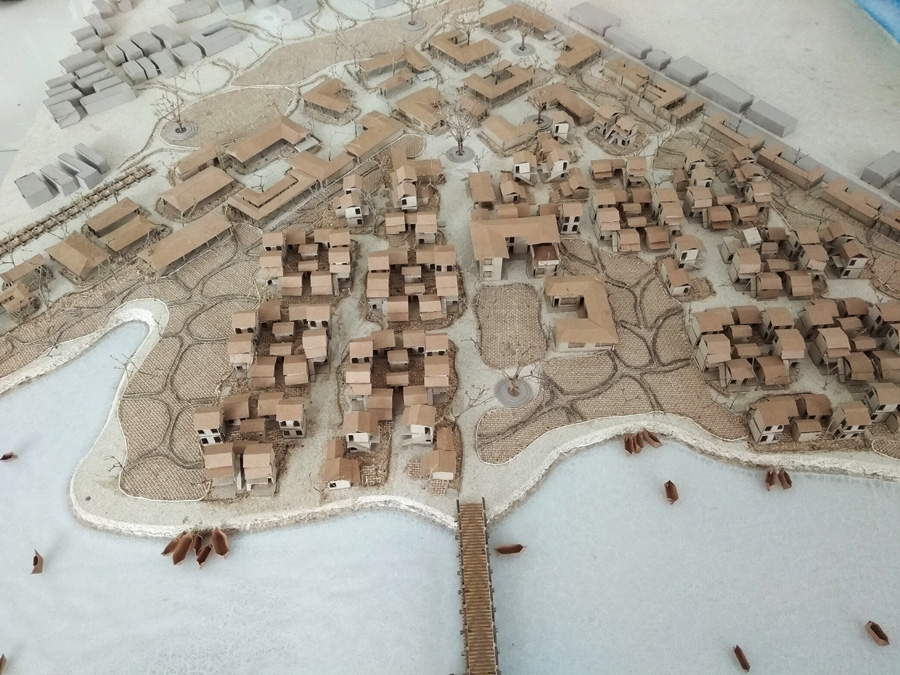
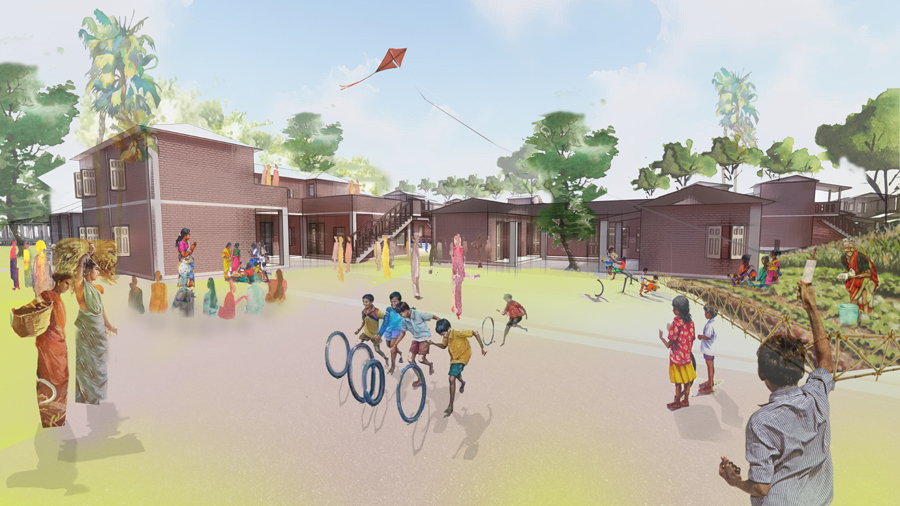
Major interventions were proposed by creating homestead within a business area with required privacy and a healthy lifestyle. Other intervention goals included creating opportunities for the sex workers to move forward (by physiological therapy for mental capability as well work opportunities); ensuring a safe and sound childhood for their upcoming babies (ensuring privacy and safe environment); opening up the space outer wards ensuring security that may help both the sex workers as well neighborhoods. Hence, the main aim of the project was to create new opportunities for women and their children by increasing interaction between the marginalized and mainstream societies. In that sense, the economic hub is the handshake point of these two communities where the sex workers can find an alternative livelihood by selling their handmade products. A training center, perhaps with collaboration of local NGO, has a particular role to play in this regard.
Hence the project rethinks the ‘bazar‘ and the ‘pora‘ vita where the ex-worker living at present and proposes a rehabilitation center, training centre, health care, school both for sex workers and their children. In the landuse plan, land parcels are allocated for agricultural production and fish farming so that the villagers are encouraged to come and mix up with them to create a socially just environment.
The core of the proposed design schemes stems out of some major realizations like: rapidly increasing demand for affordable housing as current urbanization rate is 3.15 percent, sustainable housing solutions with cost efficiency and energy efficiency; appealing aesthetically with cultural relationship. The design proposal aims at creating spaces rather than designing keeping in mind the different demands of the individual families.
Conceptual Sketches by Tanmoy Dey
The design proposal has been developed aiming the mountainous landlocked country Lesotho which had annual population growth rate of 0.68 for the last decade from 2006-2016. Basic program for designing the housing includes unit that includes two bedrooms, living cum dining space along with service functions like kitchen and toilet. But the main challenge was to accommodate all the programs within extreme budgetary design proposal for the people of Lesotho with very low annual income.
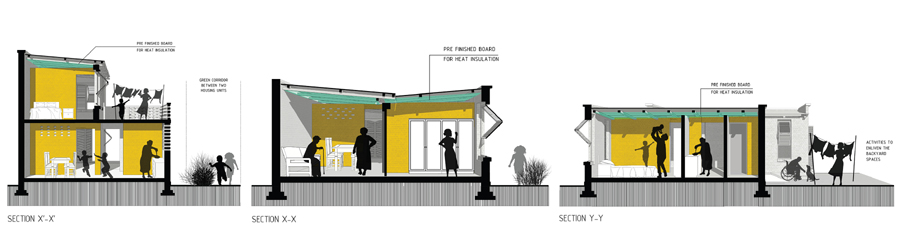
Within the extreme budgetary challenge, the design proposal has come out with innovative community involving plans along with sustainable design solution.Several convertible options kept possibilities for users in order to explore various planning for present and future as well according to the individual family needs. Families from housing units can increase their habitable spaces with several options like units of two floors with two rooms or even four rooms. Families who can’t afford to extend vertically but have need for more than two bed rooms can use up the backyard space for extension. Not only the incremental options, according to the need they can build micro unit house option with only one bed room and living cum dining room along with kitchen and toilet.
250mm brick walls are used as load bearing walls with mud plaster colored in indoor spaces and brick foundation as sub-structure. As roof framing saw pine time rafters have been used, corrugated aluminum sheets as roof sheeting, scrap or recycled wood for doors and windows; and reinforced concrete with sand and crushed stone have been used. Beneath roof optional ceiling of plywood can be used as heat insulting material as it is very affordable and available material at site. The idea of sharing kitchen and toilet between the owner and the tenant ensuring proper privacy for the house owner at the ground floor helped to minimize the footprint of the structure as well as construction cost. All these inventiveness helped to achieve the challenge to minimize the construction cost of each housing unit tentatively within LSL50,000 ($3,750 USD).
The design proposal aims at achieving healthy community interaction by arranging a yard space at the back of each house unit. Moreover, these back yards are oriented face to face with green/open space that can create playful community interaction among the families living there. Women can develop their handicraft practices at these yards as the folding doors while folded can create a common space combining the backyard and the room with the folding doors. These provisions and interventions will help the housing to achieve goal as stated before preference for created spaces rather than designed spaces. The vehicular pressure is kept on the other side of the housing units.
The six shortlisted designs for the first stage were: Tanmoy Dey (Bangladesh); Sixin Lian (Italy);Amanda Saputri (Indonesia);Gogo Zhu (USA); David Kwantwi Mensah (Ghana) and Tumelo Lerata (Lesotho).
According to the jurors, “The ingenuity of Tanmoy Dey’s team’s winning scheme is encapsulated in the simplicity of the plan and the ability of the house to incrementally expand vertically. The building can evolve into a more urban and denser environment with a good public street presence and an interior with enhanced privacy.”
The jury included: Mariam Kamara (Atelier Masōmī and United4design, Niger, and Associate Professor at Brown University); MphethiMorojele(MMA Design Studio, Johannesburg); Sam ÓghaleOboh(FAIA, FRAIC, AECOM Canada Architects, Edmonton); Peter Rich (FAIA, IntFRIBA, PRich Style & Design, Johannesburg); and Nadia Tromp (Ntsika Architects, Johannesburg).
A community design workshop will follow including the winning designer, promising design winner (local), along with low-income families and the local construction sector where the winning design will be modified and built by the Lesotho Housing and Land Development Corporation. The prototype will be used to gauge the market response as to whether it is a viable solution to the current shortage of affordable housing in Lesotho.
The present is a time, where no fixed guideline remains as to from what point of view a project should be understood or observed. Whether it be an engineer or an architect, we are to find that grey area in between, which maximizes the output of the objectives to be achieved.
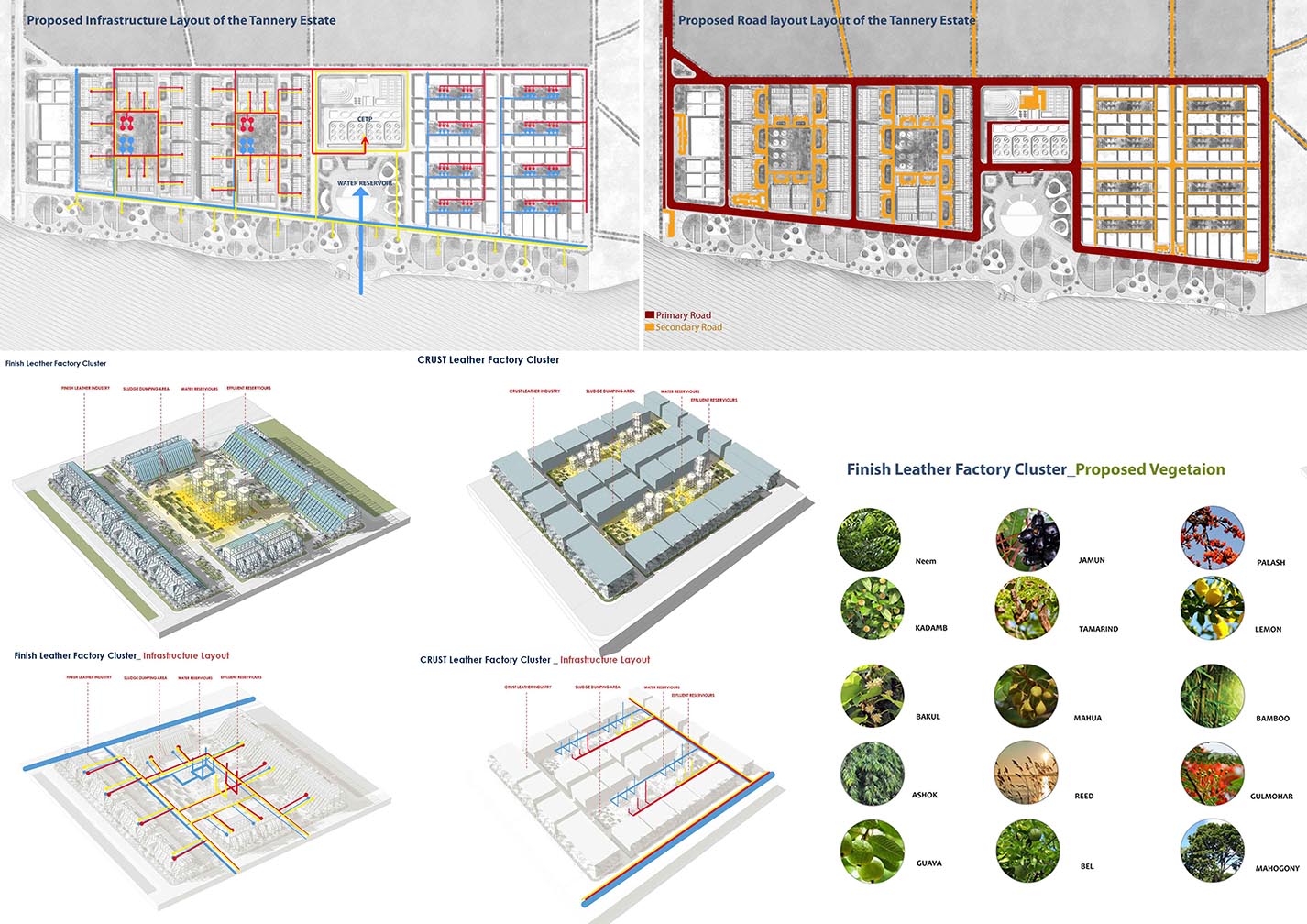
This project is based on the concept, ‘Assemblage’ which is an ontological framework developed by Giles Deleuze and Felix Guattari, originally presented in their book “A thousand plateaus(1980)”. Assemblage theory provides a bottom-up framework for analyzing social complexity by emphasizing fluidity, exchangeability, and multiple functionalities through entities and their connectivity.
The concept of assemblage is being observed in a wide variety of fields in today’s time. Now the question arises whether the same concept can be applied to address the rapid growing disruptions in an urban context.
The tannery industry is one of the thousand industries which faces this form of disruption at a massive scale. And of the many proposals to tackle this disruption, the middle ground of assemblage seems to be one of the most reasonable ones in terms of solving this crisis from the basic core.
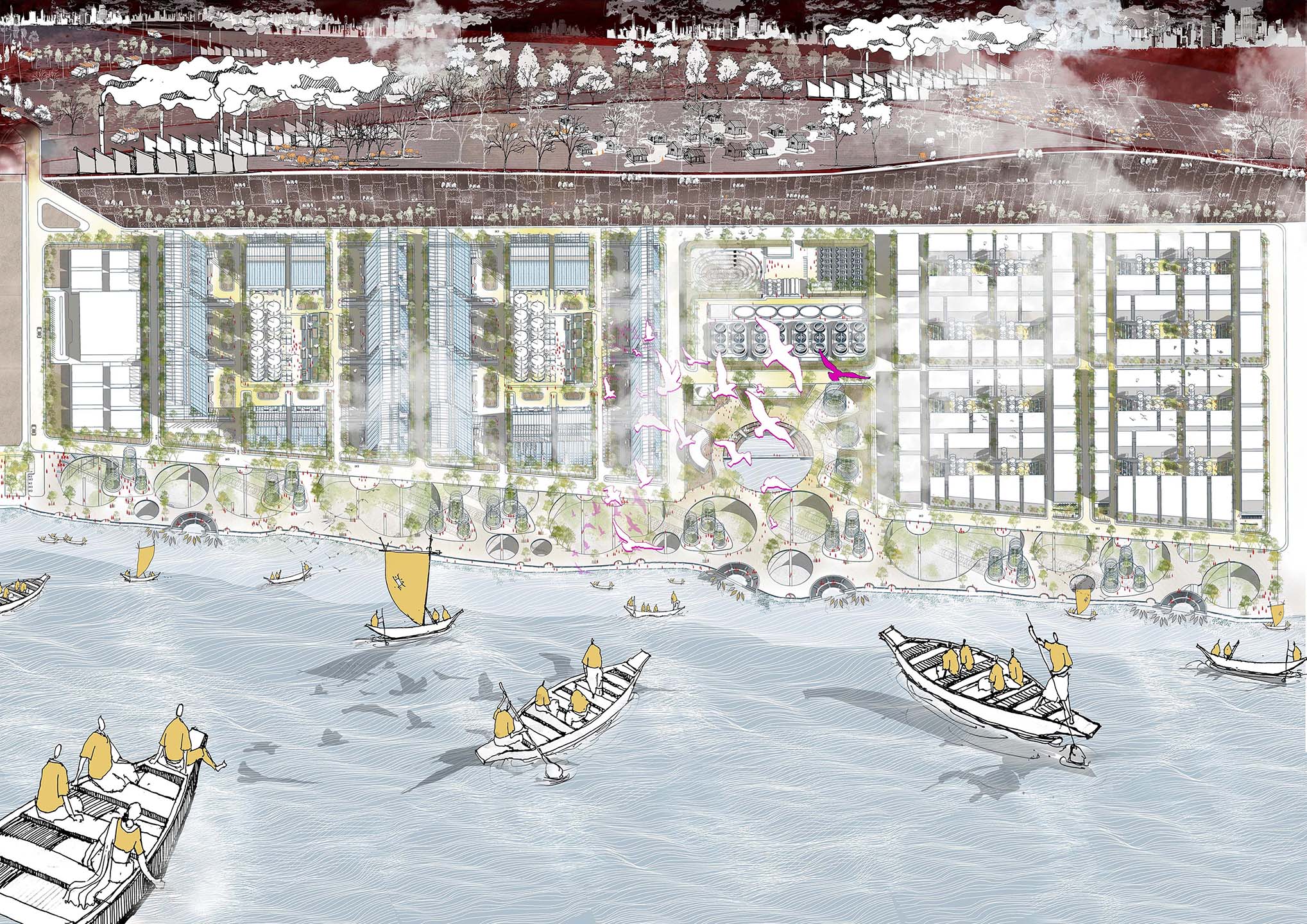
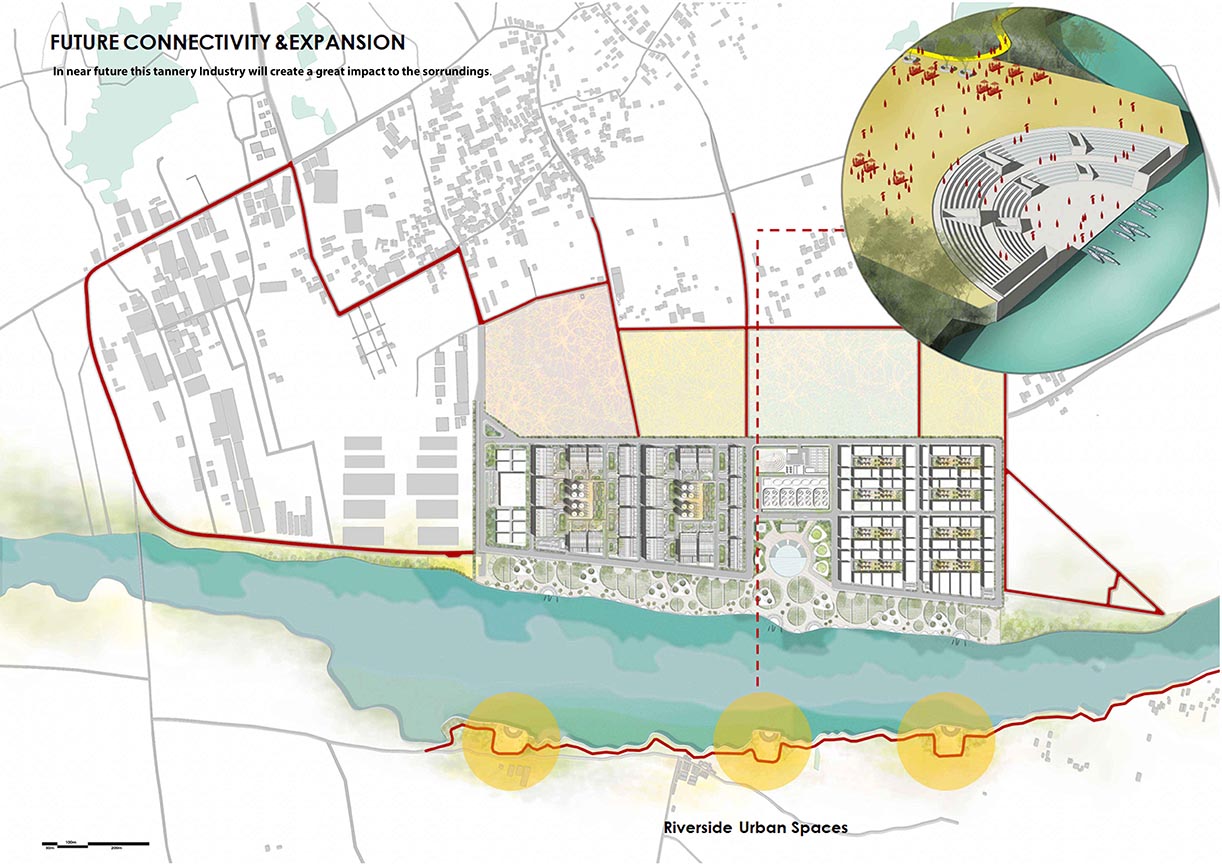
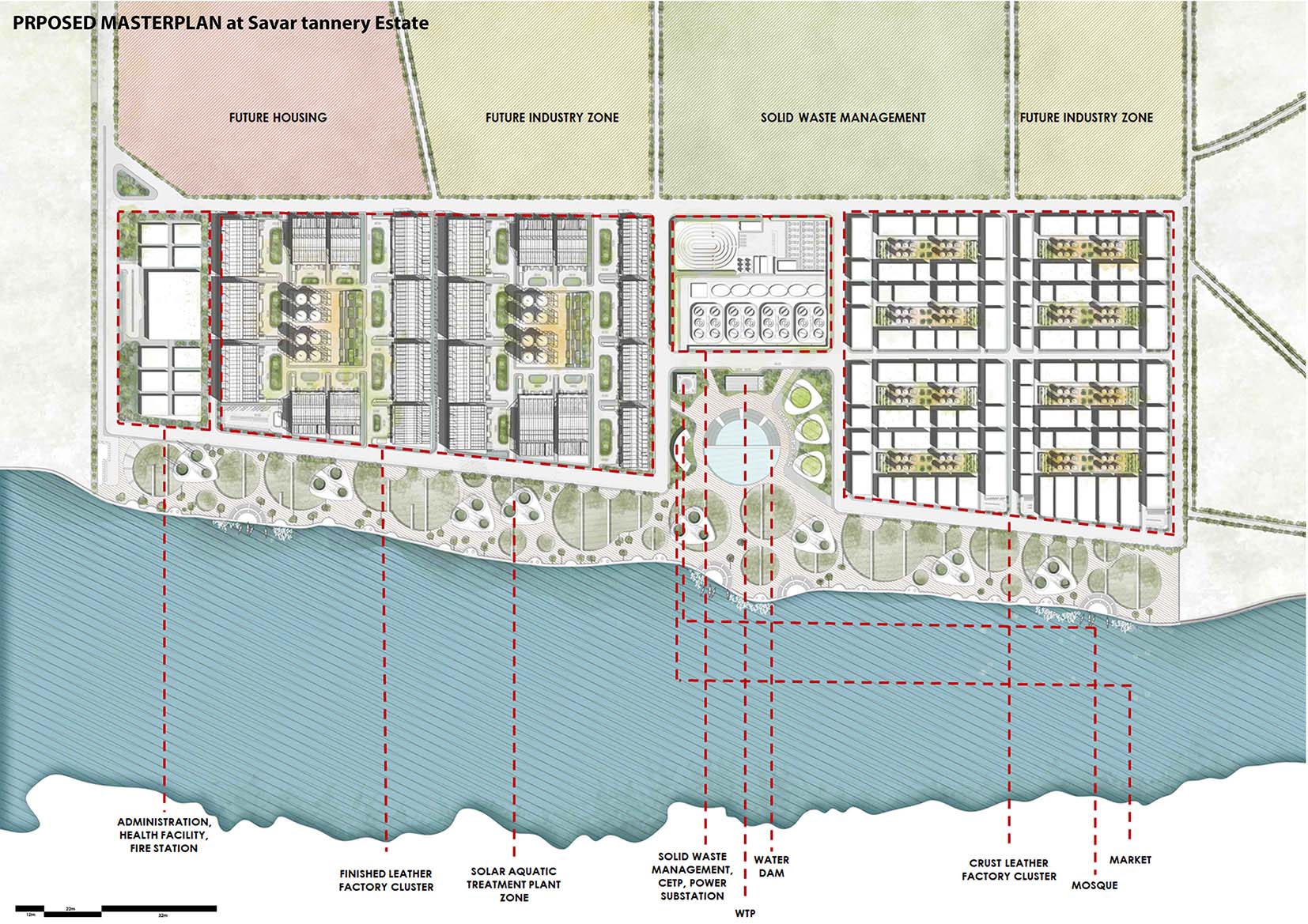
For the last 50 years, the tannery industry has grown with all its chain of networks in Hazaribag, which has eventually lead to manifold disruptions and adverse effect upon the environment, especially the Buriganga river. In recent years, the industry has been shifted to Savar with the aim of regenerating the tannery estate in a technologically advanced and environmentally sustainable way. But unfortunately most of the objectives are not achieved and with the exclusion of the social fabric of Hazaribag, the disruptions are forming with newer dimensions. The alarming part is that Dhaleswari is soon turning into the next Buriganga.
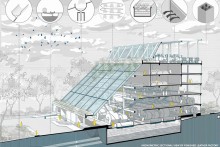
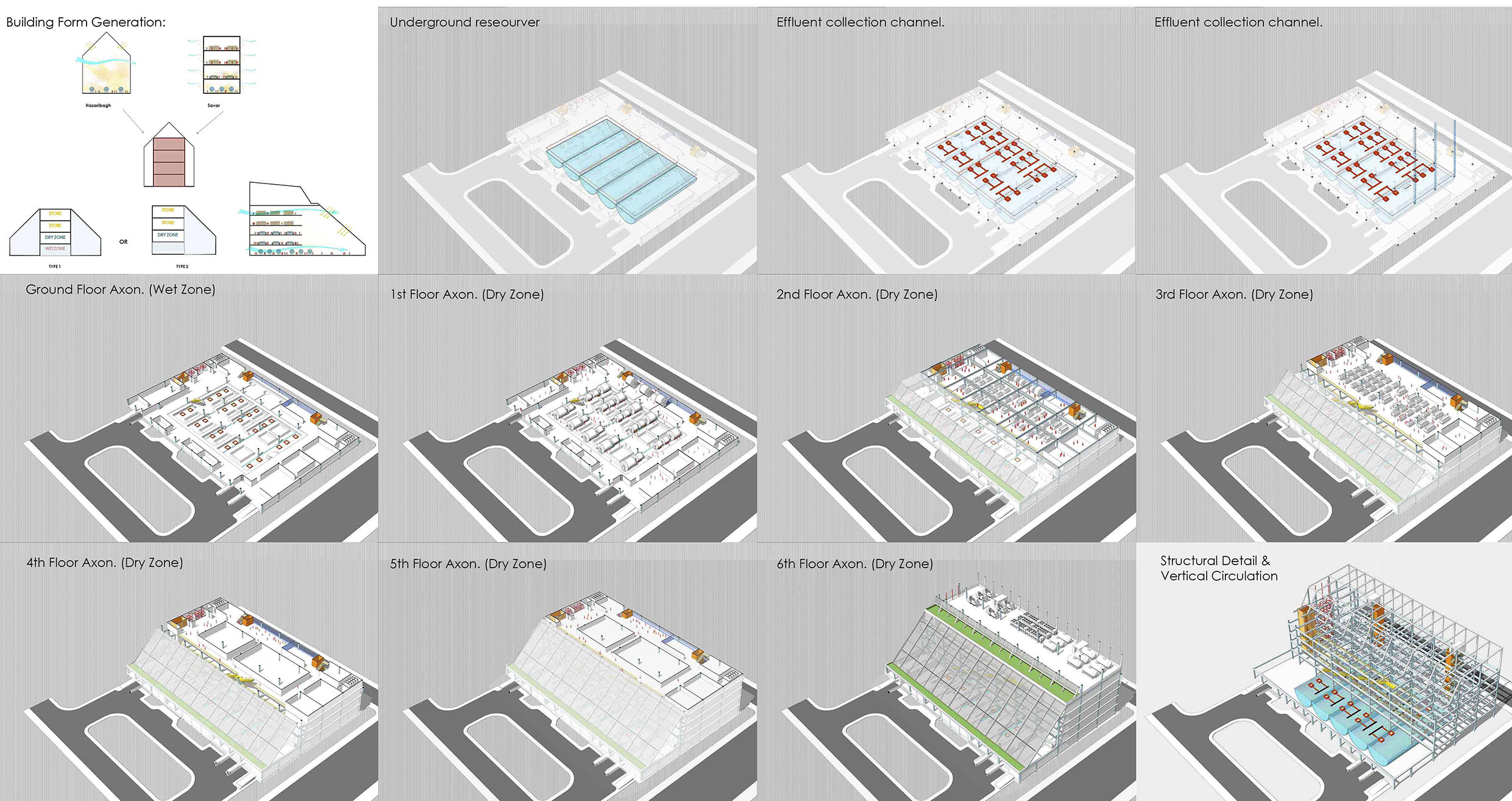
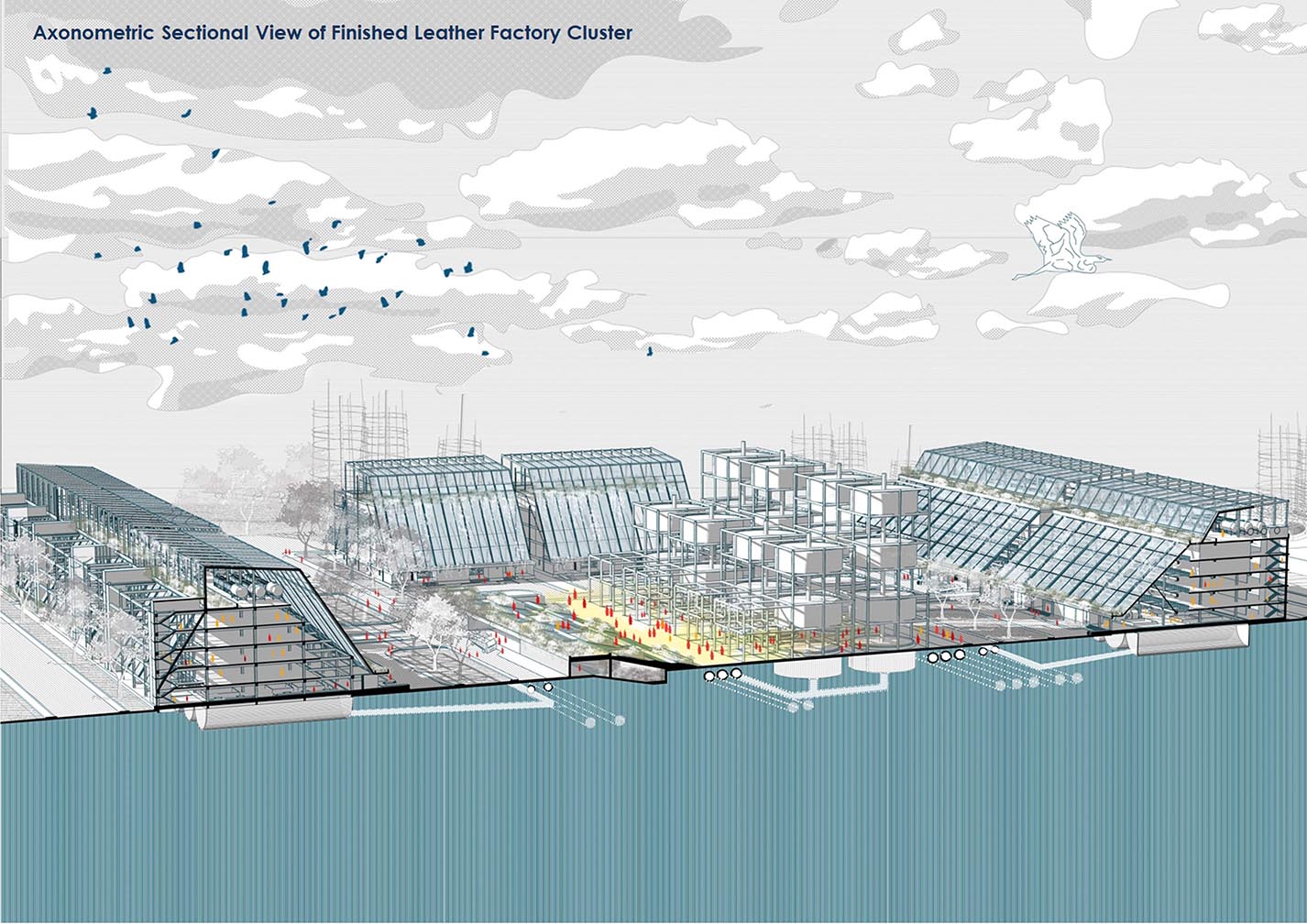
Now the main challenge was to design a new tannery estate at Savar, regaining the lost social fabric of Hazaribag and including the upcoming technologies for upgradation. The spatial design was generated following the five points of Rhizome from the assemblage theory, connection, heterogeneity, multiplicity, asignifying rupture, cartography, and decalcomania.
Starting from the building mass to the clusters and finally the entire master plan – these factors could actively decrease the predictable disruptions and generate opportunities for future adaptability from a single unit industry to the urban scale.
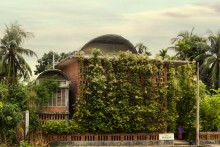
The Miazi Bari Jame mosque in Chandpur is a small community mosque designed and built for the locals through participatory design process. The mosque is located in a small neighborhood that has a great sense of community and responsibility towards each other. Mosques are not only used for the daily 5 times prayers; ceremonies like marriages or funeral also takes place in the mosque. The architectural history of Bangladesh is dominated by extravagant mosque designs with large onion shaped domes and tall minarets dating back to the Mughal Empire and the Muslim rulers from 1338 AD. Devoid of any large domes or tall minarets, the Miazi Bari mosque is a contemporary expression of architecture in Bangladesh that encompasses spiritual activities within a simple form that becomes a part of the surrounding landscape and local context.
The symbolic expressions of a traditional mosque is abandoned to create an envelope that encourages participation, interaction, expresses the local culture, climate, the daily activities and allows multiple usage of the community. The monumental feeling of a large space is obliterated by the intimate scale of the entryways, the clear and precise organization of functions and the humbleness of the form.
The roof system is designed with barrel vault to dissipate hot air and maintain interior temperature. The spacious interior allows gathering of large congregation effortlessly on its monolithic neat cement floor and naturally ventilated high ceiling. The brick pattern on all sides are cleverly created to filter the sunlight and offset heat gain on a singular surface during high temperature period. The porosity of the facade ensures visibility of the activities inside with ample ventilation. To prevent driving rain inside the mosque, a vegetated cover is provided around the brick facade which acts as the second skin of the building.
The Rangoon creeper envelops the building overtime providing sufficient shade while allowing fragrant and soothing breeze to pass through the interiors. The entire site is landscaped with selective native species to attract local birds, butterflies and squirrels to help the Mosque become a part of the existing ecosystem that adds to its surroundings and welcomes both human and nature.
True architecture is life-enhancing. To touch the souls of the people, architecture must have a soul of itself. No place of work, study, worship, play or any other human activity should be depressing inspirit. Our built environment should be in harmony with nature and human senses, uplifting the functionality of the entire community. A sensitive architect will design spaces that will evoke our deepest sensations, which will spontaneously respond to our feelings, desires and touch our souls. The spirit and spirituality of architecture is not only confined within the religious buildings, it can be present anywhere-in a classroom, in an office, in a factory or at any place. The users of a space that is spiritually sublime, naturally feel and function well in that particular space.
In addition, we are always attuned to the reality the space that we use, we understand what it says to us, whether should we stay or we should leave, does it make us feel good or irritated, would we love to come back again or not. We are always capable of picking up the subtle nuances of the ambiance of the space and when all of these senses work together in harmoniously in the favor of the space, it becomes a work of Architecture.
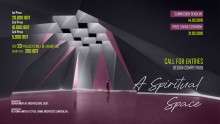
To nurture the ideas of expressing one’s soul through their design, we, the students of Architecture’14 batch, Chittagong University of Engineering & Technology are proud to organize an idea based design competition on the event of Architecture Day, 2019 on the topic of “A Spiritual Space”
Submit your ideas about your vision about a spiritual space where it will bring forth the variety of multi-functional senses ranging from silence to shouts of joy, songs, poetry, dance, ecstasy, delight and even fear.
Courtesy: Dept. of Architecture, CUET
SUBMISSION PERIOD:
Submission Starts: February 21, 2019 (00:00:01 BD Local Time) Last Date of Submission: March 14, 2019 (23:59:59 BD Local Time)
DESIGN REQUIREMENTS:
Site:
The approach & choosing of site is rested freely upon the participants. You are free to choose any existing site of any size you want for your expression of ideas. The site can be outside of your room, it can be on a river, or it can be on a foreign domain. You can design a cantilever on a hill, a glass tower in amazon, or a place of meditation under water! Just feel free to to share any kinds of ideas that you think will represent the picture of an expressive spiritual space playing into your mind. The freedom of participants in choosing the themes & site will be able to give the students ample opportunities to express their inner spirits through the designs.
Who May Enter?
Individual/ Group of 2
All the undergraduate students of architecture departments of any universities of Bangladesh are eligible to participate in this competition. The design can be submitted individually or in groups of two.
SUBMISSION FORMAT & RULES OF PARTICIPATION :
The submissions will have to be provided with site location,size & necessary drawings to give a total idea of the project. The required presentation format and rules are as follows:
1. The submission may include any necessary drawings such as
plans, sections, elevations, perspectives, rendered images etc all
compiled on a sheet including the suitable title and project brief within 500 words.
2. The dimension of the sheet is 20″x 40″ .The sheet can be in jpeg/jpg or pdf format and The maximum size of the jpeg/jpg/pdf file will be 25 MB.
3. The submission must also include a docx/doc file containing the followings:
i. Participant’s name/Group mates’ name
ii. Name of the University
iii. Current Semester No (I.e. : For Level 4 Term 1 write “4/1” )
iv. Email Address
v. Contact no.
vi. Transaction id of bkash
4. Compress all files in a .zip format
5. Upload it in google drive and send to
cuet.archday.2019@gmail.com (with link sharing to anyone)
6. The Subject of the mail Should be : ASP_Your Names_ University
Name
i.e. : ASP_Samiul Haque_CUET
or for Group : ASP_Samiul Haque_Anika Ishmam_CUET
7. Before emailing, The entrant must Pay the Registration fee via
Bkash. The Details of payment procedure is given on the
“Registration Fee” Section below. (Pleas Save the Transaction id for future reference)
8. Remember only selected Projects will be exhibited On
Architecture Day 2019 at CUET.
REGISTRATION FEE:
All participant must pay the entry fee in order to complete the Registration procedure, other wise the project will not get selected for judgement.
Entry fee is 200 BDT (+10tk bKash charge)
Bkash Procedure: Entrant must Choose the “Send Money” option and Send the money to +8801674894854 or +8801761228228. Type “Competition Fee” in the Reference Option.
Please give a call to the number after payment to confirm.
JUDGING:
The submissions will be judged by the jury panel on the basis of ideas/concepts, context, relevance, sustainability. The result will be announced on the date of Architecture Day, 2019, Department of Architecture, CUET .
(Name of the Judges will be declared soon)
Date of Exhibition: March 21, 2019
COMPETITION PRIZE:
1. The Champion, 1st Runners-up and 2nd Runners-up will receiveCrest, Certificate and Prize Money.
2.The Prize money of the Competition is as follows Champion : 20,000 BDT
Runners-up : 10,000 BDT
2nd Runners-up : 5,000 BDT
3. Other Participants will be awarded Certificate of Participation.
Terms and Conditions of submission:
*** Only Digital Submission is allowed
*** Dept of Architecture, CUET holds the right to examine the authenticity of the Project in order to confirm compliance with these rules.
*** Dept of Architecture, CUET can use the submitted projects for promotional activities but will not use any project for commercial purpose.
***Dept. of Architecture,CUET & the Jury Panel holds the right to immediately disqualify any submission that is proved to be a copy or replica of any previously designed project.
Right to cancel or suspend the competition :
If, for any unforeseen reason the competition is not capable of running as planned or any other causes beyond the control of Dept of Architecture, CUET that hampers smooth operation of the competition, Dept of Architecture, CUET reserves the right, at its sole discretion, to disqualify any individual(s) who tamper with the entry process, and/or to cancel, terminate, modify, or suspend the competition.
or You can email us at – cuet.archday.19@gmail.com
We are waiting for your submission . So, hurry up !
Frequently Asked Questions About the Competitions (FAQ):
1. When is the Submission Deadline?
=> Submit within March 14,2019
2. Can I Participate if I am not from CUET?
=> Yes you can. “A Spiritual Space” is an Inter University Design Competition. Meaning any Undergraduate Student of Architecture of any University of Bangladesh can participate.
3. Do I need to Register Before?
=> No need. You will only register when you are Ready to Submit your project.
4. How to Register?
=> When you are ready to submit your project, Send us the Entry fee via bkash. Then send us the doc file containing necessary information and the images of your project (maximum 10) via email. That’s it!
5. What to send if I want to do the project by hand drawings? => Simple! Scan the drawings and make jpeg files (maximum 10). Then send it according to registration process. Remember only digital submission is allowed. So email only.
6. How to submit via email? => The submission may include any necessary drawings such as
plans, sections, elevations, perspectives, rendered images etc all
in jpeg/jpg/pdf format. The jpg/jpeg/pdf files must not contain any
kinds of identity i.e. Name, University Name, ID No. etc. of the
individual.
-The limit of jpeg files is maximum 10 per entry.
-The submission must also include a docx/doc file containing the followings:
i. Participant’s name/Groupmates’ name
ii. Name of the University
iii. Current Semester No (I.e. : For Level 4 Term 1 write “4/1” )
iv. Email Address
v. Contact no.
vi. Transaction id of bkash
vi. A Suitable title and description about the project within 500 words.
-Compress all files in a .zip format
-Upload it in google drive and send to
cuet.archday.2019@gmail.com (with link sharing to anyone)
-The Subject of the mail Should be : ASP_Your Names_ University
Name
i.e. : ASP_Samiul Haque_CUET
or for Group : ASP_Samiul Haque_Anika Ishmam_CUET
7. How do I send the Entry Fee?
=>Entry fee is 200 BDT (+10tk bKash charge)
-Choose the “Send Money” option and Send the money to +8801674894854 or +8801761228228. Type “Competition Fee” in the Reference Option.
Please give a call to the number after payment to confirm.
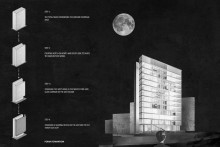
Eastern Sun is shining through the ceramic etched glass fins, standing straight and high like the emergent layers of the tropical forest facing all the odds to protect his habitats. One is seating in the table at his designated territory of the office building enjoying the glorious morning light through the filtered surface, breathing the purified air and mingling with his colleagues around the spaces. Spaces that is more informal towards the eastern wing, creating vertical connectivity through the office floors creating a break among all the formal tasks. A pause between all the rush, a space to think all the thin lines and try to rejuvenises through the conversations. When people are spending more time in the work places rather than the home, then we have to think the spaces in a different way. Ways that makes the user feel more adaptive and healing. Then a space is created, shining in the morning, lighted throughout the day, protect from the evils and stand high in the artificial jungle.
During the past few years, we are discovering how the built environment affects our psychological state and long term health. But few are creating examples for others to follow, to change the way we observe the city, the place we mingled. The demand is changing, so the functions, functions to communicate, to connect. The changes in the functions pushing the surface of the Architecture towards a new horizon, trying hard to set another new brick in the wall.
Approaching from the west end of the road, one can feel the verticality of the structure, the slenderness of the form. The land was the challenge to distribute all the spaces in a poetic manner. Still one can enjoy the entrance through the lobby and the controlled reception area to maintain a secured circulation. Multipurpose hall situated nearest to the ground for easy access. The interactive spaces like the dining, gym and the play rooms are placed in between the main office floors for creating a walking community inside the office. The majority of the work force are concentrated around this common functional spaces.
How about meeting in steps, like an amphitheater, where the light is brighter than the other places and environment is more informal. 12 to 16 people can easily gather around those steps and have their conversations. For a more formal meetings one can enjoy the room beneath those steps. It is like an inter-related furniture which works in a both way, meeting needs for the different users. The roof is double height above the steps, so one can join the meeting from the upper floors too.
The more you move towards west wing to east wing, the office spaces are getting more informal and interactive. We have revisited the visitor’s space and introduced the POD (Informal meeting cubicle) systems through the east surface. So one can have their conversations with the visitors without interrupting others, in a more cozy way.
The function is more clean and simple to provide all the service and utility works in a cost effective and sustainable way. The clients want the building to be a GREEN one and get the PLATINUM certificate from the authorized body. To think the whole building in such a way, many possibilities have been applied, approached and viewed. Here we have proposed LEED, or Leadership in Energy and Environmental Design, the most widely used green building rating system.
We have planned the building considering the site geographical and climatic condition. To reduce the heat gain and use the maximum amount of daylight throughout the day, the surface of the building is designed.
The journey through the design process raised many ideological obstacles from different perspectives. We have tried to dig into the subconscious networks for the answers and build a coherent Architecture for IDCOL. Where all the major factors are noticed and the functions are placed in a harmonious way to create a piece in urban environment.
The aim of this project is to build a platform which would provide all the facilities required for the people interested in the field of research on nature. By this project, people may aware & may know about coral asset in our country. The proposed “coral conservation research and recreational center” is proposed to be constructed in west site of Saint Martin island. The project would provide research facilities & recreational facilities to save the coral of saint martin which is now in peril.
Saint Martin Island, Bangladesh
Saint Martin, the one and only coral island of Bangladesh where coral communities extend to about 200m offshore of st. martin’s island with maximum coral cover of 7.6% and colony density of 1.3m-2m. The island has 66 hard coral species. the most common are porites, acropora, favites, goniopora, cyphastrea and goniastrea. There are some unique coral reef species which are only available on Saint Martin within this sub-continent. Reefs are home to a variety of animals, including fish, seabirds, sponges, cnidarians, worms, crustaceans, mollusks, echinoderms, sea squirts, sea turtles and sea snakes.
But day by day coral is being damaged for uncontrolled fishing and tourism. the government declared the island as Ecologically Critical Area (ECA) in 1999, but did not take any major initiative under the declaration. It’s the time to protect & preserve the ecosystems of coral reefs of Saint Martin. This project location is on the west side of Saint Martin which is also in the new proposed master plan for Saint Martin by Cox’s bazar development authority.
There are mainly two functional areas of the project: Research lab and Museum. Creating a space, where researchers & general people meet in a common platform to protect the coral reef. Which will be a ’floating structure on the ground’. as the site is so close to sea and home of many marine habitats such as green turtles and crabs, I want to create a floating structure where men will move on the upper part and the lower part will be free for marine habitats. It will work as a live museum for tourist.
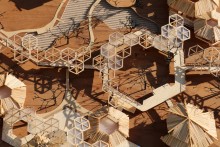
Concept comes from coral formation. The form of the structures inspired from shape of coral unit which is hexagon. Each hexagon unit joins with two or more and creates an ultimate organic form which runs with the topography. Saint Martin is an island where wind direction changed 3 times of a year. so organic form is the only solution to deal with this situation.
The initial concept of my design was to utilize the site forces, such as plantations, topography, adjacent sea. So, at the beginning of the design I tried to identify zoning of the program on the basis of topographical drawing, plantation pattern and air flow diagrams. when I start the master planning of the project with zoning, I start thinking about a focus point which would guide the circulations throughout the landscape. to generate such a linear space which flows forward to the sea and try to create relation between academic activity & the existing water body.