The idea project SHOMONNOY | COMMUNITY BASED SYNCHRONIZED SLUM UPGRADATION by team Onushongo has won the Urban Innovation Challenge, 2018 in ‘Low-Cost Urban Housing’ category. Organized by BRAC, the competition promotes innovative social entrepreneurs to solve various urban challenges across five categories: Climate Change, Healthcare, Low-Cost Urban Housing, Renewable Energy, and WASH. Drinkwell, Nirvana, Jotno Healthcare, City Bird and Onushongo are the five social entrepreneurs among 13 shortlisted finalists, who won the competition this year.
Courtesy: Team Onushongo
BRAC launched the Urban Innovation Challenge in 2016 to identify passionate innovators who are ready and willing to tackle pressing urban related issues. This year the competition strongly focused on several ‘Sustainable Development Goals’ including climate action, affordable and clean energy, sustainable cities and communities etc. On November 27, 2018 winners in all five categories were announced by the organizers. Team Onushongo, a group of young architects from BUET – Moinul Alam, S.Y. Andalib, A.K.M Saleh Ahmed Anik, Shuvo Datta, Umor Faruk Sanim, B.M. Tahammul Kabir and Sampad Khalifa won the award in ‘Low-Cost Urban Housing’ category. The team proposed a unique solution for slum areas of Dhaka to establish a masterplan with the help of technology, research, community attachment and phases, which will blend easily with their lifestyle, avoiding gentrification and marking a positive long-term impact. This way, it will work as a sustainable approach to make slums a livable space for the 3.5 million inhabitants.
Wondering what is so special about rickshaw? Isn’t it something that blame for causing traffic congestion in the city? Isn’t this ‘slow moving’, ‘unsafe’ transport unfit to keep pace with the fast-moving modern city? Isn’t the subaltern rickshaw puller causing social nuisance in the city? Should it not be evicted from the urban street anyway?
Well, this is how ‘rickshaw’ has been defamed. At present, only in few countries in Asia, rickshaws are still plying on the street, but for many it is often considered as the deplorable history. Obviously, ‘rickshaw’ is not the ‘perfect’ vehicle; but it deserves a more sensible and positive perspective considering its 150 years long history, its role as a convenient, environmental friendly, alternative mode of transport for the city dwellers and its contribution to absorb a large marginal group of urban population by creating employment opportunity. Nevertheless, growing consensus to promote car free, bicycle friendly city in order to limit high carbon footprint of automobile and shifting focus towards a more compact city, further highlight the importance of a new, changing perception about rickshaw. In fact, several attempts were taken in the past to improve the mechanical efficiency and design of the rickshaw, but for some reasons none of those improvement works could make any meaningful change to its existing form. The overarching goal of this work is to shed light on this least explored, often neglected mode of transport- the rickshaw- firstly by documenting its design features and secondly by providing some possible design improvement from holistic perspective considering its historical, mechanical, artistic, socio-economic and cultural significance.
A brief history of Rickshaw: Predecessors and Descendants
Rickshaws are commonly believed to have been first invented in Tokyo, Japan in 1868. Sources often credit Izumi Yosuke, Suzuki Tokujiro, and Takayama Kosuke as the co-inventors of rickshaw. The earliest form of rickshaw is known as Jinrikisha (人力車, 人 jin = human, 力 riki = power or force, 車sha = vehicle), which means “human-powered vehicle” [1]. It was basically two wheeled cart pulled by a human known as ‘Coolie’. Due to its huge popularity, rickshaw was quickly spread to China (Shanghai), Hong Kong, Singapore and Vietnam. Initially it was a private transport. Later, by the end of 19th century, it became an inexpensive mode of public transportation across Asian cities.
In South Asia, Japanese ‘Jinrikisha’ first appeared in Simla, most probably through northwest Indo-China border. It is interesting to note that rickshaw was an entirely urban transport and mostly concentrated at the capital cities. But in India, its initial presence at Simla was an exception. However, later in the beginning of 19th C, it was introduced in Kolkata. A common consensus is that Dhaka got rickshaw from Kolkata. However, such human pulled rickshaws, which are still evident on the street of Calcutta, were never common in Dhaka [2]. What we see in Dhaka is known as ‘cycle rickshaw’.
Now question is who invented this cycle rickshaw? The history of cycle rickshaw is not well documented as ‘Jinirikisha’. Multiple countries including Cambodia, Thailand, China are claiming the credit as the inventor of cycle rickshaw, but those claims are not beyond dispute. However, record shows earliest version of the cycle rickshaw was evident in Singapore (1915), Vietnam (1939) and Thailand (1933). Its worthy to note that the form of cycle rickshaw has been developed incrementally over times and its present forms are not same all across Asia. Broadly speaking there are three distinct types based on the configuration of passenger-driver seats:
Trishaw: This is the most rudimentary form of cycle rickshaw which was first appeared in Singapore. In trishaw, the passenger seats are usually located beside the driver in a side car. This type of cycle rickshaw is also seen in Philippine (Padjak) and Myanmar (Sai kaa).
Cyclo/ Becak : In this format the driver’s seat is located behind the passenger. It was designed by a French called Pierre Coupeaud and first manufactured at Phenom Penh, Cambodia. However, it was first introduced as public transport in Saigon, Vietnam followed by Indonesia and Malaysia (Becak).
Rickshaw: It is the most common type, where the driver sits in front of the passengers. The county of origin is in dispute; however, few unofficial sources noted Thailand as the inventor for this type of cycle rickshaw. In Bangladesh, India, China (San lunche) and Thailand (Samlor) this type of rickshaws are readily seen.
Rickshaw in Bangladesh
In Bangladesh, the first rickshaw is said to be imported from Calcutta in 1938 by the European jute exporters living in Narayanganj and Netrokona (in Mymensingh) for their personal use. However, its use as public transport in the urban street of Dhaka was first recorded in 1941, when its number was limited to 37 only. In last 75 years its number has increased to 1.1 million [3]! Despite its explosive growth, rickshaws have been almost entirely overlooked by policy-makers and there were several attempts to phase them out. Robert Gallagher, a British urban specialist and former faculty member in URP, BUET and author of the book -‘ The Rickshaws of Bangladesh’ (1992) mentioned, “this oversight is largely because the rickshaws are seen as inefficient, inhumane, and a symbol of under-development”. Due to this negative view, several experiments to improve the design of rickshaw in past actually never saw the lights.
“Rickshaws generates every year BDT 374 billion (approx $4.8 billion), sufficient to run whole Bangladesh for about a month and a half.In these sense, rickshaws lead the transportation sector even compared to air and rail services.” [4]
“The money supports almost 1.5 million rickshaw pullers and their families directly. Indirectly, this non-motorized vehicle supports a few million more including mechanics, painters, workers, parts suppliers and helps sustain the demand for roadside food vendors.” [4]
We, therefore, echo Gallagher (1992)- “It would be best to accept them, and plan for their future accordingly”.
Rickshaw and its sub-types
In the past, number of scattered attempts were taken by both GO and NGO to improve the design of rickshaw. For instance,
_In 1979 Bangladesh University of Engineering & Technology (BUET) had developed two different rickshaw prototypes.
_In 1983 Bangladesh Small and Cottage Industries Corporation (BSCIC) produced three rickshaws based on the BUET model.
_During early 1980, Inter Pares is a Canadian NGO, produced several experimental rickshaws with a tubular frame and jute plastic seat.
_In 1986 FredWllkie, a cycle engineer from Canada who was brought by Comilla Co-Operative Karkhana (CCK) organization, produced five models of Rickshaw.
_In 2015-16 CARC of BRAC University with funding from infrastructure Development Company Limited (IDCOL) implemented prototypes of rickshaw-vans with PV support and torque sensor pedal
Most of these model rickshaws were focused on the improvement of mechanical efficiency, hence used metal frame replacing the traditional wooden passenger seat structure to reduce the weight, lowering the foot-board height for better ergonomics, improved suspension system for better comfort and braking system for smooth and safe operation of rickshaw. Some of the proposal also included overhead shade for the driver. In recent time few improvement proposals also included solar panel on experimental basis. Sometimes effort has been also made to make it faster by adding battery driven motor. We argue that such so called improvements deserve criticism because of its predominant focus on increasing mechanical efficiency. One of the most absurd example of such modification is ‘electric rickshaw’ which is highly unsafe, erroneous and energy hungry. We must not forget, traditional form of rickshaw is crafted for slow movement, short distance commuting by combining local material and knowledge and adorned with very special kind of artworks. A rickshaw in Bangladesh is more than just a transport, it’s a means of livelihood for a considerable population group, it’s a moving display of a Bengali folk art. Therefore, the low tech, low maintenance, zero carbon footprint and artistic features should be the key considerations for any future vision of rickshaw. We should also consider its strong tie with marginal social groups and micro industries. Nevertheless, rickshaw has strong mental image, any drastic change in its form and material for the sake of its mechanical efficiency might not be socially accepted.
One of the primary aims of this work is, therefore, to generate ideas on various design improvements of cycle rickshaw and its sub-types. By sub-types we mean, all other types of non-motorized vehicles made for varied purposes that make use of the whole chassis of the rickshaw or some parts of it. We have identified three basic types of NMT based on its uses/ purposes:
Passenger Vehicle (3 wheeler; example: Rickshaw and School van)
Cargo Vehicle (3 wheeler; example: Rickshaw van and covered van)
Mobile shop (2 or 4 wheeler; example: Food carts, fruit/ vegi cart etc)
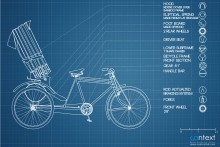
In the first phase, we have produced the scaled drawings of all the non-motorized vehicles that are plying on the urban streets of Dhaka. The CAD file of this drawings are available for download. We grouped them under the above-mentioned classification. We observed, with due respect to indigenous wisdom, these vehicles significantly lack fundamental ergonomic requirements, passengers and drivers comfort and safety etc. We also believe that only improvement of its form can barely solve the problem, rather equal emphasis should be given for its planning and operation in the street. Special program should be taken to train up the drivers about road rules and safety.
In phase two, our study will focus on the scope of potential design improvements particularly for the passenger vehicle (rickshaw and school vans). We welcome all the promising ideas, critical thoughts or any sort of volunteer participation to make the design process more inclusive and engaging.
For the drawing files and/ or volunteer participation in the design research please contact:
The Rohingya people are one of the most ill-treated and persecuted refugee groups in the world, having lived in a realm of statelessness for over six generations. According to UNHCR an estimated 899,349 Rohingya have been driven into Bangladesh. Over half of them are children. A total of 33,131 registered Rohingya refugees are living in two registered camps in Cox’s Bazar, and up to 80,000 additional refugees are housed in nearby makeshift camps. Overall, the living conditions of Rohingya refugees inside the overcrowded camps remain dismal. Mental health is poor, proper hygiene conditions are lacking, malnutrition is endemic, and physical/sexual abuse is high. And children are losing their childhood without any memory to recall.
The design team reviewed several documents on Rohingya refugees, visited a registered refugee camp at Thaingkhali, collected case reports and conducted a series of meetings with stakeholders.
During the visit, the team tried to identify the faults of the local techniques practiced by the local artisans in their rapidly erected sheds.
The Client was looking for a Child Learning Center for orphans who are spending childhood in camp and deprived of basic human needs. The project aimed to generate some spaces to provide them a proper childhood full of memories.
At present, the unplanned temporary sheds are constructed by local workers according to guidance and space requirement of different NGOs which offer very poor ventilation and natural lights. And this is reported as uncomfortable for human living. On top of that, the temperature goes high in summer and an extra power supply is needed to keep the space in the comfortable range.
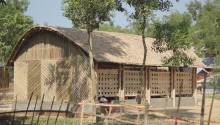
The team focused on this issue with utmost priority to ensure enough natural lights and air circulation through the interior spaces installing perforated north-south façade. Bamboo columns were placed on a designed concrete post to detach the bamboo from the floor, which secured them from termite.
The design was inspired from local construction techniques and craftsmanship of Rohingya community. The roof was specially considered to make the shed more sustainable and comfortable. In between two sheds some play areas were designed to attract the neighborhood children.
The team stayed at the construction site during the construction phase for two weeks and helped the workers at first hand to adopt the details with sketches. On-site decisions were taken consulting with Rohingya artisans and construction workers who are expert in bamboo works. With a seating capacity of about 300 students distributed in two sheds, the design approach has become very popular and many other similar sheds are being made in the camp now after the inauguration. It is also reported that the students of this school are using these sheds for sleeping at night as they get enough air ventilation which is missing in their homesteads.
The design intention was not to make something complicated and flashy rather empowering the community with some simple detail techniques that they practice. The materials were chosen according to availability that ensured a sustainable and locally accepted solution. This project is a humble attempt to restore human-nature connection by generating a child-friendly playscape in the dense context of the refugee camp.
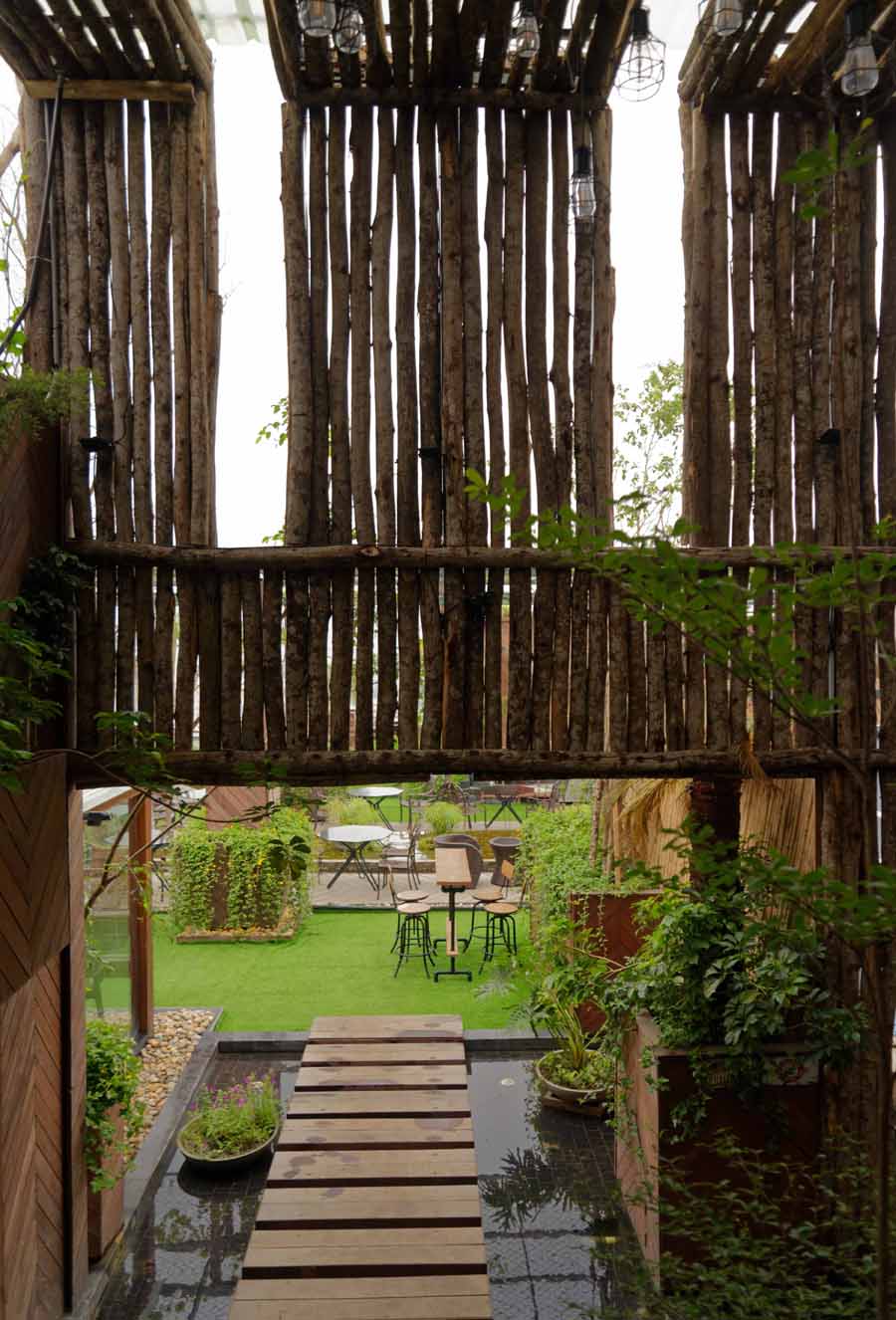
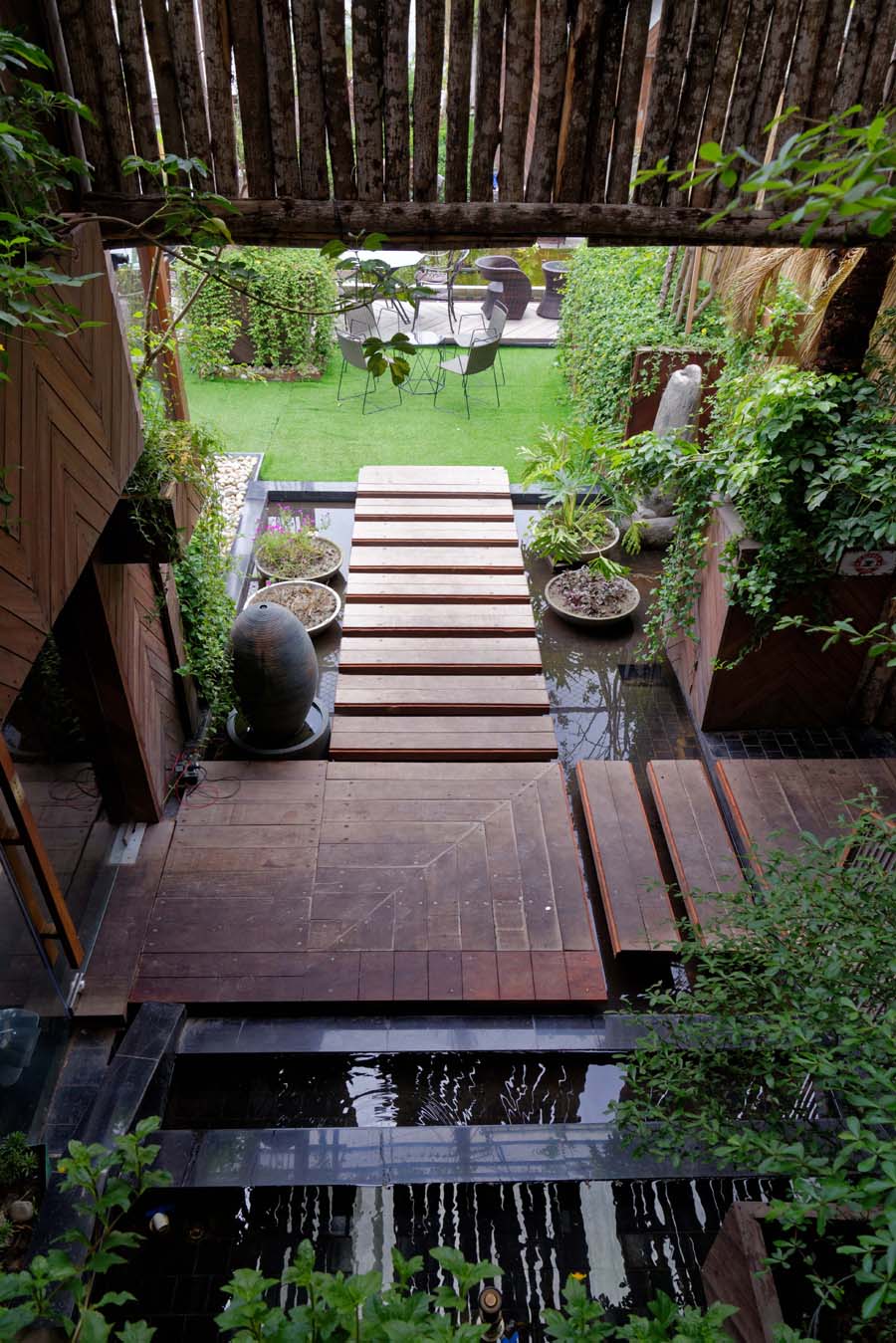
As lives are increasingly getting urbanized, the connection with nature, natural light, green space and organic materials are gradually disappearing. Such transformations are causing lives in such cities to be unendurable. This project is a humble attempt to restore human-nature connection by mimicking the ‘groundscape’ on the hard surface of urban rooftop while offering the visitors a ravishing green experience.
The context demands for a space to be developed where the users can transcend themselves from hustle and bustle of the city and have a deep breath. The idea of the design has been derived from the retreat to a countryside that the city dwellers do to recharge themselves with the charms of the nature. Involving the sounds of the flowing water, tweets of the birds and rustling of leaves, these are depictions of the countryside that have enriched the intended flavour for the project. Here in this project architecture seamlessly blended with nature.
Here spaces are derived from the architecture of villages. Ghat chemistry, courtyard, river edge, pond detail, vegetable cultivation structure, seating under tree, village house form, rural landscape, boat on river edge, jungle and ground figure relation between soil and trees are the metaphors that finally imparts a merger of physics and chemistry of the spaces.
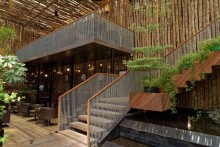
As the project faces west, a tall tree trunk- made wall and natural trees have been incorporated to cut the scorching sun. A large ( 120’x50′) MS mesh made see through green canopy is developed for exaggerated the play of light and shadows, further giving a sense of enclosure.
As such the project is a combination of indoor and outdoor spaces that are constructed mostly with steel supplemented with the incorporation of trees, bamboo structures in cases. High-tech glass works have been incorporated to some challenging areas. Customised attempts are made for the steel structures are painted with green colour to merge with the concept of nature. The project is a fair example of what can be done at roof level at any high rise building.
Though the tensile membrane evolved in twentieth century but it has historical linkage with lightweight tents. These tents are being used in various activities for a long time in human history ranging from the use of nomadic tents to war tents as well as in disaster relief. Tents are lightweight and portable, hence less interventions are required to install them. These qualities of traditional tents have been transformed into modern Tensile Membrane Architecture. Philip Drew discussed the historic relation of tents to contemporary tensile membrane architecture in his book ‘The New Tent Architecture’. Where he compared the traditional Arab Bedouin black tents with tensile membrane structures and discussed its similarities. But unlike tents, tensile membrane has some unique characteristics such as it requires tension in fabric to be in equilibrium for its stability and to resist wind uplift force, double curvature of the fabric, translucency, optimized patterning of the fabric, fire retardancy and self-cleaning properties. Due to the lightweight character of the membrane, the tensile membrane structure is also considered as ‘Lightweight Structure’.
Basic forms of Tensile Membrane StructureDouble Curvature in Tensile Structures
The development of contemporary Tensile Membrane Structure occurred in twentieth century Europe. Many architects and engineers contributed to the development of lightweight architecture. Among them most notable names are Spanish-Mexican Architect Felix Candela for his contribution in thin shell concrete structures, Italian Engineer and Architect Pier Luigi Nervi contributed in the development of innovative lightweight concrete structures such as Air craft hanger, Orvieto, Italy 1935. The German Architect Frei Otto devoted his life for the development of the tensile membrane structures. After the world war II Frei Otto began experimenting with tents for quick shelter. Frei Otto founded the famous Institute for Lightweight Structures at the University of Stuttgart in 1964, where he experimented tensile membrane structures. He coined the term ‘Form Finding’ which is a special form searching process for a equilibrium form via several iterative steps. Some of the most influential works of Frei Otto are German Pavilion of Expo ’67 and Munich Olympic Stadium 1972. In the later part of the twentieth century tensile membrane architecture spread all over the world especially in Middle East due to its resemblance to Arab Bedouin tents. One of the largest tensile membrane structures was Jeddah International Hajj Terminal. Which was inaugurated in 1981. It was designed by Bengali-American Engineer Fazlur Rahman Khan of Skidmore, Owings and Merrill (SOM) and engineered by German-American Engineer Horst Berger. The fabric was fabricated by Birdair, USA and the steel was fabricated by NKK, Osaka, Japan. Horst Berger was one of the leading tensile membrane structure designer of twentieth century. He engineered many iconic tensile membrane among them most notable membrane structures are King Fahd Stadium in Saudi Arabia, Canada Place in Vancouver, Canada, Denver International Airport in USA, and Cynthia Woods Performing Arts Pavilion in Houston, USA.
The main design challenge of a Tensile Membrane is its form itself. The form of Tensile Membrane is achieved through defining its boundary conditions and support elements. The ultimate form is found through an iterative process named as ‘Form Finding’, the equilibrium of tensile forces act on the membrane and then distributed to the ground. The mathematical concept of Form Finding is based on minimal surface of soap bubble, now a days this form finding process is done through software simulation. After form is finalized the nonlinear analysis is done to check wind load and water ponding. Pattern making is done afterwards to make the three dimensional Membrane from two dimensional flat fabric.
There are several basic forms of Tensile Membrane Structure such as Hyper shape, Wave form, Conical form, Arch form and Cushion or Pneumatic Structure. Many forms and shapes can be achieved from the combination of these basic forms. The surface of the tensile membrane structure typically has a double curvature profile. There are two types of double curvature depending on their orientation, one is anticlastic curvature another is synclastic curvature. When the surface is curved in opposite ways in two direction, it is called anticlastic curvature and if the surface is curved toward the same side in all directions, it is called synclastic curvature. The example of anticlastic shape is a simple hyper shape which is consist of two high points and two low points. And the example of synclastic shape is a cushion form.
There are various types of Membranes which are used in Tensile Structure. Among them the most commonly used are PVDF(Polyvinylidenefluoride) coated PES (polyester), PVC(Polyvinylchloride) coated PES, PTFE (Polytetrafluoroethylene) coated glass fiber. PTFE coated glass fiber coated fabrics are the most expensive and difficult to handle but the longevity of this fabric is excellent. PTFE coated glass fabric can last more than 30 years. PVDF coated PES fabric is comparatively less costly, the longevity of the fabric is medium but the cleaning maintenance and handling of the fabric is easy. On the other hand PVC coated fabric is less expensive, the life span is relatively small and the dirt is easily deposited on the fabric. The overall thermal performance of the fabric is quite comfortable. Around 70% of the incident solar radiation is reflected, 10% absorbed and rest is transmitted. The acoustical performance is not good but special fabric with higher acoustical performance is available. PVDF coated fabric is fire retardant which means it will self-extinguish and prevent the fire spread out. The PTFE fabric is fire resistant. Translucency is an important character of Tensile Membrane. Due to translucency interior space will be lit and less energy will be required during the daytime for interior lighting. The overall light translucency of these fabrics are around 10 to 12 percent but the translucency of the PTFE coated PTFE fabric can be up to 50%. The translucency of the ETFE (Ethylene tetrafluoroethylene) is extraordinary around 96 %. Due to high translucency of the ETFE harmful UV rays may penetrate interior so some controlled shading may be required for acceptable level of solar radiation.
There are variety of support elements which are used in a Tensile Structure among them most commonly used are steel members and wire ropes. Steel elements such as I beam, H beam, tubes, trusses are widely used. Other natural elements such as Wood and bamboo with sufficient load capacity are also used. Edge of Tensile Membrane can be flexible or fixed. Flexible edges consist of wire ropes or belts. And the fixed edges consist of stiff elements like pipe or beams. Cables are used as tension elements in fabric edges or as ridge or valley cable in a wave form tensile architecture or as stay cables behind the inclining columns.
The indoor environment of a Tensile Membrane Structure depends on the shape and height of the structure. During the day membrane will be heated and air near it will be thermally stratified and convective as well as radiative heat exchange will occur within the interior space. So a well-ventilated space is desirable under the tensile membrane. Ventilation space can be designed within the membrane structure. Due to translucency of the fabric, an ambient light is achieved within the membrane during day time which eliminates the use of extra artificial lighting. The acoustical performance of the membrane material typically poor, but double layer membrane with sound absorber can improve the acoustical performance. The tensile membrane with its seam joints is completely water proof but connection with supporting steel structure may leak due to improper workmanship.
In our climatic context tent structures are used in various purposes for a long time. Historically from Moghul period ‘Shamiana’ tents were used from battle field to various outdoor festival and activities in the Indian subcontinent. In recent times the largest tent structure is built for ‘Bisho Ijtema’ every year with jute fabric on the bank of Turag river in Gazipur. Unfortunately these tents lack innovation and modern technology. The new tensile structures are introduced and constructed in our country in last few years. One of the first Tensile Structure was built in BUET by students of 00 batch Dept of Architecture under the supervision of Ar Dr Khandaker Shabbir Ahmed and Ar Mahmudul Anwar Riyad. It was an outdoor shade in front of the Architecture Department Building. The entry gate of British Council was another elegant tensile structure designed by Ar Dr Khandaker Shabbir Ahmed. One of the largest and most iconic tensile membrane in Bangladesh is the entry porch of Radisson Bay View Hotel ( designed by Vistara Architects Ltd) where eight translucent tensile cone shaded the loft porch nearly 60 feet high. VSM (Village Super Market) is another largest and beautiful tensile structure in Bangladesh which is located in Dumuria Khulna, it is designed by Ar Nazimuddin Payel and constructed by ALM Tensile Membrane Structure Ltd. The nine triangular cones with cascading height crisscrossed the central court of the bazaar providing an aesthetically pleasing lofty atmosphere and a well-ventilated space with diffused natural light. The other recent notable tensile structures in Bangladesh are Bangladesh Gallery of BGB in Benapole designed by Ar Alamgir, Roof top Tensile Structure of Amari Hotel in Gulshan 2, and entry shade of American International School Dhaka (AISD) etc. In conclusion it can be said that the advantages of tensile structures over regular structures like lightweightedness, translucency and aesthetic form cannot be denied. So a well thought tensile architecture can provide quality space enclosure and dramatic architectural form with minimum obstruction.
About the Author:
Architect Golam Morsalin Choudhury Rana has obtained his B.arch from BUET and Archineer from IMS, Germany. He is the Managing Director at ALM Tensile Membrane Structure Ltd.
CONTEXT contributor: Architect Tabassum Zarin, Asst Professor , Dept of Architecture, AIUB.
Gauḍa or Gaur, also known as Lakhnauti, is a ruined city that served as the capital of Bengal between the 12th and 16th centuries. This project aims to the reformation of this archeological site into a gateway of tourism for the two countries recalling the ancient memories of Gaur emblem in Indian subcontinent.
This former citadel is situated on the present Indo-Bangladesh border where comparatively smaller part is located in Nawabganj District of Bangladesh. It lies on a narrow strip of land near the former junction of the old Ganges and the Mahanada rivers and was probably selected as a capital of convenience of water communication with all parts of the country after the downfall of the former and equally large, capital of the Pandua. Now the parts of the Gaur in Bangladesh mainly used as the transportation hub between India and Bangladesh via Sona Mosque Landport.
Over a period of four centuries, Gauda has seen ruled by more than a dozen ruling dynasties. Today it is the home of some spectacular archeological ruins mostly from Bengal’s Islamic period. Historically and architecturally there is much in Gauda that is of interest, especially its glorious mosques. The regeneration of architectural heritage of Gaur emblem is proposed to be performed by retrofitting the existing building into a functional space. The proposed heritage buildings to be reformed are:
Choto Sona Mosque . Tahkhan Complex and Mosque . Shah Niamatullah’s Shrine . Darasbari Mosque and Madrasa . Khania Dighi Mosque . Land port Immigration of Choto Sona Border
Retracing the ancient map of Gaur, 1801, the circulation layout is regenerated through new landscape development. The main idea of the project was to create a continuous loop of circulation that can give an essence of walk through to the capital of Medieval GAUR of 1400AD period.
Starting from the Choto Sona mosque point, a tourist can be facilitated with the programs he is required to have while visiting an archaeological site. The first point of interest Choto Sona mosque is redeveloped with new landscape design including parking facility, restrooms, information center, exhibition space and internal transportation pick up point.
New built form and landscape formation is generated referencing from the Islamic Architecture pattern of 1200AD and following the pure geometrical shape (Rectangle) mostly used in the planer organization of building and mosque plans. Being an archeological site, ruins of the ancient Gaur found in the site and site surroundings is used for re development of new circulation and landscape retracing the old map founded in British Museum.
About the design of new museum, all the forms and patterns are derived from the existing architectural styles and patterns from the ruins. The Jali work that is represented for fencing and elevation treatment reflects the Islamic Architectural motifs used by the Sultans and Turkish rulers between 1200AD to 1400AD. Thick wall, brick detailing, Jali work and motifs found in Tahakhana complex is used for the new design museum, accommodation and landscape.
Choto Sona mosque and Tahakhana Complex is regenerated with continuous loop of circulation to GAUR empire connected via Indo Bangladesh border to Maldah. Tourist friendly functions like accommodations, library and museum is incorporated in design to enhance the landscape with the scope of learning from the past to present. The overall design represents the Pre-Islamic and Sultantate Architecture of Bengal with its own identity and style of being a part of art and culture of Bengal.
To submit project in CONTEXT send your project materials (images and text as separate attachments) to context.editor4@gmail.com
I believe, a sketch a day can keep your stresses away. Drawings can often express the fragmented thoughts of one’s scattered mind and the projection of the very inner self, triggered by the subconscious. It often expresses one’s thoughts or state of mind or can be just an impression. Exploring different media has always been a point of interest of mine. The drawings I have drawn digitally, as it works as a break or a medium of stress relief to me, did not take more than 20-30 mins to complete.
I kind of admire the skills of people who can draw things beautifully, as it is. Since childhood, I always found it difficult to draw something looking at it. Rather I found it easier and comfortable to draw something that I often visualize in my mind and drawing it as if I am seeing it right now on the canvas.
Abhay Mitra Ghat Chittagong Port 2017– My cell phone wasn’t working right at that very moment when this beautiful scenario was just before me. I couldn’t take a picture while my friends were busy clicking random shots. So I gazed the scenic beauty of my beloved city with my eyes and created a picture in my mind so that later I can paint the picture on my own.
Dhulivita 2017–It was the winter of 2017, Dhulivita which was just outside the Dhaka city area. It was so foggy at night that even a thing at a feet distance can be hardly seen. The darkness, mist and reflection of the night sky on the river water made the environment so unreal that I had to question my existence. I tried to capture that momentary impression in the painting recalling from memory.
The Magician-One day while walking down the streets I came across two kids playing with a bottle, one had the strings in hand tied with the bottle and hung over a bar and the other was acting as a magician. A small empty plastic bottle brought enormous happiness to those kids that million dollars may not buy.
I strongly believe that a high-rise building’s significance is not only creating a landmark in the sky line but also promoting an interactive dialogue with its users, public and the vicinity around it especially when the building is for one of the most valuable public companies in USA. Creating an exciting as well as lively landmark space through public gathering and interaction, is one the key ideas of this project.
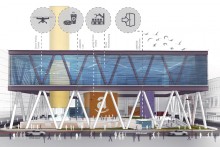
The site is located at the very center of Downtown St. Louis surrounded by high rise buildings. Inevitably ground floor is the most busy, happening and vibrant space considering the easy access and movement of people as well as visual and physical connection with surrounding pathways, roads and structures. Instead of typically blocking the entire ground level by massive podium, the design intent is to lift the whole podium above the ground to create a very dynamic public realm underneath it. This open ground level works as a multi-function space such as exposition space, advertising space, gathering space for people. People can enjoy the display, get familiar with the new products and offers, roam around the ‘St. Louis Corner’ , hang in the Amazon café, and enjoy the Amazon’s cutting edge drone technology as the drone testing tunnel comes down from the manufacturing level to a certain height of ground level for public exposure. The office and residential entry occur through the semi basement with separate entry lobby as the entire ground level is dedicated for public use.
This project has four major functions. These are i) Office space for Amazon employees (including recreation space and cafeteria) ii) Amazon Drone Manufacturing and Testing iii) Residential Space (around 30-40% of total built area) iv) Customer Service and Public Auditorium.
The Shape and orientation of the tower is predominantly driven by view corridor in the midst of surrounding high-rises as well as utilizing maximum sunlight as the form mostly elongates to east and west. As per the project’s requirement, Charlie Gitto’s Restaurant (historically valuable) located in the site, is preserved to its original location and state along with displaying a full size replica of ‘The Spirit of St. Louis’ (the first solo, non-stop, transatlantic flight in 1927 from New York to Paris). The project dedicates a separate zone in the ground level as ‘St. Louis corner’ to make the restaurant standout along with the full size replica of ‘the spirit of St. Louis’. The exterior walls of the restaurant contain mural drawing portraying history of this city graphically. All these together depict culture, history and heritage of St. Louis in a cohesive manner. The 300 seat Auditorium is located right above the ‘St. Louis Corner’ and it’s designed in such a way, so that the roof of the auditorium can be used as a dedicated open amphitheater for amazon officials and employees. The drones are manufactured and tested in the podium floor and later on played and inaugurated open air on the amphitheater in a very festive manner.
The residential portion has been placed on the top part of the tower with a clear vertical separation from the office portion underneath it. This intermediate transition works as a community space as well as leisure space both for office and residential user with a clear separation from each other vertically and horizontally.
Recent developments in digital game creation software have opened up new space for the creation of participatory design tools for urban design engagement. This has enabled new ways for architects and urban planners to explore digital games as a design ‘language’, to facilitate participants and designers to communicate ideas and concepts to one another. The Maslow’s Palace project takes advantage of this trend, utilising a digital gaming approach to participatory urban design to include marginalised communities in urban upgrading conversations.
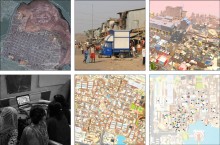
The Maslow’s Palace project currently works with three landfill-based informal settlement communities in Bhalaswa and Ghazipur in Delhi and Shivaji Nagar in Mumbai. The project uses a purpose-built gaming platform to allow participants to connect with one another, share opinions and experiences on urban focused needs and problems and generate ideas for future urban development and as an analytical tool for designers at the front end of the development process.
The primary goals of the project are to explore community perceptions surrounding urban development problems; to promote participant cooperation between community members and partner organisations as facilitators through mutual understanding of urban issues and relationships and to encourage dissemination of workshop outcomes and experiences to provoke future action.
Central to the gaming approach is the concept of the “perceptual bridge”, defined by James Auger in the field of speculative design, which considers a carefully constructed balance of fictional and nonfictional urban design elements. When applied within Maslow’s Palace, fictional game elements – such as islands, explosions and fictional buildings open up new avenues for community dialogue and collaboration through temporarily bypassing existing socio-cultural structures embedded with the pragmatic requirements of the development process. The approach not only asks players to consider how things might be, but also why things are the way that they are. Nonfictional elements – such as familiar buildings, spaces and spatial relationships ensure the game play speculations and debate are grounded in reality, as well as ensuring the accuracy of in-game analytics to interface with future development processes.
Participants of the Maslow’s Palace workshops have reported gaining further understanding of each other’s perspectives and that the game made them feel comfortable expressing their opinions with each other as they knew other players would understand their points if they could communicate them visually. When conflict arose – generally around a more complex issue such as livelihood generation and security– peripheral issues or other facets of the issue were voiced and explored, allowing for players to gain a better understanding of each other’s perspectives through discussion and ideation. Fictional elements also allowed participants to pragmatic impasses that can obstruct traditional engagement methods.
Visser et al. point out that by not carefully considering people’s tacit and latent feelings and perceptions in participatory practice we unnecessarily limit designs engagement processes to “explicit and observable knowledge about contexts” and negate their ability to explore future alternatives with reference to non-physical attributes of setting (122). Digital gaming represents a promising avenue for the drawing out these important design attributes.
Works Cited:
Beattie, Hamish, Daniel Brown, and Morten Gjerde. “Generating Consensus: A Framework for Fictional Inquiry in Participatory City Gaming.” In Serious Games, 126–37. Valencia: Springer, 2017.
Johansson, Martin. Participatory Inquiry – Collaborative Design. Blekinge Institute of Technology, 2005.
Visser, FroukeSleeswijk, Pieter Jan Stappers, Remko Van Der Lught, and Elizabeth Sanders. “Contextmapping: Experiences from Practice.” CoDesign: International Journal of CoCreation in Design and the Arts 1, no. 2 (2005): 119–49.
About the Author:
Hamish Beattie the founder at HeardSpace – an urban development focused design collective and designers of Maslow’s Palace (2017). Hamish is a lecturer in Design Ethnography and PhD (Architecture) candidate from Victoria University of Wellington, New Zealand. His doctoral research investigates how digital participatory design strategies can strategically enhance empowerment of waste picker communities in Delhi and Mumbai. He has worked with the United Nations Human Settlements Programme in Nairobi, Kenya on the Block by Block programme to deliver public space and urban infrastructure projects. He was also a 2014 New Zealand Institute of Architects Design Awards finalist.
CONTEXT Contributor: ,Shuva Chowdhury | Architect, Faculty Member (AIUB) and PhD Researcher (Victoria University of Wellington, New Zealand)