Echoes of the Estuary: A Tourism Center at Hatiya Dwip

World Environment Day 2026

Urban [Re]Stitch

Bamboo Playscape: An Experiential Platform for Underprivileged Children

| From the Author |

A city with a rapidly growing economy and an equally booming urban development sector, Dhaka, as we all know, faces a harsh deficit in urban spaces for recreation, rest and realization. It is a city undergoing spontaneous growth in order to meet the high demand for housing, leaving no space for a pause. Limited amount of land area and exorbitant prices have not only lead to the encroachment of this city’s water bodies and agricultural lands by builders, but also caused the peri – urban areas, previously agricultural fields, to undergo land filling so that they may be developed into areas for ‘new housing.’ The case of a recently developing land area, Washpur Garden City in Bosila, within Keraniganj Upazilla is no different. Land are here has also been divided up into 3 – 5 katha plot sizes and sold off effortlessly under the name of ‘green housing and high livability standards.’ However among the many insufficiencies, an alarming one, revealed through conversation with a present landowner, is that only 5katha of land area has been allocated for community play by the housing authorities. Buyers and builders have little to complain nevertheless, not realizing what is at a loss here.

Elements such as swings and hammocks installed underneath raised platforms | © Paraa Team

Out of the many plots within this housing, one is owned by LEEDO – a local charity that works to support a number of underprivileged floating children through education, health and their basic needs. Paraa– a multidisciplinary design and architectural studio focusing on enhancing spaces with the communities, has been working with LEEDO since 2013. It seeks to understand the role of designers in projects that work with and for the vulnerable urban children of Dhaka. Through previous collaborations, indepth study of the children’s lifestyle and the direction of Washpur Garden City’s upcoming development,  Paraa recognized this neighborhood’s crucial need for a space of reflection, for children’s play and one which allows a scope for investigation on models of urban landscape.

Grounded on these thoughts the ‘Bamboo Design Build Workshop’ was launched on April 2017 with support from Ghorami.Jon, HBRI Bangladesh and others. This workshop was launched after the particular success of a previous attempt by Paraa, where the design of a ‘Play Garden’ for the under privileged urban children of the LEEDO Peace Home was worked on with the focus to generate awareness on models of urban agriculture and the importance of play for growing children. This workshop comprehended on the previous understandings, and sought to explore ways to meet the UN Sustainability goals, methods of participatory design – its importance and impact and methods of rethinking institutionalized design processes.

© Paraa Team
© Paraa Team

The bamboo workshop was designed to generate awareness on livability standards within the community and on the use of sustainable resources. It also worked on explaining to the young architects the role of a user in designing their own spaces.  The 12 day design build workshop was planned to guide the participants into unlearning the conventional models of design, where design is usually preconceived, made mostly through computer generated modeling or through the top down design method. Participants were guided to learn design through participation and building through apprenticeship. Sessions were designed to help learn how to work with the people – the bamboo construction facilitators, the children’s community, the craftsmen and the artists.

The design conditions of the workshop were set to bring out a proposal that had the qualities of an ‘experiential urban platform of learning and sharing for all children.’ This was because we intended to remove the identity crisis that the children of the Peace Home currently face and also create an opportunity for them to feel belonged. The children coming from an unconventional background are not widely accepted as we all know, and thus the intention to create a space owned by them by for the community and neighborhood. It was also set to create a scope of revenue generation for LEEDO, possibly through collaborations with other schools by hosting book fairs, crafts workshops, children’s fairs and so on.
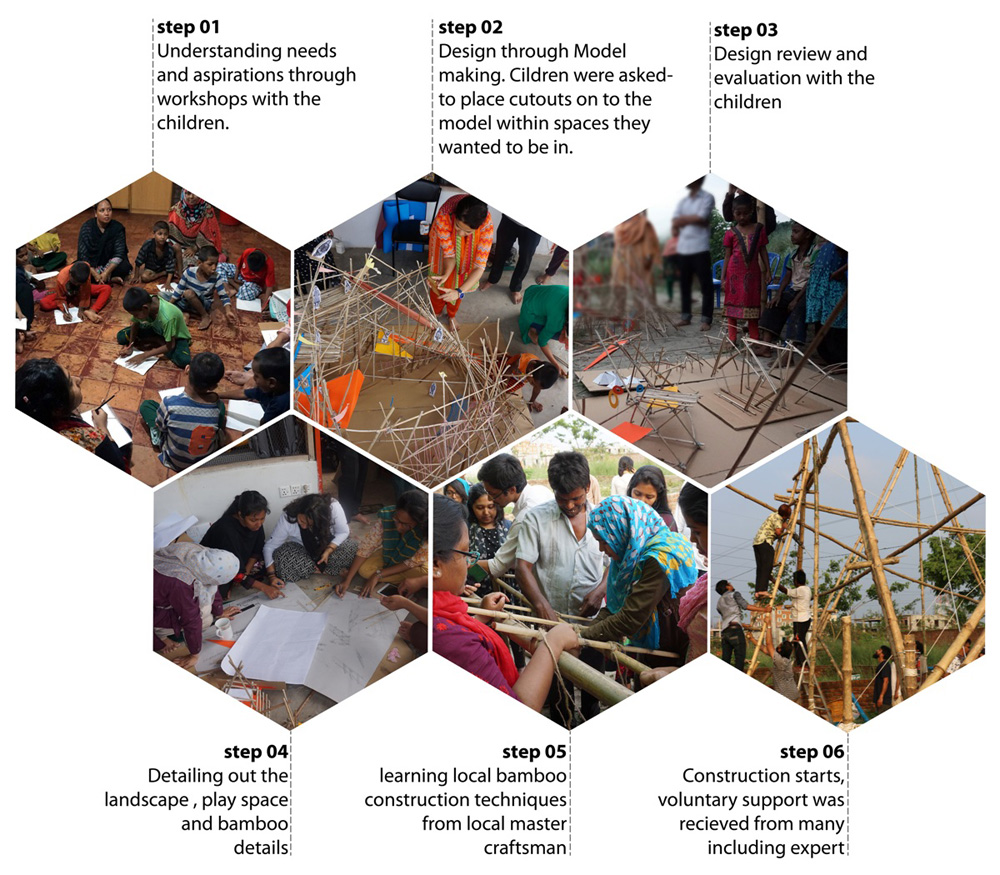
Bamboo playscape : process diagram © Paraa

The built outcome of this workshop may lack ‘architectural grammar and aesthetic’ as observed by some. Architectural critics may comment that the space could have been built through modulation, exploring architectonics, innovative bamboo construction technology and geometry, and it must have been at the least treated the bamboo pieces through chemical injection. However, what needs to be understood here, is that the built space is an outcome of a process led design method and not one that focused on the innovative methods of constructing with bamboo that we typically find online. It was focused to promote the local bamboo construction methods thus appointing Badshah Bhai – a local bamboo construction facilitator, as the lead coordinator of the built sessions. The designed structure follows spontaneity but does have a hidden grammar. Elements have been placed to intentionally defy geometry to allow easy maintenance – replacement of any element without hampering spatial quality, and to defy the stagnant form which built forms usually take up. Built from a pentagonal base for stability, the geometry was later broken deliberately to prevent the idea that an architect has the sole quality of designing spaces from flourishing. It has been left ‘unfinished’ to allow the users of the space to personalize as necessary without any institutionalized guidance. On the note of durability, chemical treatment was avoided as the team believes this process hampers the inherent characteristics of bamboo and contradicts with the idea of environment friendly and sustainable architecture.

© Paraa
© Paraa

The Play Space intended for use by the children of the LEEDO Peace Home, along with the people of the local neighborhood and of Dhaka, provides a precedent for understanding the role of architects in civic or public space creation, and especially, working with a user group to design the place in a participatory manner. Although this project is temporary ( up to 2 years) it is intended to provide a much needed amenity – a space to play, to relax, to sit, to enjoy performances and beyond. At the scale the project has been delivered, it is intended to inspire young architects intending to push forward some of the boundaries of what is possible. At the same time, this space now open to public, is simply a new play space for the many vulnerable children of LEEDO Peace Home.

© Paraa
© Paraa

Some comments from the children

Hasan: “I’m very much pleased with the stage! And the swings are awesome!”

Rubel: “I liked the hammock very much! I’m going to use the swings a lot.”

Russel: “I’m very pleased! It was a barren field and we couldn’t play. Now we can play at this playground. Building this playground has been fantastic for us.”

Nizam: “I’m delighted with this spacious playground. Hopefully we can explore the space for our entertainment. We’ll manage the playground.”

© Paraa
© Paraa

Some self-reflections by Paraa

Regarding the involvement of the children in feedback and also the design development processes: This is always going to be the most difficult design challenge, and perhaps, not enough was done. So, although there was plenty of engaged workshops and friendships developed, there could have been better workshop designs. A key note here and the importance for Paraa in this process was to show that it is not so easy to quickly get the information (the user is not just a data source) but to develop meaningful interactions and participation if possible.

Regarding the wider engagement with the local community: Although we intended to engage with the local public, the time and resources did not allow for such an activity. However, on the opening day, the public came, enjoyed the space immensely and gave us positive feedback throughout the construction phase. They were intrigued, and we imagine, will make full use of the space too.

Bamboo Workshop team, Paraa:

Farasha Zaman, Kazi M.Arefin, Ruhul Abdin, Zahidur Rahaman Abeer, Zaqaria Prince
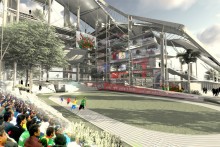
Sports Center for Social Cohesion and Youth Development | KUAD

It’s a well acknowledged fact that sport plays a fundamental role for social cohesion. The following project upholds a vision for a sports center in a deprived area of Dhaka City. The proposed facility runs program for individuals of all ages and reaches. It will also serve as a central sporting hub for the surrounding schools.

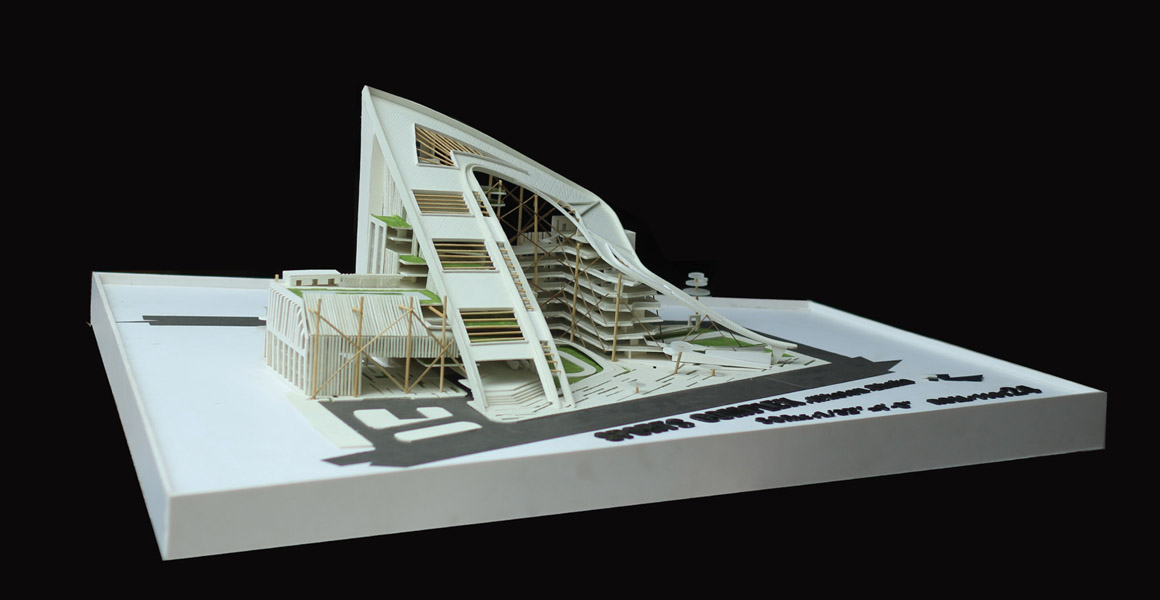
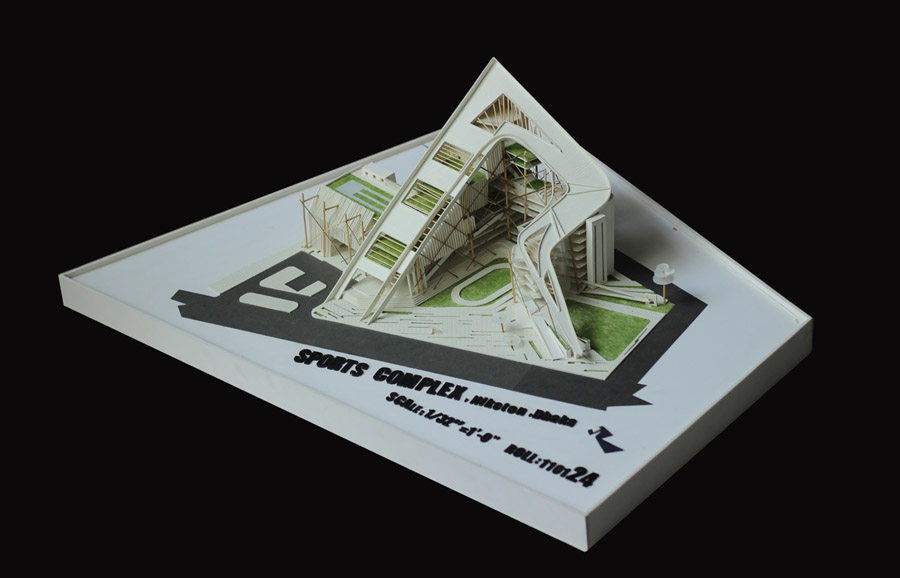
Design and planning of citizen’s recreational facility in a high density urban environment poses a very special challenge. In order to achieve a balance between needs and resources, efficient use of the available land is often argued as a viable strategy.  The following exercise explores the potentials of this strategic approach to develop a design proposal for a vertical Sports Complex in the context of Dhaka-one of the densely populated cities in the world.

© Mahmudul Hasnat | KUAD

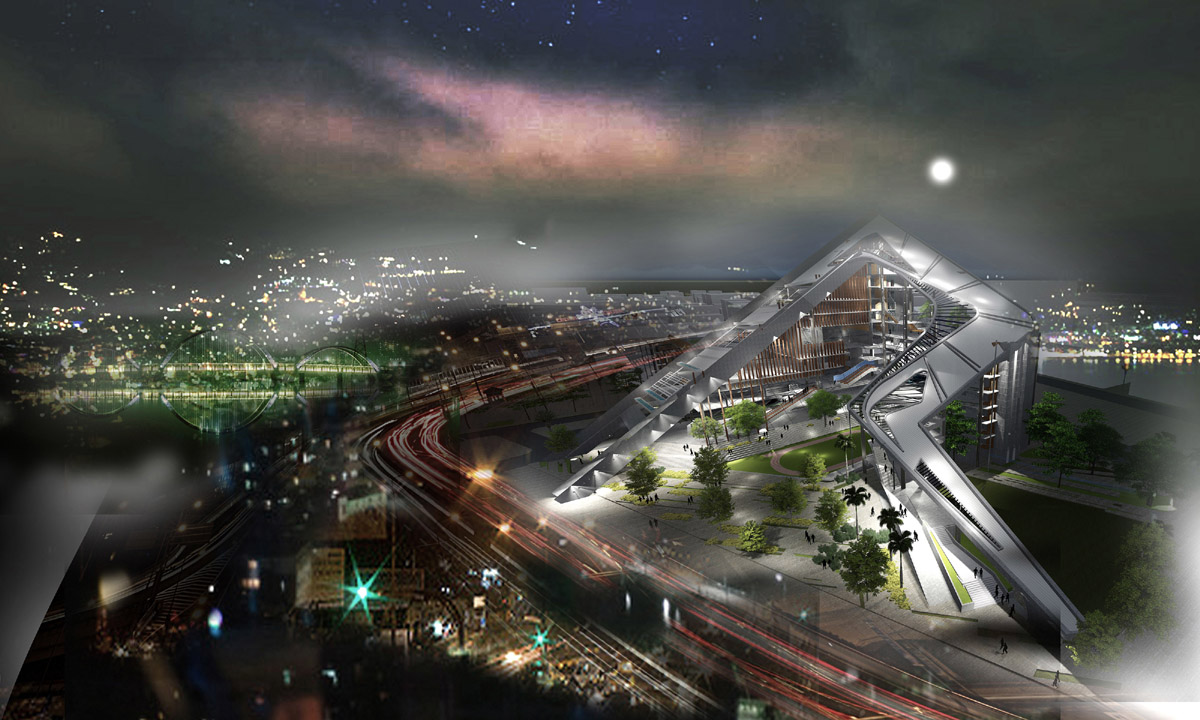
Gulshan, Banani, Badda, Niketan, Boshundhara are the core residential areas in North Dhaka. Although this half of Dhaka comprises the recent development, but it severely lacks the essential public amenities. However, the regeneration of Hatir Jheel has created opportunities to cater the need of citizen’s long awaited recreational facility. The project site is located along the Hatir- Jheel and firmly connected with the community and the city by a system of road networks and public transports.   Hatir-Jheel – the largest watershed in the city – is a popular destination place for the citizen. So it is expected that the proposed sports center will complement with the genre of  place.

© Mahmudul Hasnat | KUAD

The main concern of this project is to promote sport as a means of social cohesion and youth development. Sports center has the potential to serve as a focal point of citizen engagement, pride and achievement. The diversity of sports and sporting activities makes it an ideal medium to reach men and women from every age group and socio economic background. The complex is envisioned to provide a variety of enjoyable leisure opportunities including indoor and outdoor sports facilities. In addition to that it will create opportunities to find out the new talents in sports through its academic and training program.

© Mahmudul Hasnat | KUAD

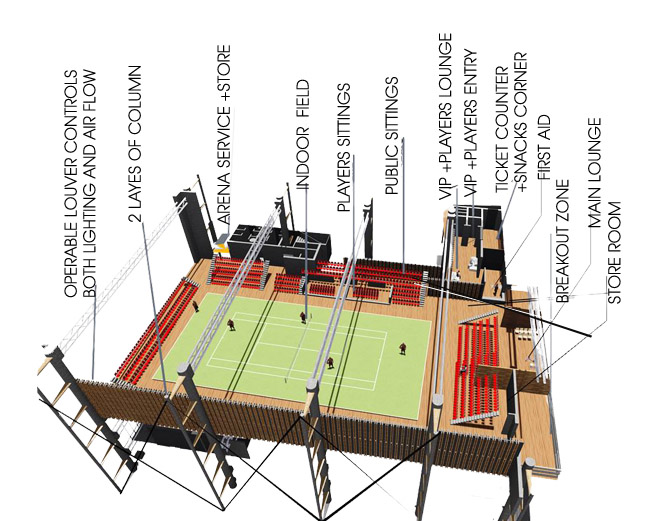
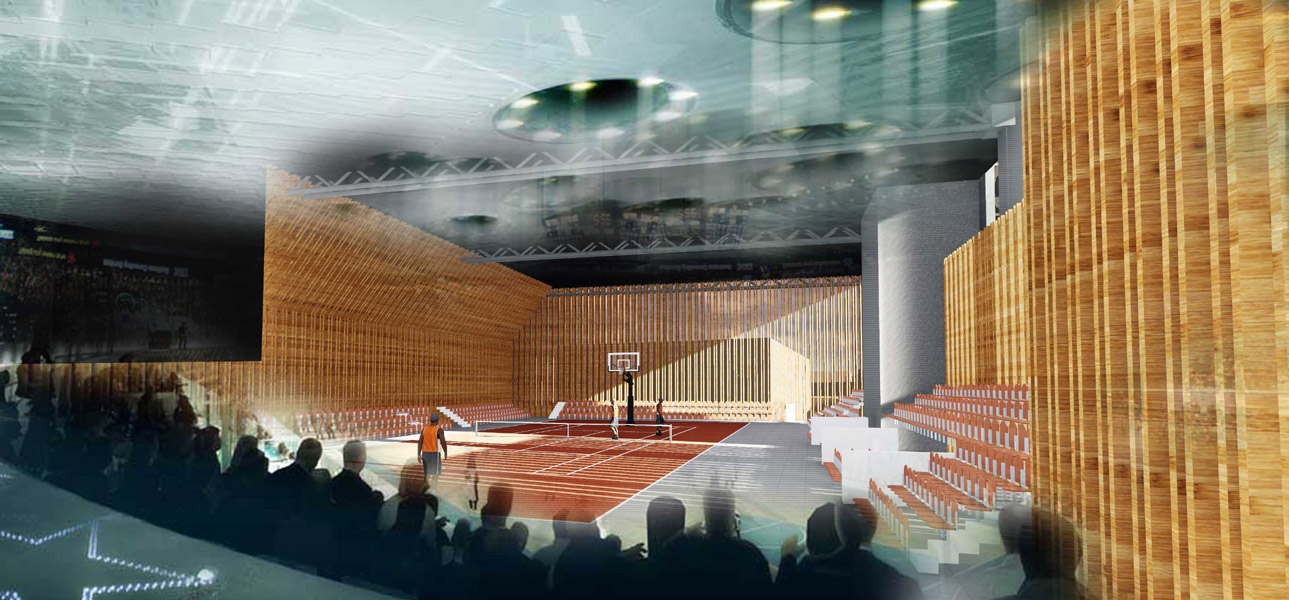
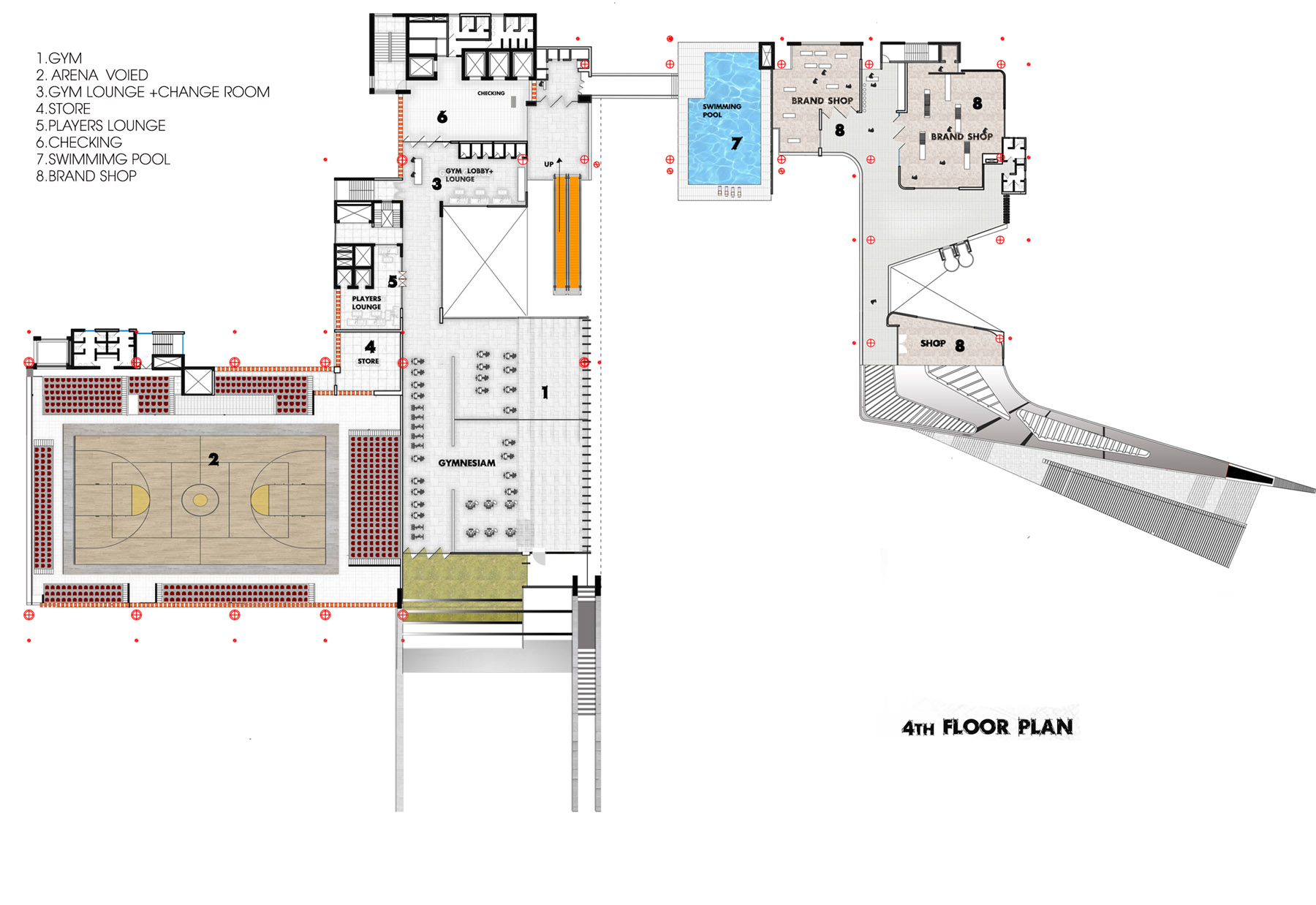
Every sport requires its own type of playground, so it is obvious to ensure proper grouping of them. In the heart of the complex, there is an open ground large enough to host annual sports program of the local schools in surrounding area. Indoor functions are stacked vertically leaving the ground free.  The ground can be also used for fair and festivals and thus flexible enough to serve as an extension of existing public realm of Hatir Jheel.  Central arena in the built structure is a triple height, lofty space where people can enjoy indoor sports on a large scale. The impact of the large volume of the superstructure has been reduced through perforation and slanted roofline.

| Image Gallery |

  • Context_Sports center_KUAD_15
  • Context_Sports center_KUAD_14
  • Context_Sports center_KUAD_07
  • Context_Sports center_KUAD_13
  • Context_Sports center_KUAD_11
  • Context_Sports center_KUAD_12
  • Context_Sports center_KUAD_10
  • Context_Sports center_KUAD_09
  • Context_Sports center_KUAD_08
  • Context_Sports center_KUAD_25
  • Context_Sports center_KUAD_02
  • Context_Sports center_KUAD_01
  • Context_Sports center_KUAD_16
  • Context_Sports center_KUAD_21
  • Context_Sports center_KUAD_17
  • Context_Sports center_KUAD_23
  • Context_Sports center_KUAD_20
  • Context_Sports center_KUAD_24
  • Context_Sports center_KUAD_06
  • Context_Sports center_KUAD_05
  • Context_Sports center_KUAD_04
  • Context_Sports center_KUAD_03


CONTEXT Contributor : Arup Nag , student , Dept of Architecture , Khulna University Architecture Discipline 


ACI AQUA- LAB & SOLUTION | Team AYOTEEK™

|From the Architect|

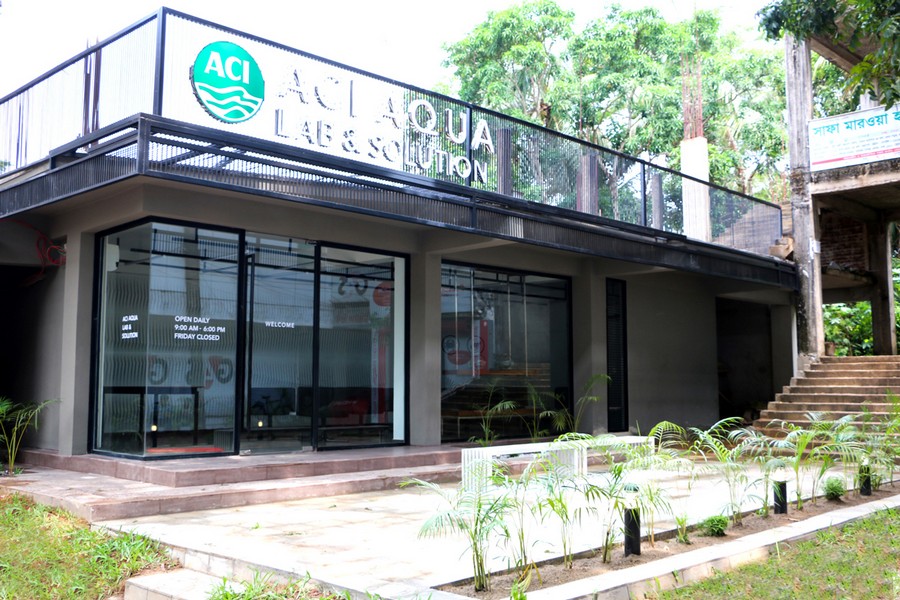
The project ACI AQUA- LAB & SOLUTION designed by Team AYOTEEK™ primarily aims to spread information about shrimp culture as well as to test larva for healthy shrimp, among the local shrimp culture business. Due to a close proximity to the sea and the nature of the facility, the project takes the phenomena of reflecting upon the wide sea along with a sandy beach as core idea and creates an abstract setting for it.

ACI AQUA- LAB & SOLUTION | Team AYOTEEK™
©AYOTEEK™. Photo credit: Ar. ASM Bashirul Alam


ACI AQUA- LAB & SOLUTION | Team AYOTEEK™
©AYOTEEK™. Photo credit: Ar. ASM Bashirul Alam


ACI AQUA- LAB & SOLUTION | Team AYOTEEK™
Ground Floor Plan. ©AYOTEEK™. Photo credit: Ar. ASM Bashirul Alam


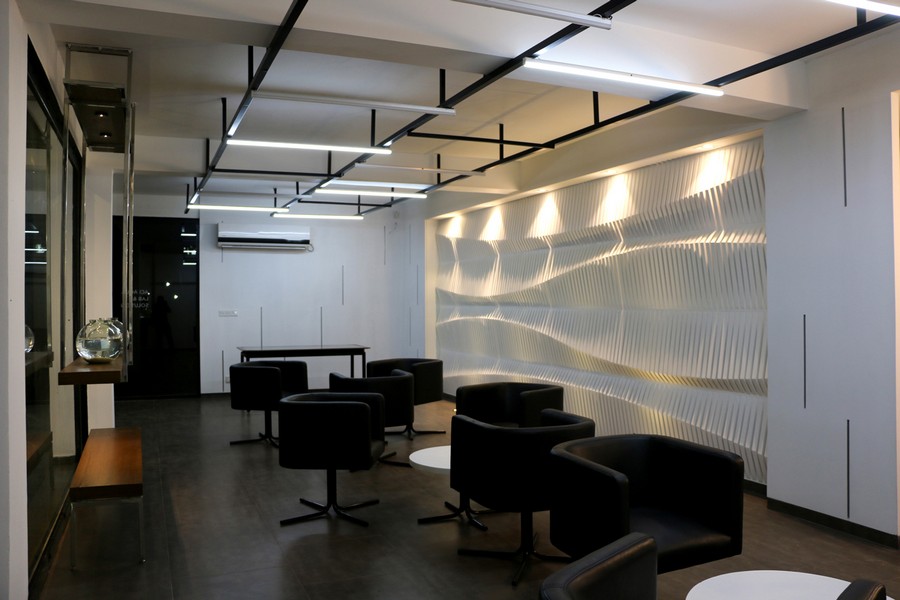
On approach,the visitors will receive a gentle sandy plaza with a garden & seating at outdoor. Large openings connect the visitors both from indoor and outdoor so that they can get an idea of the shop before they enter the premise. On the inside, a white wavy patterned feature wall has been incorporated directly opposite to the plaza with a contrast of deep brown glossy floor to resemble the wide sea. Immediately upon entering the facility one gets reminded of standing facing the sea. Artificial light creates a play to animate the patterned surface. The wall has been generated in rhinoceros combined with the grasshopper plugin.Triangular wooden blocks with a mathematical proportion has been placed with equal spacing to achieve four different wave patterns.

ACI AQUA- LAB & SOLUTION | Team AYOTEEK™
Wall pattarn. ©AYOTEEK™. Photo credit: Ar. ASM Bashirul Alam


ACI AQUA- LAB & SOLUTION | Team AYOTEEK™
©AYOTEEK™. Photo credit: Ar. ASM Bashirul Alam


ACI AQUA- LAB & SOLUTION | Team AYOTEEK™
©AYOTEEK™. Photo credit: Ar. ASM Bashirul Alam


White color for wall and ceiling with warm white spot lights both from ceiling and floor has been used to create a neutral setup. Black metal screen at the outdoor has been used to mitigate the inadequacy of the existing building roof.


ACI AQUA- LAB & SOLUTION | Team AYOTEEK™
©AYOTEEK™. Photo credit: Ar. ASM Bashirul Alam


Program of the project required two major portion: firstly, an open flexible space,accommodating reception, waiting lounge, display area and can be used as a training or seminar room from time to time. And secondly, as back office, administration area, a small sample test laboratory, washroom and a store for miscellaneous products.

ACI AQUA- LAB & SOLUTION | Team AYOTEEK™
©AYOTEEK™. Photo credit: Ar. ASM Bashirul Alam


ACI AQUA- LAB & SOLUTION | Team AYOTEEK™
©AYOTEEK™. Photo credit: Ar. ASM Bashirul Alam


ACI AQUA- LAB & SOLUTION, Team AYOTEEK™
©AYOTEEK™. Photo credit: Ar. ASM Bashirul Alam


In order to achieve a lofty feeling, use of false ceiling has been discarded. Three black metal frames running along the longer direction have replaced the orthodox false ceiling concept. Cool white down lights have been placed over these frames in a staggered formation to illuminate the area.

The construction of the whole project has been segmented into three major phases. Phase-I was the showroom and laboratory along with other amenities. Phase-II was the landscape in front of the showroom. The Third phase is a cold storage for the shrimp larva which is yet to be built.

ACI AQUA- LAB & SOLUTION | Team AYOTEEK™
©AYOTEEK™. Photo credit: Ar. ASM Bashirul Alam


ACI AQUA- LAB & SOLUTION | Team AYOTEEK™
©AYOTEEK™. Photo credit: Ar. ASM Bashirul Alam


Project Facts:

Site Area: 217.65 sqm

Built up Area: 135.32 sqm

Landscape Area: 82.33 sqm


CONTEXT contributor: Tabassum Zarin, Assistant Professor, Architecture Department, AIUB


|  Image Gallery  |

  • IMG_7019
  • IMG_6929
  • 2.-plan_ceiling
  • 1.-plan_furniture
  • IMG_6923
  • IMG_6914
  • fractal cropped
  • IMG_6903
  • IMG_6894
  • IMG_6893
  • IMG_6891
  • Untitled-1
  • view from outdoor night
  • outdoor plaza at night
  • open space
  • indoor open area

Harmony of Architecture and Sculpture | Talk with Hamiduzzaman Khan

Renowned sculptor Hamiduzzaman Khan has achieved acclaim both locally and internationally for his metal-based sculptures, with his main focus lying on forms and geometrical shapes. He is also a prolific artist, excelling in water colour and painting. He has taught sculpture in Fine Arts Institute, Dhaka and at multiple architecture schools for more than 35 years. Many of his works are located in United Kingdom, United States, South Korea, India and in few other countries. In 2006, he was one of the recipients of Ekushey Padak, the second highest civilian award in Bangladesh.

Harmony of Architecture and Sculpture|Talk with Hamiduzzaman Khan
Sculptor’s Studio |  Photo Courtesy: CONTEXT


 How did you find interest in fine arts initially?

 My father, being a doctor, wished that I follow his footsteps and pursue a profession in medicine. But soon enough, I realized that was not what I wanted to do in life. I used to draw from an early age, ever since I was in school. It was at that time I inquired about the Fine Arts Institute in Dhaka. Afterwards, at home, I expressed my wishes of studying fine arts at Charukola. It took a lot to convince my father, but finally, he agreed.

My next step was meeting with Zainul Abedin in Dhaka in 1962. When I went up to him and disclosed the fact that I am from his hometown Kishoreganj, he pulled me forward in a hug. He asked me to show him some of my works. He spoke with me for a while and then said I can go and get admitted to the Fine Arts Institute on the next day. So thanks to him, I got enrolled in Charukola.

I was already late in attending the semester. I could see all the students had gotten far ahead than me. In the first year, all I did was work with pencils. But I had a lot of passion for art and I knew I was in the right place to learn. So I kept on trying. Artist Mustafa Monowar was one of my teachers. He noticed my hard work and he used to inspire me a lot. That encouraged me to perform very well for all other students during my second year. By this time, I had developed a sense of individuality, one that could be identified as my own personal style. I had my own way of drawing. I never did exact imitations. This was highly appreciated by my teachers.
Harmony of Architecture and Sculpture|Talk with Hamiduzzaman Khan
Hamiduzzaman Khan |  Photo Courtesy: CONTEXT


How did you shift your focus from fine arts to sculpting?

I kept on painting for a while as I had little knowledge about the other departments in Charukola. During the final year, I was involved in a serious accident, where I hit my head very badly. I was in the hospital for a long time and Abedin Sir stood by me during the whole time. It took me a while to recover, after which I sat for my final year examinations. After I passed, my doctor said I needed to get another operation done in the UK. In order to arrange finances for my treatment, I held an exhibition in Chittagong in 1969, where all my paintings were sold. Then a gentleman arranged a ticket for me to go to the UK by a cargo ship. It took me 1.5 months to reach Dundee. From there I moved to Edinborough, where I received my treatment. When I went to pay my medical bills, the hospital authorities decided not take it as one of the doctors there was my neurosurgeon’s student. I decided to stay in London for 4 months. It was a big learning opportunity for me as I spent a lot of time visiting all the museums. Places like the British Museum and Tate Gallery had all the works that I had previously only seen in books. After those 4 months, I decided to stay in Paris for 3 weeks.

In Paris, I had a chance to visit the National Museum of Modern Art and The Louvre. Before visiting The Louvre, I attended an exhibition for Impressionist sculpture, which made me realize how powerful this medium can be. Afterwards, I visited St Peter’s Basilica and Sistine Chapel in Italy, both of which drew me very much to sculpture and architecture. When I went back to Dhaka, I felt very much enlightened. I felt like that 6 months’ long visit taught me more about art than my 5 years’ long education did.

In 1970, Abedin Sir asked me to apply for a faculty position to teach sculpture at Charukola. He believed I could do it since he felt that my drawings were impressive. In 1973, he encouraged me to pursue a Master of Fine Arts degree in the Faculty of Fine Arts at University of Baroda, with the help of the newly launched scholarship program by the Indian Government. That was an enlightening experience for me as I learned how to make relations between art, sculpture and architecture.

Harmony of Architecture and Sculpture|Talk with Hamiduzzaman Khan
Sculptor’s Studio  |  Photo Courtesy: CONTEXT


 How did you first start collaborating with architects?

When I shifted my focus to sculpting, it was still a very new field. In 1982, I was commissioned a work by the government at Bongabhaban complex. It was then that I had a chance to work with structural engineers and architects. Afterwards, I met Nahas Khalil. At that time, he was offered to design a house by a client, in exchange of some paintings. When he received the paintings, he realized they were all mine and that was when he decided to meet me. Later on, we collaborated on many projects together. I have also worked with Mustapha Khalid Palash, Rafiq Azam and Iqbal Habib.

When my work of a 13 feet long bronze figure in Jalalabad Cantonment, Sylhet was finished and acclaimed appreciation, I was commissioned for the work at Bangabhaban, where I worked with chief architect Zahir Uddin. Bangabhaban is a designed complex. I had little experience, but I had the knowledge about art embedded in me. Thanks to my Europe trip. Even though Zahir Uddin is a renowned architect, he and the rest of the team had little idea about sculpture as not much work had been done here by then. I was asked to make something that was about 15 feet high, but I said we needed a sculpture of around 25 feet high for a space like that.

Harmony of Architecture and Sculpture|Talk with Hamiduzzaman Khan
Sculptor’s Studio  |  Photo Courtesy: CONTEXT
Harmony of Architecture and Sculpture|Talk with Hamiduzzaman Khan
Sculptor’s Studio  |  Photo Courtesy: CONTEXT


How do you initiate your working process?

I am always in sync with the environment. For instance, I was asked to work on a piece in 150 feet long and 35 feet wide space near a green lawn at Krishibid Institution of Bangladesh. There I used a new material for the sculpture, keeping in mind the colour of the building itself. I have been working with stainless steel since the last 12 to 13 years. But in this case, I used iron as I felt it was a more natural element. I believe art should be simple and this material also made the light appear to be more natural. The colour of the sculpture very much complements the louvers that are visible on the facade of the building. It was difficult for me to convince the rest of the team about working with iron, as it was a new concept for them. I was very certain that I was making the right decision regarding material selection, because I had previously worked on iron sculptures.

You have been teaching sculpture at multiple architecture schools for a few decades now.  What is your experience like when it comes to teaching architecture students?

I have been teaching in BUET since the last 30 years. One of the benefits is that this gives me a great opportunity to hang out with architects. I can engage in conversations with them. This gives me a good opportunity to exchange ideas with both with junior as well as senior architects. I also believe that if I have an architect working beside me, then he/she can help me position and situate my work with better understanding.

Harmony of Architecture and Sculpture|Talk with Hamiduzzaman Khan
Sculptor’s Studio  |  Photo Courtesy: CONTEXT


 What made you develop such attachment with architects?

Architects think similarly like I do. I am familiar with many architects, both struggling as well as established ones. I am in good terms with Mobasshar Ali and Shamsul Wares. I have even interacted with the late Muzharul Islam. I have worked with Iqbal Habib, Mustapha Khalid and Rafiq Azam. Each architect has his own working philosophy and I find it interesting to work symbiotically.

 Architectural elements like form, line, geometry are quite evident in your work. 

This is achieved due to the fact that I work with a variety of different materials. Sometimes I even use a combination of two materials, for instance, stone and metal.

I have been working since the past 45 years. From that experience, I can say that I have had interactions with more architects than artists or sculptors. Interacting with architects perhaps played a huge role in my inclination towards adopting architectural elements in work.

Harmony of Architecture and Sculpture|Talk with Hamiduzzaman Khan
Sculptor’s Studio  |  Photo Courtesy: CONTEXT


 You started working with bronze. How did you further experiment with other materials?

I made sculptures using bronze for about 11 years. Next, I moved onto sheet metal. Afterwards, I worked using pipes for 12 years. Then I worked with wood for a while. Currently, I am working with stone. I believe it is the most ultimate material.

I feel like artistic taste has evolved here. Many local artists are doing excellent works. They are able to take the concept of a building to an artistic level. Additionally, there are more clients interested to get such work done. The best part is that clients and artists can now reach a mutual understanding of what they both find to be tasteful.

Thanks a lot, Sir. We are looking forward to meeting you again and have a more elaborate discussion on a couple of matters we touched today.

Harmony of Architecture and Sculpture|Talk with Hamiduzzaman Khan
Sculptor’s Studio  |  Photo Courtesy: CONTEXT


Narrated by: Farhat Afzal, Architect and Contributor, CONTEXT

Editor: Azizul Mohith, Architect and Academic

2 years of context_cover_low

Confessions of a non-architect

So I just smile politely, and somewhat cryptically reply “Yes and no.” This answer confuses people even further. What was the point of going through five years of grueling academic struggle, if you are not going to get involved in the profession itself? Moreover, if not practice, what else is there to do?

To answer the first question, one needs to look beyond what appears on the surface. Architecture has been widely acknowledged as one of the most difficult academic fields. There is no beating around the bush about the fact that studying architecture is stressful, and it often drains you physically and mentally, perhaps more so than many other fields of study. But we often overlook one of the other important aspects of architecture education: diversity of the subjects offered in it. Matthew Frederick wrote in his brilliant compilation titled 101 Things I Learned in Architecture School, that “An architect knows something about everything. An engineer knows everything about one thing.” [1]

We are offered a little bit of insight in environmental studies, planning, accounting, art, physics, mathematics, history and even music. Such variety of topics can hardly be found in any other major. This was the biggest reason why I was drawn so much to architecture.

Secondly, since the degree equips one with so much knowledge, there are a whole other bunch of career alternatives that can be explored.  When Neelkanth Chhaya’s son got into both the fine arts program as well as the architecture program at CEPT, Ahmedabad, he went up to Balkrishna Doshi for advice on which major to pick.  Doshi replied that he must choose architecture as one can make a transition from architecture to art, but not the other way around. In Bangladesh, practicing architects like Enamul Karim Nirjhor and Taukir Ahmed have ventured into filmmaking. One of the cofounders of the immensely popular website Pinterest is an architecture graduate from Columbia GSAPP. [2] The late Muzharul Islam himself was very much conscious about relation between architecture and politics. [3] So clearly, an architect can choose to pursue a variety of different fields of interest.

No wrong path | he various pathways and staircases represent the multiple ways one can pursue their passion in life. The image can be viewed in two ways. Regardless of whether it is viewed from the top side or the bottom, one can find their way in it © Imran Hasan
No wrong path | the various pathways and staircases represent the multiple ways one can pursue their passion in life. The image can be viewed in two ways. Regardless of whether it is viewed from the top side or the bottom, one can find their way in it © Imran Hasan


Another issue is that architects are notoriously underpaid. I remember hearing an established architect once say that it is a profession for elite intellectuals with aristocratic backgrounds, those who need not worry about paying the bills. I am neither an elite nor an intellectual but I strongly disagree with his views. I believe whoever has a clear idea of how a space should function, how proportions work (among a million other things) and a true passion for learning can study architecture. However, the truth remains that it is not a financially rewarding field. Fellow architects have confided in me that they would have thought twice about pursuing this profession, had they known about its pay scales. In such a case, if somebody decides to leave the profession and pursue something else, can you really blame them?

Question is, how do I explain a senior member of the profession, why I am not following the same path taken by them and thousands of other graduates?  How do I put in words that I would rather learn more about Kahn’s philosophy behind the use of light in the Parliament Complex than prepare construction drawings for a three-bedroom apartment? Or that I would rather do a detailed study of Diwan-I-Khas of Fatehpur Sikri,  than spend my days preparing cost estimation documents?

Perhaps I do not need to explain my choice of taking the road less traveled.  Maybe, only time will tell if I am able to put my degree to good use or not. Till that happens, I shall focus on ways I can increase my knowledge about the things that interest me and create a niche for myself, where a non-architect such as myself can co-exist with architects and other design professionals.

Works cited :

[1] Frederick, Matthew, 101 Things I Learned in Architecture School, MIT Press, Cambridge, Massachusetts, 2007.

[2] young-architects-guide-alternatives-to-architectural-practice

[3] muzharulislam.com


About the Author 

The author is currently working in the academic program for Bengal Institute for Architecture, Landscapes and Settlements. When she is not working, she finds herself in the middle of an existential crisis.This article was intended for those who are uncertain about their career choices and to assure them that sometimes it is alright to be a little lost.


2 years of context_cover_low

Strolling through the RED LINE AREA

The human brain often prioritizes against the wishes of the conscious mind: the tidbits of our golden days may be forgotten in a few years, while the seemingly most insignificant random encounter might choose to remain on the slate boards of our memory.

I saw a middle-aged man on the city bus the other day. In his wallet was an old passport-sized photo of a much younger version of himself. The transient nature of youth and all its prosperity stirs the artist’s mind and he must find a way to express it. He jots down this moment in his scrapbook for later, when he decides to craft his expression of the event.

Glitch | © Imran Hasan
Someone Enters without Knocking | © Imran Hasan


Expression of oneself cannot be measured if the question is how best to portray something. What is the best way to recreate that exact moment in your psycho-existential continuum? Should you even be asking that question? Any individual that ventures an expression has to face the insecurities that his and the society’s perception of both him and the surrounding environment bring about.

Mother | © Imran Hasan
Unfinished | © Imran Hasan


In my eyes, I am not an artist. I do not feel compelled to periodically have an opinion or articulate every single reaction that is conceived in my psyche. I am very dissimilar to a poet who pursues rhythm and eloquence in daily life. When expressions manifest themselves, do they necessarily reflect our sense of right and wrong? Is it OK to use red ink if you’re not correcting someone or crossing something out? However the use of red ink was born not out of a need to challenge convention. Isn’t red a striking color anyway?


Therapy for the Soul © Imran Hasan
My Favorite Planet © Imran Hasan
Sunflower | © Imran Hasan


Thus the cycle of stimuli and responses repeats as we journey through the disruptive clutter of feelings and emotions. The definition of fulfillment and significance are varying in nature across different walks of life. Not all are lucky enough to possess the ‘philosopher’s stone’. A highly celebrated person may not experience a fraction of the amount of fulfillment that a simple family man or a vagabond does. A mundane place at a mundane hour of the day may be completely transformed by the simple addition of sounds, colors or the culmination of little positive actions. I once read in a book of how an otherwise unremarkable street was said to have been morphed into a place that inspired happiness when children started drawing on the street-facing walls of the adjacent houses. Such is the power of art: a channel of expression that pre-existed verbal language. It is what an individual gives back to the world that is purely they. For me, these drawings are not art per se, but a tool to recover the sensation of life, while coping with the dynamics of my very existence.

“And art exists that one may recover the sensation of life” – Viktor Shklovsky.

More works from Imran 

  • love and other drugs 2
  • Daily sketch
  • mindscape (2)
  • new face 2

Secretariat Complex at Sher-e -Bangla Nagar | An Architectural Repercussion of Kahn’s Vision

Louis I Kahn’s Capital Complex at Sher-e-Bangla Nagar is an architectural masterpiece and source of pride to Bangladeshi National. This Capital Complex put Bangladesh on the roster of nation boasting the most sophisticated examples of modern architecture.  Next to Le Corbusier’s Chandigarh, it is the most important project to influence the architectural culture of the region. Although, unlike Corbusier, Kahn did not provide a canon for making a building , he did provide a way of building based on rules and shapes and on the architectonics of material and structures [1].    His building adorned with variety of platonic forms and shapes- provided a vocabulary that could be incorporated into any design act.

Fig 01 . Design process | © Md. Iqbal Hossain Talukdar
© Md. Iqbal Hossain Talukdar


Initially there was a plan for a secretariat to be built opposite the Parliament building. Infact Kahn also completed a design, but the whole idea was scaled down with other aspects including plans to develop areas to the north of the complex to create a prototype for Dhaka’s future urban development. The following academic exercise is a humble effort to reinstate Louis I Kahn’s vision of Capital Complex as a ‘Citadel’ – a center of administration for People’s Republic of Bangladesh. The scope of the project was limited to envision a design proposal for the Secretariat Complex in the same site as proposed by Master Architect Louis I Kahn.

© Md. Iqbal Hossain Talukdar

Kahn recognized the essence of the landscape during his very first trip to Bangladesh in 1963. He realized the fundamental building fact in this delta country is the molding of the earth to provide both platforms and proto-architectural shapes. He conceptualized this as the process of “dig and mound” something that involves an excavation of the ground to create an earth mound on which the building is placed. The excavated pit becomes the pond.

Courtyard view__Capital complex

Semi public mass vehicle entry__Capital complex

© Md. Iqbal Hossain Talukdar


The Capital complex is a host of formal characteristics which are traces of Kahn’s innate geomancy.  The most conspicuous feature of Kahn’s plan is their seemingly bilateral symmetry where buildings and individuals units are arranged in formal classical manner. Robert McCarter, author of the book Louis I Kahn, showed the relationship (the tilted square and the axis) between the assembly building and secretariat complex ( fig 1 )  . This relationship has taken as reference for the new scheme of the secretariat complex where functional units are organized following the geometric principle of repetitive multiplicity and bilateral symmetry. Not unlike Kahn’s vision, functions are articulated around a central space – a democratic platform- where citizens can come and interact with the governing body. In volume the proposed complex is lower in height to retain the supremacy of the assembly building. The proposal also carefully considers Kahn’s ideology about material and structure.

© Md. Iqbal Hossain Talukdar


| Image Gallery | 

  • Secretariat_Stamford_feature
  • design steps_Capital complex
  • ground floor plan_Capital complex
  • Capital complex
  • Courtyard view__Capital complex
  • Semi public mass  vehicle entry__Capital complex
  • Semi public mass cortyard side__Capital complex
  • Landscape _ Aerial view_Capital complex

Errante: Restaurant and Rooftop Lounge | Cubeinside Design Ltd

|From the Architect|

EAT, SLEEP, TRAVEL, REPEAT

ERRANTE; a Portuguese word, means “Nomadic ” or the feelings that drives people to travel frequently.

Human is nomad by nature from his inception. He always tries to settle down, but it’s the basic human instinct that makes him to explore more. People travel not only for living, but also for living fully, for feeding his soul. In his way at traveling, people always explore new foods  as a mean of  gathering new experiences.  And that’s the story behind the name of the restaurant – as well as the core concept behind the interior design. The restaurant is in the 8th floor and the rooftop of a commercial building in Chittagong.

Entrance of the restaurant. Image Courtesy: Maruf Raihan


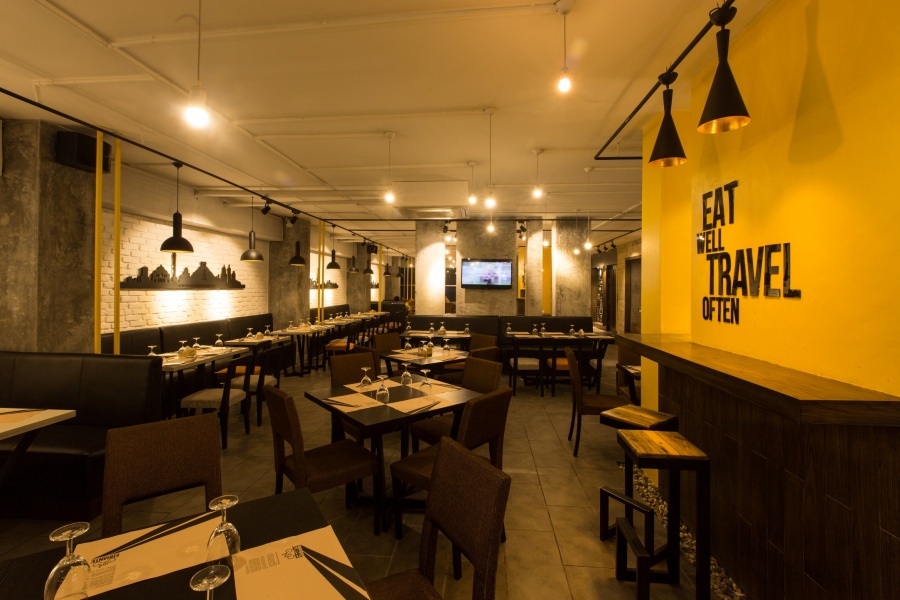
Exploring the trueness of material, exploiting the branding color and other elements and abstracting the concept of travel and cuisine – that’s how the principles worked behind this interior. Anyone entering to the restaurant is greeted by rustic metal nameplate and a huge door with a bold yellow handle. And once entered, a monumental yellow wall appears with a cycle hanging on its rusty metal surface.


The massive yellow wall with a bicycle hanging on rustic metal surface, depicting an iconic image of the restaurant, as well as creating privacy. Image Courtesy: Khandaker Ashifuzzaman


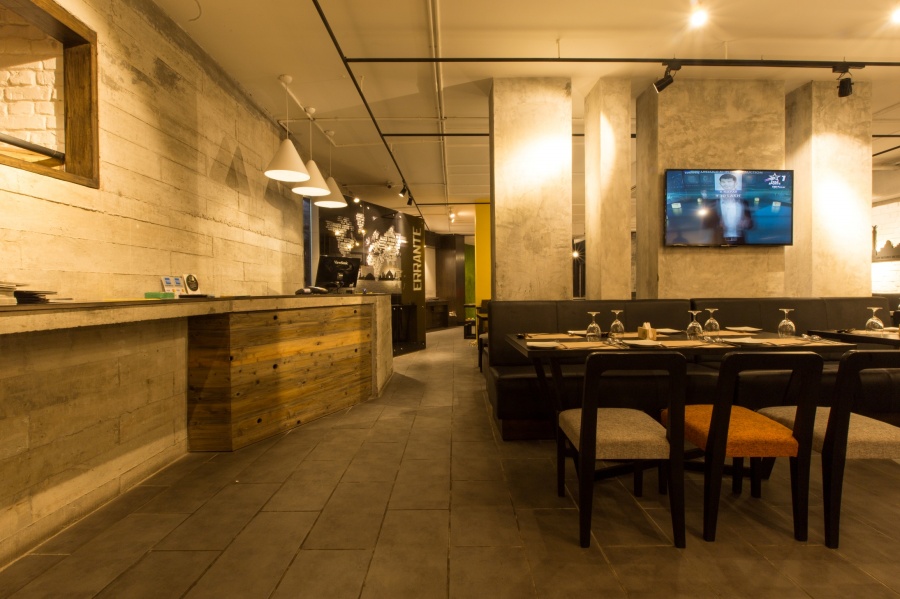
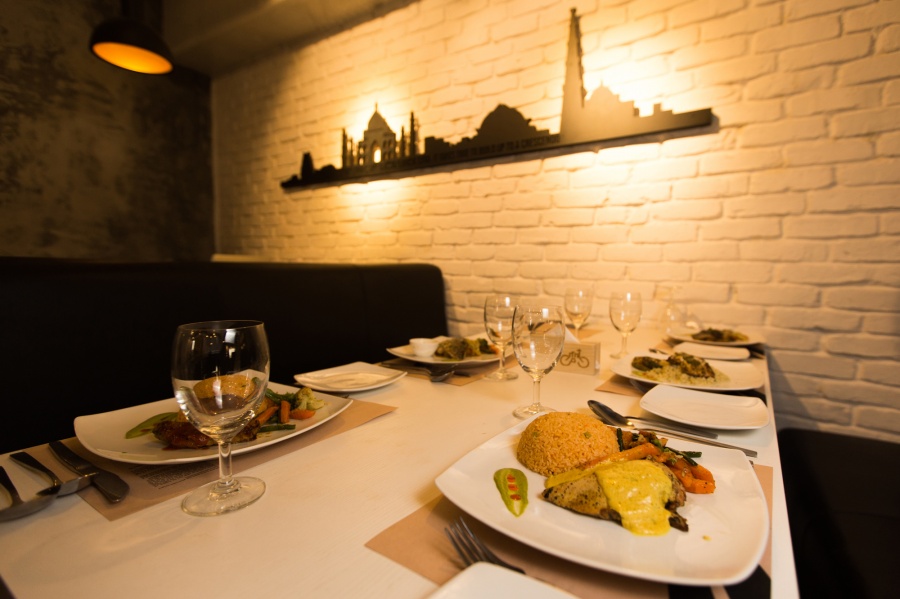
 This wall is one of the two monumental walls used to express the synchronization with the branding color and creating screening for the foyer and service station as well. The elongated solid brick wall at the south side is kept as exposed brick with white color and holding the identity of the main four cuisine countries with their silhouette cityscapes. Other wall finishes are neat cement finish which creates an ambiance with a rustic softness. The kitchen is separated with a rustic as cast concrete wall, which also creates spaces to accommodate the counter and the aperture to the stair that leads to the rooftop.

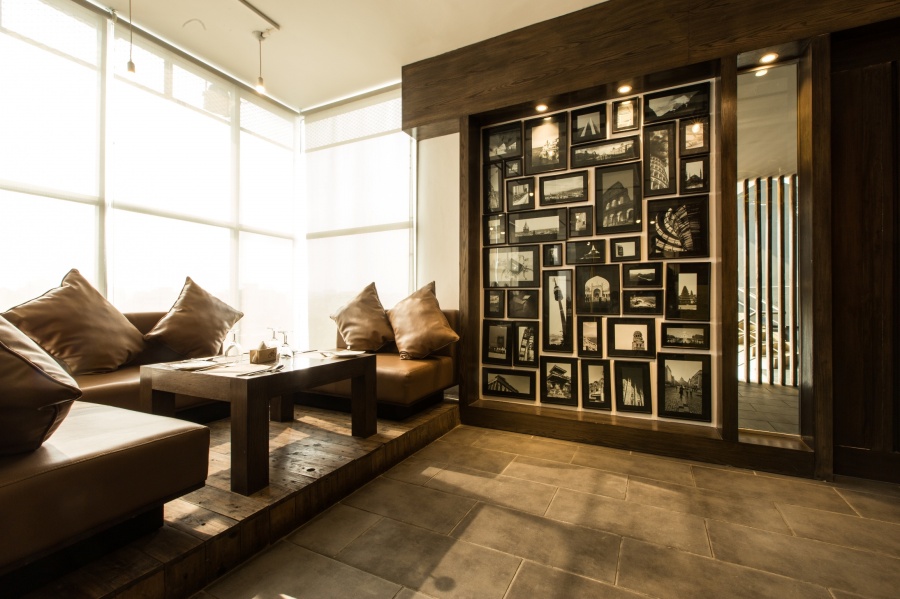
The travelers diary - a gallery of photographs of places around the world, taken by the owners. Image Courtesy: Maruf Raihan
The travelers diary – a gallery of photographs of places around the world, taken by the owners. Image Courtesy: Maruf Raihan


The cash counter and the sitting places. Image Courtesy: Maruf Raihan


Dining spaces. Image Courtesy: Maruf Raihan


Dining spaces and the second massive yellow wall. Image Courtesy: Maruf Raihan


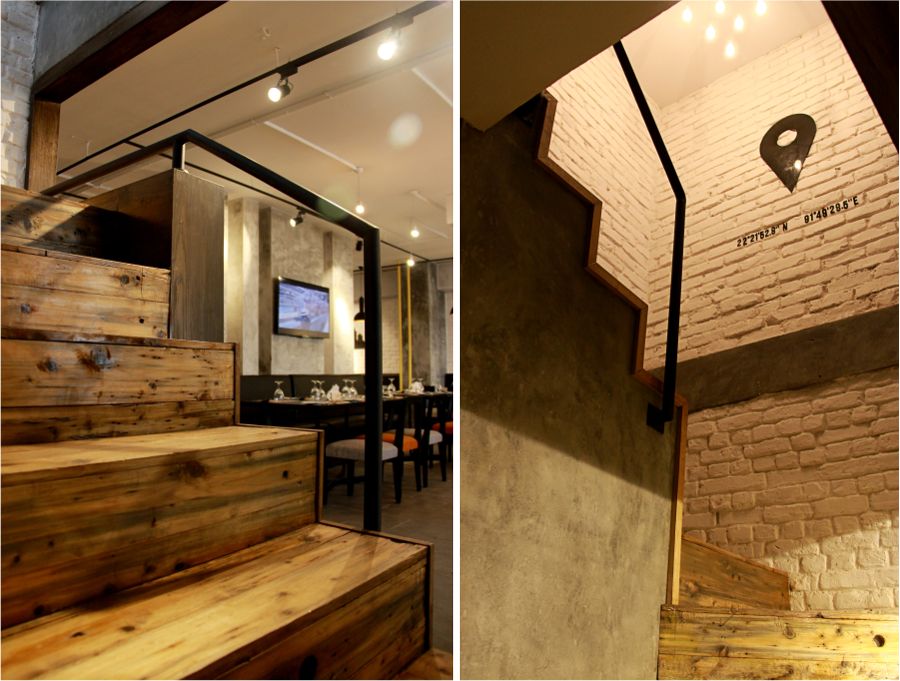
The rooftop is basically a semi open lounge with casual seating made of brick and wood. A wooden deck at the center is the main feature of this floor. All these woods used here were bought from junkyards. Previously, these woods were used as river decks. So, all these super seasoned woods gives a unique expression of material which enhances the aesthetics and serves economy as well as durable. Green creepers from all the side and planter boxes having tiny bamboo trees create a screening from the neighborhood and also give the perfect sense of rooftop open space.

Wooden stairway to the rooftop lounge. Image Courtesy: Khandaker Ashifuzzaman


Rooftop lounge. Image Courtesy: Maruf Raihan


A building or a space ages – naturally, just like any other living organizm in this world. The entire design of the spaces at Errante is sought out keeping this principle in mind. The concrete walls will be more tactile, the metals will be more rusty, the woods will be more seasoned and the creepers and plants will be more lush green – over the time . The inherent qualities and intelligence of materials will be more vibrant, matured and expressive as the time passes by – that is the absolute beauty of this design.

Dining Spaces. Image Courtesy: Washif Shadman


Dining spaces and the first massive yellow wall. Image Courtesy: Maruf Raihan


Dining spaces. Image Courtesy: Maruf Raihan


Project facts:

Site Area: 371 sqm

Total built up area of the Project : 371 sqm

Project Cost in BD Taka : 5.5 million BDT

|Image Gallery|

  • ER 13 (2)
  • ER 01
  • ER 03
  • ER 02
  • ER 04
  • ER 05
  • cover_2-900x600
  • ER 06
  • ER 08
  • ER 07
  • ER 11
  • PC WASHIF SHADMAN (1)


Architecture Schools add Colours to Nationwide Celebration of ‘Pohela Boishakh 1424’

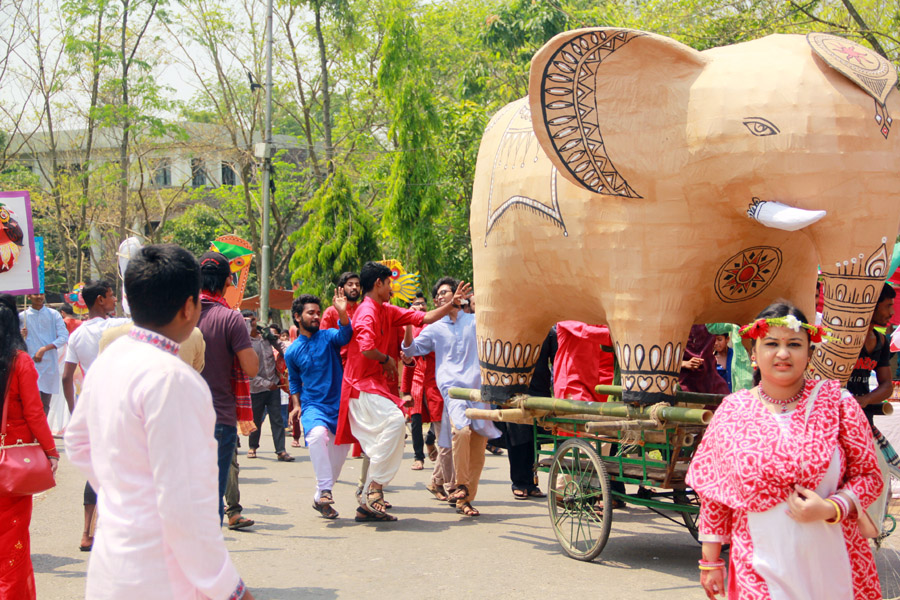
Architecture is a manifestation and expression of culture. As such it must acknowledge and respond to the cultural needs and values of the society with which it interacts. Architecture students, consequently, tend to get inclined towards culture and heritage through their sense of nationalism which is partly enhanced by the training they receive in architecture schools. It is not uncommon for students of architecture to mark a national celebration with effort and passion going extra mile.

Borshoboron 1424 | Dept of Architecture,BUET  | Courtesy : Syed Saif , Sumaiya Sharmin & Tarek Morad

The premise of Architecture dept of BUET | Photographs by Syed Saif (BUET)

  • BUET_SYED SAIF_02
  • BUET_SYED SAIF_03
  • BUET_SYED SAIF_05
  • BUET_SYED SAIF_06
  • BUET_SYED SAIF_04
  • Tarek morad_02
  • Tarek morad_01
  • Tarek morad_03

It all started in Department of Architecture, BUET as it is the first of such in the country; but exactly when is untraceable. However, there had been suggestions in 70s from veteran architects who studied under Richard Vrooman to observe an occasion in the courtyard in front of architecture building (BUET) to strengthen the bond between current and old students. Observing ‘Pohela Boishakh’ probably emerged from that idea which, now has turned out to be a yearly celebration of ‘life’ in totality.

Sthapatte Boishakh 1424 | Dept of Architecture, SUST | Courtesy: Tariqul Islam Opu, Apurba Ratan Roy, Shafayet Hossain

Tariqul Islam Opu_sust 18

  • BUET_SYED SAIF_01
  • Apurba Ratan Roy_sust 4
  • Apurba Ratan Roy_sust 2
  • Tariqul Islam Opu_sust 15
  • Apurba Ratan Roy_sust 1
  • Apurba Ratan Roy_sust 6
  • Tariqul Islam Opu_sust 12
  • Tariqul Islam Opu_sust 11

This year, first day of the Bengali new year has been celebrated over the architecture schools in the country with vigor, hope and youthfulness. Architecture students, generally known for their creativity and hard work left no stone unturned to put a mark on ‘Pohela Boishakh’ celebration with ever green gestures and spectacularity. There were colorful rallies, decorated campuses and graceful participation of students and faculty members. Day long cultural shows were arranged as well. Photography exhibition and  drawing and painting competitions for children were also in the list. Most of the campuses were full of alumni along with regular students. Since it’s a national occasion students and faculties from other departments also participated with joy and best wishes; needless to mention the cooperation of the university authorities. However, respecting government instruction s on security issues programs were mostly ended by evening.

Pohela Boishakh 1424 | Dept of Architecture, AIUB | Courtesy; Asif Rahman

Asif Rahman_AIUB_008

  • Asif Rahman_AIUB_009
  • Asif Rahman_AIUB_006
  • Asif Rahman_AIUB_007
  • Asif Rahman_AIUB_004
  • Asif Rahman_AIUB_010
  • Asif Rahman_AIUB_002
  • Asif Rahman_AIUB_003
  • Asif Rahman_AIUB_001

Students from respective architecture departments started to work on the celebration program from at least a week before and worked hard in between their studies. The atmosphere was at the end phenomenal.