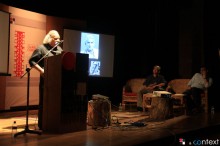
Partha Ranjan Das is an Indian Architect. He completed his Bachelor of Architecture from Jadavpur University in 1979 and Maters of Architecture from School of Planning and Architecture, New Delhi in 1984. He is the founder architect of the consultancy named Partha Das and Associates. Partha Ranjan was involved with Correa in the City Centre project in Kolkata as the resident architect.
Video documentation: S. M. Asif Ur Rahman and Sadman Sharar Rafi.
To watch the VIDEO (PART 02) click the following link :
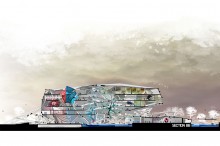
`Warwick Junction’, a unique location within central Durban, is the site for the international competition open to architecture students worldwide, launched as part of the next UIA congress in South Africa (3-7 August 2014). This transport node is a place for exchange and informal commerce with unique qualities at an unprecedented scale. Based on the congress theme `Architecture Other-where, the aim of the competition is to highlight the complex ecology of Warwick Junction and its economic, social and cultural dynamic by proposing solutions that will be to the benefit and wellbeing of the community and the half a million people who frequent this area every day. Projects must propose three visions simultaneously: a long term – large scale solution; medium term – medium scale solution; an immediate small scale intervention.
Throughout years Warwick junction has hold the significance of commercial roots of Durban, South Africa. This hustled and bustled area has always back supported the Durban city. If we think Warwick with a vision of 2035, Warwick will be the first economically prominent space where culture, religion, nation will be a single stage to represent the world.
Connectivity Diagram
Informal traders and vendors of Warwick are the main man power for the futuristic business flourish of Durban. Thus we can turn on the city as an informal but world class formal commercial hub. Space through Warwick junction and market places rejuvenates the place as a walking city. Which will provide accommodation, connectivity of religion, ecological balance, artist city as well as morphological process of architecture.
BRICS stands for Brazil, Russia, India, China & South Africa. The developed cities after U.S.A , U.K. Durban is said heart of south Africa and thus Warwick is the provider of Durban. Now the outer periphery of Durban is developed but Warwick is the opportunity for whole Durban. Multiculturalism of Durban city is the influential remarks for the political and racial environment .
Flow Diagram
[VISION 2035]
“Warwick – where the city plugs in with its soul”
Warwick is arguably the soul of Durban, the amazing port city of South Africa. Our vision of Warwick in the future of 2035 includes multiple dramatic changes to this historic place and programs that will change the definition of Warwick in a greater optimistic level.
Our theme is “Warwick – a bridge between Public Arena & UrbanBusiness Park.”
“For an urbanist, form is best expressed when it is designed to enclose a space that fosters overlapping and complex social exchange and interaction” – William H. Fain. Jr.
Like this quote, here landscape and building have progressively entwined to form a symbiotic relationship, each as mutually necessary, one to each other. It creates an amazing environment where everything is interactive, each thing engaging with the next, forming a series of EVENTS rather than PLACES.
The site forces here being the variety of informal markets with their unique characteristics and the cemetery loudly expressing the art of multiculturalism, Warwick emerges as the true-self of Durban and its people. As the multiple forces acting on the site invent, transform and produce EVENTS, their agglomeration translates into an urban architecture that could never have been produced otherwise.
Site Plan
The station being gradually covered with the green park-scape of the cemetery, it gives a sense of open ended structure creating a beautiful conversation with the city. Privileging park-scape over built form, the markets, cemetery and the station park converge onto a single site, merging topologically. While it begins as a default structure, it soon morphs and mutates according to certain contextual forces.
The public armature takes full advantage of its horizontal footprint, creating density across a large swath of land and allowing for a rich program. This thickened armature becomes the backbone of the site, providing the macro organization of constantly evolving systems and sub-systems.
Zoning
As it weaves and interconnects program and transportation pathways into flexible and accessible spaces, a public realm emerges. For the most part, however, the armature serves as a constant to which multiple scenarios are applied, adding unlimited potential for the built program and character of the district.
Our modified program for this urban business- public community space includes a “Religious City”, ” Multi-storied taxi stands”, “A futuristic commercial belt”, “Tourist hotels”, ” A watch tower”, “Accommodation for the traders”, “Hospital complex”, “Station building converting into a market landscape within the junction”, “Storage facilities”, ” Public service” a complete interaction space for the people of Durban.
Proposed Urban Amenities
We are willing to see Warwick junction as one of the most promising urbanscape with modern business schemes and amenities, locally independent economy & having one of the landscapes of modern South Africa that creates stories of livelihood with respect towards the future. We are willing to see Warwick as another strong tourist zone at the heart of Durban having a great open ended public armature to serve the people.
Pedestrian Access Diagram
[PHASES]
Short term : Shortly accommodation for vendors in temporary container [shelter and storage] placed at a single taxi stand. And the taxis will be replaced in an another stand. Then the modification of main station market will begin simultaneously.
Mid term : Present early morning market’s top floor will be the accommodation place for the vendors. Storage and workshop will be placed at old buildings of Warwick. Day by day those will be replaced at top of early morning &g station market. Sufficient water and electric supply will be provided by government Solar system, water recycle system will be included for greater ecosystem. Auto locker kiosk will be provided for street vendors.
Long term : With a big sight in 2035 at Warwick:
There will be a formal business center with street vendors.
A green pedestrian roof with greater connectivity of all markets will be built.
Futuristic housing with the hospital and institute will be provided.
For business purpose and for middle class tourist motels and hotels will be built at theatre lane edge.
Taxi stands and workshop will be shifted in the station building.
Bus and rail station will be connected with spaces.
A religion city will be built.
A cycle path with auto locker service will be provided.
In greater extent some pocket green park from cemetery to the sea shore can be built.
“flow of green space” A gradual progress of the green footprint starting from the cemetery through the BROOK STREET MARKET linking the STATION and the EARLY MORNING MARKET
[01]
There were four streets, we had to choose one and we selected the Brook Street Edge as it is connected to the station directly and appears to be most promising one. The Badshah Peer Mazza also resides at this edge and plays a vital role to the unique characteristics of Warwick. Brook street market occupies most area of this edge. But it conflicts with the entrance of the Mazza. So, we proposed a space allocated only for the Mazza visitors under the shade.
[02]
The informal traders after being organized under CBOs/NGOs will be able to trade systematically and become self-sufficient. We are proposing low cost container shelter where they will be able to sleep through the night and also cook temporarily. Some containers will have storage facilities as well. The sanitary facilities will be provided locally at the public ablution blocks located far from the shelters.
Sections
[03]
The taxi cabs which were densely parked at the end of this edge and will be shifted on top of the rail track. The steel structure will be a multi-layered taxi stand. The circulation regarding arrival-departure of the commuters will be properly solved. The pedestrian service will be increased with the extension of the present footpaths. Storage for the traders can be provided on the top of the station market by increasing the number of floors. Electricity needed at nights will be provided by adjusting solar panels.
“The cemetery” the place of undividing belief and the inner spirit, a sacred place with four different religions commercial building but the meeting place of all.
[04]
Our vision of Warwick area appearing as another individual in the economic progress of Durban in future can only be achieved by taking some cautious steps. The construction and building of the commercial hub, extension of the STATION MARKET linking the green-scape of EARLY MORNING MARKET and other proposals can only be achieved if these are done by the government or CBO/NGOs. Any kinds of developers or consulting developing
farms can only harm the idea as these people always calculate the loss over the achievement. Developers only care about the investment and their profit but not the greater good of people. Thus our proposal need the assistance of several CBOs and NGOs protecting the unique environment Warwick has achieved over the years.
[05]
The natural stage can only be created if stakeholders can be united and through the supervision of the government itself.
Only then Warwick can achieve the success of becoming Durban’s prominent economic character and an amazing example of nature merging with the built forms in an urbanized city. It will be the only place in the world where informal trading is encouraged through the web of green interaction with the cemetery along with the commercial hub.
[06]
Another example lies here at Dhaka city, Bongobazar area which is in fact quite similar with the markets of Warwick. Bongo Bazaar, which collectively consists of a few markets clustered together, has been catering to our clothing needs since 1989. Bongo Bazar’s attraction stems from the variety of clothing it offers to customers at a much cheaper price than anywhere else in the city. Even expatriates and travelers, who are aware of its existence, never miss the chance to visit the place. From sweaters, tights, jackets, trousers, shirts, skirts, shorts, saree, lungis and every type of garment you can think of, locally made shoes and undergarments are also a big draw for customers at Bongo Bazar.
Site model 01
[07]
Warwick is a diverse area within the multi-colored city of Durban. The junction keeps the thread of independent livelihood and culture intact as it plays a crucial role in the economy of the poverty affected part of Durban. The street vendors and traders make this place unique in an unprecedented scale and it screams for a better voice that will carry out their demands and needs in this area. Many CBO, community based Trade Unions, NGO etc. can play a significant role in the poverty alleviation as well as in achieving the rightful demands of the traders regarding security, health, accommodation, storage, wages, taxes, and working conditions. This can be the major key for the short term intervention.
The informal trading which has created the unique characteristics of Durban, can flourish only if there are several human social organizations (CBO, NGO, Trade Unions) acting to protect their rights of working hours, taxes and working conditions.
Site Model 02
[08]
If all the traders/vendors can be united under one or two Community Based Organizations, then their representatives in these markets (Brook Street market, Berea station market, Herb market, Music Bridge market, Lime market, Victoria Street market, Beads market etc.) would be chosen among themselves and traders would be heard properly about their needs and demands. The representatives will communicate with the other vendors and they will report to their respective organization heads to create policies and developments to ensure that the rights are well practiced and protected. Our dream is to see that Warwick Junction area develops a better organized urban ecology so that all the traders could practice their livelihood and necessary facilities as well as maintain the colors of multi-cultured people at the heart of Durban.
The human mind is truly a fascinating realm with its incredible complexity and unpredictability. It’s like an endless ocean of feelings, emotions, and thoughts. Reesham Shahab [Tirtha] tries to peer into the uncharted depths of the mind; searching for duality, contradiction and conflict. Walking through the darkest corners, he tries to show ourselves inside out. His illustrations depict our horrid nightmare, deepest agony, strongest rage, unbearable trauma and despair.
Most of the illustrations are figurative, set in a surrealistic landscape done by pencil, pen or ink on paper. One can find himself gazing onto an eye in many of them. The illustrator describes it as the eye of the beholder, most of the time the illustrator himself looking into the mind.
Reesham Shahab [Tirtha], is an Architect and Academic, currently teaching in Architecture Dept. of State University of Bangladesh (SUB) as well practicing Architecture. He is a former graduate of Bangladesh University of Engineering and Technology (BUET).
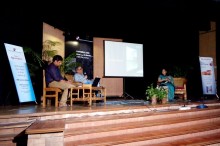
One of the most influential architects of South Asia, convener of modern architecture in post independence India, Architect Charles Correa died in 16 June this year. Essence of his work had a great impact in shaping the approach of regional architecture in the subcontinent and Bangladeshi architects are no discrete from the scenario. The Institute of architects Bangladesh plaid homage to the brilliant architect by organizing a discussion on him with prominent local architects and Architect Partha Ranjan Das from India. Professor Shamsul Wares, Architect Nahas Ahmed Khalil and Architect Mahmudul Anwar Riyaad were the local invitees while Architect Partha came from Kolkata. The latter had the opportunity to work with Correa in person. This time CONTEXT team had the privilege to play a part in organizing and shaping up the event with IAB.
The first speaker was Architect Partha. His personal experience with Correa was the key attraction of the speech. He also explained several local (Indian) and international projects focusing on architectural excellence. Professor Shamsul wares with his usual disinterest to ‘slide presentation’ delivered an engaging speech on the phases of Charles Correa’s works explaining the tranquility and concepts embedded within. He also explained the state of Indian subcontinent from where Correa had began his exceptional journey.
Unfortunately Architect Nahas Ahmed Khalil could not attend in person, but to his generosity he sent a video recording of his speech. He explained Correa from the view point of an architect graduated in early 80s. Architect Nahas mentioned how the projects of Correa, seen through the hardly available magazines and books started to have a footprint in their mind. He also advised students and young graduates about the thin line of what to grasp and what might be subject to avoidance due to different climate and social condition. Starting with the interesting ‘Dronacharya-Ekalavya’ story Architect Mahmudul Anwar Riyaad called himself a student of the ‘red book’ (Charles Correa: Architect in India, Butterworth Architecture 1989). He explained several of Correa’s projects through slides but insisted on the thematic influence of the architects work and essence of his concept rather than just relying on stylistic or materialistic impact. His speech was informative yet enchanting.
Architect Kazi Golam Nasir, the Chief Architect of Department of Architecture, GOB presented crests to the invitees along with a short speech about his personal experience of City Centre, Kolkata. Continuing her enormous effort as the Secretary- seminar of the institute, Architect Farhana Sharmin Emu organized and moderated the event. CONTEXT team played their part with Architect Emu starting from planning to realization. All in all it was a remarkable event much appreciated by the audience.
INSIGHT, is a multidisciplinary platform that will provide an experiential edutainment center which will act as a place of learning about one’s own self and will deal with functions related to human brain and how it works.
The idea of the project is to create a nature of acceptance that anyone suffer from even slightest bit of mental/ psychological distress and it is not a difficult task to control it if only one knows the whole scenario of how to deal with one’s inner powers. Brain is that very essence any human being possess that try to give signals and signs as to how to cope with all the problems. So if the notion of understanding the difficulties become clear, there will be a possibility that people will be able to bring good to themselves as well as their surroundings.Moreover they’ll be able to learn many unlearned things as well as unlearn many learned things. The spaces can be as such that people can explore themselves and their surroundings. The research zone will deal with the psychological factors and will come up with ideas and techniques as to how these people can enhance themselves.
In context of Bangladesh, a project like this is necessary in order to uphold the glory of being Bangladeshi. As a nation we have a very glorious background. With the passage of time and with the idea of a “Digital Bangladesh” which is not being used in a fruitful way, the new generation is not focusing on how to improve themselves. In a city where the idea of an open field is on the verge of being a myth, where new generations are focusing on fast food rather than homemade food, where children are focusing on who has got the most expensive toy cars, and who has got the most expensive smart phone, so in a city like that which is trying adopt to all the western cultures other than holding onto one’s own culture, the rate of depression and mental disorder will rise no matter what. So in order to make the young generation, kids and adults of the present situation understand the importance of self-insight and self-development, and how to deal with the slightest possible psychological disorder, a center like this is an absolute necessary.
A connectome is a comprehensive map of neural connections in the brain, and may be thought of as its “wiring diagram”. More broadly, a connectome would include the mapping of all neural connections within an organism’s nervous system. The production and study of connectomes, known as connectomics, may range in scale from a detailed map of the full set of neurons and synapses within part or all of the nervous system of an organism to a macro scale description of the functional and structural connectivity between all cortical areas and subcortical structures. The principal focus of such a project is the brain, any neural connections could theoretically be mapped by connectomics, including, for example, neuromuscular junctions.
The site is a potential and strategic zone for creating a project like this, since it can attack all kinds of audience from all over Dhaka city. Since the target audience was mainly city dwellers, who can’t take a break from their normal life and relax. Thus the site that was taken is located right at the center of the city (Gulshan-Tejgaon-Badda nodal point, presently location of BRAC Aarong) to provide a convenient access and the existing water body of Hatirjheel will add to the design.
It is strongly established that for such a project to be successful it needs to facilitate different categories of mental healing that are available so that people can chose from anyone of them. For that reason the program has been categorized into three different types, the meditation zone, the psychological zone and the museum to explore. So that one whole is not interested on one side of the process can always come back to the other side which according to him is beneficial for him. Besides these three types there will be also facilities like religious zones, library, audio/visuals and other entertaining facilities for the ones who would just like to have a visit of the place for a better understanding of the aspects of the Human Brain.
The form was generated from the concept connentomic, the wiring diagrams that helps researchers to identify the how brain actually functions. The idea was to create a shell that itself gives a feeling of the complexity of the brain and its functioning but yet again the spaces within will be so visually clear resembling the various features of the brain and how it is connected to other human organs and functions accordingly.
In order to create the journey the idea was to create a loop of function that displays and exhibits the different zones of the brain. The visitors will be first introduced by the different portions of the brain along with the exhibit of how synapses occur in the brain. Then the rest of the zones will be triggered one after another in a sequential process. They journey follows like this:
A new typology has been created in this project, it provide variety of facilities starting from a museum to a research center, as well as recreational zones and counseling facilities. The design was made in the dream of making people realize the importance of staying positive and how one can control themselves and not indulge into means that actually harm the organs of the human body. Initially the design might seem like a mere place which deals with human brain and its functioning, but the main aim and intention was to stoke people to think, and think deep, of themselves and the surrounding. The intention was to make people philosophically aware of themselves and their surroundings.
The world today is wonder about how to generate resources out of the natural resources provided by the upper most spiritual power, but we often forget that the best of all creation is human, and human mind, if used correctly can create wonders. Thus the project, to realize that greatness of human excellence.
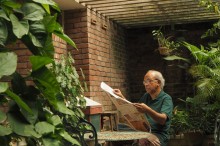
Professor Haroon Ur Rashid, the veteran academic and architect has been consulting in development sector with focus on water and sanitation programs for more than three decades. He has worked for agencies like World Bank, UNDP, UNCHS and others of such type in different parts of the world. A passionate academic, Professor Rashid presented in many national/international seminars and taught in different architecture schools for several years. Context team got the opportunity to talk with him about his early life, works in different arenas, vision for our development sector, thoughts on architecture education/practice and so on.
1. You started as an academic in BUET but moved to development sector and for almost 25 years worked for water and sanitation programs. Please draw some light on the early days when you initiated the move; might be of interest of young professionals.
My career started at BUET in 1974. Very soon I became passionate about teaching and would probably have continued teaching in BUET till my retirement had things gone well. Circumstances forced me to resign after I went to the US for graduate studies. On return I was requested to join BUET again, but BUET and I could not agree on the terms. I started teaching part time in BUET for a while, but as my duties in the World Bank became more demanding I had to leave BUET for good.
My coming to the development field was incidental. On completing my graduate studies, I returned home in 1981 and joined a private consultancy firm managed by a few friends. Before joining this firm I had designed a few run-off-the-mill residences for dubious clients who had no idea of what architecture really meant. I was not at all happy with the many ways in which the clients changed and distorted my designs without even my knowledge. On joining this firm I got the opportunity to do my first ever professional work. It was a small training facility for blind children. I worked hard and in close consultation with the client designed the facility. Those were the days before the advent of the computers. I prepared fifty sheets of working drawings manually, the tender documents and the cost estimate. The draftsmen prepared an additional 20 sheets of structural, plumbing and electrical drawings – a total of about 70 sheets of drawings for a small project costing only Tk 4, 500,000 in 1981-82.
Construction bids were invited, but there was only one submission at a high rate of 32% above the estimated cost. Unfortunately the client was inclined to select this one person without any prior experience in civil construction. His only past experience was constructing a boundary wall. We as the consultant insisted on re-tender. Fresh bids were invited with a better response. There were four or five submissions with the lowest being 5% above the estimated cost. The highest bid was that of the contractor from the first round of bidding at 28% above estimated cost. Despite the fact that there was a lower bid the Client was favoring this highest bidder. The Consultant is expected to protect the interest of the Client. The client wanted us to support their decisions which we could not with a clear conscience. The bidder in question tried influence, enticement and even money. I stood my grounds. We were not at all surprised when a few days later we received a notice from the Client terminating our contract for “unsatisfactory” performance.
In another instance the director planning of an organization offered to give me an assignment costing about Tk 300 million at six percent fees on the condition that I return to him three percent. A contractor even approached me to hike the estimate of a certain building I designed by Tk 20 million, in return for Tk6 million in cash. An official of influence even offered me two kathas of land for certain other favors. I did not give in to the many enticements. I preferred not working to being entangled in shady and dubious deals and be condemned before my own conscience. These incidents may have dampened my enthusiasm but not my spirit. I have no regrets as I was determined to live an honest and clean life. Being “honest” because of a contorted logic that “honesty is the best policy” is in essence, being “dishonest”. I believe in the virtue of “honesty” and I would continue believing in it even if it were not the best policy.
I was not certain as to what I should do for the future. The thought of going abroad again did occur. When such as my predicament, the UNDP/UNCHS advertised for a consultant to work as a planner in the National Physical Planning Project for six months. During my graduate studies in Urban Design I was exposed to many planning courses and I had concurrently done a Certificate Course in Urban and Regional Planning. I applied, was selected and joined the project for six months which was ultimately extended to two and half years till the termination of the project. This was my first exposure to the development sector and I was excited and full of expectation. The initial euphoria that my work may help change the urban growth and environment slowly gave way to despondency. On termination of the assignment the World Bank advertised the position of a consultant for only three months in its Low Cost Sanitation Projects for Municipalities. My interest in this project was because on my belief that low cost sanitation was an important component of low cost housing. I joined the World Bank for three months but continued working for its Water and Sanitation Program (WSP) for15 years.
Architect’s own residence | Photo courtesy_Haroon Ur Rashid
2. What, from your experience is the biggest challenge in our water and sanitation sector?
I think the main challenge is inequity in people’s access to the benefits of development. Under the prevalent arrangement people do not have a space to participate in decisions that influence their lives. Why should people in Dhaka decide what happens in Rajshahi or Jhalakati or for that matter anywhere else? Why cannot planning, implementation and management of services take place at the lowest appropriate level? This leads to the question of decentralization of authority and responsibility. The political economy inhibits logical decision making. People who have the least at stake are the most powerful while people who stand to lose much have virtually no power in making decision. Decisions are taken on the basis of group or even individual interests rather than in consideration of the common weal. The prevailing system aggravates rather than reduces the inequity.The “experts-know-all” attitude among most professionals and officials further compounds the matter. This phenomenon is pervasive in our administration and to a large extent among professionals as well. For example in a sanitation project there was a Socio- economic study to assess people’s attitude towards sanitation, health and hygiene. A meeting that a member, Planning Commission chaired failed to appreciate the importance of such a study in promotion of sanitation and health. Such are the challenges development workers and practitioners face.
It is not mere awareness but behavioral change in health and hygiene practices that is important. The water from the tube well may be safe but if the container in which the water is carried home is dirty, pure water from the tube well is of little use. Sanitary toilets would not contribute to improvement in health if the users do not wash their hands with soap or ash after using the toilet. A general level of awareness on the linkage between good health and hygiene habits exist but transforming the awareness into practice has not been easy. Achievement in behavioral change has lagged behind the physical provisions of services.
Notwithstanding the many hurdles, Bangladesh has come a long way. The water supply coverage has increased both in the urban and the rural areas. About 87% of the rural population has access to arsenic free water. On an average more than 87% of the urban population has access to water supply. The gains in sanitation over the last 10-12 years have been dramatic. From only 34% in 1990 access to improved sanitation has risen to 61% in 2015. Bangladesh is now considered an Open Defecation Free (ODF) country with about one per cent currently practicing open defecation. The average urban sanitation coverage is 58% with larger towns registering higher coverage. Despite improvement in coverage, water and sanitation services still evade the poor and the disadvantaged in both the rural and urban communities.
Photo courtesy_ Haroon Ur Rashid
Photo courtesy_ Haroon Ur Rashid
3. You were talking about our attitude towards planning. In this respect what do you think could be a key parameter for change?
I am firmly committed to the concept of participatory approach to development. People must be given a role in decisions that affect their lives. People need information and choice to make informed decisions. Administrators and professionals are mere facilitators giving people information. The ultimate decision makers must be the people. In the last few decade countries round the globe are increasingly adopting participatory approach to development planning, implementation and management. It is participatory decision making and decentralization that would rid the system of a development administration that serves different interest groups and not the people.
4. Therefore, do you see a real change in near future?
I have been working in the development sector for a long time. There have been some positive changes. About 20-30 years ago the concept of involving citizens in development planning was strange and alien to many people. A Division Commissioner inaugurating a local level policy planning workshop openly doubted the ability of the “misinformed and uneducated” as he called the elected municipal chairmen, to contribute to policy issues. His remark was met with indignant reactions from the participants. In the past people accepted decisions handed down from the top without question, but today things have changed. People’s ability to assert their rights and aspiration has been on the increase. This is cause for hope. Thanks to the efforts of civil societies and a few donor-assisted initiatives. I am confident that the day is not long when not paying heed to local people’s needs and aspirations would be a political suicide.
Effective decentralization is essential for the development of the people and the country. It has been much talked of by every government that came to power, but no government did anything substantial to bring about real decentralization. A multi-donor funded project disburses development funds directly to the Union Parishads (UP). This initiative has been bringing about some positive changes at the local level. UPs now have fiduciary responsibility and authority, they now plan and implement local development activities; and prepare annual budgets in a participatory process. Projects like these can make a positive contribution in involving people, bringing about equity and improving local governance. The flip side of this is the local Parliament Members interfering in local administration and inhibiting citizens’ participation in development process. Whether the government would institutionalize these project-based positive changes after the project ends is an open question. Political economy of promoting political expediency, influence and group interest over general welfare has done more harm than good. Bangladesh has made substantial progress in almost all fields. The credit goes to its people – they have prospered in spite of the government but the distribution of the benefits has not been equitable.
Photo courtesy_ Haroon Ur Rashid
5. It is not very common for architects in our country to get involved in development sector for so long and being so involved. How do you think your capacity as an architect had a positive impact (if any) in conducting researches and projects in this sector?
My involvement in the development sector especially in the water and sanitation has been personally very rewarding. I have learnt much from the people.I have learnt that given the opportunity people can make and do make significant contribution; that people have experience that is varied and rich and no less important than ours; and that they are the best judge of their priorities, needs and aspirations. I am ever grateful to the people who have helped to change my attitude towards people, development, profession and life itself. I had started working in low cost sanitation program because sanitation is an integral component of low cost housing but I ended up learning much more than I bargained for. My personal satisfaction lies in being able to touch the lives of many people through my work.
(On a separate note) To be honest my contribution to the profession of architecture has been minimal. At best, it has been indirect, as a simple member of the executive committee of the Institute of Architects Bangladesh and as a teacher in different schools of architecture. My professional work as an architect has been very limited and at times I regret not having practiced more. Graduate study has exposed me to many planning courses including different branches of social science. These have helped broadened my perspective on the world around us.
6. You have worked with the very poor in rural areas for long. From your perspective, please tell us about the stand of an architect in terms of Social responsibility.
Architecture that does not respect the context betrays its sensitivity to the needs and aspirations of the society. Architecture has to be contextual or risks being irrelevant to the community of its origin. As Charles Correa had once said in one of his many talks that teaching the rural people to build better houses is like sending a Chinese cook to teach them cooking. The only way an architect can be useful to the poor is through a better understanding of their context, being aware of and taking lessons from their rich experience and building on them. Charles Abrams in his epoch making book, “Man’s Struggle for Shelter in the Urbanising World” puts it very succinctly when he states that the only way to improve housing for the poor is by building on their existing local experience. Improvement cannot be premised on new technology alone or a new housing model. The act of designing is problem solving and the process of design makes the understanding of the problem imperative. A problem taken out of context cannot be understood in totality. How can you address a problem that you do not understand? I am a firm believer in the importance of understanding the problem and its context prior to addressing it. My experience in the field of development has only strengthened my belief.
Architects have a social responsibility which cannot be value free. It cannot be the same across borders, cultures and context. We have to be aware of what others are doing, but must also appreciate the fact that every situation is unique. We may draw lessons from others, but mimicry disparages our culture, our psyche and our very being. Unless we can evolve our own architecture we will always play the second fiddle in the international stage. I believe that an architect who designs contextually, addresses a social responsibility. The contrary is born of intellectual dependence on or guidance of others who are often perceived as “superior”. This is that outcome of the contemporary version of colonialism disguised as “globalization” which is not physical but intellectual, which makes us dependent on others for guidance. This is how financial institutions like the World Bank, UNDP and the ADB define and control development for us. We have to be able to appreciate our own context; evaluate our own needs;decide on what we want or do not want;and not rely on concepts and philosophy of foreign origin. Let us not forget that we were building Taj Mahal when people in New York were living in shacks. Such is our heritage. Let us at least show it some respect!
Photo courtesy_ Haroon Ur Rashid
7. Let us draw some light on other parts of your professional engagements. You have been teaching architecture for a long time and are involved in practice as well. Please comment on architecture ‘then’ and architecture ‘now’ in Bangladesh from your personal viewpoint. (‘Then’ obviously refers to when you started)
This is a very interesting question. In the seminar celebrating 50years of the founding of the Department of Architecture at BUET I presented a paper on the objective of architecture education. In my opinion the responsibility of a school has to be defined in terms of meeting social needs.At the minimum, the intent of a school should be graduating architects who can design and build with competence. Architects must have the basic skills and know the language of architecture.The architects who excel professionally and those who do not, both use this same skills and language. Using an analogy from the literature both Tagore and I use the same Bangla, but Tagore’s composition is valued and appreciated globally, but mine is not worth the paper it is written on. Such is the nature of architecture. Every architecture program must at the minimum offer these skills and language – the grammar and idioms.
Anything over and above the minimum may give an architecture program varying degree of emphasis and focus. Such focuses do not evolve by themselves. They need the guidance of iconic figures with strong philosophical vision.For example Harvard and MIT have always benefited from big names in architecture. The architecture profession in Bangladesh has not yet sired visionary architects of such stature. This should not be a cause for concern as advent of a visionary cannot be willed or ordered. The winds of change are in the air, I am optimistic that the future of architecture education in Bangladesh would change for the better.
For the moment architecture programs should offer the basic skills and concepts to graduate architects of merit and competence. Students should be exposed to the essential core courses and non-essential optional and general education courses. For an engineer just knowing engineering is enough, but an architect has to know a little bit of everything. The essential skills and language would comprise the core courses with optional and general education courses providing variety and choice. In academia I would like to see architect-based studios similar to the model of ‘Glenn Murcutt Architecture Studio’. It would be too simplistic to be oblivious of the hurdles architecture schools face. To start with most schools in Bangladesh are in institutional environments that seldom understand and appreciate the nature of architecture. In architecture the whole is not the sum of its parts. To most people in the host institutions this very concept is alien. Changes in such institutions would, at best, be gradual and slow. We have to be steadfast on our commitment, to persevere, to be patient, struggle and move on.
Professionally we have come a long way. When we graduated in 1974 there were few jobs. Today most new graduates do not feel the compulsion to get a job. They prefer being self-employed which implies that people today value the services of an architect. In the past most people did not know what architecture was or its importance in the society. In 1974 I quoted only Tk10000 for the design of a residence in Lalmatia. The client was astonished and told me that he had paid only Tk250 for the design of his first house in Dhamnondi. Don’t you think we have come a long way? Those were the days when the government was the biggest builder. There were hardly any private assignments.It was difficult for any consulting firm to survive on private assignments alone. The situation has changed today. The majority of architects are surviving and doing well on private commissions only.The expansion of the private sector and social change have opened up opportunities for the professionals.
8. You had been an active practitioner for a while, won professional awards for various projects. We don’t see you working much now a day. You, however, lightly participating in some events/competitions as jury member and playing some advisory role. What is the reason for such disappearance?
No one gives me work. Perhaps I do not know how to deal with the clients (laughing….). I did not have a very pleasant experience in dealing with clients. To tell the truth I always had a serious problem in asking for fees from the clients. I even have problem asking for money that I have loaned! Once a synthetic ‘kurta’ for me and a ‘saree’ for my wife were all the compensation I received for my consultancy services. I do not blame the client. The fault is mine for not being able to assert myself. The only person who paid me a proper professional fee is my sister. What an irony!Nonetheless I still have a passion for design and do take it very seriously.
9. Any advice for the students and professionals?
Architecture in Bangladesh presents a paradox. Some works give us hope for the future while others are disconcerting with a profusion of the latter kind. Perhaps historically this was always the case everywhere. Average architecture does not predict a trend. It is always the selected few that light the way. Let us be true to ourselves, our society, or culture and to our environment. It has taken the better part of the last century for man to realize that technology is not the panacea for all human ills. On the contrary it is the “mindless” use of technology that is responsible for all of our environmental problems. We have to respect the context and build sustainably. Let us not forget that human kind have always lived in harmony with nature. Man and environment with everything in it, are in a symbiotic relationship. Nature does not belong to man but man belongs to the nature. It is after the industrial revolution that things began to change and the growth of capital have deified greed into an “omnipotent and omnipresent” entity. Let’s not get carried away with the stream. Let’s be true to our own selves, let’s think rationally and design contextually.
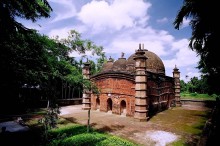
A few number of mosques, built in the outlying areas of Mughal Capital Dhaka during the early Mughal Period, reveal a happy blending of the Sultanate features with the new Imperial Mughal features, which characterise a transitional phase in the development of the mosque architecture in Bangladesh. This Atiya mosque is an illustrious example of this transitional phase. It is located, about six kilometers south of Atiya Union under Sadar Upazilla in the District Tangail. According to the original date-plaque inscription, which is now preserved in the Bangladesh National Museum, the mosque was erected between 1019/1610-11 by Sayid Khan Panni.
Plan & Elevation, Atiya Mosque, Tangail
The mosque belongs to the group of square shaped plans with a foreroom that developed during the Sultanate period. The mosque measures externally 16.51m by 10.52m with a 3.55m wide foreroom. There are three arched openings in the east facade and one on each side of the foreroom. The main hall is accessed by three openings from the foreroom and has one opening on each of the north and south sides. Corresponding to the eastern openings there are three mihrab niches in the kibla wall. Introducing typical Mughal octagonal turret, four instead of six in each corner, is the most inquisitive feature of this mosque. The large central dome on the square prayer hall is supported on sequences at each corner and the three domes over the foreroom are carried on pendentives. The entire eastern façade is adorned with several rectangular recessed paneled niches and divided by a string course in the middle. The area of each recessed niches is faced with extensive terracotta ornamentation of geometrical and floral nature. Eastern façade has gentle curved cornice embedded with merlon shaped battlements, whereas the southern and western façade has straight parapet.
Photo Credit : Syed Zakir Hossain
The mosque brings together harmoniously both the Sultanate and Mughal features of Bengal. Square shaped room with a verandah, flat façade, curved cornice, exquisite terracotta ornamentation, horizontal string-course are typical sultanate features, whereas, plastered turrets embellished with niched paneling, blind kiosk on the corner turrets, plastered surface paneling, dome with octagonal shoulder embellished with merlon, kalasa typed finial on a lotus base recall Mughal architecture in Bangladesh.
Photo Credit : Syed Zakir Hossain
Author: Prof. Abu Sayeed M. Ahmed, Ph.D and Shaila Joarder
Photography: Syed Zakir Hossain
Drawings: Elevation: Pundranagar to Sherebanglanagar, Chetana, Dhaka; Plan: Mosque Architecture of Bangladesh, UNESCO, Dhaka
One of the most critically acclaimed architects in South Asia-Architect Bashirul Haq participated in a talk at Chayanat auditorium on 20 August, Thursday. The talk was a part of the lecture series ‘Sharing Stories’ organized by Institute of Architects Bangladesh in regular interval. The rain soaked evening and the spell bound audience provided the architect a perfect opportunity for a walk in the memory lane which at the end turned out to be a very informative discussion.
Architect Haq started with the stories of his childhood, his studies in Dhaka college and initial days of architecture education in the National College of Arts, Lahore, Pakistan. He talked about how he ended up studying and working in United States being patronized and somewhat financially assisted by the prominent structural engineer Fazlur Rahman Khan. His refusal to work in US to establish own practice in Dhaka was inspirational for young graduates. The architect’s friendly discussion of his initial commissions and set up of first office sorted curiosity of many.
Form the stories Mr. Haq moved to discuss some of his projects explaining how he perceive a project form beginning to end considering its context to the foremost. A number of projects including his own residence portrayed his sensitivity to nature, respect to culture and inclination to sustainability. He presented his Chittagong University Ayne (law) Bhaban, a recent project in detail explaining how the contour site was respected and somewhat utilized which is just a kilometer away from Architect Majharul Islam’s iconic Chittagong University complex. All in all this part shined with glimpse of his well known ideological environment responsive architectural style.
The talk was followed by the regular yet interesting question answer session which drew insight in the profession of Architecture in our country, architect-client relationship etc. Ar. Farhana Sharmin Emu (Secretary Seminar, IAB)moderated the occasion with her wit and familiar glimpse of humor.
BRAC University, Department of Architecture hosted its Jury for Undergraduate Thesis Studio on the 9th and 10th of August 2015 at their Mohakhali Campus, marking the first of the traditional two thesis juries per year. This year saw an eclectic mix of twenty-four projects which ranged from rather ‘futuristic’ design approaches to pragmatic projects, upholding BRAC Architecture School’s liberal perspective to allow its students to explore new and unorthodox ideas to the fullest. The primary jury panel consisted of Architect Imran Hossain and Architect Mahmudul Islam Forhad on the 9th August, and Architect Tanzim Hossain Salim on the 10th of August, alongside other renowned architects and all of BRAC Architecture School’s teachers.
Some projects garnered absolute praises and others invited friendly yet heated discussions that could only contribute to the greater enlightenment and enthusiasm of the students and jurors alike. While projects such as “Cultural Filigree” explored possibilities of interweaving the public realm with the urban context in Bogura, others such as “Crime and Punishment Museum” and “Citizen Arena” questioned issues embedded within the society. Attempts were made by students to explore the thresholds between providing commercial solutions keeping intact the spirit of spaces and the city in projects such as “Abahani Sports Complex” and “Five-Star Hotel in Khulshi”.
Both days ended with amicable notes, greeted with the bitter-sweet sentiments of students completing their journey as an undergraduate architecture student and stepping into a new phase of learning as professionals. BRAC University, as always, cordially welcomed both praises and criticisms with equal warmth.
With a vision to ensure housing for all through optimum utilization of scarce resources and vernacular techniques, Housing and Building Research Institute (HBRI) was established in 1975 under Housing and Public Works Ministry. Since its inception, HBRI played a leading role in the development of inexpensive and new technologies for construction through pilot projects while promoting new and better uses of commonly used building materials; both in rural and urban areas. The following section gives a glimpse of research and development activities being carried out by HBRI in last 40 years of its establishment.
Improvement of Ferrocement Technology and exploration of its versatility
Ferrocement (FC) is a thin and light weight form of concrete consisted of sand cement mortar laid upon iron wire mesh. It is considered a very potential building material because of its light weight nature, easy technique and versatility.
Research is in progress on exploring the effects of different type of mesh including polymer, bamboo, and jute fiber as replacement of iron mesh in order to make it corrosion free and cost effective. Structural elements like pre cast post and beam of FC, considering rural settlements for now, are under test and results show better strength for FC elements than that of RCC.
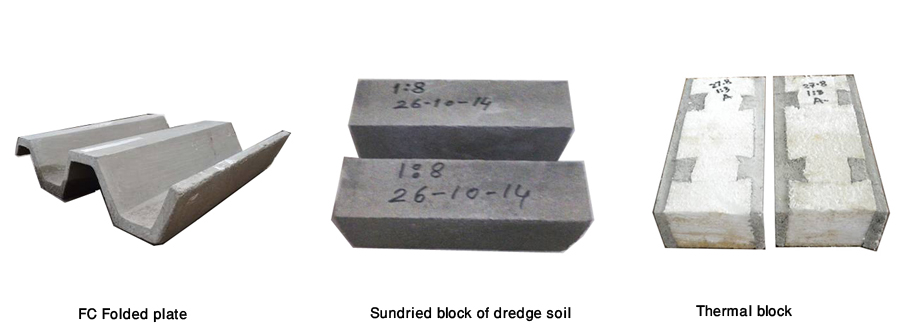
Polystyrene is incorporated in ferrocement in order to improve the insulation quality and named ferrocement sandwich panel. It is being cast in situ till now and properties under supervision. Another alternative building block is being studied which is made of sand cement mortar encapsulating polystyrene. Till now it is being cast in a volume of 4”x4”x12”.
Sundried brick made of dredged soil
With a view to control the use of cultivable top soil and carbon emission in brick production, dredged soil is used and sun dried. This material is receiving much attention countrywide and properties are being tested in laboratories. The impact of weather when used as external wall is under supervision. The size of regular brick is considered for this block.
Utilization of ETP sludge in building material
Study is going on to incorporate ETP sludge into building construction with a view to utilize the industrial waste that does considerable harm to our environment. The methodology includes incorporation of ETP sludge along with dredged river soil, reaction between which creates geo-polymer and restricts the hazardous particles to leach out consequently. The physical tests are undergoing.
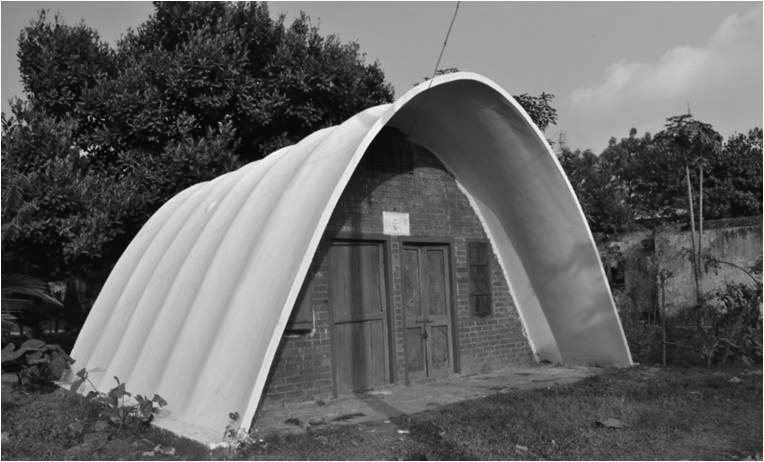
Various types of FC slab and roofing elements are already in practice. Depending on project nature relevant one can be utilized. FC channel, folded plate, L panel, FC corrugated sheet are the types and they are used as designed modules pre cast elements. It is estimated that use of FC elements instead of RCC slab reduces the construction cost up to 20-25%.
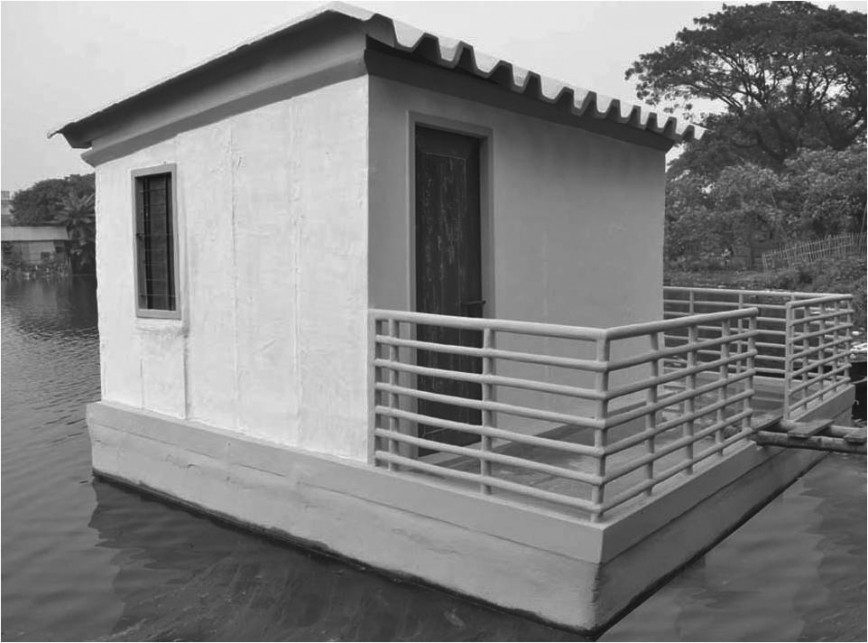
Ferrocement is also being applied as non load bearing walling elements either pre cast or cast in situ. Door window frames and shutters of FC are in progress. Ferrocement because of its lightweight nature is used as the floating base of floating houses.
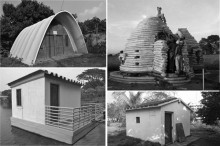
Innovative and cost effective architectural and structural solutions for different disaster prone areas are being searched for. At present research is in progress on housing for cyclone prone areas and haor (flash flood prone) areas. HBRI is also assisting with different government project including ASHRAYAN-2 in developing disaster resilient designs with its techniques. Already four pilot constructions have been completed in four different areas having different disaster profile. For erosion prone areas such structure was provided so that pre cast elements could be dismantled and transferable. For flood prone areas the housing elements were considered treated so that it will not degrade under prolonged stagnant water. Floating house is also another type for flood prone areas. Circular shaped stilt house was provided for cyclone prone area.
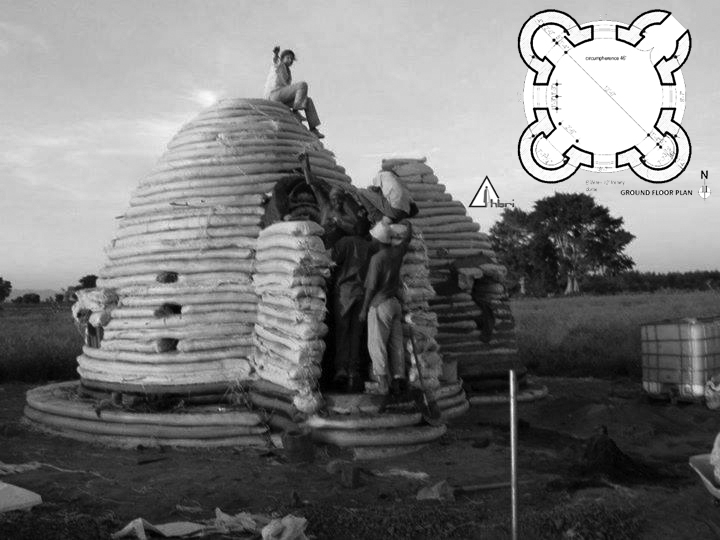
Emergency Sand/earth Bag Shelter
Concept sand/earth bag technique is derived from the temporary and emergency barracks of wars. It is mainly developed by Architect Nader Khalili and won Aga khan award. Architect Iliona khalili initiated this technology in HBRI through a hands on workshop. HBRI is studying on adapting this technology into our culture.
Extensive studies are undertaken to develop standard housing guidelines for cyclone prone areas. This includes questionnaire survey to the coastal belt and analysis of the findings, which ultimately will lead to be the basis for guideline formulation. The study is taking into account the inclusion of gender and disability issues into design. Research on housing for HAOR areas are also in progress.
Seismic Response Analysis through Reaction Frame
Earthquake today is an important concern. HBRI is studying building behavior under earthquake and techniques to design earthquake resistant buildings. Extensive research is being carried out on Seismic response analysis through a reaction frame. The role of partition walls in increasing the strength of RCC elements are observed here and solutions for soft story incidents are studied.
Multistoried rural house prototype (construction in progress)
It is a pilot construction of the concept of multistoried house in rural areas in order to control the unplanned housing on cultivable lands. Structural frames are designed with RCC and all the other elements are designed with ferrocement including stair.
Current focus of HBRI is to promote cost effective and lightweight building materials to ensure affordable and sustainable living both in rural and urban context. A major concern is to alternate the burnt brick technologies to ensure safer environment. HBRI seeks contribution and assistance of all the relevant personnel to make its effort a success.

![Architecture Otherwhere [Durban, Warwick Junction] | AUST](https://contextbd.com/wp-content/uploads/2015/09/feature-220x146.jpg)



![Conflict | © Reesham Shahab [Tirtha]](http://contextbd.com/wp-content/uploads/2015/08/conflict-449x643.jpg)
![Let-there-be-sight | © Reesham Shahab [Tirtha]](http://contextbd.com/wp-content/uploads/2015/08/let-there-be-sight-453x643.jpg)
![Eye-scream | © Reesham Shahab [Tirtha]](http://contextbd.com/wp-content/uploads/2015/08/eye-scream-439x643.jpg)
![Getting-out | © Reesham Shahab [Tirtha]](http://contextbd.com/wp-content/uploads/2015/08/getting-out-502x643.jpg)
![Death-his-friend | © Reesham Shahab [Tirtha]](http://contextbd.com/wp-content/uploads/2015/08/death-his-friend-379x643.jpg)
![End-of-vie | © Reesham Shahab [Tirtha]](http://contextbd.com/wp-content/uploads/2015/08/end-of-vie-379x643.jpg)
![The-calling | © Reesham Shahab [Tirtha]](http://contextbd.com/wp-content/uploads/2015/08/the-calling-376x643.jpg)