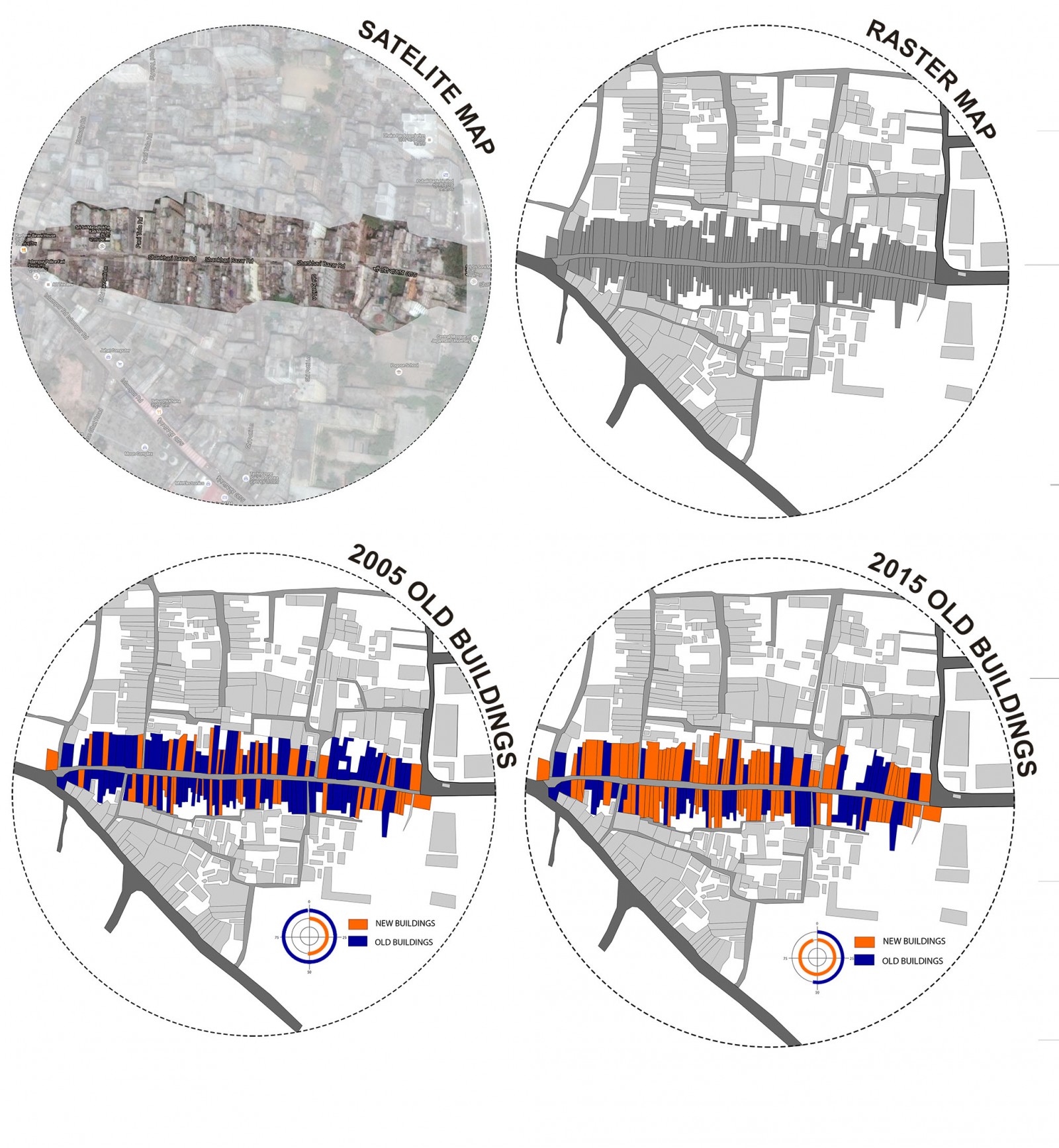
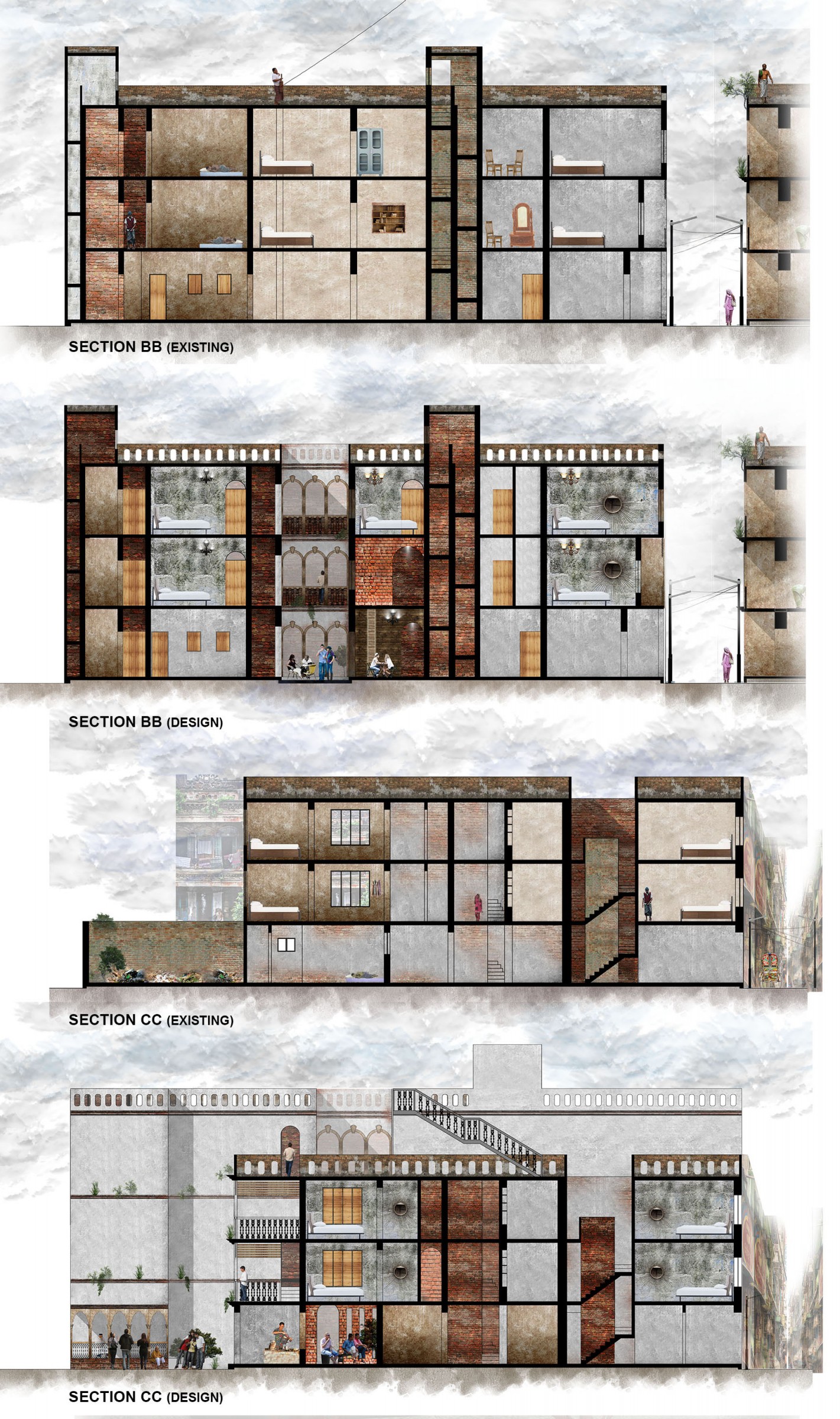
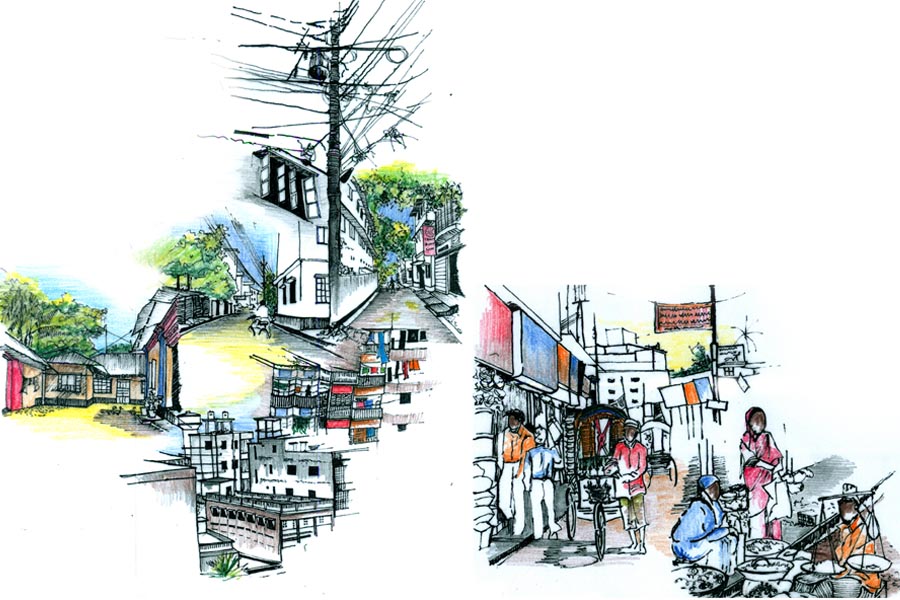
Shakharibazar is a very unique site of historic Dhaka. The area has been a sanctuary of a specific ethnic (business) community for more than three centuries [1]. The mixed use, narrow buildings of Shakharibazar presents a very interesting urban fabric. Like other historic quarters, Shakharibazar is also going through the process of transformation. New buildings are rapidly replacing the old structures. A survey shows that there were more than 95 old buildings on Shakharibazar band in 2003. But at present in 2016 only 55 old buildings are observed in this area. Recently government has declared this area as a heritage site, however local tension over this decision has been strongly felt. Local people are still demolishing the old buildings in order to make a new one.
Apart from many socio-political issues ‘building economics’ seems to be one of the major challenges for preserving historical buildings in Shakharibazar. Landowners are more interested in rebuilding on the site for better return. With the increased land value, the existing way of using the old structures is seemingly unprofitable. Many of these Century old buildings are structurally vulnerable as well.
The site has a potential to become a tourist spot because many buildings in Shakharibazar represents the architectural history of Dhaka. Old Dhaka itself is an important tourist destination. Historical edifices like Ahsan Manjil, Lalbagh fort, Ruplal houses, Tara mosque, Armenian Church etc are the evidences of Mughal and colonial architecture that are frequently visited by many local and foreign tourists.
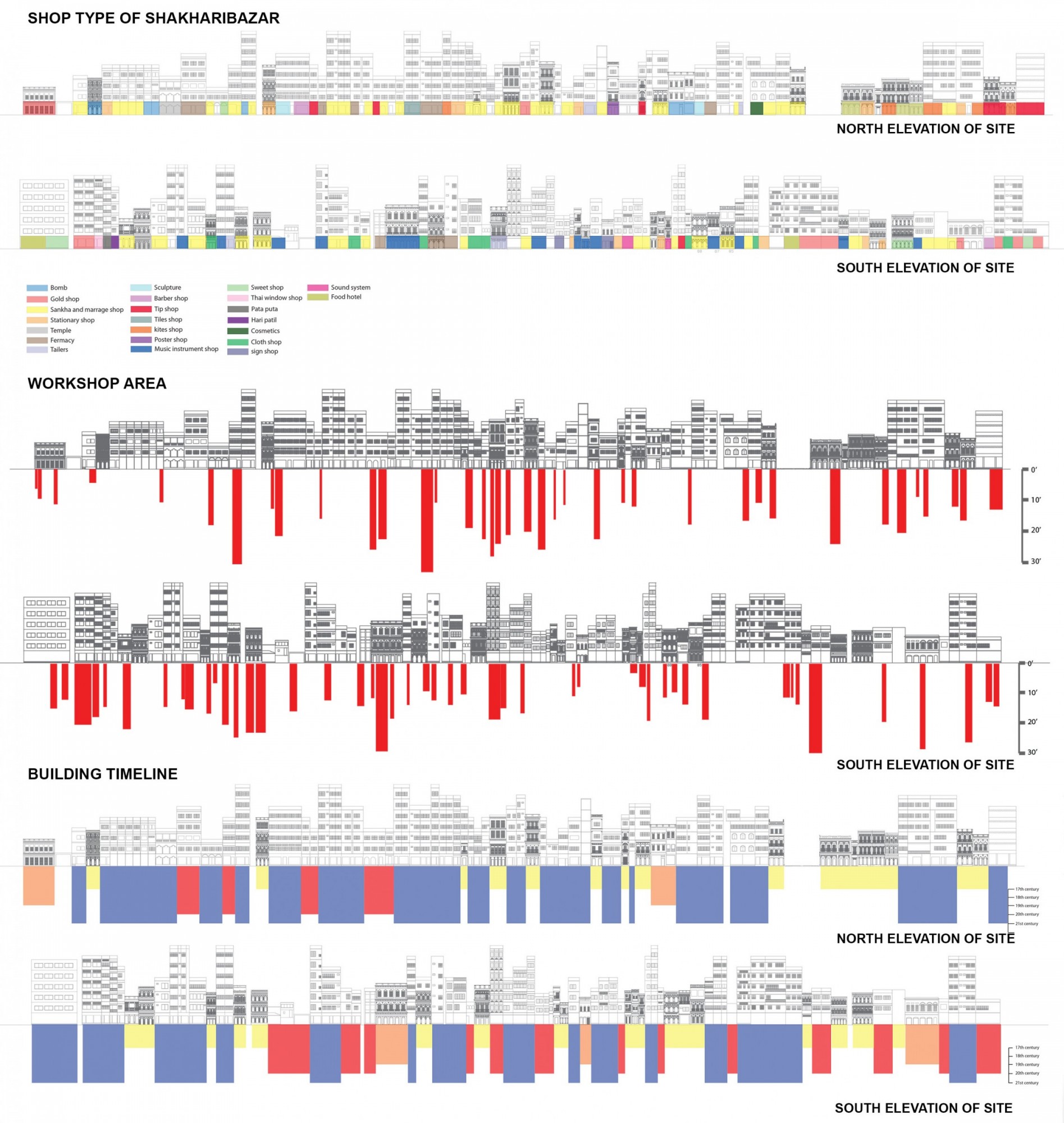
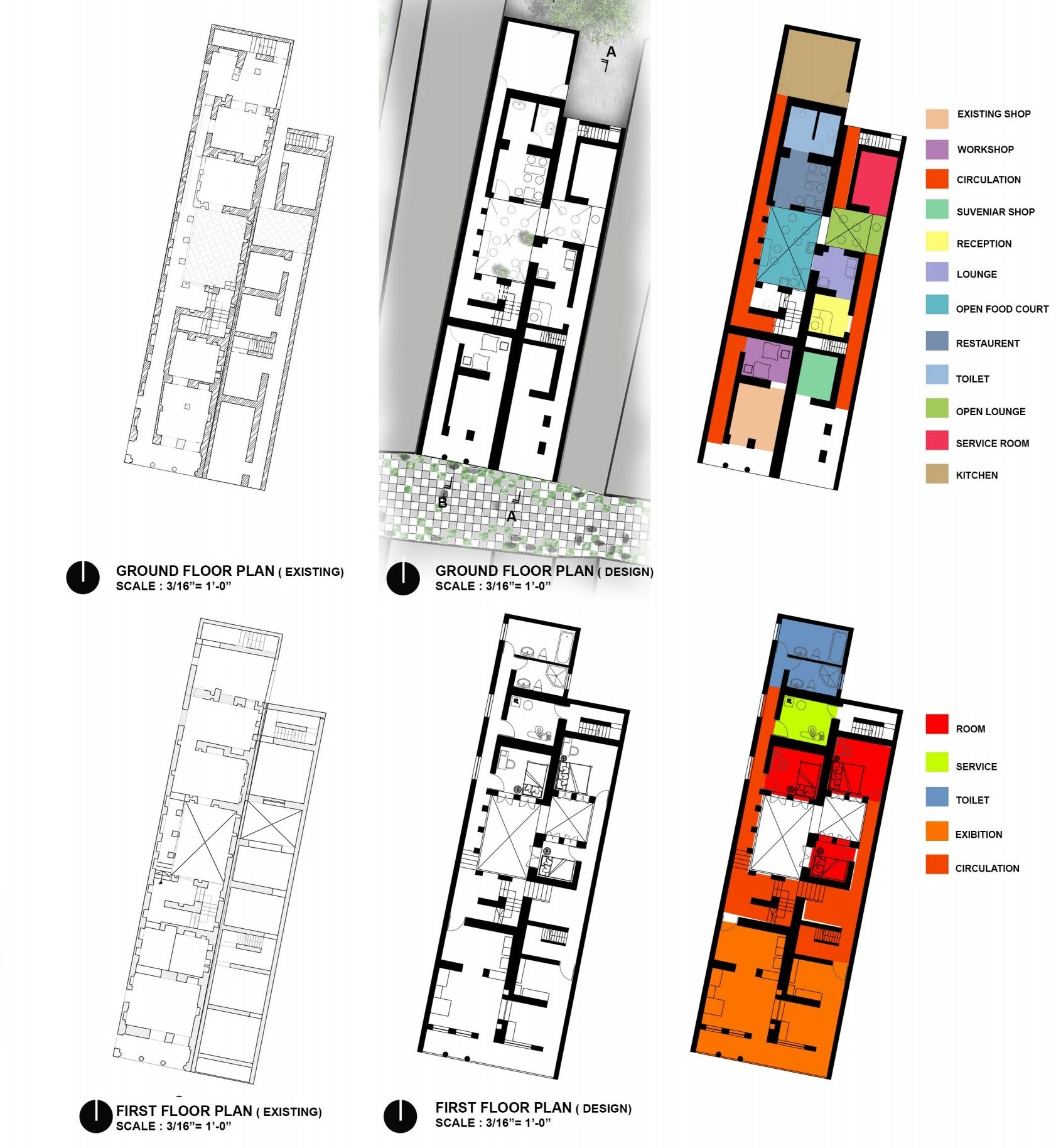
Shop house is the generic archetype of existing urban fabric of Shakharibazar. Ground floor is occupied by the shops with workshop at rear side of the houses. The other floors of the multistoried buildings are rental spaces partly used for commercial and residential purposes. Numbers of house owners who running their business here are living in new Dhaka to avail better urban services and amenities. The existing old buildings are often accused as inhabitable, dark and shabby and structurally vulnerable and thus economically less viable.
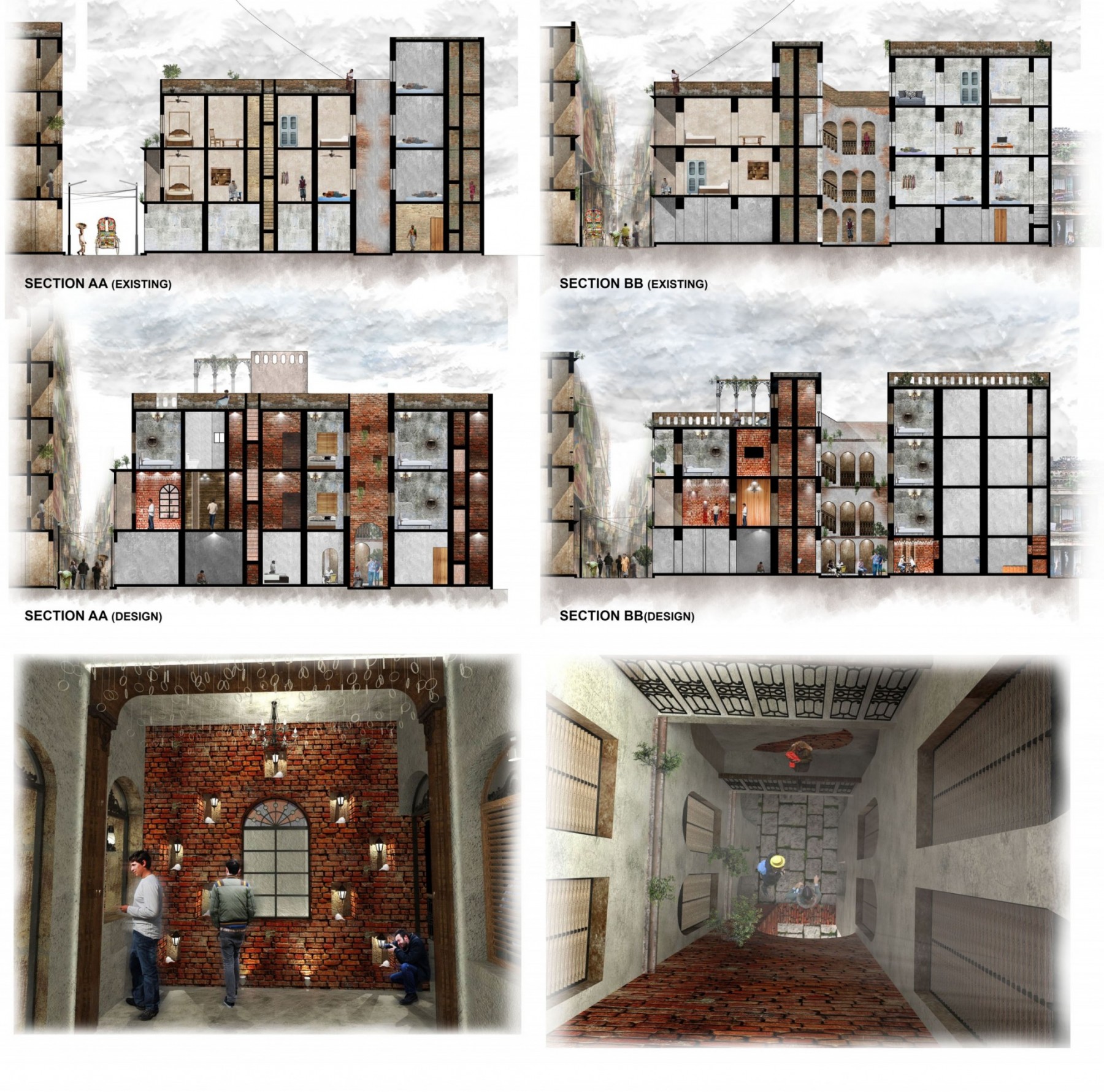
The project aims to regenerate the rentable part of selected historic buildings into a functionally, economically and culturally viable place. Taking references from successful examples around the world, the old structures are designed to be transformed into touristic/public functions like exhibition space, hostel for tourist, café etc. Existing shops at the ground floor and living area for local inhabitants will remain unchanged. Effort has also given to make urban pocket space to allow interaction between the tourist and the local people.
A win-win policy is, therefore, required that best informs the interest of local landowners as well as preserve the rich building tradition of Dhaka. Measures should be taken to preserve remaining historical structures through local participation for safeguarding community interest.
With this insight, the following project proposed a metamorphosis of Shakharibazar where historic buildings are transformed into economically viable alternatives while keeping its architectural and archeological value intact.
DESIGN PROCESS
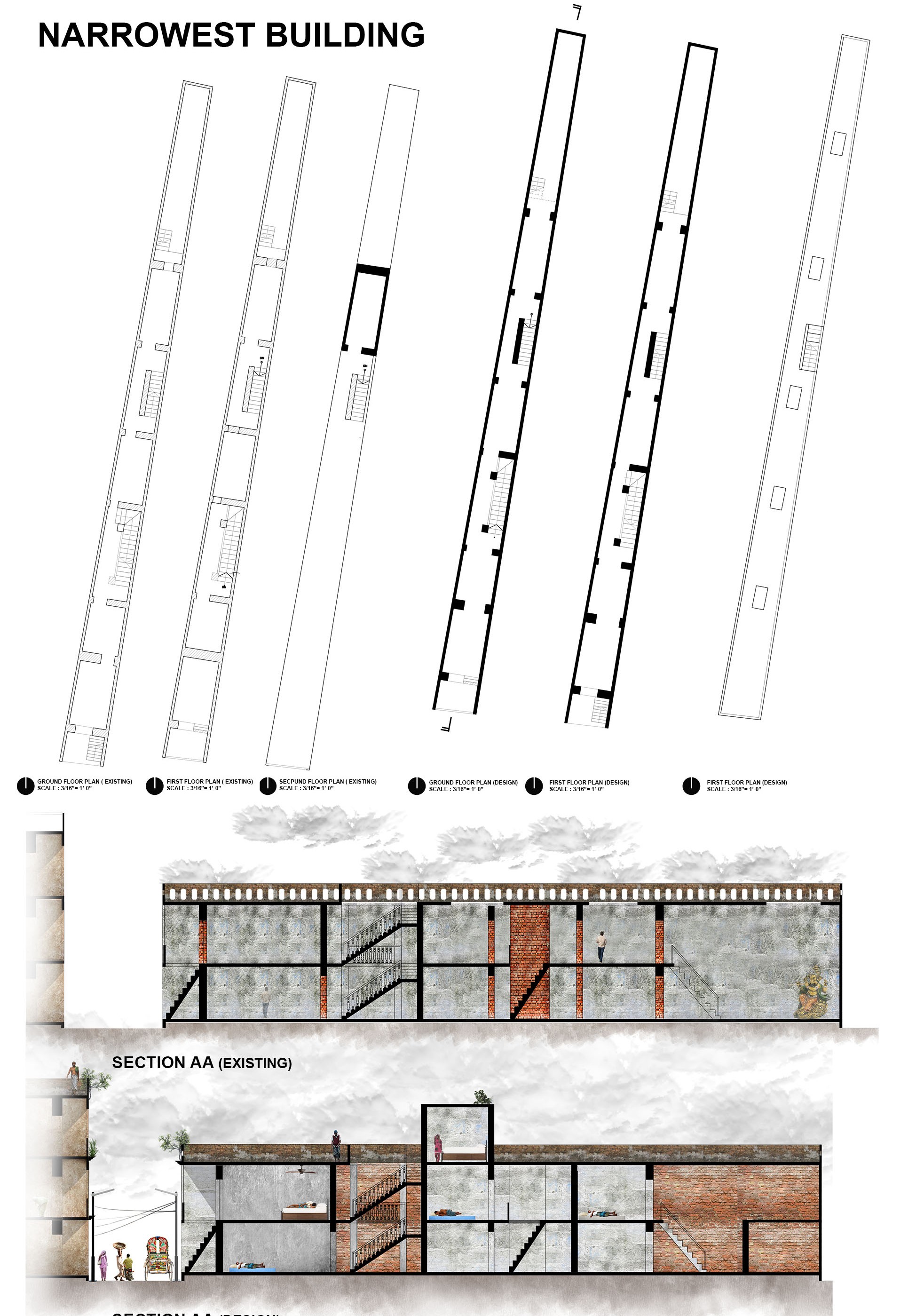
In order to regenerate the urban fabric of Shakharibazar six generic archetypes are identified: 1. the Path or Goli ; 2. Open space in between buildings; 3. Building with shankha shop; 4. Two buildings with a goli in between 5. The narrowest building.
1.The path or Goli
The main access road is a narrow path which have a highest width of 19 feet . This path is used for the people as a shortcut from Islampur to Laksmibazar. It saves about 10 to 15 minutes of time. A large numbers of passerby prefer this road for movement. When rickshaw enters on this road it creates blockage. There is an alternative rickshaw route from Laksmibazar to Islampur. This road is thus proposed as a pedestrian path so that only people can walk on this. And hard surface of the road are downgraded to semi-paved surface in order to make it permeable to storm water.
2.Open space in between buildings
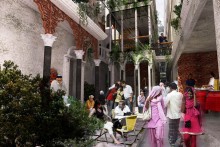
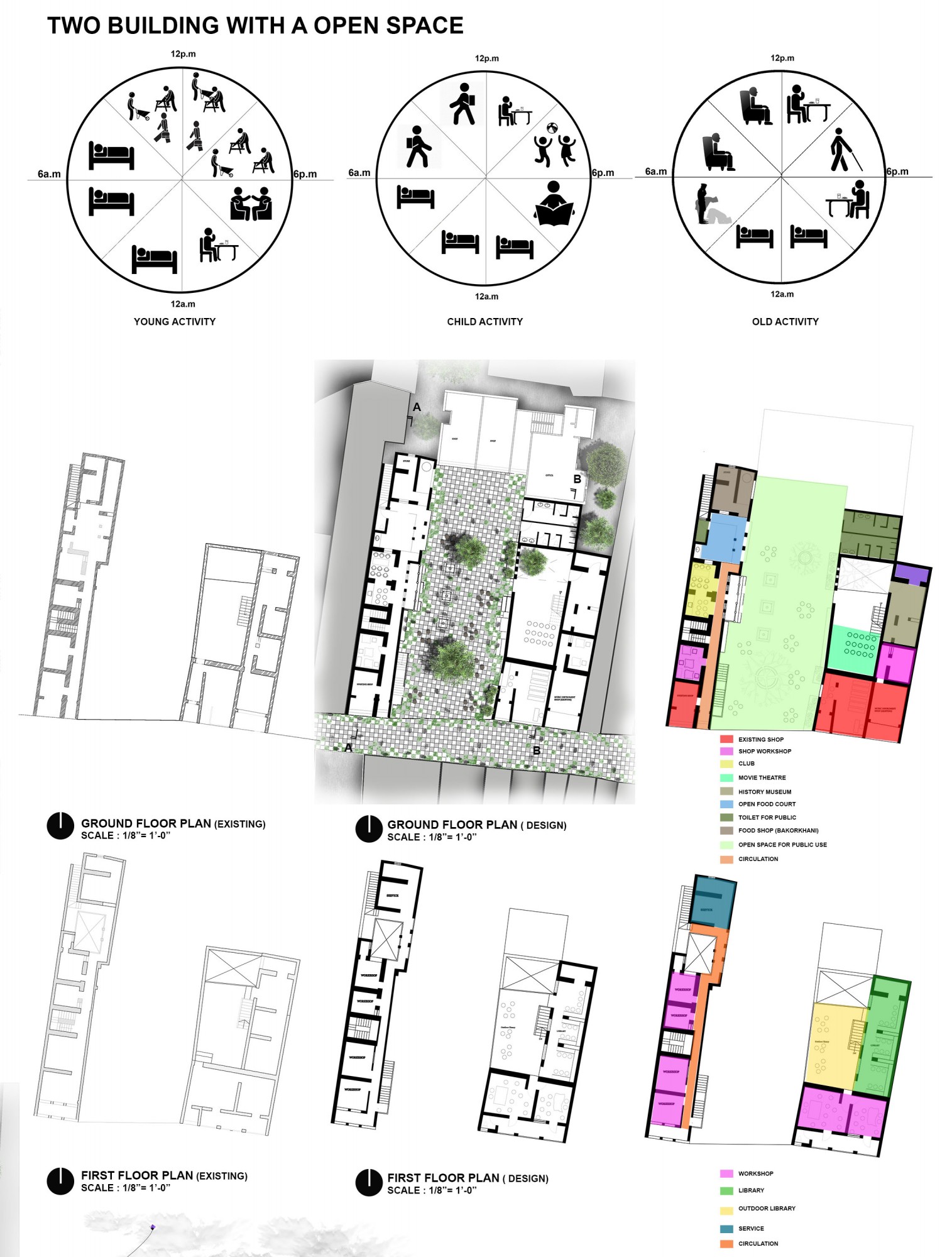
In 2013 holding no. 14 was demolished by the local owner while attempting to construct a new building. But the construction work was stopped by the city authority and the land is vacant now. So, effort has given to make use of that open space by providing some temporary functions or activities. On day time there will be some food vendors on that open space for tourist and local people. The local people can hangout with friends and family at night. Tourists can join them and enjoy the street life. The adjacent buildings which connect with that open space are transformed into public functions like movie, exhibition, library, workshop etc. Also this open space can be used for exhibition.
This typology represents the original pattern of Shankhari house. The upper floor’s rental spaces, which has residential use currently, are rearranged to make it suitable for tourist hostel, thus keep the change optimum. The existing shop on the ground floor will remain unchanged. Some related functions like cafe, reception, exhibition spaces where the handmade shankha can be exhibited are also proposed.
On the existing road there are some small food shops like tea stall, small restaurant etc though it lacks sitting place where people can sit and eat those foods. Even within this dense urban fabric small unsed open spaces are found. Such underused leftover spaces are designed to function as an activity enclave equipped with urban furnitures and functions.
Once the narrowest building (holding no: 12) was a temple and later people started to live on this building. But it is very difficult to live on this building because the maximum width of the building is 6 feet .The proposal suggests reconversion of this building into a temple again.
[1] Maher Niger, Preserving Urban Roots: The Case of Shakhari Bazaar, Dhaka, Bangladesh, Nakhara: Journal of Environmental Design and Planning, Vol 9, 2013.
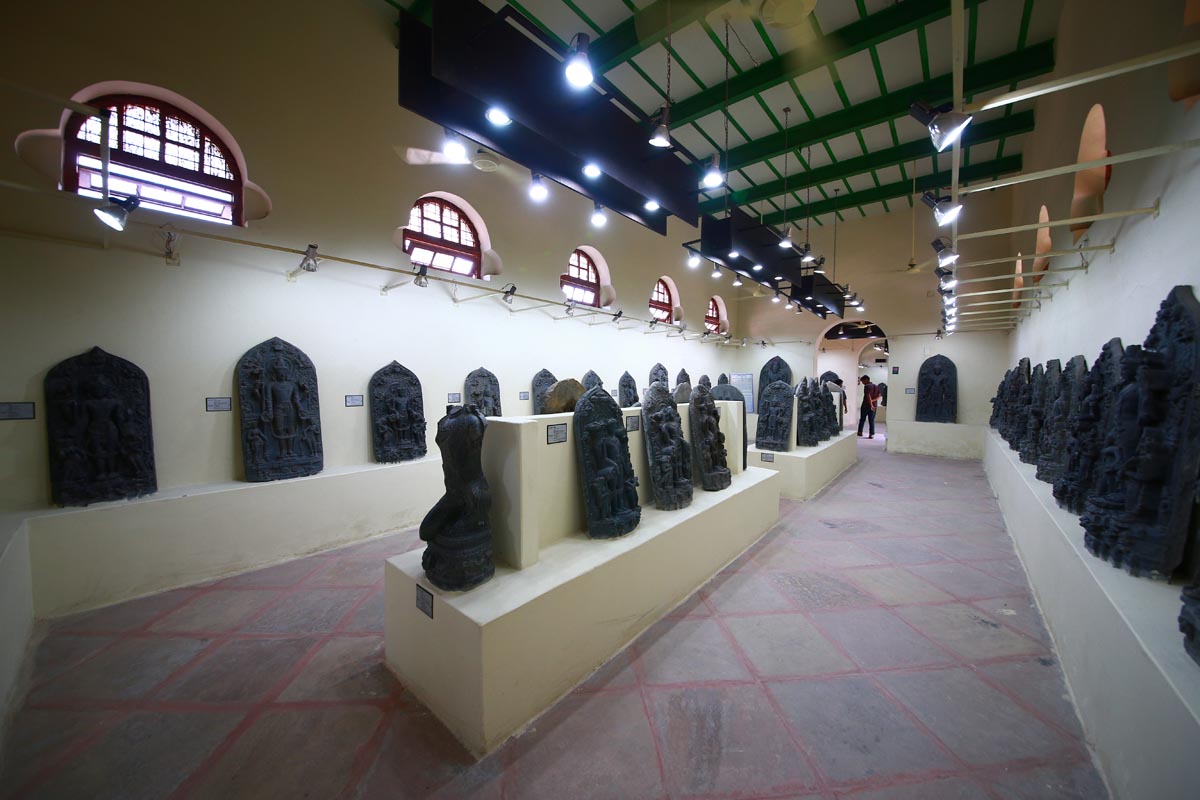
The Varendra Museum started with the personal collections donated by the Rajahs of Rajshahi and Natore, notably Prince Sharat Kumar Ray. Currently this museum houses more than 15,000 different antiquities including 5,000 old manuscripts. The museum library itself contains more than 14,000 rare and valuable periodicals, journals and books. The oldest collections of this museum are from the Maurian period (C. 322 B.C. – 182 B.C). The museum also houses a large number of Hindu and Buddhist images.
This museum building is highly important for its collection. Due to inadequate funding, the Bengal heritage and Varendra antiquity are in threat . Last couple of decade this historic building was at risk because of ill planning and unprofessional maintenance; ceiling and facades were vulnerable and falling apart because the materials used in the roof of this building are wooden beam and rafter, earthen tiles and lime mixed with brick-dust which was used as plaster. Day by day the structure is losing its strength against the climate and aging of those materials used. Since this museum has been engaged in collection and preserving the heritage of Bengal as well as promoting higher study and research in arts, archaeology, history, culture and literature for almost one hundred years, little more attention is required to save this historic building.
The goal of this project is to preserve the unique colonial-era museum building. promoting the preservation of existing building focusing on exterior wall, preserve the landscape and outer wall, proper storage system and display of the wonderful collection. This building and its collection is an incredible representation of Bengal’s cultural heritage, and this project envisage to serve both i.e. store the artifacts in proper conditions and display them appropriately to scholars, public and preserve for the next generation.
The Museum was an early AFCP (Ambassador’s fund for Cultural Preservation ) grantee (in 2002), receiving limited funding to create bases for some sculptures and create some exhibit materials. On (FY 2010) Varendra received another grant by AFCP. That grant was used for exterior and interior wall preservation, Ceiling renovation, Lighting and electrification, Entry reception facilities, rearrangement of display area.
After finishing this preservation work we found some extra work to be done. Like Entry boundary wall preserve with entry gates, Guard room rearrangement with some security facilities, Preserving Existing landscape and its internal road network following its original design, rearrange the lighting system in the landscape.
On 2010, some of the features of exterior facade were yet to be finished like re-open the existing window which is blocked by brick wall for last couple of decade. Re-making security grill for those windows following its original design, preserve all the decorative art exists on the wall needs to preserve as early as possible, Need to rearrange the power supply room with some modern facilities. Varendra Museum does not have adequate and modern storage system need to look on it. A fully fledged store room is very important for a museum like Varendra. This heritage building has one store but not in a proper arrangement so lots of artifact and manuscripts are at risk. Therefore it needs a proper rearrangement without hampering the original design.
A slightly nippy breeze flowed in over the green canopies, as she opened the window, to let in some warm winter sunlight. She smiled as the sun kissed her cheeks, before flooding into her room. Her gaze followed the line of the parrots taking off from their nests into the thick winter fog hanging over the rice fields. She could make out the silhouettes of farmers heading off to work, their straight shoulders challenging the cold. She could feel their hearts low in worry, for they not knew how their fields had stood up against the monotonous rain, which had drenched every fold of the town in the last two days. She silently sent up a small prayer of thanks, ignoring how the eastern fraction of her apartment courtyard had befallen victim to the shadow of Nilima housing. One must consider oneself blessed, to still be able to enjoy nature in this small town, where six storey apartments were the new urban trend.
Sketch by : Farasha Zaman
A quick glimpse at the clock in the hallway showed her to be an hour early of office time. A little excitement bubbled up inside her, at the thought of managing a detour to the river edge under the banyan, before heading off to the gallery. She chose to wear the burgundy shawl, with a threadwork that depicted characters from the folk songs of Mymensingh. Today was a big day. A year into playing referee between globalization and the fading culture of Mymensingh had proved worthwhile. She did be hosting her second “folk art and craft exhibition,” with praiseworthy support from the youth of this town, promoting the inherent tribal culture of Mymensingh, rapidly being suppressed by modernization.
Sketch by : Farasha Zaman
Starting down the red oxidized cement stairs to the “uthan”, she loved how the hog plum and pomelo trees, bent with the weight of their children, lined the western periphery of the courtyard. Their reflections dancing in motion to the respiratory bubbles reaching the surface of the pond. Following the brick laid pathway, she skipped over a puddle and two. She was wearing her flip flops today, so the pot holes ahead did not dampen her mood. The “kolayanshomity” readily forgot its promise of tending to the needs of Jamtola Masjid- by-Lane” till date, when their proposal of a multi storey mall, over the play fields next to the national academy for primary education, to house “social activities”, were promptly rejected by us residents.
Sketch by : Farasha Zaman
She could hear Joyonto tinkle away on his bicycle, as a shabby cat purred on the sunshade of Manikbari. As water gushed into the open sewers, she looked up to catch a glimpse of Rehnuma letting the laundry out to dry. She waved to get the attention of kaka, and mounted the three-wheeler with daily ease. They crossed past a street vendor, as he heaved a basket of fresh ripe bananas onto his head, and was on foot for his daily chore. All else was quite, as her rickshaw rattled onwards through the bucolic setting of Cantonment Road. In a distance, a few ducks feasted on the micro life, amongst the decaying leaves that dappled the ditches, alongside the road.
Sketch by : Farasha Zaman
Kaka shooed at a mother goat, which blocked their way near AMC Mosque. She had been happily munching away on the plants that demarked Nijammudin Mia’s residence apart from Ram Chondro’s. There was not a worry, as a squabble between the neighbors on this subject was never to rise, for in this small town the two religions dwelled in peace. Snug amongst the concrete built, tin shed houses encircled around small courtyards, lined with dung sticks let out to dry. Once dried, these would prove to be an efficient source of energy to the small cooking fires that light these neighborhoods, like fireflies from a distance, each morning and evening. Sparrows chirped playfully as they hopped about the bottle gourd veins that covered the eroding rooftops of these small households.
Sketch by : Farasha Zaman
The urban fabric around her was quickly changing now, as kaka took her further into the town. The streets were beginning to be bounded more in concrete built square feet. One would get sudden surprises when crossing an empty plot dotted with sleek trees, or when one came across an old one storey house, around its courtyard of mix use. The streetscape was now decked with black rubber cables, connecting concrete electrical poles that boldly stood in front of almost every child’s window. But what took to her heart, was how each house with its personalized architecture, had verandahs, which had a story of its own to share. In contradiction, the fact of how the built characters of one house, highly influenced those adjacent to it irritated her, unless ofcourse someone took a to a different initiative and borrowed from buildings a few streets away. The thought of a hundred opportunities, that could be explored for each of these houses, capped with a water tank and its deserted rooftops, made her insides a bit more uncomfortable, causing a small sigh to escape.
They moved on, she asked kaka to stop by for a few minutes in front of Dutch Bangla Bank ATM, after crossing Nayanmonimarket place. They had managed to move comfortably through till here, as shops along the street were yet to open. In a while now, the shutters would be up, with careless shopkeepers occupying the foot paths to display commodities on sale. No valid thought of causing traffic congestion would budge temporary vendors off the driveways. The rickshaw pullers would go haywire, deaf to the droning sound of motor vehicles and their honks, cursing ever more and more as the day went by, making every town dweller in this part long for a homely quite spot in their town. She paused to look around; getting comfortable with security was a common mistake she did not tend to make.
Sketch by : Farasha Zaman
To her left, some young lads were chatting away over steaming cups of malai cha, on the wooden benches of the Rahims Tong, by side to Hotel Al- Shanin. An elderly man bargained with a young vegetable vendor, whose fully loaded cart gave way to the understanding that unloading of fresh stock at Teri Bazaar Ghat had been underway long since, and those that were not for Boro Bazaar were on their way around this town and to the city. The date trees ruffled in the breeze, each adorned with mud pots, collecting date juice. These would soon initiate the impish deeds in the innocent, trying to steal away the sweet drink, while elders saved them up for the rice pudding fest. To her right, a few cows were being herded past one street into another.
Sketch by : Farasha Zaman
She took only a few minutes to step in and out through the frosted glass doors of the booth, and was on way through Zilla School Road. Established by the British Raj in 1853, this school was witness to events she had only heard in stories. It is believed to have housed the British army, during World War II and the Bangladeshi Bidrohi students, during the liberation war in 1971. Set beside a beautiful dighi, with dominant British colonial architectural style, the school is landscaped with walkways lined in lush green. An open drainage around each structure channels away rain water. Fields not played on give space to the micro ecosystems, while they eavesdrop on adolescent boys pouring out their mischievous secrets to each other.
Sketch by : Farasha Zaman
She relieved kaka of his tedious obligation at BornomalaChottor, planning to continue through the unruffled setting of a residential area along Shema Choron Rai Road by foot. Part of this residential streetscape consisted of a cluster of small villas, which were not trampled on by urbanization yet. Having shifted to the cities, the owners of these wonderful abodes, which pulled at the heart strings of an urban resident, did not reside here anymore. The houses were mostly two to three storeys, with wooden swing windows, shaded and opening out to front courtyards dressed in flowering trees. The sweet smell from hibiscus clusters hosted to a get-together of bees. Balconies were dotted in bird houses, packed with pigeons looked after by Nuruddin kaka.
Sketch by : Farasha Zaman
She took through Orchid Road, wanting to avoid the unsightliness and hustle bustle of tuktuks and CNG three wheelers at Ram Babu Road Mor. There a view through the jungle of insulated cables would give way to the tragic scenery of a catalogue of signage. They lined every building facade, hanging from windows and verandahs, uncaringly leaving no space for ventilation to the mechanically lit interiors. Cacophonous chaos would inhabit this road in a while, deafening the policeman, who stood on a central two foot raised plinth, and tried in vain to guide these impatient souls through safely.
Sketch by : Farasha Zaman
The air was filled in the melodious laughter and giggles of small children, in navy blue uniforms, carrying their overloaded school bags, crossing over a dried up ditch. They cautiously balanced, as their feet sunk into the mud, groping onto the leftover bamboo, poking out from the slippery bed. This had once made a beautiful shakho.
Sketch by : Farasha Zaman
The right adjacent road lead to Women Teachers Training College, previously named the Shashi Lodge, by name of Maharajah Sashikanta Acharya Chaudhury. This residential palace, with its lavishly ornamented buildings, is soundly secured behind an intact wrought iron gateway and a lengthy, well decorated wall. The chaperoned garden only helps one imagine the horse drawn carriages and even Rolls Royce motors that undoubtedly rolled around the once fine fountain sculpture in the approach. Lying behind the Rajbari, a two storey bath house with wooden beams and a grand staircase, had once framed the river edge in awe striking 16th century architecture, but now stands beside a walled pond shrouded in trees.
Sketch by : Farasha Zaman
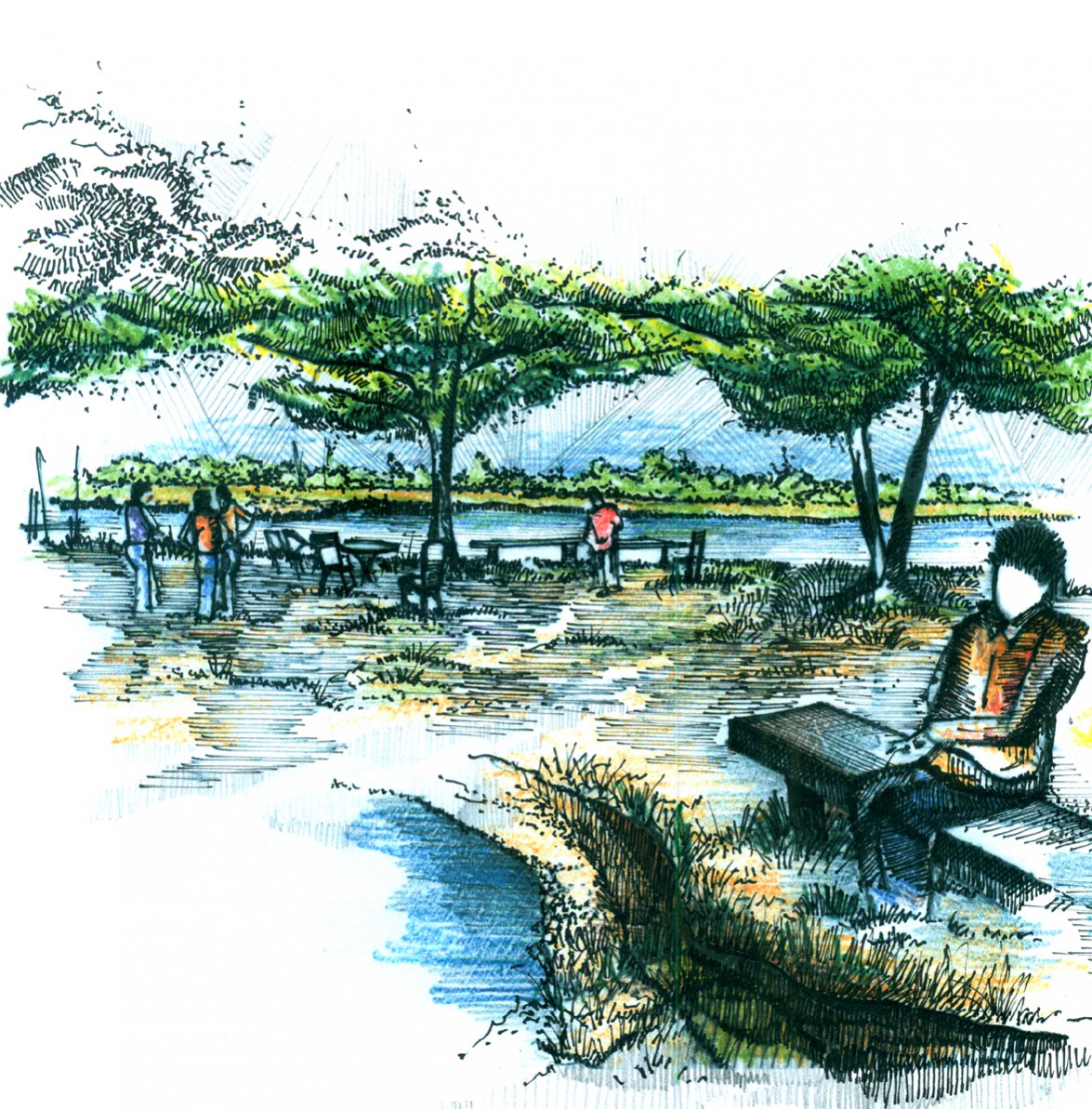
Looking almost north from Kachari Road Mor, her vision to the river edge was blocked by the road turning left to meet Abdul Mansoor Road. She crossed the park surrounding HimurAdda. Having a wonderful open space merging into a conscious river edge, this place is enjoyed by the town dwellers during many long evenings. Small concrete benches, surrounded in a play of light coming in through the foliage above, scattered along the unpaved edge, which rolled out into The Bramhaputra.
Sketch by : Farasha Zaman
Taking a turn onto the road leading to the red brick building of the Teacher Training College for Men, she was reminded why Mymensingh was known as a “city of education.” There is an institute in almost every street of this small town. She set foot onto the road adjacent to the Circuit House Field. This 90’s architecture painted in red had now adapted to the use of an officer’s club. The field, hosting to a choice of occasions, from school sports days to national and religious festivals, leads towards the river edge, its flow only disturbed by a delightful experience of a pedestrian walk lined in knights of green canopies.
Sketch by : Farasha Zaman
She followed the brick laid river edge road, past a flotilla of sleeping boats docked onto an eroding edge, past the man covered in a tattered shawl holding his fishing rod with admirable patience, to a long band of landscape covered in Kans grass. The white, amongst the fresh green, gleamed as they danced to the breeze in the morning sun. She smiled. Two yellow butterflies flew out of her banyan. She sat down, not minding as dew soaked into her garments. A patchwork of colored boat sails was up. The fishermen were on their way back from the morning catch.
Sketch by : Farasha Zaman
.
[ The article is inspired from “Invisible cities” by Italo Calvino.” It narrates the walk of the author, impersonating the persona of a museum curator, along the alleys of her town. ]
Ghorar Mosque is an excellent example of the best conserved monument in Barobazar by the Directorate of Archaeology in the southern region associated with the history of legendary Saint Khan Jahan Ali. It is located in the village Barobazar under Kaliganj Upazilla of Jhenidah district and about one kilometer west from the Jessore- Jhenidah highway.
Barobazar in Jhenidah is believed to have derived its name from a certain twelve (Baro) obscure Muslim saints who settled here prior to Khan Jahan Ali (Ahmed, N.1989: 28). The architecture of Barobazar resembles with the Illyas Shahi architecture in Gaur and Pandua than the style of Khan Jahan Ali that developed in the nearby Bagerhat. Neither structure has any inscription, but according to its stylistic resemblance with the architecture of Gaur and Adina; such as square room with foreroom, octagonal turret, vertical offset and projected shallow panels of entrance, it may be assumed that this structure was built during the Illyas Shahi period prior to the Khan Jahan architecture i.e early 15th or late 14th century AD.
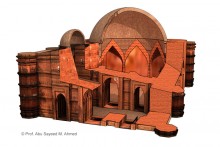
Ghorar mosque | courtesy: Prof. Abu Sayeed M. Ahmed
Typologically, it belongs to the single-domed square building with a foreroom in front and is akin to the Chamkatti, Rajbibi and Latton mosques of Gaur. The square shaped main prayer hall is 6.01m square and the foreroom is 2.08m wide internally with 1.45m wide wall. The foreroom has three pointed-arch entrances in front and one on each side. Three arched entrances lead to the prayer chamber from the foreroom. The northern and southern walls of the main prayer hall contain one arched openings each. Every outside opening has a projected shallow entrance panel, which results a vertical offset and resembles the early Illys Shahi architecture in Gaur and Hazrat Pandua. Corresponding to the front entrance there are three mihrab niches in the qibla wall decorated with abstract geometrical terracotta ornamentation. The central mihrab is higher and wider then the side ones and from outside has a projection.
Interior of Ghorar mosque | courtesy: Prof. Abu Sayeed M. Ahmed
The mosque has six corner turrets, one at each corner of the main hall and one on either end of the foreroom. Two frontal turrets are square in shape and the rest four are octagonal in shape. Square turrets are also observed in Pathrail mosque at Faridpur, Shahi mosque at Bashirhat. The slightly curved cornice is composed with simple mouldings and the spaces between the mouldings are embedded with geometrical ornamentation. The transition from the square supporting areas of the main hall to the circular base attained first by four squinches at four corners to an octagon and finally from an octagon to the circular base by brick pendentives, upon which the dome rests. The base or shoulder of the dome is decorated from inside with blind merlons. The foreroom is covered by three equal hemispherical domes using pendentives at each corner
Interior- Ghorar mosque | courtesy: Prof. Abu Sayeed M. Ahmed
The Ghorar msque is a well renowned monument for its surface ornamentation; whereas the adjacent Khan-i-Jahan’s architecture is popular for its austerity that means less ornamentation. The whole outside surface is embellished with horizontal band of ornamentation or friezes. Besides the mouldings in the plinth and cornice level, the total height of the façade is divided into four layers by three groups of friezes. Each group consists of three types of friezes, where terracotta tile of geometrical or abstract motif is used in a repetitive style by selecting a single motif.
Corner turrets, Ghorar mosque | courtesy-Prof. Abu Sayeed M. Ahmed
Architecture changes lives as well as landscapes. The American Architecture Prize (AAP) is set to become one of the most respected awards in the industry and aims to showcase the phenomenal talent and vision displayed by architects all over the world.
We aim to recognize individuals and teams who have made a substantial contribution to all areas of architecture, who set new standards and push boundaries. Buildings clearly need to be practical and serve a purpose but AAP recognizes that excellence in architecture goes far beyond that.
We believe great architecture is about creating a lasting design that will remain for generations, inspiring people and enriching their lives. Innovative buildings, designs and landscapes can help redesign the way we live our lives for the better and enable us to make the most of the space we have.
.
AWARDS AND PROMOTIONS
The AAP Architect of the Year award winners will receive the AAP trophy, extensive publicity all throughout the following year, showcasing their designs to a worldwide audience, plus enjoy the following benefits:
_ Attending the AAP Winners Gala in NYC in November, 2016.
_ Press campaign to hundred thousands of design professionals.
_ Winners will also be listed in the AAP online design directory.
_ Winners are featured in the AAP Book of Architecture, distributed through distributed art publishers to museums and design bookstores internationally and by Dubb Publications in Europe.
_ AAP Certificate of Achievement, a certificate to promote their winning.
_ AAP Winner Seal to promote their winning online and in printed material.
.
SUBMISSION DETAILS
There are three main categories:
_ Architecture
_ Interior Architecture
_ Landscape Architecture
Entries can be submitted as conceptual designs, in the works, or complete projects. The only restriction is that entries or completed projects must be no more than 5 years old. Submissions can be made as Professional or Student.
.
ELIGIBILITY
AAP competition is open to anyone aged 18 or over, residing anywhere in the world. Professional entries will be judged against other professionals and student entries against other students.
.
ENTRY FEES
_ Professionals $250 , $100 for each additional category
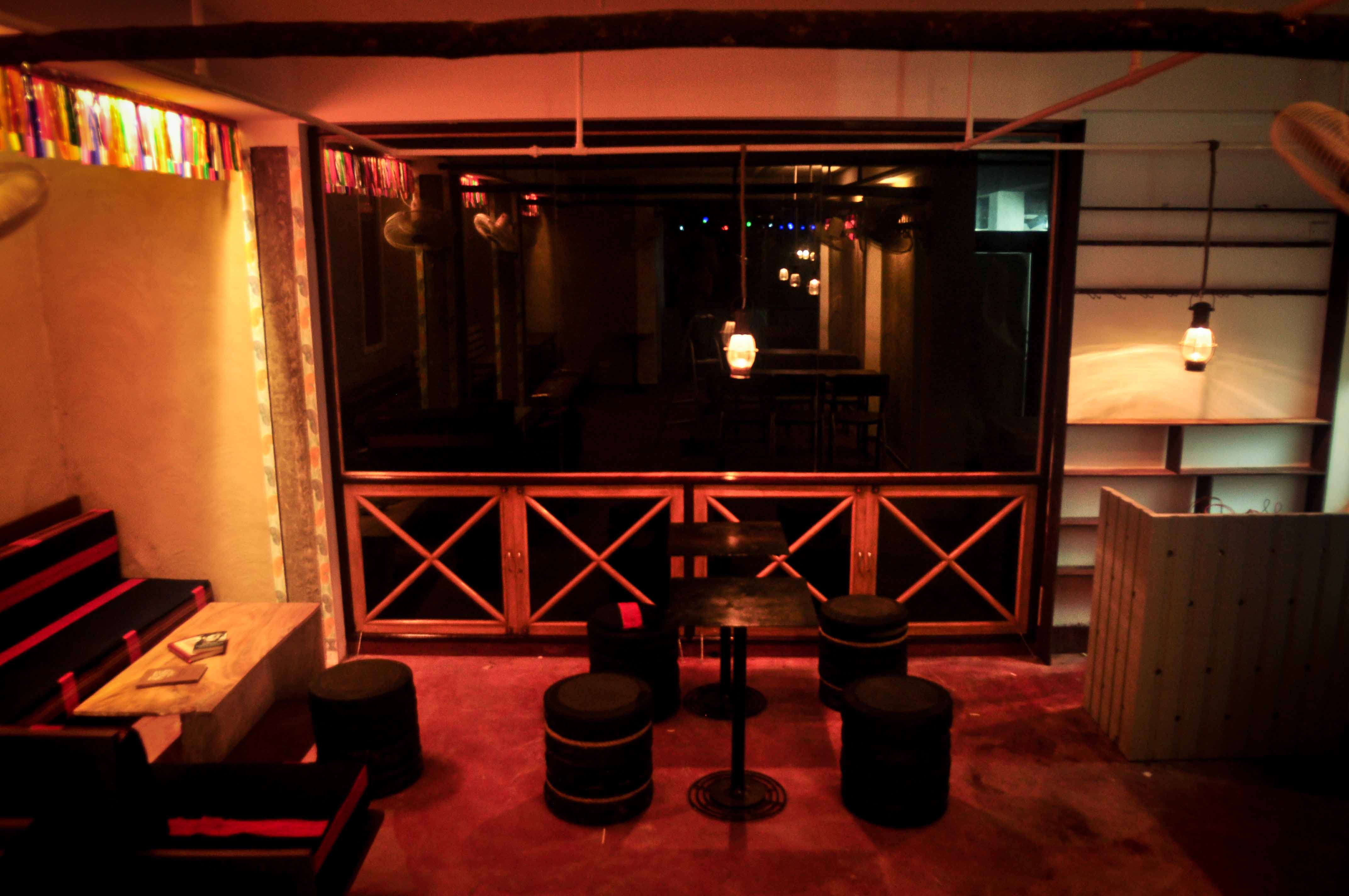
In rural Bangladesh ‘Haathkhola’ means a meeting place for people to gather and trade products as well as banter. In remote hamlet, the place ‘haathkhola’ is for everyone, and we have tried to adopt this philosophy of accessibility and interaction in our café and gallery as well. And following the concept, the design itself have tried to give people a taste of traditions of the country, that too keeping the décor urban and modern.
Rickshaw is a vital part of urban life here in Bangladesh. Hence the pillars, cash counters and the edge of light sheds are adorned with bright rickshaw art. Similarly the café’s sitting arrangements also follow the same pattern of the extraordinary urban folk art.
Here we have also tried to experiment with recycled items; stairs are made of abundant timber used in ships, chair & tools are made of rejected tires . the flooring is made of red cement, reminiscent of the houses of years gone by. Seen by day from outside, the space resembles a closed container covered in glass and green. By night, the Café and the Gallery displays a transparent image that is open to its surroundings, reflecting colorful lights and the clay coated walls onto the glass.
At the beginning we started the project over a hill facing the river jury which was a significant issue for the site location regarding that and the land pattern we made the house facing the river which is also having the orientation of north-south elongation. And regarding that river we have tried to create an infinity pool where the edgeless part facing the river and the other part is attached with the house terrace.
So in perspective -the terrace, infinity pool, and the river achieved a continuity of space with the rhythm of steps which was an approach to merging the house with nature….
Besides with a very low height structure and earth color tali was introduced also to make the house more close to the contextual natural landscape. The pattern of the roof reminds us the traditional bungalow or local regular kind of hut. Stone cladding fireplace.
Wooden louver opening and long terrace inspired from traditional tea bungalow of Sylhet which was having a tone of contemporary brick bonding representing a slightly modern context .some detail for sitting area with the brick wall punch was introduced for breaking the space and create value towards the view aperture….
Prof Khaleda Ekram, the first woman Vice chancellor of Bangladesh University of Engineering and Technology (BUET) passed away last week. while we mourn her departure, we seek the opportunity to learn of her life and contribution more through this interview, taken some years ago.
This interview catches tiny details of Professor Khaleda Ekram’s life, her contribution to the society, love for the profession and her will to do good for her students and fellows. Hence, it is published here as narrated in the original publication with no editing or shortening.
This interview was conducted by Dan Berman in 2006 under the ‘East West Center Oral History Project’ to capture the Center’s first 50 years as seen through the eyes of staff, alumni, and supporters who have contributed to its growth. Prof. Khaleda Ekram completed her masters in Urban and Regional Planning from East west Center, University of Hawaii in 1980. She was awarded the Tom Dinell “Outstanding Alumni Award, 2010”, University of Hawaii, Honolulu, USA. She served BUET from 1974-2016 in different positions, was the first woman dean of a Faculty among all the universities of Bangladesh and eventually the first woman Vice Chancellor of BUET.
The interview copyright belongs to East West Center and published here with consent of the copyright holder. Our heartiest thanks to Mr. Phyllis Tabusa and East West Center for cooperation.
[Please cite as: Khaleda Rashid, interview by Dan Berman, April 3, 2006, interview narrative, East-West Center Oral History Project Collection, East-West Center, Honolulu Hawaii ]
Personal Background
I would love to share the feelings of my childhood, my family background and the lessons learnt here and there specially at the East-West Center, Honolulu, Hawaii.
I am an architect — urban designer, presently serving as a professor in the Department of Architecture, Bangladesh University of Engineering and Technology (BUET), Dhaka, Bangladesh.
I was born in Dhaka in 1950. My parents were from different districts; it was an arranged marriage. There was an interesting turn in my father’s career, and I wish to mention it here. After graduation my father studied law and got a First Class in LLB (Hons) from Calcutta University, India. In his first day at the court he had to lie. He sensed it would not suit his temperament. He resigned from his job, giving up the lawyer’s profession.
He went to London for higher studies in Educational Psychology at the University of Edinburgh. That was way back in 1936. On return he took up the profession of an educationist. First he was in teaching, and then he joined the government service. My mother was the 4th Muslim graduate of the Indo-Pak sub-continent. Right after appearing in her bachelor’s degree from the Bethoon College of Calcutta, at the age of 20 years, she got married in the same year my father went to England. After the marriage she enrolled for the master’s degree in Bengali literature at Dhaka University, Dhaka. Towards the end of her pregnancy, when my eldest sister was about to be born, most likely in 1941, she gave up her studies and concentrated in the family life.
Of the four sisters I am the third one. I do not have any brother. My eldest sister, she is in London now. She did her Ph.D. in Plant Pathology from England, got married there with another Bangladeshi. They have settled there. The second sister after completion of M.S. degree in Economics from London joined Bengali Program Division of British Broadcasting Corporation (BBC) of London. The youngest of the four, after completing her master’s degree in English joined a college as lecturer. Two of my sisters are deceased now.
At my very childhood my father was posted respectively in two different districts namely Jessore and Sylhet. I remember only a few things of these two places. In Jessore we had swans at our house, as there was a pond in our compound. I am told that as a child I was rather calm and quiet in nature. I loved to draw and paint. I was admitted to a school of art.
Eventually my parents settled in Dhaka — the capital city. I stayed mostly in Dhaka during my young age and also afterwards. I had my schooling in Dhaka, went to Holy Cross College, Dhaka. Then studied architecture in Dhaka. I am talking of the year 1968. My father wanted me to study in physics or engineering. It was quite an indecisive situation.
A family friend’s son was an architect trained from the United States. I saw lots of models and drawings in their house and I desperately wanted to study architecture. The admission tests for architecture and engineering were administered separately. I sat for the admission tests for both architecture and engineering. My admission test result for engineering was better than that of architecture. In the engineering admission test out of more than 2,000 students my position was 3rd and in architecture of the 700 students I became 5th. Anyway, I took admission in architecture. I was the only girl in the class. After graduation I joined the same department as a lecturer from where I did my bachelor’s degree.
Khaleda Ekram was the only female student in her batch. Photo courtesy : Shafiuddin Ahmed
Life Before EWC
Applying for EWC
Within two years in 1977, I got this East-West Center scholarship. A colleague, T.K. Barua, from the same department at that time, was in Hawai`i with the East-West Center scholarship. So I learnt that the East-West Center was a very welcoming place, the people at the University of Hawai`i were friendly and the climate was magnificent. Dr. Barua, after doing his master’s with the East-West Center grant, later acquired his Ph.D. degree from Wisconsin University. Dr. T.K. Barua is now working as a consultant for the World Bank in Dhaka.
Life at EWC
Late `70s/Hale Kuahine
When I look back and think of old days, I feel contented that I availed this scholarship. I should also mention I was very lucky. That was the first application of mine for a scholarship to study abroad and I got it. At that time I was married and had the eldest daughter. I left for Hawaii alone.
I stayed in Hale Kuahine, a four-storied residential accommodation designed by famous architect I.M. Pei. Hale Kuahine is a beautiful piece of architecture with a central courtyard of indefinable quality and intimate scale. I do not know about the present set up. At that time women grantees occupied almost all the floors of Hale Kuahine. Only one floor, most probably first floor, of only one side of the building, I cannot recollect, was for male participants. It was basically women-dominated accommodation.
We used to go to the courtyard and talk loudly to get back the echoes. We would call each other’s name to see how it sounded. We could talk from one side of the inner corridor to the opposite one or the adjacent ones. There were single- or double-seated rooms, had common kitchens and shared bathrooms. My roommate, Sharon McCoy from Chicago, was a fine woman.
At the Center there were participants from Afghanistan, Pakistan, Japan, New Zealand, Australia, Indonesia, Sri Lanka, India, Malaysia, Singapore, Hong Kong and from mainland U.S.A., of course. Though we had the Liberation War with Pakistan in 1971, Bangladeshi and Pakistani participants were friendly with each other. Gradually I made a couple of friends there.
We went on a hike to Kauai island. Ms. Hasina Begum, another Bangladeshi participant from previous year, also took part in the hike We, about eight/nine of us, flew from Oahu island to Kauai. From the airport by a microbus we went up to the starting point of the hiking trip. Sadly enough now I cannot recollect some of the names of the hiking mates and also the names of the places — the starting point, and the trail. After hiking for about 10 miles in the mountains, ultimately tents were pitched on a flat site by the side of the beach for spending nighttimes. The breath-taking beauty of the natural environment – – the clear blue skies, azure blue water, beautiful natural ambience, the vast bluish-green to deep-blue ocean on one side and mountain with lush green tropical forest on the other – – were unforgettable. The hiking trip was so strenuous yet enjoyable.
Scholarships/Spouses/Hale Manoa
The next year, my husband got the EWC scholarship, and he joined me there. I guess we were the first couple who enjoyed East-West Center scholarships at the concurrent time. When my husband came, I moved to Hale Manoa, a multi-storied building with split-levels designed by the same architect, I.M. Pei. This building had almost 10 times more accommodation than Hale Kuahine. I do not remember exactly how many stories it was, certainly more than 12 stories. It was always crowded, a long queue for lifts and also for the front desk – anyhow I felt that way.
Our next-door neighbor was a Malaysian couple — Chee Wah, a degree participant, and his wife Dorothy. Chee Wah and I were in the same department at the University of Hawai`i (UH). Bangladeshis are known for taking hot food; believe me, they — Chee Wah and especially Dorothy, used to take such hot food that I and other Bangladeshis became astonished. They used to blend ripe hot chilies with a little bit of garlic and vinegar. Often Dorothy would give us some of her blended sauce. I learned a few cuisines from her and I taught her how to cook chicken curry, and egg curry. Fatema, wife of another degree participant from Hong Kong, whenever she was asked what was she cooking? “A fantastic dish,” she used to say.
Best Memories
I taught my roommate Sharon to wear sari, our national dress — the unstitched six-yard cloth that we wrap around on top of a long petticoat, from waist up to ankles, and a tightly fitted short blouse. With a little bit of assistance Sharon could put it on but she had difficulty walking with it. Only once she went out in a sari.
Sharon and me, we became very friendly. She was from Chicago, but worked in Japan for about six, seven years. She understood Asian culture, trends and lifestyles very well, especially of women. Till late at night even up to 2, 3 a.m. in the morning we used to talk, share our experiences. She would tell me about Japan and I would tell her about all the things that happened during the Liberation War. The topic usually boiled down to gender-related issues and conditions of women even of mainland America.
Maybe because of these exchanges of experiences and thoughts I was inspired to be the gender focal point for over 12 years of an Institutional Linkage Program between University of Alberta, Canada, and BUET, Bangladesh, funded by Canadian International Development Agency (CIDA).
In fact, I am very thankful to her! She was the one who taught me how to ride the buses. We used to go to different shopping malls and supermarkets together.
In Hale Manoa, almost every evening some thing or the other took place in the main lounge space of ground floor. Even when I used to make up my mind not to go down and waste time, somehow it was almost impossible to resist. Someone would call and insist or I myself felt like taking a short break. At times the function went on till late at night, and if it was an interesting one, we would be there till the function was over. The next morning, in the class, it became difficult to keep the eyes open and hold concentration. Only our eldest daughter was born then. During my research work for the thesis, I went home and brought back our daughter with me to Hawaii. Obviously we had to move out of Hale Manoa. We rented a small apartment near the Star Supermarket. It was a small apartment on the 3rd floor but was very cozy and the interior was neatly finished. The apartment had two bedrooms, a living space, a small kitchenette and two bathrooms.
The rent was high, so later when our turn came we moved to Palolo Valley government subsidized housing. One needed to apply for these apartments and there was a long waiting list. We lived on the first floor of a double-storied building. It had two apartments in each floor with entry to the apartments through separate stairs on both sides. There was a huge play field, as required by the city code, in front of the apartment that was hardly used by anyone. Somehow we did not get to know any of the neighbors there. Muhammad Ibrahim of Pakistan and a few other participants lived in Palolo Valley. At times during the weekend farmers’ market we used to meet them. I was busy working on my thesis then; my husband was busy too, and our daughter used to go to school. For me, Hawai`i was a place of beauty, pleasure and wisdom.
Khaleda Ekram in a jury session in BUET. Photo courtesy : Tahmina Rahman
International Days
It was always fun during the celebration of International
Days; we used to serve shingaras — a Bangladeshi snack of rounded triangular shape having chicken or potato stuffing within handmade thin round breads. It was liked by Hawaiians, EWC participants and staff, other students — everybody. The shingaras used to be finished within minutes.
Host Family
We felt wonderful in Hawaii. Even the very crowded Waikiki beach of weekends was a safe and lively place for loitering. I learnt driving in Hawai`i, and loved to drive around. We used to go round the whole island, often visiting Ms. Adelaide Beste, my host mother. Ms. Beste was an elderly lady, most probably she was in her 60s then, always very well-dressed, very good at sewing and other household chores. She made muumuus for my daughter and me. We had contacts even after we left Hawai`i, then as usual, gradually we lost contact, I cannot say when. I earnestly hope that wherever she is, she is in her high spirits as before!
For Asian women — young women or maybe most Asian men also — often, this is our first trip abroad. And when we were there, the East-West Center really took special care of us. Like, the first day we went shopping, we could take a car from the East-West Center, and then there were some participants from previous years who went with us … and we learned from them how to shop, and what to look for, what not to look for as well. And then we had these host parents assigned to us — and they were very helpful.
Oh! I forgot to tell you this about my host mother. She lived in a condominium right on the beach with a private backyard through which she had access to the ocean. “You cannot swim with a sari and neither can I teach you when you are in it. You better have a swimming suit, and then let me try to teach you,” she said. She helped me to choose the swimming suit and spent quite a bit of time to teach me swimming I was a bad student, scared of water — naturally her efforts went fruitless.
Inter-island trip
Like many other activities, the hiking trip I mentioned was arranged by the EWC and the participants paid for the expenses, of course. In Kauai, we used to sit by the beach, almost all daylong, watching how the water is splashing on the huge boulders. Every time we had any leisure time we used to sit at the “Blow Hole,” just looking at it.
I could watch surfing for hours together. They were simply splendid scenes. I presume waves or any kind of moving water have deep impact on peoples’ mind
The kind of joyous experiences I had in Hawai`i, they are unparalleled. I did mention about the hiking trip to Kauai. It was the first and the last hiking trip so far of my life. I was so damn tired after hiking for miles in that rough terrain, at times the width being hardly 14 inches, that after reaching the camping site I could not wait. I just fell asleep with my shoes on before the tents were even pitched. In the morning I found myself within a tent. Everybody was tired, still they took the trouble of putting me in the sleeping bag inside the tent. We had deep feelings for each other and came forward to help each other at whatever time it was needed.
Kauai is memorable for another reason. Since I left Bangladesh, I saw, for the first time, the jasmine flowers (known as ‘Bell’ in Bengali language) in Kauai. They grow in small shrub like groves. I was kind of excited, and Hasina and myself proudly showed it to others. Like plumeria (frangipani) leis of Hawai`i, leis of jasmine flowers are found in abundance — in flower shops and also small children, boys and girls sell it by the sides of the roads often coming up to the cars at the stop signs. It is quite common that while going out in the evening women would put jasmine leis on their hair, in many different ways. It smells real nice — they have light fragrance but lasts for a long time. Unfortunately, the jasmine flowers of Kauai, though were bigger in size than those of Bangladesh, it did not have much scent. While camping in Kauai I kind of felt as if I am living into the realms of the divine.
Khaleda Ekram in a student design charrate in BUET. Photo Courtesy : Nazli Hussain
Negative Memories
It is not really negative [memories]. I did not feel comfortable with a few little bit of things. There weren’t too many Bangladeshis in Hawaii then. So whenever I used to go at the supermarkets, the shopping malls and even during meetings and get-togethers, in a sari, someone would ask whether I was from India or not. Often they would take it for granted that I was from India.
Another thing made me a bit unhappy, when I found out that most of the people did not know about Bangladesh, even when I explained that it is in South Asia, liberated from Pakistan in 1971 and is a neighboring country of India. They did not know much about Pakistan either. At that time I used to be a little sentimental. I was there from 1977 to 1981, and we were liberated from Pakistan in December 1971. Now I realize it was a trivial matter.
Community Service Project
I worked in two community service projects. In one of the community service projects, the Manoa Valley Trail Project, I was actually the co-chair. It is the trail that goes behind the Jefferson Hall and beside the Manoa canal/ stream.
While on a reconnaissance survey of the trail all of a sudden we found a very small cave and strangely enough someone was living there — a small stove, some books, a few T-shirts and trousers, a sleeping bag and a backpack, etc., were there. Couple of days later also we passed by that area but could not see any one though the things were there along with an empty cup of freshly finished coffee. In some of the functions of Hale Manoa Lounge, we noticed that a poorly dressed man came, took a seat and listened. Towards the end he had the pupus and then silently walked away. He never talked to anyone. Once one of our fellow mates of that project followed him. It seemed that he was the one who lived in that cave. That was really surprising to all of us. After a couple of days, one of us noticed that in the cave there were only a few torn papers, no books, no clothes. We were kind of feeling guilty for invading his privacy — thinking maybe he found out that we have come to know of this arrangement of him. From then on, we never went to that side of the trail. I guess I was a bit disturbed for a few days. I wondered why a person in an affluent society where there were provision of social securities and unemployment benefits chose such a life devoid of any facilities and utilities. Now I presume, who knows, maybe he was having a taste of a very different lifestyle! Till today at times I question what made him leave his tiny habitat.
Life After EWC
Working in Hawaii
I got master’s degree in Urban and Regional Planning. I went for the Practical Training Program. I took a job in an architectural consulting firm Michael T. Suzuki & Associate. I worked there as an assistant architect planner for five months, as my husband completed his degree by then.
In that office, I worked on three projects. I did the master plan of Housing Development at Keawanui, [on] a different island, not Oahu. Nine-storied Academy Business Center, Honolulu, Hawai`i, was already designed by one of the architect owners of the firm. I did the working drawing only. I designed a studio apartment building — Ala Moana Condominium, Honolulu, Hawai`i. Since I was not a registered architect of U.S.A. — I could not sign the drawing sheets.
Most probably this office designed the Physical Science Buildings of the Oahu campus of University of Hawaii. I enjoyed my work there. It was a small office, two architect owners, a draughtsman and myself.
Designing Housing in Dhaka, Bangladesh
We came back to Dhaka in 1981, and I joined the University. In 1986 I became an associate professor.In 1992, I went to Sweden to participate in a post-graduate program at the Lund University of Sweden. That was an extensive program and my work was related to housing for urban low-income families with provision for community facilities. After coming back, within three years I became a professor. I mostly teach in the undergraduate design studios of Level IV or V. At the post-graduate level I teach three courses, two of Urban Design Stream and one of Housing and Settlement Stream.
During one of the visits of Mr. Dan Berman to Bangladesh, either in the year 2004 or 2005, Mr. Berman took some photographs of the design projects of Level IV Term II. We just finished grading the projects then. Most probably it was housing for middle and lower-middle income families — there were five different sites, all at the fringe areas of Dhaka City. The challenge was in accommodating 30,000 people (6,000 families) with necessary community facilities, such as primary schools, clubs, mosques, etc., in 30 acres of land. Mr. Berman may have the photos.
Students and colleauges remembering her. Photo courtesy : Noufel Sharif Sojol
Community Service in Social Work
My hobby is social work. I am an honorary advisor of Bibi Khadeja Kalyan Sangstha – a non-profit social welfare organization. It is voluntary work. I suggest on how to go for low-cost improvements in the squatter settlements, such as road layout and its pavement, installation self-help sanitation improvements, setting up of hand pumps for drinking water.
Gender Equality Work
From 1992 till December 2004, I worked as a focal point of a group on a gender project. I mentioned it earlier. This group was known as Gender Equality Policy (GEP) Group. It was quite a fascinating coincidence, being an architect – urban designer — how I became fully involved with this gender program.
Around 1990/1991 we had about 4 percent female students at BUET. Somehow, the next year, the number of female students decreased — it became little less than 3 percent. The then Canadian high commissioner came on a visit to BUET, my university where I teach, and our vice chancellor mentioned it to him. The high commissioner readily offered his
support. Then and there our vice chancellor called me in his office, as I was the senior-most female teacher. The vice chancellor introduced me to the high commissioner. Within days a female colleague of mine, Dr. Dil Afroza, and myself were invited to the high commissioner’s residence. We met the gender specialist of Canadian International Development Agency (CIDA) there. A fund was initiated from CIDA and we started our work motivating prospective female students to study in technical fields. There is no quota for girls neither for admission nor for employment at BUET. Merit is the only basis to join BUET either as a student or as a teacher.
I truly concentrated on the project. Dr. Dil Afroza was very helpful. Now in our university of the total students more than 24 percent are female students and they are doing well-having positions within the first 10 of the merit list.
Before the closure of the project we submitted an action plan for removing barriers to employment of women technical professionals. This is now under active consideration of the Bangladesh government. Lately an association of Women Architects, Engineers and Planners Association (WAEPA) has been launched in Bangladesh. I am its advisor.
At the East-West Center Women’s Conference in Sydney, Australia, I read a paper on women entrepreneurs of Bangladesh. In that women leadership conference there was an interactive discussion among women of different countries updating knowledge on the gender issue. My involvement in gender-related projects, seminars and workshops has given me lots of different exposures and insights. I took my son with me to Australia and he kind of felt shy when everybody called him “our son.” Nevertheless he too enjoyed the trip.
EWC’s Impact
On Career, Perspectives
I easily mix with people of different cultures. In Swedish food, in almost everything there was pork. As a Muslim, I do not take pork. When I was in Sweden I had problems in choosing foodstuff especially ground meats, and all that. Even when a little bit of pork is mixed with beef I could tell the moment I put it in my mouth. Anywhere I ate or while shopping I explained it and never received any rude reply. I sense the way I spoke they were not offended. The shopkeepers in Sweden did not know much English. They knew German, Danish and/or Swedish language. Subsequently I managed to find the managers or someone who understood English, and often they would read the label translating it to me.
They even explained like this, “Well, it doesn’t have pork but it may have pork fat,” at times adding, “foodstuffs have lard and are fried in lard because then it becomes crisp and tasty.”
My degree, the practical training helped me in later years. At BUET every position is advertised and each appointment is a fresh appointment. I had to compete with applicants from outside as well as from the department. Eventually I was given chairmanship of the department and in 1999 I became the first woman dean of a Faculty among all the universities of Bangladesh. The intense discussions with my roommate Sharon McCoy about social norms and women’s issues channeled me to do social work and get immensely involved in gender projects.
Students and colleauges remembering her. Photo courtesy : Noufel Sharif Sojol
On Personal Life
My feeling is Asians by nature are very much like Hawaiian people, at least, the people who were at the Center. In Bangladesh, people are very friendly and to some extent are eager to help others specially foreigners. Ms. Sumi Makey, Ms. Rose Nakamura, Mr. Ramon (sorry, cannot recollect his full name) [True] were easily approachable, always gave a patient hearing to our problems. They had a broad vision; no wonder discussions often took place on many diversified topics and continued for quite a bit of time.
Now we have 3 children; 2 daughters, and a son. They are grown-ups now — one is doing master’s degree; another one is in the final year of bachelor’s program. The youngest one is in the 11th grade of schooling of the ‘A’ Level. Our children are capable of mixing with people from different cultures. I am not sure if it is for the exposure to different cultures through media or visit to other countries or for our attitude. I told them about the Hawaiian people and our experiences there.
I guess it is very natural that we would talk about EWC and Hawai`i a lot when we returned from there. The memories were fresh and that was our first visit to the Western world. An uncle of mine on his way back from mainland U.S.A. had a brief stopover in Honolulu in the late 1980s. I enjoyed every bit of Hawaiian culture: the hula dance, the Polynesian Cultural Center, the food — poi, the paste of powdered taro root, coconut milk, the salmon fish and all those things. In Bangladesh cuisines sometimes we use coconut milk, we take taro roots but in a different way. We cook it with chicken, beef or fish.
After we came back I tried to make poi, tried out some of the dishes that I learnt at the EWC.
Ties That Last
Alumni Network
Somehow, you know, these days, people are so busy with their own work and they are so pressurized with time, they cannot really afford to go for any voluntary work or social welfare kind of things. Because of traffic condition and non-availability of comfortable public transports, it takes lots of time to go from one place to another. Since this East-West Center Alumni Bangladesh chapter was formed after a long elapse initiated by Mr. Dan Berman’s visit to Bangladesh in 2004, I communicated with many alumni over telephone. They all were happy that EWCA Bangladesh Chapter was formed again, but when it comes to attending meetings usually the attendances are very poor. This is really frustrating.
About 10 to 12 years back, when Ms. Mary Jo Furgal was the director of the American Center of Dhaka, she took extra interest in the running of EWCA activities in Bangladesh, as she was an EWC alumnus. During her tenure, of about four or five years, we truly had an active East-West Center alumni group here. At that time, at least twice or thrice delegates from EWC or dignitaries from Honolulu, Hawai`i, visited Bangladesh. We arranged cultural programs, dinners, site visits and shopping trips. On the EWC Days, we invited important personalities from the government, from private sectors and educational institutions. Mary Jo Furgal was there as a special guest or chaired the function. In those days we had quite big gatherings. However, these days when we invite people, we hardly have 15 to 20 people, at best 30. We inform them; we remind them. We are trying to bring in EWC alumni together. For the last three years I have been publishing articles on EWC day in more than one newspaper. I am rather optimistic that once community service starts, other East-West Center alumni will make some time to come and join us. I look forward to it.
Personal/Professional Legacy
I guess as a teacher of architecture discipline. I enjoy teaching — minding the young minds. In this globalizing world we need to be even more careful than before to retain our identity and culture. I believe as a physical designer I have a role to play in making visible the socio- cultural, even economic aspects of the communities. As a social worker and advisor of WAEPA, I am focused on doing my bit for my country.
As an EWCA member, my contribution is minimal in this otherwise chaotic world. Nevertheless, I am confident that even small contributions of all rational human beings will eventually make this world a better place to live in. As a proud alumnus of EWC, I am certain our efforts would not go in vain.
Being the torchbearer of cultural understanding and better relations between the United States and the nations of Asia and the Pacific, I wish that EWC and EWCA would one day be able to bring peace in this world.
I love teaching as well as my professional career. I am sure my students also love me. My students, they call me from abroad. When I was in Australia for the EWC program, two of my students, who are now practicing architects in Sydney, came to see me in the hotel. Some of my students were pursuing higher studies there. During the workshop they took my son for looking around. The day I was leaving the hotel, they drove my son and me to my relatives’ place. They arranged a get-together where there were 14 Bangladeshi architects; two of them came from Melbourne, one from Brisbane. I was so surprised.
I should not be continuing any further. If you allow me I can go on talking forever about Hawaii, EWC and its numerous activities.
Photo courtesy : Naziur Rahman
[These narratives, which reflect interviewees’ personal perceptions, opinions, and memories, may contain errors of fact. They do not reflect positions or versions of history officially approved by the East-West Center.]
While designing large complicated architectural and urban spaces it is often difficult for designers to understand the relation between space and human behavior by only their senses and experiences. Computer simulation of pedestrian movement is a useful method to help designers to understand the relation between space and human behavior and find an optimize situation. The following thesis project is a proposal for redevelopment of Gausia market – an unique marketplace where goods and variety of products are available in competitive price. Customers from all over Dhaka flock here to buy the desired item. Using Mass motion – a crowd simulation software, the project basically deals with the pattern of customer’s circulation inside the market with an aim to find an optimized layout for the redevelopment proposal. Though smart integration of adaptive reuse and retrofitting, the proposed extension of the Gausia market is expected to retain its original flavor while satisfying general standards of a marketplace.
The construction of Gausia and Nur-mansion started around 1960 and built over many phases. The marketplace covers total approximately 38000 sft of solid ground, were Gausia covering around 20000 sft and Nur-mansion about 18000 sft. Different kinds of shops are running their business here. There are mainly Sharee, Three piece, Salwar- kameez, Undergarments, Baby product shop, Cosmetics, Jewelry, Boutique, Food corner.
The growth of Gausia market is organic in nature; hence, it is not alike Newmarket or other shopping malls. In spite of being a popular market of Dhaka, Gausia lacks enough breathing space. It is a very compact market with hundreds of retail and wholesale outlets. The market is functioning but it lacks certain important environmental and safety requirements.
One of the major challenge of this project is the space constraint . Even though the market lacks basic facilities of a modern shopping mall , the space rent at Gausia is still very high. Through time, the market developed organically according to the needs; it didn’t follow any planning or design standards. A huge number of people visit this place every day. Due its tight space layout and lack of air circulation inside the building, many people often result in a complete blackout. The area isn’t widely spread as new market as it is almost impossible to get any vacant land for expansion of Gausia.
Due to the historical and cultural importance of the marketplace, a bottom-up design process is applied in order to give an optimized solution while keeping the existing organic nature of the market undisturbed. Every movement of people has been tracked and recorded. Independent movement of people has been simulated using ‘Mass Motion’ on every floor to find out a common transition path which was then being used to derive new plan. A number of simulations were run to find the most optimum path and shop arrangement. Then the result was juxtaposed to make the adjustment to existing model. Old structure in transitional part has been demolished to make open space and pathways. All the square feet that have been lost due to this renovation are relocated at the top of the market in a new form.
The bamboo screen obviates the use of a harsh visual barrier, combining and blending it with surrounding nature and simultaneously secluding the spaces and activities to retain privacy.
.
PROJECT BACKGROUND
NKA Foundation organized this competition, calling for the design of an innovative, modest, and affordable housing for artists that could be built using earth and local materials in Abetenim Arts Village, Kumasi in the Ashanti region of Ghana. The built environment is to provide a place of stay for 8 to 10 international participants who come to immerse in the local culture to create works or collaborate on a community project. The tropical warm humid climate of Ghana and the local building materials were the guiding sources for possible architectural solutions that can be realized in the presented situation.
ABODE+ADOBE strives to create an environment best suited for the pristine, bucolic setting in which artists and designers will come for a time of contemplation and creative pursuits. The design methodology focuses on multi-functional spaces and cost effective construction techniques to ensure maximum efficiency.
.
ARCHITECTURAL CONCEPT
The indigenous craft of making of an abode has a rich cultural heritage and history that has been passed on through generations. The traditional house influences the psychological, physiological and metaphysical well-being of its members, encompassing its environmental, ecological, cultural, social and economic aspects. Here, building with natural materials is a response to its physical and chemical attributes. The construction process and outcome rely on available local resources, as well as the environmental, climatic and functional contexts.
Abode+Adobe is a contemporary adaptation of traditional earth construction practices to encourage the local community with a realization of the potentials this form of architecture holds. It brings back a practice that has waned and been sidelined by faster and less labor intensive “modern” methods. While such architecture acts as a cultural representative of a region, its place-making process, its growth and function follow an organic pattern that is self-sustaining, reciprocal and adaptive to contextual situation.
The residence is approached through a shaded walkway along the central courtyard.
.
DESIGN LAYOUT & ORIENTATION
The building conforms to a prototypical modular design; a generic system which provides flexibility to accommodate different user preference, as user-centric ideas were a pre-requisite by the jury board. The dimensional parameters of the basic module is derived from the construction techniques and building materials, their potentials and limitations, the functional parameters have been derived from the type of activities it will cater while the spatial parameters develop from contextual and environmental considerations.
The whole site is set as a platform for art enthusiasts and related activities with the house as a backdrop.
.
The house acts as a southern backdrop for an outdoor activity area, which is hence under constant shade, ensuring a comfortable environment all day long, much preferred in the tropical Ghanaian climate. The facades are designed in such a way that it doesn’t create any mental constrains with harsh visual barriers but combine and blend it with surrounding nature.
The two-storied indoor structure is made of mud and bamboo; functional, structural and climatic factors coercing a flexible and efficient built-form. Each module accommodates four people at two levels, while a common work space spanning two modules caters the individual personal quarters. Mud walls give rise to a bamboo structure to hold the upper floor. The lighter bamboo framework transmits lesser load to the heavier mud structure below. The multi-layered bamboo and wood screens obviate the use of solid barriers, but simultaneously seclude the spaces and activities to retain privacy.
Sections showing different spatial uses as per the user need.
.
The work spaces are aligned along the courtyard, as they may be used for multifarious reasons with higher number of people, they may also be curtained off to secluded areas if one wants to work in solitude. The private, living areas are at the southern end to ensure maximum comfort for the residents. The service blocks are located on the east and west end, strengthening the north-south orientation of the building. The north and southern sides are completely open, lined by bamboo screens allowing maximum air circulation, a must for thermal comfort in warm-humid climates. A central gathering space has been provided as the focal point, spatially entwining and tying the whole landscape and adjacent residential modules. The reverse-pitched roof has been designed to collect rainwater along a central channel while allowing more air and sunlight inside and a stronger indoor-outdoor connection.
The central gathering space as the focal point, spatially entwining and tying the whole landscape and adjacent residential modules.
.
The free uninterrupted space of the interior makes visual connectivity consequential retaining individuality and privacy. A strong indoor and outdoor relationship is tried to be maintained throughout the whole design linking the outside landscape with internal spaces visually and physically at different levels. The common activity area looks on to the rustic landscape outdoors, creating a through visual and physical connection between the indoors and outdoors, vital to the essence of a lifestyle much closer to nature.
This design aims to create a harmonious architecture which doesn’t disturb the existing physical texture and landscape pattern rather enhances the environment quality being at an interdependent and coherent existence. The aesthetics of this design evolved from the traditional building art and techniques based on the cultural, social and environmental context which helps to integrate it easily with people both physically and psychologically. The blending of contemporary methods with the indigenous ones also helps to attain cultural responsiveness revitalizing the spirit of contextuality.
The common activity area looks on to the rustic landscape outdoors, creating a through visual and physical connection between the indoors and outdoors, vital to the essence of a life much closer to nature.
_ Please find the details of the workshop in the following link :