Echoes of the Estuary: A Tourism Center at Hatiya Dwip

World Environment Day 2026

Urban [Re]Stitch

Center for Rehabilitation of the Paralyzed (CRP) | BUET

Center for Rehabilitation of the Paralysed, commonly known as CRP, is a healthcare with rehabilitation facility, aiming to ensure the inclusion of the disabled people into mainstream society, to promote an environment where all disabled people can have equal access to health, education, employment, physical environment and information. CRP-Bangladesh was founded in 1979 by a small group of Bangladeshis and a British physiotherapist, Valerie A. Taylor, who was appalled at the lack of facilities for the disabled in the aftermath of the 1971. Since then, CRP commenced its service to the poor, disabled people and still continues to be the only center of its kind in Bangladesh.
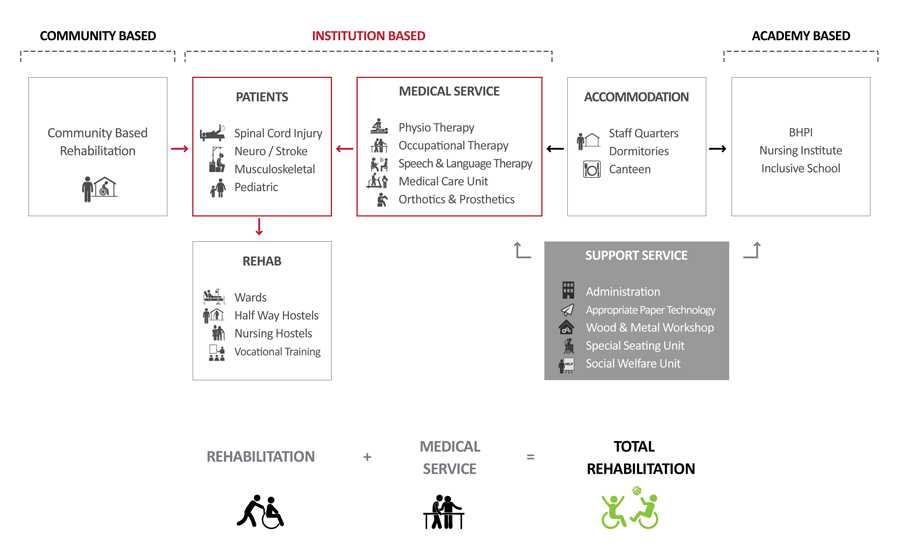
CRP Services © Mohaimeen Islam |BUET


At present CRP’s headquarter is in Savar. Hence CRP intends to establish sub-centers to all six divisions of the country. A corporate stakeholder in Bangladesh has donated a site from their enlisted property at Kalurghat, Chittagong. The following  project aims to develop an ideal and comprehensive programme for a Model CRP Center based on which a detailed Master Plan for CRP Chittagong Center can be designed.


Site and Context - CRP Chittagong Center © Mohaimeen Islam |BUET
Site and Context – CRP Chittagong Center © Mohaimeen Islam |BUET


SITE AND PROGRAMME

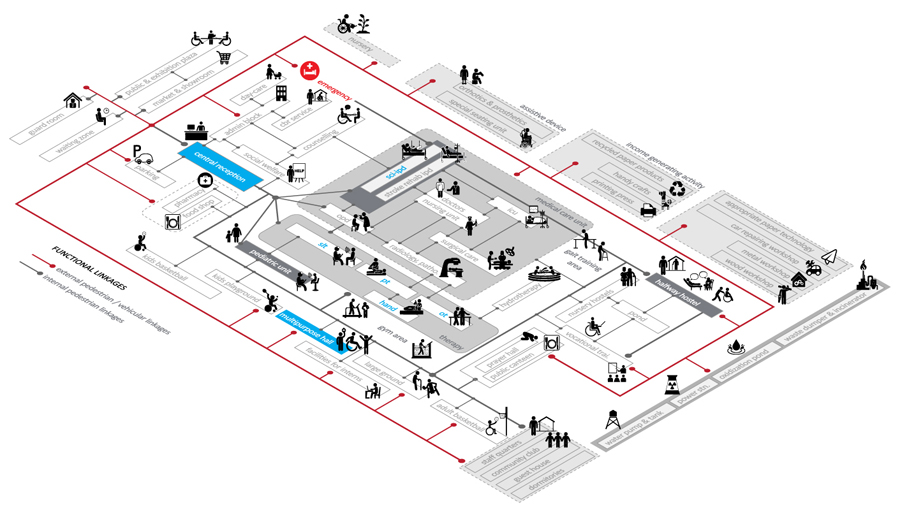
The site is comprised of multiple division of plots, acquired over decades, hence has formed a rather irregular demography. Being sited adjacent to a  narrow creek, which eventually has led its path into  the greater Karnafuli river, the site has opportunity to arrange the complex along its primary NW-SE axis, directed towards the river. However, along with all ancillary facilities the required programme for a Model CRP Center has an estimated area of 100600 sqm, of which, the major services at CRP Chittagong Center shall include Spinal Cord Injury (SCI) Rehabilitation ward,  Stroke Rehabilitation Ward , Pediatric Unit, Outpatient facilities, Emergency service, Operation theaters for ICU Beds ,Therapy ( Physiotherapy , Occupational Therapy and Speech & Language Therapy),  Halfway hostel and Multipurpose Hall.

Center for Rehabilitation of the Paralyzed (CRP) - Chittagong Center
Design development studies [CRP Chittagong Centre] © Mohaimeen Islam | BUET
Functional Linkages of programme [CRP Chittagong Centre] © Mohaimeen Islam | BUET
 

DESIGN APPROACH

To understand the scope and need for this project many possibilities on design layout has been studied and explored. Aspects those were given particular consideration were – therapeutic environments (environment of care, green design and sustainability), functional clarity, disaster planning (building in block-system), safety and security, energy efficiency and cost-effectiveness (low height building construction).  Nevertheless, the following key notes are the basis for initial design approach, which led to undertake major design decisions –

‘ABILITY, not DISABILITY’

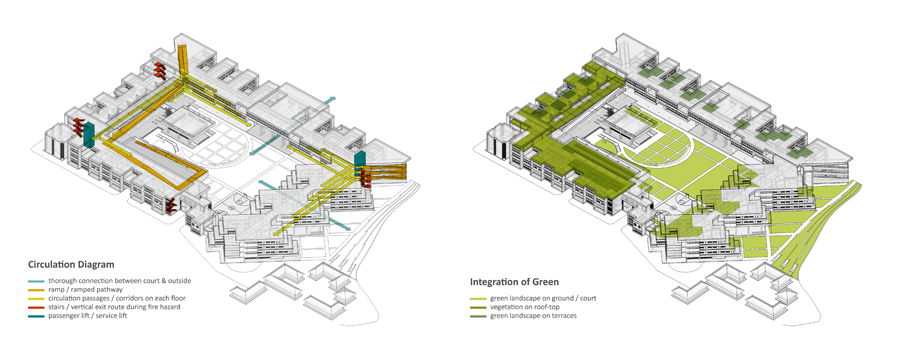
Ease of movement for the PWDs (people with disabilities) is a pre-requisite. A ramp that can lead PWDs from ground to roof-top can create a statement for universal accessibility, if designed with harmony with the overall building volume.

‘Psychological demand transforming into space’

The building volume needs to confine an enclosed space within itself to curtains the internal area from the external world. As such, the building blocks can act as buffer (yet functional) to achieve that required privacy.

Center for Rehabilitation of the Paralyzed (CRP) - Chittagong Center
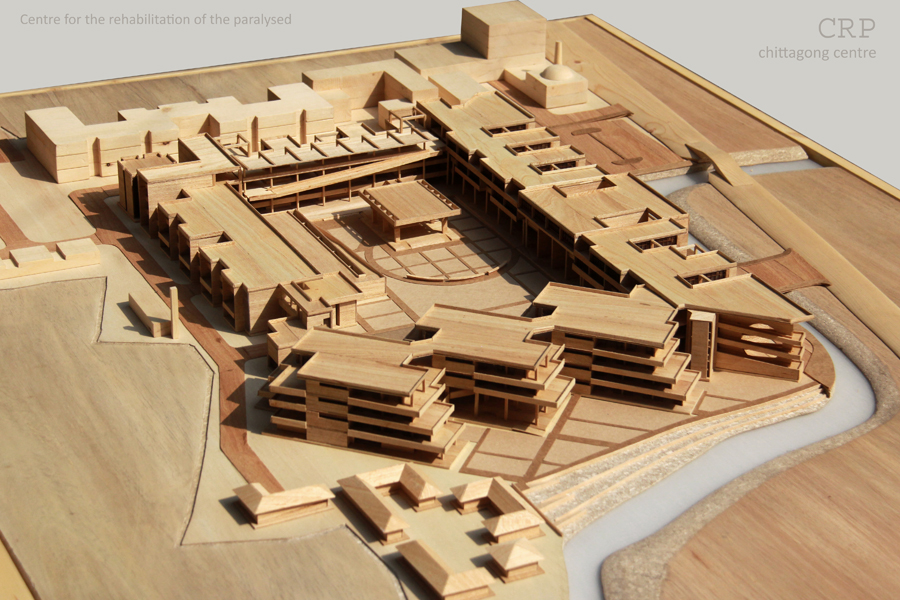
CRP Chittagong Centre © Mohaimeen Islam | BUET
Center for Rehabilitation of the Paralyzed (CRP) - Chittagong Center
CRP Chittagong Centre © Mohaimeen Islam | BUET


SPATIAL ORGANIZATION

Spinal cord injury is a catastrophic condition. It not only includes physical disability for the person but invariably causes the family economic hardship. Since the patient will stay in the center for a long period of time, therefore they must feel a sense of belongingness. Here the design has been done taking all these factors into consideration.

Center for Rehabilitation of the Paralyzed (CRP) - Chittagong Center
Spirit of the central court [CRP Chittagong Centre] © Mohaimeen Islam | BUET

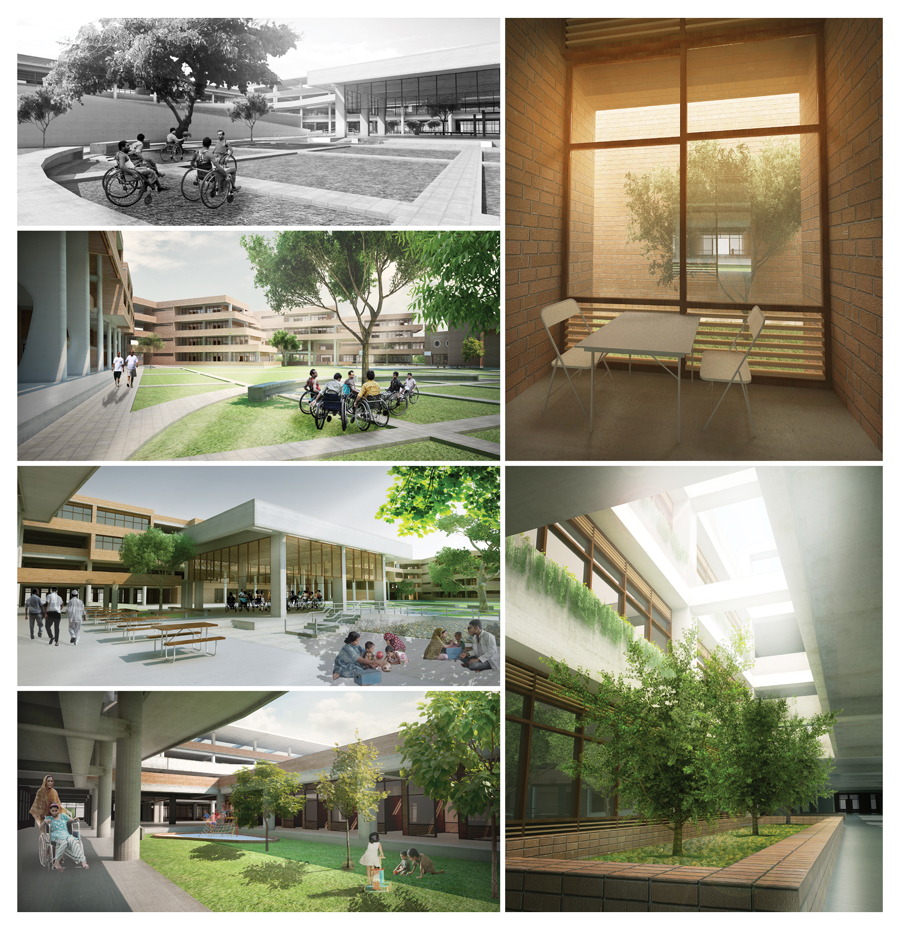
The complex forms an internal court that isolates the internal area from the outside, which is compulsory for the patients’ well being and privacy as they find themselves tortured into a changed physical condition. Therefore, the Entry block, along with the OPD & Operation block create a buffer from the main road, so penetration of noise is curtained. Also, such open ground can be adequate for patients to facilitate them with multi-physical activates, which can attract a new patient and generate hope at first sight.

Design development studies [CRP Chittagong Centre] © Mohaimeen Islam | BUET

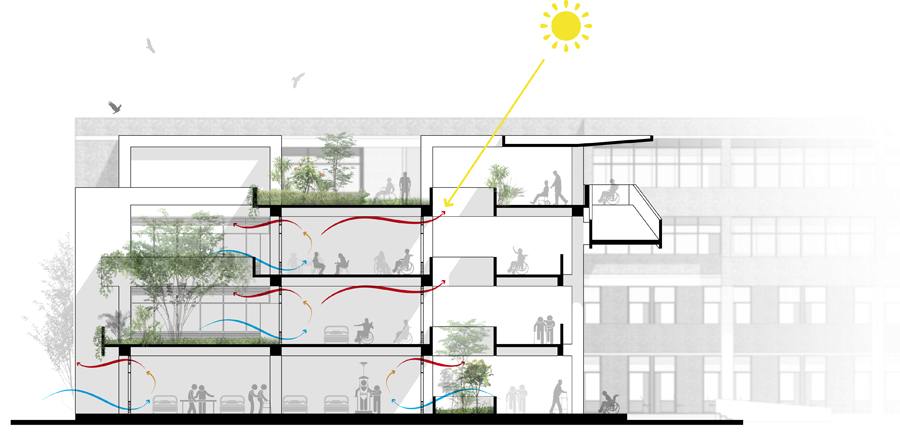
Environmental comfort has been kept in mind. The pediatric block and the ward block have been placed in a way that it directly receives the southern air. The ward block being place at an angle of 45 degree allows optimum cross air flow into the wards and also helps to refrain from religious conflicts that a patient with serious injury might not want to attend. Also wheel chair patients can easily use the adjacent verandas, coming out directly from their wards to enjoy the views.

Environmental configuration of therapy block [CRP Chittagong Centre] © Mohaimeen Islam | BUET

On the other hand the Therapeutic block is placed on the west. Since it will run till the end of morning session, this again is an attempt to protect the internal complex from direct heat gain. The Pediatric block is benefited with a personal green court and a hydro-therapy pool. However, flexible modules have been articulated for designing these therapeutic and pediatric blocks, for ease of future expansion.

Accessibility and Landscape [CRP Chittagong Centre] © Mohaimeen Islam | BUET

There are scopes for any physically challenged person to access the building from the ground to the roof top with three ramp-access ways. This is again an example that can put mark on the surrounding neighbourhood to make aware that how a building can be designed for physically challenged person, where ramps can act as corridors; hence a symbol for “Universal Accessibility”.

The patients are taught gardening and vegetation in CRP. Scope has been created both on the ground and on roof top by ensuring roof gardening system. A good number of open-to-sky terraces has been designed which acts both as breathing space and add to the aesthetic value to the overall built volume. Natural ventilation is allowed in most functional rooms where fresh air shall be drawn-in through seal level and used warm air can flow-out through louvres above windows.

Center for Rehabilitation of the Paralyzed (CRP) - Chittagong Center
CRP Chittagong Centre © Mohaimeen Islam | BUET


The building complex extends upto the riverside, where a GHAT (river bank) has been created with access for the patients with disabilities. Patients prefer suggestions and inspirations through peer activity. Therefore interactive space,  in form a Shaded Pavilion has been designed to hold multiple activities (e.g. paper bag making, ball through, target through etc.), since the best way to rehabilitate patients is to keep them engaged in variety of activities. All ancillary service blocks have been placed on the periphery, connected by a service road.
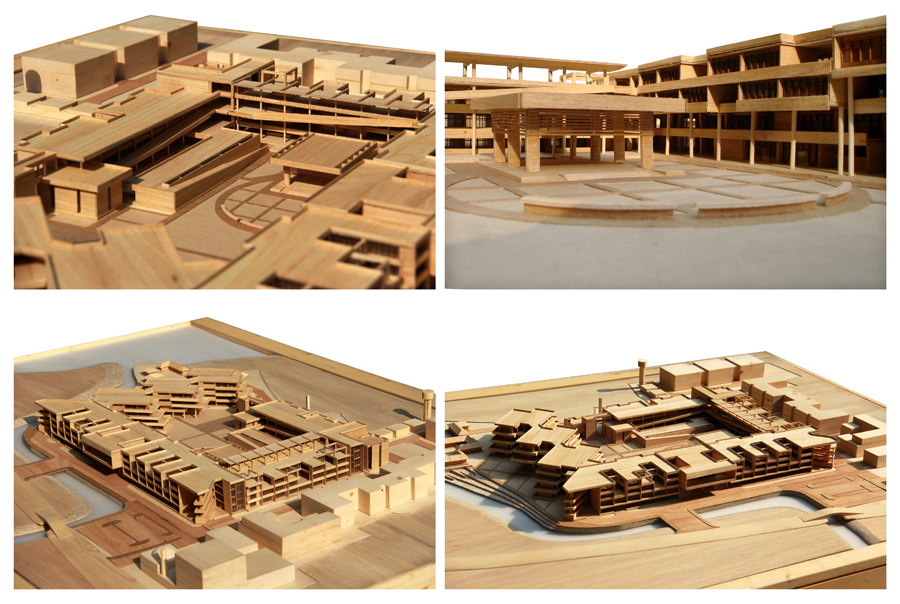
CRP Chittagong Centre © Mohaimeen Islam | BUET


<< Image gallery >>


  • Centre-for-rehabilitation-of-the-paralysed-CRP
  • 18 CRP-Chittagong-Centre
  • CRP-Services-CRP-Chittagong-Centre-
  • site context CRP
  • Functional-Linkages-of-programme-CRP
  • design dev studies CRP
  • Form-derivation-CRP-Chittagong
  • 07. Site Plan
  • 09-CRP-Chittagong-Centre
  • Print
  • 05. Plan 03&04
  • Spirit-of-the-central-court CRP
  • Functional-blocks-arrangement-CRP-Chittagong-Centre-©-Mohaimeen-Islam_BUET
  • Accessibility-and-Landscape-CRP
  • Design-logic-for-block-formation-CRP
  • Sections CRP
  • enviromental section CRP
  • CRP-Chittagong-Centre
  • CRP Chittagong Centre 15
  • 09. Model Image_02_others

Shahid Minar at SAU| Ar. Rajon Das

|From the architect- Shahid Minar at Sylhet Agricultural University|

সিলেট কৃষি বিশ্ববিদ্যালয়ের নির্মিত শহীদ মিনার ‘সূর্যালোকে বর্ণমালা’ সৃষ্টির স্থাপত্য ভাবনা

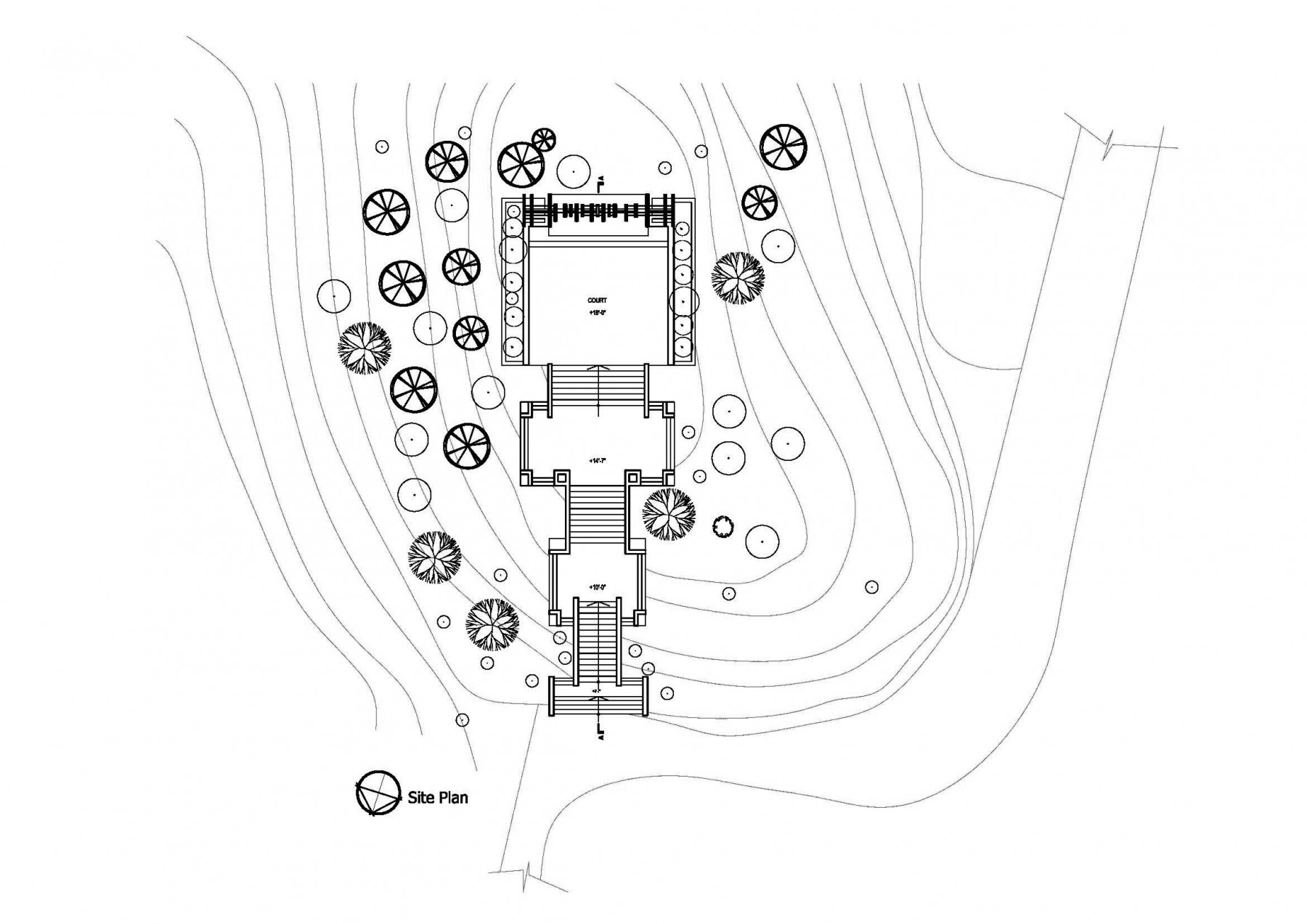
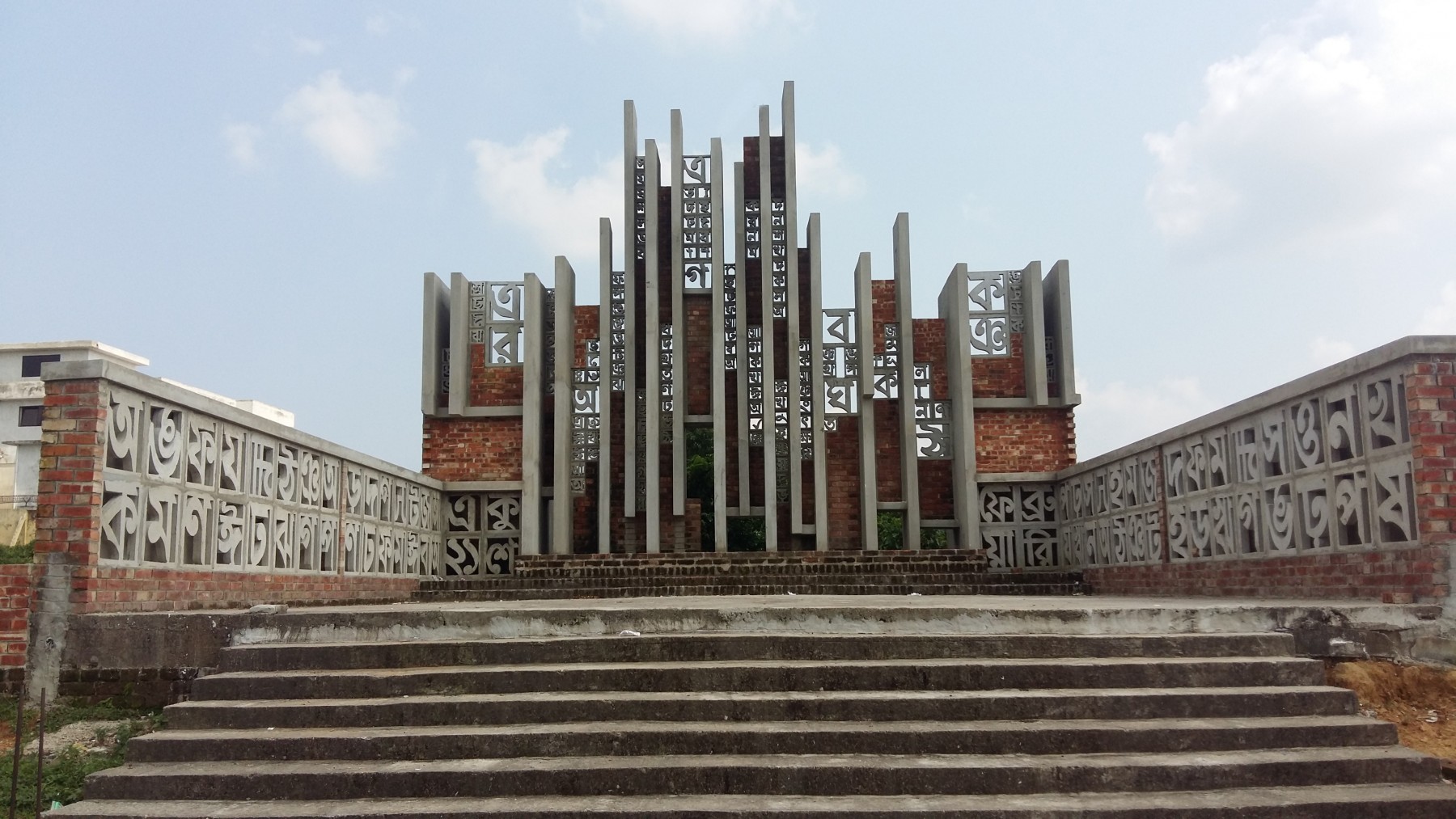
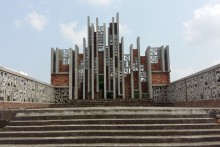
শহীদ মিনারটি সিলেট কৃষি বিশ্ববিদ্যালয়ের লেইকের পাড়ে ছোট্ট টিলার উপরে নির্মিত।প্রায় বিশ ফুট উঁচু টিলা। এই টিলার উপর নির্মিত হয়েছে দৃষ্টিনন্দন শহীদ মিনার। সিলেট কৃষি বিশ্ববিদ্যালয়ের প্রধান ফটক পেরুলোই চোখে পড়বে নির্মিত এই শহীদ মিনারটির চুড়ো।
লিডিং ইউনিভার্সিটির স্থাপত্য বিভাগের সহকারী অধ্যাপক স্থপতি রাজন দাস শহীদ মিনারটির নকশা প্রণয়ন করেছেন।

Shahid Minar at SAU
Shahid Minar at SAU© Ar. Rajon Das
Shahid Minar at SAU
Shahid Minar at SAU© Ar. Rajon Das
Shahid Minar at SAU
Shahid Minar at SAU© Ar. Rajon Das


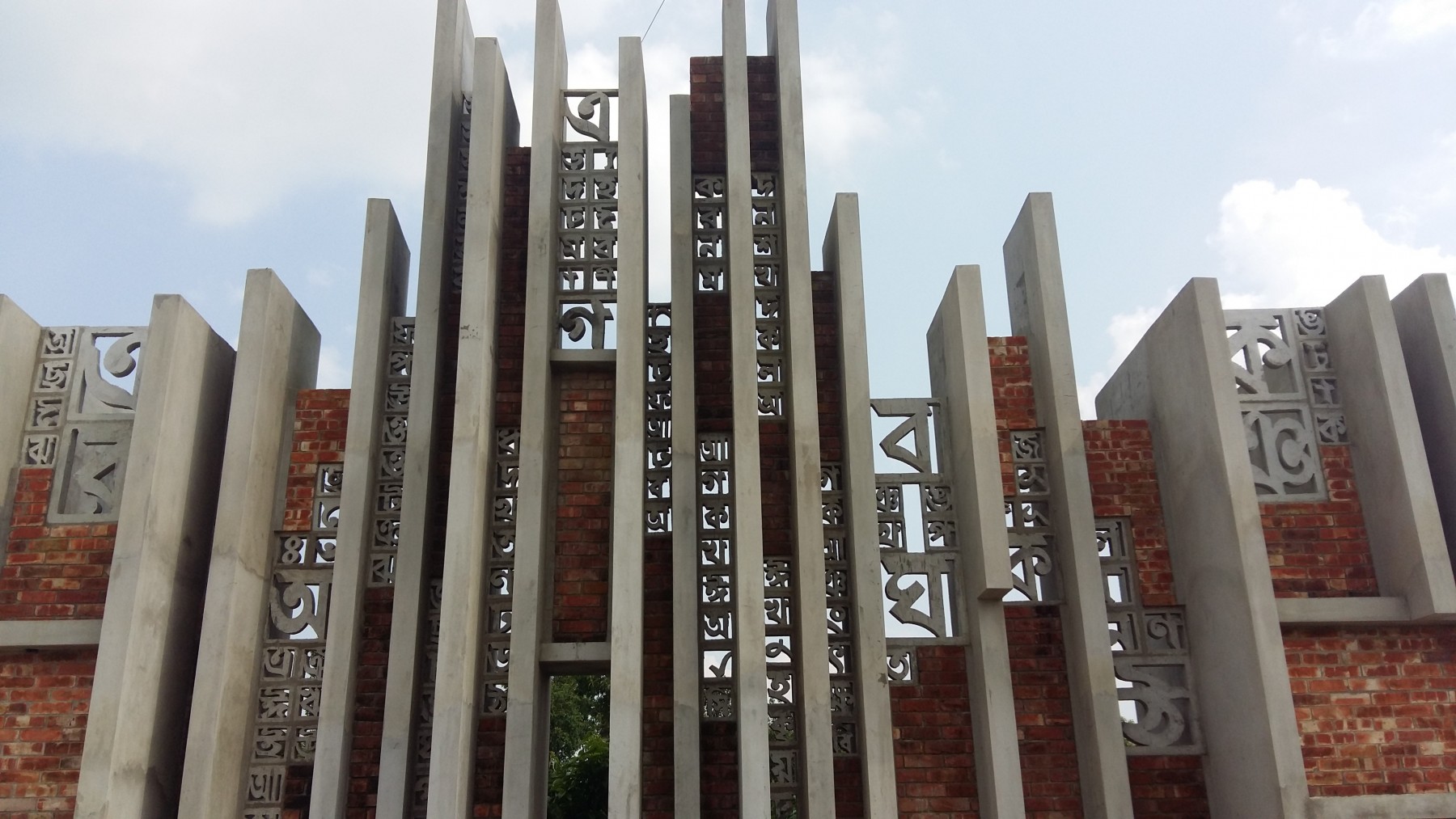
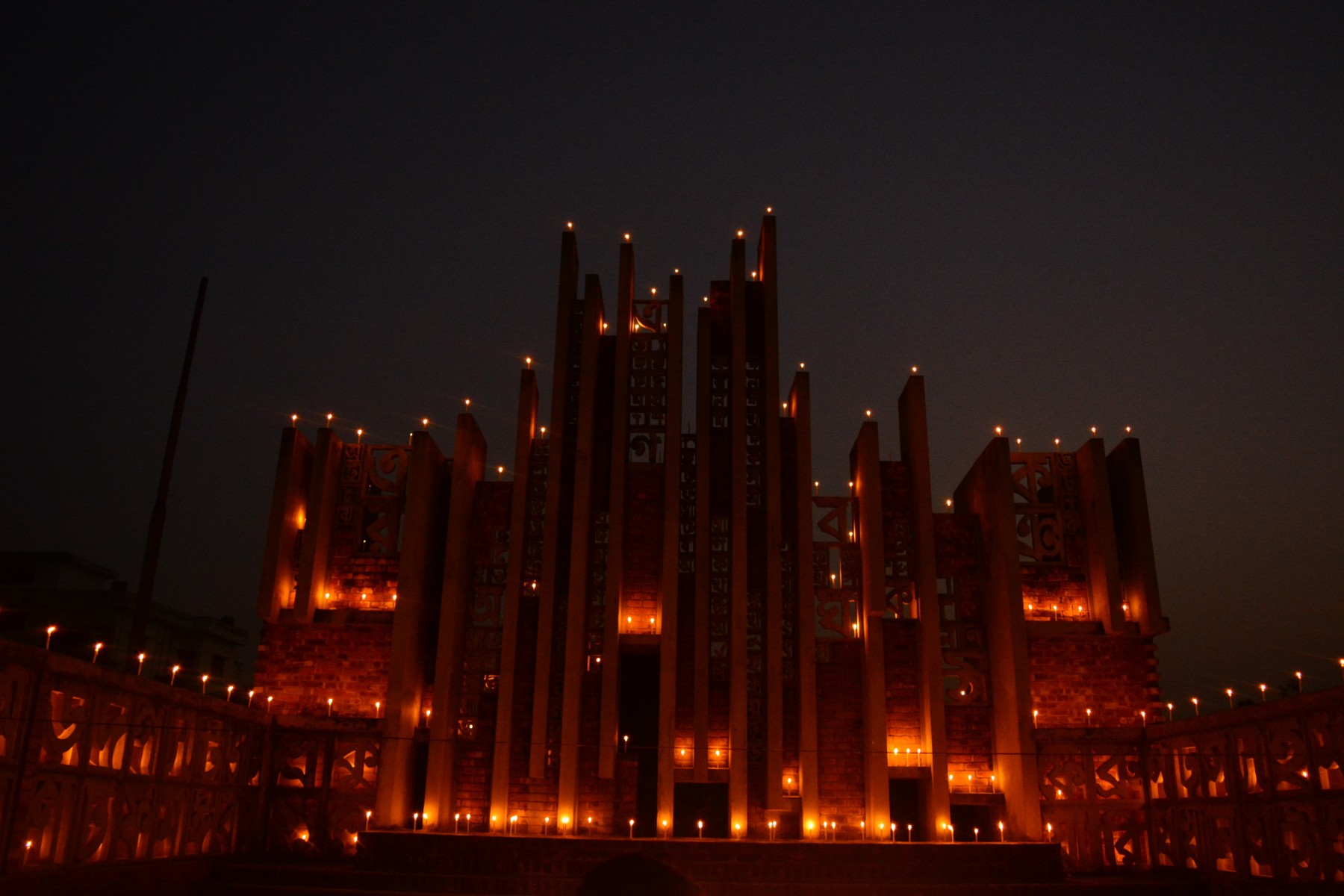
বিশ্ববিদ্যালয়ের প্রধান প্রবেশদ্বার অতিক্রম করলেই দূর থেকে টিলার উপরস্থিত শহীদ মিনারটি চোখে পড়ে। টিলার পাদদেশে পৌঁছালে মিনারের শিরভাগ দর্শনার্থীকে আকর্ষন করবে এবং সেখান থেকেই সিঁড়িপথের যাত্রা শুরু। অনেকগুলো সিঁড়ি ভেঙ্গে ক্রমশ এগোলে মিনারটি পূর্নাবয়ব পেতে শুরু করবে। মূল চত্বরে উঠে গেলে দেখা যাবে সম্মুখে অনেকগুলো খাড়া সরু দেয়াল ঘন সন্নিবিষ্ট হয়ে আকাশমুখী হয়ে বিভিন্ন উচ্চতায় দাঁড়িয়ে আছে এবং দেয়ালগুলোর মধ্যকার অল্প-সল্প ফাঁকটুকু আমাদের মাতৃভাষার বর্নমালায় ভরে আছে। বর্ণমালায় কোন বর্ণ বড়, কোন বর্ণ ছোট। দেখে মনে হবে শিরদাঁড়া টান করে দাঁড়ানো উর্ধ্বমুখী দেয়ালগুলো যেন প্রতিবাদমুখর। আর তারা যুথবদ্ধ হয়েছে বর্ণমালার একতার ঐকতানে।

Shahid Minar at SAU
Shahid Minar at SAU© Ar. Rajon Das
Shahid Minar at SAU
Shahid Minar at SAU© Ar. Rajon Das


মিনারটি উত্তর পশ্চিমমুখী আর বর্গাকৃতি চত্বরের উত্তর দক্ষিণে পাঁচ ফুট উচ্চতার পাঁচিলে বর্ণমালা খচিত রয়েছে। চত্বরে দাঁড়ালে মনে হবে চারদিকে বর্ণমালার ব্যঞ্জনা, যেন ‘ক-খ-গ-ঘ-র’ উঠানে দাঁড়িয়ে আছি। যেদিকে চোখ পড়বে হয় বর্ণমালা, নয়তো আকাশ।এই শহীদ মিনারটি উত্তর পশ্চিমমুখী হওয়ায় প্রতি প্রভাতেই এর পশ্চাৎপটে রক্তিম সূর্যের আবির্ভাব হবে এবং দিনের বয়স বাড়তে থাকলে সূর্য মধ্যগগণ পেরিয়ে পশ্চিমে ঢলে পড়বে। সকালে সূর্যালোকে মিনারটি ছায়াচ্ছন্ন অস্পষ্ট এবং সূর্যের দিন পরিক্রমায় ক্রমশ সে আলোকিত ও স্পষ্ট হয়ে উঠবে। মনে হবে আপনি বর্ণমালার বাগানে আছেন। বর্ণমালা ছাড়া মাথায় আর কিছু থাকবে না। অর্থাৎ বাংলা ভাষার যত প্রতীক আছে তা কিছু সময়ের জন্য আপনার আশপাশে ঘুরে বেড়াবে। আমাদের হাজার বছরের বাংলা ভাষার সাথে প্রাচীনতম সূর্যের এক অনির্বচনীয় কথোপকথন চলবে প্রতিদিন। তাই এই মিনারের শিরোনাম ‘সূর্যালোকে বর্ণমালা’।

Shahid Minar at SAU
Shahid Minar at SAU© Ar. Rajon Das
Shahid Minar at SAU
Shahid Minar at SAU© Ar. Rajon Das
Shahid Minar at SAU
Shahid Minar at SAU© Ar. Rajon Das
Shahid Minar at SAU
Shahid Minar at SAU© Ar. Rajon Das


শহীদ মিনারটির ২০১৫ সালের শুরুর দিকে নির্মাণ কাজ শুরু হয়। কাজ সমাপ্তির পথে। নির্মাণ ব্যয় ৪৫ লাখ টাকা।

|An English version of the text will be added shortly|

  • new feature image
  • 5
  • Untitled-7
  • Add_1
  • Untitled-6
  • Plan_mod
  • Untitled-5
  • Untitled-4
  • Untitled-2
  • Untitled-3
  • Untitled-1

Vision 2050: MRT Interchange Station, Kawranbazar | BUET

| From the submission |

Dhaka Metropolitan Region (DMR) is experiencing phenomenal growth since the independence of the country. Due to regular migration from outside of the city, it is getting over crowded with time thus influencing rapid urbanization. The problem is further aggravated by limited land supply in urban areas, lower land utilization and lack of proper policy and planning of integrated land use and transportation system. The over-congestion of the core city calls for an imminent vision for redistribution of activities for a more balanced metropolitan region. The main theme of the proposed “Multi-Core Mega Urban” concept was to decentralize concentration i.e. diffusing the major functions performed by the core city and redistributing it to different urban centers with high levels of accessibility within the regional boundary of RAJUK. Mass Rapid Transit (MRT), with a combination of train and bus, is suggested to be the most popular solution to support the masses of Dhaka. This will help to create a hierarchical framework of different magnitudes of urban centers providing corresponding levels of services and employment opportunities to meet the local demand that will reduce long-distance trip generation thus traffic congestion.

MRT Interchange Station, Kawranbazar , Dhaka
© Md.Tariquzzaman (Tomal) | BUET


By definition,  a center is a place where varying concentration and combination of retail, commercial, civic, cultural and residential uses are focused around transport facilities that make its live and vibrant. The adjacent area of the site can be characterized by as a center connecting north-south and east-west of the city with intense traffic, dense commercial & mixed use development and other recreational public spaces. The prime concern of this project was the creation of an urban tissue with metro station as a logical center, combing the functions of transportation and social communication. The intention of the project was to ensure seamless urban experience through pedestrian interconnection and land use integration with site & surroundings that will facilitate steady incoming and outgoing pedestrian traffic with obvious and convenient intermodal transfer within transit center to solve the last mile problem. Finally, to take challenges of integrating architecture and urban design which deals with the terms and issues regarding transport planning, urban intervention, pedestrian linkage and urban regeneration.

MRT Interchange Station, Kawranbazar , Dhaka
© Md.Tariquzzaman (Tomal) | BUET


CONCEPT & CONSIDERATIONS

Strategic visioning framework

This project tried to envision some strategic framework to make it a sustainable transit center that will not only facilitate steady incoming and outgoing pedestrian traffic but also regenerates local urban fabric. The utmost consideration for this project were followings-

Complete Street Network, MRT as a system the viability of this mega project depends on other mode of transit specially walking, cycling, public transit and pedestrian oriented development strategy. To ensure those facilities within catchment area we need to establish street hierarchy, access hierarchy, should avoid cul-de-sacs, should promote integrated and continuous pedestrian access, safe and secure shared street that will allow all types of vehicles which will solve the last mile problem and will help to reduce pedestrian & vehicular congestion.

Land-use Development, to reduce travel cost MRT system must need to maximize its ridership to ensure its economic viability. To cater its transit ridership each station area should be regenerated as moderate to high density mixed use development (Transit Oriented Development (TOD),Pedestrian Oriented Development (POD)) which will allow diversity, density and pedestrian oriented development within 800m radius from station area to outward . Underutilized, small plot could be amalgamated or transformed into more efficient plot to increase its commercial and  social benefit.

MRT Interchange Station, Kawranbazar , Dhaka
© Md.Tariquzzaman (Tomal) | BUET


Place Making, MRT Infrastructure  as a mega urban intervention project could change the urban fabric of the city through its appropriate integration with the adjacent land use, landscaping and with other built and natural environment  which will transform the station interface to an appropriate transition area. Thus creating an active urban realm for the city dwellers that will cater waiting, drop-off, disperse and other social & cultural activity which in other way will create an positive image of the city and a strong sense of orientation towards station area.

Multimodal Transportation System, MRT as a system will not sustain until it is properly integrated with the other mode of transit like pedestrian, cycling, public transit, para-transit and water transit system within the catchment area in micro and macro scale. The network of these modes will form an urban tissue which will enhance an integrated system of transportation thus cater its sustainability as a transit center.

Protecting Natural Habitat, At the end of the day we can’t survive fighting with our natural environment. The project intervention strategy should not harm the existing natural settings rather steps should be taken to retrofit existing ecosystem which will help to improve the spatial quality, thermal environment and minimize negative micro and macro climatic impact.

MRT Interchange Station, Kawranbazar , Dhaka
© Md.Tariquzzaman (Tomal) | BUET


DESIGN BRIEF & PROCESS

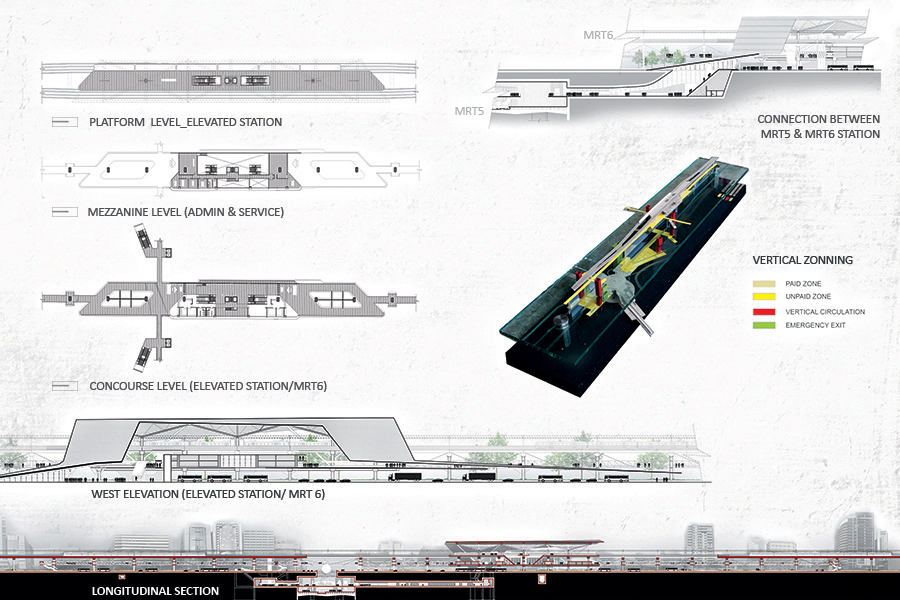
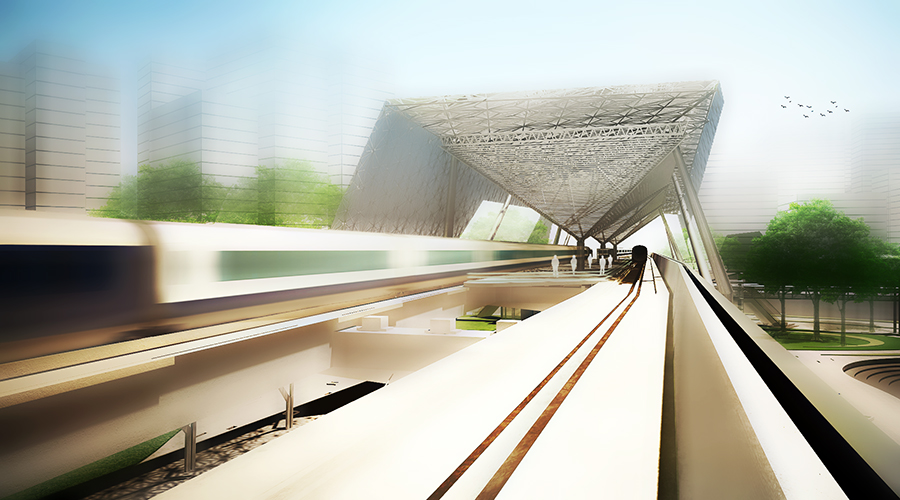
The proposed MRT LINE-6 is an elevated structure over the existing transit corridor and stations are distributed along the route at some important locations connecting administrative, cultural, commercial, residential and educational district of the city where each station area is different in its character and identity. So, in the design process the station interface has been designed in a way that reinforces the character of the site which will also act as an active public realm.

MRT Interchange Station, Kawranbazar , Dhaka
© Md.Tariquzzaman (Tomal) | BUET
MRT Interchange Station, Kawranbazar , Dhaka
© Md.Tariquzzaman (Tomal) | BUET


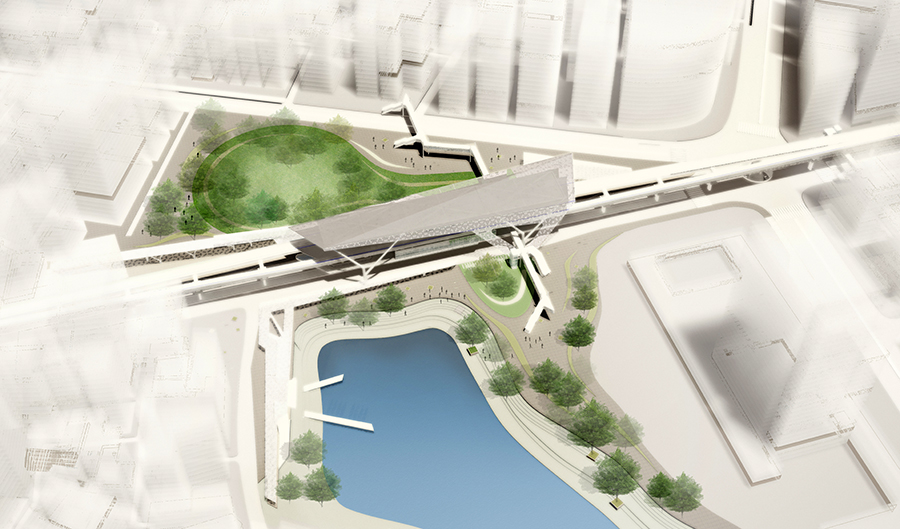
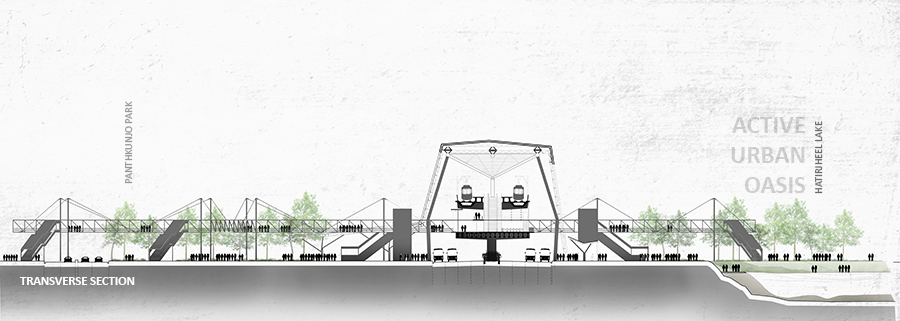
The proposed location of the station was in front of Panthakunjo Park at Kawranbazar, Dhaka. The adjacent area of the site can be characterized  as a center connecting north-south and east-west of the city with intense traffic, dense commercial & mixed use development and other recreational public spaces. Also a spectacular view to Hatirjheel Lake and existing Panthakunjo Park are the major site forces for the design that will help to create an active urban oasis at the heart of the city.

MRT Interchange Station, Kawranbazar , Dhaka
© Md.Tariquzzaman (Tomal) | BUET
MRT Interchange Station, Kawranbazar , Dhaka
© Md.Tariquzzaman (Tomal) | BUET


The prime concern of this project was to retrofit and integrate those built and natural environment with MRT station and to transform the station area as an active, vibrant urban realm that will facilitate not only incoming and outgoing traffic but also act as a social platform for sharing feelings and emotions. In the design, the station was designed considering MRT LINE-6(Elevated) with MRT LINE 5(Conceived Underground), future inland waterways along Hatirjheel and existing ground traffic which connects the north-south and east-west of the city. The design discouraged the route of Dhaka Elevated Expressway(DEEP) along its proposed route that conflicts with the MRT station in its current location and did not comply with many other urban design issues.

MRT Interchange Station, Kawranbazar , Dhaka
© Md.Tariquzzaman (Tomal) | BUET
MRT Interchange Station, Kawranbazar , Dhaka
© Md.Tariquzzaman (Tomal) | BUET


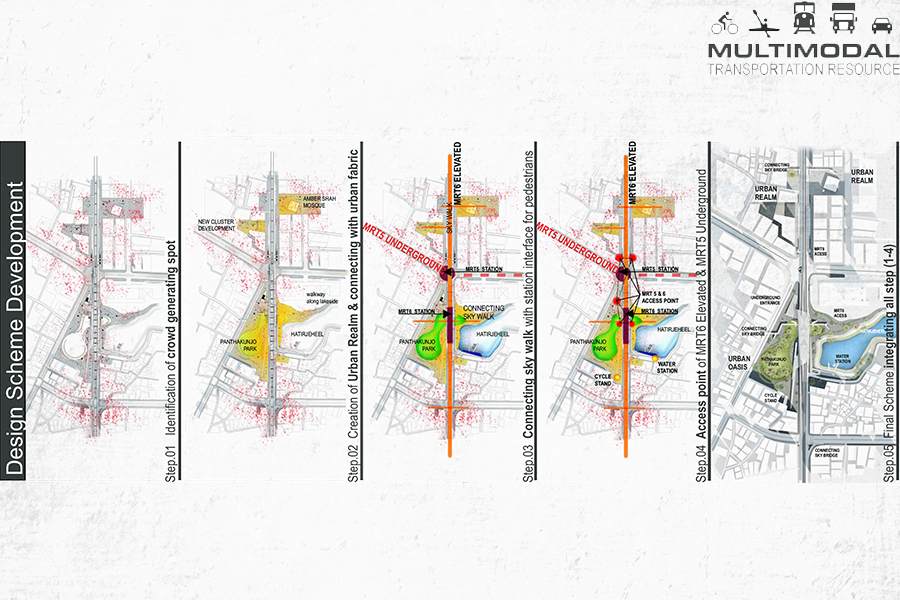
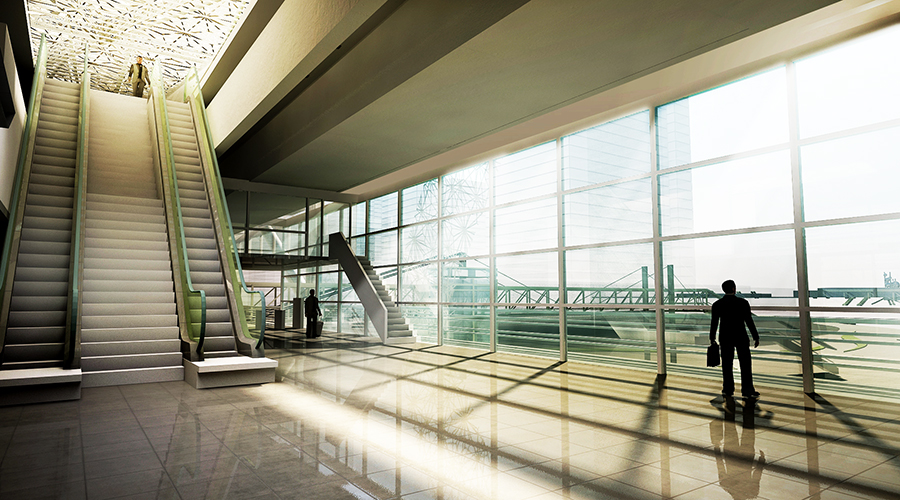
The design evolved through some sequential stages. Firstly; it started through the  Identification of crowd generating spot within the influence area, Secondly; creation of an active urban realm at those crowed generating spot that will help in efficient transfer of passengers and will connect it with existing urban fabric to allow seamless pedestrian interconnection, Thirdly; creation of a skywalk to connect those urban interface with MRT station to facilitate MRT passengers to find their destination without conflicting with ground traffic , Fourthly; establishment of an interconnecting network within MRT6, MRT5, water bus stand and existing ground traffic., Finally; connection and integration of the station area with the adjacent lake(Hatirjheel) and park (Panthkunjo) to form an active urban oasis.

<< Image gallery >>
  • MRT _BUET_01
  • MRT _BUET_11
  • MRT-_BUET_04
  • MRT_81X57.cdr
  • MRT _BUET_06
  • MRT _BUET_07
  • MRT _BUET_08
  • MRT _BUET_09
  • MRT _BUET_10
  • MRT _BUET_02
  • MRT _BUET_03
  • Context_MRT _BUET_12

Street for Resilient Community | Joint-winning Entry in Model Streetscape Competition

| From the submission |

Cities can be seen as vast built-forms: through its grain, grid, form and system. On other way it can be seen as a large humanscape: through its community, neighbourhood, collective memories and identity. For being a responsive living abode city needs to considered much from the second perspective; community as its core unit to maintain such human landscape.

A city is represented by it streets and life on it. And that life is made by the active participation of its people. A model street should have that kind of representations and engagement. A Street is not only a traffic corridor rather the interface of communities, connector of neighbourhoods that it passes through.

© Lines Architects + CSA + terracotta architects


Dhaka inherently being an informal city celebrated the power of community and people through its past. It has amazing resilient quality of adaptability and self-generation through informal sector and community participation. Alike other developed cities the process of development and busy urban life tends to loosen the sense of community and suppress the power of informality. This scheme by principle wants to integrate those two core qualities of resilience into our city development. It envisions a street as the engagement platform and representative interface for such resilient community, which is aware of own history, healthy and active by walking and biking, responsive to nature by interacting with the lake and vegetation and socially engaged by community interaction.

© Lines Architects + CSA + terracotta architects


STRATEGY 

The proposal celebrates the context of this part of Dhaka. Mirpur Road is an important arterial traffic corridor, at the same time signifies being connector between elements of two inspirations and two foundations. The conceptual transfer-zone between foundations: Old-Dhaka (city’s historic origin) and the cultural and campus-district (civic and intellectual root) and towards inspirations: Kahn’s new citadel (pride of new nation) and historic Bangabandhu residence (the inception point of our national endeavour). The scenario encourages a framework for a remarkable urban corridor for people and in participation of people.

© Lines Architects + CSA + terracotta architects


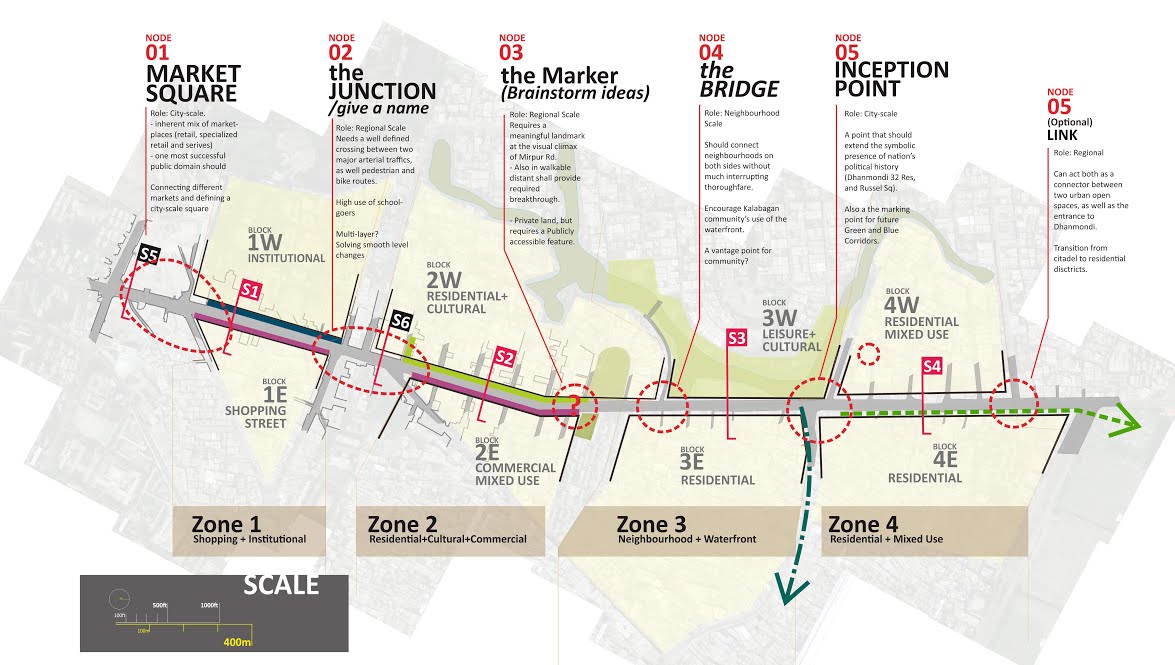
Mirpur Road within its precincts contains a number of urban catalysts: a vibrant marketplace, an active water body, significant historic site, and a busy intersection. The masterplan considers those components and defines local needs and programmes based on each section’s neighbourhood and community characteristics. It suggests four strategic nodes and four zones. It proposed prototypes of community modules and street sections based on each zones community needs (ie shopping and hawking related, institute related, park related, traffic-intersection related). Apart from residential, other forms of communities like: book lovers community in Nilkhet, Hawkers’ community at marketplace, nature lovers at lake, are encouraged and accommodated to take care of their portion of spaces, to create more belongingness and work as unit in the time of emergency or needs.

Principles Street Programme
Community as
History Aware Historic Park, Play n Learn
 Socially Engaged Community Module,

Lease & Manage: Community Engagement Programme, Hawkers’ Programme, Shared Pedestrian Scheme,

 Nature Responsive Share & Care, Friends of Lake, Rain Garden Programme, Rain-water Harvesting Programme
Active & Healthy Bike Programme, Walkability,
© Lines Architects + CSA + terracotta architects


The programme in its master planning proposes development of four strategic nodes.

Node 01 is in the mid of an impressive mixture of marketplaces: New Market (household, fashion, foods), Nilkhet (stationaries and old books, small press), Gausia (ladies’ fashion market) and precincts (fashion market, large kitchen market) allows a robust assembly of shoppers and shop-keepers along with parking and hawker issues. Market square and extended pedestrian crossing plus hawkers’ plaza have been programmed for this city-scale public domain.

Node 02 basically addresses traffic and transit-issues with a busy crossing of two major traffic corridors. To avoid traffic-pedestrian conflict an elevated pedestrian network proposed for the first phase; that network shall connect hospitals, colleges, shopping and bus interchange on a pedestrian share scheme. It would be a win-win situation for the sharing shopping, hospitals and offices for better connectivity and human flow. In third phase a short overpass over Science Lab intersection and bus interchange is proposed to ease up the traffic crossing.

Node 03 is situated in between neighbourhoods of two different characters. A shallow connection at Dhanmondi 10 and Kalabagan indicates Kalabagan’s disjunction with the lake and Dhanmondi. Neighbourhood Court, an elevated connector neighbourhood plaza between Kalabagan and Dhanmondi Lake will encourage more interaction with the lake and both neighbourhood ends at a local scale.

Node 04 carries both past and future significance. Vicinity of Bangabandhu Residence at Road 32 (old) and active public square of Bangabandhu Museum demands the extension of that realm into Russel Square for larger exposure. Strategically this node is also important for future MRT Line 4 station and green and blue corridors. Proposed scheme namely Inception Point shall signify such a critical node with a history park informing communities on Bangabandhu and Residence at Dhanmondi-32’s role in our history. A history park in the mode of play-and-learn for kids, inception tower in form of watchtower will lead towards a neighbourhood plaza consisting rain terrace that houses few lake-based community activities.

© Lines Architects + CSA + terracotta architects


And In between four zones are programmed to encourage street side activities responsive to the adjacent frontages, typed into retail-front, institution-front, house/mixed-front, and park-front. Street section prototypes are devised accommodating zone-specific community modules (i.e. information kiosks, charging booths, pedestrian shelters, parklets, social seating, stalls) and run-through elements.

© Lines Architects + CSA + terracotta architects


ELEMENTS

Bicycle Route

As a primary aim of this streetscape project, bicycle route is the integral part of this proposal. Through bicycle connected neighbourhoods, market, park, work and campus, this portion of Mirpur Road should be the exemplar for a future Bikable Dhaka for active and healthy communities. The whole stretch with a 20-minute cycle journey shall connect Dhanmondi, Lalmatia, Kalabagan and Sobhanbagh neighbourhoods and offices with major colleges and universities and New Market and Elephant Road. Along with bike-corals and lending facilities, two routes are envisioned: A continuous cycle lane along the pedestrian stretched through Mirpur Road and the other looped around the lake and intersect at Dhanmondi 32 and 10.

© Lines Architects + CSA + terracotta architects


Pedestrian Programme

The second element of active citizenship is ensured through walkability: a safe, well graded, age-friendly and accessible pedestrian route that enjoys a journey through a pedestrian programme of various street frontage and facilities in 5 minute walk intervals. Considerably vegetation and shadings are part of landscape to provide a comfortable journey and street image. It proposes to encourage programme-specific street frontage (art and food street, arcaded retail front, street side café table, corporate plaza, park-walk etc.) by phase to make the pedestrian journey remarkable and active.

© Lines Architects + CSA + terracotta architects


Overpass-Plaza

The most immediate devisable element is the existing foot-overpasses. There are a number of overpasses on this part of Mirpur Road, yet used at a very low frequency (apart from the New Market over bridge). Accessibility, location in relation to adjacent demand point, vertical ride versus travel benefit and such are responsible for ineffectiveness. To reduce cost this proposal aimed in modifying the connection, access and more importantly make the crossing space more active and purposeful, by extending its platform and stairs and accommodating stalls, kiosks and few more facilities.

© Lines Architects + CSA + terracotta architects


DESIGN TEAM

Lines Architects + CSA + terracotta architects

Ar. Mohiuddin Zilanee, Ar. Shah Fuad Mohammad Cyrus, Ar. Mohammad Sami Al Hasan,

Ar. Reesham Shahab Tirtho, Ar. Adbana Taj Anis, Ar. Md. Fahad Bin Mostafiz, Ar.Ferdoush Hasann, Ar.Sayon Sur


<< Image gallery >>

  • Context_Street resilient community 18
  • Context_Street resilient community_01
  • Context_Street resilient community 03
  • Context_Street resilient community 04
  • Context_Street resilient community 10
  • Context_Street resilient community 05
  • Context_Street resilient community 04.1
  • Context_Street resilient community 06
  • Context_Street resilient community 07
  • Context_Street resilient community 08
  • Context_Street resilient community 09
  • Context_Street resilient community_feature
  • Context_Street resilient community 15
  • Context_Street resilient community 12
  • Context_Street resilient community 13
  • Context_Street resilient community 11
  • Context_Street resilient community 14
  • Context_Street resilient community 17
  • Context_Street resilient community 16


<< CLICK HERE TO VIEW  OTHER SUBMISSIONS  IN COMPETITION  >>


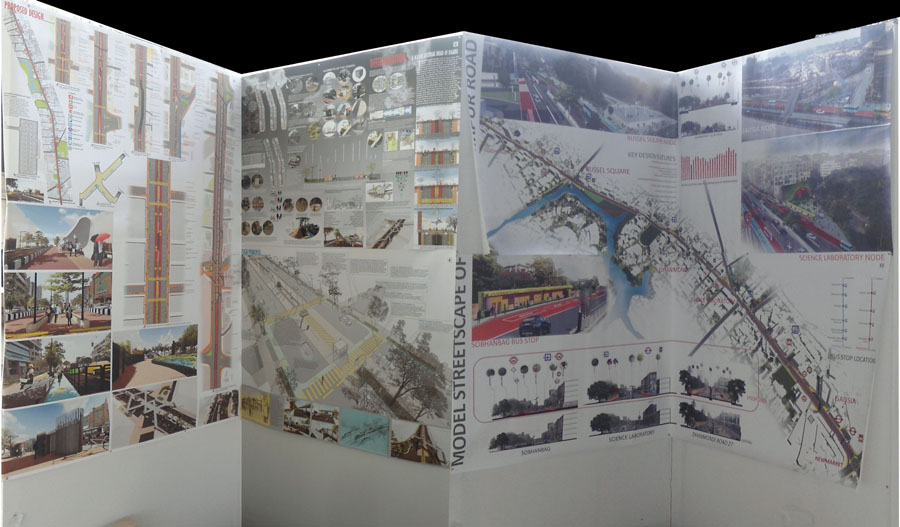
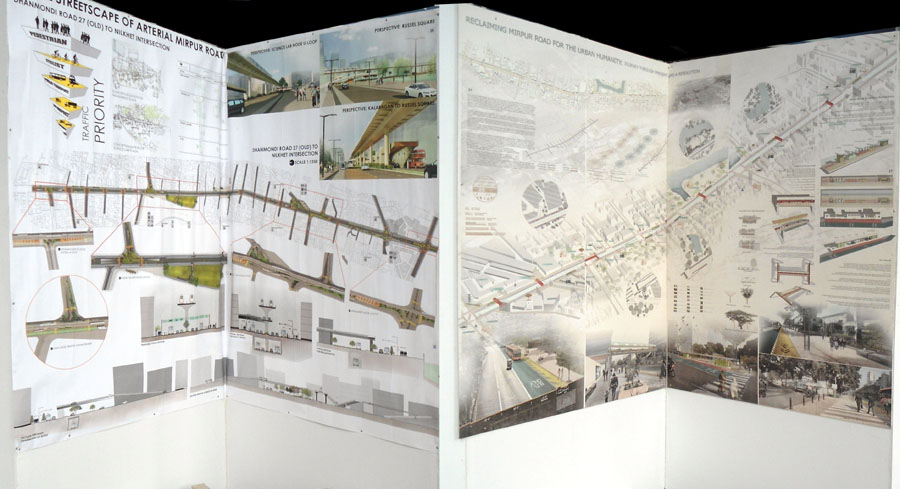
PROJECT SHOWCASE | Urban Design Competition for Arterial Mirpur Road

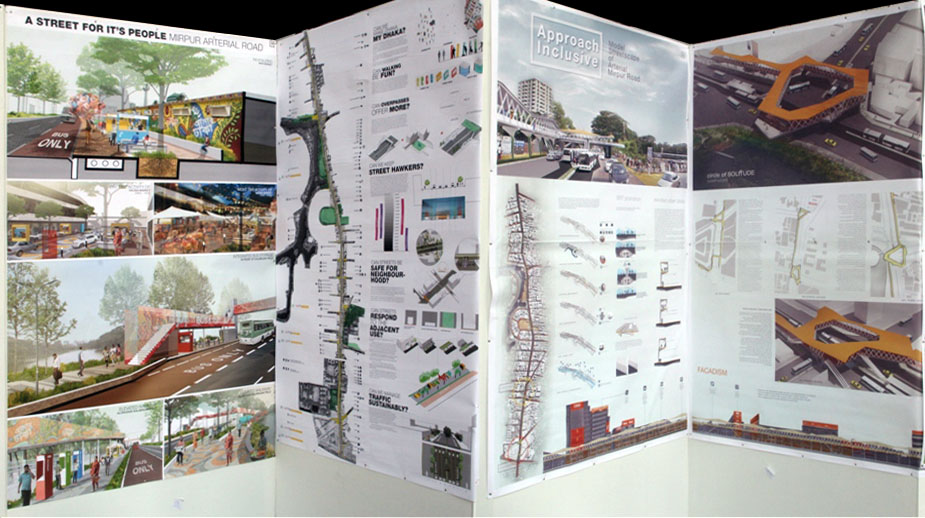
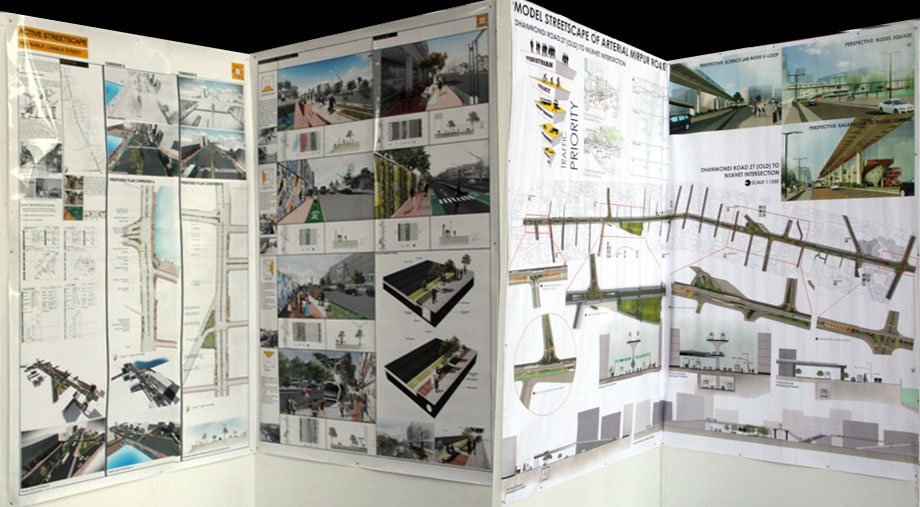
Dhaka with its 400 years of history and increasing urban population is going to be amongst world ten largest megalopolises in 50 years. By development trend, Bangladesh is at an advance rising stage and Dhaka as its capital showing all megatrends of middle-income cities on the trail of developed Asian urbanscape. At the same time present Dhaka’s physical development is over-saturated and infrastructure is highly stressed, while from social perspective neighbourhood bonding is loosening than ever. On such pivotal moment, Dhaka’s urbanism demands proper direction. Fortunately recent city authorities and government are showing intention and keenness through development programmes. The captioned competition has been such a gesture by Dhaka South City Corporation comprising a very important element of city: street. Collaborated with Institute of Architects Bangladesh, the open urban design competition called upon streetscape design proposals for three-kilometre stretch of Mirpur Road [from Newmarket node at south to Dhanmondi 27 (old) node at north] as a visionary and executable model for Dhaka streets. The brief sought to fulfill design objectives of a street that is community participated, universally accessible, walkable, cycle-friendly, clean, safe, well-equipped and aligned with Dhaka’s future plans. The project output ranged a vision statement to masterplan and street furniture design.


01
previous arrow
next arrow

[ Press Left/ Right arrow to change the image ]

Photo Courtesy : Md Rashed Hasan


The competition result was announced on 9th February. LINE ARCHITECTS [Ar. Mohiuddin Zilanee, Ar. Shah Fuad Mohammad Cyrus, Ar. Mohammad Sami Al Hasan, Ar. Reesham Shahab Tirtho, Ar. Adbana Taj Anis, Ar. Md. Fahad Bin Mostafiz, Ar.Ferdoush Hasan, Ar.Sayon Sur] and DESHAR WORKS [Ar. Ziaul Islam , Ar. Rashed Hassan Chowdhury , Ar. Jimi Chakma, Ar. Sakib Ahmed ]   have jointly won the first prize. Congratulations to the Winner.


Glimpse of model images of the competition entries :

model 01
model 02

model 03

model 04

model 05

model 06

model 07

model 08

model 09

model 10


<< CLICK HERE TO VIEW THE WINNING PROJECT >>


Article by: Ar. Mohammad Sami Al Hasan  |  Photo courtesy : Reesham Shahab and Md Rashed Hasan.

Projects, models and images belong to respective copyright holders, architects, firms/team.

CITIES WITHOUT ARCHITECTURE – International Photography Competition

© Arquitectura Sin Fronteras, demarcation Andalusia (ASF-Andalusia)

Arquitectura Sin Fronteras, demarcation Andalusia (ASF-Andalusia) have announced the 1st edition of International Photography Competition entitled “Cities Without Architecture” .The objective is to select a photograph which will be the feature image for their ongoing campaign.

BRIEF

…When we say cities without architecture, we mean that they lack basic and necessary urban facilities, organization or proper public spaces, for instance. Their infrastructures are inexistent or they are threatened, and they have a vast amount of houses which were built with shapes, materials or techniques that wouldn’t stand the natural phenomena.

These cities are as a matter of fact in risk, yet they are cities. Are we aware that these cities are amongst the biggest cities in the world? Do we really know they are also exposed to all the social, economic, military or geographic storms possible? However, these cities, far from being an issue, are the solution for many people, those who settle with the scarce resources at their reach.

The universal access to a proper city and housing, makes more urgent the need to intervene in these cities in risk in order to improve their condition. Raising awareness is a necessary first step towards the obtention of resources for the improvement of the hábitat. And this is the main reason why we launch this initiative.

ELIGIBILITY

This competition is open for everyone over the age of 18 years, both amateurs and professional photographers, regardless their nationality and place of residence.

TECHNICAL REQUIREMENTS

Each contestant will be able to present a maximum of three photographs, independent from each other or as part of a series, meeting the technical characteristics required here under. The authors shall present photographs taken from 2010 and until the competition deadline. The photographs will be unpublished and will have not been previously exhibited in other events. The photographs will be delivered in digital format, in tiff files with a size of 40x30cm and 300ppp quality. Illumination, exposition, contrast, shadow, saturation and other similar adjustments are permitted. Including or deleting elements in postproduction is not permitted, as the aim of this contest is to show a reality. Photomontages, collages or combinations of other techniques with photography will not be accepted.

JURY

A jury of five members will be responsible for choosing a winner and other awards. The jury will be composed by experts of national and international areas, in photography, architecture, and a representative of Arquitectura Sin Fronteras Andalusia.

AWARDS

The name of the winner will be published on the ASF Andalusia blog.

The winner will win an trip to one of the international projects that ASF is currently developing with a cost of up to 3000€ for expenses, where they will carry out a photographic report of the situation in the area and the actions developed by ASF.

The winner will win an trip to one of the international projects that ASF is currently developing with a cost of up to 3000€ for expenses, where they will carry out a photographic report of the situation in the area and the actions developed by ASF.

Besides, all the pictures will:

– Be published in a digital magazine, together with a brief explanation and the name of the author.

– Be disseminated in social media from the organization’s profiles (Instagram, Facebook, Twitter and blog).

– Be displayed in an exhibition at the Higher Technical School of Architecture of Seville, from April to June   2017.

SCHEDULE

13 February ,2017 | Competition announced

24 March, 2017 at 11:59pm | Closing date for all submission

7 April, 2017 | Announcement of winner [published on the ASF blog]

SUBMISSION

Only the digital submission will be accepted, to the email address:

comunicacionandalucia@asfes.org within the period described on the calendar, and meeting the technical requirements mentioned on the point E of these terms and conditions.

The email should specify:

Subject: name of the photograph

Personal data: name and surname(s), ID, address, cell phone number and email address.

Place and date of the photograph

Attached photograph in tiff format, named with the name of the photograph

INQUIRY

comunicacionandalucia@asfes.org

Detail (+)

Center for Religion | AUST

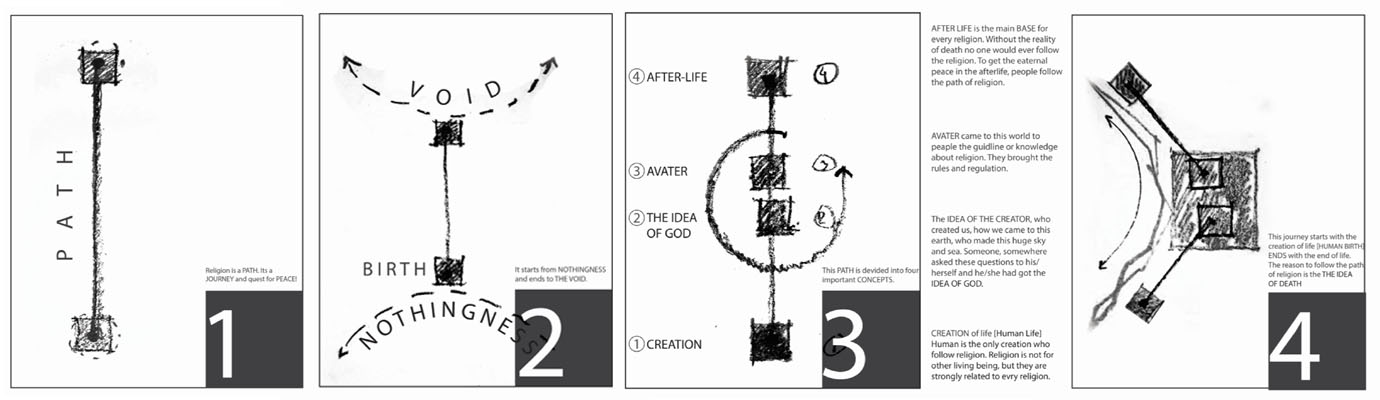
Every religion teaches men to be honest and helps them to become Human. We try to make Him happy who created us. We start to pray for the tranquility and pray to that strong unknown power. We have a feeling that we have someone who is taking care of us all. Thus it will take care of our soul. This is called DIALOUGE BETWEEN MEN AND GOD.

Towards meditation space [ Center for religion] © Ahsan Habib | AUST
Concept [ Center for religion] © Ahsan Habib | AUST
 

This project will bring people together from different religions and help them share their knowledge. They will have the chance to express the true essence of their religion. Philosophies will be shared. It will become a platform for the truth and thirst for knowledge.

It is an inter-faith center; it is a research platform for the people who are thirsty for knowledge. It is a place for sharing thoughts and respecting others, a universal connection between human and their deepest feelings.

It is a place of hope and peace.

Master plan of the complex[ Center for religion] © Ahsan Habib | AUST
Center for religion © Ahsan Habib | AUST


Light was one of the most important elements of the project, it removes odor and bring the truth in its path! Forms are treated in such way that the light can come where it is needed philosophically or functionally. Water was another vital and divine element. It has a symbolic characteristic that it refreshes body and soul. Meditation space is designed as a space in nature [as “nature is the temple”]. Effort has given to create a symbolic interaction between tall trees and flat plate. Respecting the context and making harmony with it. And these things are arranged sequentially “like a journey”!

Context_CFR_AUST_07

Context_CFR_AUST_08

Context_CFR_AUST_09

Center for religion © Ahsan Habib | AUST


I am the way into the city of woe.

I am the way to a forsaken people.

I am the way into eternal sorrow.

 Sacred justice moved my architect.

I was raised here by divine omnipotence,

Primordial love and ultimate intellect.

 Only those elements time cannot wear

Were made before me, and beyond time I stand.

– Dante Alighieri

<< Image gallery >>
  • Context_CFR_AUST_01
  • Context_CFR_AUST_10
  • Context_CFR_AUST_09
  • Context_CFR_AUST_08
  • Context_CFR_AUST_07
  • Context_CFR_AUST_02
  • Context_CFR_AUST_04
  • Context_CFR_AUST_06
  • Context_CFR_AUST_05
  • Context_CFR_AUST_03

Nidrabilash | Roofliners-Studio of Architecture

Nidrabilash by Roofliners Studio Architecture
© ROOFLINERS_STUDIO OF ARCHITECTURE
Nidrabilash by Roofliners
© ROOFLINERS_STUDIO OF ARCHITECTURE

|From the architect|

Nidrabilash  (A residence by Roofliners-Studio of Architecture) places itself in the heart of a dense vegetation surrounding in a village named Kashiani near the district of Gopalganj , Bangladesh. This is a home of a joint family having eight siblings. They had passed their childhood in this premise of the village with their parents. Currently all the family members reside themselves in different cities of the country but they always pay visit to their village time to time. Rendering the new needs with a large number of family members, they decided to erect this house while being nostalgic to their memories of this place. They allocated the land for the new house at the end of the premise keeping all the old structures comprising as an extended house with an open front yard in between.

Nidrabilash by Roofliners
© ROOFLINERS_STUDIO OF ARCHITECTURE
Nidrabilash by Roofliners
© ROOFLINERS_STUDIO OF ARCHITECTURE
Nidrabilash by Roofliners
© ROOFLINERS_STUDIO OF ARCHITECTURE
Nidrabilash by Roofliners
© ROOFLINERS_STUDIO OF ARCHITECTURE
Nidrabilash by Roofliners
© ROOFLINERS_STUDIO OF ARCHITECTURE
Nidrabilash by Roofliners
© ROOFLINERS_STUDIO OF ARCHITECTURE
Nidrabilash by Roofliners
© ROOFLINERS_STUDIO OF ARCHITECTURE
Nidrabilash by Roofliners
© ROOFLINERS_STUDIO OF ARCHITECTURE
Nidrabilash by Roofliners
© ROOFLINERS_STUDIO OF ARCHITECTURE
Nidrabilash by Roofliners
© ROOFLINERS_STUDIO OF ARCHITECTURE
Nidrabilash by Roofliners
© ROOFLINERS_STUDIO OF ARCHITECTURE


In the rural settlement of native Bangladesh one is generally encountered with the organic growth of households which poses a sense of temporal ambiance. Several houses containing one or two rooms find their place around an open courtyard in scattered formation. From this norm the project is conceptualized. The layout for this project is formulated in such a manner so that it takes the most benefit of the micro climatic condition. Group of free standing volumes are arranged in an organic manner stimulating a sense of ambiguity and openness while keeping an undiscovered rhythm inside. It is intended to have a blurry boundary between outdoor and indoor space.

Nidrabilash by Roofliners
© ROOFLINERS_STUDIO OF ARCHITECTURE
Nidrabilash by Roofliners
© ROOFLINERS_STUDIO OF ARCHITECTURE


Through the placement of terraces toward the yard and also with the perforated wall and different apertures framing the nature, the relationship has been strengthened with surroundings . The use of thick brick wall as the main structure endeavors a notion of purity which also rectifies the acceptance of aging.

Nidrabilash by Roofliners
© ROOFLINERS_STUDIO OF ARCHITECTURE
Nidrabilash by Roofliners
© ROOFLINERS_STUDIO OF ARCHITECTURE


From the very beginning of conceptual stage it is focused to design an experience rather a house itself. The ground floor is recessed intentionally with a calculative offering of day light to navigate one’s experience through an engraved reflecting water pool followed by a green court and light well, whereas in the upper floor they have been offered with the abundance of light to get more generic vista towards the frontal yard  and  open field.

Nidrabilash by Roofliners
© ROOFLINERS_STUDIO OF ARCHITECTURE


Envisioning a nostalgic tranquil environment contrasting to the busy city life, it is a place for gathering with family having a lot of stories to share and even more to create for the future.

Nidrabilash by Roofliners
© ROOFLINERS_STUDIO OF ARCHITECTURE
Nidrabilash by Roofliners
© ROOFLINERS_STUDIO OF ARCHITECTURE
Nidrabilash by Roofliners
© ROOFLINERS_STUDIO OF ARCHITECTURE
Nidrabilash by Roofliners
© ROOFLINERS_STUDIO OF ARCHITECTURE
Nidrabilash by Roofliners
© ROOFLINERS_STUDIO OF ARCHITECTURE
Nidrabilash by Roofliners
© ROOFLINERS_STUDIO OF ARCHITECTURE
Nidrabilash by Roofliners
© ROOFLINERS_STUDIO OF ARCHITECTURE
Nidrabilash by Roofliners
© ROOFLINERS_STUDIO OF ARCHITECTURE
Nidrabilash by Roofliners
© ROOFLINERS_STUDIO OF ARCHITECTURE


<< Image gallery >>
  • 18
  • plan GROUND FLOOR
  • plan 1ST FLOOR
  • 17
  • elevation SOUTH
  • elevation EAST
  • 21
  • 20
  • 19
  • 16
  • 15
  • 13
  • 07
  • 10
  • 08
  • 11
  • 05
  • 12
  • 04
  • 02
  • 03
  • 01
  • section A
  • plan SITE PLAN
  • m4
  • m5
  • m3
  • m2
  • m1
  • section B

SHAYAMBHAR : Center for Underprivileged Children | BRACU

The project ―”Shayambhar” intends to give the underprivileged children the platform where they can receive education and at the same time help their families by doing some productive works by retrofitting an existing industry. It is hoped that in future the children will be educated and at the same time they will become self-dependent. There will be a time when these children will be referred as an asset for the nation rather than a burden of society if they are given proper opportunities.

©Afreen Ahmed Rochana, BRACU


The word ―”Underprivileged” refers to a group of people deprived through social and economic condition of some of the fundamental rights of all members of a civilized society. Our society can see many people who are totally deprived of most of their basic rights due to poverty. If we think of the underprivileged children, they drop off their school only to run their families, whereas the other children of the same society who are well off are blessed to continue their education. Those underprivileged children have no other choice than leaving the school and work for the family to earn some money. Most of them want to continue their education but are helpless. Being children of a society where others can get the light of education, they do not deserve to be deprived of this basic need.

©Afreen Ahmed Rochana, BRACU


AIMS AND OBJECTIVES OF THE PROJECT

1. Create a platform for the underprivileged children and parents who are deprived of education and proper working skills.
2. Establishing a school, vocational training center and enterprise which will be inter-related.
3. Making it easy for children by creating space according to their psychological needs.
4. Providing opportunities for the underprivileged children and small scale entrepreneurs.
5. Assuring benefits for both end(institution and children)
6. Exploring the network through a sustainable system.

©Afreen Ahmed Rochana, BRACU


SITE

According to the client’s(who are considered as CSO or NGO) need the site was chosen. While thinking about the expansion there was a strategy taken. They are – Primary expansion, Secondary expansion, Tertiary expansion. According to proposition savar is an area which is in the primary expansion zone. The area near bangshibari is mainly an industry and agriculture based area. Mostly low income people live here where their children do not get proper and quality education. Moreover, the capacity of the site is good enough to accommodate the underprivileged children of savar area as it is regularly accessible. So this can be an appropriate area where their children would be able to get quality education.

© Afreen Ahmed Rochana, BRACU


Another possibility is if it is needed to provide an online educational system, it can be constructed in this area as there is a good communication system of internet. After proposing some site images and contextual analysis it is decided that the natural setting which is required was here in the proposed site.

Lastly the chosen site gives us a notion of peace. So if this center is built this can be a breathing spot and interaction centre for the local community as well. For instance there is no vehicular access in the chosen site. The only communication and transport way is boat between east and west sides. Transport by boat from savar thana ghaat, balurghaat and bhagolpurghaat. this centre will be a healing space for the people. The calm and peaceful environment will eventually help in this aspect.

© Afreen Ahmed Rochana, BRACU


CONCEPT & CONSIDERATION

Unprivileged children are very sensitive group of human being. They have different background. They are insecure, some have some physical disabilities, some belong from broken families and some of them don`t even have a family. So the aim was how to make them confident and how can they continue to get education and at the same time support their family by being self-dependent considering the benefits of both the institute and the underprivileged by analyzing their psychological pattern and current importance of creating and marketing our local crafts. Then again as the site is full of natural diversity and ecological asset it was necessary to propose a sustainable building technique to respect the environment and reduce costing in construction.

© Afreen Ahmed Rochana, BRACU


As one of the design priority was low cost construction one of the main site force which is an existing abandoned industry was used. The design mainly consists of 3 main activities which are- school,vocational training and craft production sector and an enterprise. Eventually, the system will tie a knot among these programmes. As there was two separated form in the industry one of them was taken as a school block and another one as the block for vocational training which will be later connected by another form which will contain the enterprise. The whole natural setting was kept as a natural resource for the interface.

© Afreen Ahmed Rochana, BRACU


While working along with children it was necessary to understand their psychology. So a psychological theory called Erikson`s psychology was studied and tried to match that up with what a child requires and how does he or grows up. According to that zoning was derived which intends to give these underprivileged children the platform where they can receive education and at the same time help their families by doing some productive works. It is hoped that in future the children will be educated and at the same time they will become self-dependent.

© Afreen Ahmed Rochana, BRACU


After that a sustainable cycle was derived for the enterprise which will eventually help the children and other local investor to be self-depended. The cycle consists the benefits of both ends.

<< Image gallery >>

  • Center-For-Underprivileged-Children_BRACU12
  • Center-For-Underprivileged-Children_BRACU09
  • Center-For-Underprivileged-Children_BRACU10
  • Center-For-Underprivileged-Children_BRACU-008
  • Center-For-Underprivileged-Children_BRACU06
  • Center-For-Underprivileged-Children_BRACU11
  • Center-For-Underprivileged-Children_BRACU005
  • Center-For-Underprivileged-Children_BRACU004
  • Center-For-Underprivileged-Children_BRACU003
  • Center-For-Underprivileged-Children_BRACU002
  • Center-For-Underprivileged-Children_BRACU01