
 DESIGN. ARCHITECTURE. CULTURE
PROJECT BACKGROUND
Grameen associated companies are expanding their activity, operation and business since their inception. They strive to transform societies through Social Business. Through practical realization of Social Business ideas they envision in achieving a world without poverty. Grameen associated companies will make every effort to implement projects within 2025 abiding by the policies set forth for Social Business. Keeping the vision in view, Grameen associated companies are providing technical and financial assistance to the projects in the following key areas –

Grameen Telecom Trust (GTT) and Grameen Kalyan (GK) have purchased 25.75 bighas (8.51 acres) of land in joint venture on Avenue 2 at Diabari, Uttara 3rd Phase, Dhaka. On 19 bighas (6.28 acres) ofarea within this land GTT and GK are planning to develop a project named ‘Health Complex One Project’ comprising 500 bed Samajik Medical College Hospital, Grameen Caledonian College of Nursing and Samajik Health Technology Institute. Commercial high-rise building(s) will be constructed on the remaining land.

The objective of the competition was to produce a design and proposal for:

DESIGN CONCEPT
“Towards Productive Architecture: A Bioclimatically responsive complex”
While cities offer opportunities for living a life with a low ecological footprint, they suffer from pollution, noise and remoteness from nature. Integrating vegetation into the urban fabric allows us to improve these quality of life issues, by offering ‘Biophilic’ benefits (intuitive and deeply ingrained attraction to nature, and a biological need for contact with the natural world) to inhabitants, increase the ecological productivity of the site, and connect buildings with their unique local environment.

In the spirit of Grameen-
Visioning future as an enabler of social business ideas, Grameen focuses to achieve a world without poverty. It initiated to implement projects in healthcare sector and various other areas within 2025.While designing the project ‘Health Complex One’ at Diabari, Uttara, Dhaka, we metaphorically assumed that as self reactive platform, the building entity connects and works according to people’s activity, need and possible reaction to nature. This design inspires the buildings work together as generically expressive buildings which do not differ from its own climate and context.
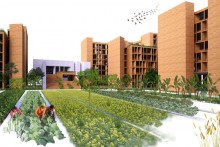
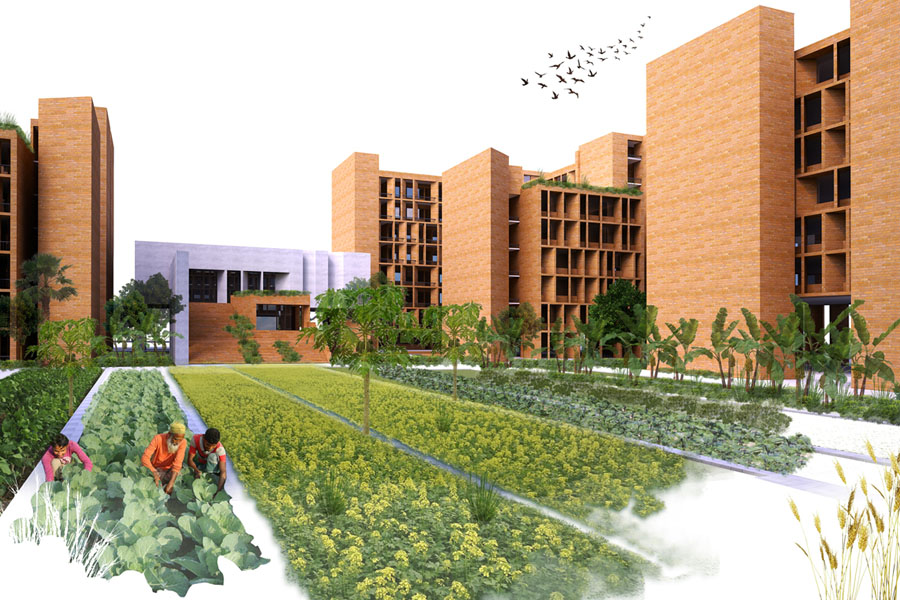
The intention was to address issues of food production and sustainable land use in this site. Perhaps the most cost effective and rewarding benefit of integrating vegetation into buildings is the biophilic connection it gives to building occupants that we tried to provide. Plants are part of the high quality environment that sustainable productive architecture should focus. The design of this complex aims at identifying, through the perception of different groups of users of urban space and provided nature.
DESIGN MORPHOLOGY
Building Form, Orientation, Accessibility & Circulation in the Masterplan
In the masterplan, the building forms have been generated through various phases of design and oriented according to its different activities and possible reaction to oriental weather. Inner courtyards in-between building forms and open green vegetation area have been introduced to ensure cross ventilation and to create maximum vista to the site.

Orientation is a significant consideration as proper placement of the built forms will enable the buildings to receive maximum natural ventilation and light. This would save electricity and in the long-run prove to be environment friendly. The masterplan is designed in such manner so that the buildings gain maximum natural light but avoid the heat and also well ventilated by the openings and well protected from heat by angled louvers throughout building periphery.

The nursing college academic block and hostel block have their own courtyard to circulate natural air. Buildings also have been designed with single loaded corridor circulation to ensure maximum ventilation. The whole complex has its own peripheral vehicular circulation and every building has pedestrian access. Inside the complex, around building blocks and vegetable garden has pedestrian connection to each other.
Addressing Urban Context with Open Green
The site is in an area which can be seen as a margin of the residential belt of Uttara. The approach to the site is clear and conscious in terms of visibility. The architectural strategy for the exterior of the buildings was to maintain the same expression to create a strong establishment. The green vegetation area on the ground and open terraces has been considered as stronger portion of the master plan.

Towards Productive Architecture: Organic Vegetable Gardening area
A big green area on the ground has been considered as productive food source of the master plan. We designed around 50,000 sft area for this organic vegetable gardening purpose, which will grow various all-year round vegetables (potato, bottle gourd, eggplant etc.) and seasonal vegetables (tomato, cabbage, cauliflower, onion, spinach) for the inhabitants of the hostel area and serve the canteen as well.

The site is in an area which can be seen as a margin of the residential belt of Uttara. The approach to the site is clear and conscious in terms of visibility. The architectural strategy for the exterior of the buildings was to maintain the same expression to create a strong establishment. The green vegetation area on the ground and open terraces has been considered as stronger portion of the master plan.

The green terraces allow vast amounts of light and ventilation deep within the building; and provide pleasant views to those working or residing within the building. The shrubs in these open terraces will help to filter pollutants from the air entering into the interiors.
<< Image gallery >>




Our future is set to be urban. ‘No country has ever reached middle income status without urbanising’ according to World Bank reports. By harnessing economies of scale, cities have a special ability to achieve more adding value for both people and companies. This means these cities are more productive than other countries with better economic structures, by sharing knowledge, ideas and honing pools of talent.For example, the rise of China’s middle class – a distinctly urban phenomenon that has lifted 500 million people out of poverty in less than 30 years – is testament to the power cities uniquely possess to elevate living standards .Dhaka can act as an example of powerful and inclusive development for the whole nation. This article discusses the background, scopes and understandings for present Architects and Urban designers to look beyond the square and prepare for the future.
An Architect is an Architect for life, it is the way of life you lead as a social activist, designer, promoter, visionary and above all creator of future leaders to ensure this world is a better place to live.
We are lucky to be Architects. Our strength is our unconditional love for Architecture.
Collective strengths of professionals and building materials gives us a building! Collective strengths of buildings, utilities, landscapes gives us a town! Collective strengths of these towns and human capital gives us a country! We need to capture this collective strengths to respond to our environmental, humanitarian, resilience and social issues in contemporary architecture and future directions. This collective strength is powerful enough to launch an Architectural Movement for us to be ready for next century!
But what is the mindset of 21st century Architects? What could be 21st century architecture? Is it just about designing buildings, landscapes and interiors? Is it about creativity, innovation or working with people? Is it about influencing society to understand the meaning of ‘living’ rather than just designing accommodation? Is it about being visionary and empowering others with that vision?
We are Architects and Urban Planners, trained to ensure the health of urban environment and accountable to develop preventive measures for the urban systems to cope with uncertainties for today and tomorrow. We understand society, economy, and environment and can visualise future! We can picture the past for our learnings and work for the present!
BUT are we ready, for the future? Are we capable of performing that ‘future’ role? Is our training adequate to cope with these challenges? Are we aware of our responsibilities?
I have been involved in numerous discussions on Cities and Urbanisations. I know many established practitioners on urban design engaged for number of years. But what I am going to say today is going to link Dhaka with all other Megacities and therefore the Megatrends happening around the world .All cities share the same effective ‘DNA’ because they’re made up of people; cities are fundamentally social networks, complex adaptive systems that behave similarly regardless of geography, political system or economic model.
There are thousands of networks, depending on activities, interests, professions, affiliations, but remember this, the most important network of cities is you. Cities are just a physical manifestation of your interactions, our interactions, and the clustering and grouping of individuals.
You need to take a differentiated approach and it’s really what increasingly businesses and organisations need to do if they’re going to be successful in these ever changing economies.
You can bring a fresh perspective perhaps different from the normal debate and address the challenges of 21st century by looking at the economy and society as a whole. If there is 10 billion people on the planet in 20501 want to live in places like this,how is it going look like?
Let’s talk about it.
21st century City is a collection of preferences. It’s the place where people have voted with their feet and the places that thrive, the places that people want to live in, want to work in will be the places that satisfy those two primordial human instincts to make stuff and to be with each other. It’s also about creating open spaces, creating thoroughfares where people walk, places where people mingle. People want place. They want a place that they’re emotionally attached to, a place that they live in and, at the same time they want the job opportunities.
People in that city have an absolute aspiration to be part of this successful dynamic developed world and they increasingly know about things around them as their TV, smart phone, tablet and internet tells them.
Cities, generally speaking, are the crucible of civilization. They have been expanding, urbanization has been expanding, at an exponential rate in the last 200 years so that by the second part of this century [1], the planet will be completely dominated by cities. Cities are the origins of global warming, impact on the environment, health, pollution, disease, finance, economies, energy — they’re all problems that are confronted by having cities.


Looking back over 150 years to megacities of the past, such as London or New York, we recognise that they suffered from much the same negative image often associated with megacities of today. Think of the Dickensian image of London: a city pervaded by crime, pollution, disease and destitution. Nevertheless, these cities were highly mobile, evolving and diverse societies, offering huge opportunities ultimately resulting in their modern manifestation as drivers of the world’s economy. Much the same could be speculated about megacities emerging today in Africa, Asia and other parts of the world.

Today we’ve got over 200,000 (2 lacs) people per day, that’s 1.5 million(15 lacs) [2] a week coming from the countryside to the city in a pattern of distressed migration that is swamping any megacity.
From 2% urban in 1800 to one that is already 51%, but is going to be 80% by 2050. [ 3]
Thirty-five megacities with over 10 million people will emerge by 2030, with twenty-two of them in Asia. [4]
By 2030 there is going to be 4.9 billion people living in African and Asian slums alone. [5]
Resource scarcity and climate change there are quite fundamental changes happening over the next 10, 20, 30 years. Firstly, the number of people on the planet is going to grow and by 2025 we could have eight billion, by 2050 nine to 10 billion. Those people are going to want to eat food, consume power and water; about 50% more energy, 40% more water, 35% more food [6] will be needed to feed, house and clothe those people to give them a way of life.

For decades now science has been telling us that we can expect to see certain levels of sea level rise regardless of whether we stop producing greenhouse gas in the global economy for the next 20 years or so. So, some of these big issues are locked in. Others are definitely reducible. We can, and will need to, improve the quality of what we do and how we do it.
So, we’ve got one of the defining challenges of the 21st century which is what are we going to do with these people?
Where are the jobs going to be? How is it going to work?
How are we going to avoid the outcome of these crime-ridden slums and the cities of future getting swamped?
Is it a product in trash out city that’s really just a giant waste processing zone?

You’ve got the chance with revolutions in energy and manufacturing to have a different vision of urbanisation where we make the countryside work, where we make the city work and we turn it not into a welter of slums, but into a series of villages in the city where people are thriving.

In the US, Detroit shows us how neglecting diversity can lead to losing that buzz. Detroit was narrowly focused on the automobile industry, which indeed spun off other associated but highly dependent industries, which led to a temporary boom. But because of its lack of business diversity, the city was unable to adapt when the ageing automobile industry hit tough times. Cities are quintessential complex adaptive systems constrained by underlying social and infrastructural networks. Diversity is crucial for their resilience, because all of their benefits, successes and problems are thereby highly coupled, interacting and continually changing.
You can’t deliver change in the 21st century without understanding deeply the technology drivers of it and how you implement and change technology [7]. The pace of change is going to accelerate and being open-minded to that, recognising the skills and the capabilities that you need to have within your practice in order to deal with that.
The third Industrial wave is consumers particularly taking that power back. So, you’ll start to own your digital brand. You’ll start to own who you are on the web.
Look at things like Facebook, Twitter, LinkedIn, they allow you to have a network of thousands. That transforms how you can access information, how you can organise yourself, how you can go to meetings with clients. So, on both sides, both on the consumer side and on the production side of the economy we’re finding there are just new models that are being underpinned by different ways of using technology.

The centre of global economic [8] gravity moving almost for the first time since the Industrial Revolution.
E7, which is the larger 7 emerging economies, so the 4 BRIC economies(Brazil, Russia, India and China), plus Mexico, Indonesia, Turkey, against the G7, the established, advanced economies, the US, Japan, the big European economies. And what we’re seeing is that 20 years ago, the E7 were miles behind. Now, they’ve narrowed the gap considerably and by 2030 we actually think they’ll be relatively larger than the G7, in terms of the size of their economies. China will emerge as the biggest economy in the world. And all 7 of these economies will be in the top 12 economies in the world by 2030 by our estimates.
Beyond the E7 for some of these broader opportunities. There is another economic group called the F7, which is just the level below, in size, the E7 and the BRICs, and that includes Columbia and Peru, in Latin America, Nigeria and Morocco in Africa, and they include Vietnam, Bangladesh and the Philippines in Asia.
These emerging economies as they continue to develop over the next 10 – 15 years will become huge consumer markets. We’re already seeing that the middle class in Asia Pacific region is actually going to become bigger than the US and Europe combined by 2015, by 2030 it will move far ahead. It’s no longer quite so simple, it’s not just all about growth and GDP, it’s more about differentiation. It’s more about being aware of the nuances, the institutional differences, the regulatory differences, the differences in social perspectives in these economies.

Why am I telling this to you? (Fig above tells us that) city modality has changed since it’s initial phase.
The people who can live in the cities are not the people who that used to be because of this change. In fact it is you Architects, Engineers, Doctors, Policy makers who are the inhabitants of a city. So there was never a better time to react than now [9].
We need to shift from a top-down model of governance towards one that is distributed [Michael Blowfield and Leo Johnson, 2013].
We believe that the distributed economy, while not a panacea to all of society’s challenges, can combine with the assets built up by the mass era to help create a prosperous future.
In terms of adequacy, it presents a model of growth that is both green and inclusive. In terms of achievability, it makes sense according to the underlying logic of capitalism.
Against this note of caution about the future, our final reason for optimism is anchored in the past.
One of the most fascinating collisions between demographics and another mega trend is that between demographics and climate change and resource scarcity. The huge change in salary scale happened in Bangladesh since the Multi-National companies started to employ the creams of the professions. Same happened recently during Mining boom in Australia, companies started to fill in experts from all around the globe manipulating 457 visa. Large Architecture Practises in Australia, UK and US advertises in Global cities rather than local newspapers.
There are many people aged and stubborn who, faced with the major crises on the main factors of the twenty-first century may prefer insteadto say there is no alternative to the present situation, or that solutions will arrive of their own accord.
But really what is going to happen as a fact in terms of Demographics [11] is –
Now, we can either allow that to happen at a pace driven by the facts or we can embrace it earlier and identify how we can improve the way in which we tap into the value that is generated by it more quickly. And the organisations that do that and the economies that do that will be the ones that are more successful in the future.

Our Society is not at a tipping point yet, but you need to take the first steps into this new model of growth by recognition of the logic and value with targeted government support to accelerate it. The transition towards the Turnaround for society’s promises for the greater congruence and prosperity. It is this civic intent, enabled further by technologies that promote empowerment, from participatory budgeting to monitoring of corruption, which will help us all accelerate towards the final shift of 21st Century.
There has never been a greater challenge for Architects to be innovative and creative to complement the reforms in social, economic and environmental arenas. We still have poverty, social discrimination, disadvantaged children, slum dwellers, economic barriers and environmental illiteracy.
Unfortunately we do not have magic wand or buckets of money! But what Architects have, is a set of skills to think outside the square, how to nurture the creative cells of our brain, how to use creativity, innovation to support human beings and to bring good to all societies.
I believe it is time to challenge the traditional mindset surrounding architecture and explore the nucleus of its creative aspirations. We need to promote the role of architects as social activists, masters of creativity and leaders of innovation. We only have a window of ‘one generation’ (85 years) until the year 2100! But the way we are doing things may not lead us to our destination. We may have to think outside the square.
The key technological foundations are already laid, and as innovation spaces in Germany, Silicon Valley outside San Francisco, Barcelona’s Fab City [Michael Blowfield and Leo Johnson, 2013] and Tonsley in South Australia [13] are among many others, show, it is already starting to happen on the ground. ‘Thefields’, as Ben Okri said, ‘are sprouting strange new mushrooms.’
About the Author(s):
Farhadur Reza
An Architect-Planner by training and most recently Founding President of ‘Build Bangladesh’has extensive work experience in all levels of Australian governments and corporate sectors. To complement his architectural and planning ‘genre’, Farhad’s work focus is at the nexus of capacity building, social entrepreneurship, economic empowerment, housing & health and environmental sustainability. He also led the team at Infrastructure Australia to establish the first strategic policy on infrastructure for Australian remote Indigenous communities.
Samik Waiz
An Architect from Bangladesh with postgraduate studies in Building design from University of Sydney. With more than 14 years of working experience in Bangladesh and Australia, Samik has gained skills in many areas including Strategic Planning, Urban Design, GIS and CAD information management sectors. He has worked in Sydney based Architectural practices. Samik is also Former President of Bangladeshi Architects in Australia.
The article was prepared as part of a lecture by Architect, Planner, Change-maker Farhad Reza during the Architecture week event at Ahsanullah University of Science and Technology in November 2015 under the heading of “RETHINKING ARCHITECTURAL EDUCATION AND PRACTICE IN THE 21st CENTURY: Responding to Environmental, Humanitarian, Resilience and Social issues.”


Building Trust international have announced their 7th international design competition which seeks to find an innovative design proposal for a landmark pavilion structure made from bamboo.
The bamboo piece will be the centre of a Bamboo Festival Building Trust are hosting in Phnom Penh, Cambodia this March. The competition challenges architects, designers and engineers to provide a design solution which has the chance to shape the future of building with bamboo globally.
The aim of this design challenge is to:
DESIGN CONSIDERATIONS
Submissions should consider the following factors:
EVALUATION CRITERIA
Entries will be evaluated based on the main criteria made up of the following 8 points:
AWARDS
1st prize: BTI will build the winning design as the centre piece to the CAMBOO: 2017 bamboo festival
There will also be 9 honorable mentions.
SCHEDULE
16 January, 2017 | Competition announced
3 March, 2017 | Registration deadline
17 March, 2017 | Closing date for all submissions
20 March, 2017 | Announcement of winners
REGISTRATION
Early-bird Registration : £25 (16th Jan – 22nd Jan)
Advance Registration : £50 (23rd Jan – 5th Feb)
Final Registration: £75 (6th Feb – 3rd March)
Entrants may register by e-mailing Building Trust International at
competitions@buildingtrustinternational.org
SUBMISSION
Submissions can be the work of an individual or a group. There is no age limit.
Submission of entries must be in one PDF document in A2 landscape format
(594x420mm). All images contained should be 300dpi
All entry submissions should be sent to:
competitions@buildingtrustinternational.org by 17th March 2017 at midnight (11:59 pm-00:00 GMT).
|From the student|
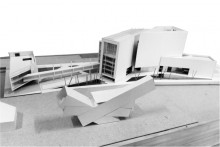
The design of Retrospective of Modern Art (A Museum in Perspective) was developed by a simple notion of connecting spaces both physically and visibly. Respecting the priority of connectivity among pedestrians in an urban space the site was crisscrossed with five major axis, which in terms creates an intermediate space for public gathering. The axis were generated from some major focal point which passes through the site but not visible to human.


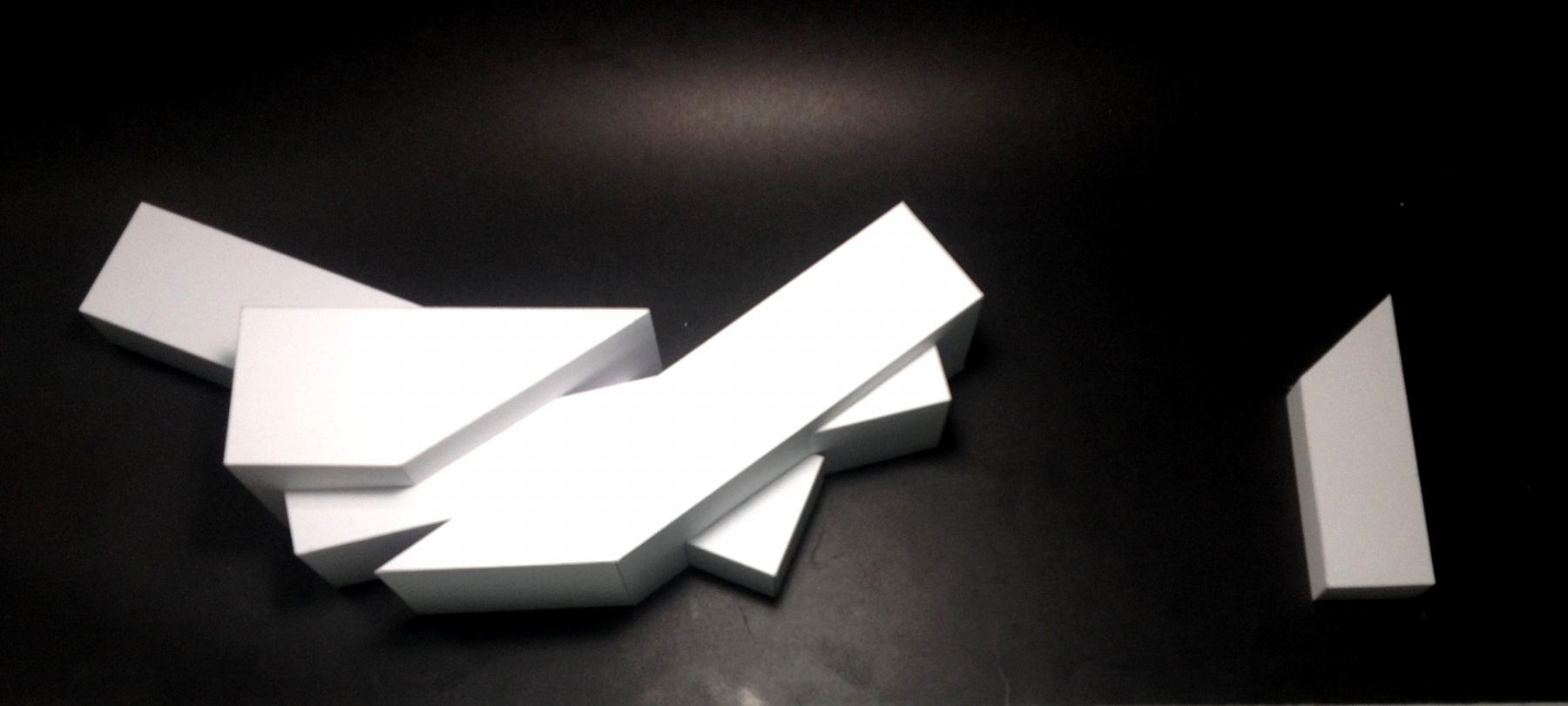
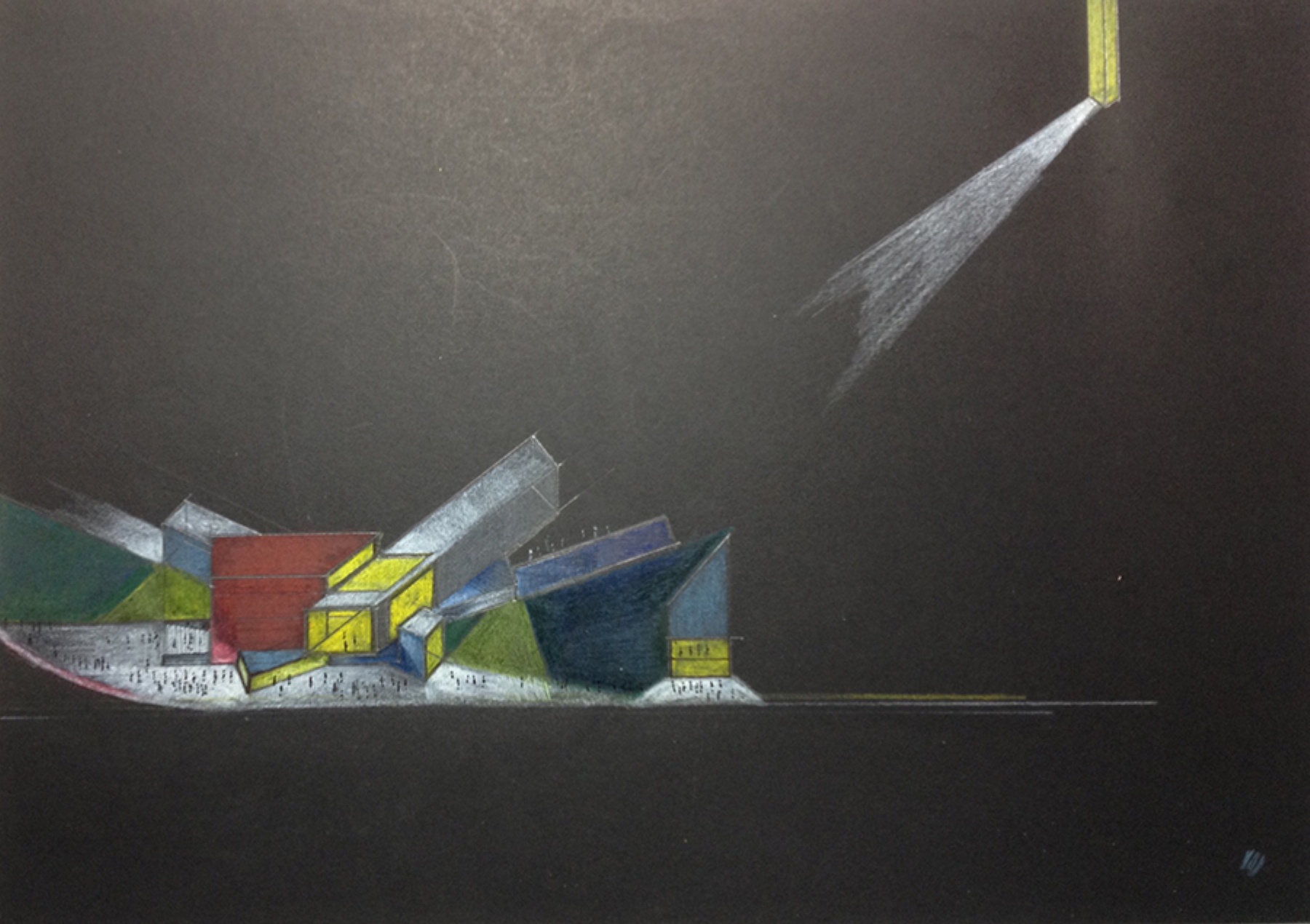
The five axis which later created the five forms of the museum was basically originated from the pedestrian level. One of the axis establishes a connection among the Fine Arts Institute and the Dhaka club. One of the major axis which generated from the northern road (visually running over the site) also denotes the tallest and widest form of the whole structure. It houses the major Permanent Galleries. Then there is one which connects the National Museum and the Shadhinota Stambha. It also houses some permanent galleries, Temporary galleries, cafeteria, and research lab. Another axis oriented from the fine art institute Last of all the form which holds the common utilities also connect the other four main form of the complex.


The whole parking lot was submerged into the ground to allow enough space to have a public realm at the ground level. Thus the ground level has been kept open as much as possible by taking all the major functions above 1st floor.
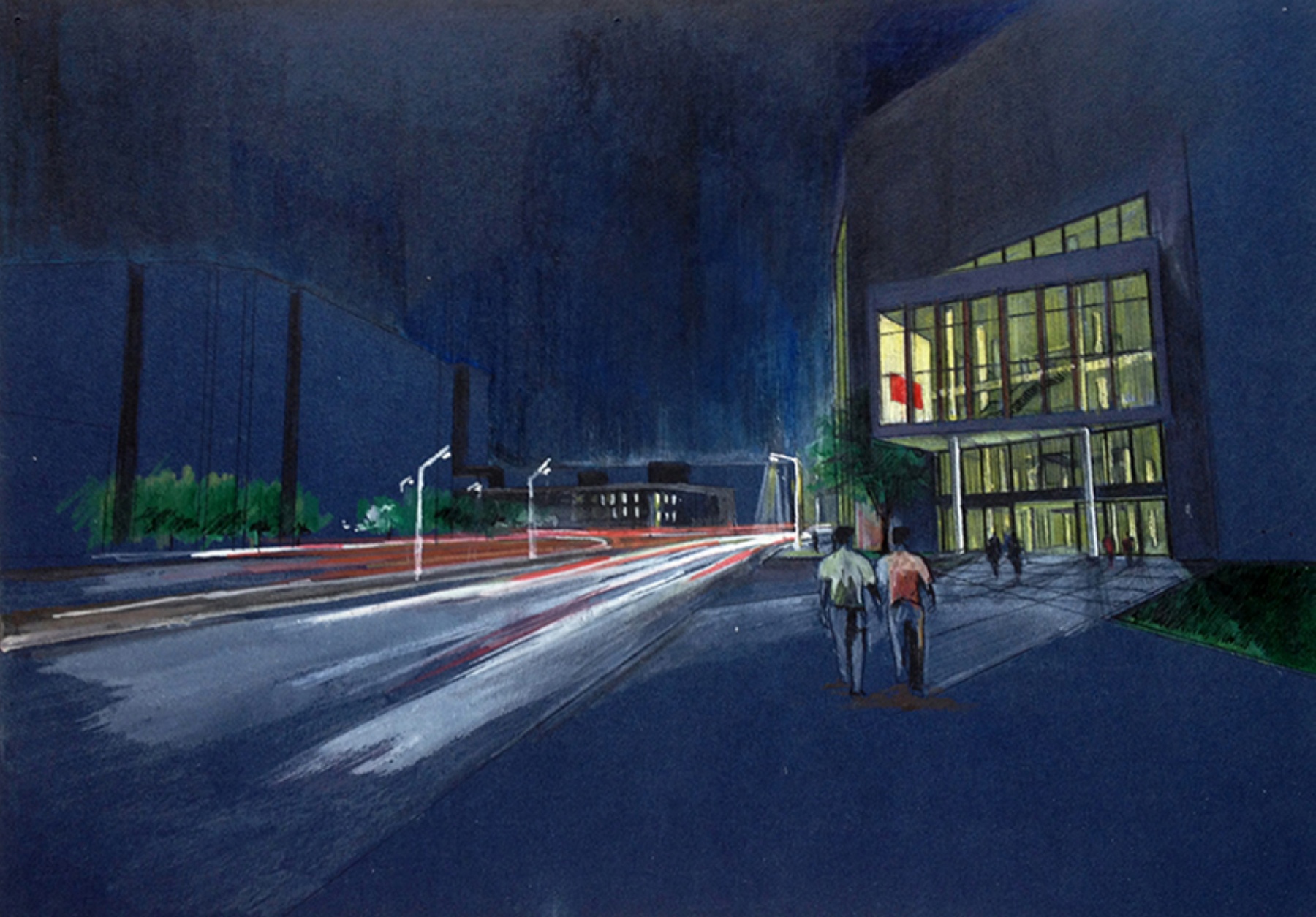


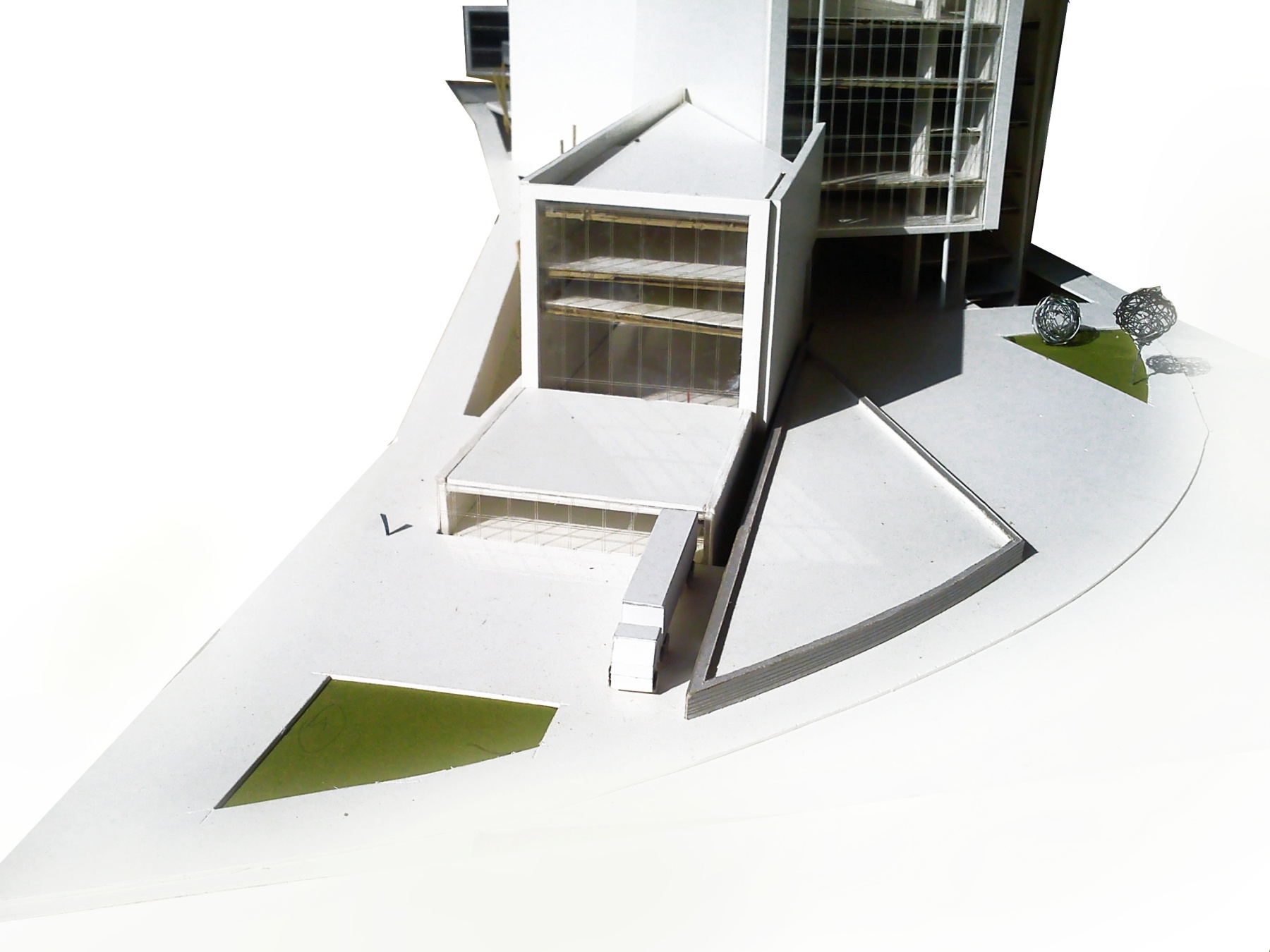
Image Gallery


|Form the architect |
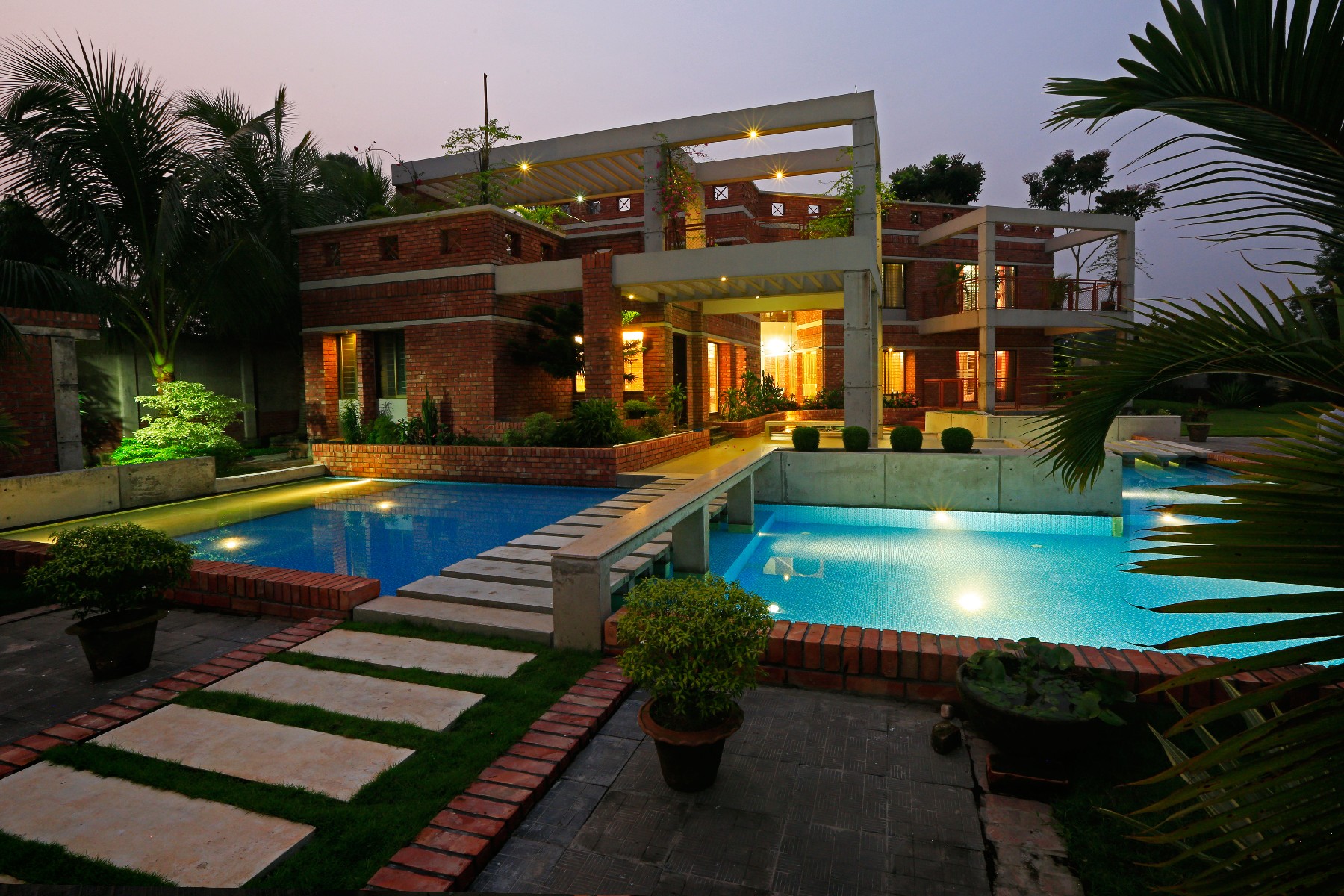
Form generation:
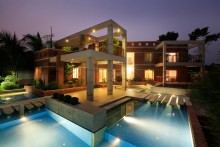
The existing building mass is elongated along the North where an additional angular building mass adjoins containing the new residential programs.
The major interlocking geometric points are selected to locate the functional spaces of the stairs, kitchen and a double height space.


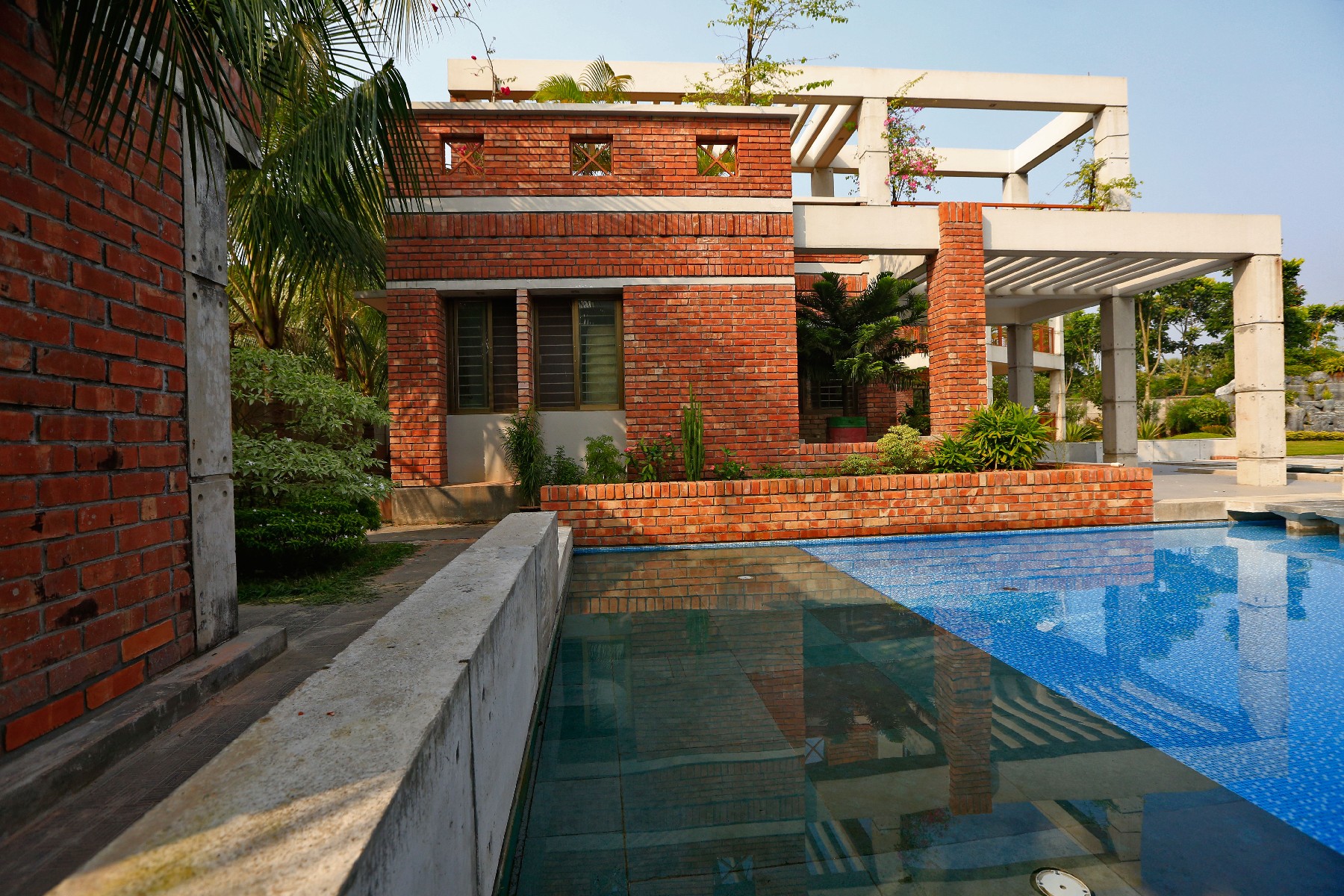
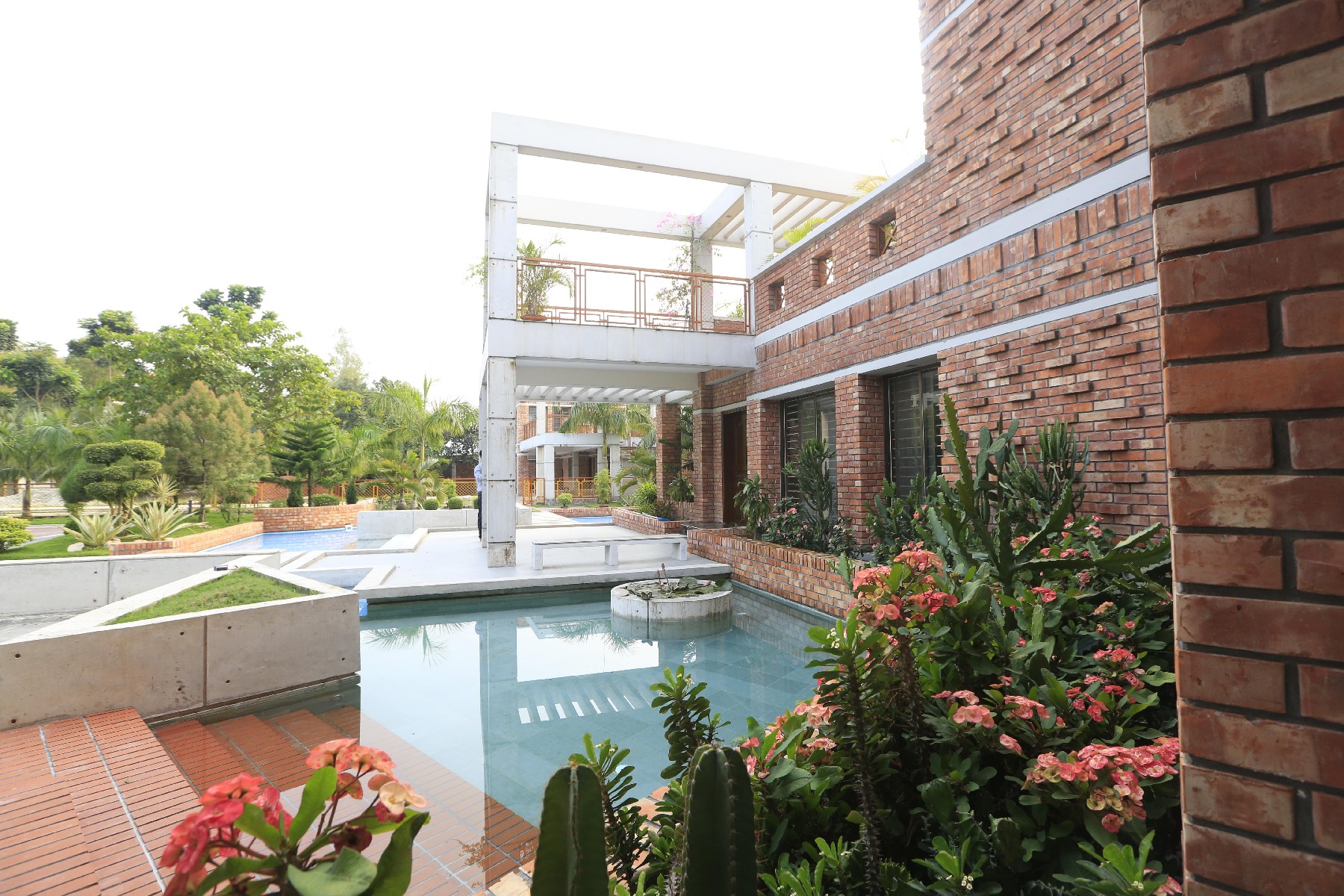
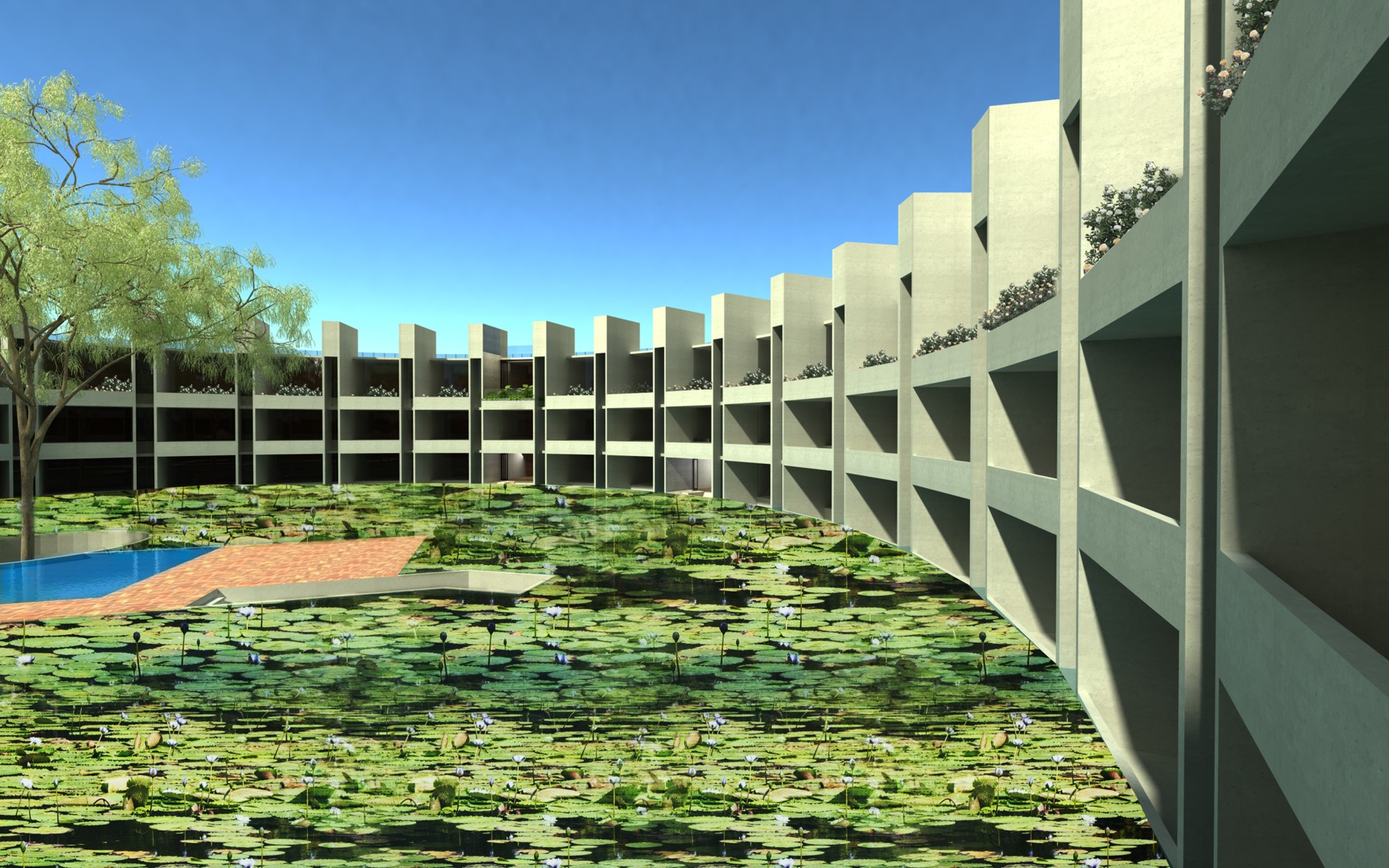
The mass evolves with the placement of a courtyard in the centre encompassed by streaming water. The water body connects the built spaces with paves and steps acting as interfaces for user’s walking experience over the varied depth of water, surrounded by green on the offset.
Further progression carries on with the addition of parking and indoor games room alongside the same building width.
The structural frames come out of the form to create framed vistas to the vast nature.



Context:
The concept aims to connect the form towards nature in ground level and extended balconies on the top to get the maximum view of the surrounded nature.
Here, water acts as the transition from built form to green.
Functional performance:
program resolution (decision) and why The service areas (toilets and kitchen) are minimized to allow a greater free flow of space for multipurpose activities. Greater access to open spaces are accentuated by the connection to the wide roof of the old renovated building mass from the first storey of the additional building joint. The ratio of the balcony to the master bed is kept similarly proportionate.


Sustainability:
10” periphery local brick walls are fabricated bearing the climate responsiveness in mind.
The angular building block facilitates to catch maximum wind from the South East.
The design decisions of long spans and local material use have blended into a creation rendered to be cost effective.


Materials and Construction Detail:
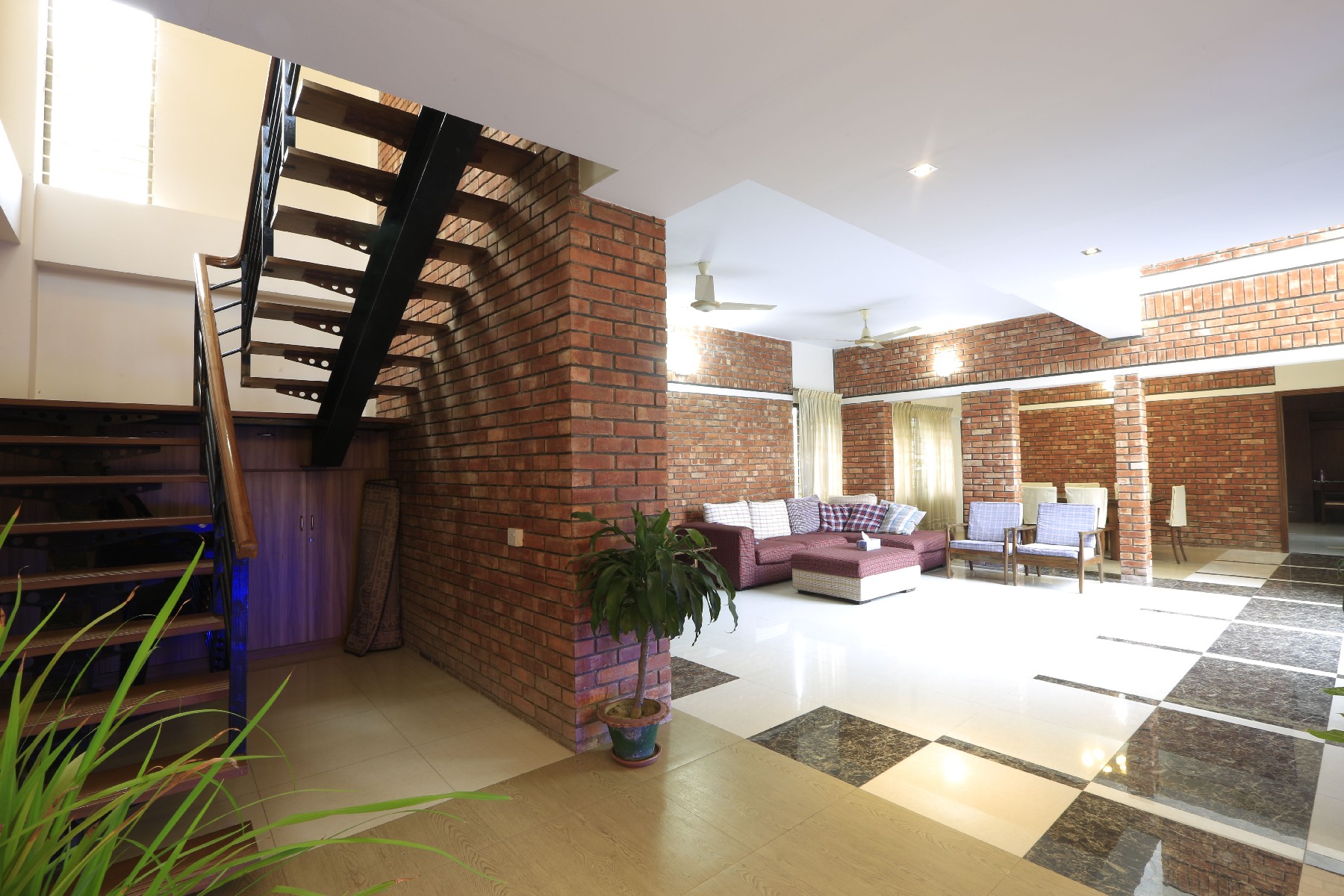
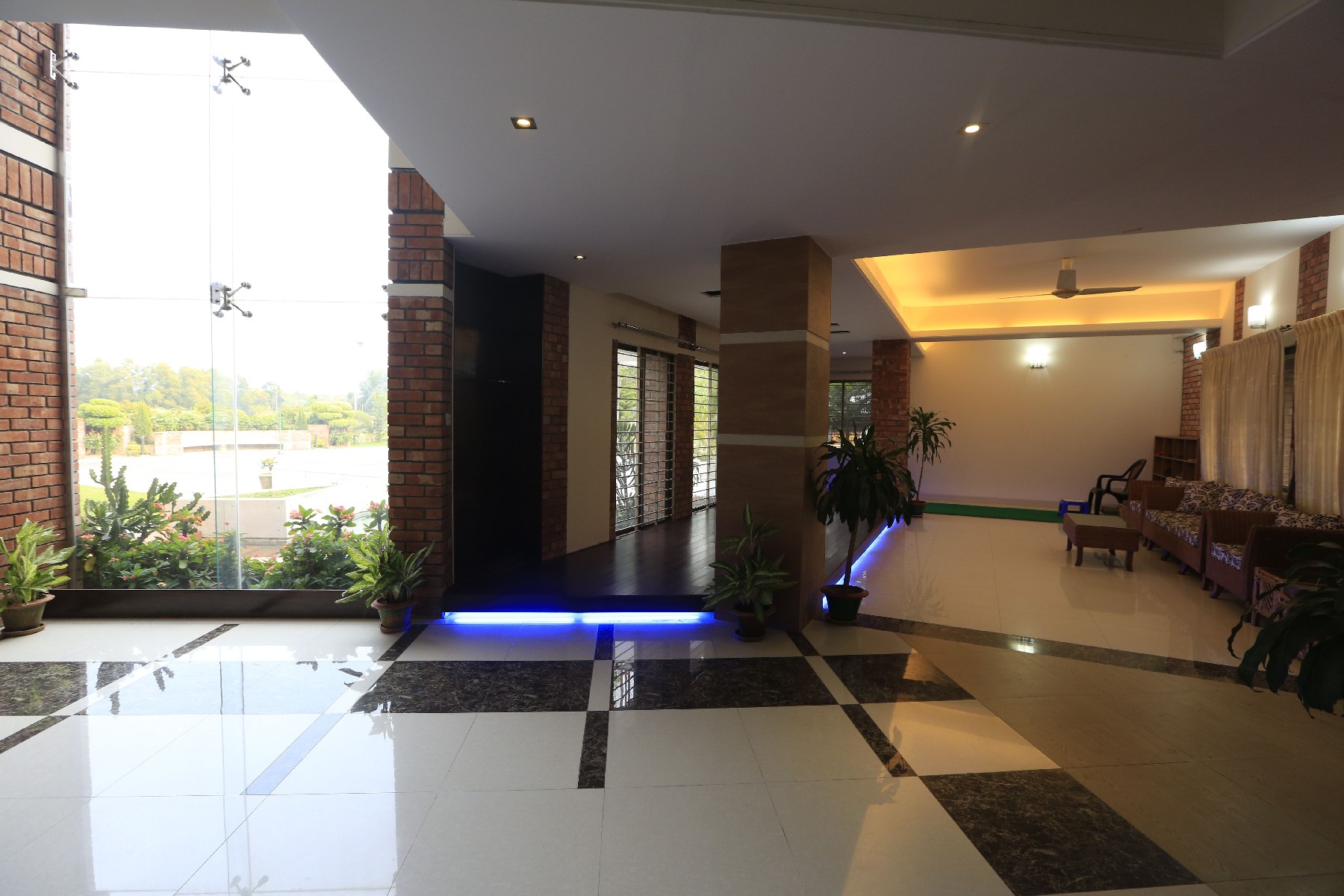
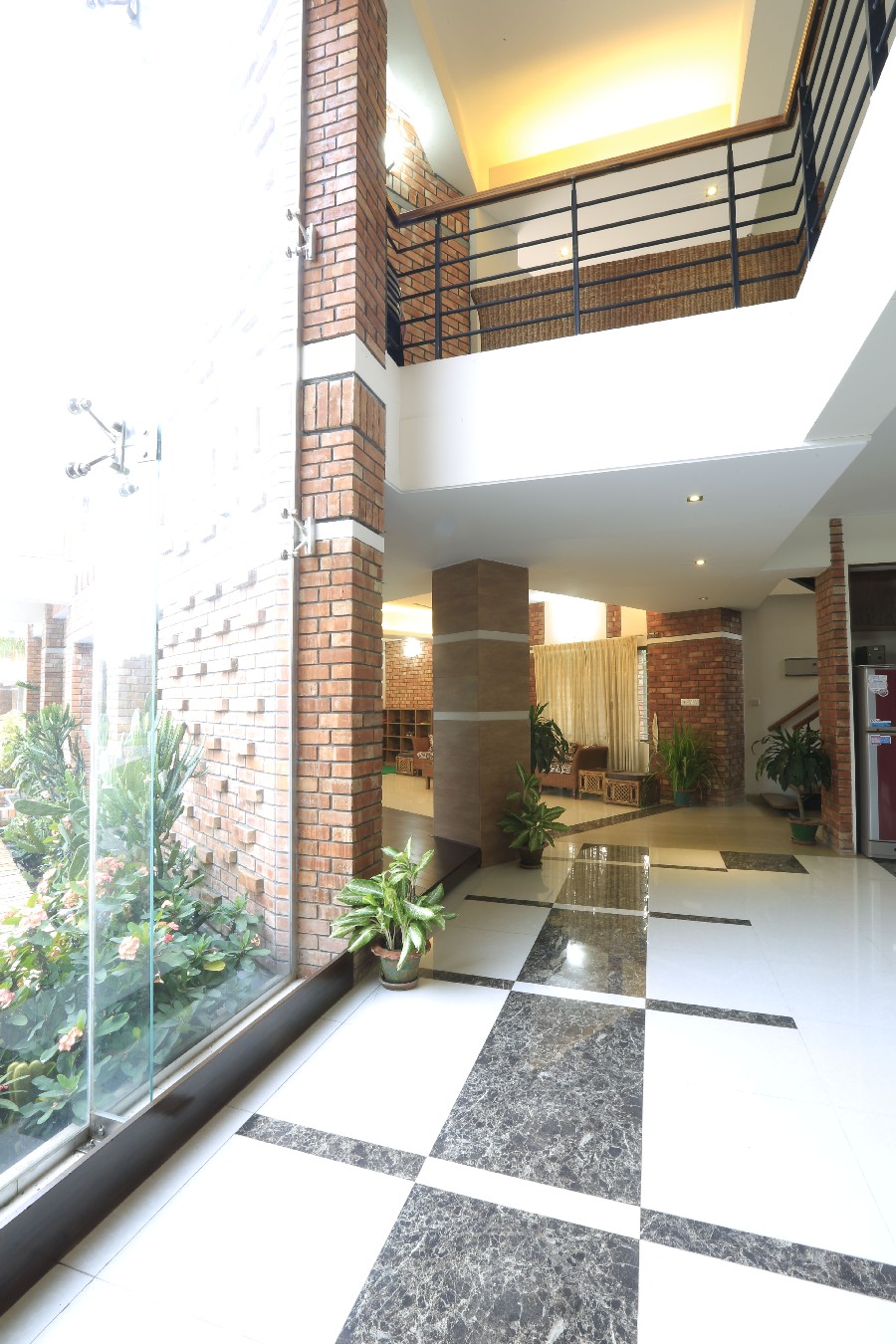
An emphasis is put on using locally available material and hence a structural system of exposed RCC and exposed brick are used to create the finished product. A wooden raised floor adds variation to the living space. A brick work pattern is weaved on the walls of the internal courtyard.
Marble is used in some outdoor sitting areas.
RCC fair-faced concrete is used in the pool retaining walls and walkway for durability.
Indoor walls have a combination of exposed brick walls and walls partially plastered and painted white for better illumination.

Special Features:
There is a backyard that can be used as an extended kitchen purposefully designed for the cooking of big gathering and barbeques.
The enveloped space of semi-outdoor courtyard is shaded mainly due to its orientation and enables comfortable day-time use.
The steps disembarking into a vastness of water creates a space that acts like a traditional ghaat where people can sit in an outdoor natural setup.
The water depth where the steps are designed are kept shallow for safety purpose.

For larger images click on the gallery


| From the student|Knowledge Sharing Center: An Interactive Platform for readers, writers and publishers |
Preamble:
In Bangladesh we have a large number of readers, writers and publishers and according to statistics the number is increasing day by day. Moreover we have a very reach book culture. Ekushe boi mela is a very unique and famous book related activity all over the world. Recently the venue of Ekushe boi-mela has also been shifted to Shaheed Shuhrowawrdi uddyan from Bangla academy because of space shortage. This also indicates the increase of book related activities.
Though these activities are increasing but there is lack of a common platform for book related people. Ekushe boi-mela is one of the most vibrant platform for readers, writers and publishers but this platform is only for a month. Neelkhet book market and Aziz super market are another common platform for readers, writers and publishers. But these are now in threatened condition. Another problem is the book related zones of Dhaka city is confined in a particular zone; Neelkhet and Shahbag zone. But the city has expanded to north largely. So book related zones also should be spread-out throughout the city. This project should become a new landmark of the city for book related activities.
So a new common platform is highly needed to uphold these book related activities where readers can not only come, read and buy books, but also share their thoughts with other readers and writers and where publishers will also get chance to see a new future of their business.
Background issues:


Project objectives:
Site selection criteria:
Site have been selected based on these two facts:



Selection and Justification:
According to the criteria Panthapath, Karwan bazar is a best potential site for this project moreover this site has some character which is very positive for future impact of this project.

Thoughts and spaces:
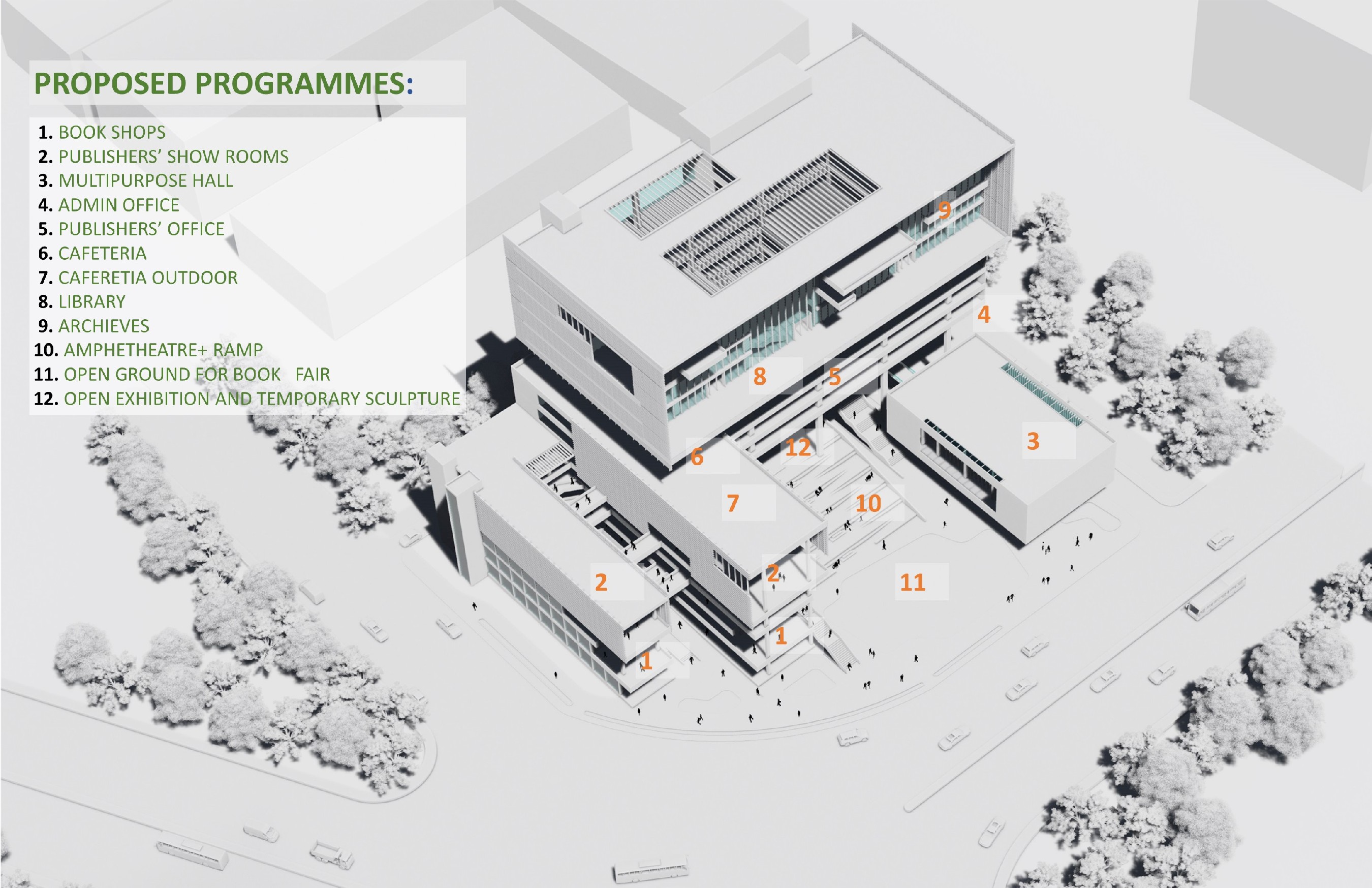
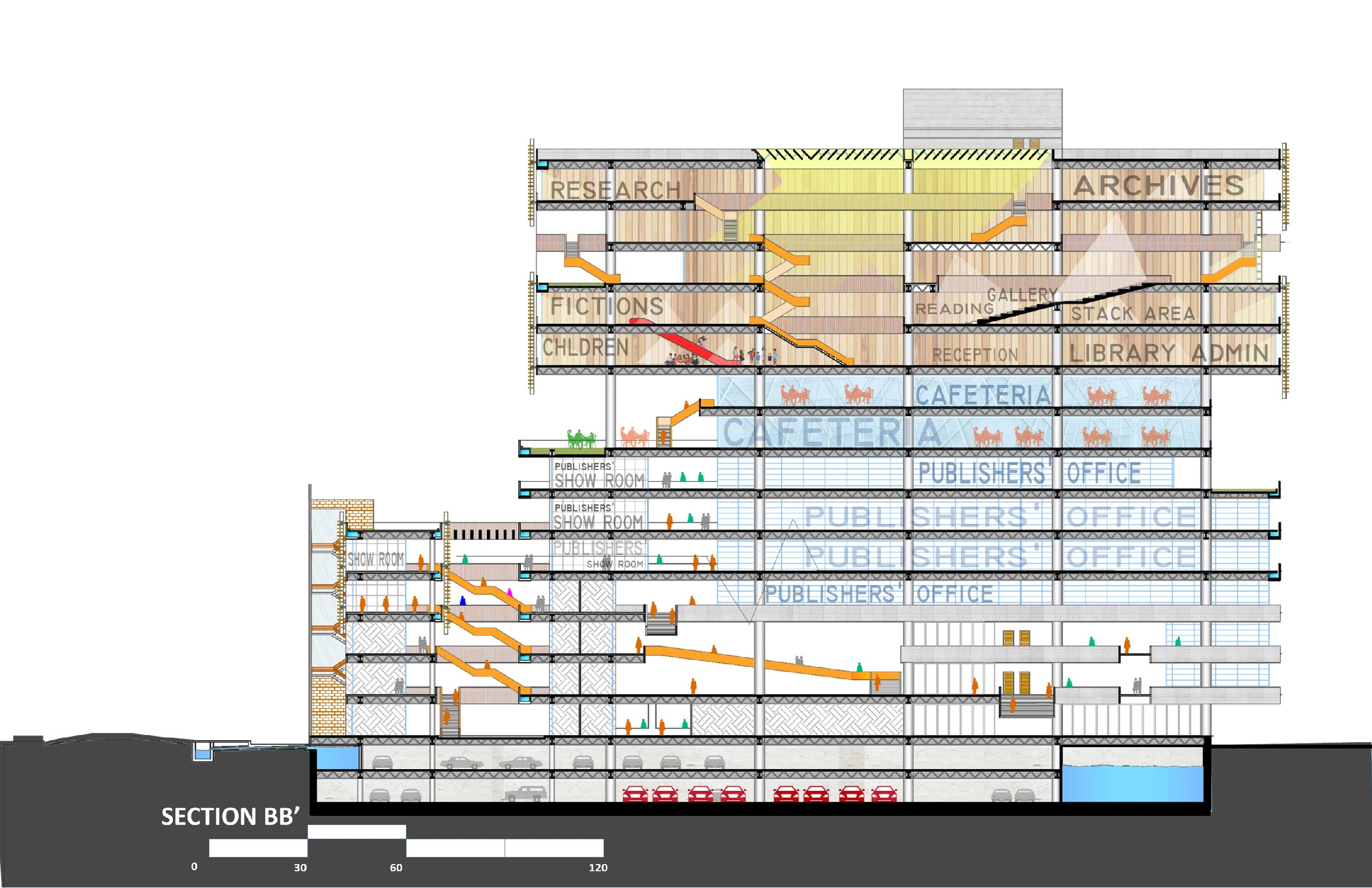
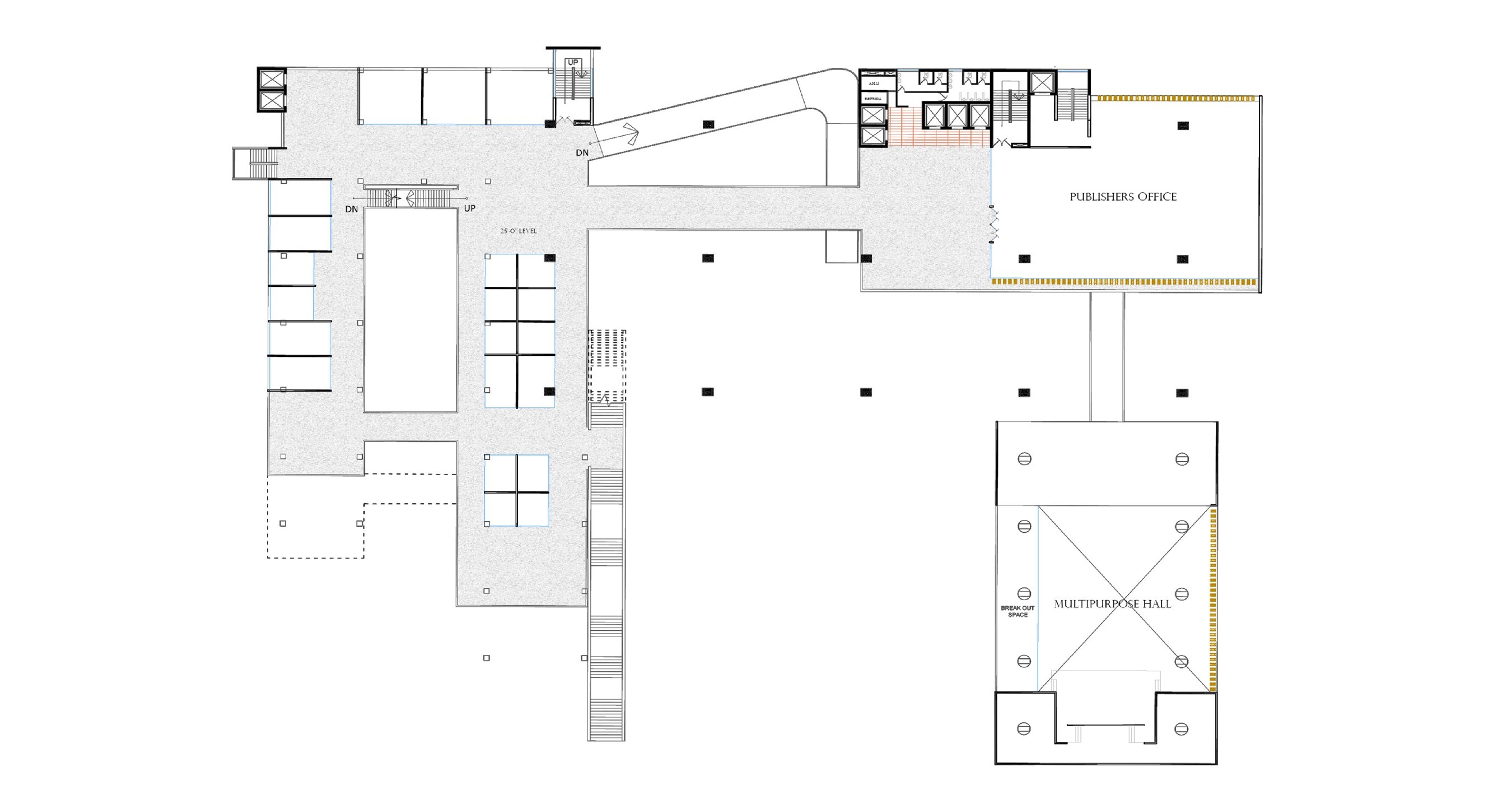
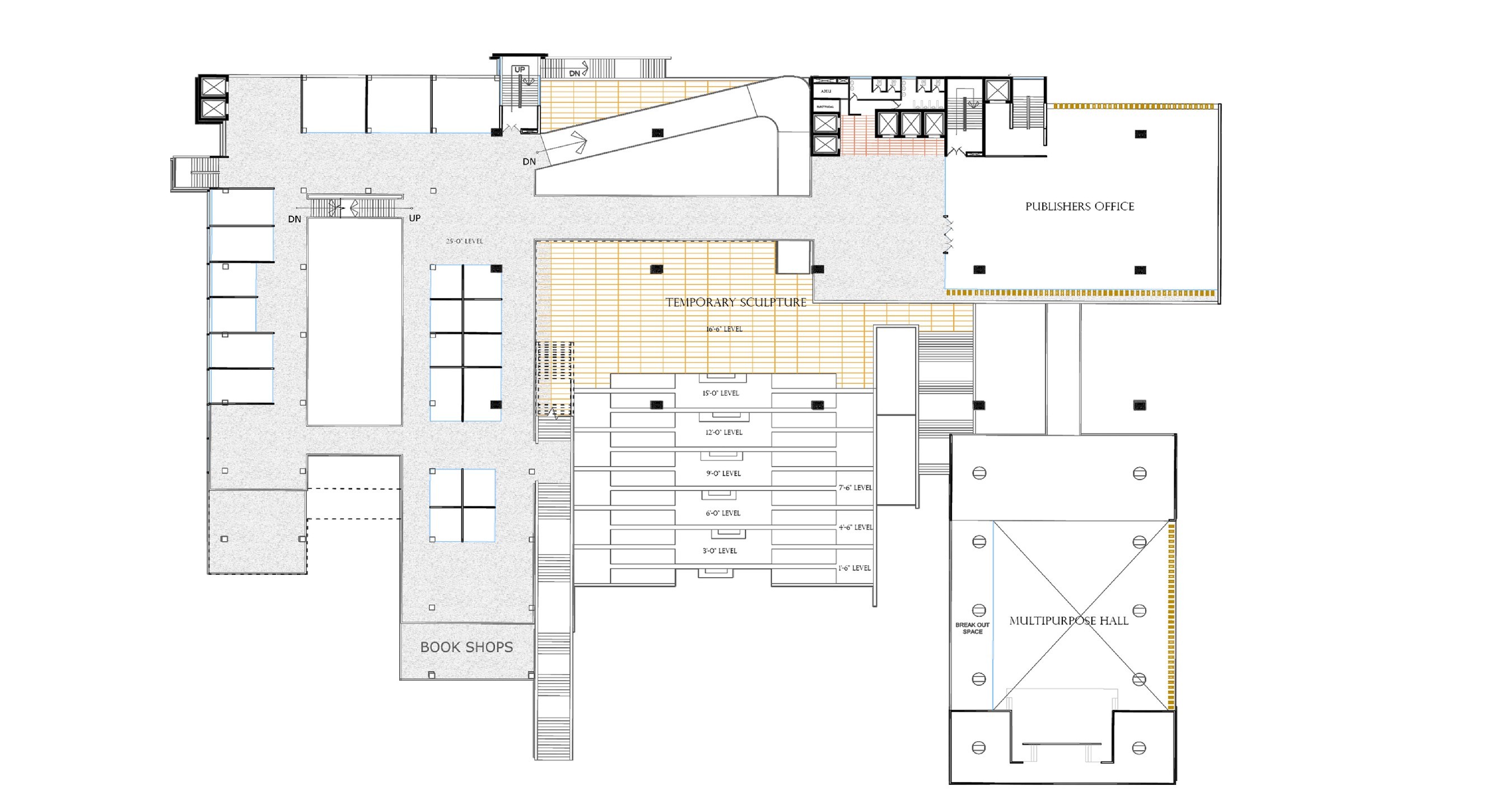
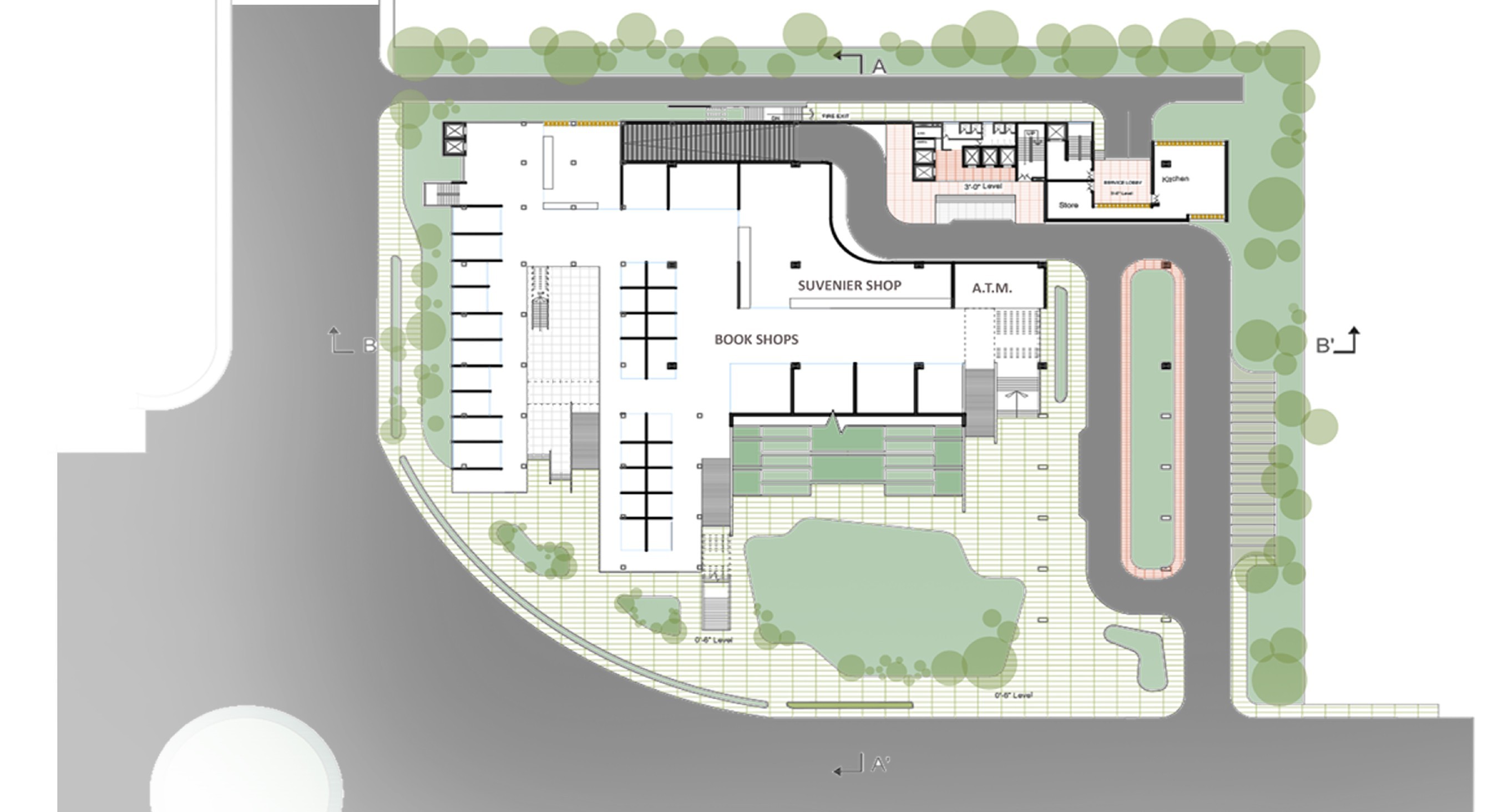
Amalgam of different types of programs was primary challenge of this project. The programs must not be arranged by conventional zoning system. Formal and informal spaces must talk with each other. That’s why books shops have been kept close to publishers’ office spaces as they are in Neelkhet, Bangla bazar, Motijheel and some other areas.
Use of control has been applied in a different way as found in Neelkhet book market area. The book shops are not controlled centrally by any closed atrium. Rather kept open by voids and corridors. On the other hand regular control has been provided to less public functions like publishers’ office spaces.
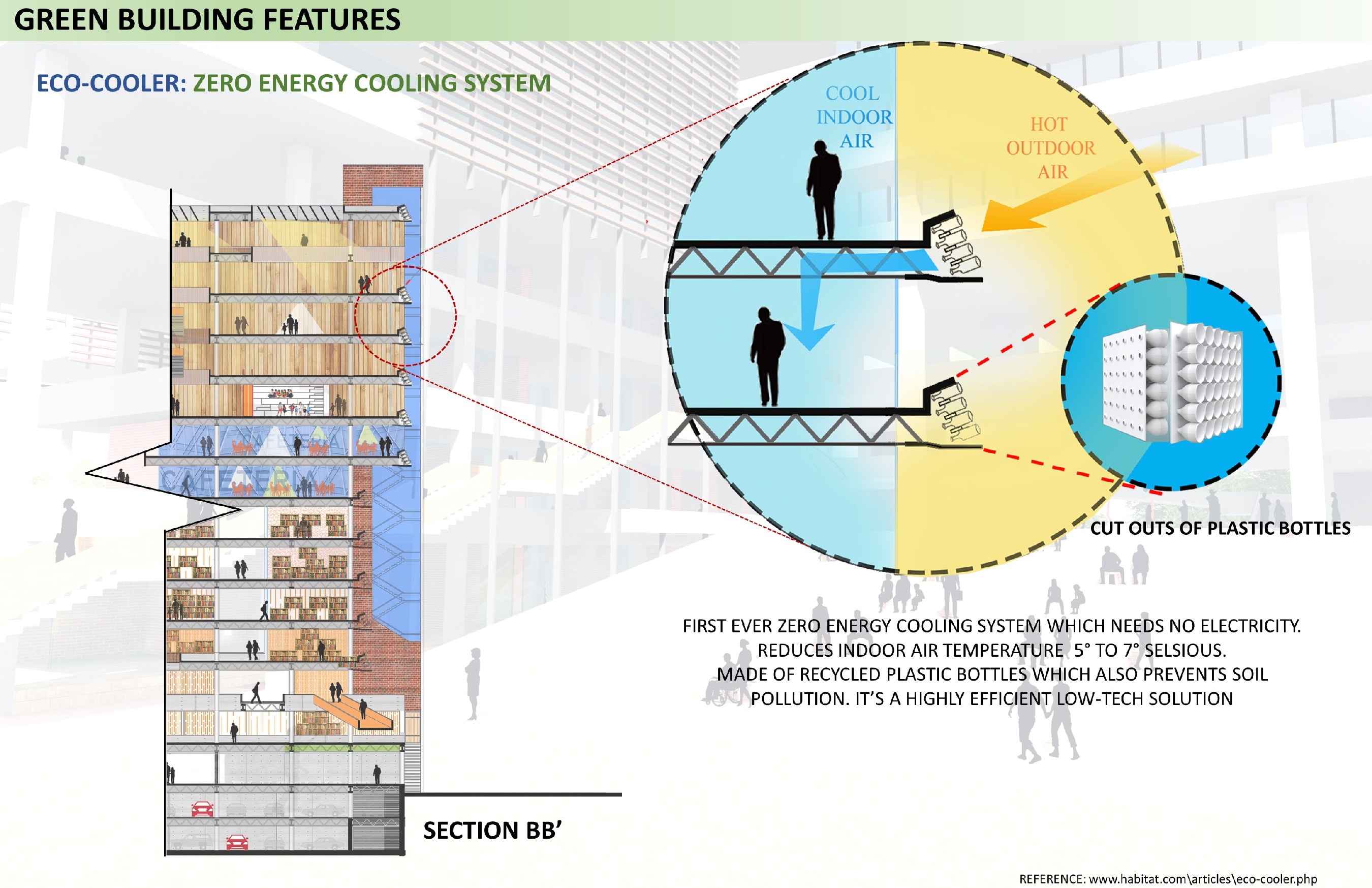
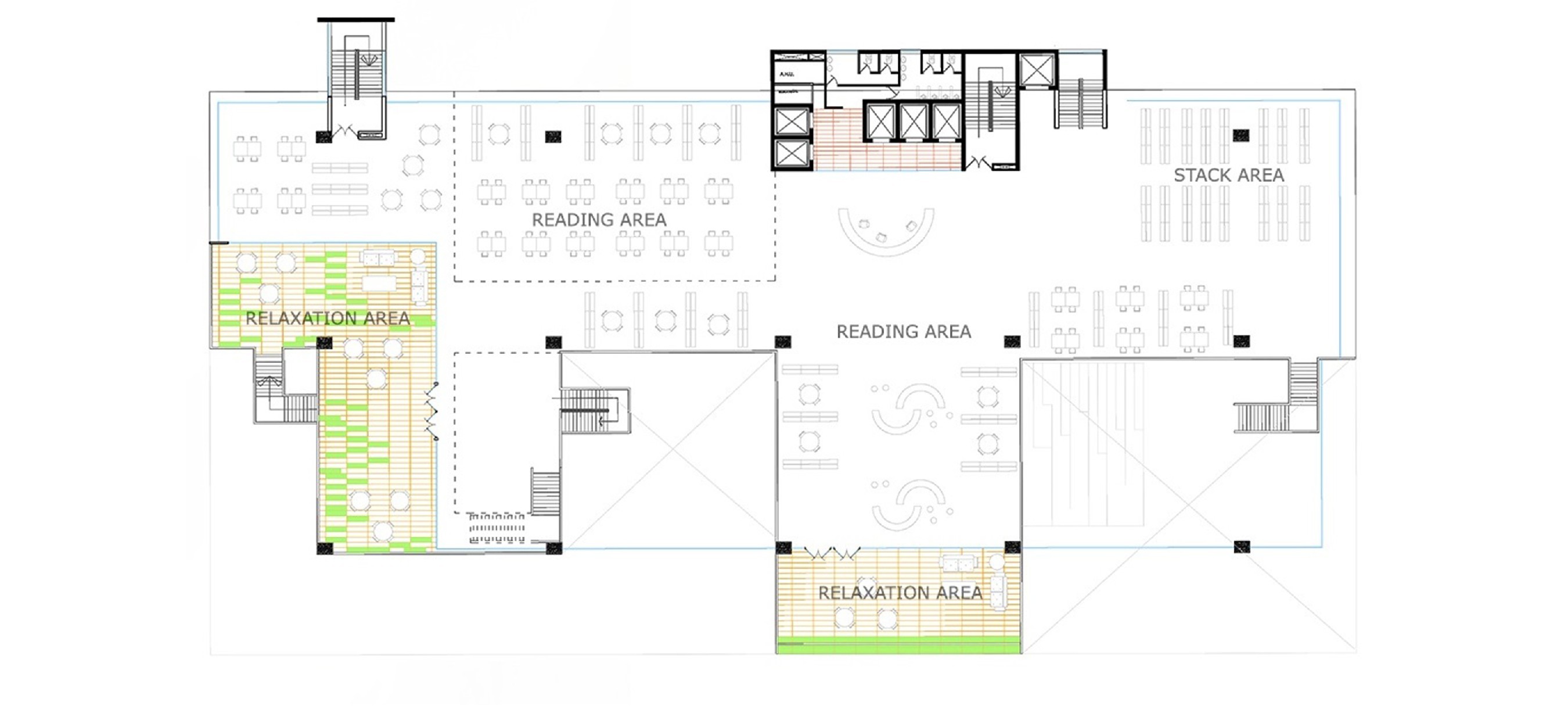
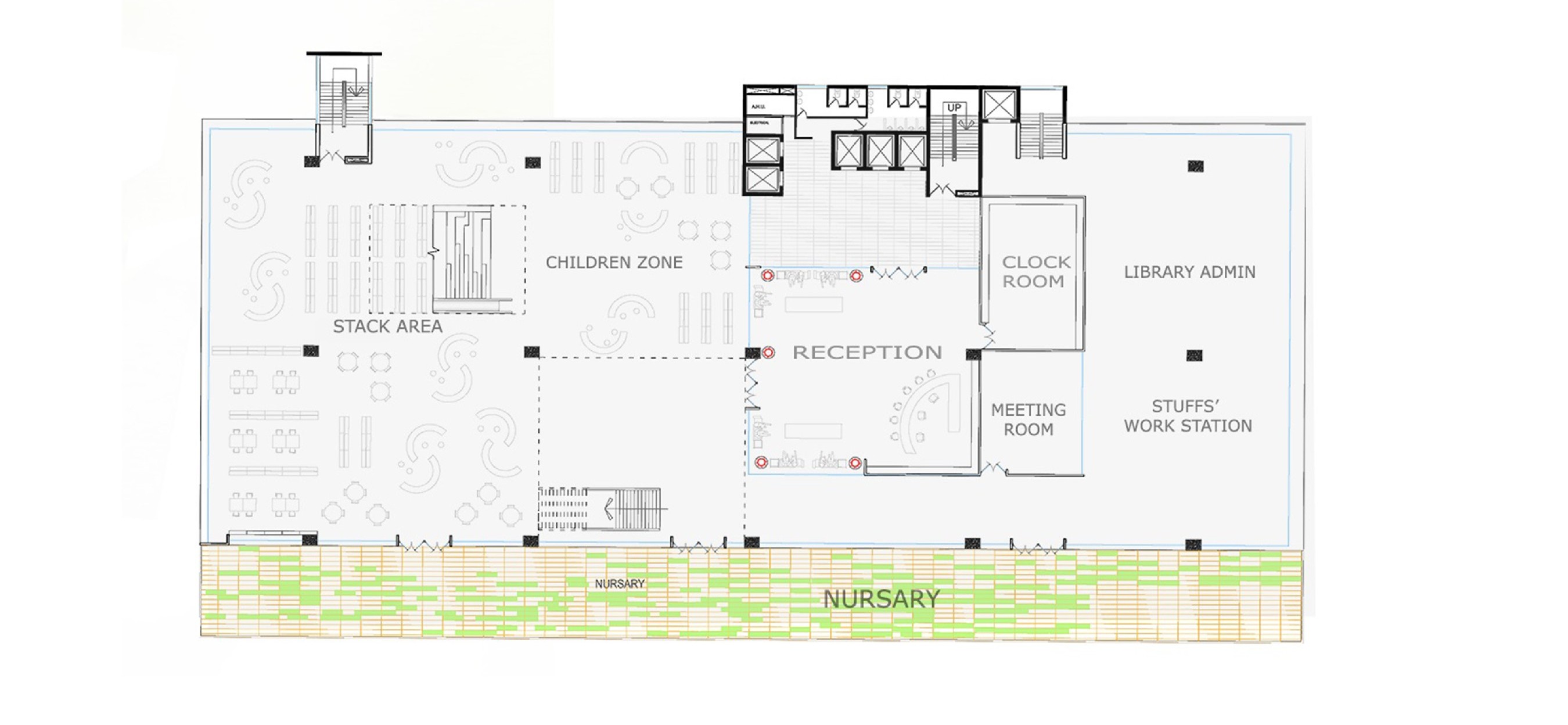
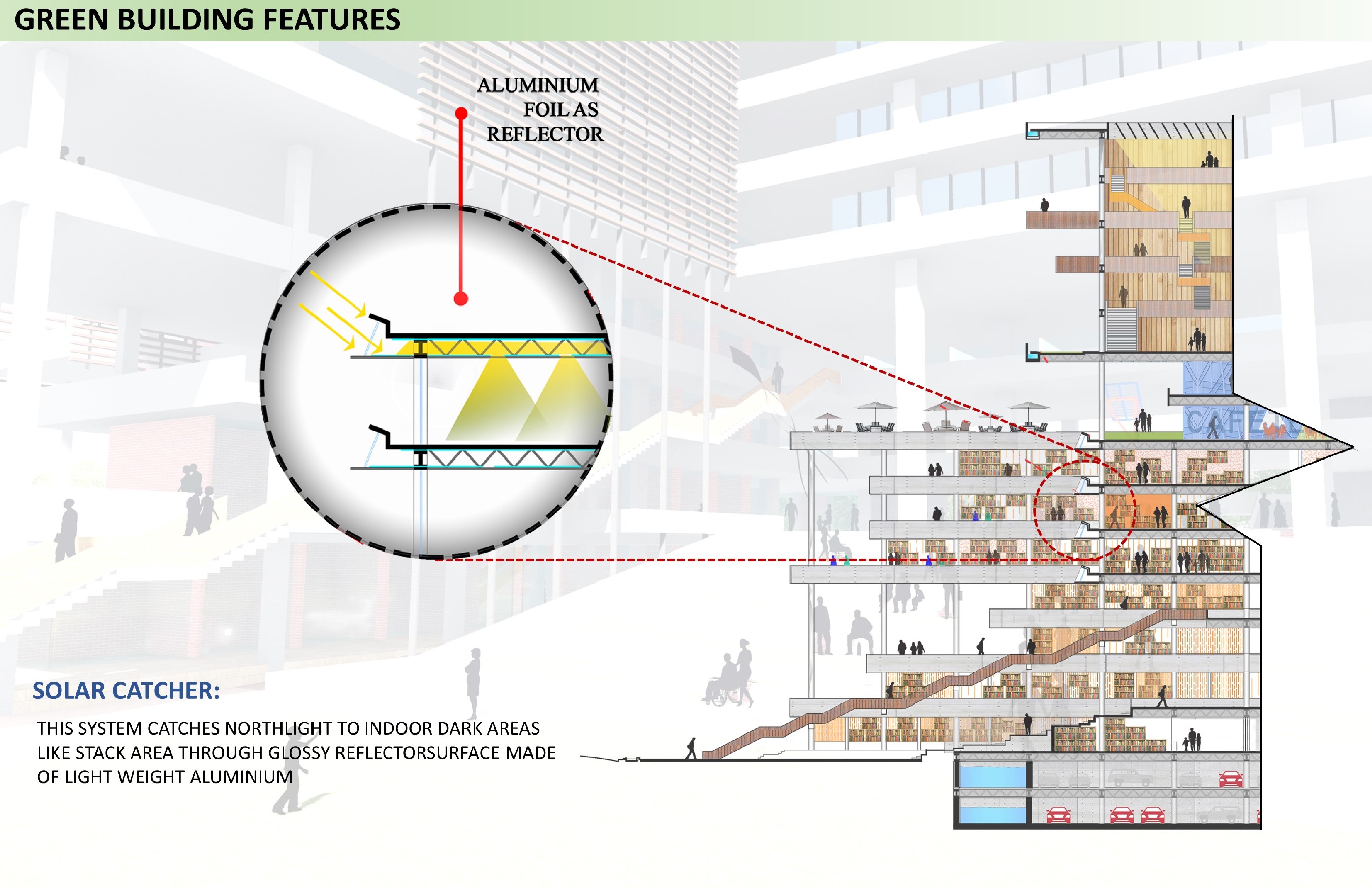
Library is the most important program here but it has been kept at upper level. The reason is not to impose on the context but for spiritual reasons. It has been compared with the head of a body. Another functional reason is that any city scale library needs scope for future extension. That’s why it has been kept at upper level with 3 dedicated lifts for library for easy accessibility. The inner spaces of the library is designed with informal and enjoyable spaces to maximize public involvement. People should enjoy to spend their time inside the library.
Book shops are at the lower levels to communicate with mass people and maximize book related business
Library is at the upper level to attract people from distant areas.
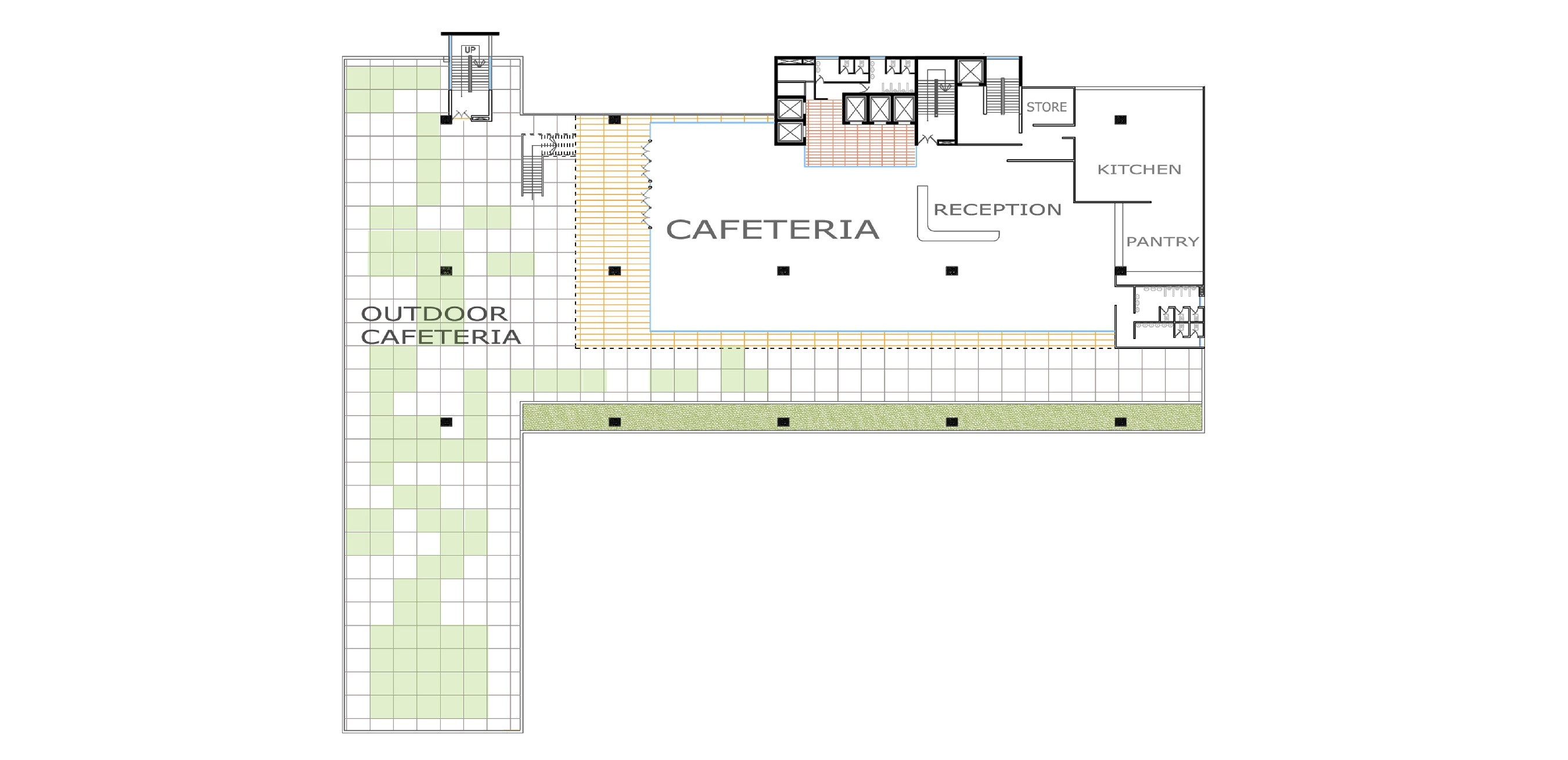
The intermediate space between library and book shop is kept void to create an urban aperture from the node. Cafeteria and outdoor food facilities are provided there to attract people upward
Publishers’ offices are kept with book shops and publishers’ show rooms to provide maximum communication with readers, writers and publishers.






The architect and his team believe that Architecture is a poetic expression of needs responsive to climate, place and economy. Whatever the Project is, wherever the site is, an architect must try to be honest to its requirements and give best effort to produce a rational outcome. There is nothing more enjoyable in architecture than to experience it. One should be able to touch, smell and feel the warmth of it.
Considering all these in mind the architect designed this resort which spatially resembles a ‘Garo’ village in the appropriate context with features of contemporary architecture embedded.




Gallery View


Theme
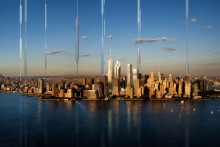
Expanding human population creating high frequency pressure on the limited resources of earth. Ultimate result provokes an unstable future for human civilization. In such scenario what would be the degree of urbanism? Questioning dictates to investigate for options to face future challenges, exploring new possibilities for city development & living environment.

What if….
• We stop creating concrete jungle on earth.
• Gravity gets victimized by mankind.
• We magnify our habitable area by inserting perpendicular development.
• We leave enough space for a green planet.
• We build vertically align cities with self composed mechanism.
• Our lifestyle & society become information embedded.
• We adopt intelligent building system.
• Our built structures produce energy by itself.
• Clouds become source of water.
• Earth surface is used for only production and leisure.
• Civilization progress from global to universal.
• Sky becomes the bottom limit for us.


About the Architect(s)
Oli Mahmud Architects is a design based studio with contemporary design approach. Office portfolio fluctuates from small residential building to master plan. Remarkable projects are Savar DOHS master plan, Indigenous training institute at Rajshahi, Bangabandhu Sheikh Mujibur Rahman hall & Bangamata Fazilatunnesa Hall at NSTU. Among them indigenous training institute has received Cityscape Highly Commended Award in 2010 in future community category.